International Journal Advances in Social Science and Humanities
Available online at: www.ijassh.com
RESEARCH ARTICLE
Women Participation in Local Governance: A Case Study of the Kumasi
Metroplolitan Assembly
Edward Brenya*, Akuamoah Ernest Mensah,
Cudjoe Jonathan Nana Nyarko
History and Political Studies Department, Kwame Nkrumah University of Science and Technology.
*Corresponding Author: Email: [email protected]
Abstract
Mainstreaming women through gender specific policies is an acknowledged pre-condition for achieving meaningful development in any developing country like Ghana. This paper evaluates the extent to which women participate in local governance in the districts/metropolitan assemblies’ level in Ghana with a special focus on the Kumasi Metropolitan Assembly (K.M.A). Drawing on core facts and figures regarding the ratio of men to women involvement in Local Government, this paper postulates that there is a lack of broad participation of women in community development and governance over the years. This is against the fact that there is increasing efforts and some measures put in place to ensure increased women participation in the political process of Ghana.
Keywords: Participation, Local Government, Kumasi Metropolitan Assembly, Community Development, Women.
Introduction
“Every Country deserves to have the best possible leader and that means that women have to be given a chance to compete. If they are never allowed to compete in the electoral process then the countries are really robbing themselves of a great deal of talent”. - Madeleine K. Albright, NDI Chairman.
Women’s leadership and effective participation is increasingly on the agenda of governments, bilateral and multi-lateral agencies, and non-governmental organizations including feminist movements and women’s rights groups. Evidence from programmes and research indicates the vital role women play as key actors and decision-makers in the development process across a wide range of sectors. However, in most countries political space for women participation have been circumscribed. In the political sphere in particular, there is a growing momentum among governments to foster and ensure women’s participation and leadership in governance structures. Establishing quotas for women representation at different levels of governance has been a strategic tactic in achieving this goal in many countries. The possibility for citizens to participate in the management of public affairs is at the very heart of democracy. In the majority of countries however, the political arena remains largely dominated by men, and is even an
exclusively male bastion in some countries. Yet this neglects a fundamental principle of democracy, which the Inter-Parliamentary Union which adopted the Universal declaration of Democracy incorporated in the document.
Universal Declaration on Democracy
The declaration indicates that "the achievement of democracy presupposes a genuine partnership between men and women in the conduct of the affairs of society in which they work in equality and complementarity, drawing mutual enrichment from their differences” [1]. Political participation could be influenced by many factors like sex, caste, social status, education, income, age, family background etc. It has been observed that the process of development has failed to improve the social position of the underprivileged section in general and women in particular. Greater participation in development is considered as an important factor in reversing the ongoing trend that signifies unequal social, economic and political position of men and women.
of the vital areas of concern. It made two essential commitments to change. First, it called for measures that will ensure women’s equal access to and full participation in power structures and decision making. Political quotas or positive measures are examples of these. Second, the Platform urged states to increase women’s ability to participate. Training on leadership, Public Speaking and political Campaigning for instance groom women to compete, win and be good leaders who can inspire others [3].
Women equal participation in local governments and decision-making processes is vital for creating gender sensitive policies and for enhancing sustainable development. Unfortunately, women are under-represented in politics and they consistently face a number of obstacles that range from cultural exclusions to the resistance of key political institutions and mechanisms to creating gender balanced local administrations. For instance, in communities where women’s roles as politicians and decision makers are not well accepted, women face strong cultural barriers entering local governments.
The factors that hamper or facilitate women’s political participation vary with level of socio-economic development, geography, culture, and the type of political system. Women themselves are not a homogeneous group; there are major differences between them, based on class, race, ethnicity, cultural background and education. The exclusion of women from decision-making bodies limits the possibilities for entrenching the principles of democracy in a society, hindering economic development and discouraging the attainment of gender equality. If men monopolize the political process, passing laws which affect society at large, the decision-making process does not always balance the interests of the male and female populations.
As noted in the Millennium Development Goals, women’s equal participation with men in power and decision making is part of their fundamental right to participate in political life, and at the core of gender equality and women’s empowerment. Women have to be active participants in determining development agendas [4]. In many cases, male dominated political parties are not willing to involve women in their local branches and subsequently in local politics. According to the UN Habitat, most local governments are inherently patriarchal institutions. Their structures and procedures are designed for and by men and do not take into
account women’s multiple responsibilities in their homes and communities or differences of communications and decision making styles existing between men and women.
Shaul in the study on the status of women comments that there is no country in the World today where women have equal status with men in all of the major areas of life [5].
Few women like Indira Gandhi, Goldamer and Bandaranaike have held important positions. And women who hold such important national offices are mostly from upper class families with a good record of political participation, and are highly educated. The author also points out that in most of the developing countries, the low level of education make women unaware of their rights. Although women are enfranchised and given constitutional equality, they remain practically in a subordinate position to men in almost all the spheres of socio-political life. Legally, most of the modern democratic constitutions of the world including India had established equality of men and women in matters of rights and opportunities but contrary to this picture they have to encounter so many obstacles like tradition, prejudice, social and economic conditions.
Chafe [6] points out that discrimination against women was deeply rooted in the structure of the society, in the roles the women played and in the sexual division of labor which restricted women primarily to the domestic spheres of life. These discriminatory laws and practices engender women’s under-representation in politics. For instance, just over 21 per cent of parliamentarians were women, up from around 11 per cent when the Beijing Fourth World Conference on Women took place in 1995 [2].
Many studies suggest that (i) women are not independent voters (ii) that a majority of them are illiterates (iii) that a majority of them make their choice on the basis of suggestions from members of the family, husbands and so on; (iv) that women lack political information (V) women are not politically conscious. However, these studies define the word ‘political participation very narrowly. Wilson [7] argues that Representative democracy needs to be supplemented by participatory democracy. He asserts that More than voting is needed to deliver what is sometime called “the promise of democracy”.
efficacious, less politically interested, have less political information and are less likely to participate in politics. However, political participation of women necessarily depends on the overall political situation.
Ulla Skovgaard [9] points out that women’s political representation depends upon the type of electoral system whereas Madhu Kishwar [10] argues that women have relatively less ability to use money, muscle power and other forms of influence in the public sphere. Research indicates that political structures can play a significant role in women’s recruitment to political office. The system of elections based on proportional representation (PR), for example, has resulted in three to four times more women being elected in countries with similar political cultures, for
example, Germany and Australia.
Generalizations such as this are valid so long as there are cultural similarities that are similar levels of social and economic development, between countries [4].
Susan Welsh and Donley Studlar [11] also maintain that countries with multimember proportional representation system do consistently have more women in the central legislature. Certain factors like voter bias against female candidates, reluctance of party committees’ selection committees to nominate women for winnable seats, single member plurality districts and the long term depression influence of incumbency on females gaining office are behind women’s electoral disadvantages.
Ghana has often been described as an exemplary country when it comes to implementing and consolidating democracy. However, the rate of women’s participation both in policy making and government representation is shockingly low. Currently, Women account for only 30 of the 275 positions in the Nation’s Parliament. Statistics indicate that in 1998, about 588 women contested the district assembly level elections and the figure rose to 1,770 in 2010 out of which only 412 women were elected, representing 7.4 per cent as against the 5,681 men elected.
The 2004 parliamentary elections saw the election of 25 women as Members of Parliament (MPs) out of the 230 parliamentarians and this reduced to 20 in 2008, with one of them passing away. Since 2002, administrative guidelines have required 50 per cent of appointed members of district assemblies to be women. While the quota has contributed in some way to increase women’s presence, assemblies have not adhered totally to
it [12]. In 2006, of the 4,691 candidates for District Assembly Elections, only 443 (9.4%) were women [13]. The under-representation of women within both National and Local Government structures, limits women’s potentially valuable contribution to development, poverty reduction and the achievement of gender parity [14].
Overview of the Global Situation of Women Political Participation
Globally, women make up a little over half of the human population in most countries. They play key roles in the socialization processes in their societies especially as mothers. Through their dual roles of production and reproduction, they make significant contributions to development. Millions of women work as volunteers for major political parties and for individual candidates’ world-wide. In spite of all these, the process of governance have been male centered and until the twentieth century, women were either totally marginalized or absent in the process of governance at all national levels throughout the world. For instance, until 1893, women did not have the right to vote in any country worldwide New Zealand was the first country to give women the right to vote in 1893 [4].
This long period of political exclusion of women has consequently resulted in the erroneous perception that the process of governance was the exclusive privilege and universal right for men. Finland was the first country to adopt both fundamental democratic rights for women to vote and be voted for in 1906. In the United States, women were granted the right to vote in 1920 after decades of struggle by various women’s groups [15].
In Europe, the situation was not better. According to Bruely [16], in Britain for instance the representation of the People’s Act 1918 allowed only women aged 30 years and over to vote. The Parliamentary Qualification of Women Act 1918 also allowed women to contest for Parliamentary seat and to exercise their franchise. This was achieved after a long struggle by women’s groups, such as Women’s Suffrage. Societies, which later became National Union of Societies for Equal Citizenship (NUSEC) in 1920.
Women’s Political Participation in Africa
of culture of African societies but on colonial administrators and religion [18].Women however played important roles in top decision-making process in African societies. Examples of the important African women leaders were Queen Yamacouba of Sierra Leone, the Ethiopian empress Menetewab, Mnkabayi the first Shaka princess in 1780, and Yaa Asantewaa, a queen mother of Ejisu under the Asante Confederacy who mobilized men to fight the British in 1900 in the then Gold Coast (modern day Ghana) [19]. It can therefore be stated that African women have had access to governance in their traditional areas before colonization.
However, their participation in governance during and in the postcolonial era had been low. This has been attributed to the introduction of the western process of governance with its new institutional framework as well as combined pressure of traditional practices and conformity to western values. As a result of the gross under-representation of women in governance, efforts have been made by International and National bodies including some civil society organizations to ensure the active participation of women in governance at all levels. For instance, the UN Convention on the Elimination of All Forms of Discrimination against Women which came into existence in 1979 explicitly provide an adequate framework on the elimination of gender-based discriminations, corrective affirmative action and the protection of women’s human rights.
Current statistics on women participation in Africa with fifty four countries is very worrying. For instance, Ellen Johnson -Sirleaf is the only female head of state in Africa currently. This is albeit the fact that there seems to be some signs of progress on the continent with regards to women empowerment and participation in politics in general. Today, one of the most fascinating developments in African politics has been the increase in women’s political participation since the mid-1990s. Women are becoming more engaged in a variety of institutions from local government, to legislatures, and even the executive [20]
Today, Africa is a leader in women’s parliamentary representation globally. African countries have some of the world’s highest rates of representation: Rwanda claimed the world’s highest ratio of women in parliament in 2003 and today Rwandan women hold 64% of the country’s legislative seats. In Senegal, Seychelles and South Africa, more than 40% of parliamentary seats are held by women, while in Mozambique,
Angola, Tanzania and Uganda over 35% of seats are occupied by women. Ellen Johnson-Sirleaf became the first elected woman President in Africa in 2005, and more recently Joyce Banda took over as President in Malawi, Catherine Samba-Panza of the Central African Republic [3]. There have been nine female Prime Ministers in Africa since 1993, including Luisa Diongo in Mozambique, who served for six years. Since 1975 there have been 12 female vice presidents like Wandira Speciosa Kazibwe in Uganda.
Presently there are female vice presidents in Mauritius, Zimbabwe, Gambia and Djibouti and there have been others in South Africa, Malawi, Zimbabwe, and Burundi. There are female speakers of the house in one- fifth of African parliaments, which is higher than the world average of 14%. Women are taking over key ministerial positions in defense, finance and foreign affairs, which is a break from the past when women primarily held ministerial positions in the so-called ‘softer’ ministries of education, community development, sports and youth [3]. Today, South Africa has a female defense minister, Nosiviwe Mapisa-Nqakula, while Ngozi Okonjo - Iweala serves as Nigeria’s finance minister.
Women are similarly visible in regional bodies, holding 50% of the African Union parliamentary seats. Gertrude Mongella served as the first president of the Pan African Parliament and in July 2012, South Africa’s Nkosazana Dhlamini-Zuma took over the leadership of the African Union Commission. Even at the local level, women make up almost 60 percent of local government positions in Lesotho and Seychelles, 43 percent of the members of local councils or municipal Assemblies in Namibia, and over one-third of local government seats in Mauritania, Mozambique, Tanzania, and Uganda. More women than men vote in countries like Botswana, Cape Verde, Lesotho, South Africa and Senegal, although overall rates for men seem to be about 5% more in countries surveyed by Afro -barometer.
heads the health Ministry, Hannah Tetteh of the Foreign Affairs ministry and several other women are manning top ministries and other government institutions.
Evolution of Local Government in Ghana
In Ghana, women constitute about 51.2% of the total population (Ghana Statistical Service; 2010). In spite of their proportion, women are not well represented when it comes to the issue of governance. The National Council on Women Development [22] observed in a survey conducted in Ghana that women were marginalized and remained the minority in politics. Like other developing countries in the world, Ghana has made certain moves towards participatory governance and this has its own practices and systems that come together to ensure the smooth administration of the country at all levels. One of such indispensable tools is democracy. Democracy allows for freedoms and equality and ensures fair representation in all spheres of national life. But embarrassingly, when it comes to women who form the majority in our societies the situation is nothing to write home about although women have been known to be of incomparable importance to the sustenance of the human race. Decentralization came into force immediately after independence with the introduction of the Local Government Act of 1958 under the Kwame Nkrumah led Convention Peoples Party (CPP), the Acheampong led National Redemption Council (NRC) introduced a new Local government structure comprising of Regional Councils, District Councils and Town and Village Development Committees [23]. The Provisional National Defense Council (PNDC) law 207 saw the creation of a hundred and ten (110) Metropolitan, Municipal and District Assemblies (MMDAs). The New Patriotic Party (NPP) government created an extra 60 through a re-demarcation exercise pushing the total number of the assemblies to one hundred and seventy.
A further forty six districts have been added since June 28, 2012 bringing the number to 216 districts to ensure effective participatory government at the local levels. Membership into these assemblies is via voting by the electorates in a particular metropolis (i.e. 70% by voting) and the remaining 30% is through appointment by the President. Ghana has an open policy, which gives both men and women, who have the appropriate qualifications, equal access to their participation in governance. Moreover, there is no impediment in the Constitution provisions to limit women contesting for or being appointed to any position
under the 1992 constitution of Ghana. This is explicitly stated in Article17 (2) of the constitution which states that “A person shall not be discriminated against on the grounds of gender, race, color, ethnic origin, religion, creed or social or economic statues”.
In spite of these conditions, the number of women participating in decision-making within the various structures in local governance in Ghana remains low. In terms of quantity, women are grossly underrepresented in local governance. In 2002, out of a total of 7,700 assembly members of the then 110 district assemblies, only 5% were women [24]. On the other hand, there is a general perception that women’s impact in the decision-making process at the local level is generally weak [25]. Yet, many women played very significant roles in the struggle for independence.
Market women and other individual women worked tirelessly as supporters and financiers of the Convention Peoples Party (CPP) and contributed enormously to the attainment of Independence in 1957. Despite their low level of literacy, the women demonstrated a great capacity for the struggle and were much more obstinate than males and quicker to use any weapon, traditional or modern, against Colonialism [18]. Nkrumah in his autobiography openly acknowledged women’s substantial contribution to the anti-colonial struggle in the following words:
Much of the success of the Convention Peoples Party has been due to the efforts of women members. From the very beginning women have been field organizers. They have travelled through innumerable towns and villages in role of propaganda secretaries and have been responsible for the most parts in bringing about the solidarity and cohesion of the party [26].
Women Participation in Local Governance in Ghana
The CPP government under Nkrumah sought to address gender discrimination through Affirmative Action in the political and social spheres, although women played significant roles in the struggle for independence, they were under-represented in governance. As a result, the Representation of the People Act was passed in 1959 to make provision for the elections of women into the National Assembly in 1960 and ten seats were therefore reserved for women in the National Assembly. Consequently, ten women were elected as Members of Parliament in the first sitting of the first parliament [22]. The literature on the participation of women in governance acknowledges the enormous efforts the various governments after independence have made and the significant roles the few women who have been involved in politics have played. In 1975, in response to the UN’s call for governments worldwide to set up national machinery for women, the National Commission on Women and Development (NCWD) was set up by the National Redemption Council Decree (NRCD 322).
In the Third Republic, five women were retained from a total of twenty candidates who stood in nineteen constituencies. However, because the market women were blamed for economic problems of the Acheampong and the Akuffo regimes, major markets in Accra, Kumasi and Tamale were demolished during the 1979 coup d’état. This was in sharp contrast to the First Republic, which used the support of market women to gain political power. Again, this was against the objectives of the UN’s declaration on women. This could have contributed to Ghana’s late ratification of CEDAW in 1985, six years after it came into existence [25].
The decentralization of governmental system in 1988 was to open the floodgates for women’s participation in local governance, but this was not taken advantage of in any significant way by women in Ghana [27]. In the district assemblies that were constituted in 1989 under PNDCL 207, out of 6,907 assemble members, only 6.6% were women. Majority of these women were appointed rather than elected. Of the 110 District Secretaries appointed in 1988, only eight were women. In 1994, women made up three percent of the elected members and this rose to five percent in 1998. In 1998, out of 110 District Chief Executives, only 12 were women. Women also constituted 24 percent of those in local government.
In 1999, there were only three women (i.e. 3.6 percent) among the 110 District and Metropolitan Coordinating Directors and only three of the 110 presiding members were women [25]. Information on women in local governance in 2002 just before the local level elections were as follows: out of 7,700 members of the 110 district assemblies, 385 (5%) were women; seven out of 103 DCEs were women; none of the seven Metropolitan and Municipal Chief Executive was a woman and majority of the 30% appointed Assembly Members were men.
Out of the 133 women who contested 102 parliamentary seats in the 2012 elections, only 29, that is, 21.8% have been sworn in as legitimate Parliamentarians .This means that of the 275 members of parliament only 10% are women. These figures indicate that there is still a long way to go in achieving a good participation of women in the decision making process at the local level. In an effort to address this problem, successive governments as a matter of policy aimed at increasing appreciably the numbers of women in decision making at the level of district assemblies have reserved a 30% quota for women out of all the members that makes the Metropolitan, Municipal and District Assemblies (ACT 462, 1993). The total number of female government appointees in the 2002-2006 District Assemblies was therefore 1,231 against 2,281 males.
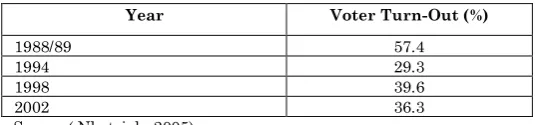
The number of women, who filed for nomination in 1998, was 580 as compared to 981 who filed for 2002. Whereas only 199 or 34% of the women won in the election in 1998, 368 women won in 2002. Although the number of elected women to the District Assemblies increased by 4% in 2002, it is still considered low. This is irrespective of the generally low turnout of registered voters at the district level election since 1988 [25].
Table 1: Voter Turn-Out
Year Voter Turn-Out (%)
1988/89 57.4
1994 29.3
1998 39.6
2002 36.3
Source ( Nketsiah, 2005)
The Ashanti Region
this region. As a predominant Akan society, the matrilineal system, which accords women high status and significant social and political influence, is practiced. The matrilineal decent system of inheritance is the basis of the Ashanti social structure and this system raises the status of women.
In the traditional system of governance, the Ashanti’s have a monarchy whose King is chosen by a Queen mother. The Queen mothers’ play important roles in local governance despite the fact that they are not supposed to meddle in politics. They occupy remarkable positions in the courts of the chiefs and are generally important in Ashanti society [25]. In spite of the position of women in the Ashanti culture, and their roles in the development of the region, women are underrepresented in the modern system of governance.
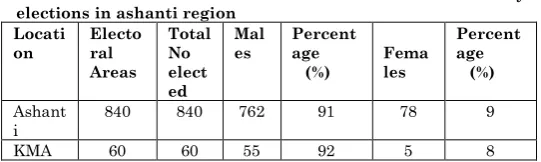
In 2002, there were only two women members of parliament out of a total of thirty three and only one women District Chief Executive out of the eighteen in the region. In the same year, there was no female Presiding member in the entire District Assemblies. The total number of assembly members in the region was 1,187, out of this 1100, (92.6%) were males and 87 (7.3%) females. The total number of elected assembly members was 840 out of which 807, (96.1%) were males and 33 (3.9%) were females. The percentage of women appointed was only 5% while that of men was 25%. These add up to the stipulated 30% government appointees.
In the 2004 parliamentary elections, 16 women contested out of a total number of 158 contestants. Only 5 out of the sixteen women won the election to become parliamentarians.
Table 2: Nomination statistics for 2002 district assembly elections in ashanti region
Locati
on Electoral Areas
Total Nos. Of contesta nts
Mal es
Percent age (%)
Femal es
Percent age (%)
Ashant
i 840 2737 2525 92 214 8
KMA 60 298 286 96 12 4
Source: (Electoral Commission, Ashanti Region) [24].
Table 3: Number of elected members in 2002 district assembly elections in ashanti region
Locati
on Electoral Areas
Total No elect ed
Mal
es Percentage (%)
Fema les
Percent age (%)
Ashant i
840 840 762 91 78 9
KMA 60 60 55 92 5 8
Source: (Electoral Commission, Ashanti Region) [24]
Considering the total representation of Assembly Members in the Ashanti Region and comparing the number of men and women in the assemblies, it is evident that women are woefully underrepresented. The membership of the district assemblies comprised 70 percent elected members and 30 percent appointed members. Only 35 percent of the appointed members were women in all the eighteen district assemblies in Ashanti in 2002. This indicated that in terms of quantity, the participation of women in local governance was low. Given the fact that the matrilineal system of inheritance practiced in Ashanti favors the position of women and also the fact that women are influential in the appointment of chiefs, one would have expected a higher representation of women in local governance among the Ashanti’s and the region occupied by the Ashantis.
Kumasi Metropolitan Assembly (KMA)
The Local Government Act 462, 1993 and Legislative Instrument LI 1614 of 1989 established the Kumasi Metropolitan Assembly (KMA) to manage the city. These legal frameworks have empowered KMA with legislative responsibilities to promulgate rules and bye-laws, giving legal effect to its decisions. The Local Government Act 462 (1993) and Legislative Instrument LI (1614) has also given authority to KMA to become a Planning Authority to formulate policies, programs and projects as well as to mobilize resources within its jurisdiction to undertake development projects.
Area of Coverage
Kumasi is located in the transitional forest zone and is about 270km north of the national capital, Accra. It is between latitude 6.35o – 6.40o and
longitude 1.30o – 1.35o, an elevation which ranges
between 250- 300 meters above sea level. The land area of the Metropolis is about 254sq/km and approximately ten (10) kilometers in radius. There are 103 communities.
Population
The Kumasi Metropolis is the most populous district in Ghana. It has a Population of 2,035,064 with an annual growth rate of 4.8% as against 3.1% of Accra Metropolitan Assembly. The population of Kumasi is projected to 2,396,458 by the year 2013, (2010 Housing and Population Census).
Sex Structure
indicate that there are 972,258 (48%) males and 1,062,806 (52%) females in the Kumasi Metropolis.
Representation of Women
The total number of the assembly members in 1998-2002 including Members of Parliament and the Metropolitan Chief Executive was 87 and comprised of six elected and appointed women (7%) and 54 (85%) men. The remaining 8% were Members of Parliament and the Metropolitan Chief Executive who are members without vote. Of the total, fifty-six were elected members and twenty four were government appointees. The elected women constituted 7% while men were 93%. In the 2002-2006 district assembly however, the elected women constitute 8%. This indicates a marginal increase of 1%.
Of the twenty-four appointees, only 8% were women while 92% were men. Women were underrepresented in the assembly, and this emphasized the observed low trend of women’s representation in the assemblies. The presiding member was a man and no women were a chairperson of any of the four sub-metropolitan council. The picture as shown in Figure 1.2 is not different from that of the region.
Factors Accounting for Women's Poor
Representation in Ghana
Ghanaian women have been active in politics since the struggles for independence and have contributed to the social, economic and political life of Ghana since then. They have also participated in policy making towards women's issues and gender equity and within the international arena. In spite of this long history of engagement, women are largely absent from mainstream political decision-making processes [28].
The arena of politics and decision making is one area where gender disparities are most visible, persistent and have proved hard to tackle. Women's poor showing in political and public life are at once a reflection of the pervasiveness of gender inequalities and a barrier to tackling this problem. Various reasons have been offered for the low levels of women's participation in public life, politics and decision making which are systemic and structural. Three often cited factors are a) the impact of women's position in other spheres of life as a result of the inequalities in the sexual division of labor, women's disadvantages in the control of resources and gender ideologies which naturalize and reinforce inequalities; b) the
problems of the political system, and c) the failure of public policy.
Women's Position in the Larger Society
At the level of the household where decisions regarding fertility and the production, exchange and consumption of resources are made, at the level of the community, within institutions and in society at large, women consistently have a weaker voice than men. Within the household, the customary social demarcation of expenditure generally gives the responsibility for visible, formal and predictable expenditures such as rent, electricity and school fees to men. This promotes their status as the main providers leaving women with the unpredictable, every day and invisible responsibilities such as provision of clothes, school uniforms and food.
It also leaves women disadvantaged in terms of their ability to control resources and to negotiate matters of vital concern to their wellbeing such as the number of children they might have and how to space them, the frequency and manner of sex, the use of contraception and the status of the marriages they enter into. Within the division of labor within households, Ghanaian women continue to shoulder the burden of reproductive activities, commonly known as household chores, within the household. Although more men are increasingly involved in some of these activities, successive Ghana Living Standards Surveys point to the fact that women do the bulk of domestic work in addition to their income earning activities.
These multiple tasks result in women's workload being far heavier than men's. This compromises their ability to accumulate resources from productive activities and participate in public life. Both women and men are active in community affairs. However, their involvement is gendered, with men dominating community governance institutions such as chieftaincy and the unit committees of the District Assemblies and women participating more in community level activities related to the reproduction of their households.
skill deficits in formal education, public speaking and the craft of politics. This reinforces the pervasive notion that politics and political positions are not for women, and that they are better suited for support and service functions. Many proverbs about the role of women convey this, whether it is in the view that women should sell garden-eggs rather than gunpowder or that even if they should own a gun, it would be lodged in a man's room or that if they should rear livestock, it would be a man's responsibility to sell it [29].
The Challenges of the Political System
The political system has several interrelated segments. Therefore, problems in one area can have ramifications in others. In the same vein, changes in one area can be experienced downstream. Within national political processes, the culture of power disadvantages women. In a system of multiparty politics such as Ghana, political parties bear some responsibility for the low numbers of women who contest elections. While Ghana has had political parties since independence, the long years of political instability and coup d'état regimes has meant that political parties have been in continuous existence only since 1992. There have been several mergers and fissures on the party front since then. Even the larger and more stable political parties such as the National Democratic Congress and the New Patriotic Party are quite weak internally and do not function fully in between elections.
Women in political parties are largely organized through women's wings which tend to be
marginal except in periods of mobilization for elections [30]. Party electoral processes discriminate directly and indirectly against women candidates in various ways. Apart from their steep financial conditionality, which few women can meet patronage structures are dominated by men and favor male candidates. None of the political parties in Ghana have systematic plans to remedy their failure to select women candidates in their primary elections. While they have been prepared to select candidates based on ethnic, regional and religious considerations, gender has seldom been a basis for action, particularly for the large parties, where the jockeying for positions is much more intense.
This is because both politicians and their constituencies strongly believe that regional and ethnic considerations hold the key to political power. Therefore these are taken much more
seriously than issues of gender equality and equity [22] Party structures continue to be male dominated, with men occupying the majority of seats in National Executives, Standing Committees and as regional chairpersons [20].
That gender issues are not electoral rallying points and this is partly a function the weaknesses of the Ghanaian women's movement. Women have not been successfully mobilized to make demands that cannot be ignored or to vote on the basis of the attitudes of political parties towards women. Parties are not penalized in any way for not including women and not implementing their manifesto promises. Thus election and appointments of women to political offices continue to be on the basis of patronage or good conscience, rather than political pressure.
Double standards of morality also disadvantage women who do not conform to stereotypes of ideal female behavior. The strong socialization of men and women to see men as natural leaders and women as followers, as well as the low gender consciousness of the electorate disadvantage women candidates for office. The failure of women candidates to win elections then discourages other women from vying for political office, thereby creating a cycle of disadvantage. Increasingly, violence during elections constitutes an additional a threat to women's participation as it is a tool largely controlled by male politicians and perpetrated mainly by younger male party activists on opponents in political contests, male and female.
Acts of violence create a pervasive environment of insecurity, which builds resistance to women's participation from their family members and well wishers. This problem was demonstrated in the last local government elections in 2006. There were several media reports of intimidation and misinformation against women. The most disturbing was the case of a husband assaulting his wife for collecting nomination forms to contest the September 2006 elections in the Garu Tempane District.
pressure on them to step down in favor of male candidates or face the wrath of family members. Both Parliament and the District Assemblies in the last two decades have operated in ways which confirm the view of the postcolonial state and its institutions as patriarchal.
Ways have not been found to accommodate women's numerical weakness and lack of influence in state institutions. The strategy of high profile appointments will certainly not fill the void in parliament or the District Assemblies. Thus in Ghana, the electoral system which operates a constituency based first past the post electoral process, the state of political parties and state institutions and the weaknesses of the women's movement have all played a part in the poor state of women's representation and the gender sensitivity of policies.
In relation to local government in particular, this and several other issues arising from the 2006 elections have raised fundamental questions about its democratic promise and the principle of subsidiarity it is intended to embody. Two of these, the issue of partisanship and the role of chiefs are particularly challenging for efforts to improve women's representation. On partisanship, the GNA also reported that the campaign in the Upper West Region had in some cases become heavily partisan. Cate Bob Milliar, Regional Director for the Department of Women who raised this concern argued that it did not favor women.
There has been report that some candidates in Accra complain that their MP was supporting a particular candidate in a partisan effort. The CDD, a civil society organization called on the Electoral Commission to adopt clear guidelines on what constitutes partisanship in the District Level Elections in order to reduce its incidence [31] This was in line with the position of women's organizations such as Abantu for Development that the nonpartisan character of the District Assembly ought to be maintained and strengthened to promote the participation of disadvantaged social groups such as women. This position of support for the maintenance of the non-partisanship principle in local government has to be understood in the context of the electoral system currently in operation in Ghana. It is arguable that if the electoral system were to change to proportional representation or a mixed system, and political parties supported and implemented affirmative action for women and included them in their party lists, partisanship at the local level would not be so damaging for
women's chances. However, it would still exclude citizens not involved in partisan politics.
Over the last two decades, chiefs have become increasingly vocal in demanding a stronger voice in local government and organizing their subjects to make demands in relation to the naming of districts, the location of District Capitals and the distribution of key offices in the District Assembly and Administration. In 2007, the government set up a committee to review the Local Government Act, Act 462. The over ten-member committee had two females- one representing the Institute of Local Government Studies and the other, the Attorney Generals Department.
The Chairman of the National House of Chiefs was represented on this Committee which was mostly made up of representatives of institutions with direct functions under decentralization. The announcement of the committee was accompanied by a report that the Minister of Local Government had said that chieftaincy was an integral part of decentralization and that this was not negotiable. This statement, even before the committee had begun its work, as well as their representation on the committee gave chiefs an unfair advantage in a discussion of interest compared to many other interest groups such as women and migrants.
It has been argued in some quarters that chiefs ought to have a stronger voice in local government because of their historical links with the local government system, their control of natural resources and their role in the mobilization of communities for development [32]. Others have advanced equally strong reasons for not increasing the influence of chieftaincy in local government. One of these is that the basis of chieftaincy, blood and ethnicity, is not compatible with republican democratic citizenship, which is at the basis of local government.
strengthening their hand might have the effect of entrenching the kinds of conflicts they have engendered [28].
Depending on what new powers are granted to chiefs, the affirmative action provisions for women's participation in local government could be compromised. Even when women are given political office, the failure to democratize political institutions results in tokenism, which is manifested by putting a few women in office without support or the removal of impediments to their effective participation. Often, the roles and responsibilities they are assigned reinforce the notion that women should focus on survivalist questions rather than exercise power for socioeconomic development [33].
The failure of successive governments to make good their international commitments, manifesto promises and policy commitments is an important element of the failure to achieve full and equal participation of women in decision making and power. Although there have been administrative instructions regarding affirmative action in local government and in appointments to boards of public corporations and other areas of public life since 1998, these have still not been properly implemented.
A result of women's poor representation is that their voices are excluded or underrepresented when priorities and agendas, policies, strategic plans, budgets and action plans are being formulated at all levels of government. Given the poor knowledge and appreciation of gender issues in government and the general lack of capacity to ensure gender equity, government policies and processes have failed to reflect the needs and interests of women generally, and poor women and men specifically [33]. From the foregoing, it is clear that the poor showing of women in political representation and in public life has many elements which need attention. Affirmative Action would address the problem of numbers
and through that begin a process of addressing some of the systemic structural problems identified, some of which need more general policies to tackle. Without tackling these, affirmative action policies would not result in sustainable improvements in the representation of women 34-48].
Conclusion
The active involvement of women in local government has been identified as very necessary because of the effective management capabilities of women and also because of the fact that women constitute the largest proportion of Ghana’s population. Successive governments since independence have made efforts to boost women participation in local governance especially by putting in place several laws and ratifying several other international conventions on women participation as well as ensuring that the local government act is put to full utilization. In spite of all these, Ghana still remain far from achieving gender parity in the political arena because of several socio-cultural, economic and political factors. Democracy cannot truly deliver for all of its citizens if more than half of the population remains under-represented in the political arena.
Therefore creating space for women to participate in local government is a vital step towards enhancing gender equal governments and gender sensitive policies. Since women have different needs and perspectives on political and social issues, it is imperative to involve women in government to enable them contribute to policy formulation and decision-making processes. Through their active involvement in community work, local women are well informed about the needs of the people and for that matter better placed in finding solutions to these problems. Women have a right to equal participation and once in leadership roles, they can make a difference that will benefit the entire society.
References
1. Inter-Parliamentary Union (1999) “Participation of women in political life: Aassessment of developments in national parliaments, political parties, governments and the IPU five years after the Fourth World Conference on Women”.
2. Beijing Fourth World Conference on Women, (1995). 3. Inter-Parliamentary Union, (2014). UN Women
Report.
4. Shvedova NA (1994) ‘A woman’s place: how the media works against women in Russia’. surviving together. Vol. 12, no. 2.
5. Shaul Marnie S (1982) “Status of Women In Local Governments: An International Assessment”, Public Administration Review, November-December. 6. Chafe WH (1991) The Paradox of Change: American
Edward Brenya et. al.| March. 2015|Vol.3|Issue 03|16-28 27 7. Wilson D (1999) Explaining the Limits of Public
Participation in Local Government. Parliamentary Affairs, 52(2):246-259.
8. Baxter S, Lansing M (1983) Women and politics: The visible majority. University of Michigan Press. 9. Ulla Skovgaard Jensen (1983) “Political and Economic Inequalities in Capitalist Polyarchies”, European Journal of Political Research, II(3):270. 10. Kishwar M (1996) “Women and politics: Beyond
quotas” economic and political weekly, 2867-2874. 11. Studlar Donley, Susan Welch (1991) “Does district
magnitude matter? Women candidates in london local elections”. The Western Political Quarterly 44 (2):457-466.
12. Salome Donkor (2014) “Women in Decision-Making : Ghana’s initiative over the years”.
13. Electoral Commission, (2006) “Nomination Statistics for 2002 District Assembly Level Elections in the Ashanti Region”. (Unpublished) 14. Gender Centre Ghana, (2010) “We know Politics
Project II”.
15. Newland K (1979) Women in Politics: A Global Review (Washington, DC: World watch Institute) 16. Bruely S (2012) The Women and Men of 1926.
Chicago: The University of Chicago Press.
17. Nzomo Maria (1994) "Women in Politics and Public Decision-making" in Himmelstrand, U. et al (eds) In Search of New Paradigms for the Study of African Development. London: James Currey.
18. Coquery-Vidrovitch C, (1997). “African Women, A Modern History”. Oxford, West View Press.
19. Nzomo M (1994) “The Status of Women’s Human Rights in Kenya and Strategies to overcome Inequalities”. A Journal of Opinion, Vol XXII (2), ed Hawk, B.G., Michigan, McNaughton and Gunn Lithographers Inc.
20. Abantu for Development (2004) Data base Research, Accra, Ghana.
21. Ghana Statistical Service (2006) Hagan, E. (2002). “A Welcome Address at the Training Workshop for Prospective Candidates for 2002 Local Government Elections”, Unpublished (FIDA).
22. ISSER/DPPC (1998) Women in Public Life in Ghana, Accra.
23. Buah FK (1980). A History of Ghana. London: Macmillan Educational, 229pp.
24. Electoral Commission, (2005a and 2005b). “Nomination Statistics for 2002 District Assembly Level Elections in the Ashanti Region”. (Unpublished).
25. Ofei-Aboagye E (2000) “Promoting the Participation of Women in Local Governance and Development: The Case of Ghana”.
26. Nkrumah, K. (1957) The Autobiography of Kwame Nkrumah. London: Nelson and Sons Ltd.
27. Government of Ghana (1993). Local Government Act, 1993, Act 462.
28. Tsikata D, Seini W (2004) “Identities, Inequalities and Conflicts in Ghana”, Working Paper No 5, Centre for Research on Inequality, Human Security and Ethnicity (CRISE), Queen Elizabeth House, University of Oxford, pp. 1-51.
29. Amoah E (1997) ”Women as portrayed in some African Proverbs”, in Saayman, W. (ed), “Embracing the Baobab Tree: The African Proverb in the 21st Century”, Proceedings of the Interdisciplinary Symposium on the African Proverb in the 21st Century, University of South Africa, Pretoria, 2- 7 October, 1996.
30. Allah-Mensah B (2008) The 2004 General Elections in Ghana. Electoral Process and the Prospects for Democracy Consolidation: Contextualizing the African Multiparty Elections of 2004: 51.
31. Ghana News Agency (GNA) Report, August 8, 2006. 32. Yankson PWK, (2000) “Decentralisation and
Traditional Authorities in Ghana”, in Thomi, W., Yankson, P.W. K. and Zanu, S.Y.M., EPAD (eds.)”. A Decade of Decentralization in Ghana, Retrospect and Prospects.
33. Cusack et’ al, (2005). Women in Politics and Decision Making, Report on the Status of Women in Ghana, Netright, Accra.
doctoral thesis submitted in partial fulfilment of the degree of Doctor of Philosophy in Cultural Study. 35. Baah-Ennumh TY, Owusu SE, Kokor JY (2005) “Participation of Women in Local Governance in Ghana: A Case Study of Ashanti Region”. Journal of Science and Technology (Ghana) 25: 95-107 36. Boadi C, Thompson ES (2008) “Women’s
Participation in Local Governance in Ghana the Case of the Nadowli District of the Upper West Region”. Studies in Gender and Development in Africa 2.
37. Bruely S (1999) Women in Britain Since 1900 London, Macmillan Press Ltd.
38. Coalition on the Women’s Manifesto for Ghana, (2004) “The Women’s Manifesto for Ghana, Abantu for Development”, Accra Ghana.
39. Convention on the Elimination of All forms of Discrimination Against Women, (1979).United Nations General Assembly.
40. Ghana News Agency (GNA) Report, Accra: November 30Government of Ghana (1992). The Constitution of the Fourth Republic of Ghana.
41. Government of Ghana (2002) “Report on 2000 National Population and Housing Census”.
42. Mahamadu AR (2010) “The Challenges of Women Participation in Local Governance: The case study of Accra and Tamale Metropolitan Assemblies”. 43. Matland RE (2005) “Enhancing Women’s Political
Participation: Legislative Recruitment and Electoral Systems”. Women in Parliament: Beyond Numbers: 93-111.
44. Newland, K (1979) The Sisterhood of Man. New York, W.W. Norton and Company.
45. Nketsiah P (2005) “Let’s Participate in Local Governance”. Daily Graphic,(Accra) March 9
46. Nzomo M (2002) “Gender, Governance and Conflicts in Africa” Council for the Development of Social Science Research in Africa (CODESRIA). Dakar, Senegal.
47. Ofei Aboagye E (2004) “Promoting Gender Sensitivity in Local Governance in Ghana”. Development in Practice 14(6):753-760.
48. Sylvia B, Sanyare F (2013) “Women's Participation and Representation in Politics: The Case of Accra