International Journal Advances in Social Science and Humanities
Available online at: www.ijassh.com
RESEARCH ARTICLE
The Gender Gap in Reported Homosexuality
Greggor Mattson*
Assistant Professor of Sociology, Gender, Sexuality and Feminist Studies Institute, Oberlin College.
*Corresponding Author: Email: [email protected]
Abstract
Men consistently report higher rates of homosexual behavior and identity than women in national population surveys of sexuality, a gender gap that has received little attention. Though women express similar levels of same-sex desire, they are far less likely to claim a lesbian identity or to report recent homosame-sexual same-sex. This paper establishes the gender gap in homosexuality as a robust social by compiling historical and anthropological evidence and population surveys. It then evaluates two competing sociological explanations for differences in homosexuality between men and women: economic inequalities and differences in human capital. I tested these explanations with variables from the National Health and Social Life Survey (NHSLS) on the dependent variable of reported same-sex same-sexual contact in the past five years. The economic hypothesis is not supported, as none of the economic variables are significant. Some of the human capital variables are significant: controlling for age and marital status, education and urban residence together explain 28% of the difference in reported homosexuality between the sexes. This paper considers the implications of human capital and the value of the gender gap for future research on the intersections among sexuality, sex and gender.
Keywords: Sexual orientation, Sex differences, Economic inequality, Human capital, Sexuality research traditions,
Gender
Introduction
Scholars have frequently observed inequalities among the sexes in the social organization of homosexuality-men run more gay rights organizations, lesbian bars and commercial establishments are more rare, and gay men have much greater presence in gay neighbourhoods and community life, for example [1-5]. While early explanations defined these phenomena as artifacts of the male bias in research or the result of gay men’s activism around AIDS [6], population surveys consistently show that men report higher rates of homosexuality than women. Rarely are these two trends connected, however. Men are twice as likely as women to report a gay or bisexual identity, and are more likely to report recent same-sex sexual behavior. Yet when asked about their degree of same-sex desire, women report higher rates than men. This gender gap between expressed homosexuality and homosexual desire between the sexes has received little explicit discussion, yet has important implications for studies of gay and lesbian life and the etiology of homosexual behavior and identity. This paper presents evidence that homosexuality’s gender gap is a social fact that is
historically and cross-culturally persistent. I report two sociological theories that have been deployed to explain the differences in homosexuality between men and women: an economic hypothesis citing independent income as necessary to express homosexuality and one citing differences in human capital. I then present logistic regressions modelling these two hypotheses, which show no support for the influence of economic variables but support for the gap’s correlation with levels of education and urbanism. I discuss the implications of these findings for understanding the intersection of gender and sexuality generally and for understanding gay and lesbian life specifically.
Evidence for Homosexuality’s Gender Gap
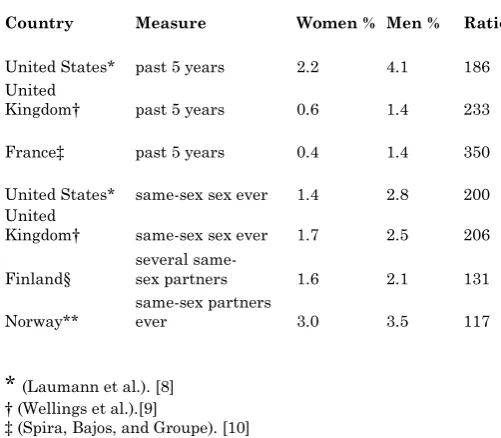
homosexuality in the population [7], but also different ratios between men’s and women’s reports of homosexuality, the indicator I use to operationalize the gender gap (see table 1):
Table 1: Reports of homosexual behavior from national population surveys
Country Measure Women % Men % Ratio
United States* past 5 years 2.2 4.1 186 United
Kingdom† past 5 years 0.6 1.4 233
France‡ past 5 years 0.4 1.4 350
United States* same-sex sex ever 1.4 2.8 200 United
Kingdom† same-sex sex ever 1.7 2.5 206
Finland§ several same-sex partners 1.6 2.1 131
Norway** same-sex partners ever 3.0 3.5 117
* (Laumann et al.). [8] † (Wellings et al.).[9]
‡ (Spira, Bajos, and Groupe). [10] § (Kontula and Haavio-Mannila ) [11]
The gender gap ranges from 117 reports for men to each 100 for women in Norway to 250 for France. In the United States, the ratio is 186 for reports of same-sex sexual contact in the last 5 years, but 200 for lifetime reports of same-sex same-sexual contact.
The U.S. data are from the National Health and Social Life Survey (NHSLS), which conducted in 1992 using a nationally-representative sample of 3,432 Americans. The survey also included a question on desire for same-sex sexual contact. Though men report higher levels of expressed homosexuality (reported behavior or claimed identity) than women, the level of homosexual desire is statistically the same between the sexes (see Table 2):
Table 2: NHSLS Reports of Homosexuality††
Measure Women % Men % Ratio
Any homosexual sex ever 4.3 9.1 212
Homosexual sex, past 5 years 2.2 4.1 186
Homosexual sex, past year 1.3 2.7 208
Homosexual identity (g/l/b) 1.4 2.8 200
Homosexual desire 7.5 7.7 97
Though the ratios for sexual identity or same-sex same-sexual contact vary from 186 to 212, women’s reported desire for same-sex sexual contact is not statistically significantly different from men’s.
Women claim a gay, lesbian or bisexual (g/l/b) identity at half the rates of men. These findings raise a puzzle: if women have the same rates of homosexual attraction, why are they nearly twice as likely to express this in behavior or identity? This gap seems to historically durable. Convenience samples of homosexuality in the United States during the 20th century consistently found higher reports of homosexuality among men than women (see Table 3):
Table 3: Incidence of homosexuality in American‡‡ convenience samples
Study Women % Men % Ratio
Hamilton (1929) 37 57 154
Bromley & Britten (1938) 4 13 325
Gilbert Youth Research (1951) 6 12 200
Kinsey et. al. (1953)
Same-sex contact ever 28 50 179
Same-sex orgasm ever 13 37 285
The ratio of the gender gap ranges from 154 in the Gilbert Hamilton sample of married, middle-class New Yorkers to 325 among 1,300 college students in the 1938 study [12].
Anthropological surveys also support the existence of the gender gap in reported homosexuality as a cross-cultural social fact. The first analysis of the Human Area Resource Files concludes (HRAF), a standardized assessment of anthropological studies, concluded that “it appears highly probable that human females are less likely than males to engage in homosexual relations” [13]. Other reviews of the literature note fewer records of homosexuality among women [14] and evidence for higher rates among men [15]. Though early anthropological data are limited by their collection by and among men and the suppression of sexuality in fieldwork accounts [15-16], there are no descriptions of human societies where female homosexuality is more prevalent than male.
On the one hand, more education for women may represent greater gender nonconformity. But it may also represent a higher level of personal resources (human capital) that can translate into more economic and social opportunities, which would, in turn, increase one’s ability to please one self rather than others.
Their invocation of human capital draws upon Gary Becker’s [18] influential application of economic theory to human behavior. In terms of realizing one’s sexual preferences, human capital can be conceived as personality and/or attractiveness (ugly ducklings have a harder time than swams), selectivity (if you only seek princes, your selection pool is small), and competence in seeking (looking for a needle in a haystack takes longer than looking for one in a sewing basket). While the use of market metaphors has been influential in conceptualizations of marriage or sexual risks, it has attracted criticism from sociologists for its inability to explain variability in sexual norms that create stratification in sexual markets and the origins of sexual agency [19, 20]. Nevertheless, human capital is the only existing hypothesis that has specifically addressed the sexed differences in reported homosexuality in population surveys.
Earlier historical and qualitative research focused on economic differences between men and women to explain differences in the organization of gay and lesbian lives. This economic hypothesis noted the intersecting disadvantages women face as women and as homosexuals. Historians noted the growth of lesbian subcultures with the rise of women’s wage labor [3, 21]. As Beth Schneider has written, lesbians: employed full-time continue to receive significantly less pay. Most do not have college degrees and enter occupations of traditional female employment where unionization is rare, benefits meager and prestige lacking. Continued employment in female-dominated occupations maintains women’s disadvantage relative to men, since it is associated with lower wages; typically, lower wages keep women dependent on men-their husbands (when they have them) or their bosses [22].
The wage gap, glass ceiling, and other forms of sex discrimination are cited as mechanisms by which women are disadvantaged in their expression of homosexuality [23]. This gender gap has received may have received such little attention because these two observations-more men express homosexuality than women, the organization of lesbian lives is impacted both by sex and homosexuality-remain separated by research traditions (for an exception see Schwartz
and Rutter [17]). Integrating findings from qualitative and quantitative research traditions, and the kinds of questions they ask, hold significant promise to understanding the implications gender gaps for theories about the sexed expressions of sexuality.
Study
This study uses multivariate logistic regression [24] to evaluate the ability of economic and human capital variables to explain the gender gap. Ioperationalized homosexuality using the NHSLS measure of same-sex partners in the past five years. It has the advantage of more respondents than sexual identity because so few respondents claimed one. The measure “same-sex “same-sexual contact ever” is so broad as to include individuals who had only one homosexual experience. The five year time period is short enough to measure only those who are currently able to engage in homosexuality but long enough to include those who had no sex partner in the last year (a common event, especially for women). The 5-year variable is highly correlated with sexual identity at .880 (.000 sig.), supporting its reliability to measure expressed homosexuality. There are only N=90 individuals who responded to the question out of 3,432 survey respondents, limiting the number of demographic and independent variable categories that could be evaluated.
Demographic dependent variables included respondents’ sex (WOMAN), whether respondents are heterosexually MARRIED and their AGE, recoded into 5 cohorts 18-29, 30-39, 40-49, 50-59, and 60+. Three variables measure economic factors, and four to measure human capital. Economic resources were tested using the NORC variable for annual household INCOME and individual WAGES coded in six groups: <$20K, $20-29K, 30-39K, 40-49K, 50- 59K, $60K+. The only measure of economic stability is provided by INC CHG, which measures whether the respondent experienced a 20% change in their income in either direction in the past year.
XNORCSIZ into four categories: small cities, towns and open country; unincorporated areas near cities greater than 50,000; suburbs near cities greater than 50,000; in a city of 50-250,000; and living in a city with a population greater than 250,000.
Human capital variables that capture both broader conceptions of social class and developmental trajectories were captured by parental educational attainment recoded in the same way as educational level (MOM ED, DAD ED). Level of urbanization of respondent’s residence at the age of 14 reflects greater opportunities for exposure to gay and lesbian events, media and individuals at a key moment of adolescence.
I fitted a reduced model containing only significant variables to mitigate the increased estimated standard errors for factors that do not show explanatory power. To allow each variable the maximum possibility of showing statistical significance, I used backward-removal based on Wald statistics. Below I also display the univariate model testing the effect of sex on respondents’ reports of homosexuality.
Results
The univariate model testing the effect of sex on respondents’ reports of homosexuality is significant (see Table 4).§§
Table 4: Correlates of self-reported homosexual behavior in the past five years
Full model Reduced Model Univariate
Variable B SE ExpB B SE ExpB B SE ExpB
WOMAN - .4730† .2814 .6213 -.7102* .2345 0.4915 -.8169*** .2300 .4418
† significant at .1 *significant at .05 **significant at .001 ***significant at .005 ****significant at .0001
EDUC LEV .3391† .1768 1.4037 .5329**** .1221 1.7039
URBAN 1581† .0907 1.1713 .2430*** .0704 1.2751
MARRIED -1.6221**** .3311 .1975 -1.6952**** .2660
AGE -.0145 .0156 .3536
MOM ED -.0407 .1432 .9601
DAD ED .1472 .1210 .2238
INC CHG .0212 .1074 1.0214
INCOME -.0002 .0843 .9998
PRESTIGE -.0023 .0023 .9977
URBAN14 .1076 .0961 1.1136
WAGES .1246 .0924 1.1327
constant -4.3049**** .6290 -4.2261**** .3359 3.2782**** .1290
-2 log
likelihood 529.649 721.40 821.807
N 66 89 90
Chi-square 12.3032 14.1801 --
df 8 8 --
§§ Hosmer and Lemeshow advise a critical value of 2 for the univariate Wald, calculated by dividing the beta value by its standard error. Since SPSS reports the Wald statistic as the Wald squared, the suggested critical value (2) must be squared as well, yielding 4.
Being a woman decreases the log odds of reporting homosexuality by .8169 (.0005 sig.), or a ratio of 222 when no other variables are controlled for, and is the benchmark gap against which I compare the multivariate models. In the full model, being married is significant at .0000, while being a woman, educational level, and degree to which current residence is urban are significant at .1, a promising result given the few degrees of freedom present in the sum of categories in the dependent variables.
Univariate models for each of the variables in the full model showed all variables were significant
except for economic measures (INCOME, INC CHG, PRESTIGE, and WAGES).
The reduced model includes only those variables that are significant using backwards removal. I ran interaction effects for all of the economic variables against each of the variables in the reduced model; none of these proved significant. Sex and being in a heterosexual marriage are strongly negatively correlated with reports of homosexual sex in the past 5 years, while educational level (.5329) andmore urban residence (.2430) are positively correlated. The correlation between urban residence and homosexuality echoes previous findings run only for men [26].
The reduced model explains 28% of the gender gap. Table 5 displays the log odds tabulated as probabilities of reporting homosexuality for eight hypothetical individuals that reflect the maximum and minimum effects of the significant variables:
Table 5: Probability of selected cases reporting homosexuality in full model
Case Women p Men p Gap
A: single, > university degree, most urban area .1694 .2933 173
B: married, > university degree, most urban area .0215 .04280 199
C: single, < high school, least urban area .0071 .0144 202
D: married, < high school, least urban area .0013 .0027 203
Type A cases are single with more than a university education living in a central city. The reduced model predicts that 29 percent of Type A men and 17 percent of women will report homosexual sex from the past five years. Type As also represents the smallest gender gap of 173, meaning the reduced model has explained 28 percent of the gap from the benchmark of 222.
The size of the effect is significant-the model predicts that highly urban and educated married women will report three times the rate of homosexual behavior over the last five years than single, rural women with less than a high school education. Type D cases have the highest gap, as married individuals with less than a high school education living in a rural area. The model predicts that only 0.27 percent of men and 0.13 percent of women will report homosexuality among individuals of this type. The gap is reduced
by only 9.4 percent for these individuals of Type D who derive few benefits from the significant variables.
As might be expected, demographic variables had the largest correlations with reports of same-sex same-sexual contact. Marital status has the largest effect on reports of homosexuality, twice the beta value of the next-largest factor. Its effect on reports of homosexuality varies depending on their levels of education and urbanisation. Among the rural-dwelling, marital status has almost no effect on the gap, but for city-dwellers it reduces the gap by 13 percent.
Discussion
gender. Using data from the NHSLS, the interactions among sexual orientation and sex were explored to show this relevance. Economic explanations for men’s higher rates of expressing homosexuality were not supported, with none of the measures of economic resources or stability showing significance in univariate or multivariate models. This contradicts a long tradition of scholarship in gay and lesbian studies that suggest that financial resources, particularly individual wages, are important to realizing homosexuality. Two variables operationalzing human capital showed modest, statistically significant, positive correlations-levels of education and degree of urban residence, which together with demographic variables explained 28% of the gap. Interaction effects of between education and economic variables also showed no significance, suggesting that education’s effect is independent of the economic benefits with which it is highly correlated.
These findings suggest that the heritage of economic materialism in gay and lesbian historical scholarship may need to be re-examined. It is too soon to discount completely the impact of wages or income on homosexual desires, as they mediate many aspects of human capital including education. The models I have explored in this paper suggest that historical and qualitative scholars should attend to the interactions between monetary and human capital factors in arguments about the differences among lesbians and gay men. Likewise, scholars of human capital should do more work to operationalize their concept in ways that take into account the qualitative research traditions of women’s disadvantages in expressing “sexual subjectivity,” “sexual agency”, or their “missing discourse of desire” [27,28]. A common vocabulary and operationalization of human capital in both traditions of sexuality research would contribute to a deeper understanding of the relative impact of education and geographic location that are correlated with the gender gap.
Indeed, if sexual agency is the prime mechanism by which individuals are able to engage in sexuality in general, much less homosexuality in particular, then women’s lower rates of homosexuality can be seen in the context of women’s lower rates of sexual actions generally. Indeed, women are less likely than men to report ever or frequently masturbating [8, 29], desire for anonymous, recreational, or group sex [8], initiating sexual encounters [30], or use of pornography [8]. Women also cite similar factors as important in their evaluation of sexual
satisfaction and well-being whether in heterosexual or homosexual relationships [31]. Evidence such as these lend support to the supposition that sexual agency offers one reasonable mechanism for impact of human capital to explain some of the sexual differences among the sexes.
This study was only able to assess the impact of sex because it was the only variable included in the NHSLS. Laumann et. al. use “gender” to describe their findings, an error that has attracted just criticism because they did not include any measures of masculinity or femininity. Surveys with richer measures of gender as well as sex would provide data against which the role of gender versus sex could be tested-suggestions Laumann et. al. raise but cannot answer [8].
Future quantitative researchers should deploy more specialized techniques for small-N results to explore the ability of human capital variables to explain the gap in reports of sexual identity and reports of sexual contact in the past year. Such techniques should also be used to test models for the sexes separately to ensure that the effects are not the result of strong correlations with only one of the sexes. These techniques may allow for the consideration of a broader panel of demographic variables; in particular, race and religiosity.
There is also no reason to suggest that the gender gap is historically invariant. This paper used only contemporary population surveys to establish the gap. More recent surveys that have occurred present time as a potential variable of interest, especially controlling for women’s rates of gains in higher education and variable rates of urbanization across countries. The age cohort effect hypothesized by Laumann et. al. to represent higher rates of human capital among younger respondents was not supported by the reduced model, although it is possible that this was an artifact of an interaction effect with education levels [8].
intersections among sexuality, sex and gender [32-34].
References
1. Altman Dennis (1971) Homosexual; Oppression and Liberation. New York,: Outerbridge & Dienstfrey; distributed by Dutton p.29.
2. Armstrong Elizabeth A (2002) Forging Gay Identities: Organizing Sexuality in San Francisco. University Of Chicago Press.
3. D’Emilio John, Estelle B Freedman (2003) Intimate matters: A History of Sexuality in America. University of Chicago Press p.240,291.
4. Meeker Martin (2006) Contacts Desired. Berkeley, CA: University of California.
5. Weeks Jeffrey (1979) Coming Out: Homosexual Politics in Britain from the Nineteenth Century to the Present. Quartet Books (UK) p.86-87.
6. Risman, Barbara, Pepper Schwartz (1988) Sociological Research on Male and Female Homosexuality. Annual Review of Sociology 14(1):125-47.
7. Priebe Gisela, Carl Göran Svedin (2013) Operationalization of Three Dimensions of Sexual Orientation in a National Survey of Late Adolescents. Journal of Sex Research 50(8):727-38. 8. Laumann Edward O, John H Gagnon, Robert T
Michael, Stuart Michaels (1994) The Social Organization of Sexuality: Sexual Practices in the United States. University of Chicago Press p.303,309. 9. Wellings Kaye, Julia Field, Anne M Johnson, Jane
Wadsworth, and Sally Bradshaw. 1994 p.187.
10. Spira Alfred, Nathalie Bajos, ACSF Groupe (1994) Sexual Behaviour and AIDS. Avebury Aldershot p.107.
11. Kontula Osmo, Elina Haavio-Mannila (1995) Sexual Pleasures: Enhancement of Sex Life in Finland, 1971-1992. Brookfield, Vermont: Dartmouth Publishing p.150.
12. Terry Jennifer (1999) An American Obsession: Science, Medicine, and Homosexuality in Modern Society. University of Chicago Press p.137-142.
13. Ford Clellan S, Frank A Beach (1951) Patterns of Sexual Behavior. New York: Harper & Row p.133. 14. Kinsey Alfred Charles (1953) Sexual Behavior in the
Human Female. Indiana University Press p.474. 15. Greenberg, David F (1988) The Construction of
Homosexuality. Chicago: University of Chicago Press p.74-77.
16. Kulick Don (1995) Introduction: The Sexual Life of Anthropologists: Erotic Subjectivity and Ethnographic Work.” Pp. 1-28 in Taboo: Sex, Identity and Erotic Subjectivity in Anthropological Fieldwork. New York: Routledge.
17. Schwartz Pepper, Virginia Rutter (1998) The Gender of Sexuality. Thousand Oaks, CA: Pine Forge Press p.30-40.
18. Becker Gary S (1976) The Economic Approach to Human Behavior. University of Chicago Press.
19. Green Adam Isaiah (2008) The social organization of desire: The sexual fields approach. Sociological Theory 26(1):25-50.
20. Levi Martin, John, Matt George (2006) Theories of Sexual Stratification: Toward an Analytics of the Sexual Field and a Theory of Sexual Capital.”Sociological Theory 24(2):132, 107.
21. Smith-Rosenberg, Carroll (1989) Discourses of Sexuality and Subjectivity: The New Woman,1870-1936.” Hidden from history: Reclaiming the gay and lesbian past 264-80.
22. Schneider Beth E (1998) Peril and Promise: Lesbians’ Workplace Participation.” Pp. 377-89 inSocial perspectives in lesbian and gay studies: A reader, edited by P. M. Nardi and B. E. Schneider.
23. Hennessy Rosemary, Chrys Ingraham
(1997) Materialist Feminism: A Reader in Class, Difference, and Women’s Lives. New York: Routledge. 24. Hosmer David W, Stanley Lemeshow (1989) Applied
Logistic Regresion. John Wiley & Sons.
25. Nakao Keiko, Judith Treas (1990) Computing 1989 Occupational Prestige Scores. National Opinion Research Center Chicago. Retrieved May 24, 2014 (http://publicdata.norc.org:41000/gss/Documents/Report s/Methodological_Reports/Mr07 0.pdf).
26. Binson Diane et al (1995) Prevalence and social distribution of men who have sex with men: United States and its urban centers. The Journal of Sex Research 32(3):245-54.
27. Fine Michelle (1992) Sexuality, Schooling, and Adolescent Females: The Missing Discourse of Desire. Pp. 31-59 in Disruptive Voices: The Possibilities of Feminist Research. Ann Arbor: University of Michigan Press.
28. Tolman Deborah L (1994) Daring to Desire: Culture and the Bodies of Adolescent Girls.” Pp. 250-84 in Sexual Cultures and the Construction of Adolescent Identities. Philadelphia: Temple University Press.
29. Hatfield Elaine, Richard L Rapson (1993) Love, Sex and Intimacy: Their Psychology, Biology, and History. Harper Collins College Publishers.
30. Schwartz Pepper, Philip Blumstein (1983) American Couples: Money, Work & Sex. New York: William Morrow.
31. Holmberg, Diane, Karen L Blair, Maggie Phillips (2010) “Women’s Sexual Satisfaction as a Predictor of Well-Being in Same-Sex versus Mixed-Sex
Relationships. Journal of Sex Research 47(1):1–11. 32. Martin Karin A (1996) Puberty, Sexuality, and the Self:
Boys and Girls at Adolescence. New York: Routledge. 33. Sundet Jon M, IL Kvalem, Per Magnus, Leiv S
Bakketeig (1988) Prevalence of Risk- Prone Sexual Behaviour in the General Population of Norway.