ARTIGO ORIGINAL
RESUMO
Introdução: O Sistema Nacional de Avaliação da Saúde é um sistema de avaliação da qualidade global dos prestadores de cuidados de saúde desenvolvido pela Entidade Reguladora da Saúde. Uma das áreas avaliadas pelo Sistema Nacional de Avaliação da Saúde é a cirurgia de ambulatório. O objetivo do nosso trabalho é demonstrar que a introdução da avaliação do Sistema Nacional de Avaliação da Saúde no nosso hospital melhorou não só a qualidade da cirurgia de ambulatório, mas também a qualidade do registo clinico.
Material e Métodos: Estudo retrospectivo dos dados clínicos do hospital. O estudo foi realizado no centro integrado de cirurgia de ambulatório do Centro Hospitalar e Universitário do Porto. Foram analisados 100 procedimentos cirúrgicos consecutivos, de todas as especialidades cirúrgicas, previamente selecionados para a auditoria Sinas, realizada no ano de 2015 e 46 procedimentos cirúrgicos realizados em 2008 no nosso hospital, antes da implantação do Sistema Nacional de Avaliação da Saúde. Foi avaliada a validação e registo dos sete indicadores do Sistema Nacional de Avaliação da Saúde para cirurgia de ambulatório.
Resultados: Verificou-se uma melhoria em todos os indicadores após a implementação do Sistema Nacional de Avaliação da Saúde, exceto para o indicador 4.
Discussão: O nosso trabalho demonstra que a introdução do Sistema Nacional de Avaliação da Saúde no nosso centro de ambulatório resulta na melhoria não apenas das práticas clínicas, mas também dos registros clínicos.
Conclusão: Concluímos assim que a aplicação de avaliação de indicadores de qualidade e benchmarking pode ser usada para melhorar os resultados de saúde.
Palavras-chave: Benchmarking; Melhoria da Qualidade; Portugal; Procedimentos Cirúrgicos Ambulatórios; Qualidade de Cuidados de Saúde
SINAS: Effective Impact in the Quality Improvement of
Ambulatory Surgery at an Ambulatory Centre
SINAS: Impacto na Melhoria da Qualidade em Cirurgia
de Ambulatório num Centro Integrado de Cirurgia
Ambulatório
1. Departamento de Cirurgia. Centro Hospitalar Universitário do Porto. Porto. Portugal.
2. Departamento de Cirurgia. Instituto de Ciências Biomédicas Abel Salazar. Universidade do Porto. Porto. Portugal. 3. Centro de Investigação em Tecnologias e Serviço de Saúde. Universidade do Porto. Porto. Portugal.
4. Departamento de Cirurgia. Instituto de Ciências Biomédicas Abel Salazar. Universidade do Porto. Porto. Portugal. 5. Departamento de Saúde Pública. Instituto de Saúde Pública. Universidade do Porto. Porto. Portugal.
Autor correspondente: Ana Povo. [email protected]
Recebido: 20 de julho de 2019 - Aceite: 28 de novembro de 2019 | Copyright © Ordem dos Médicos 2020
Eurico Castro ALVES1,2, Teresa CORREIA1,2, Pedro BRANDÃO1,2, Laetitia TEIXEIRA3,4,5, Ana POVO1,2
Acta Med Port 2020 Sep;33(9):546-551 ▪ https://doi.org/10.20344/amp.12580 ABSTRACT
Introduction: The National Health Assessment System is a system designed by the Portuguese Health Regulatory Entity in order to evaluate the overall quality of the health care institutions. One of the key areas evaluated by the National Health Assessment System is ambulatory surgery. The aim of this study is to demonstrate that the introduction of the National Health Assessment System evaluation at our ambulatory centre not only improved the overall quality of ambulatory surgery but also the quality of the clinical record entries.
Material and Methods: A retrospective analysis was performed from the hospital’s clinical database. The study was carried out at the ambulatory centre of the Hospital and University Centre of Porto, and included 100 consecutive surgical procedures, across all surgical specialties, previously selected by the National Health Assessment System audit performed in 2015 in our ambulatory surgery centre and other 46 surgical procedures performed in 2008 at our hospital, before the National Health Assessment System was implemented. The main outcome measure was the validation and record of the seven indicators of National Health Assessment System for ambulatory surgery.
Results: We have seen an improvement in all indicators after the National Health Assessment System implementation, except for criterion 4.
Discussion: Our study demonstrates that the introduction of the National Health Assessment System in our ambulatory centre resulted in the improvement in the quality of both of clinical practice, and clinical record keeping
Conclusion: We can conclude that the application of evaluation of quality indicators and benchmarking practices can be used to enhance healthcare outcomes.
Keywords: Ambulatory Surgical Procedures; Benchmarking; Portugal; Quality of Health Care; Quality Improvement
INTRODUCTION
The Portuguese Constitution, revised in 1976, states in
its 64th Article, the protection of Health as an obligation of
the State towards its citizens, and that all citizens have the right to benefit from it.1
In 1979, the National Health Service (SNS) was created out of the ideal that good healthcare should be available to
all.2 In 1982, with the first constitutional amendment, a
refer-ence to a decentralized and participatory management was added to article 64 of the Constitution.3
ARTIGO ORIGINAL verifiable criteria, including user satisfaction indexes”, as
stated in Article 36 (b) of the Decree-Law 127/2009,
pub-lished on the 27th May 2009.4 This was the moment when
the National Health Assessment System – (SINAS) was es-tablished.4
The genesis of SINAS began in 2006 and it was imple-mented in 2009. Finally, in 2015, SINAS was extended to the entire Portuguese hospital network covering both the public and the private sector.
Recently, there has been a growing interest in the as-sessment and benchmarking of the quality of care provided by healthcare institutions.5,6 Accreditation and certification
procedures have fostered the discovery of skills and
tech-nology specifically designed to improve performance.5,6
Ad-ditionally, outcomes, processes and structural quality indi-cators, aimed to detect suboptimal care, have been used as tools to promote continuous quality improvements of health care services.5,6
Developed with industrial purposes in the 1930s,
bench-marking made its first appearance in healthcare in 1990.7-9
Benchmarking involves a comparison of performances in order to identify, introduce, and sustain good practice. This is achieved by collecting, measuring and evaluating data that are then used to establish a target performance level, a benchmark.7-9
SINAS is the Portuguese tool for benchmarking in healthcare.
One of the areas that SINAS evaluates is ambulatory surgery. SINAS defines seven quality indicators for ambula-tory surgery:
• SCAMB1 - Patient selection for administration of
postoperative nausea and vomiting prophylaxis;
• SCAMB2 – Selection of postoperative nausea and
vomiting prophylaxis;
• SCAMB3 – Postoperative pain evaluation;
• SCAMB4 – Pain medications after discharge;
• SCAMB5 - Education after discharge;
• SCAMB6 – Contact telephone number provided;
• SCAMB7 – Postoperative evaluation 24-hours after
discharge.
The aim of this study is to demonstrate that the intro-duction of SINAS evaluation at our Ambulatory Centre im-proved both the quality in Ambulatory surgery and the qual-ity of the registration.
MATERIAL AND METHODS
Our study was conducted at the Ambulatory Centre of the Hospital and University Centre of Porto. The Hospital and University Centre of Porto is a tertiary hospital be-longing to the network of Portuguese public hospitals. Our ambulatory centre is an independent building, with ten op-erating theatres, that performs around 20 000 ambulatory surgical procedures per year. Different types of surgical procedures across multiple specialties are performed at our centre.
SINAS was implemented at our ambulatory centre in 2011, and since then the evaluation process is performed twice a year. The results obtained by our centre have been used to promote continuous improvements in the quality of services provided. Additionally, it has allowed for compari-son with other Portuguese ambulatory centres.
Table 1 – Distribution by ICD-9 procedure of each sample
ICD-9 (before SINAS)2008 (after SINAS)2015 Total
443 6 6 12
640 2 2 4
806 1 1 2
1474 4 4 8
1475 1 1 2
3859 15 15 30
4946 1 1 2
5303 1 1 2
5305 5 5 10
5317 1 1 2
5349 4 4 8
6373 1 1 2
7757 1 1 2
7867 1 1 2
8339 1 1 2
8621 1 1 2
1479 0 51 51
1712 0 2 2
ARTIGO ORIGINAL This study is a retrospective analysis using data retrieved from the hospital’s clinical database. Surgical records were
reviewed for the comprehensive set of SINAS indicators for ambulatory surgery, after institutional approval. Since it was a process analysis, without analysis of patient data and us-ing the data from the SINAS audit, the study dismissed Eth-ics Committee approval. We only considered effective com-pliance of a quality indicator when appropriate registration was clearly found in the patient’s clinical record. Patients were not at any time considered nor involved in the study. We retrospectively reviewed the surgical records from our ambulatory centre, before (year of 2008) and after- (year of 2015) the implementation of SINAS. For this study, we chose 100 consecutive surgical procedures, from all surgical specialties, that had been previously selected by the audit SINAS performed in our Ambulatory Surgery Cen-tre in the year of 2015. The distribution by ICD-9 surgical procedures is presented in Table 1. In order to construct the sample prior to the implementation of SINAS, we selected consecutive surgical procedures, from the same ICD-9 sur-gical procedure of the 2015 sample, performed during 2008 at our hospital. Since at that time some surgical procedures were not performed in the ambulatory setting, this sample only included 46 surgical procedures (Table 1).
For the comparison of the two samples we performed two distinct analyses.
In the first analysis, we compared 46 surgical proce-dures from the before- SINAS sample with 100 surgical
procedures from the after-SINAS sample. The after-SINAS sample included 54 additional surgical procedures (last three rows, Table 1) that were not carried out in the am-bulatory setting in the year 2008. In fact, these procedures are the result of new technological advances in the fields of anaesthesia and surgery that now allow complex medical conditions to undergo surgical procedures on an ambula-tory basis.
In the second analysis, we compared 46 surgical proce-dures with similar ICD-9 codes for each sample.
In both analyses, the samples were compared accord-ing to the seven quality indicators for ambulatory surgery described above, using the chi-square test or Fisher’ exact test. A level of significance of 0.05 was considered in all cases.
RESULTS
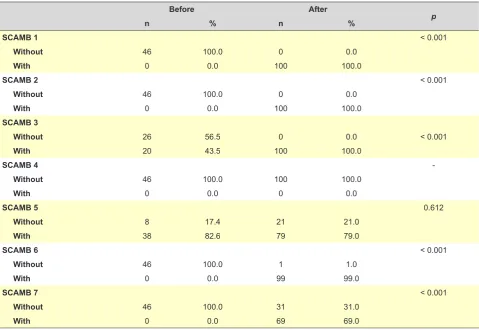
Firstly, we compared the seven criteria defined by SI-NAS in the total sample of the patient records of the before- and after- SINAS period. The analysis included 46 surgical procedures from the before- SINAS and 100 surgical proce-dures from the after-SINAS samples.
While criteria 1 and 2 were never met in the before-SI-NAS period, they were fully met in the after-SIbefore-SI-NAS period (Table 2).
Criterion 3 was applied in 43.5% of the before-SINAS procedures and in 100% of the after-SINAS procedures (Ta-ble 2).
Table 2 – Distribution of SINAS indicators before and after implementation of SINAS
Before After
p
n % n %
SCAMB 1 < 0.001
Without 46 100.0 0 0.0
With 0 0.0 100 100.0
SCAMB 2 < 0.001
Without 46 100.0 0 0.0
With 0 0.0 100 100.0
SCAMB 3
Without 26 56.5 0 0.0 < 0.001
With 20 43.5 100 100.0
SCAMB 4
Without 46 100.0 100 100.0
With 0 0.0 0 0.0
SCAMB 5 0.612
Without 8 17.4 21 21.0
With 38 82.6 79 79.0
SCAMB 6 < 0.001
Without 46 100.0 1 1.0
With 0 0.0 99 99.0
SCAMB 7 < 0.001
Without 46 100.0 31 31.0
ARTIGO ORIGINAL Criterion 4 was not met both before neither after the
im-plementation of SINAS (Table 2).
Criterion 5 was the only criterion whose values did not change significantly before- and after-SINAS with percent-ages of 82.6% and 79.0%, respectively (Table 2).
For criterion 6, the pattern is similar to criteria 1 and 2, with only one after-SINAS procedure not being registered (Table 2).
Finally, criterion 7 was never met in the before-SINAS period. In contrast, in the after-SINAS period it was regis-tered in 69.0% of the records (Table 2).
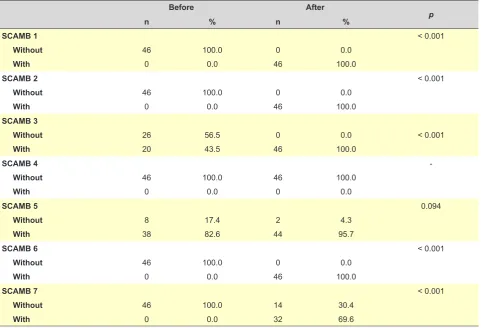
Secondly, we compared patient records before- and af-ter- SINAS period only considering the same type of proce-dure. Each sample includes 46 surgical procedures (Table 1).
Criteria 1, 2 and 6 were never met in the before-SINAS period and were fully met in the after-SINAS period (Table 3).
While the criterion 3 was applied in all of the after-SI-NAS procedures registered, it was only met in 43.5% of the before-SINAS procedures analyzed (Table 3).
Criterion 4 was not recorded in any of the periods, either before or after SINAS (Table 3).
Criterion 5 was the only criterion whose values did not change before- and after-SINAS periods with proportions of 82.6% and 95.7%, respectively (Table 3).
Finally, criterion 7 was not registered on any record of the before-SINAS period, while it was met in 69.6% of
records in the after-SINAS period (Table 3)
Considering the frequency of each procedure presented in Table 1, only comparisons between before- and after- SI-NAS period were specifically performed for ICD9 surgical procedure 3859 (saphenous vein stripping). The results obtained were similar to those when the total sample was considered (Table 4).
DISCUSSION
SINAS is an evaluation system developed and imple-mented by the Portuguese Healthcare Regulation Author-ity which aims to assess the global qualAuthor-ity of Portuguese health care providers and is based on three fundamental values: rigor, transparency and objectivity. Built on a frame-work that considers several distinct dimensions of quality, the main objectives of SINAS are: to foster scientific and technical accuracy, to ensure objectivity and fairness in the evaluation process, to promote the engagement of stake-holders and to encourage transparency and intelligibility. With this study we demonstrate that the introduction of SINAS in our ambulatory center enhanced not only the quality of clinical practice, but also the quality of clinical re-cord documentation. Quality improvement was observed for all the SINAS indicators analyzed, except for SCAM4. SCAM4 refers to the evaluation of pain medications given to the patient after discharge. The lack of improvement ob-served was due to an internal decision of the hospital board that determined that ambulatory medication would not be
Table 3 – Distribution of SINAS indicators before and after implementation of SINAS, considering ‘paired’ samples by criteria
Before After
p
n % n %
SCAMB 1 < 0.001
Without 46 100.0 0 0.0
With 0 0.0 46 100.0
SCAMB 2 < 0.001
Without 46 100.0 0 0.0
With 0 0.0 46 100.0
SCAMB 3
Without 26 56.5 0 0.0 < 0.001
With 20 43.5 46 100.0
SCAMB 4
Without 46 100.0 46 100.0
With 0 0.0 0 0.0
SCAMB 5 0.094
Without 8 17.4 2 4.3
With 38 82.6 44 95.7
SCAMB 6 < 0.001
Without 46 100.0 0 0.0
With 0 0.0 46 100.0
SCAMB 7 < 0.001
Without 46 100.0 14 30.4
ARTIGO ORIGINAL
dispensed.
Regardless of whether we compared the period before-SINAS with the total sample after-before-SINAS or only with the same type of procedures, the results obtained were simi-lar. Therefore, we conclude that the knowledge and skills acquired after the implementation of SINAS was effective across different surgical specialties and are transferable to different contexts.
Several previous studies looked at the effect of the use of quality indicators in various areas of care.6,7,10-25 A recent
study compared SINAS quality indicators for ambulatory surgery with international-used indicators.10 The authors
concluded that, although SINAS is generally well adapted to current international practices, it would be useful/advis-able to take into account two additional variuseful/advis-ables/factors, namely patient satisfaction and surgery cancellations dur-ing the scheduled day.10
Most studies found in the literature are focused on the identification and definition of the best quality indicators for particular/specific situations, while very few evaluate the real impact of the measurement of quality indicators on the improvement of care. In fact, we were only able to identify two studies concerning this issue.6,7 De Vos et al explored
the best implementation strategies for quality indicators, and quantified the effectiveness of quality indicators usage as a tool to improve quality of hospital care.6 The authors
concluded that most studies reported combinations of
im-plementation strategies in which audit and feedback were most frequently used, but few studies showed significant improvements in the outcomes measured. Furthermore, most studies focused on process measures, and reported significant improvements in terms of the measured process indicators.6 They also concluded that only a few studies
fo-cused on the improvement of patient outcomes.6
To the best of our knowledge our study is the first study presenting results regarding the effect of the introduction of SINAS in a Portuguese hospital, and that compares two different periods of time (before and after the introduction of SINAS). It is also the first study that quantifies the effective-ness of using quality indicators as a tool to improve quality of hospital care in the scope of ambulatory surgery. The fact that this study was only done in one centre, is the main limitation of our study. We believe that it would be of great interest to compare our results with the results of other Portuguese hospitals.
Another limitation of our study is that we did not deter-mine the statistical significance of our sample. This was be-cause we selected the patients from the hospital sample used for the SINAS audit. As some of the surgical proce-dures done in 2008 were not performed as ambulatory sur-geries, the sample before SINAS is smaller than the sample after SINAS, which is another limitation of our study. By informing users about the quality of healthcare services and treatments available, SINAS enhances and
Table 4 – Distribution of SINAS indicators before and after implementation of SINAS, considering ‘paired’ samples by criteria, for 3859
ICD9 Surgical Procedure
Before After
p
n % n %
SCAMB 1 < 0.001
Without 15 100.0 0 0.0
With 0 0.0 15 100.0
SCAMB 2 < 0.001
Without 15 100.0 0 0.0
With 0 0.0 15 100.0
SCAMB 3
Without 12 80.0 0 0.0 < 0.001
With 3 20.0 15 100.0
SCAMB 4
Without 15 100.0 15 100.0
With 0 0.0 0 0.0
SCAMB 5 1.000
Without 1 6.7 0 0.0
With 14 93.3 15 100.0
SCAMB 6 < 0.001
Without 15 100.0 0 0.0
With 0 0.0 15 100.0
SCAMB 7 0.001
Without 15 100.0 6 40.0
ARTIGO ORIGINAL supports patient participation in the decision-making
pro-cess. Indeed, patients are now able to make their health-care choices based on credible and reliable indicators. SINAS also allows healthcare institutions to assess the im-pact of a certain factor on the quality of the health services provided. Moreover, it enables performance comparison with ‘competitors’ thus affecting strategic institutional deci-sions. Overall, SINAS has the potential to highlight quality improvement areas, to identify areas for further study and to track changes over time.
We observed an improvement of clinical quality after the introduction of SINAS and therefore it is plausible that the application of the evaluation of quality indicators and benchmarking may foster the improvement of health out-comes. However, it is important to consider that the clinical indicators used in SINAS for Ambulatory surgery are more focused in the process rather than in patient outcomes. We believe that, in the future, new indicators should be created focusing on patient outcomes. It could be of interest, in the near future, to study the association between process indi-cators and patient outcomes.
CONCLUSION
In this study we demonstrate that the implementation of SINAS at our ambulatory centre has led to an increase of quality of both clinical practice and clinical record filing. We can conclude that the evaluation and benchmarking of
quality indicators play an important role in the improvement of clinical performance.
We also suggest that future analysis of the impact of the implementation of SINAS on clinical patient outcomes will allow for a better understanding of the relevance of the use of quality indicators. Furthermore, comparing quality across national hospitals as well as across different SINAS-evalu-ated areas, will be important to assess the causes underly-ing potential differences and to determine which additional actions may improve health outcomes.
PROTECTION OF HUMANS AND ANIMALS
The authors declare that the procedures were followed according to the regulations established by the Clinical Re-search and Ethics Committee and to the Helsinki Declara-tion of the World Medical AssociaDeclara-tion.
DATA CONFIDENTIALITY
The authors declare having followed the protocols in use at their working center regarding patients’ data publica-tion.
CONFLICT OF INTEREST
No conflict of interest has been declared by any author.
FUNDING SOURCES
No financial support was received by any author.
REFERENCES
1. Assembleia Constituinte (1976). Constituição da República Portuguesa – V Revisão Constitucional. [consultado Jan 2019] Disponível em: http:// www.parlamento.pt/const_leg/crp_port/index.html..
2. Decreto-lei nº214/1979. Diário da República, I série, nº56 (1979/09/15). 3. Decreto-lei nº1/1982. Diário da República, I série, nº54 (1982/09/30). 4. Decreto-Lei nº127/2009. Diário da República, I série, nº36b (2009/05/27). 5. Lovaglio PG. Benchmarking Strategies for Measuring the Quality of
Healthcare: Problems and Prospects. Scientific World J. 2012:1-13. 6. De Vos M, Graafmans W, Kooistra M, Meijboom B, Van Der Voort P,
Westert G. Using quality indicators to improve hospital care: a review of the literature. ISQua. 2009;21:119-29.
7. Wind A, van Dijk J, Nefkens I, van Lent W, Nagy P, Janulionis E, Helander T, Rocha-Gonçaves F, van Harten W. Development of a benchmark tool for cancer center; results from a pilot exercise. BMC Health Services Res. 2018;18:764-78.
8. Ettochi-Tardy A, Levif M, Michel P. Benchmarking: a method for continuous quality improvement in health. Healthc Policy. 2012;7:e101. 9. Longbottom D. Benchmarking in the UK: an empirical study of
practitioners and academics. BIJ 2000;7:98-117.9
10. Nunes JS, Gomes R, Povo A, Alves EC. Quality Indicators in Ambulatory Surgery: A literature review comparing Portuguese and international systems. Acta Med Port. 2018;31:425-30.
11. Saluja S, Mukhopadhyay S, Amundson JR, Silverstein A, Gelman J, Jenny H, Lin Y, Moccia A, Rashad R, Sood R, Raykar NP, Shrime M. Quality of essential surgical care in low- and middle-income countries: a systematic review of the literature. Int J Qual Health Care. 2019;31:166-72.
12. Nakahara S, Sakamoto T, Fujita T, Uchida Y, Katayama Y, Tanabe S, et al. Evaluating quality indicators of tertiary care hospitals for trauma care in Japan. Int J Qual Health Care. 2017;29:1006-13.
13. Sampurno F, Zheng J, Di Stefano L, Millar JL, Foster C, Fuedea F, et al. Quality Indicators for Global Benchmarking of localized prostate cancer management. J Urol. 2018;200:319-26.
14. Voeten SC, Krijnen P, Voeten DM, Hegeman JH, Wouters MW, Schipper IB. Quality indicators for hip fracture care, a systematic review. Osteroporosis Int. 2018;29:1963-85.
15. Verburg IW, de Jonge E, Peek N, de Keizer NF. The association
between outcome-based quality indicators for intensive care units. PloS one. 2018;13:e0198522.
16. Rieb HC, Debus ES, Schwaneberg T, Hischke S, Maier J, Bublitz M, et al. Indicators of outcome quality in peripheral arterial disease revascularisations – a Delphi expert consensus. Vasa. 2018;47:491-7. 17. Ewald DA, Huss G, Kraska RA, Geraedts M. Feasibility testing od the
Core set of quality indicators for Paediatric Primary Care in Europe, COSI-PPC-EU. Eur J Pediatr. 2019;178:707-19.
18. Sim J, Joyce-McCoach J, Gordon R, Kobel C. Development of a data registry to evaluate the quality and safety of nursing practice. J Adv Nurs. 2019;75:1877-88.
19. Bieler D, Hörster A, Lefering R, Franke A, Waydhas C, Huber-Wagner S, et al. Evalutation of new quality indicators for the TraumaRegister DGU using the systematic QUALIFY methodology. Eur J Trauma Emerg Surg. 2018;doi: 10.1007/s00068-018-1055-z.
20. Wagg A, Gove D, Leichsenring K, Ostaszkiewicz J. Development of quality outcome indicators to improve the quality of urinary and faecal continence care. Int Urogynecol J. 2019;30:23-32.
21. Cillis M, Spinewine A, Krug B, Quennery S, Wouters D, Dalleur O. Development of a tool for benchmarking of clinical pharmacy activities. Int J Clin Pharm. 2018;40:1462-73.
22. Zecchin R, Candelaria D, Ferry C, Ladak LA, McIvor D, Wilcox K, et al. Development of Quality Indicators for cardiac rehabilitation in Australia: a modified Delphi method and pilot test. Heart Lung Circ. 2019;28:1622-30.
23. Fuccio L, Bhandari P, Maselli R, Frazzoni L, Ponchon T, Bazzoli F, et al. Ten quality indicators for endoscopic submucosal dissection: what should be monitored and reported to improve quality. Ann Transl Med. 2018;6:262.
24. Nouira H, Ben Abdelaziz A, Kacem M, Ben Sik Ali H, Fekih Hassen M, Ben Abdelaziz A. Which indicators used to assess quality performance in Intensive Care Units? A systematic review of medical literature. Anaesth Crit Care Pain Med. 2018;37:583-7.