doi:10.1136/bmj.323.7311.490
2001;323;490-
BMJ
and Andy Haines
Elizabeth Murray, Hilary Davis, Sharon See Tai, Angela Coulter, Alastair Gray
therapy in primary care
multimedia decision aid on hormone replacement
Randomised controlled trial of an interactive
http://bmj.com/cgi/content/full/323/7311/490
Updated information and services can be found at:
These include:
References
http://bmj.com/cgi/content/full/323/7311/490#otherarticles
11 online articles that cite this article can be accessed at:
http://bmj.com/cgi/content/full/323/7311/490#BIBL
This article cites 21 articles, 7 of which can be accessed free at:
Rapid responses
http://bmj.com/cgi/eletter-submit/323/7311/490
You can respond to this article at:
http://bmj.com/cgi/content/full/323/7311/490#responses
at:
2 rapid responses have been posted to this article, which you can access for free
service
Email alerting
the top right corner of the article
Receive free email alerts when new articles cite this article - sign up in the box at
Topic collections
(400 articles)
Patient - caregiver communication (including Patient education)
(445 articles)
Other evidence based practice
(365 articles)
Health Economics
(561 articles)
Health Services Research
(93 articles)
Drugs: obstetrics and gynaecology
(308 articles)
Other Medical Informatics
(466 articles)
Randomized Controlled Trials: examples
(140 articles)
Menopause (incl HRT)
Articles on similar topics can be found in the following collections
Notes
http://www.bmjjournals.com/cgi/reprintform
To order reprints of this article go to:
http://bmj.bmjjournals.com/subscriptions/subscribe.shtml
go to:
BMJ
To subscribe to
on 22 May 2006 bmj.com
Papers
Randomised controlled trial of an interactive multimedia
decision aid on hormone replacement therapy in
primary care
Elizabeth Murray, Hilary Davis, Sharon See Tai, Angela Coulter, Alastair Gray, Andy Haines
Abstract
ObjectiveTo determine whether a decision aid on hormone replacement therapy influences decision making and health outcomes.
DesignRandomised controlled trial.
Setting26 general practices in the United Kingdom.
Participants205 women considering hormone replacement therapy.
InterventionPatients’ decision aid consisting of an interactive multimedia programme with booklet and printed summary.
Outcome measuresPatients’ and general
practitioners’ perceptions of who made the decision, decisional conflict, treatment choice, menopausal symptoms, costs, anxiety, and general health status.
ResultsBoth patients and general practitioners found the decision aid acceptable. At three months, mean scores for decisional conflict were significantly lower in the intervention group than in the control group (2.5v2.8; mean difference −0.3, 95% confidence interval −0.5 to−0.2); this difference was maintained during follow up. A higher proportion of general practitioners perceived that treatment decisions had been made “mainly or only” by the patient in the intervention group than in the control group (55%v 31%; 24%, 8% to 40%). At three months a lower proportion of women in the intervention group than in the control group were undecided about treatment (14%v26%; −12%,−23% to −0.4%), and a higher proportion had decided against hormone
replacement therapy (46%v32%; 14%, 1% to 28%); these differences were no longer apparent by nine months. No differences were found between the groups for anxiety, use of health service resources, general health status, or utility. The higher costs of the intervention were largely due to the video disc technology used.
ConclusionsAn interactive multimedia decision aid in the NHS would be popular with patients, reduce decisional conflict, and let patients play a more active part in decision making without increasing anxiety. The use of web based technology would reduce the cost of the intervention.
Introduction
Decision aids to assist patients in deciding about health care have been welcomed as one solution for improving doctor-patient communication, providing information for patients, and addressing the shortcom-ings in much of the information available.1–5 Both
patient outcomes and the rational use of health service resources may be improved by better provision of information.6–9
Decision aids for patients differ from simple infor-mation packages. As well as containing inforinfor-mation about the probability of risks and benefits of available treatments, they often contain exercises to help patients clarify their own health needs, and they emphasise that different patients reach different decisions.10Decision aids aim to promote shared
deci-sion making,11where the clinician and patient jointly
negotiate and agree on a treatment decision, taking into account both the probability of a range of clinical outcomes and the relative weight the patient places on these outcomes.
A recent systematic review of decision aids determined that they improve patients’ knowledge of their condition and treatment options.12They seem to
help with decision making in that “decisional conflict scores” (a measure of patients’ internal perceptions of ability to make a decision and satisfaction with the decision made) tend to be lower in groups that have used a decision aid than in control groups.13There are,
however, several unanswered questions,14in particular
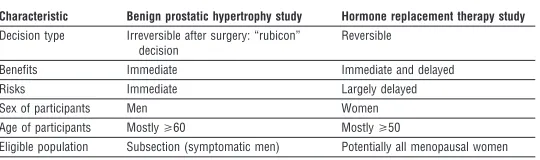
the impact of decision aids on choice of treatment, sat-isfaction, health status, and persistence with treatment. Additionally, as most trials have been done in second-ary care in the United States, there is little evidence on the use of decision aids in primary care. Few data are also available on clinicians’ perceptions of decision aids or their cost effectiveness. We address these questions here and in the accompanying paper on patients with benign prostatic hypertrophy.15 The two trials were
designed to complement each other by examining qualitatively different decisions in different populations (table 1). In this paper we aimed to determine whether an interactive multimedia decision aid promoted greater patient involvement in decision making and what influence this had on the uptake of hormone replacement therapy, health status, and anxiety. We also
Department of Primary Care and Population Sciences, Royal Free and University College Medical School, University College London, London N19 3UA Elizabeth Murray senior lecturer Hilary Davis research fellow Sharon See Tai senior research fellow Andy Haines professor Picker Institute Europe, Oxford OX1 1RX Angela Coulter director Health Economics Research Centre, University of Oxford, Oxford OX3 7LF Alastair Gray director
Correspondence to: E Murray elizabeth.murray@ pcps.ucl.ac.uk
aimed to determine the acceptability of such a system to patients and general practitioners and the impact on a general practitioner’s workload and to undertake an economic analysis.
Participants and methods
Patient recruitmentWe invited general practitioners in two urban (Oxford and London) areas and one suburban (Harrow) and one semirural (Thame and the Chilterns) area to participate in our study. We asked participating general practitioners to recruit perimenopausal or menopau-sal women who were facing a decision about whether to start, stop, or continue with hormone replacement therapy. The women needed a sufficient understanding of English to be able to consult without an interpreter. Women were excluded if there was an absolute indica-tion or contraindicaindica-tion to hormone replacement therapy or if they had breast or pelvic cancer, severe visual or hearing impairment, or severe learning difficulties or mental illness. Ethical approval was obtained from local research ethics committees.
Intervention
The intervention, developed by the Foundation for Informed Medical Decision Making, comprised an interactive multimedia programme, with booklet and printed summary.16Information comprised quantified
probabilities of the risks and benefits of hormone replacement therapy taken from systematic reviews and other published data available in 1996 and updated in 1998. Topics discussed were menopausal symptoms, mood changes, skin changes, changes in energy, vaginal dryness, changes in libido, heart disease, osteoporosis, breast cancer, and endometrial cancer. After viewing the programme the patients were given a summary of the information; a copy was also sent to their general practitioners.
As the programme used interactive video disc tech-nology, we imported specialised hardware from the United States. This limited the number of machines available for patients to use. Patients travelled to one of five sites, chosen for ease of access from referring prac-tices, to view the programme in a private room. All the
patients saw the core programme, lasting about one hour; viewing optional sections for further information took up to 30 minutes more.
Randomisation
Patients randomised to the control group received normal clinical care. Randomisation was performed after obtaining informed consent and baseline data from eligible patients. The randomisation schedule, stratified according to recruitment centre, was gener-ated by computer. Allocations were sealed in opaque numbered envelopes, opened by the study nurse after collection of the baseline data.
Data collection
We collected data from the patients at baseline and at three and nine months after randomisation. Outcome measures included personal details, decisional conflict scores, patients’ and general practitioners’ perceptions of who made the decision, treatment preference, persistence with treatment, anxiety (Spielberger state trait anxiety inventory short form),17health status and
limitations in physical functioning (SF-36),18 health
states and valuation of health states (EQ-5D),19 and
menopausal symptoms (MenQol).20 Patients in the
intervention group completed a questionnaire imme-diately after viewing the programme.
After the follow up consultation the general practi-tioners filled in a questionnaire to determine the time spent on the consultation, their perceptions of who made the treatment decision, and whether the programme had helped or hindered the consultation for patients in the intervention group.
Economic evaluation
We recorded the resources used by each patient over the trial period. These were the cost of providing the interactive information (video costs, nurse time, and accommodation were shared with the accompanying trial, with 64% of costs attributed to the present study on the basis of patient numbers), the number and duration of consultations with the general practitioner, the number of referrals to specialists, and the use of hormone replacement therapy and related drugs. The unit costs were attached to resource volumes to obtain a total cost per patient. As the technology we used was superseded by CD Rom, personal computer, and inter-net technology by the time our trial was completed, we also present some estimates of the costs of an alterna-tive delivery system. Utility was measured with the EQ-5D at baseline and at three and nine months. Valu-ations of health states were taken from the UK popula-tion tariff.21We compared point values, summed values
over the trial, and changes from baseline to the end of the trial. We conducted our economic evaluation from the perspective of the healthcare system. All costs are in pounds sterling at 1999 prices. To aid generalisabil-ity of the results we obtained unit costs from national sources where possible (table 2).
Sample size
Evidence has shown that the more information women have about hormone replacement therapy, the greater is the likelihood of their using it.22 We therefore
hypothesised that more women in the intervention group than in the control group would choose hormone replacement therapy. Allowing for a 30% dropout rate, 120 women in each arm (84 women
Table 1 Details of two studies on decision aids
Characteristic Benign prostatic hypertrophy study Hormone replacement therapy study Decision type Irreversible after surgery: “rubicon”
decision
Reversible
Benefits Immediate Immediate and delayed Risks Immediate Largely delayed Sex of participants Men Women Age of participants Mostly>60 Mostly>50
Eligible population Subsection (symptomatic men) Potentially all menopausal women
Table 2 Unit costs in pounds sterling (at 1999 prices) and sources of information used in economic evaluation
Item Unit cost Source
Generic consultation with doctor 14.00 Department of Health Doctor’s cost per minute (initial intervention) 1.62 Department of Health 3 months’ supply of Prempak-C 15.00 British National Formulary Specialist referral from doctor 60.00 Department of Health TFR2 returns Interactive session* 216.06
*Total equipment costs £17 520. Software cost $1300 (£770) per disc; total cost $6500 (£3850) plus £400 for shipping and insurance. Mean cost per patient £216.
Papers
2 BMJVOLUME 323 25 AUGUST 2001 bmj.com
on 22 May 2006 bmj.com
completing the trial) would give our study an 80% power of detecting a 15% point difference in use of hormone replacement therapy (between 8% and 23%)23in the two arms at the 5% significance level. A
retrospective calculation showed that the power of our actual sample size to determine the observed difference in decisional conflict score between the two groups at the final assessment was 95% at the 5% significance level.
Statistical analysis
We analysed data for all outcomes for those patients who completed all the assessments. We also performed an intention to treat analysis to allow for those patients who did not complete the study and who were therefore unable to provide data at the nine months’ assessment. For that analysis we assumed no change in score on any outcome from the beginning of the study, and we substituted baseline data for the missing data at the final assessment. We present the results for those who completed the nine months’ assessment, as the intention to treat analysis did not alter the results.
We compared the change in scores from baseline to final assessment for the MenQol and Spielberger scales between study groups, and we compared decisional conflict scores between the two groups at three and nine months. We present the means and standard deviations for resource use and costs and means and 95% confidence intervals for differences in resource use and costs by allocation.
Results
RecruitmentOverall, 26 general practices agreed to participate; 12 from London and Harrow, 14 from Oxford and Thame and the Chilterns. Between October 1996 and August 1998, 205 women were recruited (figure).
Baseline characteristics
The intervention and control groups were comparable at baseline (table 3) except for educational achieve-ment, which was higher in the control group. Subsequent analysis showed that educational attain-ment was not related to use of hormone replaceattain-ment therapy nor was there an interaction between educational attainment and the intervention.
Reactions to decision aid
Patients reacted positively to the decision aid (table 4). Women in the intervention group seemed to make a
more definite choice about treatment than those in the control group, with fewer women being “undecided” and more women deciding not to take hormone replacement therapy at three months; by nine months, however, this difference was no longer significant (table 5). This was confirmed by the decisional conflict scores, which were lower in the intervention group than in the control group at three months (table 6); the significant differences persisted at nine months (total score at nine months: mean (SD) scores, intervention group 2.45 (0.56), control group 2.80 (0.61); mean difference
Patients referred to study by general practitioner (n=259)
Randomised (n=205)
Intervention
Received intervention as allocated (n=102) Did not receive intervention as allocated (n=1); patient dropped out of trial after randomisation
Not contactable (n=14)
Control
Received intervention as allocated (n=102)
Followed up at 3 months (n=94); 4 women who did not complete data at
3 months did at 9 months Followed up at 9 months (n=93)
Followed up at 3 months (n=96); 3 women who did not complete data at
3 months did at 9 months Followed up at 9 months (n=94)
Completed trial (n=93) Completed trial (n=94) Dropped out (n=8) Dropped out (n=10)
Not randomised (n=40): Ill health in family (n=2) Too busy (n=9)
Misunderstood purpose of study (n=2) Difficult relation with general practitioner (n=1)
No menopausal symptoms (n=1) Had made decision (n=2)
Could obtain information elsewhere (n=2) No reason (n=13)
Did not attend appointment (n=7) Unknown (n=1)
Progress of patients through trial
Table 4 Acceptability of decision aid to patients
No (%) of patients (n=101) Was the video easy to understand?
Very easy 84 (82)
Quite easy 17 (17)
Quite difficult 0
Very difficult 0
Effect on understanding of issues around hormone replacement therapy Understand more 88 (87) Understand same 13 (13)
Understand less 0
Effect on difficulty of decision making
Easier to decide 56 (54) Neither easier nor harder to decide 37 (36) Harder to decide 8 (8)
Table 3 Baseline characteristics of participants. Values are numbers (percentages) of women unless stated otherwise
Characteristic
Intervention group (n=103)
Control group (n=102)
Mean age (years) 50.75 50.11
Ethnicity (white) 95 (92) 93 (93) Educational attainment:
Up to secondary education 40 (39) 24 (24) Beyond secondary education 63 (61) 78 (77) Treatment choice for hormone replacement therapy:
To take 31 (30) 27 (27)
Not to take 21 (20) 18 (18)
Let doctor decide 4 (4) 5 (5)
Unsure 47 (46) 51 (51)
Mean (SD) MenQol score:
Vasomotor 2.71 (1.73) 3.02 (2.0) Psychosocial 3.55 (1.82) 3.65 (1.81) Physical 3.42 (1.33) 3.47 (1.35)
Sexual 2.85 (2.16) 2.34 (1.62)
Mean (SD) decisional conflict score:
−0.35, 95% confidence interval for mean difference
−0.53 to −0.16). General practitioners perceived the decision to have been made “mainly or only [by the] patient” in a significantly higher proportion of patients in the intervention group than in the control group, although there were no differences in patients’
percep-tions of who should make the decision (table 7). The wording of the question was altered from “who made the treatment decision” (asked in the study on benign prostatic hypertrophy) to “who do you think should make the treatment decision?” as we postulated that many women would not have made a decision about their treatment by the end of the trial.
We found no significant difference between the two groups in the change in anxiety score between baseline and at nine months (t test, mean change scores: intervention group 0.34, control group 2.49, mean dif-ference −2.15, −6.45 to 2.16). We also found no significant changes in scores from baseline to final assessment between the two groups in the SF-36 or the EQ-5D or MenQol.
Of 73 subsequent consultations, the general practi-tioners said that the decision aid helped in 61 (84%), made no difference in 11, and hindered one.
Economic analysis
Table 8 shows the resources used and the costs per patient by allocation group. No significant differences were detected when the cost of the trial technology was excluded. When the cost of the video intervention was included, the cost per patient was £306 in the interven-tion group and £91 in the control group over nine months (P < 0.001).
Discussion
Our pair of trials are the first randomised controlled trials of interactive multimedia decision aids in a primary care population in the United Kingdom. The decision aid in this paper was acceptable to both the patients and their general practitioners. It enhanced the women’s understanding of the effects of hormone replacement therapy and seemed to reduce decisional conflict for the duration of follow up. Lower decisional conflict scores imply less uncertainty about the decision. At three months fewer women in the intervention group than in the control group were undecided about their use of hormone replacement therapy. The general practitioners perceived a higher proportion of patients in the intervention group than in the control group to have “mainly or only” made the decision, although this finding must be interpreted with caution as the doctors were not blinded to the patients’ study groups. The intervention made no difference to the rate of uptake of hormone replacement therapy or the use of health service resources in general. The main costs of the intervention were due to the technology used. These findings are compatible with the recent systematic review of decision aids5and provide new information
on the acceptability of such decision aids to clinicians and patients in primary care and the impact on costs to the NHS.
Implications for the NHS
Public demand for improved access to quality sources of information is high and likely to increase. Decision aids have the potential to alter the use of healthcare resources in line with patients’ preferences and, through the influence of patient choice on clinicians, may help to promote evidence based practice.24 No
study has yet examined the effect of decision aids on
Table 5 Treatment preferences for hormone replacement therapy at three and nine months’ follow up. Values are numbers (percentages) of patients unless stated otherwise
Treatment preference Intervention group Control group % difference (95% CI) Three months’ follow up*:
Therapy 36 (40) 40 (42) −2.1 (−16.3 to 12.1) No therapy 41 (46) 30 (32) 14 (0.8 to 27.9) Undecided 13 (14) 25 (26) −11.9 (−23.3 to−0.4) Nine months’ follow up†:
Therapy 36 (41) 31 (36) 5.8 (−8.7 to 20.2) No therapy 46 (53) 44 (51) 2.3 (−12.5 to 17.1) Undecided 5 (6) 12 (14) −8.1 (−16.8 to 0.7) Data are missing for some participants.
Confidence intervals are based onttests assuming unequal variances between study groups. *÷2
=5.573, df=2, P=0.06. †÷2=3.30, df=2, P=0.2.
Table 6 Decisional conflict scores at three months. Values are means (SDs) unless stated otherwise
Intervention
group Control group Mean difference (95% CI) Uncertainty 3.1 (1.0) 3.4 (1.1) −0.3 (−0.7 to−0.04)* Factors contributing to uncertainty 2.4 (0.5) 2.8 (0.6) −0.4 (−0.5 to−0.2)** Perceived effective decision making 2.2 (0.6) 2.5 (0.7) −0.3 (−0.5 to−0.2)** Total decisional conflict score 2.5 (0.5) 2.8 (0.6) −0.3 (−0.5 to−0.2)** *P<0.05. **P<0.01.
The decisional conflict scale contains three subscales that elicit uncertainty about choosing between alternatives, awareness of modifiable factors contributing to uncertainty, and perceived effectiveness of decision making process. Higher scores indicate increased uncertainty in each subscale. Subscales can be combined to give a total decisional conflict score.
Table 7 Patients’ and general practitioners’ perceptions of decision making. Values are numbers (percentages) of patients unless stated otherwise
Intervention group Control group % difference (95% CI) General practitioners (n=76) (n=67)
Who do you think made the treatment decision?:
Mainly or only general practitioner 1 (1.3) 2 (3) −1.7 (−6.5 to 3.1) General practitioner and patient together 33 (43.4) 44 (65.7) −22.3 (−38.2 to−6.3) Mainly or only patient 42 (55.3) 21 (31.3) 24 (8.2 to 39.7)*
÷2=8.37, df=2, P=0.015
Patients (n=94) (n=95)
Who do you think should make the treatment decision?:
Mainly or only general practitioner 5 (5.3) 6 (6.3) −1.0 (−7.7 to 5.7) Patient and general practitioner together 40 (42.6) 36 (37.9) 4.7 (−9.3 to 18.6) Mainly or only patient 49 (52.1) 53 (55.8) −3.7 (−17.9 to 10.5)
÷2=0.45, df=2, P=0.8
Table 8 Resource use and costs in sterling (at 1999 prices) per patient, by allocation. Values are means (SDs) unless stated otherwise
Intervention (n=85)
Control (n=84)
Mean difference (95% CI) Cost of video technology 216.00 0 216 Duration of initial consultation (minutes) 13.4 (5.9) 13.9 (5.8) −0.5 (−2.5 to 1.6) No of appointments to see doctor over
9 months
3.4 (1.2) 3.6 (1.5) −0.2 (−0.6 to 0.2)
Cost of appointments over 9 months 64.6 (23.6) 66.5 (24.6) −1.9 (−9.2 to 5.5) No of specialist referrals over 9 months 0.03 (0.17) 0.03 (0.18) 0.00 (−0.06 to 0.06) Cost of specialist referrals over 9 months 1.7 (10.1) 1.9 (10.6) −0.19 (−3.75 to 3.37) Cost of hormone replacement therapy over
9 months
24.3 (28.3) 23.0 (27.2) 1.3 (−7.1 to 9.7)
Total cost 306.5 (42.8) 90.9 (39.2) 215.5 (203.1 to 228.0)*** ***P<0.001.
Papers
4 BMJVOLUME 323 25 AUGUST 2001 bmj.com
on 22 May 2006 bmj.com
litigation, although viewing such a programme could be considered evidence of informed consent.
Delivering programmes to standard personal com-puters through the internet would reduce the cost per session from about £177 to £5 (excluding the cost of software). This assumes equipment costs of £1500 over three years, with a fairly low utilisation rate (two users per weekday) and lower space and staff costs commen-surate with a less dedicated technology. Thus this type of interactive decision aid, which provides a realistic and practical solution to the problem of achieving informed patient choice at low cost, could easily be incorporated into multiple access points for infor-mation such as those envisaged for NHS Direct Online. Our trial was not designed to determine the extent to which patients would seek out and use a decision aid if they were not referred to it; however the rapid rise in numbers of visitors to health information sites on the internet25 confirms previous evidence on the
wide-spread demand by patients for information on health care.
Conclusions
Evidence shows that further coordinated investment is required in decision aids for patients. This would involve incorporation of information from systematic reviews (where available) into high quality decision aids, particularly addressing decisions where patients’ needs are paramount.
We thank Jo Burns for administrative support, the research staff Liz Redfern, Sue Davis, Jean Catterson, and Marjorie Talbot, and the general practitioners. AH is currently based at the London School of Hygiene and Tropical Medicine, London WC1E 7HT. Contributors: AC and AH developed the idea for the study, participated in the design of the trial, and helped write the paper. AG initiated the health economic component of the
study, determined the health economic data to be collected, par-ticipated in the analysis, and helped write the paper. HD coordi-nated the project, collected the data, participated in the analysis, and helped write the paper. SST participated in the study design and analysis of the data and helped write the paper. EM, the principal investigator, participated in the research design, coor-dinated the project, participated in data analysis, and helped write the paper; she will act as guarantor for the paper.
Funding: BUPA Foundation and the King’s Fund. Competing interests: None declared.
1 General Medical Council.Seeking patients’ consent: the ethical considerations. London: GMC, 1998.
2 Department of Health.Saving lives: our healthier nation. London: Station-ery Office, 1999.
3 Jones R, Pearson J, McGregor S, Cawsey AJ, Barret A, Craig N, et al. Ran-domised trial of personalised computer based information for cancer patients.BMJ1999;319:1241-7.
4 Meredith C, Symonds P, Webster L, Lamont D, Pyper E, Gillis CR, et al. Information needs of cancer patients in west Scotland: cross sectional survey of patients’ views.BMJ1996;313:724-6.
5 Coulter A, Entwistle V, Gilbert D. Sharing decisions with patients: is the information good enough?BMJ1999;318:318-22.
6 Legg England S, Evans J. Patients’ choices and perceptions after an invita-tion to participate in treatment decisions.Soc Sci Med1992;34:1217-25. 7 Kaplan SH, Greenfield S, Ware JEJ. Assessing the effects of
physician-patient interactions on the outcomes of chronic disease.Med Care 1989;27:110-27S. [Published erratum appears in Med Care
1989;27:679.]
8 Flood AB, Wennberg JE, Nease RFJ, Fowler FJJ, Ding J, Hynes LM. The importance of patient preference in the decision to screen for prostate cancer.J Gen Intern Med1996;11:342-9.
9 Wolf AM, Nasser JF, Schorling JB. The impact of informed consent on patient interest in prostate-specific antigen screening.Arch Intern Med
1996;156:1333-6.
10 Llewellyn TH. Patients’ health-care decision making: a framework for descriptive and experimental investigations. Med Decis Making
1995;15:101-6.
11 Charles C, Gafni A, Whelan T. Shared decision-making in the medical encounter: what does it mean? (Or it takes at least two to tango).Soc Sci Med1997;44:681-92.
12 O’Connor AM, Rostom A, Fiset V, Tetroe J, Entwistle V, Llewellyn TH, et al. Decision aids for patients facing health treatment or screening decisions: systematic review.BMJ1999;319:731-4.
13 O’Connor AM. Validation of a decisional conflict scale.Med Decis Making
1995;15:25-30.
14 Molenaar S, Sprangers MA, Postma-Schuit FC, Rutgers EJ, Noorlander J, Hendriks J, et al. Feasibility and effects of decision aids.Med Decis Making
2000;20:112-27.
15 Murray E, Davis H, See Tai S, Coulter A, Gray A, Haines A. Randomised controlled trial of an interactive multimedia decision aid on benign pros-tatic hypertrophy in primary care.BMJ2001;323:493-6.
16 Foundation for Informed Medical Decision Making.Hormone replacement therapy: a shared decision making program. Clinician’s guide. Boston: FIMDM, 1996.
17 Marteau TM, Bekker H. The development of a six-item short-form of the state scale of the Spielberger state-trait anxiety inventory (STAI).Br J Clin Psychol1992;31:301-6.
18 Brazier JE, Harper R, Jones NM, O’Cathain A, Thomas KJ, Usherwood T, et al. Validating the SF-36 health survey questionnaire: new outcome measure for primary care.BMJ1992;305:160-4.
19 EuroQol Group. EuroQol: a new facility for the measurement of health-related quality of life.Health Policy1990;16:199-208.
20 Hilditch JR, Lewis J, Peter A, van-Maris B, Ross A, Franssen E, et al. A menopause-specific quality of life questionnaire: development and psychometric properties.Maturitas1996;24:161-75. [Published erratum appears inMaturitas1996;25:231.]
21 Dolan P, Gudex C, Kind P, Williams A. The time trade-off method: results from a general population study.Health Econ1996;5:141-54. 22 Isaacs AJ, Britton AR, McPherson K. Utilisation of hormone replacement
therapy by women doctors.BMJ1995;311:1399-401.
23 Townsend J. Hormone replacement therapy: assessment of present use, costs, and trends.Br J Gen Pract1998;48:955-8.
24 Entwistle VA, Sheldon TA, Sowden A, Watt IS. Evidence-informed patient choice. Practical issues of involving patients in decisions about health care technologies.Int J Technol Assess Health Care1998;14:212-25. 25 Fox S, Rainie L, Horrigan J, Lenhart A, Spooner A, Burke M, et al. The
online health care revolution: how the web helps Americans take better care of themselves. Pew Internet and American Life Project. 1. www.pewinternet.org (accessed 5 January 2001).
(Accepted 6 April 2001)
What is already known on this topic
Patients want more information about their conditions and treatment options, and many want to play an active part in decision making
Decision aids improve patients’ knowledge of their conditions and treatment options
What this study adds
The decision aid was acceptable to both the patients and their general practitioners
Decisional conflict was reduced in the intervention group
Patients who viewed the programme played a more active part in the decision making process and were no more anxious than control patients