Proceedings of the
Workshop on OCL and Textual Modelling
(OCL 2010)
Navigating Across Non-Navigable Ecore References via OCL
Martin Hanysz, Tobias Hoppe, Axel Uhl, Andreas Seibel, Holger Giese, Philipp Berger and Stephan Hildebrandt
6 pages
Guest Editors: Jordi Cabot, Tony Clark, Manuel Clavel, Martin Gogolla Managing Editors: Tiziana Margaria, Julia Padberg, Gabriele Taentzer
ECEASST
Navigating Across Non-Navigable Ecore References via OCL
Martin Hanysz1, Tobias Hoppe1, Axel Uhl2, Andreas Seibel1, Holger Giese1, Philipp Berger1and Stephan Hildebrandt1
1[email protected],http://www.hpi.uni-potsdam.de/giese/
Hasso Plattner Institute at the University of Potsdam Prof.-Dr.-Helmert-Str. 2-3, 14482 Potsdam, Germany
SAP AG, Office of the CTO
Dietmar-Hopp-Allee 16, 69190 Walldorf, Germany
Abstract:The Eclipse Modeling Framework (EMF) and its meta-meta model Ecore support uni-directional and bi-directional references. It is quite common that refer-ences are defined uni-directionally only because of saving storage space or sepa-rating meta models, which is problematic when implementing Object Constraint Language (OCL) constraints that require navigation against the direction of uni-directional references. This is essential for certain approaches, e.g., incremental evaluation of OCL constraints on models shown by Altenhofen et al. that is used in SAP’s Modeling Infrastructure (MOIN). In this paper, we present an approach that overcomes the aforementioned issue by providing navigation across non-navigable Ecore references via OCL. We further discuss different alternative solutions and briefly describe the realization that was outcome of a project in cooperation with the SAP AG.
Keywords:OCL, Ecore, EMF, Navigation
1
Introduction
The Object Constraint Language (OCL) [Obj06b] was originally designed as a formal lan-guage to describe invariants and queries on Unified Modeling Lanlan-guage (UML) [Obj04] models. Nowadays, the application of OCL is more extensive, e.g., it is applied in Meta Object Facil-ity (MOF) [Obj06a] compliant tools or the Eclipse Modeling Framework (EMF) [SBPM08] to constrain EMF models that are conform to the meta-meta model Ecore. However, in contrast to Complete MOF (CMOF) [Obj06a, pp. 45], Ecore, which is conceptually equal to Essential MOF (EMOF)[Obj06a, pp. 31], uses the restricted reference concept of EMOF. In CMOF references (associations) always have association ends, which implies that there is always the possibility to address the opposite of a reference, even if the reference is defined as uni-directional.
OCL constraints cannot be expressed against navigation direction. This is essential for certain approaches, e.g., incremental evaluation of OCL constraints on models shown by Altenhofen et al. in [AHK07] that is implemented in SAP’s Modeling Infrastructure (MOIN). Furthermore, OCL constraints can be optimized by restructuring navigation, which is restricted when refer-ences are uni-directional. Thus, navigating across non-navigable referrefer-ences via OCL is required to overcome this issue in such cases.
In this paper, we present an approach that overcomes this issue with minimal impact to existing applications. It supports navigation across non-navigable references via OCLwithinandbetween EMF meta models without adding cyclic dependencies. The approach was implemented as a part of a project (see [Ber10,Hop10,Han10,Sch10]) in cooperation with the SAP AG2. Therefore, we first introduce our requirements and design decisions in Section2. In Section3we give a brief explanation of our approach and finally conclude this paper in Section4.
2
Design Considerations
To support the acceptance of our approach by the EMF community, the following requirements have to be satisfied:
1. Avoid invalidation of existing technologies
2. Avoid impact on current usage of technologies
3. Avoid high integration efforts
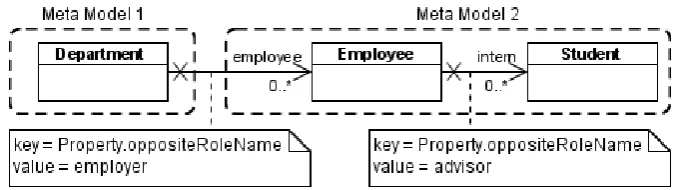
There are several alternatives to provide navigation across non-navigable references in Ecore. A straightforward approach is to only use bi-directional references in EMF models instead of uni-directional ones. Consequently, partitioning of EMF models would be restricted due to cyclic dependencies and the partition in two meta models as shown in Figure1would not be possible. This clearly violates requirement two, because it restricts how EMF models can be partitioned.
Another approach that avoids the dependency cycles a bi-directional reference creates, is to allow the opposite reference to be contained by the original reference. This circumvents the limitations of the aforementioned approach, but yields severals other problems. For example the validation of multiplicity or ordering constraints for the opposite reference becomes a very expensive operation, due to the fact that the list of referenced instances is not stored explicitly. Apart from that, the original architecture assumes that a reference is always contained by an element. Since this assumption does not hold anymore, existing technologies relying on it might be invalidated.
To circumvent those requirement violations, another alternative that avoids to change Ecore has been taken into account. It relies on annotations, which are added to uni-directional refer-ences in EMF models, as shown in Figure1. The example shows a simple situation with two
1http://www.eclipse.org/uml2/
ECEASST
Figure 1: An example that visualizes the problem of uni-directional references
meta models defining two concerns of a company. The annotations contain opposite role names of the references. This solution does not impact the usage of existing technologies, because it can be seamlessly integrated into existing EMF models. It also does not impact requirement three since these annotations can be automatically generated. To navigate across non-navigable references using these annotations, we extend the OCL meta model as well as the OCL tool-ing of EMF. Our extension of OCL does not invalidate requirement two because it is downward compatible.
3
Contribution
In this section, we explain how we exploit the annotation concept of Ecore and the extensions we have made to the OCL tooling in EMF.
3.1 Adding Annotations to EMF Models
Annotations in Ecore are defined by theEAnnotationelement, which can be added to any ele-ment. EAnnotationmay have a details entry, that mapskeytovalueattributes. In our approach, every uni-directional reference that should be navigated in its opposite direction, represented by anEReference element, is associated with anEAnnotationelement holding a details entry that has akeyattribute “Property.oppositeRoleName”. The valueattribute contains the name of the opposite role. EMF models that should benefit from bi-directional navigability can be modified manually or automatically.
3.2 Extending OCL
Our approach does not come without extending EMF’s OCL, but we are using thedotnotation for navigation across references to be compatible to legacy OCL constraints. Thus, there is no need to introduce an extra notation to make the missing navigability explicit. For example, the expression in Figure2refers to the annotated opposite role name of theEReferenceintern. This constraint expresses, that eachStudentmust have at least oneEmployeeas his advisor.
Figure 2: An example OCL expression using reverse navigation
3.2.1 Abstract Syntax of OCL
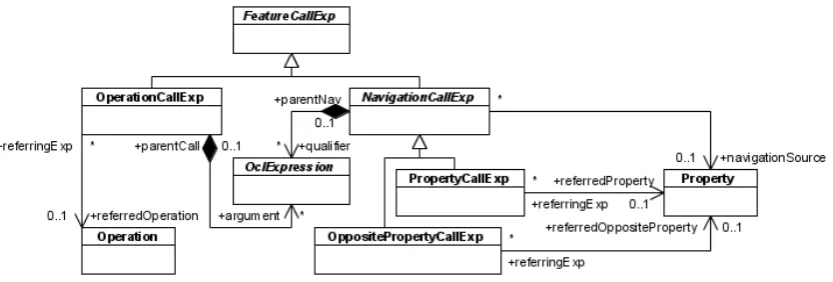
Although we did not change the concrete syntax of OCL, we have extended the abstract syntax of OCL to reflect the navigation across non-navigable references. Therefore, we extended the
NavigationCallExpwith anOppositePropertyCallExpas shown in Figure3. An OppositeProper-tyCallExpdescribes the navigation of a reference between two elements that are not explicitly connected via an EReference pointing from the source element to the target elements, which avoids cyclic dependencies if elements are defined in different meta models. Instead, this asso-ciation is built by an EReference from the target that defines the opposite navigation direction.
TheOppositePropertyCallExpinherits a navigation source property, which is the element from where the navigation is started. It is also related to a referred opposite property, which contains the opposite role name that is defined in theEAnnotationof anEReferencepointing to the navi-gation source element.
Figure 3: Extended OCL meta model
3.2.2 OCL Parser
OCL constraints are handled by means of their abstract syntax. Thus, OCL constraints defined in the concrete syntax have to be parsed into the abstract syntax first. The parsing of OCL constraints in EMF is performed by an OCL analyzer. We extended the parsing functionality to createOppositePropertyCallExpinstances when necessary.
ECEASST
encapsulated in theOppositeEndFinderto allow different implementations of it3. The example in Figure2contains an opposite property after the firstdot, sinceadvisoris the annotated opposite role name of theEReferenceintern. Hence, anOppositePropertyCallExpis created.
3.2.3 OCL Validator
After parsing the OCL expression into an abstract syntax, it needs to be validated. Through-out the whole OCL tooling of EMF, several visitors are used. To make these visitors aware of opposite properties, the commonVisitorinterface has been extended with a visitOppositeProper-tyCallExp()method and theAbstractVisitorhas been adapted to properly call this method when coming across anOppositePropertyCallExp. TheVisitorused to validate OCL expressions is the
ValidationVisitorand has been modified to implement this method to check if the correctness of theOppositePropertyCallExpis given.
3.2.4 OCL Evaluator
The OCL evaluator actually executes the evaluation of the parsed and validated OCL expres-sion. For this task, theEvaluationVisitor is used. It has also been modified to implement the
visitOppositePropertyCallExp()method and use a modified, opposite property aware version of theEvaluationEnvironmentto perform the navigation.
Navigating an OppositePropertyCallExpresults in the set of instances, that reference one of the expression’s source instances via anEReference that is annotated with the given opposite role name. Therefore, the evaluation of the expression in Figure2leads fromself to all instances ofEmployeethat reference that one instance ofStudent. Our approach uses EMF’s reflection mechanism for resolving the requires instances to avoid cyclic dependencies between meta mod-els. To find all instances pointing to anEObjectvia anEReference, EMF provides a utility called
ECrossReferenceAdapter. The cross-referencer iterates through the content tree rooted at the initially passedEObject,Resource, or ResourceSetand checks for each retrieved reference of all objects if it points to the wanted object or not. In case of a positive match, the object is added to the result [SBPM08, pp. 523].
Because the cross-referencer is a simple implementation, we may get scalability issues when dealing with large models. Thus, we have implemented a modular interface to integrate alter-native technologies for resolvingOppositePropertyCallExps, e.g, Model Query 2 (MQ2)4. MQ2 provides an efficient interpreter for resolving queries, which comes with an index structure. In this alternative, MQ2 queries are formulated and interpreted to return all objects referencing the source via anEReferencewith a specificEAnnotation.
4
Conclusions & Future Work
Throughout this paper, we presented a solution that overcomes a restriction of Ecore. This re-striction prohibits navigability through EMF models via OCL constraints, because uni-directional
3currently Model Query 2 is used to find the properly annotated references
annotations are used by an extension of EMF’s OCL that we have implemented.
As future work we plan to evaluate the scalability of our approach by using EMF’s cross-referencer, MQ2, and other indexing technologies like EMF Index5. Furthermore, multiplicities cannot be expressed via the annotations currently.
Bibliography
[AHK07] M. Altenhofen, T. Hettel, S. Kusterer. OCL Support in an Industrial Environment. InProc. of the Workshops and Symposia at MoDELS 2006, Genoa, Italy. LNCS, pp. 169–178. Springer, 2007.
[Ber10] P. Berger. Central Event Manager for the Eclipse Modeling Framework. 2010. http://www.hpi.uni-potsdam.de/giese/gforge/bibadmin/uploads/pdf/Ber10 Philipp Berger Bachelorarbeit.pdf.
[Han10] M. Hanysz. Instance-Based Context Calculation of OCL Expressions. 2010. http://www.hpi.uni-potsdam.de/giese/gforge/bibadmin/uploads/pdf/Han10 Martin Hanysz Bachelorarbeit.pdf.
[Hop10] T. Hoppe. Synthesis of Event Filter determining the reevalu-ation of affected OCL expressions. 2010. http://www.hpi.uni-potsdam.de/giese/gforge/bibadmin/uploads/pdf/Hop10 TobiasHoppe Bachelorarbeit .pdf.
[Obj04] Object Management Group. UML 2.0 Superstructure Specification. October 2004. Document: ptc/04-10-02 (convenience document).
[Obj06a] Object Management Group. Meta Object Facility. 2.0 edition, January 2006.
[Obj06b] Object Management Group. Object Constraint Language. 2.0 edition, May 2006.
[SBPM08] D. Steinberg, F. Budinsky, M. Paternostro, E. Merks.Eclipse Modeling Framework 2.0. Addison Wesley, 2 edition, December 2008.
[Sch10] T. Schr¨oter. Effiziente Navigation bei der OCL-Auswertung. 2010. http://www.hpi.uni-potsdam.de/giese/gforge/bibadmin/uploads/pdf/Schroeter10 Thea Schroeter Bachelorarbeit.pdf.