International Journal of Advances in Management and Economics
Available online at:
www.managementjournal.info
RESEARCH ARTICLE
Corruption and Covid-19’s Lethality: “So What?”
Arthur do Nascimento Ferreira Barros*, Lucas Libini Ramos dos Santos, Raul
Antonio de Lemos Bernardo, Louise de Oliveira Xavier, Anna Gabryella do
Carmo Trajano Cavalcanti
Federal University of Pernambuco, Brazil.
*Corresponding Author: Arthur do Nascimento Ferreira Barros
Abstract: We aim to verify if there is an association between the level of corruption and the lethality on countries due to COVID-19 pandemic. Previous studies provide evidence that corruption can harm health outcomes, especially in developing and under-developing countries where resources are already scarce. We apply a strictly quantitative approach using dispersion graphics analysis and Pearson’s correlation on 171 countries. On countries from America, Africa, Asia and Oceania we observed that as more corrupt the country, higher its lethality, although in Europe this association is inverted. We attribute this last result to the continent possess the elderly population among other continents, the fact that countries loosened to earlier measures of physical distancing and cases of corruption were reported in some countries with a low perception of corruption. Therefore, corruption remains an issue that needs more understanding so we can decrease its effects on health outcomes and save lives, particularly in countries with weak healthcare systems. Besides, the next pandemic is coming and we need to be prepared.
Keywords:Corruption, Healthcare system, Health outcomes, COVID-19, Lethality.
Article Received: 20 March 2020 Revised: 14 April 2020 Accepted: 22 April 2020
Introduction
The corona virus disease 2019 (COVID-19) pandemic began in Wuhan City, China, on late December 2019, and continues to spread globally [1-2]. At the time that we wrote this paper, the disease had appeared in 214 countries and territories with 3,145,407 confirmed cases and 221,823 deaths, according to the World Health Organization [3] (WHO). Those data are referent to April 30th and it’s important to notify that they diverge from other sources like the European Center for Disease Prevention and Control or the Johns Hopkins University. MacKey and Liang [4] warned that the next global pandemic wouldn’t be the only threat that the health systems would face, currently, it is fighting on two fronts: (1) one is the COVID-19, as we are seeing; and (2) the other is corruption [5].
The heath system constantly appears in corruption researches that shows considerable evidence that there are serious consequences to the patients [6]. Hutchinson, Balabanova and Mckee [6] and MacKey and Liang [4] state that corruption scandals have
afflicted health programs around the world, precisely numbers are deceptive but is estimated that billions of dollars are lost annually due to corruption and frauds in the health sector on global bases, something around 10% of world’s gross domestic product (GDP). Corruption has major impacts in people’s lives, especially in countries where it is generalized, the literature shows negative consequences from it in the health system as severely compromise the quality and coverage of services, causes price inflation that drags away low-income people and hinders treatment access that could save lives, furthermore, prevents an effective, equitable and responsible healthcare [4, 6-7].
assess emerging opportunities for corruption [8]. According to Factor and Kang [7], studies on corruption and health outcomes have widely been of a theoretical nature, therefore, exists a need for a deep investigation about theoretical bonds between corruption and health outcomes, especially on how the first could affect the second. Some studies explored relations among corruption and health outcomes; we can quote Gupta, Davoodi and Tiongson [9], Hanf et al. [10] and Holmberg and Rothstein [11].
They used as health outcomes mortality rates and found an association between the country’s corruption-level and child, infant and maternal mortality. That result could be used as empirical proof that corruption cost is higher than some believes and even ignore. According to Nemexis [5], a Berlin-based anti-fraud consulting firm, corruption is reducing the response capacity of healthcare systems during COVID-19 pandemic leading to deaths. Our purpose is to verify if there is an association between the level of corruption and the lethality on countries due to COVID-19 pandemic in order to give empirical support on the effects caused by corruption because of its nature that makes its consequences uncertain.
Also, we believe that once our findings have helped to achieve clarification on the issue, additional questions on the subject that need to be investigated will appear as its combat. As well as the COVID-19 disease (at this moment), more investigation on corruption is necessary, because, since once understood will lead us to its combat in the hope that lives could be saved.
Besides, COVID-19 pandemic is a unique event that can “evaluate” the consequences of a corrupt system in the midst of a crisis.
Materials and Methods
Prior literature indicates that countries with precarious health system due to high corruption-levels are more likely to have a greater COVID-19 lethality rate than those which have low corruption-levels. Therefore, we will test with there is an association.
Study Design and Data Collection
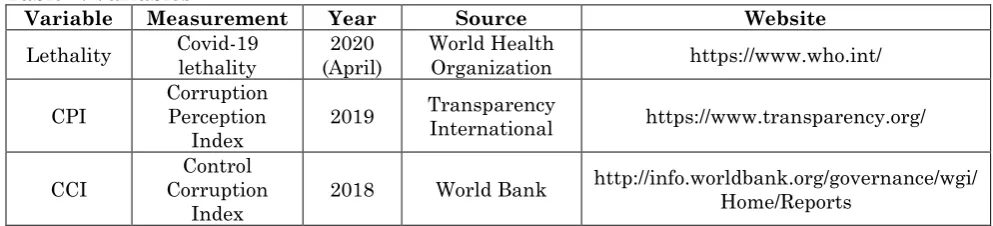
To measure corruption, we use as proxy the Corruption Perception Index ( ), taken from Transparency International [12], like in other studies [9, 11, 13-14]. The index is calculated since 1995 and in 2012 its methodology was revised to allow comparison of scores from one year to the next. draws on 13 surveys and expert assessments to measure public sector corruption in 180 countries and territories, giving each a score from zero (highly corrupt) to 100 (very clean). We see the utilization of one measure of corruption as a potential shortcoming for our results, thus, we also test using as corruption proxy the Corruption Control Index ( ).
Which reflects perceptions of the extent to which public power is exercised for private gain, including both petty and grand forms of corruption, as well as "capture" of the state by elites and private interests [15]. The index is measured by The World Bank and scores from -2.5 (weak governance) to 2.5 (strong governance).
Table 1: Normality tests
Variables Kolmogorov-Sminorv Shapiro-Wilk
Statistic df Sig. Statistic df Sig.
0.191 159 0.000 0.804 159 0.000 0.119 159 0.000 0.937 159 0.000 0.121 159 0.000 0.933 159 0.000
How the virus that causes COVID-19 (SARS-Co V 2) is new, its behaviour is yet uncertain [16], for that reason we prefer not add other variables in that might influence the number of deaths caused by it, even though early studies have indicated some characteristics that could increase its lethality [16-20]. Therefore, we decided to apply only
Table 2: Variables
Variable Measurement Year Source Website
Lethality Covid-19 lethality (April) 2020 World Health Organization https://www.who.int/
CPI Corruption Perception
Index 2019
Transparency
International https://www.transparency.org/
CCI Corruption Control
Index 2018 World Bank
http://info.worldbank.org/governance/wgi/ Home/Reports
Study Population
Our population composes the 180 countries and territories that are evaluated by Transparency International to measures the , for comparison, we take the same countries and territories that also have the . Next, we compared with the countries that are in WHO lists and obtained a sample of 171 countries and territories, almost 80.0%
of the countries that the disease has appeared. We split the sample into four groups, by continents, due the different time that the disease arrived in each one and the similar characteristics that the countries in each continent have. How we have only three countries from Oceania, we decided to join them in Asia due to proximity. Table 3 presents our sample.
Table 3: Sample
Continent(s) Countries and Territories
Asia 40
Oceania 3
Europe 44
America 32
Africa 52
Results and Discussion
The COVID-19 World’s lethality, at the time that we collect our data, according to WHO, is 7.05%. In our sample, the lethality’s mean is 4.0% with a standard deviation of 4.2%, table 4. Some countries in Africa, America,
Asia and Oceania presented 0.0% of lethality while Nicaragua, 28.57%, France, 18.93%, United Kingdom, 15.79%, and Belgium, 15.67%, faced a lethality higher than twice the World’s rate.
Table 4: Descriptive statistics
Continent Variable N Minimum Maximum Mean Standard-deviation
Asia and Oceania
Lethality 43 0.000 0.080 0.018 0.000 CPI 43 13.000 87.000 41.930 18.774 CCI 43 -1.640 2.170 -0.176 1.000
America
Lethality 32 0.000 0.286 0.055 0.055 CPI 32 16.000 77.000 43.375 16.380 CCI 32 -1.470 1.874 -0.042 0.859
Africa
Lethality 52 0.000 0.130 0.038 0.032 CPI 52 9.000 66.000 32.269 12.545 CCI 52 -1.800 0.770 -0.684 0.661
Europe
Lethality 44 0.010 0.190 0.051 0.045 CPI 44 28.000 87.000 57.659 18.339 CCI 44 -0.870 2.210 0.644 0.997
Sample
Europe has the highest corruption indexes, as expected, meaning that its countries, in general, are very “clean”. Africa holds the lowest corruption measures, if we observe the mean, indicating that countries in the continent are usually corrupt. However, the continent also presents one of the lowest lethality in our sample while Europe has the second-highest lethality (5.1%). Pilling [21], in an article for the Financial Times, express specialist’s opinions where some believe that aspects regarding the African continent: as younger population, warm weather or the prevalence of BCG vaccinations against tuberculosis; could be the reason for
explaining the low death rate. Yet, is still early to make conclusions, some forecast estimates a rise in deaths tolls in Africa and America [22]. Due to the SARS-CoV 2 rapid dissemination [1, 23-26], the factor time is an important variable to consider. NWhen we perform our analysis separately, among the groups that we have formed, with dispersion charts, the tendency lines on charts 1-6 shows evidence that could confirm our hypothesis. New Zealand, Singapore and Australia, the less corrupt countries in Asia and Oceania, have the lowest lethality, besides the countries that haven’t had fatalities until we collect the data.
Figure 1: Dispersion graphic Asia and Oceania ( )
Figure 2: Dispersion graphic Asia and Oceania
New Zealand, that is considered one of the less corrupt countries in the World, has been used as an example in COVID-19 combat. Cousins [27] states that the “elimination strategy”, how they have been called their measures against the pandemic, have reached that level of success due to implementation of a strict national lockdown, border closure and testing, of course, that geographic conditions allow a more effective response to the disease like the country’s size and the fact that it is formed by two islands. New Zealand and Australia started to discuss
by the Ministry of Health, the first lady and
the Vice President, exclude from the total of positive cases patients who died or recovered from the virus, causing misleading results.
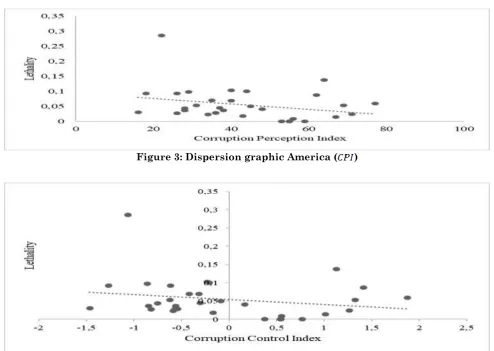
Figure 3: Dispersion graphic America ( )
Figure 4: Dispersion graphic America ( )
One of the characteristics of corrupt countries is the lack of transparency, another example in America is Brazil where President Bolsonaro has attempted in 2019 to extend the scope of classified information to reduce transparency and protect members of his cabinet and family [29-30].
Regarding Brazil, the country holds most deaths in America (6.9% lethality) and these
data are probably substantial
underestimates, besides, President Bolsonaro also flouts and discourage measures of physical distancing and lockdown [31] implemented by Governors and Mayors even though Brazil’s prediction for raise in the number of cases and deaths due to COVID-19 be dangerous [22, 31].
When asked about the deaths on the country by journalist Bolsonaro answered “So what? What do you want me to do?”. The lack of investments on health, among many reasons, due to corruption can cause insufficient test
capacity, delay on results and
underestimation on the number of cases like
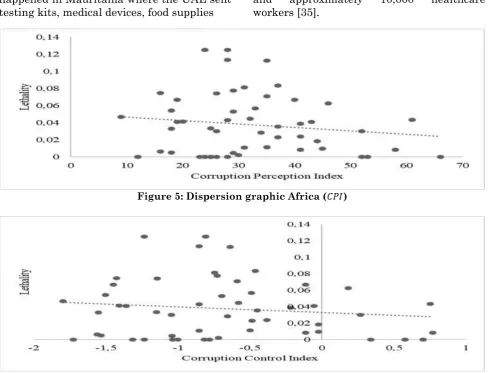
studies have been showing in many countries (by a factor of 10 or even more), putting the population in a possible greater need of mechanical ventilation and ICU care which imposes higher costs on the health system [32-33]. This deceptive data makes the disease combat ineffective because it does not allow that measures of physical distancing or lockdowns, and that increases the number of healthcare workers be applied where essential, causing health system’s collapse is. Even though Africa has the second lowest death rate, that is uncertain yet as mentioned previously, we also observe a tendency that corrupt countries present higher lethality than less corrupt ones (charts 5 and 6).
happened in Mauritania where the UAE sent
testing kits, medical devices, food supplies and workers [35]. approximately 10,000 healthcare
Figure 5: Dispersion graphic Africa ( )
Figure 6: Dispersion graphic Africa ( )
Another problem is the financial crisis that involves the continent, low resources governments cannot handle long-terms measures of physical distancing and lockdown because they cannot afford so much time with most of the economic activities halted. For instance, Algeria has eased restrictions allowing several businesses to reopen [36-37]. That issue is related with income inequality, especially among corrupt countries as some studies have demonstrated [38-39], which hurts the poor more than the rich in African countries [40] that do not
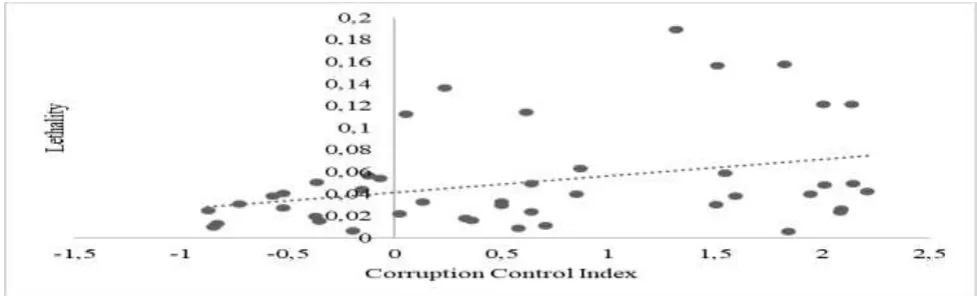
stand been deprived of their work for long periods due to their low income. Different from the results that we have seen so far, in the European continent as less corrupt the country as higher its lethality (charts 7 and8). That is evidenced in countries like
Sweden ( = 12.13%; = 85; =
2.14); Netherlands ( = 12.14%; = 82; = 2.01), United Kingdom (
= 15.79%; = 77; = 1.83) and Belgium ( = 15.67%; = 75; = 1.51). That could be explained for some factors that we will discuss next.
Figure 8: Dispersion graphic Europe ( )
The first one we attribute to the age structure, according to the Europe Union [41] in 2018 19.0% of its population was 65 years or more and almost a third (32.8%) was 55 years or more, that becomes important to observe when some studies have indicated that people in advanced age are more at risk when they are diagnosed with COVID-19 [16, 18-20, 42].
At the time that we collected our sample Italy, United Kingdom, Spain and France had each between 24.000 and 28.000 deaths from the novel corona virus. The second one regards the physical, or social, distancing, which is recommended to combat the SARS-Co V 2 [43-44], however, Sweden loosened physical distancing reopening schools, restaurants and most businesses [45]; The Netherlands had first adopted a policy to
strive for “herd immunity” against COVID-19 [46]; The United Kingdom reopened parks to soon after public pressure [47]; and Belgium on its first shutdown measures allowed physical activities, go outside with family, friends, etc. [48], though, Belgium was counting untested fatalities as COVID-19’s deaths [49].
Looking at the charts, specifically to the tendency line, we observe an association between corruption level and lethality. However, this association is low in light of the β and R-squared (R²) analysis. As we had seen, table 5 shows that Asia, Oceania, America and Africa presented a negative β, meaning that as more corrupt a country higher its lethality; while Europe had a positive one, representing that less corrupt countries have higher lethality.
Table 5: Dispersion analysis
Continent Corruption Perception Index Corruption Control Index
β R-squared (R²) β R-squared (R²) Asia and Oceania -0.0003 0.0546 -0.0047 0.0481
America -0.0009 0.0749 -0.0138 0.0462 Africa -0.0004 0.0208 -0.0068 0.0163 Europe 0.0008 0.1149 0.0152 0.1103
In both proxies to country-level corruption, Europe has the highest corruption explanatory power to COVID-19’s death toll. Besides the reasons that we have presented so far. The United Kingdom, Italy and Sweden adopted the vertical social distancing as a measure to combat the COVID-19 disease [50].
Vertical social distancing consists of isolate only risk groups; however, this kind of social distancing is not effective since even with the restricted circulation of these risk groups, they may still have contact with people that are exposed to the virus [51]. Duczmal et al.
Table 6: Pearson’s correlation
Continent Variable
Asia and Oceania
1.000 -0.234 -0.220 -0.234 1.000 0.993** -0.220 0.993** 1.000
America
1.000 -0.274 -0.215 -0.274 1.000 0.983** -0.215 0.983** 1.000
Africa
1.000 -0.144 -0.128 -0.144 1.000 0.981** -0.128 0.981** 1.000
Europe
1.000 0.339* 0.332* 0.339* 1.000 0.993** 0.332* 0.993** 1.000
*. Significant correlation at the 0.05 level (2 extremities). **. Significant correlation at the 0.01 level (2 extremities).
In spite of that, when Nemexis [5] findings are looked closely we observe that deaths are consequence of corruption in European countries as France ( = 18.93%; = 69; = 1.32), United Kingdom, Belgium, Italy ( = 13.59%; = 53; =
0.24) and Germany ( = 3.95%; =
80; = 1.95).
Issues of stealing, purchase or sale at the unusually high price of personal protective equipment (PPE) and ventilators; the existence of black market and faulty equipment; and embezzlement of health care funds were reported among those countries, some with high corruption-level scores as we saw. Lastly, both corruption proxies are very correlated, that was expected since they are a public perception of corruption [14, 53].
Conclusion
Our purpose was to verify if there is an association between the level of corruption and the lethality on countries due to COVID-19 pandemic to give empirical support on the effects caused by corruption because of its nature that makes its consequences uncertain. In countries of Asia, America, Africa and Oceania more corrupt countries presented higher COVID-19 lethality as we expected, but with a low association when we observe the correlation and β analysis.
Corruption can result in less investment in health, harming both private and, especially, public healthcare systems, and the consequences are seen in the death toll during a health crisis as we are living. However, in Europe, we did not see the same.
Actually, as less corrupt the country higher the lethality.
We attributed those results to factors as the elderly population in the continent, weak physical/social distancing measures and corruption problems that those countries reported on their health systems during the pandemic. Proving that no country is free from this issue. Facing both corruption and a pandemic have one similar thing: responses must be swift and decisive. Improving governance in healthcare systems can be the first step, reforms to detect and eliminate corruption that impacts health must be coordinated to ensure that those systems are protected and that global health interventions reach their potential.
The consequences are seen from a corruption point to a lack of a specific international framework to deal with the subject. Healthcare systems and programs could be projected to realign incentives, detect and respond to corruption cases. Anticorruption must be incorporated to plans and strategies in the healthcare system, however, the main goal must not be eliminating all the corruption, what seems impossible, but minimize its practices that harm the healthcare system.
and lethality, specifically regarding COVID-19. Statically, those founds did not contribute as we were expecting to the theoretical background, they indicate association in both ways, either positive and negatively. Our main conclusion is that corruption is an issue that needs to be further explored, future research must improve the understanding of mechanisms underlying corruption and develop and evaluate interventions that will reduce countries’ corruption-level and improve health outcomes.
We also suggest seeking other metrics to measure it or propose a new one. One of the ways to improve the healthcare system for the next pandemic is to decrease corruption. Limitations on this work lie first on the matter that our studied event is still ongoing, therefore lethality can change and also the results. Second, we use lethality to compare COVID-19 consequences among countries but other measures could, and must, be used in future researches as deaths per million inhabitants once underreporting is a problem. We were only able to perform nonparametric tests; an improvement on the matter could light on the problem.
The SARS-Co V 2 is been studied yet, in almost daily-bases researches come up with new information on the virus, so other variables besides corruption and some discussed previously can influence the death rate of the new virus. The corruption indexes are subjective, thus, no matter how higher the perception that a country is corruption-free is, corruption will exist.
References
1. JM Read, JRE Bridgen, DAT Cummings, A Ho, CP Jewell (2020) Novel coronavirus 2019-nCoV: early estimation of epidemiological parameters and epidemic predictions,
MedRxiv, 1-11,
https://doi.org/10.1101/2020.01.23.20018549. 2. R.Tuite, II Bogoch, R Sherbo, A Watts, D
Fisman, K Khan (2020) Estimation of Coronavirus Disease 2019 (COVID-19) Burden and Potential for International Dissemination of Infection From Iran, MedRxiv, https://annals.org/aim/fullarticle/2763328/esti mation-coronavirus-disease-2019-covid-19-burden-potential-international-dissemination. 3. World Health Organization (2020) Corona
virus (COVID-19). Available at https://covid19.who.int/ (accessed 30 April 2020).
4. TK MacKey, BA Liang (2012) Combating healthcare corruption and fraud with improved global health governance, BMC International Health and Human Rights 12(1):1-7.
5. Nemexis (2020) FRAUD’S IMPACT ON HEALTHCARE DURING COVID-19. Berlim. Available at: https://nemexis.de/wp- content/uploads/2020/05/NMXS-Survey-Covid-19.pdf (accessed 30 April 2020).
6. E Hutchinson, D Balabanova, M McKee, M We (2019) need to talk about corruption in health systems, International Journal of Health Policy and Management 8(4):191-194.
7. R Factor, M Kang (2015) Corruption and population health outcomes: an analysis of data from 133 countries using structural equation modeling, International Journal of Public Health, 60(6):633-641.
8. LC Rispel, P Jager, S Fonn (2016) Exploring corruption in the South African health sector, Health Policy and Planning, 31(2):239-249. 9. S Gupta, H Davoodi, E Tiongson (2001)
Corruption and the provision of health care and education services, International Monetary Fund, Working Paper.
10. M Hanf, A Van-Melle, F Fraisse, A Roger, B Carme, M Nacher (2011) Corruption kills: Estimating the global impact of corruption on children deaths, PLoS ONE, 6(11):1-7.
11. S Holmberg, B Rothstein (2011) Dying of corruption, Health economics, policy, and law, 6(4): 529-547.
12. Transparency International (2020) Corruption Perceptions Index 2019. Available at: https://www.transparency.org/ (accessed 30 February 2020).
13. N Ambraseys, R Bilham (2011) Corruption kills. Nature, 469(7329):153-155.
14. M Escaleras, N Anbarci, CA Register (2007) Public sector corruption and major earthquakes: A potentially deadly interaction, Public Choice, 132(1-2):209-230.
15. D Kaufmann, A Kraay, M Mastruzzi (2010) The worldwide Governance Indicators: Methodology and Analytical Issues, World Bank Policy Research Working Paper, Available at: http://ow.ly/JaiU50qDu1Z (accessed 30 February 2020).
16. AL Giwa, A Desai, A Duca, Novel (2020) coronavirus SARS-CoV-2 (COVID-19): An updated overview for emergency clinicians, Emergency medicine practice 22(5):1-28.
https://www.medrxiv.org/content/10.1101/2020. 03.07.20031393v2 (accessed 28 May 2020). 18. A Hauser MJ, Counotte CC, Margossian G,
Konstantinoudis N, Low CL Althaus, J Riou (2020) Estimation of SARS-CoV-2 mortality during the early stages of an epidemic: a modelling study in Hubei, China and northern Italy. MedRxiv, Available at: http://medrxiv.org/content/early/2020/03/30/202 0.03.04.20031104.abstract (accessed 28 May 2020).
19. C Leung (2020) Risk factors for predicting mortality in elderly patients wit COVID-19: a review of clinical data in China, Mechanisms of Ageing and Development, 2020, Available at: https://doi.org/10.1016/j.mad.2020.111255. 20. TMV Strabelli, DE Uip (2020) COVID-19 and
the Heart, Arquivos brasileiros de cardiologia, 114(4):598-600.
21. D Pilling (2020) Low Covid-19 death toll raises hopes Africa may be spared worst, Financial Times, Available at https://www.ft.com/content/e9cf5ed0-a590-4bd6-8c00-b41d0c4ae6e0 (accessed 08 May 2020). 22. S Bhatia et al (2020) Short-term forecast of
COVID-19 deaths in multiple countries, Available at https://mrc-ide.github.io/covid19-short-term-forecasts/index.html#authors (accessed 08 May 2020).
23. Z Cao, Q Zhang, X Lu, D Pfeiffer, Z Jia, H Song, DD Zeng (2020) Estimating the effective reproduction number of the 2019-nCoV in China, MedRxiv, Available at: http://medrxiv.org/content/early/2020/01/29/202 0.01.27.20018952.abstract (accessed 08 May 2020).
24. R Li, S Pei, B Chen, Y Song, T.Zhang, W Yang, J Shaman (2020) Substantial undocumented infection facilitates the rapid dissemination of novel coronavirus (SARS-CoV2), Science, 368(6490):489-498.
25. T Liu et al (2019) Time-varying transmission dynamics of Novel Coronavirus Pneumonia in China. bioRxiv, Available at https://www.biorxiv.org/content/10.1101/2020.01 .25.919787v2.full (accessed 20 February 2019). 26. A Pan et al (2020) Association of Public Health
Interventions with the Epidemiology of the COVID-19 Outbreak in Wuhan, China, JAMA - Journal of the American Medical Association, 2115:1-9.
27. S Cousins (2020) New Zealand eliminates COVID-19: An aggressive approach has enabled New Zealand to end community transmission of SARS-CoV-2, The Lancet, Available at: http://dx.doi.org/10.1016/S0140-6736(20)31097-7 (accessed 15 May 2020).
28. WM Aburto (2020) Nicaragua has unusually low numbers of OCVID-19 cases: Government presents statistics excluding deceased, recovered cases, while not conducting massive testing, Anadolu Agency, Available at https://www.aa.com.tr/en/americas/nicaragua- has-unusually-low-number-of-covid-19-cases/1813537 (accessed 09 May 2020).
29. I Brusca RF, Manes, N Aversano (2018) Accountability and Transparency to Fight against Corruption: An International Comparative Analysis, Journal of Comparative Policy Analysis: Research and Practice, 20(5):486-504.
30. C Pring, J Vrush (2020) Latin America & the Caribbean 2019: Citizens ’ Views and Experiences of Corruption, Transparency International, Available at: https://www.transparency.org/files/content/pag es/2019_GCB_LatinAmerica_Caribbean_Full_ Report.pdf (accessed 09 May 2020).
31. The Lancet (2020) COVID-19 in Brazil: “So what?”, The Lancet, 395(10235):1461.
32. S Goli, KS James (2020) How much of SARS-CoV-2 Infections is India detecting? A model-based estimation. MedRxiv, 1-6.
33. P Richterich P Severe (2020) underestimation of COVID-19 case numbers: effect of epidemic growth rate and test restrictions, MedRxiv, 1-13.
34. J Cassim (2020) Zimbabwe: Malaria death toll rises amid COVID-19. Anadolu Agency,
Available at
https://www.aa.com.tr/en/africa/zimbabwe- malaria-death-toll-rises-amid-covid-19-/1813565 (accessed 09 May 2020).
35. Africanews (2020) Corona virus- Mauritania: UAE Sends Medical Aid to Mauritania in Fight against COVID-19. Available at https://www.africanews.com/2020/04/20/corona virus-mauritania-uae-sends-medical-aid-to-mauritania-in-fight-against-covid-19/ (accessed 09 May 2020).
36. BBC (2020) Algeria lifts lockdown on corona virus epicentre, Available at Retrieved from https://www.bbc.com/news/topics/cp7r8vglgyet/ algeria (accessed 09 May 2020).
37. France 24 (2020) Algeria allows more businesses to-reopen amid fears of Covid-19 endangering economy, Available at
https://www.france24.com/en/20200426- algeria-coronavirus-covid-19-lockdown-restrictions (accessed 09 May 2020).
39. AH Samadi, B Farahmandpour (2013) The Effect of Income Inequality on Corruption in Selected Countries ( 1995-2007 ), Journal of Emerging Issues in Economics, Finance and Banking, 1(3): 214-231.
40. K Gyimah-Brempong (2002) Corruption, economic growth, and income inequality in Africa, Economics of Governance, (3):183-209. 41. E Union (2019) Ageing Europe: Looking at the
levels of older people in the EU. European Union (Belgium: Imprimerie Bietlot, 2019). 42. T Abel, D McQueen (2020) The COVID-19
pandemic calls for spatial distancing and social closeness: not for social distancing! International Journal of Public Health, 7, 2020, 1366.
43. E. MahasE, Covid-19: UK starts social distancing after new model points to 260 000 potential deaths, BMJ (Clinical research ed.), 368(March):1089.
44. Keyton , V Gera (2020) Sweden broke norms with “low-scale” lockdown. Is it working? The Christian Science Monitor, 2020. Available at https://www.csmonitor.com/World/Europe/202 0/0413/Sweden-broke-norms-with-low-scale-lockdown.-Is-it-working (accessed 09 May 2020).
45. J Pieters (2020) Temporary lockdown a possibility, not yet necessary, Dutch PM says about COVID-19, Available at https://nltimes.nl/2020/03/18/temporary-lock- possibility-yet-necessary-dutch-pm-says-covid-19 (accessed 09 May 2020).
46. M Busby, N Parveen (2020) Police urges people to maintain physical distancing in UK parks, The Guardian, Available at https://www.theguardian.com/world/2020/apr/1
1/police-urge-people-to-maintain-physical-distance-in-uk-parks (accessed 09 May 2020). 47. Chini (2020) how is the police handling
Belgium’s shutdown measures? The Brussels Times,. Available at
https://www.brusselstimes.com/all- news/belgium-all-news/101201/how-is-the-police-handling-belgiums-shutdown-measures/ (accessed 09 May 2020).
48. L Cendrowicz (2020) Why Belgium has the highest corona virus death rate in the world, The Independent, Available at https://www.independent.co.uk/news/world/eur ope/coronavirus-belgium-death-toll-lockdown-trump-who-uk-spain-italy-a9494186.html (accessed 09 May 2020).
49. GL Werneck, MS. Carvalho (2020) A pandemia de COVID-19 no Brasil: crônica de uma crise sanitária anunciada. Cadernos de Saúde Pública, 36(5):e00068820.
50. AZ Schuchmann, BL Schnorrenberger, M E Chiquetti, RS Gaiki, BW Raimann, M A Maeyama (2020) Correlação entre o aumento da incidência de sarampo e a diminuição da cobertura vacinal dos últimos 10 anos no Brasil. Brazilian Journal of Health Review, 3(1):406-415.
51. LH Duczmal, ACL Almeida, DB. Duczmal, CRL Alves, FCO Magalhães, MS Lima, IR Silva, RHC Takahashi (2020) Vertical social distancing policy is ineffective to contain the COVID-19 pandemic, Cadernos de Saúde Pública, 36(5):e00084420.
52. Anbarci M, Escaleras, R Charles (2006) Traffic Fatalities and Public Sector Corruption, KYKLOS, 59(3):327-344.