Research Article
July
2017
Computer Science and Software Engineering
ISSN: 2277-128X (Volume-7, Issue-7)
Modification of an Uninterruptible Power Supply (UPS) for
an Extended Running Time
1
Ogunrinde M. A, 2Adewole S. M., 3Abdulsalami B. A.
1, 3
Department Maths& Computer Sciences, Fountain University, Osogbo, Osun State, Nigeria
2
Works and Maintenance Services Unit Redeemers University, Ede, Osun State, Nigeria
DOI: 10.23956/ijarcsse/V7I7/01703
Abstract: Uninterruptible Power Supply (UPS) is increasingly becoming popular as a means of providing conditioned and uninterrupted power supply to sensitive and non-sensitive loads at critical and non-critical times.Sensitive modern equipment with very low tolerance for power fluctuation and failures are on the increase due to advancement in science and technology, theseequipment however require power backed up if they are to perform optimally. This study focuses on modification of the UPS in order to extend its running time.A used and dumped UPS working at a back-up time of between 0 to 10mins was modified to accommodate two, 75AH Lead acid batteries, using 1400VA Zinox UPS. An extended backup time of between 2hrs to 8hrs on the same UPS using Lead Acid/Deep Cycle batteries was achieved which at the same time operating within a very low budget.
Keywords: Uninterruptible Power Supply (UPS), Extended Running Time, Back-up Time.
I. INTRODUCTION
Inventions and development of modern equipment as a result of technological advancements has been on the increase in recent years, a great number of these equipment are electrical power dependent. Some of these equipment find their applications in areas such as, Telecommunication, Information Technology, media and other critical area of application where failure could result in grave consequences[4].
In a country with irregular power supply like ours, it becomes necessary to provide a means of sustaining the system in the event of power failure. This could be for a period of time long enough for the generator to come up or for the supply from the public utility to be restored. Uninterruptible power supply (UPS) system provides a mean of sustaining the power requirement to critical loads when power fails. An uninterruptible power supply (UPS) system is an electrical device that maintains the power supply to a road when the power supplied to the load fails [7].
An ideal UPS system should be able to deliver clean uninterrupted power while, simultaneously providing the required power conditioning for the particular application.In order to supply continuous power to the load in the absence of power from the public utility, energy storage systems such as batteries areincorporated in UPS systems. An example is the World largest, 46 Megawatt UPS in Alaska. The battery bank which is acclaimed to be bigger than a football pitch, was designed to provide emergency power to Fairbanks in Alaska whenever power supply fails.The battery bank is stored in a warehouse near the city, where temperature could plunge to as low as -51 degrees Centigrade in winter, it is expected to provide 40 megawatts of power estimated to be sufficient for around 12,000 people forup to seven minutes.The seven minutes is the estimated time, required to start up diesel generators to restore power. This is an important safeguard because at such low temperatures, water pipes can freeze entirely in two hours.With no power lines between the state and the rest of America, Alaska is often described as an "electrical island" [4].
In providing for an alternative means of sustaining a particular system there are few options that could be explored one of which is installing a UPS with a massive battery bank like the one described above, but this is capital intensive. This study was born out of the desire to make something out of an old UPS that was no longer providing a reasonable back-up time. Initially the idea was to replace the batteries on the UPS with similar type, but the desire for an extended back-up time beyond that which the UPS is capable of by design propelled me into using lead acid batteries. This was intended to make the UPS function more like a power generator but without the associated noise. For this kind of application deep cycle batteries will be more suited however because I was operating a very low budget I opted for the regular lead acid battery.
II. ABRIEFHISTORYOFNIGERIAPOWERGENERATION
ISSN(E): 2277-128X, ISSN(P): 2277-6451, DOI: 10.23956/ijarcsse/V7I7/01703, pp. 74-79 However, the power sector is one that requires active participation and investment by the key players but for over twenty years the power sector did not witness substantial investment in infrastructural development. During the period, new plants were not constructed and the existing ones were not properly maintained, it was no surprise when in 2001, power generation went down from the installed capacity of about 5,600MW to an average of about 1,750MW, as compared to a load and of 6,000MW. Also, out of the seventy-nine installed generating units only nineteen units were functional. Considering the capacity deficiency in the Nigerian Electric Power Sector, caused primarily by improper Government funding over the preceding decades, it is apparent that the private sector will play a major role if there will be improvements in the power sector. Even the Federal Government acknowledge the need for private sector intervention this is evidenced by the following statement in the Roadmap for Power Sector Reform of 2010. “To meet our Vision 20:2020 target of 40,000MW will require investments in power generating capacity alone of at least US$3.5 billion per annum for the next 10 years. Correspondingly large investments will also have to be made in other parts of the supply chain (i.e. the fuel-to-power infrastructure and power transmission and distribution networks). These sums cannot and will not be funded and directed by the Federal Government. Rather, central to the development of the sector will be the need to incentivise the private sector to partner with government” (Roadmap, 2010).
Vision 2020 is one that a good number of private organizations desire to drive, since their operations practically depend on electric power, however, trust is a major concern. The involvement of the organizations in revamping the power sector requires funding, which will be handled by the regulatory body and not the organizations that made the funds available and with corruption, which has grown to be a national issue, most organisation will rather investment in a mini power plant or generator to meet their power need. This explains why every organization including individuals are trying to solve their power problems individually.
The implication of each organization trying to solve its power problem is the increase in cost of doing business in the country. The federal Government in an attempt to attract foreign investors into the country, realised that, except the problems bedevilling the power sector is addressed no foreign investor will be interested in coming into the country. Hence, the federal government came up with a reform for the power sector the objectives of which is to:
“To reduce the cost of doing business in Nigeria so as to attract investors through the provision of quality and dependable power supply, to improve the efficiency of the distribution, generation and transmission network which is in a comatose state, and to provide our people with basic and affordable infrastructure to enable them create employment for themselves”[3]. In November 2005, while implementing the reforms ,18 Companies comprising of 6 generation companies, 1 transmission company and 11 distribution companies were incorporated; On 1st July 2006, the assets, liabilities and staff of PHCN were transferred to the successor companies, thereby granting the latter greater operational autonomy.
However even, after the reforms Power generation and distribution remains a challenge as most cities, towns, and villages are in darkness despite the privatization of the power sector. The highest power generation so far recorded, was 5074.7 Megawatts (MW), and it was recorded on February 2, 2016, unfortunately, the power generation level has
continued to drop to the extent that the National Grid collapsed at different times in
May, June, July, September, October, November and December,2016 (Vanguard,2017). The power supply from the national grid is alternating in nature, by this we mean that it flows in the positive direction for half of the electrical signal cycle, while for the other half, it flows in the opposite direction.
Fig.1 Alternating Current signal
Direct Current (D.C) batteries are a major component of UPS since they provide a means for storing electrical energy in D.C form, but because most equipment, devices or appliances run on Alternating Current (A.C) supply, it becomes necessary to convert the energy stored up in D.C battery from D.C to A.C.
Power failure is almost always unplanned and when they do occur systems shut down improperly, a result of which could lead to data loss. In a single moment, an entire day’s work could be lost. Also it could result to wear and tear on the hardware, which is a primary cause of most computer failures all of these are avoidable. An average UPS in the range 650AV to 1400VA usually give a backup time of between 0 to 15mins when the battery are fully charged and loaded within appropriate range. However in today’s world, there is an increasing demand for a continuous, quality power supply for businesses, data storage and processing, communications etc all of which require a backup time beyond which a regular UPS can provide [14].
ISSN(E): 2277-128X, ISSN(P): 2277-6451, DOI: 10.23956/ijarcsse/V7I7/01703, pp. 74-79 This study attempt to demonstrate how we can achieve an extended back up time from between 0 to 10mins provided by a 1400VA Zinox UPS, to between 2 to 8hrs on the same UPS using Lead acid/Deep Cycle batteries while at the same time operating within a very low budget.An existing UPS is to be modified to accommodate two, 75AH Lead acid batteries, using 1400VA UPS as a case study. The number of batteries used for the purpose of this study is limited to two 75-100AH batteries for 1400VA, 24V UPS. Deep cycle batteries are more suited for this operation however for this study two number lead acid are used. One 75AH battery may be considered for a 650VA, 12V rated UPS.
This is important to keep the charging time for the battery or batteries within reasonable limit. Putting too many batteries will make the charging period unreasonably long and there could be excessive heating of the device. If the battery size must be increased beyond the recommended number, it is advisable to adapt a suitable battery charger with charging current within required limits;alternatively, the charging circuit in the UPS can be enhanced however this second option requires some electronics engineering skills hence it is recommended for people with the appropriate skills. UPS are generally intended for application where the power demand is low hence, the modified UPS must not be used for Air conditioners, Electric Iron, Boilers or any device with power rating above 450W
Over the years, UPS has found its application in some areas that are vitally important to human living. Some of its major applications are in areas where power failure is not desirable. These include; Air traffic control system, Life sustaining medical equipment, Data processing applications. It may also be used for small scale capital investment with low power demands for its basic operations. e.g. Barbing Salon, Business centres, Vending server or Personal computer in which constant power is desirable, but in which the procurement and the maintenance cost of running a generating set is uneconomical.
Application for which the modified UPS may be considered includes domestic applications likeTelevision, Ceiling fans, Sound systems, Blender etc., provided the load demands from the devices are well within the safe operating range limits of the UPS. This is far more economical than running a generator.
III. LITERATUREREVIEW
The rapid growth in the demand for Uninterruptible Power Supply (UPS), according to Uwe Schmidt,1995is traceable to an increasing use of electronics equipment that requires a great deal of integrity of the power supply made available at their inputs, and also to reduce the damaging effect of power failures in data processing application.UPS system provides clean conditioned and uninterruptible power to sensitive loads such as Airlines computers, Data centres, Communication systems, and Medical support systems in hospitals etc[7].The rapid growth in the demand for UPS systems has been due to two main causes. Firstly, the increased use of electronic equipment that requires integrity of power supply to their input, to protect itself from damaging parts within the equipment and corruption of data, which can also occur, due to total failure of power supply. Secondly, in order for UPS to make power available at its output when power supply from the public utility fails, it employs some form of bulk energy-storage mechanism [10].
A good number UPS employs Lead acid batteries, for bulk energy-storage. Other types may employ the mechanical inertia of a large flywheel coupled to the shaft of a rotating machine or the stored magnetic energy in the field of a super-conducting coil. Generally, commonly used type of battery for bulk energy storage is the maintenance free gel batteries. The main reason for this is their portability and low maintenance requirements [10].
Essentially, UPS are classified either as Static UPS and Rotary UPS system. The static UPS system uses power electronics devices to process, store, and make power available in the event of power failure, while Rotary UPS uses motors and generators to perform the same function. The static UPS system is the commonly used UPS system and it is sub divided into: On-line, Off-line, and Line-interactive configurations. An ideal UPS should be able to deliver uninterrupted power while simultaneously providing the necessary power conditioning for the particular application; hence, interactive type of UPS is referred to as true UPS. Cost is however the major disadvantage of the online-interactive UPS [1].
According to [11], the selection of the class of UPS, should be based on the sensitivity of application for which the UPS system is intended to back up. For an application that permits a momentary lapse of between 20ms to100ms, an Offline UPS system will be most economical particularly where fund is a constraint. For desktop computers, the momentary lapse could range between 20ms -100ms, this makes offline UPS suitable for normal desktop computers as this range is well within their tolerance range. Critical applications will however require the online double conversion to realise the improved and stabilization of the load voltage which is a major benefit derived from UPS.
IV.COMPONENTOFUPS
ISSN(E): 2277-128X, ISSN(P): 2277-6451, DOI: 10.23956/ijarcsse/V7I7/01703, pp. 74-79
V. TYPESOFBATTERIES
Basically, there are three main types of batteries that are commonly used in renewable energy systems and other applications, each these has its advantages and disadvantages. Flooded or wet batteries are the most cost efficient and the most widely used batteries for alternative applications. They require regular maintenance and need to be used in a vented location, and are extremely well suited for renewable energy applications. Sealed batteries come in two forms, the gel cell and Absorbed Glass Mat (AGM) type. The gel cell uses a silica additive in its electrolyte solution that causes it to stiffen or gel, this eliminates some of the problems associated with venting and spillage [15].
VI. MODIFICATIONONTHEZINOX1400VA,24VZINOXUPS.
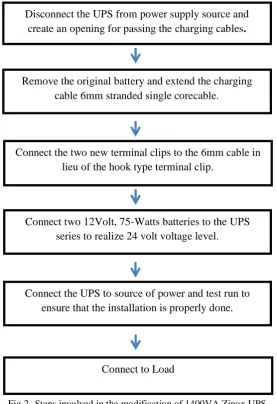
The 1400VA Zinox UPS is designed to deliver a maximum output of 840W for about 4minutes it operates at a D.C voltage level of 24V hence it comes with two 23AH,12Volt batteries which are enclosed within the UPS. The step involved in the modification of the UPS is as itemised below
Fig 2- Steps involved in the modification of 1400VA Zinox UPS
VII. THERESULTACHIEVED
The 1400VA Zinox UPS is designed to give out 540 watts output for about 10mins but that particular unit did not actually last up 10 minutes even with a connected load of about 300 watts. However, it lasted just about 3mins. Theresult achieved, which comprises of the load and the output after the modification is shown in Table 1 below.
TableIExtended running time achieved after modification of the 1400VA Zinox UPS
S/N Load Description Wattage Duration of use
1 21-inch Television set 85 6hrs
2 Ceiling fan -A 100 4hrs
3 Ceiling Fan -B 100 6hrs
4 Blender 350 5min
5 Laptop 100 5hrs
Total 735W
Connect two 12Volt, 75-Watts batteries to the UPS series to realize 24 volt voltage level.
Connect to Load
Connect the two new terminal clips to the 6mm cable in lieu of the hook type terminal clip.
Remove the original battery and extend the charging cable 6mm stranded single corecable.
Connect the UPS to source of power and test run to ensure that the installation is properly done. Disconnect the UPS from power supply source and
ISSN(E): 2277-128X, ISSN(P): 2277-6451, DOI: 10.23956/ijarcsse/V7I7/01703, pp. 74-79 Before the modification of the Zinox UPS the back time for even a load 100W is less than 30mins. But from the table we can see that by replacing the 2nos 23w, batteries that came with the UPS with 2nos 100AH batteries, we can achieved an extended running time using the same UPS.
As shown above this modified UPS can be used not just as backups for computer but it can be used for any load provided the load demand is within the output range of the UPS as you can see the 1400VA UPS was modified basically for home use. It is worth mentioning that a readymade UPS that could deliver the above load for 8-15hrs will cost about Six Hundred Thousand (N600, 000) but with about seventy Thousand (N50, 000) it is possible to achieved approximately the same result using an existing UPS
VIII. RECOMMNDATION
1. Most UPS are design for short running time excessive heat build-up could destroy a UPS; hence it is important that our choice of UPS for modification should be a unit that has an inbuilt cooling fan or be prepared to adapt one. It is good idea to set a power profile that uses very little electricity, therefore generating less heat in the UPS.
2. As much as it is desirable to achieve a long running time from an existing UPS via modification, the batteries should not be more than two 75AH or 100AH.This is necessary to keep the period for which the charging unit will be engaged for as low as possible thus reducing the risks associated with overheating.
3. Some UPS units operate on 12volt voltage while some operate at 24volts voltage. The correct voltage for the unit to be modified should be checked this cannot be changed; it is the voltage level on which the UPS must operate.
4. The batteries must not be placed on bare flood it is a good practice to insert an insulating material between the batteries and the ground alternatively a shelf or rack can be constructed.
5 Considerable time should be given to allow the charging unit to fully charge-up the batteries after which you can start using the UPS.
6. Some UPS units create a modified sine wave other units create a true sine wave. There is another set of UPS that delivers square wave output. A sine wave generates the least heat while a square wave will generate substantially more heat. So a unit that that delivers a true sine wave is most desirable.
7. The modification process involves electric current flow, voltages, and sometimes electrolyte and gasses which may cause injury if mishandled. So, handle properly and pay careful attention while effecting the modification.
IX. CONCLUSION
An existing UPS can be modified to realise a longer running time. The cost of procuring a UPS that would give a running time of 8 to 15hrs with load in the range of 300-540W is about six hundred Thousand (N600, 000) however with about Seventy Thousand (N70, 000) Naira an existing system can be modified to realise an extension of the running time. This is something that small scale businesses can take advantage of and run more economically.
REFERENCES
[1] Albu & Popenţiu (2011).High reliability single-phase uninterruptible power supply. Journal of Electrical and Electronics Engineering Research Vol. 3(2), pg 18- 20, retrieved on February 15, 2017. http://www.academic journals.org/jeeer ISSN 2141-2367©2 011 Academic Journals.
[2] Average Joe’s Guide to Uninterruptible Power Supply: Retrieved on January 15, 2017 from, http://
www.ehomerecordings.com.
[3] Benjamin. E (2014, August 11). Update – Privatization Issues, Retrieved on February 22, 2017, from http.gov.ng/National- Council-on- Power/UPDATE-ON- PRIVATISATION- ISSUES.
[4] Edmund Conway, (2003). World’s biggest battery switched on in Alaska, 28 Aug. Retrieved on February17
http://www.telegraph.co.uk/ technology/world biggest -battery- switched-on-in- Alaska.html.
[5] Legrand: A guide to choosing your UPS, page 4-5, (2012).
[6] Michael B. (2016, August 27) Behold: World’s Largest Battery. Motherboard. Retrieved on February 23, 2017
from,http://motherboard.vice.com/en_us/article/behold-the-worlds- largest-battery.
[7] Muhammad Aamir, Kafeel Ahmed Kalwar, and Saad Mekhilef (2016)Review: Uninterruptible Power Supply.
Elsevier: Renewable and Sustainable Energy Reviews volume 58, 1395 – 1410
[8] Peter M. Curtis (2011). Maintaining Mission Critical Systems in a 24/7 Environment pp. 261–262.
ISBN 9781118041628.
[9] Power stream: Lead acid battery charging basics and charger, retrieved on January 20, 2017. http://power stream.com.
[10] Power supplies in telecommunications: Editura de Vest, Timisoara, pp. 23-79. Popescu .V (2004).
[11] S. Ko and S. Lee, "A Parallel Processing Uninterruptible Power Supply for Sudden Voltage Fluctuation for Power Management," Engineering, Vol. 5 No. 1B, 2013, pp. 1-3. doi: 0.4236/eng. 2013.51B003.
[12] Folorunso Oladipo and Olowu Temitayo. The Nigerian Power System Till Date: A review, International Journal
ISSN(E): 2277-128X, ISSN(P): 2277-6451, DOI: 10.23956/ijarcsse/V7I7/01703, pp. 74-79 [13] Today in Energy. (June 29,2012) .Electricity storage: Location and cost- battery storage for transmission
support in Alaska. Retrieved June 29, 2017 from,
http://www.eia.gov/todayinenergy/detail.php?id=69 10#tabs_ElecStorage-5.
[14] Uwe Schmidt (1995) PHD Thesis on Uninterruptible Power Supply using a dual Quasi-resonant mode.
Vicvelcro: UPS-extended run time, Retrieved December 27, 2016 http://www.instructables.Com. [15] Whole solar: Types of batteries, http://www.wholesalesolar.com, Types of batteries.
[16] Wikipedia: Uninterruptible power supply, retrieved from Wikipedia page 2-3, March (2009).
[17] Wikipedia: Deep cycle battery, retrieved on January 7,2017 from http://www.en.wikipedia/wiki/Deep-