Volume 21 (2009)
Proceedings of the
3
rdInternational Workshop on
Multi-Paradigm Modeling
(MPM 2009)
A practical approach to multi-modeling views composition
Andres Yie, Rubby Casallas, Dirk Deridder and Dennis Wagelaar
10 pages
Guest Editors: T. Levendovszky, L. Lengyel, G. Karsai, C. Hardebolle Managing Editors: Tiziana Margaria, Julia Padberg, Gabriele Taentzer
A practical approach to multi-modeling views composition
Andres Yie13∗, Rubby Casallas2, Dirk Deridder4†and Dennis Wagelaar5‡
Grupo de Construcci´on de Software Universidad de los Andes, Bogota, Colombia
System and Software Engineering Lab (SSEL) Vrije Universiteit Brussel, Brussels, Belgium
Abstract:The use of several view models to specify a complex system is a common
practice to provide the most appropriate abstractions to model its diverse concerns. When several view models are used to specify a system, it is necessary to compose them to generate the application. When the view models are expressed in different
Domain Specific Modeling Languages a problem arises because aheterogeneous
compositionis required. A possible approach to avoid a heterogeneous composition
is to transform the diverse models into low-level models using a common low-level modeling language as target. Therefore, when all the view models are transformed
in low-level models specified with a common language, it is possible to apply a
ho-mogeneous compositionto obtain the final application. However, it is necessary to
identify the elements to compose in the low-level. In this paper, we present an auto-matic mechanism to identify which elements will be composed. This mechanism is based on defining correspondence relationships between the high-level view mod-els and automatically deriving new correspondence between the generated low-level models.
Keywords:Model Driven Engineering, Model transformation, Model composition,
Multi-paradigm modeling
1
Introduction
The use of several models to specify a complex system is a common practice in software engi-neering. The main objective is to provide the most appropriate abstractions to specify the diverse concerns involved (e.g., UML Class diagrams to specify structure, UML State charts to specify behavior); each of these models is called a view model.
∗This author is sponsored by the Caramelos project (VLIR)
†This author is sponsored by the MoVES project (IAP, Belgian Science Policy)
Some approaches use appropriate Domain Specific Modeling Languages (DSMLs) trying to reduce the gap between the problem and the solution domains. The use of several DSMLs helps experts to express the system specifications. Having the correct DSML for each concern reduces the accidental complexities introduced while specifying it using a unsuitable language. For instance, a web application can be specified by means of diverse view models such as data,
navigation and presentation models [CD08]. Each view model is expressed with an appropriate
DSML, for example a Presentation DSML to express the presentation view model using concepts
of the presentation domain, such asdialogs,fields,buttons, etc.
One of the main goals of Model Driven Engineering (MDE) is to automatically generate
ap-plications from models. When several view models are used to specify a system, it is neces-sary to compose them to generate the application. When the models are expressed in different
DSMLs a problem arises because aheterogeneous compositionis required (e.g., composition of
a business entity from a business DSML and a secured resource from the security DSML). This means that it is necessary to have different composition mechanism for every pair of DSMLs. A possible approach to avoid a heterogeneous composition is to transform the diverse models into low-level models using a common low-level modeling language. Moreover, this common low-level modeling language can be a General-Purpose Language (GPL) to implement the ap-plication. Therefore, when all the view models are transformed in low-level models specified
with a common language, it is possible to apply ahomogeneous composition(e.g., composition
of two Classes) for the complete set of models. A similar strategy is presented in [Van00], where
a common low-level formalism is used to bring together several specification defined in different formalisms.
Additionally, in order to compose two models it is necessary to identifywhatelements will be
composed. Sometimes, it is enough to use the signature of the corresponding elements, but when it is required more flexibility, it is necessary to establish correspondence relationships between
the elements to compose [BBD+06]. These relationships can be defined in aCorrespondence
Model (CM)that contains the links between elements to compose.
However, when the different high-level models are transformed into a common low-level lan-guage it is necessary to derive the correspondence relationships between the generated low-level models. These correspondence relationships identify the elements that actually will be composed in the low-level models.
In this paper we present a practical approach to compose multi-modeling views. This approach
uses transformation chains (TC)1 to bring two high-level models specified in different DSML
into a low-level common language. Additionally, the correspondence links defined between the high-level models are used to derive a low-level correspondence links which identify which are the actual low-level elements to compose. In order to obtain the low-level CM our approach generates traces to identify the target sets of elements in the generated low-level models. Using these traces it is possible to identify if a target set is generated from an element that belongs to
a correspondence relationship. Additionally, we use aDerivation Model (DM)which contains
constraints that allows us to find the match between the generated elements, discarding
incom-patible ones. Finally, a common composition mechanism is used to integrate the elements of
1 A transformation chain (TC) is a sequence of transformation steps that converts the high-level model, which is
each low-level model.
The structure of the paper is as follows: the next section presents an example that is used to illustrate the proposed solution. Section 3 describes the problem that we tackle. In Section 4 an overview of our solution is presented. Section 5 details how we derive a low-level CM. This low-level CM is used in Section 6 to execute the actual composition. Finally, the related works are presented in Section 7, and Section 8 presents the conclusions of our work.
2
Illustrative example
We use as case study a simplification of an MDE implementation where web applications based on components and their security are modeled using two independent view models. These two high-level models are specified using two different DSML. The main objective of the first DSML is to specify the core functionality model using business concepts. The objective of the second DSML is to specify the authorization policies of the application. In this section both DSMLs are presented.
2.1 Business modeling language
The three main elements in a DSML are: 1) Theabstract syntaxwhere the different terms of the
language are defined. Usually the abstract syntax is defined in a metamodel. 2) theconcrete
syn-taxcontains the textual or visual representation of a language. 3) Thesemanticsof the language
that is the actual meaning of each concept and possible sentence in the language.
As it was stated before, the first language is used to specify the main functionality of an
application using concepts such asEntity,AttributesandServices. Figure1(a)presents an extract
of the metamodel of the Business modeling language. The main concept of this metamodel is
Entity, which represents business entities of the application, such asProjectorItem. AnEntity
hasAttributes,RelationshipsandServices. Using this language we modeled a web based change
management application calledChangeset. The business view model of Changesetrepresents
a software project with items that belong to the project and changes that could be requested
for them. Project, Item and ChangeRequest are concepts conform to the Entity concept. In
Figure1(b)an extract of the business model ofChangesetis presented2.
2.2 Security modeling language
We define a Security language using the SecureUML metamodel defined by Lodderstedt et al.
in [LBD02], which in turn is based on the Role Based Access Control (RBAC) model. Figure
2shows the metamodel, where the main elements areUsersandGroups. ARolecan perform a
set ofActionson aResourceand it can be assigned toUsersorGroups. TheActionsare grouped
as aPermission. ResourceandActionare abstract concepts and it is necessary to extend them to
include the resources and the actions to be protected. In our case study, we extend the concept
Resourcewith EntityResource, AttributeResourceandServiceResource. Additionally, the
con-ceptActionis extended to define every action that can be protected in the extended resources..
name environment
Business
name
Entity name
dataType collectionType
Service
name roleDestination roleSource
Association
name dataType required
Attribute associations
target
source
services
attributes entities
(a)
cancel() name dueDate
<<Entity>> Project
name description
<<Entity>> Item
(b)
Figure 1: Business Metamodel (MMbus) and Model (Mbus)
Role
Subject
Group User
Permission
AuthorizationConstraint
Action Resource
EntityResource AttributeResource
ServiceResource Read Write
Create
Update
Delete Execute
Figure 2: High-level Security Metamodel (MMsec)
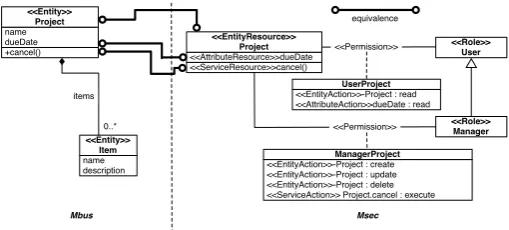
For instance, the security model(Msec)forChangesethas two rolesUserandManager. The
role Userhas a permission overReadactions on the EntityResource Project. This means that
a User can read the information about aProject, but he cannot change it. The role Manager
inheritsUserpermissions and addsCreate,Update, andDeleteactions onProjectandExecute
action on the Project.cancel()ServiceResource. These Permissions mean that aManager can
read, and change the information of aProject.
3
Problem: Composing multi-modeling views
When a complex system is specified using several view models, it is necessary to compose them to obtain the required application. Nevertheless, before performing the composition it is necessary to identify the elements that will be composed. In order to identify those elements we
use a CM. As defined in [BBD+06] a CM is a model that explicitly describes the relationships
between elements of different models. Furthermore, the CM is the definition ofwhatto compose,
which elements, described in the models, will be composed. At the high-level of abstraction, the CM model is constructed manually by the modeler.
3.1 High-level Correspondence Model (CMhigh−level)
We align the two high-level models using a CM which relates the elements to be composed. For
model (Msec) contains the resourceProject that needs to be protected. The CM between both
modelsCMhigh−levelrepresented in the figure as black lines with circles in their ends, contains a
relationship with links to the entityProjectand the resourceProject. Additionally, the Attribute
dueDate is related in the CM to the AttributeResource dueDate. The modeler creates these
correspondence links because he knows the meaning of the relationships between elements.
+cancel() name dueDate
<<Entity>> Project
name description
<<Entity>> Item
<<Role>> User
<<Role>> Manager
<<EntityAction>>-Project : create <<EntityAction>>-Project : update <<EntityAction>>-Project : delete <<ServiceAction>> Project.cancel : execute
ManagerProject <<Permission>>
equivalence
Mbus Msec
items
<<Permission>>
<<EntityAction>>-Project : read <<AttributeAction>>dueDate : read
UserProject <<ServiceResource>>cancel()
<<AttributeResource>>dueDate <<EntityResource>>
Project
0..*
Figure 3: High-level View Models.
3.2 Heterogeneous composition
A heterogeneous composition is the integration of two models expressed in two different lan-guages. This means that is necessary to define the compositional semantic for every pair of concepts in both languages. In our case, to compose the business view model and the security
view model will be a heterogeneous composition. For instance, if we have the conceptEntity
that belongs to a Business modeling language, and the conceptResourcethat belongs to a
Secu-rity modeling language, it is necessary to define what it means to compose them, e.g., if every
ServiceandAttributeof theEntitywill be protected too. Similarly, if a third language is added, it
will be necessary to define a composition semantic for each pair of languages, increasing to the complexity of implementing a multi-view solution.
Our strategy is to avoid the heterogeneous composition transforming each view model into a low-level model defined using a common modeling language. After the composition we perform
a composition between homogeneous concepts, for instance, to compose twoClasses.
There-fore, if the complete set of view-models is transformed in to a common low-level language, a homogeneous composition can be applied. However, a new problem appears: how to identify the element to compose in the low-level models. In other words, how to derivate the CM between the low-level models.
4
Approach overview
new correspondence relationships, having in mind that the TC increments the complexity of the models by adding elements at each step.
To derive a low-level CM it is necessary to trace back the elements of the low-level models and to check if they come from pairs of related elements in the high-level. With a trace model
(T M) [ANRS06] we determine the elements in both low-level models that come from a couple
of related elements in the high-level. For instance, anAttribute in the business view model is
transformed in the low-level model into: anAttribute, aGetterMethodand aSetterMethod. In
the security model aResourceAttribute with aReadPermissionis transformed in the low-level
security model into: a private Attribute and an annotated ReadMethod. Therefore, we have
to trace back all these low-level elements and verify that the high-level source element (e.g.,
Attribute) from which they originate, is related with a correspondence relationship to the
high-level concern-specific element (e.g.,ResourceAttribute).
Once, we establish which elements in the low-level models came from a pair of correspondent
elements in the high-level models, we have to relate them by identifying thecorrect matchfor
each one. For instance, a GetterMethod (in the low-level application model) can be related
to a ReadMethod (in the low-level security model) but not to a WriteMethod. The modeler
has to specify constraints, to avoid erroneous correspondences. A constraint is a relationship between two metaclasses that defines if the correspondence link between concepts that conform to them can be established or not. In our solution this set of constraints is called a Derivation
Model (DM). This approach is presented too in the context of transformation chain evolution
[YCWD09].
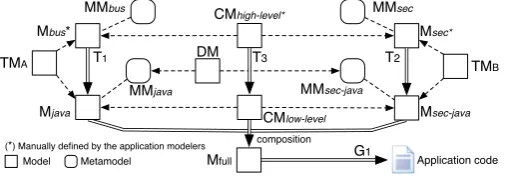
Figure4 presents the general schema of our approach. In the left, the business view model
is transformed into a Java model (MMbus,Mbus,MMjava, Mjava,T1)3. In the right the security
view model is transformed into a Java model too (MMsec, Msec, MMsec−java, Msec−java, T2).
CMhigh−level is the high-level correspondence model that aligns the two high-level models.T MA
andT MSare the trace models that relate the high-level models with the low-level models. The
DM relates the low-level metamodels with constrains between their metaclasses. The DM is used
to generate the transformationT3, that uses the trace models and theCMhigh−levelto generate the
CMlow−level.
T1 T3 T2
MMbus MMsec
MMjava MMsec-java
Mbus*
Mjava Msec-java
Msec*
CMhigh-level*
Mfull
CMlow-level
composition
Application code G1
(*) Manually defined by the application modelers
TMA TMB
DM
Model Metamodel
Figure 4: General Schema
Finally, the low-level models are composed and transformed into code by the original
model-to-text transformation (G1).
5
Derivation of Correspondence Model
To implement our strategy, low-level correspondence relationships have to be derived
automati-cally. The transformation (T3), produces the low-level CM.
5.1 Derivation
Two elements a0 and b0, from application and security models respectively, will have a
corre-spondence relationship if: 1) There is a CM relationship at the higher level betweena andb,
wherea0was produced fromabyT1, andb0was produced frombbyT2. 2) The metaclassesma0
andmb0wherea0conforms toma0andb0conforms tomb0, allow for correspondence relationship
between their instances. Intuitively, the first condition establishes that elementsa0 andb0 trace
back to a pair of elements that have a high-level correspondence relationship between them. The
second condition means that the metaclassesma0andmb0are the same metaclass or extensions of
the same one. Therefore, it is permitted to define correspondence links between their instances
and finally to compose them. If both conditions are satisfied for an elementa0 andb0, T3 will
produce a correspondence link betweena0andb0.
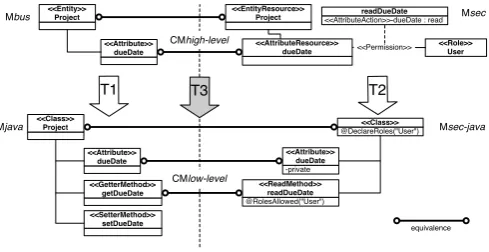
In figure5, a correspondence link is created between the GetterMethodgetDueDateinMjava
and the annotated ReadMethodreadDueDateinMsec−javabecause they satisfy both conditions.
First,getDueDatetraces back to the AttributedueDateinMbuswhenT1, transformed it and
read-DueDate trace back to the AttributeResourcedueDate inMsec when T2 transformed it.
Addi-tionally, the AttributedueDateand the AttributeResourcedueDatewere related by the high-level
CM (CMhigh−level). Second, the GetterMethod and ReadMethod the metaclasses are allowed to
be related. However, is not possible to create a correspondence link between the SetterMethod
setDueDateand the annotated ReadMethodreadDueDatebecause these metaclasses do not have
a constraint that allows to relate them.
<<Attribute>> dueDate <<Entity>>
Project
<<Attribute>> dueDate <<Class>>
Project
<<GetterMethod>> getDueDate <<SetterMethod>>
setDueDate
<<Role>> User
<<Permission>> <<AttributeAction>>-dueDate : read
readDueDate
<<AttributeResource>> dueDate
-private
<<Attribute>> dueDate
@DeclareRoles("User")<<Class>>
@RolesAllowed("User")
<<ReadMethod>> readDueDate
T1 T3 T2
equivalence
<<EntityResource>> Project
Mbus
Mjava
Msec
Msec-java
CMlow-level
CMhigh-level
Figure 5: Detailed schema
5.2 Traceability
WhenT1 is applied to the Attribute dueDate, it is transformed into the AttributedueDate, the
GetterMethodgetDueDateand the SetterMethodsetDueDate. In order to make this information
happens in theT2side,T3needs to know if the ReadMethod traces back to a related
AttributeRe-source. OnceT1 andT2are executed, two tracing models are generated (T MA andT MS). With
these two tracing links,T3can find the elements in both lower-level models that trace back to the
pair of related elements in both higher-level models.
We generate a tracing model when each transformation (i.e., T1 and T2) is executed. This
model conforms to a Traceability Metamodel and it has links between every source element and its target elements.
5.3 Derivation Model
The modeler has to define a Derivation Model (DM) to make explicit if the instances of two
metaclasses are allowed or not to be related by a correspondence link. In the same way, the mod-eler has to decide about the propagation of the compatibility relationships. If two metaclasses are compatible, are their submetaclasses compatible too? Are the composites compatibles too?
We have defined different types of constraints in the Derivation Metamodel. These types
are:Inheritable constraint(to allow submetaclasses),Final constraint(to reject submetaclasses),
Incompatible constraint (to explicitly reject two metaclasses, and Composition constraint (to
allow composites). Due to space restrictions the details of the semantics of these constraints are out of the scope of this paper.
5.4 Generating the CM Transformation
T3receives as input the high-level CM, butT3cannot use the DM as input. The DM is defined
at metamodel level and a transformation rule only receives models as inputs. Therefore, it is necessary to express the constraints as part of the transformation rules. For this reason we, use a
High-Order Transformation (HOT) that receives the DM as input and producesT3.
In our case study, the GetterMethod getDueDate in the application side can be connected
to the ReadMethodreadDueDate, because the metaclasses GetterMethod and ReadMethod are
compatible. As it was presented before, there is a constraint that allows these two elements to be connected. The case of GetterMethod and WriteMethod is clear that they are incompatible metaclasses and a correspondence link cannot be defined between their instances. In this way it is possible to relate only the compatible pairs of elements and not every generated element in each side.
6
Composition
The final step is to compose both low-level models to obtain a complete low-level model of
the application. In this composition, the generated CM (CMlow−level) is an essential input. This
model has the information ofwhatwill be composed. InChangeset, the Classes in the application
low-level model (Mjava) will be composed with the annotated Classes in the security low-level
model (Msec−java), the Attributes in (Mjava) with the private Attributes in (Msec−java), and the
Methods in (Mjava) with the annotated methods in (Msec−java). By using the correspondence links
it is possible to identify every pair of elements to be composed. To do the actual composition we
7
Related work
In our approach we integrate several of the ideas presented in the following works. These ideas help us to model the application and its concerns in independent models and delay the composi-tion to the lower-level of abstraccomposi-tion where a heterogeneous composicomposi-tion is performed.
Following the multi-modeling principle, Cicchetti and Di Ruscio present in [CD08] a proposal
for modeling a web application using three independent models: a data model, a composition model, and a navigation model. A weaving model (correspondence model) is defined between the data model and the composition model, and an additional weaving is defined between the composition model and the navigation model. These three models are composed using the CMs into a high-level model. This high-level model conforms to a platform independent web meta-model, such as WebML or Webile. These web modeling languages try to integrate all the required concepts for web application modeling in a common metamodel. However, this research does not try to generate the final application code, only the complete high-level model. Nevertheless, it is not always possible to find a common high-level metamodel that includes all the required concepts of the different concerns to model an application. In our research, we want to bring the independent models to the lowest-level taking advantage of the reduced semantic gap between the metamodels at this level and the models richer in implementation details.
In [CD06], Cibran et al. present an approach to define business rules on an application as
aspects. The business rules are modeled using a DSML. The relationships between the business rules and the application are defined using a connection DSML. This DSML abstracts the differ-ent patterns of how the business rules are connected with the application code. This connection language can be seen as a CM that relates two different models of the application. Both models are transformed to low-level models. The connections are also transformed and aspect code is generated from them. In our approach, using the DM and the HOT we automate the generation of the transformation that creates the relationships between the low-level models.
8
Conclusions
Our approach facilitates the modeling of different concerns using separated view models each one close to the problem domain. The different view models are aligned using correspondence relationships between their elements. These correspondence relationships explicitly capture the overlapping and dependencies among their elements. Additionally, our approach offers an auto-matic derivation mechanism to identify the elements to compose in the low-level models based on the correspondence relationships defined between the high-level models. With this mecha-nism, it is possible to maintain both models aligned from the high-level until the lowest-level through the transformation chain. This is the main difference of our work with other approaches where these relationships are only defined as an input, but not maintained during the transforma-tion chain. As a result of delaying the actual compositransforma-tion to the lowest-level where all the models conform to the same metamodel or to an extension of it, it is possible to perform a homogeneous composition using a single composition mechanism.
We implemented the derivation mechanism and the composition mechanism using the Atlas
an application in three or more models and bringing theses models to the lower level, where they will be composed. This is a complex problem, because the interactions among the different modeled concerns can generate several inconsistencies.
Bibliography
[ANRS06] N. Aizenbud-Reshef, B. T. Nolan, J. Rubin, Y. Shaham-Gafni. Model traceability.
IBM Systems Journal45(3):515–526, 2006.
[BBD+06] J. B´ezivin, S. Bouzitouna, M. Del Fabro, M. P. Gervais, F. Jouault, D. Kolovos,
I. Kurtev, R. F. Paige. A Canonical Scheme for Model Composition.Model Driven
Architecture Foundations and Applications, pp. 346–360, 2006.
doi:10.1007/11787044 26
http://dx.doi.org/10.1007/11787044 26
[CD06] M. Cibran, M. D’Hondt. A Slice of MDE with AOP: Transforming High-Level
Business Rules to Aspects. Proceedings of the 9th International Conference on
MoDELS/UML, 2006.
[CD08] A. Cicchetti, D. Di Ruscio. Decoupling web application concerns through weaving
operations.Science of Computer Programming70(1):62–86, 2008.
doi:http://dx.doi.org/10.1016/j.scico.2007.10.002
[DDZ08] J. Dingel, Z. Diskin, A. Zito. Understanding and improving UML package merge.
Software and Systems Modeling7(4):443–467, October 2008.
doi:10.1007/s10270-007-0073-9
http://dx.doi.org/10.1007/s10270-007-0073-9
[JK06] F. Jouault, I. Kurtev. On the architectural alignment of ATL and QVT. InSAC ’06:
Proceedings of the 2006 ACM symposium on Applied computing. Pp. 1188–1195.
ACM, New York, NY, USA, 2006.
doi:http://doi.acm.org/10.1145/1141277.1141561
[LBD02] T. Lodderstedt, D. Basin, J. Doser. SecureUML: A UML-Based Modeling
Lan-guage for Model-Driven Security.UML 2002 - The Unified Modeling Language :
5th International Conference, Dresden, Germany, September 30 - October 4, 2002.
Proceedings, pp. 426–441, 2002.
http://www.springerlink.com/content/a82dhdta602g43r5
[Van00] H. Vangheluwe. DEVS as a common denominator for multi-formalism hybrid
sys-temsmodelling.IEEE International Symposium on Computer-Aided Control System
Design, 2000. CACSD 2000, pp. 129–134, 2000.
[YCWD09] A. Yie, R. Casallas, D. Wagelaar, D. Deridder. An approach for evolving
transfor-mation chains.MoDELS ’09: Proceedings of the twelfth ACM/IEEE international
conference on Model Driven Engineering Languages and Systems, pp. 551–555,