First instalment in resolution of the
Banksia spinulosa
complex (Proteaceae):
B. neoanglica
, a new species
supported by phenetic analysis, ecology and geography
Margaret L. Stimpson1, Peter H. Weston2, Ian R.H. Telford1, Jeremy J. Bruhl1
1 Botany, School of Environmental and Rural Science and N.C.W. Beadle Herbarium, University of New En-gland, Armidale NSW 2351 Australia 2 National Herbarium of New South Wales, The Royal Botanic Gardens and Domain Trust, Mrs Macquaries Road, Sydney, NSW 2000, Australia
Corresponding author: Jeremy J. Bruhl ([email protected])
Academic editor: Hugo De Boer | Received 24 May 2012 | Accepted 25 July 2012 | Published 3 August 2012
Citation: Stimpson ML, Weston PH, Telford IRH, Bruhl JJ (2012) First instalment in resolution of the Banksia spinulosa complex (Proteaceae): B. neoanglica, a new species supported by phenetic analysis, ecology and geography. PhytoKeys 14: 57–80. doi: 10.3897/phytokeys.14.3415
Abstract
Taxa in the Banksia spinulosa Sm. complex (Proteaceae) have populations with sympatric, parapatric and allopatric distributions and unclear or disputed boundaries. Our hypothesis is that under biological, phe-netic and diagnosable species concepts that each of the currently named taxa within the B. spinulosa
complex is a separate species. Based on specimens collected as part of this study, and data recorded from specimens in six Australian herbaria, complemented by phenetic analysis (semi–strong multidimensional scaling and UPGMA clustering) and a detailed morphological study, we investigated both morphological variation and geographic distribution in the B. spinulosa complex. All specimens used for this study are held at the N.C.W. Beadle Herbarium or the National Herbarium of New South Wales. In total 23 mor-phological characters (11 quantitative, five binary, and seven multistate characters) were analysed pheneti-cally for 89 specimens. Ordination and cluster analysis resulted in individuals grouping strongly allowing recognition of distinct groups consistent with their recognition as separate species. Additional morpho-logical analysis was completed on all specimens using leaf, floral, fruit and stem morphology, providing clear cut diagnosable groups and strong support for the recognition of B. spinulosa var. cunninghamii and
B.spinulosa var. neoanglica as species.
Keywords
Banksia spinulosa, Banksia cunninghamii, Banksia neoanglica, species limits, phenetics, new species, floral and inflorescence morphology
www.phytokeys.com
Copyright Margaret L. Stimpson et al. This is an open access article distributed under the terms of the Creative Commons Attribution License 3.0 (CC-BY), which permits unrestricted use, distribution, and reproduction in any medium, provided the original author and source are credited.
introduction
Banksia is a moderately sized genus currently of 212 taxa; viz. 78 species, 9
subspe-cies and 11 varieties (see Collins et al. 2009), plus 114 spesubspe-cies previously included under Dryandra (Mast and Thiele 2007). There are 16 named species of Banksia
in the eastern states of Australia (Collins et al. 2009). Species of Banksia are often found in sclerophyllous, heathy shrublands on nutrient poor soils and have spec-tacular spike-like cylindrical or flattened, head-like conflorescences that are eas-ily recognised (Mast et al. 2005). The growth habit in Banksia ranges from small prostrate woody mats to 25 m tall trees. Only one species occurs naturally outside Australia, Banksia dentata, which extends to Papua New Guinea, Irian Jaya and the Aru Islands (George 1981; Mast et al. 2002).
According to George’s (1999) classification, the B. spinulosa complex has the broadest latitudinal, altitudinal and ecological amplitude of any species in the genus (Thiele and Ladiges 1996). The B. spinulosa complex consists of four taxa distributed from north-eastern Queensland to eastern Victoria along the coast and highlands.
Banksia spinulosa var. spinulosa occupies both latitudinal extremes but is replaced
along the coast between the Sunshine Coast area in south-eastern Queensland and the Hawkesbury River in central eastern New South Wales by B. spinulosa var.
col-lina, which also has inland outliers west to the Carnarvon National Park area.
Bank-sia spinulosa var. cunninghamii is mostly a montane taxon distributed mostly between
the Hunter River in central eastern New South Wales and eastern Victoria, with a northern disjunction in the McPherson Range along the Queensland–New South Wales border. It is broadly sympatric with, and frequently co-occurs in mixed popu-lations alongside B. spinulosa var. spinulosa between the northern Blue Mountains and the Moss Vale district. Banksia spinulosa var. neoanglica is also a montane taxon, distributed from the McPherson Range and along the eastern edge of the New Eng-land TableEng-land, New South Wales south to the Hanging Rock area. Banksia spinulosa
var. neoanglica is parapatric with a montane variant currently attributed to B. spinu-losa var. collina in the Daves Creek area, Lamington National Park; it is allopatric with other taxa in the complex.
Most herbaria follow George (1981, 1988, 1999) in treating this complex as one species with four varieties, viz. B. spinulosa var. spinulosa, B. spinulosa var. collina, B.
spinulosa var. cunninghamii, and B. spinulosa var. neoanglica. Flora of New South
Wales (NSW) Online (1999 onwards) treats the B. spinulosa complex as comprising two species, each with two infraspecific taxa: Banksia spinulosa var. collina,B. spinulosa
var. spinulosa, B. cunninghamii subsp. cunninghamii, and B. cunninghamii subsp. A (=
B. spinulosa var. neoanglica), and this paper will use this treatment as a reference point.
The primary reason for recognising two species was the broad sympatry of B. spinulosa
These competing taxonomic treatments have created confusion, examples of which can be found in species lists for some National Parks in New South Wales (unpub-lished visitor brochures), which include B. spinulosa var. neoanglica and B.
cunning-hamii subsp. A as separate entities. Some herbaria also concurrently use two names for
the same entity (see the Atlas of Living Australia). Current circumscriptions of the taxa within the B. spinulosa complex are based on intuitive assessment of observed mor-phological variation, rather than an explicit analysis of the mormor-phological variation. Thiele and Ladiges (1996) conducted a cladistic analysis of the whole of Banksia us-ing 92 qualitative characters and 14 morphometric characters in an attempt to clarify interspecific relationships and to provide a phylogenetic classification. As that was a genus-wide study, limited work was conducted on or within individual species.
The aims of this study were (1) to test and set the taxonomic status and circum-scription of B. cunninghamii subsp. A; and (2) to search for novel diagnostic charac-ters that could be used to distinguish individual taxa within the B. spinulosa complex
(sensu George 1988).
Materials and methods
Study material
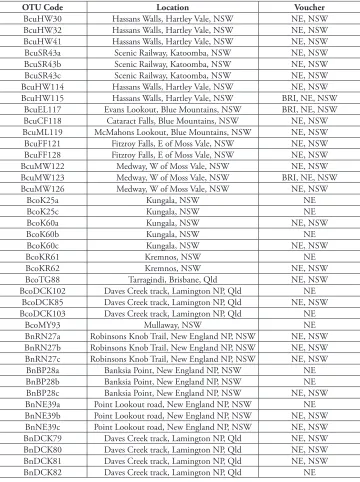
Although dried herbarium specimens were available for this study, it was consid-ered necessary to collect fresh material to adequately investigate character homology though a detailed study of different developmental stages. Existing herbarium speci-mens were deficient in some developmental stages and often were not suitable for destructive sampling. We made collections from locations in New South Wales and Queensland encompassing the full geographic range of Banksia cunninghamii subsp. A. Vouchers have been lodged at NE and/or NSW (Table 1). Each site was visited twice; the first time in February to observe the development of the rachis, the second time in May to observe the flowering process. During both visits observations were made and vouchers prepared.
Observations and microscopy
table 1.Vouchers used in phenetic and morphological analysis of the B. spinulosa complex.Numbers in the OTU code are M. L. Stimpson collection numbers. Bcu = Banksia cunninghamii subsp. cunninghamii; Bco = B. spinulosa var. collina; Bn = B. cunninghamii subsp. A; Bsp = B. spinulosa var. spinulosa; Bsp? = putative hybrid of B. spinulosa var. collina×B. spinulosa var. spinulosa. Abbreviations: NP = National Park; NSW = New South Wales; Qld = Queensland. Voucher codes are herbarium abbreviations following Thiers (continuously updated). All elements of the collections were available at NE and/or NSW during the study, replicates will be distributed.
OTU Code Location Voucher
BcuHW30 Hassans Walls, Hartley Vale, NSW NE, NSW BcuHW32 Hassans Walls, Hartley Vale, NSW NE, NSW BcuHW41 Hassans Walls, Hartley Vale, NSW NE, NSW BcuSR43a Scenic Railway, Katoomba, NSW NE, NSW BcuSR43b Scenic Railway, Katoomba, NSW NE, NSW BcuSR43c Scenic Railway, Katoomba, NSW NE, NSW BcuHW114 Hassans Walls, Hartley Vale, NSW NE, NSW BcuHW115 Hassans Walls, Hartley Vale, NSW BRI, NE, NSW
BcuEL117 Evans Lookout, Blue Mountains, NSW BRI, NE, NSW BcuCF118 Cataract Falls, Blue Mountains, NSW NE, NSW BcuML119 McMahons Lookout, Blue Mountains, NSW NE, NSW BcuFF121 Fitzroy Falls, E of Moss Vale, NSW NE, NSW BcuFF128 Fitzroy Falls, E of Moss Vale, NSW NE, NSW
BcuMW122 Medway, W of Moss Vale, NSW NE, NSW
BcuMW123 Medway, W of Moss Vale, NSW BRI, NE, NSW
BcuMW126 Medway, W of Moss Vale, NSW NE, NSW
BcoK25a Kungala, NSW NE
BcoK25c Kungala, NSW NE
BcoK60a Kungala, NSW NE, NSW
BcoK60b Kungala, NSW NE
BcoK60c Kungala, NSW NE, NSW
BcoKR61 Kremnos, NSW NE
BcoKR62 Kremnos, NSW NE, NSW
BcoTG88 Tarragindi, Brisbane, Qld NE, NSW
BcoDCK102 Daves Creek track, Lamington NP, Qld NE BcoDCK85 Daves Creek track, Lamington NP, Qld NE, NSW BcoDCK103 Daves Creek track, Lamington NP, Qld NE
BcoMY93 Mullaway, NSW NE
BnRN27a Robinsons Knob Trail, New England NP, NSW NE, NSW BnRN27b Robinsons Knob Trail, New England NP, NSW NE, NSW BnRN27c Robinsons Knob Trail, New England NP, NSW NE, NSW
OTU Code Location Voucher
BnBP96 Banksia Point, New England NP, NSW BRI, NE, NSW BnTC97 Tom’s Cabin, New England NP, NSW BRI, NE, NSW
BnMM98 Mount Mitchell, NSW BRI, NE, NSW
BnMM99 Mount Mitchell, NSW BRI, NE, NSW
BnG100 Girraween NP, Qld BRI, NE, NSW
BnG101 Girraween NP, Qld BRI, NE, NSW
BnDCK104 Daves Creek track, Lamington NP, Qld NE BnDCK105 Daves Creek track, Lamington, NP, Qld NE, NSW
BnBB106 Boonoo Boonoo NP, Morgan’s Gully, NSW BRI, NE, NSW BnBB107 Boonoo Boonoo NP, Morgan’s Gully, NSW NE, NSW BnBB108 Boonoo Boonoo NP, Morgan’s Gully, NSW NE, NSW BnBB109 Boonoo Boonoo NP, Cyprus Pine Camp, NSW NE, NSW BnGR110 Gibraltar Range NP, Mulligans Hut, NSW BRI, NE, NSW BnGR111 Gibraltar Range NP, Mulligans Hut, NSW NE BnGR112 Gibraltar Range NP, Mulligans Hut, NSW BRI, NE, NSW BnGR113 Gibraltar Range NP, Mulligans Hut, NSW NE BspDC42 Darling Causeway, Blue Mountains, NSW NE, NSW BspHB44 Hazelbrook, Blue Mountains, NSW NE, NSW BspHB45 Hazelbrook, Blue Mountains, NSW NE, NSW
BspJB46 Jervis Bay, NSW NE, NSW
BspJB59 Jervis Bay, NSW NE, NSW
BspML120 McMahons Lookout, Blue Mountains, NSW NE, NSW BspFF127 Fitzroy Falls, E of Moss Vale, NSW NE, NSW
BspMW129 Medway, W of Moss vale, NSW NE, NSW
BspML130 McMahons Lookout, Blue Mountains, NSW NE, NSW BspEL131 Evans Lookout, Blue Mountains, NSW NE BspCF132 Cataract Falls, Blue Mountains, NSW NE, NSW
Bsp?BU36 Bouddi NP, NSW NE, NSW
Bsp?BU37 Bouddi NP, NSW NE
Bsp?BU38 Bouddi NP, NSW NSW
Bsp?CA52a Calga, NSW NSW
Bsp?CA52b Calga, NSW NE, NSW
Bsp?CA52c Calga, NSW NE, NSW
Bsp?CA53a Calga, NSW NE, NSW
Bsp?CA53b Calga, NSW NE, NSW
Bsp?CA53c Calga, NSW NE, NSW
Bsp?M54a Morisset, NSW NE, NSW
Bsp?M54b Morisset, NSW NE, NSW
Bsp?M54c Morisset, NSW BRI, NE, NSW
Bsp?RM66 Morisset, NSW NE, NSW
Bsp?YM67 Morisset, NSW NE, NSW
Bsp?JB124 Jervis Bay, NSW NE
Bsp?MM86 Mount Mee, Qld NE
Bsp?MM87 Mount Mee, Qld NE
Bsp?GM89 Glasshouse Mountains, Qld NE
Bsp?GM90 Glasshouse Mountains, Qld NE
Bsp?GM91 Glasshouse Mountains, Qld NE
Phenetic analysis
Selection of characters
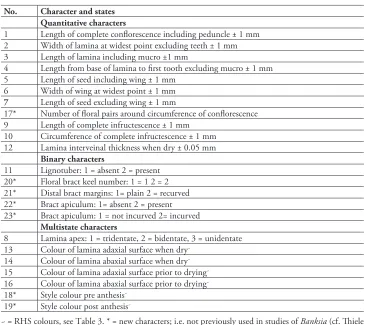
The character list was primarily constructed to include leaf, floral, stem and fruit mor-phology. Assessment of descriptions of the taxa in the B. spinulosa complex (George 1981, 1988; Thiele and Ladiges 1996; Harden 2002) led to the selection of characters for the inclusion in the phenetic analysis. Additional characters were considered based on observed differences in the field (Table 2). Wherever possible, quantitative charac-ters were used to reduce subjectivity and to avoid artefacts resulting from the conver-sion of continuous variables into categorical ones. Qualitative character states were scored as either 1 or 2. Quantitative characters for each OTU were the mean of up to 10 measurements where possible.
Colours, however, were treated as multistate characters to maximise accuracy and repeatability, which allowed for some natural variation, thus avoiding spurious
over-table 2.Characters used for phenetic analysis for the Banksia spinulosa species complex
No. Character and states
Quantitative characters
1 Length of complete conflorescence including peduncle ± 1 mm 2 Width of lamina at widest point excluding teeth ± 1 mm 3 Length of lamina including mucro ±1 mm
4 Length from base of lamina to first tooth excluding mucro ± 1 mm 5 Length of seed including wing ± 1 mm
6 Width of wing at widest point ± 1 mm
7 Length of seed excluding wing ± 1 mm
17* Number of floral pairs around circumference of conflorescence 9 Length of complete infructescence ± 1 mm
10 Circumference of complete infructescence ± 1 mm 12 Lamina interveinal thickness when dry ± 0.05 mm
Binary characters
11 Lignotuber: 1 = absent 2 = present 20* Floral bract keel number: 1 = 1 2 = 2 21* Distal bract margins: 1= plain 2 = recurved 22* Bract apiculum: 1= absent 2 = present 23* Bract apiculum: 1 = not incurved 2= incurved
Multistate characters
8 Lamina apex: 1 = tridentate, 2 = bidentate, 3 = unidentate 13 Colour of lamina adaxial surface when dry~
14 Colour of lamina abaxial surface when dry~ 15 Colour of lamina adaxial surface prior to drying~ 16 Colour of lamina abaxial surface prior to drying~ 18* Style colour pre anthesis~
19* Style colour post anthesis~
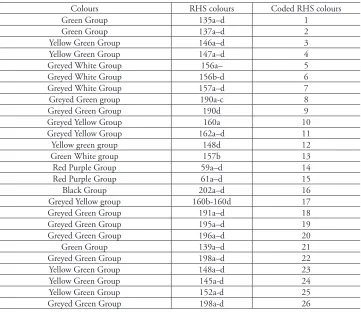
precision (see below). Royal Horticultural Society (RHS) colours were used to com-pare adaxial and abaxial leaf surfaces prior to, and after drying, as well as styles before and after anthesis. Each RHS colour was allocated a number from 1–26 (Table 3).
All leaf measurements were taken from leaves in the middle of a branchlet, selected from the whorl of branchlets subtending a resting terminal bud or conflorescence; leaves were measured after drying. Conflorescence characters such as number of floral pairs were counted live on the plant. Infructescences were measured vertically with a steel ruler and the circumference was measured with a sewing tape measure.
Infructescences were placed on a gas burner for 1–3 min then left on brown paper for two days in a dry place. Seeds were extracted using a pair of forceps and measured under a stereomicroscope using a calibrated eyepiece graticule.
Dataset
A dataset (Appendix 1) was maintained in Microsoft Excel and exported to PATN v. 3 for Windows (Belbin and Collins 2006). The characters were range-standardised and a
table 3.RHS colour codes used in phenetic analysis
Colours RHS colours Coded RHS colours
Green Group 135a–d 1
Green Group 137a–d 2
Yellow Green Group 146a–d 3
Yellow Green Group 147a–d 4
Greyed White Group 156a– 5
Greyed White Group 156b-d 6
Greyed White Group 157a–d 7
Greyed Green group 190a-c 8
Greyed Green Group 190d 9
Greyed Yellow Group 160a 10
Greyed Yellow Group 162a–d 11
Yellow green group 148d 12
Green White group 157b 13
Red Purple Group 59a–d 14
Red Purple Group 61a–d 15
Black Group 202a–d 16
Greyed Yellow group 160b-160d 17
Greyed Green Group 191a–d 18
Greyed Green Group 195a–d 19
Greyed Green Group 196a–d 20
Green Group 139a–d 21
Greyed Green Group 198a–d 22
Yellow Green Group 148a–d 23
Yellow Green Group 145a-d 24
Yellow Green Group 152a-d 25
distance matrix calculated using the Gower distance metric (Wills et al. 2000). Three-dimensional ordination plots were generated from the distance matrix using semi-strong hybrid multidimensional scaling (SSH MDS) with 100 random starts and 200 iterations to minimise stress. Flexible UPGMA (Beta-value = -0.1) phenograms, 3D ordination scatter plots, and correlation of characters with ordination pattern (PCC) were produced directly within PATN. The criteria for circumscribing distinct taxa were: (1) the OTUs representing the putative taxa formed discrete groups that did not overlap those of any other groups of OTUs in both cluster and ordination analysis and (2) the OTUs within these groups showed an amount of morphological heterogeneity similar to that of the other putative species in the B.spinulosa complex included in the analysis (Plunkett et al. 2009). In total 23 characters were used, 11 morphometric, five binary, seven multistate qualitatively coded morphological characters (Table 2).
Diagnostic qualitative morphological characters
Conflorescences
The conflorescences of all taxa in the B. spinulosa species complex consist of an elongate woody rachis that has three types of bracts. Below the base of the rachis on the short peduncle are the involucral bracts. The second type of bract is the common bract each of which subtends a flower pair on the conflorescence axis. The third type of bract, a smaller floral bract, subtends each flower in a pair(Johnson andBriggs 1975; George 1981; Thiele and Ladiges 1996).In the early stage of conflorescence development, flower pairs start to develop along the rachis basipetally. The flowers emerge from each side of the floral bracts and above and below each large common bract. Bracts and flower pairs are arranged in vertical columns on the rachis. This pattern is visually enhanced with the development of styles. The vertical striping pattern remains until the perianth and the styles have senesced or fallen from the rachis (George 1981; Thiele and Ladiges 1996; Collins et al. 2009).
Structure of the perianth (floral pairs)
The perianth segments or tepals in Banksia each consist of a limb and a claw (Thiele and Ladiges 1996). In Banksia andmost other Proteaceaethe perianth is made up of four tepals (Wrigley and Fagg 1989; Weston 2006).
Structure of the style
1981; Collins et al. 2009). All styles in the B. spinulosa species complex are hooked and extend up to 3 mm past the limb and claw just prior to anthesis. The distal part of the style is modified as a pollen presenter and the stigmatic cavity is located at the apex of the style. The style is released from the limb upon anthesis (Thiele and Ladiges 1996; Weston 2006). All styles in the B.spinulosa complex have similar surfaces. Scanning electron mi-croscopy was performed on the style surfaces and no distinguishing features were found.
Leaf morphology
All taxa within the B. spinulosa complex have leaves that are scleromorphic in texture, discolourous, and linear in shape. The indumentum on the abaxial leaf surface is felted and the midvein is raised on the abaxial surface of all leaves in all taxa within the com-plex. Continuous variation was found in the colour of adaxial and abaxial leaf surfaces both within and between populations of all taxa within the B. spinulosa complex.
Lignotubers
The term lignotuber refers to a woody swelling which may take the form of an extensive subterranean lignotuber, basal lignotuber, or an above ground lignotuber (Mibus and Sedgley 2000). The development of a lignotuber is considered to have evolved repeated-ly in different lineages in response to increased fire frequency (Whelan and York 1998).
results and discussion
Phenetic analysis
Ordination (Figure 1) and clustering (Figure 2) of the data matrix found five distinct groups of OTUs in the B. spinulosa complex: corresponding to a priori names
B. spinu-losa var. collina sens. lat., B. spinulosa var. collina × B. spinulosa var. spinulosa from near
the New South Wales locations of Morisset, Bouddi and Calga, B. spinulosa var.
spinu-losa, B. cunninghamii subsp. cunninghamii, B. cunninghamii subsp. A. The phenogram
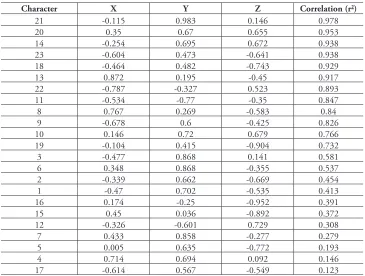
displays the same five groups of OTUs (Figure 2). Even when we reran the analyses excluding all the binary characters (Characters 11, 20–23; ordination and phenogram not presented), the same five groups of OTUs were obtained, which, along with the very low stress value (Figure 1) indicate that the results are robust. Twelve of the 23 characters, including quantitative, binary and multistate characters had correlated more than 70% with the ordination (Table 4) indicating sound choice of characters, a broad base of evidence for the patterns obtained, and confidence in the results obtained.
table 4.Principal component correlation (PCC) attributes and ordination vectors for ordination of the
Banksia spinulosa complex. See Table 2 for Character numbers.
Character X Y Z Correlation (r2)
21 -0.115 0.983 0.146 0.978
20 0.35 0.67 0.655 0.953
14 -0.254 0.695 0.672 0.938
23 -0.604 0.473 -0.641 0.938
18 -0.464 0.482 -0.743 0.929
13 0.872 0.195 -0.45 0.917
22 -0.787 -0.327 0.523 0.893
11 -0.534 -0.77 -0.35 0.847
8 0.767 0.269 -0.583 0.84
9 -0.678 0.6 -0.425 0.826
10 0.146 0.72 0.679 0.766
19 -0.104 0.415 -0.904 0.732
3 -0.477 0.868 0.141 0.581
6 0.348 0.868 -0.355 0.537
2 -0.339 0.662 -0.669 0.454
1 -0.47 0.702 -0.535 0.413
16 0.174 -0.25 -0.952 0.391
15 0.45 0.036 -0.892 0.372
12 -0.326 -0.601 0.729 0.308
7 0.433 0.858 -0.277 0.279
5 0.005 0.635 -0.772 0.193
4 0.714 0.694 0.092 0.146
17 -0.614 0.567 -0.549 0.123
multi-stemmed habit and occurs between the Hawkesbury River and Hunter Valley. Herbarium specimens from these locations have been determined by A.S. George and other botanists as “B. spinulosa var. collina×B. spinulosa var. spinulosa”. George (1981)
considered this group of OTUs to be an intergrade between B. spinulosa var. spinulosa
and B. spinulosa var. collina. These populations do not fall in a position
intermedi-ate between B. spinulosa var. collina and B. spinulosa var. spinulosa in the ordination diagram, nor do they segregate into three clusters representing parental species and hybrids. There is thus no clear phenetic evidence of either an intergrade or a mixture of hybrids and parental species between the Hawkesbury River and Hunter Valley. The taxonomic status of these populations and their relationships to others remains unclear. This cluster of OTUs could represent a distinct species, but we will investigate this question and the broader relationship between B. spinulosa var. collina and B. spinulosa
var. spinulosa further before making any formal taxonomic changes to these taxa. Slight outliers in the B. spinulosa var. collina cluster represent some discontinuous morphological variation, which we also plan to investigate.
Taxonomic inference
Given the consistent clear cut groups in the ordination and cluster analysis across a broad geographic and morphological range of OTUs (Table 1), we propose the follow-ing taxonomic arrangement, which we use hereafter in this paper: recognisfollow-ing
Bank-sia cunninghamii subsp. cunninghamii as B. cunninghamii sensu stricto; recognising B.
spinulosa var. collina as B. collina sensu lato; recognising B. spinulosa var. spinulosa as
B. spinulosa sensu stricto; formalising Banksia cunninghamii subsp. A at species rank
under the name B. neoanglica . Although the OTUs of B. spinulosa from the Morisset and Bouddi populations could be considered to constitute a distinct species on the evidence we present here, we refrain from recognising these populations as a distinct taxon until we have more thoroughly tested the hypothesis that they are part of an ex-tensive hybrid swarm and searched for any additional populations that might provide evidence for integradation between B. collina and B. spinulosa.
Morphological analysis
Growth forms within the Banksia spinulosa species complex
Banksia cunninghamii sensu stricto is a single-stemmed tree to 7 m tall, and is
non-ligno-tuberous. Banksia spinulosasensu stricto forms a multi-stemmed, rounded shrub to 3 m high. The lignotuber is subterranean. Banksia collinasensu lato is a multi-stemmed upright shrub to 3 m tall, with a subterranean lignotuber (Harden 2002; George 1981).
Banksia neoanglica has a variety of growth forms ranging from small rounded
be related to the degree of exposure of plants to fire. At sites where there have been no fires for more than 15 years, such as at Binna Burra, Lamington National Park, Queens-land and some parts of Gibraltar Range National Park, New South Wales (Pers. Comm. Justin Kreis Ranger Glen Innes National Park), B. neoanglica is a single-stemmed tree and exhibits all the traits of an obligate seeder such as a greater infructescence load and spontaneous opening of the follicles. In the tree form, B. neoanglica has a slight swell-ing at the base of the trunk just below the soil or there are epicormic buds which often develop into branches, well above ground level, similar to those of some eucalypts (Bur-rows 2008). The multi-stemmed form has a substantial subterranean lignotuber and requires fire to open follicles and has a greatly reduced infructescence load.
Individual adult morphological features
Styles: The structure of the conflorescence, including perianth and styles is similar for all taxa in the B. spinulosa complex. Size, shape and colour of the individual parts of the conflorescence, however, differ considerably across the species. Style colour in the B.
spi-nulosa complex varies depending on the proportions of chlorophyll (green), carotenoid
(yellow to orange), anthoxanthin (yellow) and anthocyanin (red to purple) pigments that develop in them (Grotewold 2006). The style colour in B. neoanglica,B. spinulosa sensu
strictoand B. cunninghamii sensu stricto usually grades from red to maroon to purple
dur-ing conflorescence development, then the style becomes discolorous at anthesis, with the apex becoming dark purple to black. This is a consistent character within and between populations of three species in the Banksia spinulosa complex. The exception is B. collina
sensu lato which has concolourous green styles both before and after anthesis. We found
no black-styled B. collinasensu lato within the geographical range of this project.
The style apex in B. cunninghamiisensu stricto seems to have substantially more anthocyanin pigment than either B. spinulosa sensu stricto or B. neoanglica. In B.
cunninghamiisensu stricto we observed that the style length is usually longer than
either B. spinulosasensu stricto or B. neoanglica and is a similar length to B.collina
sensu lato. The black pigmentation of the styles of B. cunninghamii sensu stricto starts
to develop one third of the way along the style above the ovary. In B.spinulosa sensu
stricto and B. neoanglica the dark pigmentation in the style develops one half to two
comprise less than 2% of a population and were not found in every population; therefore it is unlikely to be persistent polymorphism.
Perianth colour: The colours of the perianth in the B. spinulosa complex vary according to their developmental stage and their exposure to sunlight. The perianth colours can vary within and between populations in all four of the species in the B.
spinulosa complex. The factor that seems to have the most influence on the perianth
colour in the early stages of development is exposure to sun, often mediated by the po-sition of an conflorescence on the outside or inside branches of the plant or by shading from other plants. In B.spinulosa sensu stricto, B. collina and B. neoanglica, the conflo-rescences that are exposed to full sun tend to have orange or yellow perianths. Those that are exposed to a limited amount of sun tend to be green. The perianth colour of B.
cunninghamii sensu stricto is diagnostic for the species. At maturity the perianth always
has a distinct pink hue and this colouring continues through to anthesis. The pink hue does not vary between and within populations of B. cunninghamii sensu stricto, nor does exposure to full sun orfull shade effect the colour of the perianth at maturity.
Common bracts: Common bracts have been mentioned in previous studies (John-son and Briggs 1975; Thiele and Ladiges 1996; George 1981) but the bract surfaces had not been mentioned before this study or used to draw taxonomic conclusions. Close examination, especially at early stages of development, of the abaxial surface of the common (or flower pair) bracts found them to have differences in shape, texture, colour, and surface (Figure 3A–D) which covary in line with the entities recognised here (Figures 1–2) within the B. spinulosa complex. We will characterise these differ-ences for use in future expanded phenetic analysis and description of taxa in Banksia. Floral bracts were not examined in detail in this study.
Involucral bracts: Involucral bracts appear to be taxonomically informative at the species level in the study group. The involucral bracts of B.cunninghamii sensu stricto are caudate with an abaxial ‘spine’ (Figure 4A). The involucral bracts in B. spinulosa sensu stric-to (Figure 4B) are longer and more scleromorphic, with little or no hair and no external spine. In Banksia neoanglica (Figure 4C) these bracts are more hirsute without an external spine and in B. collina sensu lato (Figure 4D) the involucral bracts are shorter, have no external spine and limited hair. There are differences in the distal and proximal portions of the involucral bracts (Figure 4A–D) in each species that warrant further examination.
taxonomic conclusions
The diversity of species concepts in the biological literature is an asset, not a liability when considering the Banksia spinulosa complex and are an integral part of biological theory. We have taken into account the co-varying morphological discontinuities, the phenetic species concept, geographical and ecological isolation and the biological spe-cies concept of reproductive isolation. The use of differing concepts has been useful in suggesting multiple lines of evidence for testing taxonomic boundaries in the Banksia
Figure 3.Common bracts on young conflorescences in the Banksia spinulosa species complex: AB. neoanglica (M.L. Stimpson 98) BB. cunninghamii sensu stricto (M.L. Stimpson 122) CB. collina sensu lato
(M.L. Stimpson 25A) DB. spinulosa sensu stricto. (M.L. Stimpson 120). Scale bar = 1 mm.
on the results of the morphometric analyses and corroborated by new characters (cf. Thiele and Ladiges 1996) such as the abaxial surface of the common bract (Figure 3), the number of floral pairs around the circumference of the conflorescence and obvious differences in the involucral bracts (Figure 4A–D). Additionally, given the ecological isolation, reproductive isolation and morphometric differentiation of at least three of the taxa in the B. spinulosa complex, there is a compelling case to recognise Banksia
spi-nulosa sensu stricto, Banksia cunninghamii sensu stricto and Banksia neoanglica as separate
species (Table 5). Banksia collinasensu lato is considered heterogeneous and in need of further study, but is not readily confused with B. neoanglica. Similarly B. spinulosa from the Morisset, Bouddi and Calga requires further study but is distinct from B. neoanglica.
The geographic distribution of Banksia neoanglica falls within the biogeographic region known as the “Macpherson–Macleay Overlap” of Burbidge (1960), which is a biogeographically distinctive and rich area (Crisp et al. 1999) with many species of plants and invertebrates endemic to the area.
Banksia cunninghamii sensu stricto and B. neoanglica have often been
misidenti-fied because B. cunninghamii sensu stricto, on occasions, has a brown indumentum;
char-Figure 4.Involucral bracts on young conflorescences in the Banksia spinulosa complex. AB. cunning-hamii sensu stricto (M.L. Stimpson 122) BB. spinulosa sensu stricto (M.L. Stimpson 125) CB. neoanglica
(M.L. Stimpson 81) D B. collina sensu lato (M.L. Stimpson 25A). Scale bar = 2.5 mm.
acter has been used in the past as an aid to distinguishing B. cunninghamii sensu
stricto and the two other ‘varieties’ recognised at that time (George 1981; Harden
stricto. Drying of the specimens in both of these species can cause browning on the abaxial leaf surface. The browning of the abaxial leaf surface should not be used as taxonomic marker or an identification tool.
Future directions
Disjunct populations in central and northern Queensland currently assigned to B.
spinulosa var. spinulosa warrant inclusion in a more broadly framed analysis, as do the
northern and southern populations of B. collina sensu lato and Victorian populations
of Banksia cunninghamii sensu stricto. There are also other populations of Banksia that
clearly belong with the B.spinulosa group but are as yet unstudied. Further work is needed to enable suitable placement of these populations. Analysis using molecular data, together with expanded use of the novel characters presented here, would likely resolve these long-outstanding taxonomic issues.
taxonomic treatment
Banksia neoanglica (A.S.George) Stimpson & J.J.Bruhl, stat. nov. http://species-id.net/wiki/Banksia_neoanglica
Banksia spinulosa Sm. var. neoanglica A.S.George, Nuytsia 6: 315 (1988).
Type.AUSTRALIA: New South Wales: Northern Tablelands, 900 m along Waterfall Way towards Ebor from turn-off to New England National Park, 22 May 2011, M.L.
Stimpson 180, J.J. Bruhl & I.R. Telford; neotype: NSW; isoneotype: AD, BRI, CANB,
CNS, K, MEL, NE, MO, PERTH. Figure 5.
table 5.Comparison of some attributesof Banksia neoanglica, B. spinulosasensu stricto and B. cunninghamii.
Character B. neoanglica B. spinulosa B. cunninghamii
Lignotuber present present absent
Leaf length 43–75 mm 50–72 mm 53–88 mm
Leaf width 3–4.5 mm 1.5–2.5 mm 3–4.5 mm
Leaf margins not recurved tightly recurved not recurved Length of inflorescence 84–119 mm 96–144 mm 99–152 mm Common bract keels single thickened keel single keel apex two thin keels Common bract apex apex rounded apiculate apex rounded Number of floral pairs 12–14(–16) pairs 13–16 pairs 12–14 pairs
Perianth colour orange, or yellow orange or yellow pink Style colour prior to anthesis red/maroon red/maroon red/maroon
B. spinulosa Sm. var. cunninghamii (Sieber ex Rchb.) A.S.George, Nuytsia 3: 396 (1981) pro parte, excluding type.
B. cunninghamii Sieber ex Rchb. subsp. A: G.J. Harden in G.J. Harden (ed.), Flora
of New South Wales 1: 71 (1991); G.J Harden, D.W. Harden & D.C. Godden (2000)
Proteaceae of New South Wales: 170 (2000); G.J. Harden in G.J. Harden (ed.), Flora of
New South Wales 2, edn 2: 86 (2002).
The protologue of B. spinulosa var. neoanglica quotes the type:
“1 km N of turnoff to New England National Park, Ebor–Armidale road, N.S.W., 6 April 1986, S.C. Clemesha; holo: NSW; iso: CANB, BRI, MEL, PERTH”.
No specimens so labelled have been located in NSW, BRI, CANB or MEL herbaria after repeated searches. Alex George (pers. comm. 2010–2011) could find no specimens in PERTH and he believes it likely that specimens were never distributed. Accordingly, we have nominated a neotype, collected from the same population as the type.
Description. Shrubs with 2–8(–10) stems to 2.5 m from a lignotuber or trees to 7 m tall. Juvenile leaves: petiole 2–3.8 mm long; lamina narrowly obovate, 30–66 mm long, 5–11 mm wide, strongly dentate along full leaf margin, apex bidentate. Adult leaves: petiole 1.8–3.5 mm long; lamina linear, 43–75 mm long, 3–4.5 mm wide, oc-casionally toothed towards the usually unidentate, ococ-casionally bidentate apex; adaxial surface glabrous, with colour after drying RHS greyed green group 195a-d; abaxial surface felted, colour after drying RHS greyed white group 156a–d. Involucral bracts subulate, thickened at base, 3–15mm long, grey-brown pubescent. Conflorescence 84–119 mm long, 70–85 mm diameter at anthesis; floral pairs 12–14(–16) around the circumference of the conflorescence axis. Common bract with a single thickened keel on the abaxial surface that extends from the apex of the bract down to the visible part of the base of the bract, distal margins slightly concave, apex rounded, indumentum villous, lower third of bract uniformly brown and upper two thirds uniformly green (fig. 3A). Perianth 18–23 mm long, pubescent, yellow–orange at maturity but may be green, orange or yellow during developmental stages; limb c. 3.5 mm long; anthers c. 1 mm long. Style 25–38 mm long, apically hooked, colour grading from red to maroon to black just prior to anthesis. Infructescence 85–120 mm long, 35–45mm diam. Seed 15–19 mm long, including wing. Figure 6.
Distribution. Banksia neoanglica occurs on the McPherson Range, just north of the Queensland–New South Wales border, Mt Warning and the eastern edge of the New England Tableland southwards to near Hanging Rock, New South Wales. Figure 7.
Ecology. Grows in sandy soil on granite and acid volcanics, rarely on basalt, in
Euca-lyptus open forest (Figure 6), woodland and heath at altitudes of 850–1480 m. The
spe-cies is sympatric with Banksia integrifolia subsp. monticola throughout its range, with B.
marginata sensu lato on the Gibraltar Range and with B. conferta in the Daves Creek area.
fire. More commonly the plants are multi-stemmed, with up to 2–8(–10) stems from a subterranean lignotuber carry a much lower infructescence load, usually 1–3(–5) infructesences per plant. Fire is required to open the follicles.
Conservation status. The species is widespread, often locally common, and is not considered at risk. It is conserved in several reserves: Lamington, Springbrook and Gir-raween National Parks in Queensland, and Boonoo Boonoo, Gibraltar Range and New England National Parks and Torrington State Conservation Area in New South Wales.
Selected specimens examined. AUSTRALIA. Queensland: Moreton District: McPherson Range, Lamington National Park, Daves Creek track, M.L. Stimpson 79
(BRI, NE, NSW); Darling Downs District: Girraween National Park, track to Mt Norman, 21 Jan. 2009, I.R. Telford 13278 & J.J. Bruhl (NE). New South Wales: North Coast: Mount Warning, 3 Oct. 1939, F.A. Rodway s.n. (NSW); Northern Tablelands: 19 km E of Deepwater on Miles Shaw Rd, Butterleaf State Forest, J.T.
Hunter 3750 & P.J. Clarke (NE); ); 0. 4 km N of Torrington, 19 Nov 1972, J.B.
Williams s.n. (NE); Pheasant Mountain, 32 km NE of Guyra, 24Apr. 1972, H.J.
Wissmann s.n. (NE); Mount Chaelundi, E side just below crest, J.T. Hunter 157 &
V.H. Hunter (NE); New England National Park, Banksia Point, M.L. Stimpson 28
(BRI, NE, NSW); NE of Bakers Downfall Hill, Nundle State Forest, J.R. Hosking
1877 (CANB, MEL, NE, NSW).
Phenology. Resting buds start to expand in late January and conflorescences are fully developed by late March with flowering continuing until early July. These times are dependent on climatic conditions.
Breeding system. Extensive experiments conducted between May 1986 and July 1987 found that the New England population of B. neoanglica studied was autoga-mous (Vaughton 1988).
Acknowledgements
MLS thanks Leanne and David Rowbotham, Bob and Maureen Anderson for con-siderable assistance in the location and collection of some coastal populations of
Banksia, and Mark and Wendy Alexander for permission to collect on their
references
Atlas of Living Australia website at http://www.ala.org.au. Accessed on various occasions through till 24 May 2012
Belbin L, Collins A (2006) PATN. V.3.12. Blatant Fabrications Pty Ltd, Brisbane.
Burbidge N (1960) The phytogeography of the Australian Region. Australian Journal of Botany 8: 75–212. doi: 10.1071/BT9600075
Burrows GE (2008) Syncarpia and Tristaniopsis (Myrtaceae) possess specialised fire-resistant epicormic structures. Australian Journal of Botany 56: 254–264. doi: 10.1071/BT07164 Carlson JE, Holsinger KE (2010) “Natural Selection on Inflorescence Colour Polymorphisms
in Wild Protea Populations: The Role of Pollinators, Sees Predators and Intertrait Correla-tions. American Journal of Botany 97: 934–944. doi: 10.3732/ajb.0900348
Collins K, Collins K, George A (2009) Banksias. 1st edn. Bloomings Books, Melbourne. Crisp MD, West JG, Linder HP (1999) Biogeography of the Terrestrial Flora. In: Orchar AE
(Ed) Flora of Australia. ABRS/CSIRO, Melbourne, 321–367.
Flora of NSW online http://plantnet.rbgsyd.nsw.gov.au/search/simple.htm [accessed 10 No-vember 2010].
George AS (1981) The genus Banksia L.f. (Proteaceae). Nuytsia 3: 239–263.
George AS (1988) New Taxa and Notes on Banksia L.f. (Proteaceae). Nuytsia 6: 309–317. George AS (1999) Subtrib. Banksiinae, Flora of Australia 17B, CSIRO Publishing,
Colling-wood, Australia, 175–363.
Grotewold E (2006) The genetics and biochemistry of floral pigments. Annual Review of Plant Biology 57: 761–780. doi: 10.1146/annurev.arplant.57.032905.105248
Harden GJ (2002) Banksia. In: Harden GJ (Ed) Flora of New South Wales 2, edn 2, Royal
Botanic Gardens and Domain Trust, Sydney, 82–86.
Johnson LAS, Briggs B (1975) On Proteaceae. The evolution and classification of a south-ern family. Botanical Journal of The Linnean Society 70: 83–182. doi: 10.1111/j.1095-8339.1975.tb01644.x
Mast AR, Givnish TJ (2002) Historical biogeography and the origin of stomatal distribution in
Banksia and Dryandra (Proteaceae) based on their cpDNA phylogeny. American Journal of
Botany 89: 1311–1323. doi: 10.3732/ajb.89.8.1311
Mast AR, Jones EH, Havery SP (2005) An assessment of old and new DNA sequence evidence for the paraphyly of Banksia with respect to Dryandra (Proteaceae). Australian Systematic Botany 18: 75–88. doi: 10.1071/SB04015
Mast AR, Thiele K (2007) The transfer of Dryandra R.Br. to Banksia L.f. (Proteaceae). Austral-ian Systematic Botany 20: 63–71. doi: 10.1071/SB06016
Mibus R, Sedgley M (2000) Early lignotuber formation in Banksia-Investigation into the anat-omy of the cotyledonary node of two Banksia species (Proteaceae). Annals of Botany86: 575–587. doi: 10.1006/anbo.2000.1219
Pickett JW (1997) Layers of Time The Blue Mountains and their Geology. Department of Environment, Climate Change and Water, Sydney.
de Queiroz K (2007) Species concepts and species delimitation. Systematic Biology56: 879– 886. doi: 10.1080/10635150701701083
Thiele K, Ladiges P (1996) A Cladistic Analysis of Banksia (Proteaceae). Australian Systematic Botany 9: 661–733. doi: 10.1071/SB9960661
Thiers B [continuously updated]. Index Herbariorum: A global directory of public herbaria and as-sociated staff. New York Botanical Garden’s Virtual Herbarium. http://sweetgum.nybg.org/ih/ Vaughton G (1988) Pollination and seed set of Banksia spinulosa: evidence of autogamy.
Aus-tralian Journal of Botany 36: 633–642. doi: 10.1071/BT9880633
Weston PH (2006) Proteaceae. In: Kubitzki (Ed) Families and Genera of Vascular Plants Vol-ume 1X. Springer Verlag, Berlin, 364–404.
Whelan RJ, York J (1998) Post-fire germination of Hakea sericea and Petrophile sessilis after spring burning. Australian Journal of Botany 46: 367–376. doi: 10.1071/BT97075 Wills K, Whalley R, Bruhl J (2000) Systematic studies in Paniaceae (Poaceae) Homopholis and
Whalleya gen. et sp. nov. Australian Systematic Botany 13: 437–468. doi: 10.1071/SB99007
Wrigley JW, Fagg M (1989) Banksias, Waratahs and Grevilleas and All Other Plants in the Australian Proteaceae Family. Collins, Sydney.
Appendix 1
Dataset of Banksia spinulosa complex used for phenetic analysis. See Table 1 for OTU codes and Table 2 for character list. (doi: 10.3897/phytokeys.14.3415.app) File format: MS Word (DOC).
Explanation note: The dataset (organised in MS Excel) presented here as a MS Word doc-ument, includes 23 characters and 92 individuals (operational taxonomic units = OTUs).
Copyright notice: This dataset is made available under the Open Database License
(http://opendatacommons.org/licenses/odbl/1.0/). The Open Database License (ODbL)
is a license agreement intended to allow users to freely share, modify, and use this Dataset while maintaining this same freedom for others, provided that the original source and author(s) are credited.