ISSN-L: 2501 - 1235 Available on-line at: www.oapub.org/edu
doi: 10.5281/zenodo.2538212 Volume 5 │ Issue 3 │ 2019
THE KINEMATIC DIFFERENCES
IN THE GLIDE KIP ON HORIZONTAL BAR
BETWEEN THE ELITE GYMNAST AND STUDENTS
Aleksandar Aceskii,
Katerina Spasovska Faculty of Physical Education, Sport and Health,
University “Ss. Cyril and Methodius”, Skopje, Republic of Macedonia
Abstract:
The bar is one of the most attractive gymnastic disciplines that abound with elements of varying degrees of difficulty. The glide kip represents one part of the choreography of movements that the gymnast should master to the highest level in order to achieve as successful a transition as possible to other more complex elements. 2D kinematical analysis has the potential to objectively register the planar movements and that’s why the purpose of this research was to use this method to determine and compare the kinematic characteristics of the element in gymnasts and students. The research shows very similar results in the angular displacement in the hip joint and the difference in the angular velocity. Also, students show a different direction of swinging with their legs in the fourth phase. Regarding the time characteristics, the gymnasts and the students have different time duration but a very similar rhythm of movement. The largest difference is the angular displacement and the angular velocity in the knee joint. The obtained results can serve as a benchmark for the key elements of the movement which are important for a successful performance of the element and where instructions should be targeted during learning and improving the element in such a sample of respondents.
Keywords: biomechanics, artistic gymnastics, motion pattern, kinematic analysis
1.Introduction
Artistic gymnastics is a complex sport that has plenty of elements of varying degrees of difficulty, which the gymnast must master at the highest level. For this purpose, the gymnast should possess adequate anthropometric features and have a highly developed kinesthetic sense, balancing skills and excellent coordination. Glide kip is a
skill that is often used as a transitive sequence in gymnastics. Glide represents the swing under the surface to obtain the required momentum, and the kip is representing a movement to bring the body over the bars (Mitchell et al., 2002). In order to raise the body in the final position, the most important thing is the post-active transmission of the swing which is transferred from the lower part of the body to the upper part of the body (Tуфекчиевски и Ацески, 2009).
Biomechanical analysis is of great importance in many sports aimed at determining biomechanical parameters obtained through quantitative analysis, and then determining the factors that are crucial for successful performance of the sports technique.
Although today 3D analysis is the gold standard in most of the studies with kinematic analysis of the movements, however, its use is limited to a small number of respondents due to the time needed for realization and the cost (McLean et al., 2005). Nevertheless, there are many authors who underline the benefit of using and the 2D analysis, which in their research noted a high degree of accuracy and reliability, ie satisfactory metric characteristics (Miller & Callister, 2009; Munro et al., 2012; Willson et al., 2006; McLean et al., 2005; Norris et al., 2011).
Kinematic analysis is often used to compare technique of athletes with different levels of preparation, age, sex, etc with those who perform the same technique at the highest level and represent some kind of a model. However, in sports science there is no general agreement on the existence of such ideal model because that model is individually specific (Bartlett, 2007, Knudson, 2013).
For easier analysis of movements, depending on their structure, they are divided into phases that have their own spatial and temporal configuration. Figure 1 presents the four phases of the Glide kip performance (Heinen et al., 2013, Seung-Kwon et al., 2013, Mooney, 1977).
Figure 1: Phases of the Glide Kip
front of the bar. The fourth phase lasts from the moment of the angle reduction in the hip joint caused by the vigorous swinging of the legs upwardly until the moment of completion of the movement ie in this research when the center of the shoulder joint is in line with the vertical drawn from the bar to the up.
The aim of the research is to determine and compare certain kinematic characteristics of the movements in the joint of the knee and hip in the performance of the Glide kip element, between a top gymnast and students studying the element within the subject of artistic gymnastics at the Faculty of Physical Education, Sport and Health, University Ss. Cyril and Methodius, Skopje, Macedonia.
2. Material and Methods
2.1 Sample from respondents and obtaining data
The research was conducted on 5 subjects, of which 4 students (age 19 +/- 1 year, body height 171.5 cm +/- 3.11 cm, body mass 66.75 kg +/- 5.38 kg) at the Faculty of Physical Education, Sport and Health in Skopje and one top gymnast (age 23, body height 165 cm, body weight 67 kg) with 11 years of continuous training experience.
The horizontal bar was set at a height of 1.7 m from the floor, and the respondents had a 10-minute warm-up and one trial before the start of the recording. All respondents started the movement from the starting position shown in Figure 1 so that the hands were positioned in the overhand grip position. The whole time the motions were in the camera’s viewpoint and it was shot with a high-speed camera Exilim FH100 with a frequency of 240 fps and the digitization was made at 80 fps and a spatial resolution of 1024x768 pixels. The camera was positioned perpendicularly at a distance of 12 meters from the surface of movement in order to avoid wrong perspectives of the dimensions (Payton & Bartlett, 2008).
Ethical approval for the study was granted by the Ethics Committee of the Faculty of Physical Education, Sport and Health, University Ss. Cyril and Methodius, Skopje, Macedonia. The study complied with the recommendations according to the Declaration of Helsinki. Each subject was given an information sheet and provided written informed consent for participation in research.
2.2 Data analysis
limit the interrater variability between the obtained data (Bullock et al., 2017). By applying the KINOVEA 0.8.25 software, a manual digitization was performed, and the coordinates from each anatomical point were obtained. The obtained coordinates were then entered into the Microsoft Excel program where, through previously created formulas and algorithms, the angular displacement in the hip and knee joint was calculated. The data on the angular displacement were filtered by a digital Butterworth 2nd pass filter with a cutoff frequency of 4 Hz (Elmer & Martin, 2009) based on the residual analysis (Winter, 2009) and then a first-order differentiation was performed to obtain the angular velocity.
3. Results
3.1 Spatial characteristics
A. Angular displacement in the hip joint
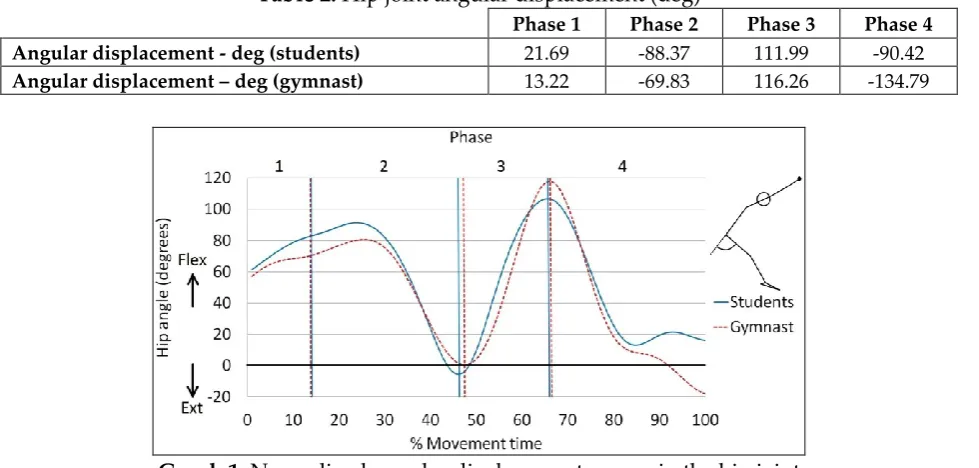
The results of the angular displacement are shown in graph 1. The motion amplitude at the gymnast ranges from -17.9 ° to 117.85 °, in total 135.75°. Among students, the amplitude of the motion is from -5.42 ° to 106.57 °, in the total angular amplitude of 112 °. The largest difference of -44.37 ° is present in the last phase 4, and the smallest in the third phase is 4.27 ° (Table 1).
Table 2: Hip joint angular displacement (deg)
Phase 1 Phase 2 Phase 3 Phase 4
Angular displacement - deg (students) 21.69 -88.37 111.99 -90.42
Angular displacement – deg (gymnast) 13.22 -69.83 116.26 -134.79
Graph 1: Normalized angular displacement curves in the hip joint
B. Angular displacement in the knee joint
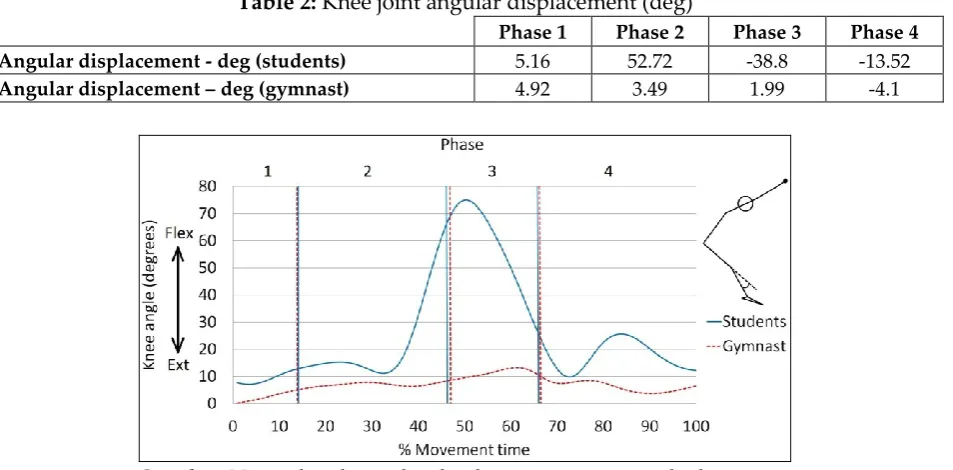
The angular displacement at all phases is presented separately in Table 2, from which it can be seen that the largest difference is present in the second (49.23 °) and the smallest in the first phase (0.24°).
Table 2: Knee joint angular displacement (deg)
Phase 1 Phase 2 Phase 3 Phase 4
Angular displacement - deg (students) 5.16 52.72 -38.8 -13.52
Angular displacement – deg (gymnast) 4.92 3.49 1.99 -4.1
Graph 2: Normalized angular displacement curves in the knee joint
3.2. Temporal Characteristics
The obtained results from the temporal characteristics of the movement presented in Charts 1 and 2, show different duration of movement between the gymnast (2.262 s) and students (2.421 s). In both the gymnast and the students, the first phase has the shortest duration in time, and the fourth phase has the longest.
Chart 1: Duration in time of the movement phases (s)
3.3Spatio-temporal characteristics
A. Angular velocity in the hip joint
The largest positive velocity value for the gymnast, indicating the counterclockwise direction is 804.41 deg/s, while among the students is 757.07 deg/s (Graph 3). The largest negative velocity value or rotation in clockwise direction among the gymnast is -789.37 deg / s, and among the students is -612.85 deg/s.
Graph 3: Normalized angular velocity curves in the hip joint
B. Angular velocity in the knee joint
The results of angular velocity in the knee joint are shown in Graph 4. The angular velocity in the knee joint is drastically higher in students and it ranges from -334 deg/s to 480 deg/s. For the gymnast it ranges from -81 deg / s to 38 deg / s.
4. Discussion
4.1Spatial characteristics A. Hip joint
Based on the shape of the curves of the angular displacement who are topologically equivalent in the hip joint (Graph 1), as well as the trend of increasing and decreasing on the angular amplitude it can be concluded that the coordination of movement between the gymnast and the students is very similar. From the very beginning, until the end of the first phase hip flexion is present, and continues to increase to approximately 1/3 of the second phase. Then, the flexion starts to decrease so that by the end of the second phase, both the gymnast and the students turn into an extension in the hip joint. From this position, they perform flexion and complete the third phase by reaching the maximum value. In both the gymnast and the students, immediately after the start of the fourth phase, there is a decrease in the flexion, which at the very end of the movement in the gymnast goes into an extension that retains it to the end of the movement, while the students stabilize at approximately the same value in the half of this phase value.
The angle in the hip joint at the end of the first phase for the gymnast is approximately 71 °. A similar result of 72.5 ° was also obtained by Hough, 1970, which analyzed the most successful performance of glide kip in respondents.
The smallest angular displacement in both the gymnast and the students is in the first phase. The highest angular displacement in the gymnast is in the third and among the students in the fourth phase. The results obtained by students in our research coincide with the results of the Kim et al. al., 2013, which determined the kinematic characteristics of glide kip on uneven bars among female gymnasts, dividing the movement into three phases so that the first phase was left out.
Regarding the angular displacement or the amplitude of motion in each of the four phases individually, the greatest difference between the gymnast and the students is present in the fourth phase and the smallest difference in the third phase.
B. Knee joint
the start of the fourth phase, while among the students there is a rapid decrease in the flexion that lasts slightly after the start of the last phase. Then it increases and gradually decreases to the very end of the movement.
The greatest angular displacement among at the gymnast is observed in the first phase, and the smallest in the third phase. Students have the highest amplitude in the second phase and the lowest in the first phase.
Observed individually in each of the phases, the largest difference between the gymnast and the students in the angular displacement is present in the second phase and the smallest difference in the first phase.
The large angular amplitude in the joint of the knee is particularly shown in begginers, since they have not yet mastered the element of the required level, so through flexion in the knee they reduce the moment of inertia of the leg so that they can ease perform angular movements in the hip joint.
4.2. Temporal characteristics
The largest difference between the gymnast and the students regarding the temporal characteristics is present in the total duration in time of the element which is longer for students by 0.159 s or 7% compared to the duration of the gymnast.
Bearing in mind the time pattern of the movement (rhythm) represented by the ratio of the length (percentage) of the duration of each of the phases of the movement, the gymnast and the students have a very similar rhythm of performing this element. Although the differences in the percentage of the duration of each phases are individually small, the largest percentage difference is present in the second phase (0.93%) and the lowest in the third phase (0.19%).
The total duration in time of the gymnast’s movement in our research is identical to the duration of the Mooney research, 1977, which determined the biomechanical features of this element in the top gymnasts of uneven bars. However, there is a difference in the percentage of the duration in time of the phases, ie, the rhythm of the movement, which is probably due to the differences in the initial position of the movement (in this study, the initial position is not by putting the hands on the bars, but they are placed on the bars immediately after the bounce from the floor), the differences in the morphological characteristics of the gymnasts and the differences in the physical characteristics of the gymnastic apparatus on which the element is performed.
4.3. Spatial-temporal characteristics A. Hip Joint
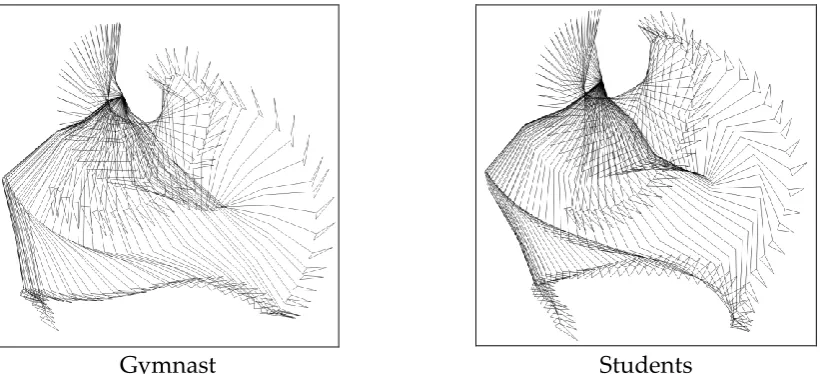
The kinogram from the 2D analysis of the element (Figure 2) shows differences in relation to the position of the body parts at the beginning of the last phase. The gymnast's hands and feet are maximally stretched and the feet are placed slightly above the bars. From this position, the swing of the legs is in the upward direction. The hands and feet of the students are bent and the feet are placed substantially higher above the bars, so that the swing of the legs is carried out horizontally forward. Bearing this in mind it can be concluded that the students use the action of the muscles of the hands and the shoulders, in contrast to the gymnast, whose main feature is the timely explosive and precisely targeted swing of the legs.
Gymnast Students
Figure 2: Kinogram from 2D analysis of glide kip
B. Knee joint
The results of the angular velocity in the knee joint (graph 4) shows significant differences between the gymnast and the students. The gymnastics, from the start up to half of the third stage, show relatively small fluctuations in velocity, which then increase and last until the end of the movement.
5. Conclusion
Despite the small number of respondents, the survey provides an overview of the spatial, temporal and spatial-temporal characteristics of the element of glide kip, preformed on low horizontal bars, performed by a gymnast and students. The kinematic analysis shows that the gymnast and students have a very similar angle-time pattern of movement in the hip joint and drastically different in the knee joint. In the temporal characteristics, the difference is present in the duration of the movement but the rhythm of movement is similar.
The angular velocity in the hip joint is significantly higher in the gymnast and the direction of swing of the legs is also different in comparison to the students. The results obtained could serve coaches or teachers to get information on how the technique of performing the element can be improved. Based on what was presented so far, one can conclude that each of the stages of the movement has its key characteristics, yet the most important instruction for learning the element in this example should be directed to the fourth phase, which refers to the speed and direction of the swing of the legs, as well as the amplitude reduction in the knee joint in order to get a better aesthetic look of the movement.
Bearing in mind that the research involves only angular kinematics in the two joints, we would also stress the need for research that would include determining some other kinematic characteristics like in other joints, determining the kinetic characteristics of the movement, comparing the performances between different qualitative levels of performance, comparing performance between different sexes, etc.
About the Author(s)
Aleksandar Aceski is currently Associate Professor at the Faculty of Physical Education, Sport and Health, Department of Biomechanics, Ss. Cyril and Methodius, Skopje, Republic of Macedonia. He has research interests in biomechanical methods of testing and analysis of human performance.
Katerina Spasovaka is currently Associate Professor at the Faculty of Physical Education, Sport and Health, Department of Gymnastics, Ss. Cyril and Methodius, Skopje, Republic of Macedonia. She has research interests in motor learning in gymnastics.
References
Bartlett, R. 2007. Introduction to sports biomechanics, analysing human movement patterns 2nd
Edition. Routledge.
Elmer, Ј.Е. & Martin, D.J. 2009. Fourier Series Approximations and Low Pass Filtering: Facilitating Learning of Digital Signal Processing for Biomechanics Students.
Sportscience, 13, 1-8.
Heinen, T., Apitius, K., & Mirzaie, F. 2013. Movement regulation of the glide kip in gymnastics. Sport Science, 1: 82‐86.
Hough, J.E. 1970. A film analysis of the glide kip. Master’s thesis. University of Tennessee.
Kim, S.K., Kim., S.E., & Jang, S.D. 2013. A kinematic analysis of glide kip motion on the uneven bars. Korean Journal of Sport Biomechanics, Vol. 23, No. 4, 307-318.
Knudson, V.D. 2013. Qualitative diagnosis of human movement 3th Edition. Champaign, IL: Human Kinetics.
Miller, A., & Callister, R. 2009. Reliable lower limb musculoskeletal profiling using easily operated, portable equipment. Elsevier, Physical Therapy in Sport 10, 30–37. Mitchell, D., Davis, B., & Lopez, R. 2002. Teaching fundamental gymnastics skills.
Champaign, IL: Human Kinetics.
McLean, S.G., Walker, K., Ford, K.R., Myer, G.D., Hewett, T.E., & Bogert, A.J. 2005. Evaluation of a two dimensional analysis method as a screening and evaluation tool for anterior cruciate ligament injury. J Sports Med,39:355–362.
Mooney, M.C. 1977. A kinematographic analysis of a glide kip on the uneven parallel bars. Doctoral dissertation in physical education. Texas Tech University. Munro, A., Herrington, L., & Carolan, M. 2012. Reliability of 2-dimensional video assessment of frontal-plane dynamic knee valgus during common athletic screening tasks. Journal of Sport Rehabilitation,21(1), 7–11.
Norris, B.S., Olson, L.S. 2011. Concurrent validity and reliability of two-dimensional video analysis of hip and knee joint motion during mechanical lifting.
Physiotherapy Theory and Practice, 2011; 27(7):521–530.
Payton, C.J., & Bartlett, R. 2008. Biomechanical evaluation of movement in sport and exercise. The British Association of Sport and Exercise Sciences Guidelines. Routledge. Robertson, D.G., Caldwell, E.G., Hamill, J., Kamen, G., & Whittlesey, N.S. 2014. Research methods in biomechanics 2nd edition. Champaign, IL: Human Kinetics.
Туфекчиевски, А., и Ацески, А. 2009. Биомеханика, второ прошиено и дополнето издание. Факултет за физичка култура – Скопје.
Wilson, D.J., Ireland L.M., Davis, I. 2006. Core Strength and Lower Extremity Alignment during Single Leg Squats. Med. Sci. Sports Exerc., Vol. 38, No. 5, pp. 945–952
Winter, D.A. 2009. Biomechanics and motor control of human movement 4th edition. John
Creative Commons licensing terms