Research Article
a
October
2017
Computer Science and Software Engineering
ISSN: 2277-128X (Volume-7, Issue-10)
Security in Smart Healthcare System: A Comprehensive
Survey
P. Jeyadurga Dr. S. Ebenezer Juliet I. Joshua Selwyn P. Sivanisha
(PG Scholar/CSE) (Associate Professor/CSE) (UG Scholar/CSE) (PG Scholar/CSE)
VV College of Engineering, Tamil Nadu, India
VV College of Engineering, Tamil Nadu, India
VV College of Engineering, Tamil Nadu, India
VV College of Engineering, Tamil Nadu, India
Abstract—The Internet of things (IoT) is one of the emerging technologies that brought revolution in many application domains such as smart cities, smart retails, healthcare monitoring and so on. As the physical objects are connected via internet, security risk may arise. This paper analyses the existing technologies and protocols that are designed by different authors to ensure the secure communication over internet. It additionally focuses on the advancement in healthcare systems while deploying IoT services.
Keywords: Internet of Things (IoT), Body sensor network (BSN), healthcare, security, privacy.
I. INTRODUCTION
The Internet of Things (IoT) is a concept of reflecting a conglomeration of devices that are connected to the internet. It is a next generation technology which will impact the whole world. Introducing automation allows people to live a sophisticated life style. IoT plays an important role in wide range of applications such as smart cities, structural health, emergency services, smart healthcare etc. In the last few years, this field has drawn huge attention from researchers to address the potential of the IoT in the healthcare field by considering various practical challenges. Wireless Sensor Network technology has its potential usage in wide range of applications. This technology is integrated with IoT to achieve huge changes to the future society. Health care is one of the most attractive applications of IoT which helps elder people to live independently. Apart from the advantages of IoT, there are several security and privacy issues to be considered when automating the healthcare system. This paper surveys about several security scheme that exist in health care and other applications of IoT.
In this paper, we conduct a comprehensive survey on various approaches in securing the healthcare system. The section II of this paper briefly describes the introduction of IoT and WBSN to give the right background for understanding the system. In this paper, section III lists out several security requirements that are required to resist various attacks to the healthcare system. Section IV describes various attacks that are more challenging to the healthcare environment. Section V presents the survey of various healthcare models and the comparison table in terms of protocol and the security services they provide. Finally, conclusion of the review paper is given in section VI.
II. OVERVIEW AND BACKGROUND
A. Internet of Things
Before investigating the IoTs in depth, it is worthy to look at the evolution of the Internet. The communication between two computers was made possible in the year of 1960. The Internet picked up ubiquity after the introduction of World Wide Web (WWW) in 1991. The Internet connectivity became more popular in many applications during 2000’s and today it is expected to be a part of many industries and enterprises to provide access to information. However, these devices require more human interaction and monitoring via applications and interfaces. Till now, the world has deployed around 5 billion “smart” connected things. Prediction says that there will be around 50 billion connected devices by 2020 [1]. IoT technology aims at transforming the world smart.
B. Wireless Body Sensor Network
ISSN(E): 2277-128X, ISSN(P): 2277-6451, pp. 39-48
III. SECURITY REQUIREMENTS IN HEALTHCARE SYSTEM
A. Mutual authentication
It refers to a two-way authentication scheme which guarantees that only an authorized user could access services. This is one of the most fundamental requirements for IoT based health care system for enabling secure communication. It improves the overall security of the system and eliminates mimicking and spoofing attacks.
B. Data Integrity
Data Integrity ensures that the data transmitted via network is not tampered, delayed or replayed by an adversary for malicious activity. Ensuring data integrity is essential to resist against modification, repudiation and replaying attacks. Data integrity maintains the correctness and consistency of the data during the entire life cycle of the data.
C. User anonymity
To protect the user’s privacy, the protocol must be able to provide user anonymity. This requirement guarantees that the attacker could never access the information of a legal party. This keeps the identity of the patient secretive. The anonymity preservation is a very important requirement to be considered in maintaining the security of the system.
D. Availability
This requirement ensures that the server must be continuously available to the user to access information or send commands when required. Sensory data and wearable medical services must be available at all times. More significantly, data should be correct always and should be able to dynamically adapt to event, time and location and the data.
E. Non-traceability
An authentication protocol should be able to provide non-traceability; i.e., the adversary should not be able to trace the action of the valid user. The patient’s location information is transmitted via communication channel. As this information is highly confidential, this must be done in a secured way so that an attacker can never trace out the exact position of the patient.
F. Session key establishment
The session key agreement is an essential property for entity authentication and secure communication. A session key shared between two communicating parties is needed to ensure confidentiality and integrity of data. Therefore, an authentication protocol should support the session key establishment.
G. Data confidentiality
This requirement ensures that the information is transmitted securely during all communications between the communicating parties. Since the medical data are highly sensitive, it must be encrypted both at storage and during transmission, so that users without the correct keys cannot access the data. Therefore, the privacy of the wireless communication channels must be considered to prevent the data from eavesdropping.
H. Access control
The security mechanism must be able to properly enforce different access rights for different users. The access control mechanism must be resilient to attacks from colluding adversaries and from cloned devices. The system should be able to verify the user and give permission to access service. For each access request, the system must verify the validity of the user. If the user is invalid, user request will not be proceed and he will not be allowed to access the services. On successful verification, the access is granted to the requester.
IV. ATTACK MODEL
From the security strength point of view, assumptions of the existence of a stronger adversary will result in stronger security guarantee, which is a prerequisite for certain critical applications, such as smart grids, smart health care system etc. In this section, few types of possible attacks in the advanced health care system are presented.
A. Eavesdropping attack
ISSN(E): 2277-128X, ISSN(P): 2277-6451, pp. 39-48
the agreed session key which is unknown to an eavesdropping adversary, who is able to eavesdrop and record all the data transmission between communicating parties during the authentication phase.
B. Impersonation attack
This attack occurs when an illegal user pretends to be a legal entity by replaying a genuine message intercepted from a previous successful communication. An adversary may attempt to launch an impersonation attack by replaying the intercepted messages or modifying the intercepted message parameters
C. Replay attack
In replay attack, an attacker usually traps and transmits the prior executed messages to the recipient entities to prove that the message has been sent from the legal sender entity .i.e., an adversary would like to cheat the protocol entities by replaying previous used messages. The random number and timestamps are two mainly used mechanisms to resist replay attack. Using these two parameter verification, the replay message will be rejected.
D. Man-in-the-middle attack
This attack occurs when the adversary silently listens to the communication of two legal parties with the intent
to delay, alter or delete messages exchanged during communication. When a patient is in urgent need of medication, an attacker in extreme conditions may prescribe worst kind of medication procedures which may lead to the loss of valuable life. Resistance to man-in-the-middle attack is one of the most important security considerations after authentication. An efficient solution for resisting man-in-the-middle attacks is to embed the identities of all communicating entities into the protocol message for entity authentication.
E. Session Key Attack
The session key attack is a serious threat to all session key establishing scheme. Session hijacking is the exploitation of a valid session to gain unauthorized access to the information in a computer system. A simple authentication and login activity without session key generation is not enough to guarantee any kind of security. The protocol must agree upon a common secret session key by which both parties exchange their information securely. The session key must be refreshed after every session in a way that does not allow the adversary to deduce any other session key and it should also be secured under one way hash function.
F. Mobile Device Stolen Attack/Stolen smart device attack
The user’s smart device is a tamper-resistant device. If the smart device of a user is lost or stolen, an attacker can retrieve all the sensitive information stored in the stolen smart device’s memory. Then, using this retrieved information, the attacker can retrieve other secret information of the communicating parties. So, mobile device stolen attack must be restricted.
G. Spoofing attack
Spoofing or Masquerading is a type of attack that causes threat to data integrity. In this attack scenario, a false user pretends to be a doctor or the medical database of a recognized hospital to give false medication to a genuine patient. Therefore, it is important to protect the system against spoofing attack.
H. Denial of service attack
It is an attempt to make a resource unavailable despite being ready for service. An attacker sends superfluous messages to a mobile station or an authentication server to make the resource inaccessible to valid users. DoS attack causes severe damage to the availability of resources. The server would be overburdened with too many fake requests to function it properly.
V. SECURITY IN ADVANCED HEALTHCARE PROJECTS
ISSN(E): 2277-128X, ISSN(P): 2277-6451, pp. 39-48
Fig.1 Smart HealthCare System
In 2006, Wood A et.al [3] developed ALARM-NET, an Assisted-Living And Residential Monitoring NETwork that combines different devices in a simple architecture, connecting wearable body networks, wireless sensors, and IP-network elements. Real-time data queries are a significant process in ALARM-NET. It permits users to interact with the running system and allows automatic data collection. Queries are determined by <source, ID> tuples, and request a certain type of sensor data about a subject. If the subject is a user, the AlarmGate translates it to a particular sensor, by consulting static sensor configuration or the current location of the subject. Authorization policies are used to control the access to the sensor data. For each and every query, the sensor samples the requested data and completes the transaction by returning a single report to the originator. Periodic queries are distributed with a given sample period and the reports are streamed back to the requester until a stop command is received. The reissue command can be used to restart the query later.The crucial part of ALARM-NET is to secure the medical records and data. To protect the data against unauthorized disclosure, access to an AlarmGate is restricted by authentication process using Secure Remote Password (SRP) Protocol. After successful authentication, the session key is used with AES (Advanced Encryption Standard) modes for encryption. Messages sent and received from/to the client by the AlarmGate are encrypted when needed. The communication between the WSN and the AlarmGate should also be secured using Message Authentication Codes (MACs) and encryption. The power consumption and overhead is reduced by the Lightweight protocols with hardware accelerated cryptography.
Next in 2009, Huang Y.M et.al [4] presented a study that focuses on developing a healthcare monitoring architecture, structured by three network tiers that provide pervasive and secure access to wearable sensor systems. The security services for an appropriate and constant healthcare monitoring are promoted by combining various wireless techniques and adaptive encryption cryptography. The Wireless Sensor Motes (WSM) design includes Bluetooth chip and a fabric belt. This belt combines two types of sensors to monitor the healthcare and the chip is built with enhanced security schemes to provide secure transmission and low-power consumption. The Wearable Sensor System (WSS) enhances the Bluetooth security authentication and encryption with AES-based encryption schemes. The point-to-point communication between two WSM is secured using a polynomial-based encryption scheme. The symmetrical key cryptosystem is used in securing data transmission.
ISSN(E): 2277-128X, ISSN(P): 2277-6451, pp. 39-48
authentication process. Both public key and symmetric cryptography are employed. The DH key agreement is employed in encrypting wireless data transmission between the nodes. Finger satisfies all the necessary security requirements to protect the system against possible attacks.
Medical Emergency Detection in Sensor Networks (MEDiSN) is a wireless sensor network developed by Ko.J et.al [6] for observing patients in hospitals. MEDiSN encompasses Physiological Monitors (PMs) and patient-worn motes. PMs are custom-built and the motes encrypt the physiological data and Relay Points (RPs) that carries the collected data. Collection Tree Protocol (CTP) is the key routing infrastructure used for transmitting PM measurements to the gateway. CTP is enhanced to deliver commands from the gateway to individual PMs. Hop-by-hop re-transmissions is used for protecting the data flowing in both directions.
Yu S et.al [7] presented a Fine-grained Distributed data Access Control (FDAC) scheme in 2011. This scheme is resilient against strong attacks like sensor compromise and user colluding. It also imposes fine-grained access control over sensor data. This scheme exploits a new cryptographic primitive named Attribute-Based Encryption (ABE), to secure WSNs and to improve performance. Employment of distributed data storage and network access gives energy efficiency and can avoid weaknesses such as performance bottleneck, single point of failure, which are unavoidable in the centralized system. Instead of sending the data immediately to a centralized site, the distributed approach stores the data locally or at some selected nodes within the network. Due to its security advantages, fine-grained data access control can be used in healthcare system in order to prevent illegal access to the sensitive data.
Later, in 2012, a novel key agreement scheme is presented by Zhaoyang Zhang et.al [8] that allows the nodes in Body Area Networks (BANs) to share a key in an energy efficient manner. The key generated by the ElectroCardioGram (ECG) signal is used in hash-based message authentication and data encryption. The Improved Jules Sudan (IJS) algorithm is proposed in order to construct the key that focuses on message authentication between the sensor nodes. The ECG-IJS key agreement scheme ensures secure data communications over BANs in a plug-n-play manner without any overheads. This approach focuses on the data confidentiality, security and data authenticity.
Fuzzy Attribute-Based SignCryption (FABSC) is a novel security mechanism designed by Hu C et.al [9] to make appropriate tradeoff between security and elasticity. FABSC leverages fuzzy attribute-based encryption to facilitate digital signature, data encryption and access control to a patient’s medical data. The rapid development of WSNs and biomedical engineering practices enables Body Area Networking. A typical BAN comprises of a number of BAN devices and a BAN controller. The devices include implanted sensors and wearable sensors. BANs are designed to monitor the human body parameters and to assist them by providing life support. A number of privacy and security issue arises while storing and processing the personal health information. The FABSC proposed in this paper, provides both security and authentication for BANs. FABSC has two desired properties:
Sincryption (signature and encryption).
Error-tolerance.
A novel Radio Frequency Identification (RFID) authentication protocol using Elliptic Curve Cryptosystem
(ECC) is developed by Chunhua Jin et.al [10]. To guarantee secure communication in RFID based healthcare systems,
various security protocols have been suggested for different applications. The RFID authentication protocol is the one of the most important protocol among them. Through this protocol, the tag and the reader can authenticate each other. This protocol involves two phases. Phase I is termed as setup phase where the key is generated for both the server and the tag. In phase II, the server and the tag authenticate each other using random number generation. So this phase is represented as authentication phase.
In 2015, Gope P et.al [11] proposed a distributed IoT system architecture. This system uses an anonymous authentication scheme which ensures notable security properties like cloning attacks, resistance to replay attacks, sensor anonymity etc. The authentication scheme consists of three phases. Phase I is called registration phase where a Home IoT Server (HIoTS) issues security credentials to a sensor node over a secure channel. Phase II is designed for inter cluster movement of the sensor node, where a sensor node may move from one cluster to another by preserving strong anonymity. In Phase III, the anonymous authentication environment for inter-network movement of the sensor node is presented. So this phase can be represented as inter-network movement phase. This authentication scheme can be used in many applications such as radio-frequency identification-based IoT system, Biosensor-based IoT healthcare system etc.
In 2015, Lightweight Anonymous Authentication Protocol Using k-pseudonym Set is proposed by Xinghua Li
ISSN(E): 2277-128X, ISSN(P): 2277-6451, pp. 39-48
users to adaptively adjust the value of k according to their own privacy requirements, which improves the flexibility of the system. The value of k can be set bigger for advanced privacy requirements which lead to a higher success rate. This method can also be applied to mobile communication, Wi-Fi, RFID, etc., due its higher efficiency. In addition to that, it can be used in Wireless Body Sensor Network to prevent privacy of patient.
Amin et.al [13] presented a health monitoring system architecture that secures the medical data transmitted over wireless networks and also reduces the energy consumption of the sensor nodes. Hash function-based mutual authentication and session key negotiation protocol is used that provides user anonymity for medical professional. The proposed authentication protocol includes five phases namely 1) Setup 2) Medical professional registration 3) Patient registration 4) Login and authentication, and 5) Password change phase. AVISPA tool is used to measure security strength of the protocol. The protocol withstands all the attacks.
In 2016, Light weight anonymous authentication protocol is proposed by Prosanta Gope et al.[14] in order to provide secure communication between Local Processing Unit (LPU) and BSN-Care Server. The protocol consists of two phases: Phase I is called registration phase where the patient data is registered securely in the BSN care server and Phase II is the anonymous authentication phase where the communication among the two entities is secured using one way hash function and Exclusive OR operation. In addition to this, Offset CodeBook (OCB) based encryption scheme is used to provide data security.
In 2016, Yeh et.al [15] developed a Secure IoT-based healthcare system which operates through BSN
architecture. The system consists of two phases: the system initialization phase and the authentication phases. In the
system initialization phase, all of the security parameters will be agreed upon and shared among the communication entities via a secure channel. The communication entities here refer to the wearable bio-sensors, the LPU and the BSN server. In authentication phase, all the communication and data exchanges among the communication entities are secured. Lightweight crypto-modules, such as a one-way hash function, bitwise exclusive-OR operations and random number generation function are implemented to achieve security robustness and system efficiency. In order to reveal the practicability and possibility of the presented mechanisms, the healthcare system is implemented with the Raspberry PI platform.
The mutual authentication and key agreement (MAKA) scheme proposed in [16] used low-cost cryptographic primitives, such as EXCLUSIVE-OR operation and one-way hash functions. The presented scheme can preserve the user anonymity for roaming services in GLOMONET. This scheme includes three phases namely, registration phase, MAKA phase and password renewal phase. The proposed scheme for global mobility networking (GLOMONET) can resist various security attacks and also reduces overhead. This developed protocol can also be used in securing the data transmission in healthcare sectors.
To increase the quality of medical services, Li X et.al [17] employed the Wireless Body Area Networks (WBAN) in healthcare monitoring. Since the sensitive information of the patients’ collected by WBAN is transmitted via wireless channel, an improved light-weight single-round authentication protocol [13] is developed by the author. The protocol contains initialization, registration and authentication phases. The security analysis shows that the protocol increases the
security of the system.
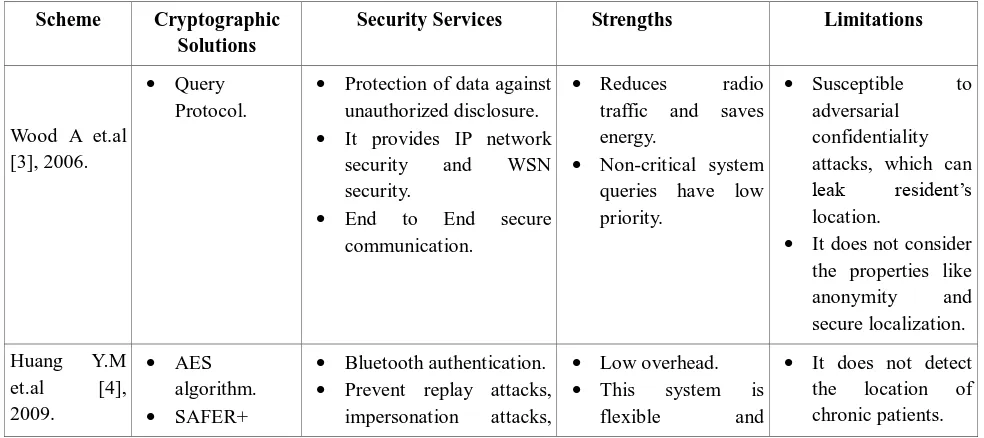
Table I Comparative analysis on different Cryptographic Solutions, Security Services, Strength and limitations
Scheme Cryptographic Solutions
Security Services Strengths Limitations
Wood A et.al [3], 2006.
Query
Protocol.
Protection of data against
unauthorized disclosure.
It provides IP network
security and WSN
security.
End to End secure
communication.
Reduces radio
traffic and saves energy.
Non-critical system
queries have low priority.
Susceptible to
adversarial confidentiality attacks, which can
leak resident’s
location.
It does not consider
the properties like
anonymity and
secure localization.
Huang Y.M
et.al [4],
2009.
AES
algorithm.
SAFER+
Bluetooth authentication.
Prevent replay attacks,
impersonation attacks,
Low overhead.
This system is
flexible and
It does not detect
the location of
ISSN(E): 2277-128X, ISSN(P): 2277-6451, pp. 39-48
encryption algorithm.
spoofed routing and
routing alteration.
Ensure non-repudiation
and quickest-path
discovery.
reliable.
Yanmin Zhu
et.al [5],
2009.
Finger policy
system.
Enforces authentication,
encryption and time
stamping to guard against attacks.
Guarantee data integrity.
This policy system
is feasible for the
majority of
available sensor
platforms.
Higher ability to
recover from errors and better flexibility
to change the
behaviour at
execution time.
Finger does not
support dynamic
code modification.
The policy
language is not a
general purpose
programming language.
Ko.J et.al [6], 2010. Delta compression algorithm. Collection Tree Protocol.
End to end encryption,
Authentication of PM data.
Physiological data
is sent with an end-to-end latency of
less than five
seconds.
Alerts from patient
are delivered with higher probability.
Less scalable.
It does not reveal
much about
security
implementation.
Yu S et.al [7], 2011.
SHA-1
(one way hash function).
Advanced
Encryption Standard.
Data confidentiality
and integrity.
Resilience to user
colluding and sensor
compromising attacks.
Backward Secrecy.
Fine-grained Data
Access Control.
It resists sensor
compromise and
user colluding
attacks.
Data security
becomes a serious
concern due to
distributed storage of sensor data.
Zhaoyang Z
et.al [8],
2012.
Improved
Jules
Sudan (IJS)
algorithm.
Key agreement
protocol
Data confidentiality.
Data authenticity and
integrity.
Low overhead.
It is a lightweight and energy efficient security solution.
It can be vulnerable
to Wormhole
attack, sinkhole
attack, and Sybil attack.
No optimal vault
size and difference tolerances.
Hu C et.al [9], 2013. Signcryption algorithm. Attribute-based cryptosystem. Authentication
Access Control
Unforgeability
Collusion Attack
Resistance.
It combines
encryption and
digital signatures to offer confidentiality, collusion Resistance and authenticity.
The
communication cost is high.
Access control
structure is not
implemented.
Chunhua Jin
et.al [10],
2015.
RFID
authentication protocol.
Mutual authentication,
anonymity, availability
and forward security.
Withstand replay attack,
impersonation attack,
RFID authentication
protocol is more
suitable for
healthcare environment.
The
communicational
and computation
ISSN(E): 2277-128X, ISSN(P): 2277-6451, pp. 39-48
server spoofing attack,
DoS attack, location
tracking attack and
cloning attack.
This protocol can
endure numerous
security attacks.
Gope P et.al [11], 2015.
Anonymous
authentication protocol.
Mutual Authentication.
Sensor Anonymity and
Untraceability.
Resistance to Replay
Attacks and cloning
attacks.
Less computational
overhead.
This scheme suits
for
resource-constrained WSN
based IoT system.
Some of the attack resistance property is not considered.
Xinghua Li
et.al [12],
2015.
Anonymous
authentication protocol.
Anonymous Success
Rate.
Untraceability.
Delay is reduced.
Easy to implement.
Participation of
server in the
construction of
k-pseudonym set
increases its
burden.
Inappropriate
construct, will lead
to significant
overhead for the networks.
Amin et.al
[13], 2016.
Hash
function-based mutual authentication
and session
key negotiation protocol.
Offers Authentication,
anonymity, data integrity
and confidentiality
services.
Resists mobile device
stolen attack,
untraceability attack, off-line password guessing
attack, impersonation
attack.
The protocol can
ensure various
security
requirements and
can withstand
several attacks.
The protocol is
not implemented
in
Internet-of-Things and cloud environments.
Prosanta
Gope et.al
[14], 2016
Light weight
anonymous authentication protocol.
OCB based
data encryption.
Data Privacy
Data Integrity
Data Freshness
Authentication
Anonymity
Secure Localization
It satisfies several
security
requirements of IoT based health care system.
Communication
overhead is
high.
Yeh et.al [15], 2016.
SHA-3 Data Integrity,
Authentication, Anonymity,etc.
It achieves system
efficiency and
robustness.
Practicability of
IoT-based
healthcare system is guaranteed.
The computation
cost can be reduced further.
Gope P et.al [16], 2016. Lightweight mutual authentication protocol. SHA-256.
Mutual Authentication
and Fair Key Agreement.
Privacy Against
Eavesdropper (PAE) with
User Anonymity and
Untraceability.
It satisfies several
security
requirements and
resists known
attacks.
The system is not
tested against
several other
possible security
ISSN(E): 2277-128X, ISSN(P): 2277-6451, pp. 39-48
Resistance to Forgery
Attack, Insider Attack.
Security against Known
Session Key Attack and Security Assurance in Case of Lost Smart Card.
Li X et.al
[17], 2017.
Single-round
authentication protocol.
SHA-1.
The system can resist
forgery attack, session
key guessing attack,
Denial-of-Service attack, replay attack,
session-specific temporary
information attack,
insider attack,
Key-Compromise
Impersonation attack
(KCI).
It achieves Mutual
authentication, user
anonymity and
untraceability property.
It satisfies almost
all the basic security properties needed to
preserve the
patient’s medical
record.
The protocol fails
to include GPS
information which
is important to
detect chronic
patient location.
The various cryptographic protocols used in different papers and the security services that are relevant to the systems are summarized in table 1. The table gives a better understanding of security measures and protocols available in the existing systems, along with a brief analysis of each security scheme's strength and weaknesses.
VI. CONCLUSION
The IoT technology brought huge attention in everybody's life. This paper presents various aspects of IoT based healthcare technologies. Since data protection and privacy of users are considered as the major challenges, researchers across the world has provided various technological solutions to enhance privacy and security mechanisms in healthcare applications. This paper surveys on well-planned security mechanisms in IoT based healthcare system. The basic security requirements such as health data protection, data confidentiality, data integrity, authentication etc., are addressed by the authors. In addition to these requirements, the protocols with light weight solution must also be considered to facilitate the researchers to come up with the more robust security mechanisms.
REFERENCES
[1] The evolution of internet of thing, TEXAS INSTRUMENTS, September 2013.
[2] Kumar P, Lee HJ, "Security issues in healthcare applications using wireless medical sensor networks: A survey," Sensors, Vol. 12, No. 1, pp. 55-91, Dec 2011.
[3] Wood A, G. Virone, T. Doan, Q. Cao, L. Selavo, Y. Wu, L. Fang, Z.He, S. Lin, J. Stankovic, “ALARM-NET:
Wireless Sensor Networks for Assisted-Living and Residential Monitoring,” Department of Computer Science, University of Virginia; Charlottesville, VA, USA:2006. Technical Report CS-2006-01.
[4] Huang Y.M, M. Y. Hsieh, H. C. Chao, S. H. Hung, and J. H. Park, “Pervasive, Secure Access to a Hierarchical
Sensor-Based Healthcare Monitoring Architecture in Wireless Heterogeneous Networks,” IEEE Journal on Selected Areas in Communications, Vol. 27, No. 4, pp.400-411,May 2009.
[5] Yanmin Zhu, Sye Loong Keoh, Morris Sloman, and Emil C. Lupu, “A Lightweight Policy System for Body Sensor Networks,” IEEE Transactions on Network and Service Management, Vol. 6, No. 3, pp.137-148, September 2009.
[6] Ko.J, J. H. Lim, Y. Chen, R. Musaloiu-E, A. Terzis, G. M. Masson, “MEDiSN: Medical Emergency Detection
in Sensor Networks,” ACM Trans. Embed. Comput. Syst. Vol. 10, No. 1, pp. 1–29, 2010.
[7] Yu S, K. Ren, and W. Lou, “FDAC: Toward fine-grained distributed data access control in wireless sensor networks,” IEEE Trans. Parallel Distrib. Syst., Vol. 22, No. 4, pp. 673–686, 2011.
[8] Zhaoyang Zhang, Honggang Wang, Athanasios V. Vasilakos, and Hua Fang, “ECG-Cryptography and
ISSN(E): 2277-128X, ISSN(P): 2277-6451, pp. 39-48
[9] Hu C, N. Zhang, H. Li, X. Cheng, and X. Liao, “Body Area network security: A fuzzy attribute-based signcryption scheme,” IEEE J. Select. Areas Commun. (JSAC), Vol. 31, No. 9, pp. 37–46, 2013.
[10] Chunhua Jin, Chunxiang Xu, Xiaojun Zhang, Jining Zhao,“A Secure RFID Authentication Protocol for
Healthcare Environments Using Elliptic Curve Cryptosystem,” Journal of Medical Systems, Vol. 39, No. 3, pp.1-8, March 2015.
[11] Gope P, T. Hwang, “Untraceable Sensor Movement in Distributed IoT Infrastructure,” IEEE Sensors Journal,
Vol. 15, No. 9, pp. 5340 – 5348, 2015.
[12] Xinghua Li,Hai Liu,Fushan Wei,Weidong Yang,“A Lightweight Anonymous Authentication Protocol Using
k-pseudonym Set in Wireless Networks,” IEEE Global Communications Conference (GLOBECOM), pp. 1-6, December 2015.
[13] Amin, Ruhul, SK Hafizul Islam, G. P. Biswas, Muhammad Khurram Khan, and Neeraj Kumar, "A robust and
anonymous patient monitoring system using wireless medical sensor networks," Future Generation Computer Systems, 2016.
[14] Prosanta Gope, Tzonelih Hwang, “BSN-Care: A Secure IoT-Based Modern Healthcare System Using Body
Sensor Network,” IEEE Sensors Journal, Vol. 16, No. 5, pp.1368-1376, 2016.
[15] Yeh, Kuo-Hui, "A Secure IoT-based Healthcare System with Body Sensor Networks," IEEE Access, 2016.
[16] Gope P, T. Hwang, “Lightweight and energy-efficient mutual authentication and key agreement scheme with user anonymity for secure communication in global mobility network,” IEEE Systems Journal, Vol. 10, No. 4, pp.1370-1379, Dec 2016.
[17] Li, X., Peng, J., Kumari, S., Wu, F., Karuppiah, M. and Choo, K.K.R., “An enhanced 1-round authentication