SYNTHESIS AND MOLECULAR DOCKING STUDIES OF
NOVEL PYRIDINE-THIAZOLE-HYDRAZONE CONJUGATES
AS ANTIMICROBIAL AND ANTIOXIDANT AGENTS
Mahesh B. Muluk,
[a]Pravin S. Patil,
[a]Sanghratna L. Kasare,
[a]Ravibhushan S. Kulkarni,
[a]Prashant P. Dixit,
[b]Prafulla B. Choudhari
[c]and Kishan P. Haval
[a]*Keywords: Antimicrobial activity, antioxidant activity, thiazole, hydrazone, molecular docking study.
In the investigation, a series of new pyridyl and thiazolyl clubbed hydrazone derivatives have been synthesized. The newly synthesized compounds were evaluated for their in vitro antimicrobial and antioxidant activities. Some among the compounds have shown excellent antimicrobial activity against both bacterial and fungal pathogens. Two compounds among the series have exhibited excellent antioxidant activity. Furthermore, a molecular docking study has been performed against DNA gyrase to know the binding modes of these molecules and recorded good binding affinity. The ADME study has also been performed for predicting the pharmacokinetic profile, which expressed good oral drug-like behaviour.
* Corresponding Authors Fax:
E-Mail: [email protected]
[a] Department of Chemistry, Dr. Babasaheb Ambedkar Marathwada University SubCampus, Osmanabad 413501 (MS) India
[b] Department of Microbiology, Dr. Babasaheb Ambedkar Marathwada University SubCampus, Osmanabad 413501 (MS) India
[c] Department of Pharmaceutical Chemistry, BharatiVidhyapeeth College of Pharmacy, Kolhapur 416013 (MS) India
INTRODUCTION
Antibiotic resistance has to turn out to be one of the major issues of global health. The various medical treatments such as cancer chemotherapy, organ, transplantation, major surgery and diabetes management have become difficult without effective antimicrobial agents.1 The available
antimicrobial agents in the market have several drawbacks, including toxicity, low effectiveness, and environmental issues. Therefore, the exploration and progress of high-efficient antimicrobial agents with a different mode of action is of prime importance.2
The incorporation of two or more bioactive pharmacophores in a hybrid architecture is one of the important technique used in the new drug discovery.3-7
Thiazole pharmacophore linked with different pharmacophores for the construction of new bioactive compounds has gained much consideration in current years.8,9 The thiazole comprising molecules are reported to
have encouraging α-glucosidase inhibiting,10 antioxidant,11
anti-inflammatory,12 anti-Candida13 and antifungal14
activities. The pyridine nucleus is widespread in many naturally occurring bioactive products and is tremendously useful for the development of new bioactive synthetic compounds. Pyridine derivatives are known for biological activities such as antimicrobial,15 anticancer,16
anti-inflammatory, analgesic,17protein kinase inhibitor,18and
antitubercularactivities.19 Pyridine-thiazole clubbed
molecules are designed with extensive applications in
medicinal chemistry.20,21 Compounds containing a N
-acylhydrazone (NAH) pharmacophore have shown to possess anticancer, anti-HIV, antimicrobial,22 antibacterial,
antitubercular,23 antioxidant,24 anti-proliferative,25
analgesic,26 anti-inflammatory,27 and anthelmintic
activities.28 Its significance and persistent presence in
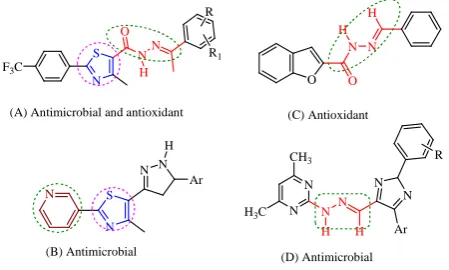
bioactive molecules have attracted many researchers towards the NAH moiety.29-32 The representative bioactive
hydrazones reported in the literature are shown in Figure 1.
Figure 1. Some bioactive hydrazones.
In continuation, of our efforts to synthesize hydrazone derivatives having medicinal properties activities,33-36 we
have synthesized new hydrazone derivatives starting from ethionamide. The synthesized compounds were evaluated for their in vitro antimicrobial and antioxidant activities.
EXPERIMENTAL
The commercially available chemicals and reagents were used directly without further purification. The IR spectra (Neat) were recorded on Bruker FTIR spectrometer.The 1H
and 13C NMR spectra were recorded on Bruker NMR
(400 MHz) spectrometer. The chemical shifts were reported
(C) Antioxidant
(D) Antimicrobial (A) Antimicrobial and antioxidant
N N
N S
O
NN
F3C H
R
N N
H H
CH3
H3C
N N
Ar
R1 N
O N H
H
(B) Antimicrobial
O
R
N
N S
N N
in parts per million (ppm). TMS is used as a reference. The coupling constants (J) are reported in Hertz (Hz).
Procedure for the synthesis of ethyl 2-(2-ethylpyridin-4-yl)thia-zole-4-carboxylate (3).
The mixture of 2-ethylpyridine-4-carbothioamide (1) (1.0 mmol) and ethyl bromopyruvate (2) (1.3 mmol) was refluxed in ethanol. The progress of the reaction was monitored by TLC. After completion of the reaction in 4 h, the ethanol was evaporated under a vacuum. The residue obtained was dissolved in ethyl acetate (50 mL) and neutralized by ammonia solution. The organic layer was washed with brine and dried over anhydrous sodium sulphate. The ethyl acetate was evaporated under vacuum and the obtained product was purified by column chromatography using ethyl acetate and petroleum ether to furnish ethyl 2-(2-ethylpyridin-4-yl)thiazole-4-carboxylate (3) as a thick oil. Yield 90 %. 1H NMR (400 MHz, CDCl
3) δ
= 1.20 (t, J = 6.4 Hz, 3H, CH3), 1.28 (t, J = 8.0 Hz, 3H,
CH3), 2.75 (q, J = 6.4 Hz, 2H, CH2), 4.30 (q, J = 8.0 Hz, 2H,
O-CH2), 7.49 (s, 1H, Ar-H), 7.62 (s, 1H, Ar-H), 8.14 (s, 1H,
Thiazolyl-H), 8.47 (s, 1H, Ar-H).
Procedure for the synthesis of 2-(2-ethylpyridin-4-yl)thiazole-4-carbohydrazide (4).
Compound 3 (1.0 mmol) and excess of hydrazine hydrate (3.0 mmol) were refluxed in ethanol. The progress of reaction was monitored by TLC. After completion of the reaction, the ethanol was evaporated under reduced pressure. The obtained residue was poured in ice-cold water. The solid obtained was filtered, washed with water and crystallized with ethanol to furnish 2-(2-ethylpyridin-4-yl)thiazole-4-carbohydrazide(4). Yield: 75 %, mp: 97-99 oC. 1H NMR (400 MHz, DMSO-d
6) δ = 1.28 (t, J = 7.2 Hz, 3H,
CH3), 2.84 (q, J = 7.2 Hz, 2H, CH2), 4.63 (bs, 2H, NH2),
7.80 (d, J = 4.1 Hz, 1H, Ar-H), 7.93 (s, 1H, Ar-H), 8.41 (s, 1H, Thiazolyl-H), 8.62 (d, J = 4.1 Hz, 1H, Ar-H), 9.88 (s, 1H, NH); 13C NMR (100 MHz, DMSO-d
6) δ = 13.69, 30.64,
117.85, 118.45, 125.04, 139.47, 150.02, 150.10, 159.62, 164.19, 164.91.
General procedure for the synthesis of substituted (E)-N'-ben-zylidene-2-(2-ethylpyridin-4-yl)thiazole-4-carbohydrazide derivatives (6a-l)
The mixture of aromatic aldehydes (5a-l) (1.0 mmol) and
4 (1.0 mmol) was dissolved in diisopropyl-ethyl ammonium acetate (DIPEAc) (5 mL) and stirred at room temperature for 30 min. Then, the reaction mixture was poured on cold water. The solid obtained was filtered and washed with cold water. The products obtained were crystallized with ethanol to furnish the correspondingsubstituted (E)-N '-benzylidene-2-(2-ethylpyridin-4-yl)thiazole-4-carbohydrazide (6a-l) with 82-95 % yields.
(E)-N'-(3-Bromobenzylidene)-2-(2-ethylpyridin-4-yl)thiazole-4-carbohydrazide(6a)
Yield 84%, m.p. 138-140 °C. IR (Neat) : 3265, 3103, 2976, 2906, 1663, 1589, 1539, 1487, 1418, 1357, 1265,
1215, 1177, 1039, 929, 840, 791, 655 cm-1. 1H NMR (400
MHz, DMSO-d6) δ = 1.30 (t, J = 6.4 Hz, 3H, CH3), 2.88 (q, J = 6.4 Hz, 2H, CH2), 7.45 (t, J = 8.2 Hz, 1H, Ar-H), 7.66
(dd, J = 8.2 & 4.1 Hz, 1H, Ar-H), 7.75 (d, J = 8.2 Hz, 1H, Ar-H), 7.88 (dd, J = 4.1 & 4.1 Hz, 1H, Ar-H), 7.94 (s, 2H, Ar-H), 8.62 (s, 1H, Thiazolyl-H), 8.67 (d, J = 4.1 Hz, 1H, Ar-H), 12.00 (s, 1H, Amido-NH). 13C NMR (100 MHz,
DMSO-d6) δ = 13.80, 30.69, 118.04, 118.64, 122.26, 126.48,
127.78, 129.18, 131.16, 132.83, 136.73, 139.36, 147.29, 149.60, 150.22, 156.88, 164.28, 165.37. HRMS (ESI)+ calcd.
for C18H15BrN4OS [M+H]+ 415.0150. Found 415.0127.
(E)-2-(2-Ethylpyridin-4-yl)-N'-(4-fluorobenzylidene)thiazole-4-carbohydrazide (6b)
Yield: 87 %, m.p. 122-124 °C. IR (Neat): 3237, 3042, 2913, 2898, 2807, 1669, 1588, 1517, 1470, 1402, 1366, 1275, 1240, 1167, 1039, 959, 908, 821, 713, 661 cm-1. 1H
NMR (400 MHz, DMSO-d6) δ = 1.30 (t, J = 7.5 Hz, 3H,
CH3), 2.85 (q, J = 7.5 Hz, 2H, CH2), 7.32 (t, J = 8.3 Hz, 2H,
Ar-H), 7.80-7.83 (m, 2H, Ar-H), 7.87 (dd, J = 3.9 & 3.9 Hz, 1H, Ar-H), 7.94 (s, 1H, Thiazolyl-H), 8.65 (s, 2H), 8.67 (d,
J = 8.3 Hz, 1H), 11.88 (s, 1H, Amido-NH). 13C NMR (100
MHz, DMSO-d6) δ = 13.82, 30.71, 115.94, 116.16, 118.04,
118.64, 127.54, 129.43, 129.52, 130.87, 139.39, 147.97, 149.74, 150.22, 156.77, 162.04, 164.31, 165.33. HRMS (ESI)+ calcd. for C
18H15FN4OS [M+H]+ 355.0951. Found
355.1028.
(E)-N'-(4-Chlorobenzylidene)-2-(2-ethylpyridin-4-yl)thiazole-4-carbohydrazide (6c).
Yield 83 %, m.p. 160-162 °C. IR (Neat): 3131, 3052, 2969, 2916, 1670, 1597, 1536, 1487, 1408, 1356, 1228, 1177, 1096, 1058, 1025, 977, 897, 828, 786, 705, 659 cm-1. 1H NMR (400 MHz, DMSO-d
6) δ = 1.30 (t, J = 5.2 Hz, 3H,
CH3), 2.87 (q, J = 5.2 Hz, 2H, CH2), 7.54 (d, J = 8.1 Hz, 2H,
Ar-H), 7.77 (d, J = 8.1 Hz, 2H, Ar-H), 7.88 (dd, J = 4.2 & 4.2 Hz, 1H, Ar-H), 7.94 (s, 1H, Thiazolyl-H), 8.65 (d, J = 8.1 Hz, 2H, Ar-H), 8.67 (d, J = 4.2 Hz, 1H, Ar-H), 11.93 (s, 1H, Amido-NH). 13C NMR (100 MHz, DMSO-d
6) δ = 13.81,
30.69, 118.03, 118.14, 118.63, 127.65, 128.89, 129.06, 133.21, 134.74, 139.37, 147.76, 149.67, 150.21, 156.79, 161.46, 164.37, 165.35.
(E)-N'-(4-Bromobenzylidene)-2-(2-ethylpyridin-4-yl)thiazole-4-carbohydrazide (6d).
Yield 95 %, m.p. 168-170 °C. IR (Neat): 3223, 3055, 2969, 1669, 1596, 1536, 1483, 1408, 1353, 1229, 1113, 1060, 1010, 897, 827, 709, 661 cm-1. 1H NMR (400 MHz,
CDCl3) δ = 1.39 (t, J = 5.2 Hz, 3H, CH3), 2.94 (q, J = 5.2 Hz,
2H, CH2), 7.54 (d, J = 4.3 Hz, 2H, Ar-H), 7.63 (dd, J = 4.3
& 4.3 Hz, 1H, Ar-H), 7.67-7.69 (m, 3H, Ar-H &Thiazolyl- H), 8.37 (d, J = 8.2 Hz, 2H, Ar-H), 8.66 (d, J = 4.2 Hz, 1H, Ar-H), 10.41 (s, 1H, Amido-NH). 13C NMR (100 MHz,
CDCl3) δ = 14.00, 31.63, 117.96, 118.88, 125.19, 126.21,
129.32, 132.14, 132.61, 139.70, 147.86, 149.96, 150.45, 156.86, 165.19, 166.44. HRMS (ESI)+ calcd. for
(E)-2-(2-Ethylpyridin-4-yl)-N'-(3-nitrobenzylidene)thiazole-4-carbohydrazide (6e).
Yield 92 %, m.p. 126-128 °C. IR (Neat): 3289, 3118, 3053, 2959, 2917, 2855, 1654, 1595, 1518, 1343, 1222, 1059, 944, 882, 802, 734, 671 cm-1. 1H NMR (400 MHz,
CDCl3) δ = 1.39 (t, J = 6.3 Hz, 3H, CH3), 2.94 (q, J = 6.3 Hz,
2H, CH2), 7.59-7.64 (m, 2H, Ar-H), 7.69 (s, 1H, Ar-H), 8.82
(d, J = 8 Hz, 1H, Ar-H), 8.25 (dd, J = 4.3 & 4.3 Hz, 1H, Ar-H), 8.40 (s, 1H, Thiazolyl-Ar-H), 8.56 (s, 1H, Ar-Ar-H), 8.59 (s, 1H, Ar-H), 8.67 (d, J = 8.2 Hz, 1H, Ar-H), 10.57 (s, 1H, Amido-NH). 13C NMR (100 MHz, CDCl
3) δ = 13.99, 31.63,
117.96, 118.87, 122.75, 125.07, 126.54, 129.95, 133.02, 135.70, 139.62, 146.42, 148.75, 149.72, 150.47, 157.07, 165.23, 166.61.
(E)-2-(2-Ethylpyridin-4-yl)-N'-(2-nitrobenzylidene)thiazole-4-carbohydrazide (6f)
Yield 90 %, m.p. 154-156 °C. IR (Neat): 3277, 3114, 3029, 2967, 2905, 2798, 1664, 1597, 1521, 1349, 1237, 1041, 928, 865, 755, 668 cm-1. 1H NMR (400 MHz, CDCl
3) δ = 1.37 (t, J = 6.2 Hz, 3H, CH3), 2.93 (q, J = 6.2 Hz, 2H,
CH2), 7.53-7.58 (m, 1H, Ar-H), 7.63-7.68 (m, 2H, Ar-H),
7.70 (d, J = 3.8 Hz, 1H, Ar-H), 8.05 (t, J = 7.9 Hz, 1H, Ar-H), 8.35 (t, J = 7.9 Hz, 1H, Ar-H), 8.41 (d, J = 3.8 Hz, 1H, Ar-H), 8.65 (t, J = 7.9 Hz, 1H, Ar-H), 8.91 (s, 1H, Thiazolyl-H), 10.74 (s, 1H, Amido-NH). 13C NMR (100
MHz, CDCl3) δ = 14.04, 31.58, 118.01, 118.88, 124.91,
126.61, 128.74, 129.50, 130.84, 133.82, 139.58, 144.02, 148.20, 149.64, 150.42, 157.04, 165.20, 166.57. HRMS (ESI)+ calcd. for C
18H15N5O3S [M+H]+ 382.0896. Found
382.0973.
(E)-N'-(3-Chlorobenzylidene)-2-(2-ethylpyridin-4-yl)thiazole-4-carbohydrazide (6g)
Yield 88 %, mp: 140-142 °C. IR (Neat): 3193, 3043, 2973, 2897, 2831, 1667, 1597, 1528, 1468, 1418, 1349, 1270, 1224, 1180, 1106, 1061, 966, 902, 834, 790, 710, 692 cm-1. 1H NMR (400 MHz, DMSO-d
6) δ = 1.30 (t, J = 6.1 Hz, 3H,
CH3), 2.87 (q, J = 6.1 Hz, 2H, CH2), 7.51 (d, J = 4.3 Hz, 1H,
Ar-H), 7.53 (d, J = 4.3 Hz, 1H,H), 7.70-7.72 (m, 1H, Ar-H), 7.80 (s, 1H, Ar-Ar-H), 7.87 (dd, J = 4.3 & 4.3 Hz, 1H, Ar-H), 7.94 (s, 1H, Ar-Ar-H), 8.63 (s, 1H, Thiazolyl-Ar-H), 8.67 (s, 1H, Ar-H), 8.68 (s, 1H, Ar-H), 12.00 (s, 1H, Amido-NH).
13C NMR (100 MHz, DMSO-d
6) δ = 13.81, 30.70, 118.04,
118.64, 126.06, 126.35, 127.78, 129.95, 130.90, 133.74, 136.51, 139.37, 147.20, 149.60, 150.22, 156.89, 164.31, 165.37.
(E)-N'-(2-Bromobenzylidene)-2-(2-ethylpyridin-4-yl)thiazole-4-carbohydrazide (6h)
Yield 82 %, m.p. 162-164 °C. IR (Neat): 3225, 3121, 3052, 2966, 2919, 2855, 1667, 1595, 1534, 1483, 1407, 1353, 1269, 1227, 1179, 1111, 1061, 1017, 974, 896, 826, 786, 705, 657 cm-1. 1H NMR (400 MHz, CDCl
3) δ = 1.39 (t, J = 6.3 Hz, 3H, CH3), 2.94 (q, J = 6.3 Hz, 2H, CH3), 7.55 (d, J = 8.1 Hz, 2H, Ar-H), 7.63 (dd, J = 4.4 & 4.4 Hz, 1H, Ar-H), 7.66-7.69 (m, 3H, Ar-H, &Thiazolyl- Ar-H), 8.37 (d, J = 8.1 Hz, 2H, Ar-H), 8.67 (d, J = 4.4 Hz, 1H, Ar-H), 10.41 (s, 1H, Amido-NH). 13C NMR (100 MHz, CDCl
3) δ = 14.00,
31.63, 117.97, 118.88, 125.20, 126.21, 129.32, 132.14, 132.61, 139.70, 147.86, 149.96, 150.45, 156.87, 165.19, 166.45. HRMS (ESI)+ calcd. for C
18H15BrN4OS [M+H]+
415.0150. Found 415.0230.
(E)-N'-(2-Chlorobenzylidene)-2-(2-ethylpyridin-4-yl)thiazole-4-carbohydrazide (6i)
Yield 93 %, m.p. 128-130 °C. IR (Neat): 3140, 3017, 2951, 2918, 1665, 1589, 1533, 1485, 1427, 1343, 1214, 1159, 1115, 1037, 891, 815, 778, 653 cm-1. 1H NMR (400
MHz, CDCl3) δ = 1.39 (t, J = 5.5 Hz, 3H, CH3), 2.95 (q, J =
5.5 Hz, 2H, CH2), 7.30-7.37 (m, 2H, Ar-H), 7.38-7.42 (m,
1H, Ar-H), 7.66 (dd, J = 3.8 & 3.8 Hz, 1H, Ar-H), 7.71 (s, 1H, Ar-H), 8.25 (dd, J = 4.0 & 4.0 Hz, 1H, Ar-H), 8.41 (s, 1H, Thiazolyl-H), 8.68 (d, J = 7.7 Hz, 1H, Ar-H), 8.76 (s, 1H, Ar-H), 10.52 (s, 1H, Amido-NH). 13C NMR (100 MHz,
CDCl3) δ = 14.03, 31.62, 118.03, 118.95, 126.36, 127.30,
128.28, 129.91, 131.09, 131.71, 134.54, 139.73, 145.36, 149.93, 150.44, 156.90, 165.20, 166.50. HRMS (ESI)+ calcd.
for C18H15ClN4OS [M+H]+ 371.8559. Found 371.0731.
(E)-2-(2-Ethylpyridin-4-yl)-N'-(4-nitrobenzylidene)thiazole-4-carbohydrazide (6j)
Yield 80 %, m.p. 188-190 °C. IR (Neat): 3255, 3081, 2978, 2905, 2851, 1667, 1562, 1523, 1367, 1217, 1047, 956, 867, 814, 754, 661 cm-1. 1H NMR (400 MHz, CDCl
3) δ =
1.40 (t, J = 6.3 Hz, 3H, CH3), 2.95 (q, J = 6.3 Hz, 2H, CH2),
7.64 (dd, J = 4.2 & 4.2 Hz, 1H, Ar-H), 7.70 (s, 1H, Ar-H), 7.99 (d, J = 8.3 Hz, 2H, Ar-H), 8.29 (d, J = 8.3 Hz, 2H, Ar-H), 8.42 (s, 1H, Thiazolyl-Ar-H), 8.57 (s, 1H, Ar-Ar-H), 8.68 (d, J
= 4.2 Hz, 1H, Ar-H), 10.56 (s, 1H, Amido-NH). 13C NMR
(100 MHz, CDCl3) δ = 14.01, 31.65, 117.97, 118.89, 124.21,
126.68, 128.47, 139.62, 139.80, 146.20, 148.94, 149.65, 150.51, 157.05, 165.27, 166.70.
(E)-N'-(2,4-Dichlorobenzylidene)-2-(2-ethylpyridin-4-yl)thi-azole-4-carbohydrazide (6k)
Yield 87 %, m.p. 144-146 °C. IR (Neat): 3247, 2993, 2944, 2831, 1662, 1598, 1522, 1489, 1418, 1349, 1265, 1214, 1183, 1058, 971, 841, 776, 722, 656 cm-1. 1H NMR
(400 MHz, CDCl3) δ = 1.38 (t, J = 7.1 Hz, 3H, CH3), 2.94 (q, J = 7.1 Hz, 2H, CH2), 7.30 (d, J = 8.4 Hz, 1H, Ar-H), 7.41 (t, J = 4.5 Hz, 1H, Ar-H), 7.65 (d, J = 4.5 Hz, 1H, Ar-H), 7.70 (s, 1H, Ar-H), 8.19 (dd, J = 4.5 & 4.5 Hz, 1H, Ar-H), 8.41 (s, 1H, Thiazolyl-H), 8.66 (d, J = 4.5 Hz, 1H, Ar-H), 8.69 (s, 1H, Ar-H), 10.57 (s, 1H, Amido- NH). 13C NMR (100 MHz,
CDCl3) δ = 14.03, 31.59, 118.01, 118.95, 126.54, 127.86,
129.03, 129.71, 129.76, 134.93, 137.06, 139.69, 144.24, 149.76, 150.42, 156.94, 165.20, 166.53.
(E)-N'-(3,5-Dichlorobenzylidene)-2-(2-ethylpyridin-4-yl)thia-zole-4-carbohydrazide (6l).
Yield 85 %, m.p. 174-176 °C; IR (Neat): 3244, 3082, 3021, 2954, 2871, 1668, 1561, 1547, 1491, 1417, 1359, 1268, 1233, 1188, 1056, 1003, 917, 849, 812, 780 cm-1. 1H
NMR (400 MHz, CDCl3) δ = 1.38 (t, J = 6.1 Hz, 3H, CH3),
2.94 (q, J = 6.1 Hz, 2H, CH2), 7.48 (d, J = 8.1 Hz, 1H,
Scheme 1. Synthesis of (E)-N'-benzylidene-2-(2-ethylpyridin-4-yl)thiazole-4-carbohydrazide derivatives.
(s, 1H, Thiazolyl-H), 8.37 (d, J = 8.1 Hz, 2H, Ar-H), 8.67 (d,
J = 4.3 Hz, 1H, Ar-H), 10.45 (s, 1H, Amido-NH) 13C NMR
(100 MHz, CDCl3) δ = 14.00, 31.63, 117.96, 118.88, 126.39,
126.90, 129.30, 130.91, 133.41, 133.76, 134.77, 139.65, 146.44, 149.80, 150.45, 156.92, 165.20, 166.52.
RESULTS AND DISCUSSIONS
The reaction sequence followed for the synthesis of target compounds has been depicted in Scheme 1. In the first step, 2-ethylpyridine-4-carbothioamide (1) (1.0 mmol) and ethyl bromopyruvate (2) (1.3 mmol) were refluxed in ethanol to obtain ethyl 2-(2-ethylpyridin-4-yl)thiazole-4-carboxylate (3) with 90 % yield. Then, ethyl 2-(2-ethylpyridin-4-yl)thiazole-4-carboxylate (3) (1.0 mmol) and excess of hydrazine hydrate (3.0 mmol) was refluxed in ethanol to furnish the important intermediate 2-(2-ethylpyridin-4-yl)thiazole-4-carbohydrazide(4) with 75 % yield. The condensation of various substituted aromatic aldehydes ( 5a-l) with 2-(2-ethylpyridin-4-yl)thiazole-4-carbohydrazide(4) furnished the corresponding substituted (E)-N '-benzylidene-2-(2-ethylpyridin-4-yl)thiazole-4-carbohydrazide(6a-l) with 82-95 % yields. Diisopropyl-ethyl ammonium acetate (DIPEAc) is used as solvent and catalyst in the condensation reaction.37
The structures of the newly synthesized compounds were assigned by their IR, 1H NMR, 13C NMR and HRMS
spectral data. In the IR spectrum, the peaks in the range of 1660 to 1670 cm-1 was observed, which confirms the
presence of hydrazone carbonyl. The C=N stretching band appears in the range of 1590 to 1600 cm-1. The band at
3150-3210 cm-1 is assigned for the N-H stretching. The 1H
NMR spectrum of these compounds have displayed a triplet-quartet pattern for ethyl substituent at δ 1.30-1.40 and 2.85-2.95. The amide N-H signal has appeared in the range of δ 10.41 to 12.00. The characteristic signal at δ 166 ppm in the
13C NMR spectrum, confirms the presence of the carbonyl
group (N-acylhydrazone). Finally, the HRMS data strengthen the structure assigned to newly synthesized compounds.
Antioxidant Activity
Free radicals are considered to be an important performers in physiological mechanisms.38,39 The radical reacts
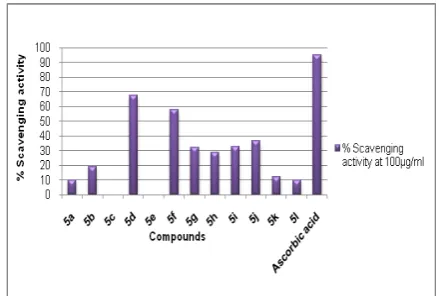
comprehensively with nearly every kind of biomolecules seen in the living cell and may deviate the cells from their normal physiological roles. Antioxidants are the substances capable of scavenging free radicals. The antioxidant properties of the hydrazones (6a-l) were calculated by 2, 2-diphenyl-1-picrylhydrazyl (DPPH) radical-scavenging method.40,41
Figure 2. DPPH scavenging activity (%) of hydrazone derivatives (6a-l).
Ascorbic acid was used as a reference for antioxidant assay. According to the results obtained from the DPPH test, the best performing hydrazones were 6d (67 %) and 6f
(57 %). The moderate antioxidant activity (10-36 %) was shown by hydrazones 6g, 6h, 6i and 6j (Figure 2). Free radical scavenging activity was measured in terms of percent inhibition.
Antimicrobial Activity
The agar well diffusion method was used for screening of the antimicrobial activity of the hydrazone derivatives ( 6a-l).42
N
NH2 S
O
OEt O Br
(1) (2)
N
(3) S
N EtOH, reflux
5h (90%) EtOH, reflux
4h (75%) H2N-NH2.H2O
H
OEt
O
N S
N H
N S
N H
(6a-l) (4)
6a: R = 3-Br; 6b: R = 4-F; 6c: R = 4-Cl; 6d: R = 4-Br;
6e: R = 3-NO2; 6f: R = 2-NO2; 6g: R = 3-Cl; 6h: R = 2-Br;
6i: R = 2-Cl; 6j: R = 4-NO2; 6k: R = 2-Cl, 4-Cl; 6l: R = 3-Cl, 5-Cl
H O
DIPEAc, rt
30 min (82-95%) +
R (5a-l) N
O H
NH2
N O
H N
Table 1. Antimicrobial activity of hydrazone derivatives (6a-l).
S.No. Pathogens Compounds Standard
6a 6b 6c 6d 6e 6f 6g 6h 6i 6j 6k 6l
1 S. typhi 23 - - 05 - - - - 12 - - - 33
2 E. aerogenes 17 12 - - 05 - - 09 05 - - 06 33 3 B. subtilis 26 12 - - - - 05 - 06 - 07 - 32
4 B. cereus 18 06 - - - 09 - - 07 - - - 33
5 P. aeruginosa 18 06 - - - 07 - - 10 - - 08 32
6 S. abony 16 07 - - - 05 - - 06 - - - 32
7 E. coli - 09 - - - 08 - 29
8 S. aureus 16 08 - 05 - - 06 - - - 05 - 29
9 S. boydii 18 08 - - - 06 - - - 34
10 C. albicans 06 05 08 - 07 - - - 15 - - - 30 11 S. cerevisiae 15 10 10 - - - - 05 05 - - - 30
12 A. niger 15 05 - - - 05 30
- = no activity
Table 2. MIC value of most potent hydrazone derivatives 6a, 6b and 6i (µg mL-1).
S.No. Pathogens Compounds Ceftazidime Fluconazole
6a 6b 6i
1 B. subtilis 40 ± 0.35 85 ± 0.35 150 ± 1.50 24 ± 0.65 NA 2 B. cereus 65 ± 1.20 95 ± 1.60 135 ± 0.90 35 ± 1.35 NA 3 E. aerogenes 60 ± 0.40 110 ± 1.30 280 ± 2.30 30 ± 0.55 NA 4 S. cerevisiae 120 ± 0.85 170 ± 1.10 310 ± 0.80 NA 20 ± 0.80 5 C. albicans 90 ± 0.45 215 ± 1.40 190 ± 1.12 NA 30 ± 1.50 NA = Not available
Both the Gram-positive and Gram-negative bacterial pathogens were used for evaluating antibacterial activity.
Staphylococcus aureus ATCC 6538, Bacillus megaterium
ATCC 2326, Bacillus subtilis ATCC 6633 were Gram-positive pathogens used in this study. Escherichia coli
ATCC8739, Salmonella typhi ATCC9207, Shigella boydii
ATCC 12034, Enterobacter aerogenes ATCC13048, Pseudomonas aeruginosaATCC9027 and Salmonella abony
NCTC6017 were the Gram-negative pathogens used. Antifungal activity of synthesized compounds was determined against AspergillusnigerATCC 16404, Saccharomyces cereviseaeATCC 9763, and Candida albicans ATCC10231 fungal pathogens. Ceftazidime and fluconazole were used as antibacterial and antifungal standard reference compounds, respectively. The hydrazone derivatives6a, 6b, and 6iwere displayed remarkable antibacterial and antifungal activity against almost all pathogens. The zones were measured and recorded by using the scale in millimeter (Table 1).
The MIC values were calculated for the most active hydrazones. The hydrazones 6a, 6b and 6i were found effective against many pathogens; hence these hydrazones were selected for MIC determination studies. The MIC was determined against B. subtilis, E. aerogenes and C. albicans.It was determined by using the method and rules of the Clinical and Laboratory Standard Institute (CLSI).43All
experiments were performed in triplicates and results are expressed as mean ± SD in µg mL-1 (Table 2).
Molecular Docking Study
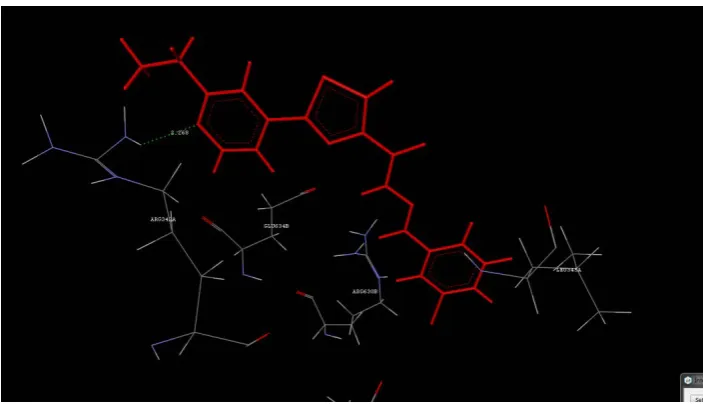
A molecular docking was performed to predict the molecular mechanism of action of hydrazone derivatives (6a-l).44,45 The crystal structure of the DNA gyrase (PDB
ID1QX1) was used for docking analysis. All the hydrazone derivatives showed excellent binding potential with DNA gyrase, which indicates the antimicrobial potential of hydrazone derivatives. Hydrazone 6a has shown hydrogen bonding interaction with ARG342, and VdW interactions with ARG630, GLU634, GLY178, ARG342, LEU345 (Figure 3). Hydrazone 6b has displayed hydrogen bonding interactions with ARG342, hydrophobic interaction with MET27, VAL31 and VdW interactions with GLU634, ALA637, MET27, VAL31, GLY341, ARG342, PRO343 (Figure 4). While hydrazone 6i has shown hydrogen bonding interactions with ARG630, hydrophobic interaction with ARG342 and VdW interactions with GLU627, ARG630, GLU634, ARG342, PRO343, LYS344 (Figure 5).
ADME Prediction
Figure 3. Binding mode of hydrazone 6a into the active site of DNA gyrase.
Figure 4. Binding mode of hydrazone 6b into the active site of DNA gyrase.
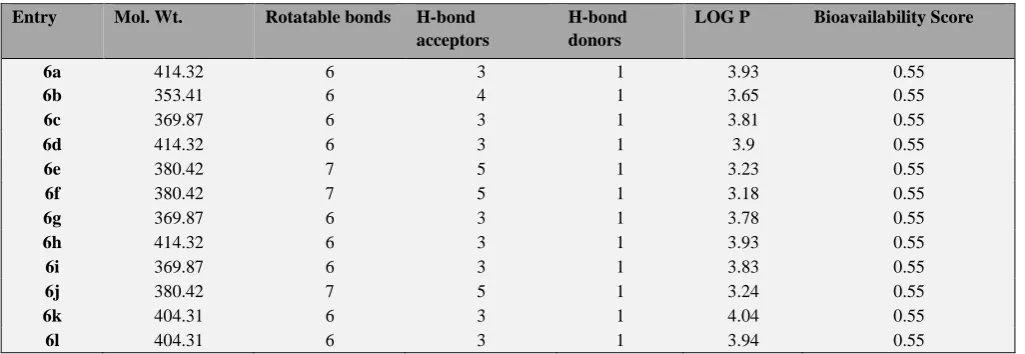
Table 3. Pharmacokinetic parameters of hydrazone derivatives (6a-l).
Entry Mol. Wt. Rotatable bonds H-bond
acceptors
H-bond donors
LOG P Bioavailability Score
6a 414.32 6 3 1 3.93 0.55
6b 353.41 6 4 1 3.65 0.55
6c 369.87 6 3 1 3.81 0.55
6d 414.32 6 3 1 3.9 0.55
6e 380.42 7 5 1 3.23 0.55
6f 380.42 7 5 1 3.18 0.55
6g 369.87 6 3 1 3.78 0.55
6h 414.32 6 3 1 3.93 0.55
6i 369.87 6 3 1 3.83 0.55
6j 380.42 7 5 1 3.24 0.55
6k 404.31 6 3 1 4.04 0.55
6l 404.31 6 3 1 3.94 0.55
CONCLUSION
In conclusion, a series of new pyridyl and thiazolyl clubbed hydrazone derivatives (6a-l) were synthesized starting from ethionamide. All the newly synthesized hydrazone derivatives were screened for their in vitro
antimicrobial activity. The hydrazone derivatives 6a, 6b and
6i have displayed excellent antimicrobial activities. Antioxidant potential of synthesized hydrazone derivatives has also been evaluated by DPPH scavenging method. The hydrazone derivatives 6d and 6f have shown good antioxidant activity. A molecular docking study was performed to investigate the binding modes of these molecules by using DNA gyrase. These compounds were showed excellent binding potential, which indicates the antimicrobial potential of synthesized hydrazone derivatives.
CONFLICT OF INTEREST
The authors declare no conflict of interest.
ACKNOWLEDGEMENTS
The authors are thankful to Dr. Babasaheb Ambedkar Marathwada University, Aurangabad, for financial assistance (MRP No. STAT/V1/RG/Dept/2019-20/323-324).
SUPPORTING INFORMATION
The supporting information of this article containing 1H
NMR, 13C NMR and HRMS spectrums of new compounds
are available for the authorized users.
REFERENCES
1Nalawade, J., Shinde, A., Chavan, A., Patil, S., Suryavanshi, M., Modak, M., Choudhari, P., Bobade, V. D., Mhaske, P. C., Synthesis of new thiazolyl-pyrazolyl-1,2,3-triazole derivatives as potential antimicrobial agents, Eur. J. Med. Chem., 2019, 179, 649-659. DOI: 10.1016/j.ejmech.2019.06.074
2Lopes, S. M. M., Novais, J. S., Costa, D. C. S., Castro, H. C., Figueiredo, A. M. S., Ferreira, V. F., Pinho E Melo,T. M. V. D., da Silva, F. C., Hetero-Diels-Alder reactions of novel 3-triazolyl-nitrosoalkenes as an approach to functionalized 1,2,3-triazoles with antibacterial profile, Eur. J. Med. Chem.,
2018, 143, 1010-1020.DOI:10.1016/j.ejmech.2017.11.052 3Beruve, G., An overview of molecular hybrids in drug discovery,
Expert Opin. Drug Discov., 2016, 11, 281-305.DOI: 10.1517/17460441.2016
4Abhale, Y. K., Shinde, A. D., Deshmukh,K. K., Nawale, L., Sarkar, D., Choudhari, P. B., Kumbhar, S. S., Mhaske, P. C., Synthesis, antimycobacterial screening and molecular docking studies of 4-aryl-4′-methyl-2′-aryl-2, 5′-bisthiazole derivatives, Med. Chem. Res., 2017, 26, 2889-2899. DOI:10.1007/s00044-017-1955-1
5Lima, C. H. S., Henriques, M. G. M. O., Candea, A. L. P., Lourenco, M. C. S,Bezerra, F. A. F. M., Ferreira, M. L., Kaiser, C. R., de Souza, M. V. N., Synthesis and antimycobacterial evaluation of N′-(E )-heteroaromatic-pyrazine-2-carbohydrazide derivatives, Med. Chem., 2011, 7, 245-249.DOI:1573-4064/11
6Ajani, O. O., Obafemi, C. A., Nwinyi, O. C., Akinpelu, D. A., Microwave assisted synthesis and antimicrobial activity of 2-quinoxalinone-3-hydrazone derivatives, Bioorg. Med. Chem.,
2010, 18, 214-221.DOI:10.1016/j.bmc.2009.10.064
7Sriram, D., Yogeeswari, P., Madhu, K., Synthesis and in vitro and in vivo antimycobacterial activity of isonicotinoyl hydrazones, Bioorg. Med. Chem. Lett., 2005, 15, 4502-4505.DOI:10.1016/j.bmcl.2005.07.011
8Dhumal, S. T., Deshmukh, A. R., Khillare, L. D., Arkile, M., Sarkar, D., Mane, R. A., Synthesis and antitubercular activity of new thiazolidinones with pyrazinyl and thiazolyl scaffolds,
J. Heterocycl. Chem., 2017, 54, 125-130.DOI: 10.1002/jhet.2552
9Nalawade, J., Mhaske, P. C., Shinde, A., Patil, S. V., Choudhari, P. B., Bobade, V. D., Synthesis, characterization, and antimicrobial screening of 4″‐methyl‐2,2″‐ diaryl‐4,2′:4′,5″‐terthiazole derivatives, J. Heterocycl. Chem.,
2018, 55, 1366-1374.DOI: 10.1002/jhet.3170
10Khan, K. M., Qurban, S., Salar, U., Taha, M., Hussain, S., Perveen, S., Hameed, A., Ismail, N. H., Riaz, M., Wadood, A., Synthesis, in vitro α-glucosidase inhibitory activity and molecular docking studies of new thiazole derivatives,
Bioorg. Chem.,2016, 68, 245-258. DOI: 10.1016/j.bioorg.2016.08.010
12Bharti, S. K., Singh, S. K., Design, synthesis and biological evaluation of some novel benzylidene-2-(4-phenylthiazol-2-yl) hydrazines as potential anti-inflammatory agents, Med. Chem. Res., 2014, 23, 1004-1015.DOI: 10.1007/s00044-013-0708-z
13Carradori, S., Secci, D., Bolasco, A., Rivanera, D., Mari, E., Zicari, A., Lotti, L. V., Bizzarri, B., Synthesis and cytotoxicity of novel (thiazol-2-yl)hydrazine derivatives as promising anti-Candida agents, Eur. J. Med. Chem., 2013, 65, 102-111.DOI:10.1016/j.ejmech.2013.04.042
14Kauthale, S., Tekale, S., Damale, M., Sangshetti, J., Pawar, R., Synthesis, antioxidant, antifungal, molecular docking and ADMET studies of some thiazolyl hydrazones, Bioorg. Med. Chem. Lett., 2017, 27, 3891-3896. DOI: 10.1016/j.bmcl.2017.06.043
15Abdelrahman, M. A., Salama, I., Gomaa, M. S., Elaasser, M. M., Abdel-Aziz, M. M., Soliman, D. H., Design, synthesis and 2D QSAR study of novel pyridine and quinolone hydrazone derivatives as potential antimicrobial and antitubercular agents Eur. J. Med. Chem., 2017, 138, 698-714. DOI: 10.1016/j.ejmech.2017.07.004
16Ahmed, M. H., E1-Hashash, M. A., Marzouk, M. I., E1-Naggar, A. M., Design, synthesis and biological evaluation of novel pyrazole, oxazole and pyridine derivatives as potential anticancer agents using mixed chalcone, J. Heterocycl. Chem., 2019, 56, 114-123. DOI: 10.1002/jhet.3380
17Helal, M. H., El-Awdan, S. A., Salem, M. A., Abd-elaziz, T. A., Moahamed, Y. A., El-Sherif, A. A., Mohamed, G. A. M., Synthesis, biological evaluation and molecular modeling of novel series of pyridine derivatives as anticancer, anti-inflammatory and analgesic agents, Spectrochim. Acta A,
2015, 135, 764-773.DOI: 10.1016/j.saa.2014.06.145
18Lawson, M., Rodrigo, J., Baratte, B., Robert, T., Delehouzé, C., Lozach, O., Ruchaud, S., Bach, S., Brion, J. D., Alami, M., Hamze, A., Synthesis, biological evaluation and molecular modelling studies of imidazo[1,2-a]pyridines derivatives as protein kinase inhibitors, Eur. J. Med. Chem., 2016, 123, 105-114. DOI: 10.1016/j.ejmech.2016.07.040
19Desai, N. C., Trivedi, A., Somani, H., Jadeja, K. A., Vaja, D., Nawale, L., Khedkar, V. M., Sarkar, D., Synthesis, biological evaluation and molecular docking study of pyridine clubbed 1,3,4-oxadiazoles as potential antituberculars, Synth. Commun., 2018, 48, 524-540. DOI: 10.1016/j.bmcl.2016.02.043
20Dhumal,S. T., Deshmukh, A. R., Bhosale, M. R., Khedkar, V. M., Nawale, L. U., Sarkar, D., Mane, R. A., Synthesis and antitubercular activity of new 1,3,4-oxadiazoles bearing pyridyl and thiazolyl scaffolds, Bioorg. Med. Chem. Lett.,
2016, 26, 3646-3651. DOI: 10.1016/j.bmcl.2016.05.093 21Oniga, S. D., Araniciu, C., Stoica, C. I., Palage, M. D., Vlase, L.,
Pirnau, A., Marutescu, L., Chifiriuc, M. C., Oniga, O.. Synthesis and antimicrobial activity evaluation of some new 2-(3-pyridil)-thiazolyl-1,3,4-oxadiazolines, FARMACIA,
2017, 65, 501-507.
22Savini, L., Chiasserini, L., Travagli, V., Pellerano, C., Novellino, E., Cosentino, S., Pisano, M. B., New α-(N )-heterocyclichydrazones: evaluation of anticancer, anti-HIV and antimicrobial activity, Eur. J. Med. Chem., 2004, 39, 113-122. DOI: 10.1016/j.ejmech.2003.09.012
23Eswaran, S., Adhikari, A. V., Chowdhury, I. H., Pal, N. K., Thomas, K. D., New quinoline derivatives: synthesis and investigation of antibacterial and antituberculosis properties,
Eur. J. Med. Chem., 2010, 45, 3374-3383. DOI: 10.1016/j.ejmech.2010.04.022
24Nastasa, C., Tiperciuc, B., Duma, M., Benedec, D., Oniga, O., New hydrazones bearing thiazole scaffold: synthesis, characterization, antimicrobial and antioxidant investigation,
Molecules, 2015, 20, 17325-17338. DOI: 10.3390/molecules200917325
25Baldisserotto, A., Demurtas, M., Lampronti, L., Moi, D., Balboni, G., Vertuani, S., Manfredini, S., Onnis, V., Benzofuran hydrazones as potential scaffold in the development of multifunctional drugs: synthesis and evaluation of antioxidant, photoprotective and antiproliferative activity,
Eur. J. Med. Chem., 2018, 156, 118-125. DOI: 10.1016/j.ejmech.2018.07.001
26Maia, R. C., Silva, L. L., Mazzeu, E. F., Fumian, M. M., de Rezende, C. M., Doriguetto, A. C., Correa, R. S., Miranda, A. L. P., Barreiro, E. J., Fraga, C. A. M., Synthesis and analgesic profile of conformationally constrained N -acylhydrazone analogues: discovery of novel N -arylideaminoquinazolin-4(3H)-one compounds derived from natural safrole, Bioorg. Med. Chem., 2009, 17, 6517-6525. DOI: 10.1016/j.bmc.2009.08.009
27Moldovan, C. M., Oniga, O., Parvu, A., Tiperciuc, B., Verite, P., Pirnau, A., Crisan, O., Bojita, M., Pop, R., Synthesis and anti-inflammatory evaluation of some new acyl-hydrazones bearing 2-aryl-thiazole, Eur. J. Med. Chem., 2011, 46, 526-534. DOI: 10.1016/j.ejmech.2010.11.032
28Kamal, R., Kumar, R., Kumar, V., Kumar, V., Bansal, K. K., Sharma, P. C., Synthesis, anthelmintic and antimicrobial evaluation of new 2‐arylidene‐1‐(4‐methyl‐6‐ phenylpyrimi-din‐2‐yl)hydrazines, Chemistry Select, 2019, 4, 713-717.DOI: 10.1002/slct.201802822
29Bondock, S., Naser, T., Ammar, Y. A., Synthesis of some new 2-(3-pyridyl)-4,5-disubstituted thiazoles as potent antimicrobial agents, Eur. J. Med. Chem., 2013, 62, 270-279. DOI: 10.1016/j.ejmech.2012.12.050
30Jin, Y., Tan, Z., He, M., Tian, B., Tang, S., Hewlett, I., Yang, M., SAR and molecular mechanism study of novel acylhydrazone compounds targeting HIV-1 CA, Bioorg. Med. Chem., 2010, 18, 2135-2140. DOI: 10.1016/j.bmc.2010.02.003
31Vicini, P., Incerti, M., La Colla, P., Loddo, R., Anti-HIV evaluation of benzo[d]isothiazole hydrazones, Eur. J Med. Chem., 2009, 44, 1801-1807. DOI: 10.1016/j.ejmech.2008.05.030
32Bedia, K. K., Elcin, O., Seda, U., Fatma, K., Nathaly, S., Sevim, R., Dimoglo, A., Synthesis and characterization of novel hydrazide-hydrazones and the study of their structure-antituberculosis activity, Eur. J. Med. Chem., 2006, 41, 1253-1261. DOI: 10.1016/j.ejmech.2006.06.009
33Muluk, M. B., Phatak, P. S., Pawar, S. B., Dhumal, S. T., Rehman, N. N. M. A., Dixit, P. P., Choudhari, P. B., Haval, K. P., Synthesis, antimicrobial and antioxidant activities of new pyridyl and thiazolyl bearing carbohydrazides, J. Chin. Chem. Soc., 2019, 66, 1507-1517. DOI:10.1002/jccs.201900198
34Muluk, M. B., Dhumal, S. T., Phatak, P. S., Rehman, N. N. M. A., Dixit, P. P., Choudhari, P. B., Mane, R. A., Haval, K. P., Synthesis, antimicrobial activity, and molecular docking study of formylnaphthalenyloxymethyltriazolyl‐N‐phenyl- acetamides, J. Heterocycl. Chem., 2019, 56, 2411-2418. DOI: 10.1002/jhet.3628
35Muluk, M. B., Dhumal, S. T., Rehman, N. N. M. A., Dixit, P. P., Kharat, K. R., Haval, K. P., Synthesis, anticancer and antimicrobial evaluation of new (E)‐N′‐ benzyl-idene‐2‐(2‐ethylpyridin‐4‐yl)‐4‐methylthiazole‐5‐carbohydra zides,Chemistry Select, 2019, 4, 8993-8997. DOI: 10.1002/slct.201902030
37Khillare, L. D., Bhosale, M. R., Deshmukh, A. R., Mane, R. A., One-pot rapid synthesis of thiazole-substituted pyrazolyl-4-thiazolidinones mediated by diisopropylethylammonium acetate, Res. Chem. Intermed., 2015, 41, 8955-8964. DOI: 10.1007/s11164-015-1940-6
38Bhale, P. S., Chavan, H. V., Dongare, S. B., Shringare, S. N., Mule, Y. B., Nagane, S. S., Bandgar, B. P., Synthesis of extended conjugated indolyl chalcones as potent anti-breast cancer, anti-inflammatory and antioxidant agents, Bioorg. Med. Chem. Lett., 2017, 27, 1502-1507. DOI: 10.1016/j.bmcl.2017.02.052
39Trouba, K. J., Hamadeh, H. K., Amin, R. P., Germolec, D. R., Oxidative stress and its role in skin disease, Antioxid. Redox Signal, 2002, 4, 665-673. DOI: 10.1089/15230860260220175 40Srivastava, B. K., Solanki, M., Mishra, B., Soni, R., Jayadev, S., Valani, D., Jain, M., Patel, P. R., Synthesis and antibacterial activity of 4,5,6,7-tetrahydro-thieno[3,2-c]pyridine quinolones, Bioorg. Med. Chem. Lett., 2007, 17, 1924-1929. DOI: 10.1016/j.bmcl.2007.01.038
41Patil, S. R., Sarkate, A. P., Karnik, K. S., Arsondkar, A., Patil, V., Sangshetti, J. N., Bobade, A. S., Shinde, D. B., A facile synthesis of substituted 2-(5-(benzylthio)-1,3,4-oxadiazol-2-yl)pyrazine using microwave irradiation and conventional method with antioxidant and anticancer activities, J. Heterocycl. Chem., 2019, 56, 859-866. DOI: 10.1002/jhet.3464
42Phatak, P. S., Sathe, B. P., Dhumal, S. T., Rehman, N. N. M. A., Dixit, P. P., Khedkar, V. M., Haval, K. P., Synthesis, antimicrobial evaluation and docking studies of substituted acetylphenoxymethyl-triazolyl-N-phenylacetamides, J. Heterocycl. Chem., 2019, 56, 1928-1938. DOI: 10.1002/jhet.3568
44Kamat, S. R., Salunkhe, R. S., Choudhari, P. B., Dhavale, R. P., Mane, A. H., Lohar, T. R., Efficient synthesis of chromeno[2,3-c]pyrazolyl-pyrazolol(s) in hydrotropic solution and their anti-infective potential, Res. Chem. Intermed., 2018, 44, 1351-1362. DOI:10.1007/s11164-017-3171-5
45(a) Kondhare, D. D., Gyananath, G., Tamboli, Y., Kumbhar, S. S., Choudhari, P. B., Bhatia, M. S., Zubaidha, P. K., An efficient synthesis of flavanones and their docking studies with aldose reductase.Med. Chem. Res., 2017, 26, 987-998. DOI: 10.1007/s00044-017-1813-1(b)Thalji, R. K., Raha, K., Andreotti, D., Checchia, A., Cui, H., Meneghelli, G., Profeta, R., Tonelli, F., Tommasi, S., Bakshi, T., Donovan, B. T., Howells, A., Jain, S., Nixon, C., Quinque, G., McCloskey, L., Bax, B. D., Neu, M., Chan, P. F., Stavenger, R. A., Structure-guided design of antibacterials that allosterically inhibit DNA gyrase, Bioorg. Med. Chem. Lett., 2019, 29, 1407-1412. DOI: 10.1016/j.bmcl.2019.03.029
46Daina, A., Michielin, O., Zoete, V., iLOGP: A simple, robust and efficient description of n-octanol/water partition coefficient for drug design using the gb/sa approach, J. Chem. Inf. Model,
2014, 54, 3284-3301. DOI: 10.1021/ci500467k
43Bauer, A. W., Kirby, W. M., Sherris, J. C., Turck, M., Antibiotic susceptibility testing by a standardized single disk method,
Am. J. Clin. Pathol., 1966, 45, 493-496. DOI: 10.1093/ajcp/45.4_ts.493