Parallel Suffix Arrays for Linguistic Pattern Search
Johannes Goller Macmillan, Digital Science Chiyoda Bldg., 2-37 Ichigayatamachi
Shinjuku-ku, Tokyo [email protected]
Abstract
The paper presents the results of an ana-lysis of the merits and problems of us-ing suffix arrays as an index data struc-ture for annotated natural-language cor-pora. It shows how multiple suffix arrays can be combined to represent layers of an-notation, and how this enables matches for complex linguistic patterns to be identi-fied in the corpus quickly and, for a large subclass of patterns, with greater theoreti-cal efficiency than alternative approaches. The results reported include construction times and retrieval times for an annotated corpus of 1.9 billion characters in length, and a range of example patterns of varying complexity.
1 Introduction
Empirical linguistic studies require access to large corpora of text, and they benefit greatly when the text is stored in a form that enables the efficient re-trieval of specific elements, such as sentences that match a pattern defined by a linguist. The size and contents of the corpus, the type and structure of its annotations, and the form of patterns involved vary greatly; the present paper deals with the re-quirements of only a subset of linguistic studies, which are characterized as follows:
• The corpus is large (hundreds of millions of words), but not extremely large (hundreds of millions of documents);
• Annotations exist in any number of layers, for example a layer of part-of-speech (POS) an-notations and a layer of semantic role labels, but the annotations on each individual layer are non-overlapping and non-ambiguous;
• A pattern is essentially a regular expression, made up of literals (to be matched against the
text), annotations (each with a specification of the layer it is expected to be found in) and wildcard elements (“gaps”);
• The retrieval results are expected to be de-livered within seconds or minutes (that is, not necessarily as fast as web search), and to be comprehensive (that is, to contain all matches, not only the top-N defined by some relevancy ranking);
• New patterns are generated constantly, per-haps by many different users or automated programs in parallel, while the text is largely static.
Corpus search engines that respond to a similar, albeit not identical, set of requirements include the Corpus Workbench1, WebCorp Linguist’s Search Engine2and Manatee/Bonito (Rychl´y, 2007). The implementation of all of these systems relies on the principle of inverted files, which is the main al-ternative to the suffix arrays presented here3. Both approaches are described and briefly compared in section 2, a direct comparison is also available in (Puglisi et al., 2006). Sections 3 and 4 introduce the concept of parallel suffix arrays and describe how it enables annotations and complex pattern search, including patterns equivalent to finite state machines. Section 5 describes results obtained us-ing an actual implementation of parallel suffix ar-rays.
2 The Two Main Approaches to Indexing
2.1 Inverted Files
The concept of inverted files requires the text to betokenized, that is, to be segmented into tokens
1
http://cwb.sourceforge.net/ 2
http://www.webcorp.org.uk/
3Suffix arrays are frequently used for n-gram analyses
(e.g. Yamamoto and Church (1998)), but without the ability to process complex search patterns.
ing two sections describe a new concept,parallel suffix arrays, and how it enables annotations and more powerful search patterns.
3 Parallel Suffix Arrays
The first step is to allow annotations to enter the index. In the following it is assumed that a text
T ∈ Σ∗ of length nis given, and one layer of q
annotations
A= ((a1, p1, `1),(a2, p2, `2), . . . ,(aq, pq, `q))
such that each annotation(ai, pi, `i) consists of a
label ai ∈ Σ∗, a starting position pi < n and a
length `i. pi indicates where in T the substring
annotated with ai starts, `i indicates the number
ofT-characters it covers. For example, given
T =is but a dream within a dream
and POS-annotations V, Conj etc., the annotation layer might look like this:
A= ((V,1,2),(Conj,4,3),(Det,8,1),(N,10,5),
(Prep,16,6),(Det,23,1),(N,25,5)).
There are two ways to bring these annotations into the suffix-array-based index forT:
Method 1: Single-integer annotations. Three steps need to be performed: (1) Each distinct an-notation label is mapped to a unique integer (e.g. using a hash table), that is, a new annotation al-phabet Λ is created, in which each annotation is represented as one integer. (2) An extra integer is introduced inΛ, below represented by∅, which is used as a dummy annotation for all areas of T
that are not covered by any element of A (in the example above, this applies to the space charac-ters between words). (3)Ais replaced by a string
A0 ∈ Λ∗ containing the new annotation symbols in the order of theT-positions they refer to, and a bitvectorBT↔Aof lengthnindicating the starting positions of annotations relative toT. The exam-ple above now becomes:
A0 =1∅2∅3∅4∅5∅3∅4
BT↔A=10110011110000110000011110000,
where V has been mapped to 1, Conj to 2, and so forth. The next step is to construct a suffix ar-ray SAA0 from the Λ-string A0, along with
aux-iliary data structures required for fast searches, cf. Navarro and M¨akinen (2007). That enables fast
searches for sequences consisting solely of anno-tations. It will later be shown how the bitvector is used to accomplish searches for mixed patterns, that is, patterns that contain both,T-sequences and
A-sequences.
Method 2: Complex annotations. In some sit-uations annotations are themselves complex and one would like to be able to search inside them, rather than mapping them to atomic integers. This is accomplished by appending a new character
] /∈ Σto every labelai as a separation mark, and
then concatenating all labels to a new stringA0:
A0 =V]Conj]Det]N]Prep]Det]N]
In addition, two bitvectorsBT↔AandBA↔Aare defined, the former in the same way as in method 1, while the latter is of length |A0| and has a 1 wherever a new annotation starts inA0:
BA↔A= 101000010001010000100010
Again, a suffix arraySAA0 forA0enables
search-ing for substrsearch-ings of annotations as well as se-quences of annotations. The ]-symbols prevent undesired matches across annotation-boundaries.
How the bitvectors are used for mixedT/A0
patterns. Both the bitvector of the first, and the bitvectors of the second method need to undergo an indexing process, during which a rank index and aselectindex are generated for each bitvector, defined as follows: LetB be a bitvector of length
bandi, j < b, then
rankB(i) :=the total number of 1s inB[1..i]
selectB(j) :=is.t. there arej1s inB[1..i].
Using techniques described by Jacobson (1989), it is possible to construct, inO(b) time, data struc-tures that implement these functions, such that a lookup can be performed in O(1) time and no more than b + o(b) bits of space are con-sumed in total (including the bitvector itself). In the case of single-integer annotations (method 1), rankBT↔A and selectBT↔A are constructed;
in the case of complex annotations, these and rankBA↔A and selectBA↔A are constructed.
In addition, in both cases the inverse suffix ar-rays for T and A0 must be computed and stored in memory: Given a suffix array SA, its inverse is defined as
and invSA can be generated from SA in linear time. To see how these data structures work to-gether, consider a mixed pattern σλ, where σ ∈
Σ∗ is a substring match againstT andλis a sub-string match against the annotations. We first as-sume that method 1 was used, hence thatλ∈ Λ∗ is a sequence of annotations mapped to integers. The next step is to search the suffix arrays and de-termine the match ranges(lσ, rσ)forσin SAT and
(lλ, rλ)forλin SAA0. Clearly, the number of
oc-currences ofσinTis occ(σ) =rσ−lσ, the
num-ber of matches for λis occ(λ) = rλ −lλ. We
must now check, for each σ-match, whether it is followed by aλ-match. Let lσ ≤ x < rσ one of
theσ-matches. It begins at positionp=SAT[x]of T and it is|σ|characters in length. Hence it is fol-lowed by aλ-match if and only if anA-annotation starts at p+|σ| and that annotation corresponds to a λ-match inA0, which is the case iff the cor-responding position inA0 is a suffix in the match range(lλ, rλ). We therefore verify, for the
candi-date offsetq :=p+|σ|:
A-element exists: BT↔A[q] = 1 (2)
Location inA0: q0 :=rankBT↔A(q) (3)
Isq0 aλ-match: lλ ≤invSAA[q0]< rλ (4)
If SA and invSA are available for random access, all of the above can be tested inO(1)time, hence it takes O(occ(σ)) time to compute the set of
σλ-matches from the two individual match ranges. Moreover, the procedure works in the reverse di-rection, too, starting from theλ-matches and de-termining those among them that are preceded by a σ-match (using selectinstead of rank; the time consumption becomes O(occ(λ))). Hence it is possible to choose the matching direction ac-cording to whichever part of the pattern has fewer matches, i.e. let occµ := min(occ(σ), occ(λ)),
then the match combination can be computed in
O(occµ)time.
Without giving a detailed proof, we note that this result can be extended to general sequential patterns t1· · ·tr, ti ∈ Σ∗,Λ∗: The match
com-bination time depends only on the least frequent (i.e. most specific) element tµ, that is, including
the time taken to determine the match range for eachti, the total asymptotic time is
O X
k
|tk|+ occ(tµ)
, (5)
which is obviously better than with inverted files, where the match combination time depends on the
frequency of all elements, as shown in (1). This shall be called the least-frequency property of parallel suffix arrays5. It should also be noted that for subsequences te· · ·tf such that all elements
refer to the same layer, i.e.∀ti ∈Σ∗or∀ti ∈Λ∗,
no match combination is required at all, since the suffix arrays do not rely on tokenization, hence
t0 := te· · ·tf can be searched for as a single
el-ement inO(|t0|)time.
Moreover, it is possible to define gaps of fixed length (measured in terms of number of
T-characters, or alternatively, as number of A -annotations) between the individual elements, e.g. a pattern likeσA./:3λ, indicating a distance of 3
ar-bitrarilyA-annotated elements between σ and λ, can be evaluated in the same asymptotic time (be-cause the length`of the three wildcard elements followingσ can be computed for each match can-didate usingrank andselect, and then added to the candidate position,q :=p+|σ|+`used in (2) and (3) before the match range check forλ).
The property also holds when complex annota-tions and method 2 are used, at least when search-ing for prefixes of annotations, rather than arbi-trary substrings of them. The distance calculations must then be made using the rank/select indexes forBT↔Ato map positions betweenTandA, and those forBA↔A to compute the string length of annotations inA0. If arbitrary substring matching in annotations is required, the match process is de-layed by a factor related to the length ofλ, as every position inside the annotation must be checked for being a possible match continuation.
4 Complex Patterns
4.1 General patterns
Multiple annotation layers
It is straightforward to add further layers of annotation, e.g. semantic or morphological in-formation, constituent classes etc. Each layer
A1, A2, . . .is represented by an annotation string A0i, a bitvectorBT↔Ai, andBAi↔Ai if it is
com-plex. Direct mappings between layers Ai, Aj
are unnecessary, as they can be emulated using
BT↔AiandBT↔Aj. Hence, total space
consump-tion of the index grows in an additive manner as layers are added.
5The name
parallel suffix arraysrefers to the view of SAT
and SAA0 as parallel layers, both related to the same
Branching patterns
An important step towards more powerful search patterns is the ability to process branching pat-terns, that is, patterns that specify multiple alter-natives. This shall be denoted using a new opera-tor⊕, such that a pattern⊕(e1, e2, . . . , em)is
de-fined as matching all substrings of T that match any of the subexpressions ei. If all ei are
dis-tinctΣ-strings, the individual match sets for each
ei are disjoint, and the final result corresponds to
the union set of the match ranges for theei.
But if some of theeirefer to annotations or are
themselves complex, i.e. sequential patterns or⊕ -expressions, the individual match sets might not be disjoint, causing the end result to contain du-plicate matches, which makes it difficult to read and might cause frequency counts to be wrong. Hence,duplicate elements must be detectedand removed from the individual match sets. This can be done either by creating a searchable result set representation, such as a hash table or tree, and in-serting the matches one by one, rejecting matches that were inserted before; or, it can be done by creating a simpler, non-searchable result list and checking for each match for any ei whether it is
also a match for one of the otherej,j < i. Both
these methods are available when inverted files are used instead of suffix arrays, too, but if the second method is used, suffix arrays often have an advan-tage because the member check for theej, if it is a
Σ- orΛ-string, involves only anO(1)range check, whereas it would be logarithmic in an inverted file.
Sequences of complex elements
In section 3, the least-frequency property was established for sequential patterns, consisting of atomic elements and fixed-length-gaps, i.e. ex-pressions like
e1Q1./ e2:x1 Q2./:x2· · ·Qm−1./:xm−1em,
whereei ∈Σ∗,Λ∗;Qi ∈ {Σ,Λ};xi integers. For
even more powerful search patterns, it is impor-tant that the above can also be processed if theei
are themselves complex, i.e. sequences or branch-ing elements. This is indeed possible; the pattern then becomes a graph, and determining the least-frequent element, at which the matching should start, becomes a non-trivial problem. The num-ber of matches of a sequence or branching subele-ment cannot be calculated accurately before the entire matching process has finished, but an up-per bound can be determined: For a sequence, it is
the frequency of its least-frequent subelement, for a branching element it is the sum of the frequen-cies of its branches. Based on this, it is possible to recursively determine the estimated best atomic subelement of the graph for the match combina-tion process to begin. Once it has begun, the least-frequency property takes full effect during the pro-cessing of sequential substructures, and the range property accelerates the duplicate-checks where branching substructures are involved, as described above. Both is not true of inverted files, hence the theoretical performance of parallel suffix arrays is, generally, superior even for the most complex pat-terns.
Iteration
Another useful operator in powerful linguistic search patterns is the iteration operator, which is denoted by ~(e) for any atomic or complex ex-pressione. It corresponds to a sequence
eT./ e:0 T./:0· · ·T./ e:0
of undetermined length. Since all its elements are identical, the least-frequency property is pre-served, even if the matching simply starts on the left end, or alternatively on the right end, and con-tinues as long as new matches are found. There-fore, iteration elements can itself become part of complex patterns, and the three operationsQ./:x, ⊕
and ~establish a pattern syntax with the power of regular expressions, over an annotated text with any number of annotation layers, and including fixed-length gaps (wildcards).
4.2 Gap-filling
In order to analyse linguistic patterns in specific contexts, it is desirable that not only substrings matching the entire pattern are identified, but that selected parts of the patterns, especially matches for gaps or annotation elements, can be extracted and separately returned as frequency lists. For ex-ample, if one wants to investigate the syntactic en-vironment of “discussion”, i.e. usages like “dis-cussion on”, “dis“dis-cussion with” etc., one might use a pattern like
discussionT./:0<Prep><Det>
| {z }
(∗)
T:0 ./<N>
suf-fix arrays are particularly well-suited for this pur-pose: Firstly, it is easy to keep track of the begin-ning and ending offsets of the desired subexpres-sions during the matching processing; secondly, frequency lists are easy to generate: Given starting positionsp1, p2of two matches for(∗), a compar-ison of invSA[p1]and invSA[p2]inO(1)time
suf-fices to determine their lexicographic order. Once the matches are in lexicographic order, identifying duplicates and counting the frequencies of distinct strings is easy.
4.3 Look-betweens and negation
Another feature related to gaps is the ability to define some of their content partially. The three types of patterns below are examples of this:
(a)e1
Q:x:y
./ e2 (b)e1
Q:x:y
./ [?e3]e2 (c)e1
Q:x:y
./ [!e3]e2
(a) represents a gap of length x ≤ ` ≤ y el-ements on the annotation level Q; (b) requires that somewhere inside the gap there must be a match for e3 (positive look-between); (c) means there must be no match for e3 in the gap
(nega-tive look-between). Without going into further de-tail, it should be noted that these types of patterns can be incorporated into the matching process us-ing match combination techniques similar to those described in section 3. There is, however, a spe-cific disadvantage of suffix arrays when process-ing variable-length gapse1
Q:x:y
./ e2: Assuming that
occ(e1) ≤ occ(e2), let(p, `)be the position and length of a match for e1. Let (qi, pi, `i) be a Q
-annotation located atpi=p+`, and
(qi+1, pi+1, `i+1), . . . ,(qi+y, pi+y, `i+y)
the following y Q-annotations. Then we need to check whether a match for e2 is found at any of the positions pi+x, . . . , pi+y, which requires δ := y −x + 1 look-ups in invSAQ. Hence,
the gap length variability δ becomes a factor in the time complexity of the match combination pro-cess. That is not the case when inverted files are used: It then suffices to check for matches atpi+x
andpi+ystored in the inverted list fore2. Since the
inverted list is sorted, all other relevant matches must be located between these too and can be re-trieved in one step.
5 Implementation and Results
5.1 Index construction and operation
The system has been implemented as a C++ pro-gram that takes as input a file containing the text
T with three layers of annotations in XML:APOS
(POS-annotations);Alem(baseforms of words,
in-dexed using method 1 (see section 3);AcPOS(POS
along with morphological information; indexed using method 2).
The index construction is performed by first es-tablishing the parallel layers and bitvectors and then creating SAQ, invSAQ and, as an auxiliary
data structure used to enable faster suffix array search, the wavelet treeWVTQ(Grossi et al., 2003)
for each layerQ ∈ {T, APOS, Alem, AcPOS}. For
the construction of SAQ, a multi-threaded version
of the DC-algorithm (K¨arkk¨ainen et al., 2006) is used, invSAQ is computed in a trivial way in one
pass over SAQ, and the wavelet treeWVTQis
con-structed using a simple multi-threaded method (for details see Goller (2011)). The only highly time-consuming steps are the constructions of SAQand WVTQ. Their running times are given in Table 1.
For efficient pattern search, it is necessary to keep all data structures in main memory at all times. Compression methods for SA, invSA and WVT are available, cf. Navarro and M¨akinen (2007), but unfortunately, using them causes the time complexity of pattern search to be increased by a factor of Ω(logn), eliminating the advan-tage it has over inverted files. As a result, us-ing parallel suffix arrays requires a large amount of RAM. The implementation used to obtain the results described above was found to require ≈
(0.06·N)/1024MB for a corpus ofN characters with the three annotation layers described above. Hence, on a 32-bit desktop computer with about 3 GB of memory available, a corpus of≈52million characters (≈ 7million words) can be processed efficiently. Therefore, although optimizing the im-plementation’s use of RAM is certainly possible, it is quite clear that possibilities to use the described approach in linguistic practice depend on whether servers with sufficiently large RAM are available, and affordable.
5.2 Pattern Search
de-Threads Used
Hard drive
Available RAM
SAT WVTT SAPOS WVTPOS SAlem WVTlem SAcPOS WVTcPOS
A 10 NFS 128 GB 3:17 3:48 1:30 1:13 1:27 11:46 3:03 2:03 B 20 Direct 512 GB 2:00 3:06 0:50 1:05 0:49 8:05 2:00 1:57 C 45 Direct 512 GB 2:00 2:37 0:51 0:54 0:55 6:16 1:49 1:43
Table 1: Construction times on three different system configurations. The text is 1.97 billion characters (375 million words) in length and contains approx. 27,000 distinct baseforms of words. Test A was performed on a server with AMD-Opteron CPUs 8356 (total 16 threads) and the hard drive mounted through NFS, tests B and C were conducted on a server with Intel Xeon X7560 processors (total 64 threads) and the hard drive installed locally. Time durations are given in the format h:mm.
Pattern #results Search
time (ms)
Extraction time (ms)
P1 millions 5,857 106 200
P2 thousands of 7,526 74 399
P3 #thousand# of 7,696 168 343
P4 discussionhINihNNi 1,296 213 80
P5 discussion$pr$$n$ 1,894 372 118
P6 discussion[$pr$$n$] 1,894 530 111
P7 #preparation#APOS./:0:2hINiT./:0⊕(hNNi,hNNSi) 752 191 28 P8 hJJihNNihNNiAPOS:0:2
./ hINiT:0
./ ⊕(hNNi,hNNSi) 13,229 4,065 621
P9 hNNihNNiAPOS./:0:2hINiT:0
./ ⊕(hNNi,hNNSi) 129,723 36,711 5,178
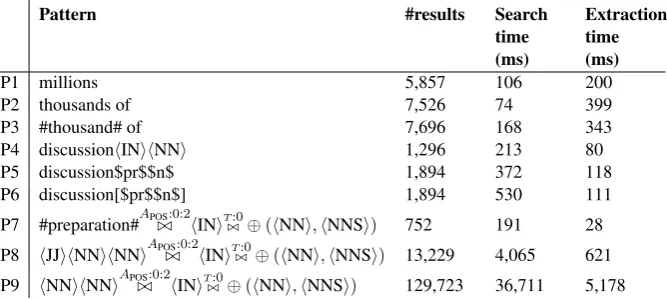
Table 2: Pattern processing times using hardware configuration A (see Table 1). Search time (identifying the set of match positions) and extraction time (extracting matches, but not including result printing). #..#-elements refer toAlem,h..itoAPOS, $..$ toAcPOS. Elements enclosed in [..] are marked for separate
pends on the “most specific atomic element” of the pattern. An element is atomic, if it refers to one layer (text or annotation) exclusively and con-tains no gaps. For example, the POS sequence
hJJihNNihNNiin P8, which would consist of three tokens in a standard inverted-file configuration, is atomic, as all three sub-elements refer to the same layerAPOS and can therefore be matched against
SAAPOS in a single step. In accordance with the least-frequency property, the overall response time for the entire pattern depends on the number of occurrences of the most specific atomic element, which in this case is hJJihNNihNNi, rather than such high-frequency individual tokens as hJJi or
hNNi. If the most specific atom is modified to be less specific, as in P9, the search time is increased by a factor of≈9.
5.3 Discussion and Conclusion
The approach presented appears to be effective, especially for complex patterns that contain at least one relatively specific element. It provides efficient solutions for special tasks like context-specific pattern matching and frequency-list gen-eration (described as gap-filling above), and it does not require any kind of tokenization, neither on the level of the main text, nor on the level of annotations and is hence suitable for corpora that involve annotations on the morpheme level, or across token boundaries, as well as for languages or writing systems that are hard to tokenize. Its biggest disadvantage is its high memory consump-tion, which however is likely to be less important in the future, as ever larger RAM hardware be-comes available at increasingly low cost.
Although this has not been discussed in detail in previous sections, it is important to point out that the approach isnotsuitable in situations that call for frequent updates to the text or the annotations. The index structures described above, especially rank and select indexes for bit vectors as well as the suffix arrays themselves cannot be updated ef-ficiently. Although data structures for suffix arrays that can be searched as well as dynamically up-dated are known, cf. (Russo et al., 2008; Gonz´alez and Navarro, 2008), using them would cause de-lays in the order ofO(logn)(wherenis the length of the text) in lookups ofselect,rankand SA, hence rendering the system considerably less effi-cient the corresponding version of an inverted file based system.
There are plans to release an open-source ver-sion of the implementation used for the tests de-scribed above as a corpus exploration tool for lin-guists before the end of the year.
References
Johannes Goller. 2011. Exploring text corpora using
index structures. PhD thesis. To appear, Centrum
f¨ur Informations- und Sprachverarbeitung, Ludwig-Maximilians-Universit¨at M¨unchen.
Rodrigo Gonz´alez and Gonzalo Navarro. 2008. Im-proved dynamic rank-select entropy-bound struc-tures. InLNCS 4957/2008, LATIN 2008:
Theoreti-cal Informatics, pages 374–386, Berlin / Heidelberg.
Springer.
Roberto Grossi, Ankur Gupta, and Jeffrey Scott Vit-ter. 2003. High-order entropy-compressed text in-dexes. InSODA ’03: Proceedings of the 14th
an-nual ACM-SIAM symposium on discrete algorithms,
pages 841–850, Philadelphia, PA, USA. Society for Industrial and Applied Mathematics.
Guy Jacobson. 1989. Space-efficient static trees and graphs. InProc. of the 30th IEEE Symposium on
Foundations of Computer Science (FOCS), pages
549–554.
Juha K¨arkk¨ainen, Peter Sanders, and Stefan Burkhardt. 2006. Linear work suffix array construction. J. ACM, 53(6):918–936.
Gonzalo Navarro and Veli M¨akinen. 2007. Com-pressed full-text indexes. ACM Comput. Surv., 39(1):2.
Simon Puglisi, W. Smyth, and Andrew Turpin. 2006. Inverted files versus suffix arrays for locating pat-terns in primary memory. In Fabio Crestani, Paolo Ferragina, and Mark Sanderson, editors,String
Pro-cessing and Information Retrieval, volume 4209 of
Lecture Notes in Computer Science, pages 122–133.
Springer Berlin / Heidelberg.
Lu´ıs M. Russo, Gonzalo Navarro, and Arlindo L. Oliveira. 2008. Dynamic fully-compressed suffix trees. In CPM ’08: Proceedings of the 19th an-nual symposium on Combinatorial Pattern Match-ing, pages 191–203, Berlin, Heidelberg. Springer-Verlag.
P. Rychl´y. 2007. Manatee/bonito – a modular corpus manager. In P. Sojka and A. Hor´ak, editors, First Workshop on Recent Advances in Slavonic Natural
Language Processing 2007, Faculty of Informatics,
Masaryk University, Botanick´a 68a, 60200 Brno, Czech Republic.
Mikio Yamamoto and Kenneth W. Church. 1998. Us-ing suffix arrays to compute term frequency and doc-ument frequency for all substrings in a corpus.