Energy Efficiency Metrics in Cognitive Radio
Networks: A Hollistic Overview
Efe F. Orumwense, Thomas J. Afullo, Viranjay M. Srivastava
School of Electrical, Electronic and Computer Engineering, University of KwaZulu-Natal, Durban, 4001, South Africa. [email protected], [email protected], [email protected]
Abstract: Due to the explosive progression in the number of users for new generation wireless communication networks which includes cognitive radio networks, energy efficiency has been a fundamental factor affecting its development and performance. In order to adeptly access and analyze the energy efficiency of a cognitive radio network, a standardized metric for this purpose is required. As a starting point, in this article we provided an analysis for energy efficiency metrics of a cognitive radio network in respect to its design and operation. The performance metrics and metrics developed at the different levels of a cognitive radio network are also studied. Establishing a comprehensive metric for evaluating, measuring and reporting the energy efficiency of cognitive radio networks is a crucial step in achieving an energy-efficient cognitive radio network.
Keywords: Cognitive Radio, Cognitive Radio Networks, Energy Efficiency, Energy Efficiency Metrics, Wireless Communication.
1.
Introduction
Cognitive radio (CR) has been presented in wireless communication as a enterprising and propitious technology for opportunistic spectrum access and usage. This will allow primary users (PU) or licensed users to share their spectral band with secondary users (SU) or unlicensed users only if the interference produced by these SUs is below a tolerable threshold thus creating an efficient spectrum utilization [1][2]. This method give rise to a substantial boost in the performance efficiency, networking efficiency, spectrum efficiency and also the overall energy efficiency of the system.
The main objective of a CRN is to maximise spectral efficiency by transmitting in vacant spectral bands. These vacant spectral bands usage is achieved through a coordinated mechanism performed by CRN functions such as spectrum sensing, spectrum hopping and dynamic spectrum access (DSA) [3]. These functions are usually considered as energy consuming operations and therefore impact on the energy consumption of the network and reduces the corresponding energy efficiency.
Energy efficiency (EE) in cognitive radio networks (CRN) is gradually gaining prominence and has received a lot of research interest lately as the network becomes more and more energy-demanding. This demand has been triggered by high energy cost and the need for green communications. EE is considered to encompass all other sub-system metrics so as to represent the overall performance of a cognitive radio (CR) system while taking into consideration the entire energy consumption, achievable throughput and the detection accuracy. The fusion of these different indicators into one single metric has branded the EE metric as a significant and important indicator of a good quality cognitive transmission [4].
Ensuring EE communications in CRN is however a daunting task as it is faced with great difficulty in satisfying the competitive demands of primary users (PUs) and CR users in the network. Significant amount of research including developmental efforts have been expended in the communications sector in order to provide more energy efficient solutions which will in turn lead to a greener wireless communication. It is imperative to accentuate the importance of EE metrics in cognitive radio networks as it provides measured and quantized information to calculate efficiency. Energy efficiency metrics are mostly used in different ways for various purposes but it is mostly used in comparing the efficiency performance and energy consumption of different systems or components of the same level. It can also be used to steer future research goals and developmental targets as regards energy efficiency.
analysed. A scheme to assess the energy-spectral efficiency tradeoff of cognitive radio based cellular networks was also studied.
Even though quite a lot of research efforts have been focused on energy efficiency and different energy efficiency metrics have been developed in wireless communications, less attention have been given to analysing energy efficiency metrics in CRN in terms of the system design and its operation. In this article, we show the energy efficiency metrics developed in cognitive radio networks with respect to its operational characteristics and design. This article is organised as follows. In section II, the concept of energy efficiency in cognitive radio is examined, section III presented an overview of energy efficiency metrics, section IV analyzed the taxonomy of EE metrics developed in different levels of a CRN, section V studied the performance metric of CRN and section VI concludes the paper.
2.
The Concept of Energy Efficiency in
Cognitive Radio Networks
Energy efficiency (EE) is considered to be a very important constraint limiting the design, operation and implementation of most wireless communication networks composing devices that are battery operated. It becomes even more demanding in wireless networks like the cognitive radio networks where energy maybe entirely non-renewable. In a typical cognitive radio network which basically comprises of cognitive radio nodes, base stations (BS) and backbone networks, network life time is a function of the energy use by the cognitive radio nodes and the energy consumption of the BS. Therefore, the way energy is expended for reception, transmission and all other related cognitive purposes is a primary ingredient affecting the network lifetime [13].
Since energy is considered as a major constraining resource for CRNs, the lifetime of the network is seen as a signitifcant performance metric due to its relation to the energy used in processing and transmitting data also the energy disspated at different levels and components of the network. Putting these factors into consideration, energy efficiency must be taken as an important factor in every aspect of cognitive radio operation and design, not only for specific parts of the network but also for the whole network communication [14]. Lowering energy consumption in cognitive radio networks is progressively demanding greater attention and requires improved technologies and solutions to better the energy efficiency in the network. Cognitive radio technology is primarily proposed to tackle spectrum usage and scarcity issues, but due to its in-built properties that encourages high energy consumption makes it a vital aspect of research in the area of green communications. CR is basically characterized of an adaptive and autonomous multidimensionally aware radio system driven by a progresssive intelligent functionality, which relates with its operating environment and learn from its observations and experiences in order to reason, plan and decide future activities so as to meet various needs [15]. These characteristics leads to a substantial increment in the network’s energy and spectral efficiency but yet contributes to an increased energy consumption in the network.
Cognitive radios usually sense for vacant spectrum band for communication using a spectrum sensing technique and they
do this periodically in order to avoid interference with any reappearing primary user. So each frame is separated into different parts, one is used for sensing, reporting and other is used for transmission. The longer the time used in sensing, the better the sensing accuracy but the higher the energy consumption and the shorter the duration available for transmission. Energy efficiency can be increased if the sensing and transmission scheduling are performed in a way that a balance is provided between the sensing accuracy and transmission efficiency and also better energy efficiency. Optimizing energy efficiency in cognitive radio networks is a very crucial step in ensuring high Quality of service (QoS) in the network. Optimizing energy efficiency will not only reduce its environmental impacts but also cuts overall network cost from the terminals to the base stations and also help makes communication a lot more affordable and practical in an ubiquitous setting.
3.
Energy Efficiency Metrics
As energy efficiency metrics continue to gain popularity amongst researchers, various standard organisations like the Alliance for Telecommunications Industry Solutions (ATIS) and the European Technical Standards Institute (ESTI) have been making frantic efforts to present a generally acceptable definition for EE metrics for wireless networks [16] [17]. Energy efficiency metrics has been formally defined in [18] as the total number of bits which can be transmitted successfully with unit energy consumption. It can also be regarded as the ratio of the overall throughput to the energy consumed for a given transmission. EE metrics play a vital role in the comprehensive assessment of energy savings and performance of wireless communication systems. These metrics help in providing detailed information in making direct comparison of various components of a network and also assessing and measuring the energy consumption of the entire network. It also aids in setting various benchmarks in the realization of energy consumption reduction.
With various research activities been carried out relating to energy efficiency and also due to the intrinsic differences of various communication components imbedded in a communication network, it is difficult for a single metric to suffice. However, an accurate EE metric should comprise of all parameters relevant to the energy consumption necessary for communication, while putting into consideration the amount of data to be delivered under specified QoS requirements. Authors in [10],[19] and [20] defined an accepted and widely used measure for EE as
. Total amount of energy consumed Joule EE
bit Total amount of delivered data
(1)
The inverse of (1), EEi which is 1 bit joule
EE has been
Φ Cnet Pnet
(2)
where Cnet is expressed as the total network capacity measured in bit/s, Pnet is expressed as the overall power consumed in the network measured in watts.
A different but generally recognised energy efficiency metric that relates power consumption and area is seen in [30-33]. It practically relates the overall power consumed by the network (Pnet) to the size of the area covered (ξ). The energy efficiency metric is denoted as Ψ
ξ Pnet
is given as
Ψ
ξ
Pnet
. (3) The optimal energy efficiency can be attained when the metric is minimized in terms of
2
W km
or maximized in terms to bit/Joule.
For a modified metric which accounts for data rate and communication distance, bit meter joule can be employed. This metric refers to the efficiency of effectively conveying the bits over a measured distance towards the required destination per the unit of energy consumed [6].
Another metric for energy efficiency in systems when it is not continuous is seen in [34] as the average goodput over per unit average power transmitted is given by the formula gd
Ptotal
, (4)where Ptotal is expressed as the average power transmitted by secondary users and gd is expressed as the average goodput also originating from the secondary users. The goodput can also be described as the number of bits transmitted successfully by an SU with the unit bit/s and can be expressed as
goodput gd
t1 t2 ..tn
1 P re
T
(5)
where r is expressed as the data rate measured in bit/s,
Pe
is expressed as the packet error rate (PER), T is packet duration andt
i is expressed as the time interval or duration in which an ith SU is transmitting during the interval T.A different metric known as the joint energy performance metrics (EPM) for ah-hoc networks that permits routing protocols to be evalauted for energy consumption and network performance was discussed in [35]. This metric captures the good behaviour of a communication system. The EPM for communication networks was defined in [35] adopting the equation below:
EPM Average Energy of the network
Average Performance of the network
(6)
where
is defined as the parameter that defines the trade-off between energy and its performance. The overall energy of the entire nodes in the network is taken as the averageenergy of the network. Evaluating the average network performance of a cognitive radio network is a very daunting task. The average network performance of a cogntive radio network is solely grounded on its ability to deliver large amounts of packets successfully, which is regarded in literature as transmission efficiency,that is, network packets received over the network packets transmitted. The lower the EPM values of the network, the higher the energy efficiency and an improved joint energy-performance. So by putting these definitions into equation (4) will give:
/
EPM Network Energy number of nodes
Transmission Efficiency
Network Energy EPMNumber of nodes
Amount of Network Packets Transmitted Amount of Network Packets Received
(7)
It is imperative to note that this form of energy performance metric has energy as its units due to the fact that the performance component has no units. The unit of EPMs are usually considered as relative metrics, but this very type of EPM is considered as a performance-scaled value of energy. The only difficulty of this EPM is choosing a desireable value for
. For a value of EPM (0), the metric turns into a pure energy metric, while for a value of EPM(
)
, the metric turns into a pure performance metric.4.
Taxonomy of Energy Efficiency Metrics
It is certain that the assessment of a metric is derived from measurements, therefore, a metric is accompanied by accuracy and also additional information to access the energy consumption of the different components and also the entire network. This section focuses on describing energy efficiency metrics in cogntive radio networks while classifying them into separate categories. These metrics are categorised into three major classes which are the facility or component level metrics, the equipment level metrics and the network level metrics.The component level is regarded as a high level system in which equipment are deployed, the equipment level metric is mainly used in evaluating performance of each equipment in a component while the network level metric is used in accessing the performance of equipment that relates to the coverage and capacity of the network.
4.1 Component Level Metrics
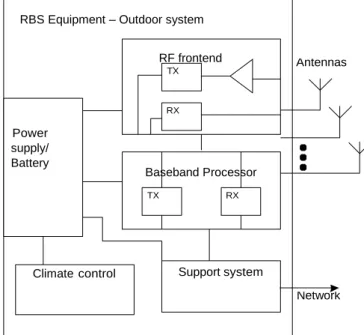
A typical cognitive radio network architecture can either be setup in an ad-hoc based method or in an infrastructural based method. In the ad-hoc manner, no infrastructural support is needed while in the infrastructural based cognitive radio network architecture, CR nodes mostly communicate with each other through radio base stations (RBS). In this kind of network, both the RBS and CR nodes are intergrated parts of the network.
detachable component which can be an air condition or climate control. The RF frontend unit is involved in the transmitting and receiving business of the equipment. The component that critically impacts on the energy efficiency of the equipment is the power amplifier which can be found in the transmission chain. The support system involved in linking the different protocol layers. It also perform various control functions and furnishes other network elements in the system with an interface. The power source consist of a power supply which can either be a battery power source or an alternating current (AC) power supply. Lastly, the climate control component which might be an air conditioner can be an optional component depending on the environmental usage.
In analysing the EE metrics of the different components of the equipment, the energy efficiency of the antenna is a function of the antenna’s input power and also the radiated power of the antenna. A large amount of the input power is usually radiated away in an antenna with a very high efficiency while most power are absorbed as losses in an antenna with low efficiency. Therefore, the energy efficiency of an antenna can be expressed as the ratio of the power radiated to its input power as in equ. (8).
Ant radiated input
P
P
. (8)The energy efficiency of an antenna can also be measured through its antenna gain. The gain of the antenna helps us to know the amount of power required to transmit in the direction of peak radiation to that of an isotropic source which also radiates in all directions [10]. Therefore, the gain of the antenna can be expressed as:
Gain
4
Radiation indensity
Input power of antenna
. (9)In the radio frequency frontend unit, the power amplifier is responsible for most of the component’s power consumption. The authors in [36] discussed that in a typical GSM base station (BS), the power amplifiers consumes about 35% of the total power available. The energy efficiency of the power amplifier (PA) is described as the ratio of both the output and input power and this can be written as
PA output input
P
P
. (10)In other to ameliorate the energy efficiency issues relating to the power amplifier, special design techniques can be employed and the power amplifier can be automatically shut down if the transmitter is not transmitting or is in idle mode, a technique currently researched in [37].
Also in the wireless equipment exist a baseband processor which in a cognitive radio is regarded as a digital baseband processor and uses its digital signal processor (DSP) for processing. The energy efficiency of a DSP is often measured by the performance per the unit of energy consumed. The performance metrics is normally given in FLOPS (Floating – point Operations per Second) so the energy efficiency metrics of a DSP of the baseband processor is measured in
FLOPS/watt or Million FLOPS/watt. Also in the wireless equipment, the support system which is classified as a computer system uses Million Instructions per Second (MIPS) as its performance metrics. Since a cognitive radio network can automatically sense its environment, learn from sensed information and adapt to the environment, the memory access and the Input/Output (I/O) can significantly influence the performance of the computer support system and also the DSP. The processing capacity of the baseband and computer support system may cause a congestion in the whole equipment which will in turn have an effect on the energy efficiency of the equipment. The energy efficiency from the power supply can be measured by the output power to the input power since its basic function is to provide power to the equipment. The energy efficiency of climate control is not normally evaluated in communication systems but however, its consumed energy is reduced as much as possible.Efforts are also in place to design the use of applied passive cooling techniques in the equipment which will phase out climate control.
4.2 Equipment Level Metrics
When measuring the energy efficiency at the equipment level of a CRN, the main equipment that make up this level which are the RBS and wireless terminals are taken into consideration for analysis. The RBS in this case refers to the radio base stations or wireless access points, while the wireless node terminals refer to the cognitive radio user nodes equipped with a wireless interface. Metrics relating to power per user ratio or the ratio of the total equipment power to the number of cognitive radio users calculated in [Watt/User], and also the energy consumption rating (ECR) which is the ratio of energy consumption to effective full duplex system throughput measured in [Watt/Gbps] are mostly used [38]. The effective full duplex system throughput is responsible for counting the frame overhead of the physical and link layer.
European Telecommunications Standards Institute (ESTI), a standard body responsible for producing globally acceptable
RBS Equipment – Outdoor system
TX
Power supply/ Battery
RX
TX RX
Climatecontrol Supportsystem
Antennas
Network RF frontend
unit
Baseband Processor
standards for the Telecommunications as well as the Information and Communications Technology (ICT) industries defined energy efficiency metrics and methods to determine energy efficiency of RBS in [39]. The RBS can be seen either as a concentrated RBS or a distributed RBS depending on the design. The concentrated RBS has all its antenna element in one location while the distributed RBS employs a remote radio head (RRH) in proximity to the antenna element so as to minimize feeder loss. At different load conditions, the power consumption is taken into consideration. For a concentrated RBS, its average power consumed in watts is defined as
equipment bhl bhl mtl mtl ll ll bhl mtl ll
P
t
P
t
P t
P
t
t
t
(11) WhereP
bhl,P
mtl and Pll are power consumptions for busy hour load, medium term load and low load repectively and alsot
bhl,t
mtl andt
ll are duration for busy hour load, medium term load and low load repectively. For the distributed RBS, its power consumption for the equipment is given as
P
equipment
P
RRH
P
C (12) where PRRH is the RRH power consumption and
P
equipment
P
RRH
P
Cis the consumed power for the central elements.Linear and constant energy profiles for evaluating the overall power consumption of a RBS is given in [40]. In the constant energy profile, the consumed power of the base station is assumed to be independent of its traffic load measured in Erlangs (A) and it is given as
P
equipment
P
C
constant
(13) From the real-world data of power consumption collected at different base station sites [40], a constant average value of 800W was selected. In the linear energy profile, the constant power in a base station is assumed to be proportional to its traffic load measured in Erlangs (A). In the case of no data traffic present, an initiate power is added and is given asequipment C
P
A P
(14)The linear energy profile is likely to be a lot more desirable and appropriate for cognitive radio networks and other future technologies with large data traffic and a more energy consuming digital power amplifiers.
In a view to investigating the energy efficiency of a wireless terminal of a cognitive radio, the whole function of the terminal should be taken into consideration. A mobile phone, mobile computer and other user equipments that employ a cognitive radio for its operation can be seen to have a typical cognitive radio mobile terminal. Since these equipments are usually energy constrained, energy efficiency is one of the important factor during their design. We can agreeably say that the stand-by time and talk time of a fully charged mobile phone is a good measure of its energy efficiency and if the data are controlled by the capacity of the battery, its energy efficiency metrics can be obtained.
4.3 Network Level Metrics
Network level metrics is employed in accessing the overall performance of network equipment while its properties and features relating to coverage and capacity of the network is considered. It is a very challenging task to define network level metrics because a lot of factors like load conditions, coverage area, density of base station (BS), throughput and also the users are to be taken into consideration. Network level energy efficiency takes into consideration not only the energy consumption of the base station equipments but also considers the characteristics and features relating to traffic volume, coverage and capacity of the network. The energy efficiency metric of the coverage area of the network reflects the level of energy that is required to achieve a desired coverage. For example, in the rural areas or a less dense area, the network is hardly loaded. In [41], the energy efficiency for the coverage area of a rural area is expressed as
rural coverage site
A
PI
P
(15)where
A
coverage is denoted as the coverage area of the base station inkm
2 andP
site is the average site power consumption. While on the contrary, in the urban or dense areas, the traffic demand is always greater than the capacity of the BS. Hence, its capacity rather than its coverage is usually demonstrated in an appropriate energy efficiency metric which can be defined asurban
total
N
PI
P
(16)Where is N denoted as the number of cognitive radio users and the total power consumed by the BS is represented as
P
total.Also in the view of optimizing energy efficiency in cognitive radio networks, the idle mode and sleep mode have been introduced into the network [42]. In a sleep mode, a station which is not transmiting can temprarily shut down its transceiver to increase energy efficiency and awakens when needed to receive or transmit signals. The ideal metric used to determine the energy efficiency in a sleep mode is the radio of the saved power to the power when the sleep mode is not activated.
When a channel transmitting is involved in deep shadow fading, a lot of energy is wasted for retransmission, therefore in [43], an algorithm was proposed to counter this problem. An adaptive automative Repeat-reQuest (ARQ) algorithm was developed where the ARQ process which is suppose to correct and control errors at the link layer is freezed the moment the channel condition becomes unfavourable. An energy efficiency metric was presented in [10] to access the energy saving performance and it is given as:
total amount of data delivered total amount of energy consumed
(17)
savings of the network but can create network partitioning where by the same node is frequently chosen for reporting sensed signals. Their batteries get depleted rapidly and the network connectivity is affected. To solve the network partition issue, cognitive radio nodes in the network should be aware of the residual energy of each node before sensed signals are reported. So in evaluating the energy saving performance of the network, energy aware reporting metrics are also refered to as energy efficiency metrics. Two impotant factors are also taken into consideration which are the residual battery level of each node and the energy cost of the reporting node. The reporting energy cost is a direct function of the distance between two neigbouring nodes and their residual battery levels drawn into a cost function, where the cost is inversely proportional to the battery level.
5.
Cognitive Radio Network Performance
Metrics
In a cognitive radio network, unlicensed or secondary users usually employ cognitive radio to identify vacant spectral band for communication and efficient spectral usage. This is achieved by a spectrum sensing process where cognitive
radios are able to monitor available spectral band, capture their information and identify vacant spectrum holes for communication. For efficient spectrum sensing and in view of mitigating the effects of local spectrum sensing issues such as multipath fading and shadowing, cooperative spectrum ensing (CSS) is used. In CSS, multiple secondary users perform local spectrum sensing in an independent manner and then makes a binary decision and forwards this decision to the base station or fusion center for a final decision about the spectrum availability [44]-[46]. The authenticity of these spectral availability information for communication can be accessed using some sensing quality specifications. These features compose of the performance metrics of the cognitive radio network. The overall performance can be evaluated by the detection accuracy of the global decision taken by the secondary base station or fusion center. However, the local independent spectrum sensing process of each CR user give rise to a binary hyopthesis-testing problem of having Primary user is absent : H0
Primary user is present :H1
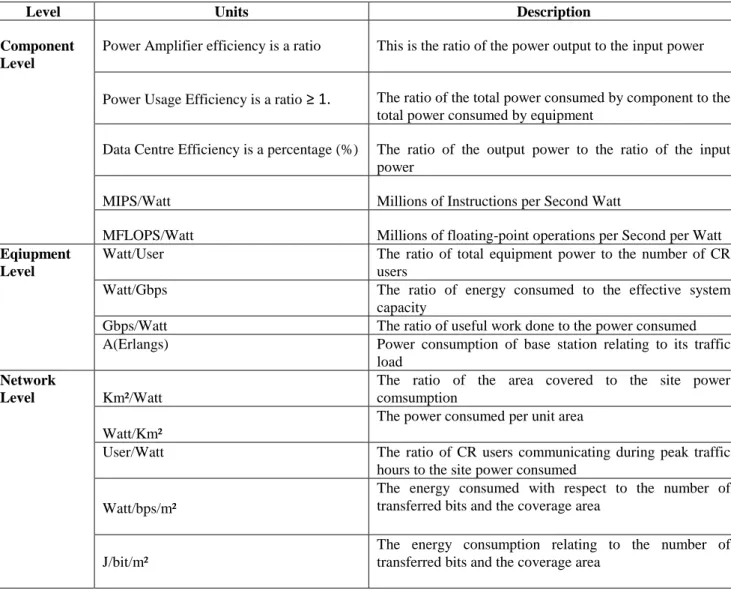
Level Units Description
Component Level
Power Amplifier efficiency is a ratio This is the ratio of the power output to the input power
Power Usage Efficiency is a ratio
≥ 1.
The ratio of the total power consumed by component to the total power consumed by equipmentData Centre Efficiency is a percentage (%) The ratio of the output power to the ratio of the input power
MIPS/Watt Millions of Instructions per Second Watt
MFLOPS/Watt Millions of floating-point operations per Second per Watt Eqiupment
Level
Watt/User The ratio of total equipment power to the number of CR users
Watt/Gbps The ratio of energy consumed to the effective system capacity
Gbps/Watt The ratio of useful work done to the power consumed
A(Erlangs) Power consumption of base station relating to its traffic load
Network
Level Km²/Watt
The ratio of the area covered to the site power comsumption
Watt/Km²
The power consumed per unit area
User/Watt The ratio of CR users communicating during peak traffic hours to the site power consumed
Watt/bps/m²
The energy consumed with respect to the number of transferred bits and the coverage area
J/bit/m²
The energy consumption relating to the number of transferred bits and the coverage area
The main metrics used in accessing the performance the spectrum sensing of a cognitive radio are the probabilities of correct decision which is denoted as
1| 1
Probability DecisnH H and
0| 0
Probability DecisnH H . Also is the probability of false alarm which is given by Probability Decisn
H H1| 0
and the probability of miss detection which is also denoted asProbability Decisn
H H0| 1
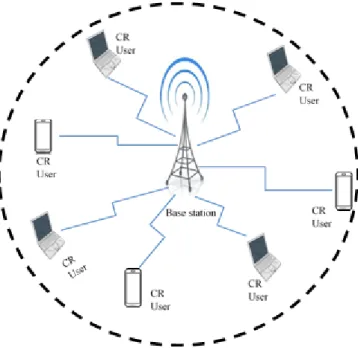
. Considering a CRN composing of number of secondary unlicensed CR users and a base station as shown in fig 2, the base station manages all the local spectrum sensing information delivered by the secondary CR users in the network. We assume that each CR in the network performs spectrum sensing independently. In order to study the performance metrics, we consider anth
i SU using energy detection spectrum sensing [47]. The local spectrum sensing problem is to decide between the resulting two hypothesis:
0 1, ,
i i
i
i
h s t w t H
x t
w t H
(18)
where xi is the signal received at the ithSU, hiis the channel gain between the ithSU and the PU, s t
is the transmitted signal from the primary transmitter and w ti
is denoted as the white additive Gaussian noise. We assume that the channel used in sensing is time-invariant when sensing is in progress. The energy detection sensing is carried out by measuring the energy of the signal received over an observation time window denoted as T. The energy collected in the frequency domain is given asY
i, which serves as a statistical decision with the distribution below [48]-[51].
2 2 1 2 2 0 2~ v i
i v H Y H
(19)where22v
2i is a noncentral chi-square distribution with vdegrees of freedom and a noncentrality parameter2i. 2 2v
denotes the chi-square distribution with 2v degrees of freedom. The instantenous SNR of the signal received at the
th
i SU is
i and v=TW which is the product of the time and bandwidth (W). In comparing the energy Yi with a defined threshold
i, the PU signal detection is carried out. Therefore, the probability of detection is given as
| 1
i
d i i
p Prob Y H and the probability of false alarm is denoted aspif Prob Y
i
i|H0
. The average probability of detection, false alarm and missed detection over Rayleigh fading channels are given below as in [52].
1 ! 1 22 1 2
2 0 2 2 1 0 1 1 ! 2 i i p i v p i
i i i
d i i i i v p p p v e p e p e
(20)
Γ , 2 Γ i i f v p v (21)
p
mi
1
p
d i (22) Receiver performance is quantified by depicting the receiver operating characteristices (ROC) curves. This curves serves as an important tool in selecting and studying the metric performance. In Fig. 3, the complementary reciever operating characteristics (ROC) curves is plotted to investigate the performance of the probability of detection over the probability of false alarm metrics at an SNR of -10db. For lesser errors made by a cognitive radio user in sensing, there is an increase in the detection accuracy which is measured by the probability of detection metric. Both the simulated and the computed probability of dectection are plotted in the same figure. The reason for a slight mismatch for both curves is that the theoretical derivation is for an ideal set-up while the simulation may tend to have random effects as per simulation settings and intrinsic limitations.Figure 4 also shows the ROC plot for the performance of the probability of miss detection with a corresponding probability of false alarm metrics for both simulation and theory computation. When a cognitive radio user misses a detection in sensing a spectrum, the probability of false alarm is seen to be very small.
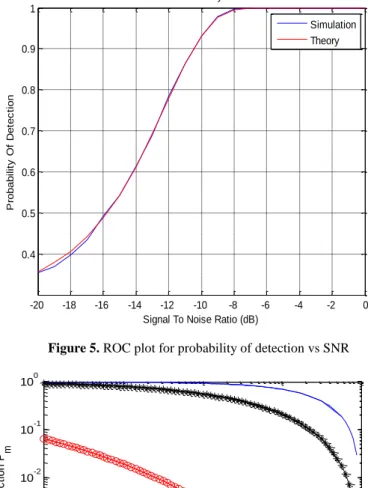
Figure 5 investigates the performance of the detection accuracy of the cognitive radio user measured by the probability of detection at different SNR. It is seen that there is a better performance in the probability of detection with an increasing value of SNR. That means SNR plays an important role in the performance of the probability of detection metric.
In a cooperating spectrum sensing environment, each secondary CR users forward their 1-bit decisions to a fusion center for a final decision [53]. Let Di
0,1 denoting the local spectrum sensing results of an ith CR user where {0} indicates the absence of PU in the spectral band and {1} indicates the presence of PU in the spectral band. The fusion center however fuse all 1-bit decisions together using a logic fusion rule.1
0 1
,
,
N i i
k H
Z
D
k H
(23)In OR rule, the FC will declare the spectrum busy when at least one of the CR users detects a PU signal, otherwise the spectrum band is regarded as vacant. In the AND rule, the spectrum band is declared busy by the FC only when all the CRU detect the PU signal, otherwise the band is regarded as vacant. While in the MAJORITY rule, the FC will declare the spectrum busy if half or more CR users detects the PU signal.
In equ (23), it can be seen that the OR logic rule corresponds to the case where there is at least k out of N CR users inferring which means the PU is present and inferring which means the PU is absent. The AND rule also corresponds to the case of k=N. From the logic fusion rules, it can be seen that the OR fusion rule is very conservative for CR users to access the licensed spectrum band, hence, the
0 0.1 0.2 0.3 0.4 0.5 0.6 0.7 0.8 0.9 1
0 0.05 0.1 0.15 0.2 0.25 0.3 0.35
Probability Of False Alarm
P
ro
b
a
b
il
it
y
O
f
M
is
s
D
e
te
c
ti
o
n
Simulation Theory
Figure 4. ROC plot for the probability of miss detection vs the probability of false alarm
-20 -18 -16 -14 -12 -10 -8 -6 -4 -2 0
0.4 0.5 0.6 0.7 0.8 0.9 1
ROC curve for SNR vs Probability of Detection for Pf=0.2
Signal To Noise Ratio (dB)
P
ro
b
a
b
il
it
y
O
f
D
e
te
c
ti
o
n
Simulation Theory
Figure 5. ROC plot for probability of detection vs SNR
0 0.1 0.2 0.3 0.4 0.5 0.6 0.7 0.8 0.9 1
0.7 0.75 0.8 0.85 0.9 0.95 1
Probability Of False Alarm
P
ro
b
a
b
il
it
y
O
f
D
e
te
c
ti
o
n
Simulation
Theory
Figure 3. ROC plot for the probability of detection vs the probability of false alarm
10-4 10-3 10-2 10-1 100
10-6
10-5
10-4
10-3
10-2
10-1
100
Probability of False Alarm Pf
P
ro
b
a
b
ili
ty
o
f
M
is
s
d
e
te
c
ti
o
n
P m
AND Rule
Majority Rule OR Rule
chance of causing interference to the PU is minimized. Figure 6 shows the performance of the probability of missed detection and the probability of false alarm metrics for cooperative spectrum sensing with the different fusion rules. The OR fusion rule gives a lower probability of missed detection than the other fusion rules. In [54], it was also confirmed that the OR rule gives a better performance than other rules hence the OR rule is evaluated below.
The false alarm probability of CSS based on the OR rule is given as
1
1 (1 )
N i
f f
i
Q p
(24)while the missed detection probability of CSS is given as
1
N i
m m
i
Q
p
(25)Assuming every CR user achieves identical probability of false alarm and probability of missed detection in the local spectrum sensing (i.e pf p fi and pm p mi ,
1, 2, , )
i N
, the probability of false alarm and probability of missed detection of CSS will then be denoted as
1
Nf f
Q p (26)
Nm m
Q
p
(27) It is also worthy to note that he detection probability of the CSS can be written asQ
d
1
Q
mError probability or the false-decision probability is also a widely used performance metric. It defines the probability of making a wrong spectrum sensing decision which is the combination of both the probability of false alarm and probability of missed detection metrics and it is expressed as
0 ( 1) 1 0 ( 1)
i i i i
e f d f m
P p H p p H p p H p p H p (28) where p H
0 means that the spectrum is vacant, p H( 1)means that the spectrum is used, low values of indicates the high accuracy of the spectrum sensing decision by the cognitive radio user which will positively influence the other aspects of the network performance.
The total energy consumption and the achievable throughput of a cognitive radio network can also serve as a vital evaluation metrics of a cognitive radio network performance. The average achievable throughput (A) is seen as the average successfully transmitted data of transmitting cognitive radio users, while the energy consumption
Ec can be seen as the average energy consumption at each state of the cognitive radio users activity. The achievable throughput is measured in bits while the energy consumption is measured in joules. It can be noticed that these metrics are directed affected by thedetection accuracy of the cognitive radio users in the network as a high achievable throughput will result to a higher energy consumption and vice versa. Hence a standardised metric that combines both achievable throughput and energy consumption is generally used and it is called energy efficiency as seen in equation (1) which can be equally written as
c
A E
(29)
It is imperative to note that energy efficiency
is a comprehensive metric that encompasses all other network perfromance metrics including the detection accuracy, achievable throughput and energy consumption in all states of the cognitive radio user’s activity. So we can regard it as a fair indicator of the whole cognitive radio network performance. Also, since there lies a connection between throughput and energy, energy efficiency
has been generally accepted as an important metric capable of achieving the balance between the various parts of cognitive radio network performance.6.
Conclusions
Energy efficiency in CRNs has been a growing concern in recent times as the network tends to ensure high Quality of service (QoS) to its users. Before the energy efficiency issues relating to the network are tackled, a standard and accurate indicator for measuring and evaluating energy efficiency needs to be realized. In this article, we provided an overview of energy efficiency metrics in CRNs relating to its design and operation. Metrics are categorized into the component, equipment and network levels for easy analysis. The performance metrics of the network was also analyzed where the probability of false alarm, probability of detection and probability of missed detection metrics were evaluated. The error of probability was also studied and acknowledged as a good measure of the performance of a cognitive radio network.
We believe that determining an accurate energy efficient metric for cognitive radio networks will pave a solid foundation for more research in the field of greener communications. It will also be a crucial step in enabling an energy efficient network and also ensuring a sustainable growth in the wireless communication industry.
References
[1] J. Mitola and G. Q. Maguire,Cognitive radio: Making software radios more personal,” IEEE Transactions on Communications, vol. 6, no. 4. pp. 13-18.August, 1999. [2] S. Haykin, “Cognitive radio: brain-empowered wireless
communications,” IEEE Journals on Selected Areas in Communications, vol. 23, no. 2, pp. 201-220. February, 2005.
[3] Q. Zhao and B.M. Sadler, “A survey of dynamic spectrum access,” IEEE Signal Processing Magazine, vol. 24, no. 3, pp.79-89. May, 2007.
[5] M. Mosonta et al, “Energy efficiency in future wireless networks: Cognitive radio standardization requirements,”
IEEE International Workshop on Computer Aided Modelling and Design of Communication Links and Networks. Barcelona, Spain. pp. 31-35, September, 2012.
[6] P. Tripathi, and R. Prasad, “Energy efficiency in cognitive radio network,” IEEE International conference on Wireless Communication, Vehicular Technology, Information Theory and Aerospace and Electronic Systems. New Jersey, USA. pp. 1-5. June, 2013.
[7] D. Huang, G. Kang, B. Wang and H. Tian, “Energy-efficient spectrum sensing strategy in cognitive radio networks,” IEEE Communications Letters. vol. 17, no. 5. pp. 928-931. May 2013.
[8] M. Naeem, K. Illanko, A. Karmokar, A. Anpalagan and A, Jaseemuddin, “Energy efficient cognitive radio sensor networks: parametric and convex transformations,” Sensors 2013, vol. 13, pp. 11032 – 11050. May, 2013.
[9] A. Gandhi and M. Newbury, “Evaluation of the energy efficiency metrics for wireless networks,” Bell Labs Technical Journal. vol. 166, no. 1. pp. 207-215, June, 2011. [10] T. Chen, H. Kim and Y. Yang, “Energy efficiency metrics for
green wireless communications,” IEEE International Conference on Wireless Communications and Signal Processing (WSCP). Suzhou, China. pp 1-6, October, 2010. [11] M. Parker and S. Walker, “Roadmapping ICT: An absolute
energy efficiency metric,” IEEE Journal of Optical Communications and Networking. vol. 3, no, 8. pp. 49-58. August, 2011.
[12] F. Haider et al. “Spectral and energy efficiency analysis for cognitive radio networks,” IEEE Transactions on Wireless
Communications. vol. 14, no. 6, pp. 2960-2980, June, 2015. [13] N. A. Pantazis and D. D. Vergados,”Energy efficiency and
power control, in Wireless Sensor Networks: A Networking Perspective,” J. Zheng and A. Jamalipour, Eds. New York: Wiley, pp. 307–341. April, 2009.
[14] I. Akyildiz, W. Su, Y. Sankarasubramaniam, and E. Cayirci, “A survey on sensor networks,” IEEE Communications Magazine., vol. 40, no. 8, pp. 102–114, August, 2002. [15] Y. S. Chen. “Green Wireless Communication via Cognitive
Dimension,” Online: Available:
www.csie.ntpu.edu.tw/yschenAvailable:/course/99-2/WMN/WMN ch7.pdf.
[16] European Telecommunications Standards Institute, Environmental Engineering (EE) Energy Efficiency of Wireless Access Network Equipment, ETSI TS 102 706, v1.1.1. August 2009.
[17] Alliance for Telecommunications Industry Solutions” ATIS report on wireless network energy efficiency”. ATIS Exploratory Group on Green (EGG). January 2010.
[18] G. Miao, N. Himayat, Y. Li and A. Swami, “Cross-layer optimization for energy-efficient wireless communication: a survey,” Journal of wireless communication and mobile computing. vol. 9, no. 4, pp. 529-542, April, 2009.
[19] S. Cui, A. J. Goldsmith, and A. Bahai, “Energy-constrained modulation optimization,” IEEE Transaction in Wireless Communication. vol. 4, no. 5, pp. 2349–2360, September, 2005.
[20] S. Wang and J. Nei, “Energy efficiency optimization of cooperative communication in wireless sensor networks,”
EURASIP Journal on Wireless Communication and Networking. vol. 2010, no.3, pp. 1-8, April, 2010.
[21] V. Rodoplu and T. Meng, “Bits-per-joule capacity of energy-limited wireless networks,” IEEE Transactions on Wireless Communications, vol. 6, no. 3, pp. 857–865, March, 2007. [22] S. Zhang, Y. Chen, and S. Xu, “Joint bandwidth-power
allocation for energy efficient transmission in multi-user systems,” In Proceedings of IEEE Globecom Workshop on
Green Communications, Florida, USA. pp. 14000-1405, December, 2010.
[23] A. J. Fehske, P. Marsch, andG. Fettweis, “Bit per Joule efficiency of cooperating base stations in cellular networks,” in Proceedings of IEEE Globecom Workshop Green Communications, Florida, USA. pp. 1406-1411, December, 2010.
[24] G. Miao et al., “Energy-efficient design in wireless OFDMA,” in Proceedings of the IEEE International Conference Communication, (ICC’08). Beijing, China. pp. 3307–3312, May, 2008.
[25] G. Miao, N. Himayat, G. Li, and A. Swami, “Cross-layer optimization for energy-efficient wireless communications: a survey,” Journal of Wireless Communications and Mobile Computing, vol. 9, no. 4, pp. 529–542. April, 2009.
[26] C. Khirallah, J. Thompson, and H. Rashvand, “Energy and cost impacts of relay and femtocell deployments in long-term-evolution advanced,” IET Journal of Communications, vol. 5, no. 18, pp. 2617 –2628, February, 2011.
[27] H. Q. Ngo, E. Larsson, and T. Marzetta, “Energy and Spectral Efficiency of Very Large Multiuser MIMO Systems,” IEEE Transactionson Communications, vol. 61, no. 4, pp. 1436– 1449. April, 2013.
[28] S. Aleksic, M. Deruyck, W. Vereecken, W. Joseph, M. Pickavet, and L. Martens, “Energy efficiency of femtocell deployment in combined wireless/optical access networks,”
Elsevier Journal on Computer Networks, vol. 57, no. 5, pp. 1217 – 1233. April, 2013.
[29] S. Navaratnarajah, A. Saeed, M. Dianati, and M. Imran, “Energy efficiency in heterogeneous wireless access networks,” IEEE Wireless Communications Magazine, vol. 20, no. 5, pp. 37–43. October, 2013.
[30] M. Ericson, “Total network base station energy cost vs. deployment,” in Proceedings of IEEE Vehicular Technology Conference (VTC Spring), Budapest, Hungary, pp. 1-5, May, 2011.
[31] G. Auer, V. Giannini, C. Desset, I. Godor, P. Skillermark, M. Olsson, M. Imran, D. Sabella, M. Gonzalez, O. Blume, and A. Fehske, “How much energy is needed to run a wireless network?” IEEE Wireless Communications Magazine, vol. 18, no. 5, pp. 40–49, October 2011.
[32] M. Fallgren, M. Olsson, and P. Skillermark, “Energy saving techniques for LTE: Integration and system level results,” In Proceedings of the IEEE Personal,Indoor and Mobile Radio Communication (PIMRC), London, UK, pp. 3269 – 3273, September, 2013.
[33] D. Tsilimantos, J.-M. Gorce, and E. Altman, “Stochastic analysis of energy savings with sleep mode in OFDMA wireless networks,” InProceedingsof the IEEE International Conference on Computer Communications (INFOCOM), Turin, Italy, pp. 1097 -1105. April, 2013.
[34] P. S. Tripathi and R. Prasad, “Energy efficiency in cognitive radio network” In Proceedings of the International Conference on Wireless Communication, Vehicular Technology, Information Theory and Aerospace Electronic Systems (VITAE) , New Jersey, USA. 24-27 pp. 1 -5, June, 2013.
[35] A. Bhatnagar and J. Teifel, “An energy-performance metrics for mobile ad-hoc networks,” An Internet Article. Available: http://citeseerx.ist.psu.edu/viewdoc/summary?doi=10.1.1.85. 4410.
[36] A. Amanna et al. “Green Communications: A Call for Power Efficient Energy Systems,” Journal of Communications. vol. 6, no. 4, pp. 340 – 351, July, 2011.
[37] --- “Extended Cell DTX for Enhanced Energy-efficient Network Operation” 3GPP R1-095011, Ericsson, November, 2009.
Greenwashing,” White Paper for ECR Initiative, August 10 2008.
[39] “Energy Efficiency of Wireless Access Network Equipment,” ETSI Technical Paper, ETSI TS102706, August, 2009. [40] K. Dufkova, B. Milan, B. Moon, L. Kencl and J.L. Boudec,
“Energy Savings for Cellular Network with the Evaluation of Impact on Data Traffic Performance,” IEEE European Wireless Conference, Lucca, Italy, 12 – 15 pp. 916 – 923, April, 2010.
[41] C. Bouras, V. Kokkinos, A. Papazois and K. Kontodima, “A simulation framework for LTE-A systems with femtocell overlays,” In Proceedings of the ACM Workshop on Performance Monitoring and Measurement of Heterogeneous Wireless and Wired Networks, New York, USA, pp. 85-90, June, 2012.
[42] Efe Orumwense, Thomas Afullo, and Viranjay Srivastava, “Effects on Malicious users on energy efficiency of cognitive radio networks,” In Proceedings of the Southern Africa Telecommunications Networks and Applications Conference (SATNAC). Hermanus, South Africa, pp. 431-435, September, 2015.
[43] M. Zorzi and R. Rao, “Energy-constrained error control for wireless channels” In Proceedings of the IEEE Global Telecommunications Conference (GLOBECOM). London, UK. 18-22th, vol. 2, pp. 1411-1416, November, 1996. [44] G. Ganesan and Ye Li, “Cooperative spectrum sensing in
cognitive radio networks” In Proceedings of the
International Symposium on New Frontiers in Dynamic Spectrum Access Networks (DySPAN). Baltimore, USA. 8-11, pp. 137 – 143, November, 2005.
[45] I. Akyildiz, B. Lo and R. Balakrishnan, “Cooperative spectrum sensing in cognitive radio networks: A survey”
Elsevier Journal of Physical Communications. vol. 4, no. 1, pp. 40-62, March, 2011.
[46] B. Benmammar, A. Amraoui and F. Krief, “A survey of dynamic spectrum access techniques in cognitive radio networks,” International Journal of Communication Networks and Information Security, vol. 5, no. 2, August, 2013.
[47] D. Oh, and Y. Lee, “Energy detection based spectrum sensing for sensing error minimization in cognitive radio networks,”
International Journal of Communication Networks and Information Security, vol. 1, no. 1, April, 2009.
[48] H. Urkowitz, Energy detection of unknown deterministic signals, Proceedings of the IEEE, vol. 55, no. 4, pp. 523–531, April, 1967.
[49] V. I Kostylev, “Energy detection of a signal with random amplitude” In Proceedings of the IEEE International Conference on Communications (ICC). New York, USA. 28, pp. 1606-1610, November 2002.
[50] F. Digham, M-S Alouini and M.K. Simon, “On energy detection of unknown signals over fading channels” IEEE Transactions in Communications. vol. 55, no. 1, pp. 3575-3579. January, 2007.
[51] A. Annamalai, O. Olabiyi, S. Alam, O. Odejide and D. Vaman, “Unified analysis of energy detection of unknown signals over generalized fading channels” In Proceedings of the IEEE Conference on Wireless Communications and Mobile Computing Conference (IWCMC). Istanbul, Turkey. 4-8, pp. 636-641, July, 2011.
[52] I. Gradshteyn and I. Ryzhik,”Table of integrals, series and Products” 7th Edition. Academic Press. March, 2007. [53] E. Orumwense, O. Oyerinde and S. Mneney, “ Impact of
primary user emulation attacks on cognitive radio networks”
International Journal on Communications Antenna and Propagation, vol. 4, no. 1, pp. 19-26, February, 2014. [54] A. Ghasemi and E. S. Sousa, “Opportunistic spectrum access
in fading channels through collaborative sensing”, IEEE