EFFICIENT DATA PROTECTION BY NOISING, MASKING, AND METERING
Qiuyu Xiao
A Dissertation submitted to the faculty at the University of North Carolina at Chapel Hill in partial fulfillment of the requirements for the degree of Doctor of Philosophy in the Department
of Computer Science.
Chapel Hill 2019
Approved by: Michael K. Reiter Lujo Bauer Jasleen Kaur
© 2019 Qiuyu Xiao
ABSTRACT
Qiuyu Xiao: Efficient Data Protection by Noising, Masking, and Metering (Under the direction of Michael K. Reiter)
TABLE OF CONTENTS
LIST OF TABLES . . . viii
LIST OF FIGURES . . . ix
LIST OF ABBREVIATIONS . . . xi
CHAPTER 1: INTRODUCTION . . . 1
1.1 Noising . . . 2
1.2 Masking . . . 3
1.3 Metering . . . 4
CHAPTER 2: DPPROCFS: NOISING SIDE-CHANNEL VECTORS TO MITIGATE STORAGE SIDE CHANNELS1 . . . . 6
2.1 Background . . . 9
2.1.1 Side Channel Attacks via PROCFS . . . 9
2.1.2 Differential Privacy . . . 10
2.1.3
d
-Privacy . . . 112.2 Design of a
d
-Private Procfs . . . 132.2.1 Threat Model . . . 13
2.2.2 Design Overview . . . 14
2.2.3
d
∗-Private Mechanism Design . . . 172.2.4 Consistency Enforcement . . . 22
2.3 Implementation . . . 23
2.3.2 Invariant Generation . . . 25
2.3.3 Reestablishing Invariants . . . 27
2.4 Evaluation . . . 28
2.4.1 Security Evaluation . . . 29
2.4.1.1 Defending Against Keystroke Timing Attacks . . . 29
2.4.1.2 Mitigating Website Inference . . . 30
2.4.2 Utility Evaluation . . . 32
2.4.2.1 Relative Error . . . 32
2.4.2.2 Rank Accuracy oftop . . . 34
2.5 Discussion . . . 37
2.6 Summary . . . 39
CHAPTER 3: POPSICL: MASKING SERVER IDENTIFIERS TO ENFORCE SERVER ANONYMITY2. . . 40
3.1 Background . . . 43
3.2 Design Principles . . . 45
3.2.1 Security . . . 45
3.2.2 Usability . . . 48
3.3 Design . . . 50
3.3.1 Registering a PoPSiCl . . . 50
3.3.2 Connection Establishment . . . 52
3.3.3 HTTP-specific Mechanisms . . . 55
3.3.4 Design Principles, Revisited . . . 58
3.4 Implementation . . . 60
3.4.1 PoPSiCl Store . . . 60
3.4.2 Cloud SDN Controller . . . 62
3.5 Evaluation . . . 63
3.5.1 Performance . . . 64
3.5.2 Scalability . . . 66
3.6 Traffic Analysis . . . 70
3.6.1 Design . . . 71
3.6.2 Evaluation . . . 72
3.7 Discussion . . . 74
3.8 Summary . . . 76
CHAPTER 4: SNOWMAN: METERING GRAPHICAL DATA LEAKAGE TO DE-TECT SENSITIVE DATA EXFILTRATION . . . 77
4.1 Background . . . 80
4.2 System Design and Implementation . . . 83
4.2.1 Overview . . . 83
4.2.2 Replication Engine . . . 84
4.2.3 Analysis Engine . . . 86
4.2.3.1 Architecture . . . 86
4.2.3.2 Taint Analysis . . . 88
4.2.3.3 Code Caches . . . 90
4.2.4 Implementation . . . 91
4.3 Evaluation . . . 93
4.3.1 Performance for Benign Users . . . 94
4.3.2 Data Exfiltration Detection . . . 97
4.3.2.1 Settings . . . 98
4.3.2.2 Leakage Detection . . . 99
4.3.2.3 Detection Delay . . . 100
LIST OF TABLES
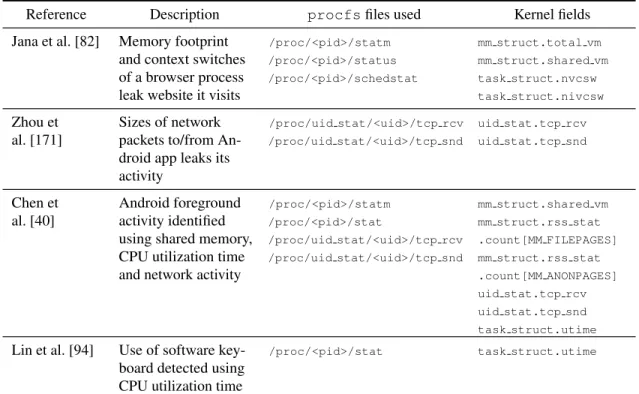
Table 2.1 – Selected attacks leveraging storage side channels in theprocfsfile system . . . 10 Table 2.2 – Selected kernel data-structure fields (Linux kernel 3.13) and generated
in-variants (Section 2.3.2) that reference them. “Protected” fields are rendered
d∗-private as described in Section 2.3.1, either because they have been uti-lized in published side-channel attacks (z) or because they are involved
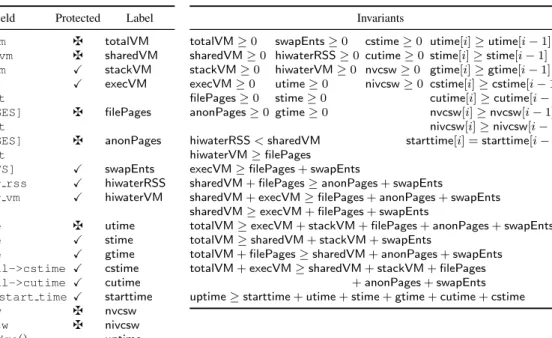
LIST OF FIGURES
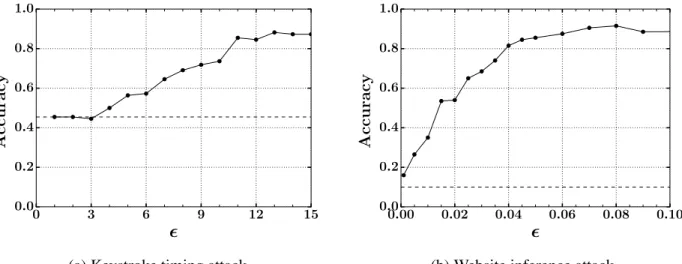
Figure 2.1 – Multi-class classifier accuracy under differentsettings; dashed horizon-tal lines show accuracies of blind guesses based only on knowledge of
the likelihood of each class. . . 31
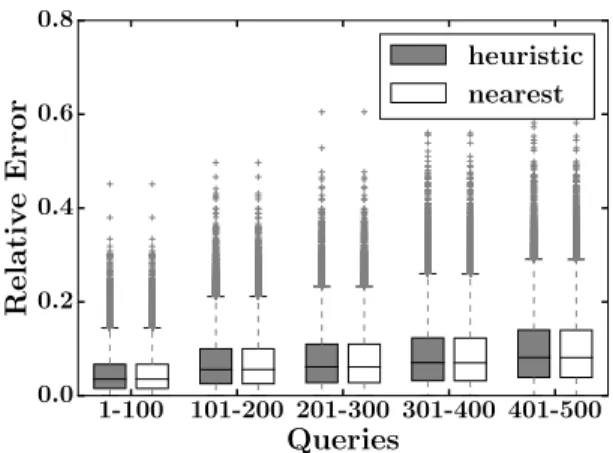
Figure 2.2 – Comparison between nearest and heuristic invariant reestablishment for drsfield;= 0.005 . . . 33
Figure 2.3 – Relative error fordrsfield under nearest invariant reestablishment . . . 34
Figure 2.4 – Relative error forutimefield under nearest invariant reestablishment . . . 34
Figure 2.5 – Average rank accuracy based onRESfield . . . 35
Figure 2.6 – Average rank accuracy based on%CPUfield . . . 36
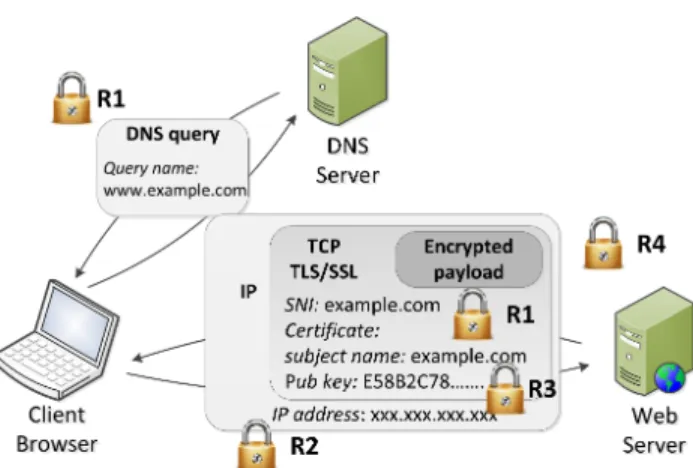
Figure 3.1 – In our threat model, the server identity can leak via the client’s DNS query, the SNI field of the client-to-server TLS connection, the server IP address, or the server public key . . . 46
Figure 3.2 – Steps for registering a PoPSiCl (Figure 3.2a) and then using it (Figure 3.2b) . . . . 51
Figure 3.3 – Performance of PoPSiCl access . . . 65
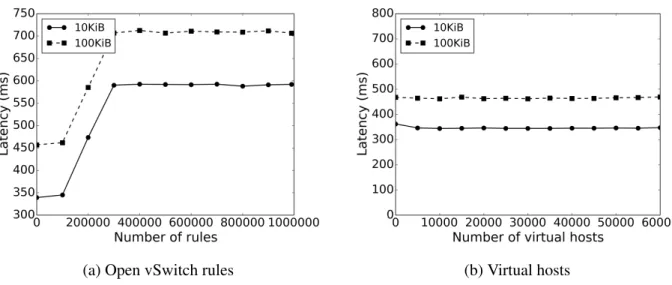
Figure 3.4 – Scalability of PoPSiCl access along several dimensions . . . 67
Figure 3.5 – Scalability of PoPSiCl access along several dimensions . . . 69
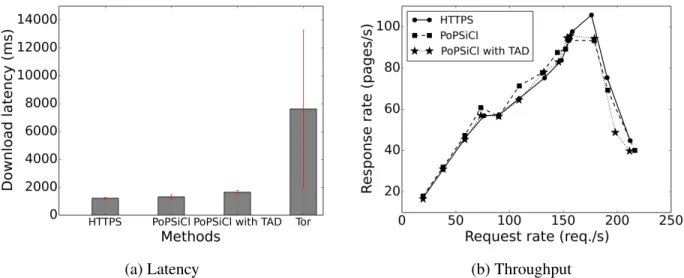
Figure 3.6 – Performance of PoPSiCl with traffic-analysis defense (TAD), for retriev-ing a web page hyperlinkretriev-ing to thirteen objects of total size 474.3KiB . . . 73
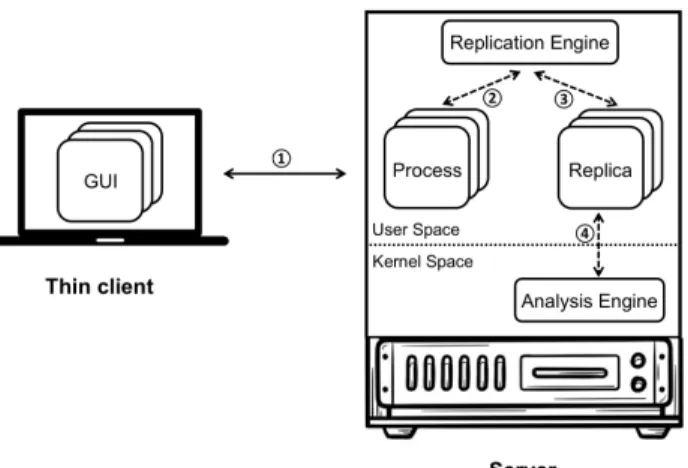
Figure 4.1 – Snowman architecture: (1) communicate user inputs and graphical out-puts (over the network); (2) record program execution; (3) replicate pro-gram execution; (4) monitor sensitive data leakage . . . 83
Figure 4.2 – State transitions: (1) consume sensitive data; (2) contain taint tags; (3) finish basic block; (4) no taint tag; (5) finish basic block; (6) protection page fault . . . 88
Figure 4.4 – Reaction time for common user actions when running the programs lo-cally 1) in the client machine, remotely 2) in the server machine with-out instrumentation, 3) monitored by Snowman, 4) by the Pin “null tool”,
or 5) by the Pin “taint tool” . . . 96 Figure 4.5 – The amount of leakage in normal and malicious sessions, as a function
of time . . . 100 Figure 4.6 – The time at which the Snowman replica detected each new leakage, as
a function of the time (in the user-facing execution) that the leakage
LIST OF ABBREVIATIONS
API Application Programming Interface CA Certificate Authority
CDN Content Distribution Network GUI Graphical User Interface IaaS Infrastructure-as-a-Service IRQ Interrupt Request
ISP Internet Service Provider NAT Network Address Translator
OS Operating System
PaaS Platform-as-a-Service PKI Public Key Infrastructure RCB Retired Conditional Branch SACK Selective Acknowledgment SDN Software-defined Networking SIMD Single Instruction Multiple Data SNI Server Name Indication
SVM Support Vector Machine TAD Traffic Analysis Defense URL Uniform Resource Locator
VM Virtual Machine
CHAPTER 1: INTRODUCTION
Protecting data secrecy is an important design goal of computing systems. A common ap-proach is data isolation. In the classic multi-level security model [16], system data and system components are categorized into various security levels. This model ensures that system compo-nents can only read data in the same or lower security levels, so that information can only flow from a lower level to a higher level but not vice versa. Modern computing systems adopt similar concepts to protect data secrecy. In Linux, the memory data of the system kernel cannot be ac-cessed by user-space processes. Similarly in Xen, the memory data of the hypervisor cannot be accessed by virtual machine kernels and user-space processes.
Simple data isolation rules often cannot meet the data protection requirements of complicated systems, especially in the multi-user environment. Many security mechanisms were proposed to control the propagation of secret data. Access control mechanisms [135, 136, 151, 81, 138] ensure that secret data can only be accessed by the users who have the required permissions. Information-flow control mechanisms [134, 95, 52, 76, 24, 110] prevent secret data propagat-ing to public data durpropagat-ing the computation of the program. Many other security mechanisms restrict the propagation of the secret data by hiding the contents of secret data. Cryptography protocols [17, 131, 130, 168] encrypt secret data to ciphertext that can be only decrypted with the private key. Anonymization schemes [148, 55, 69, 28, 78] scrub personal identifiers before releasing the data to prevent re-identification.
non-sensitive data is statistically correlated with sensitive data. This is a fundamental problem in side-channel attacks where an attacker can conduct statistical analysis on non-sensitive data (e.g., cache timing information) to recover sensitive data (e.g., private key). Second, trustworthiness is not a constant property of system components and users. The system kernel is trusted but an attacker can control the kernel by exploiting vulnerabilities. Employees are trusted to access con-fidential files but they might turn rogue and steal the concon-fidential data. Third, system’s functional requirements can be at odds with its data protection requirements. Sometimes sensitive data is chosen to be exposed to untrusted system components in favor of meeting the system’s functional requirements. For example, IP addresses in the network packets of a user are exposed to the Inter-net service provider (ISP) because routers rely on the IP information to make routing decisions. However, the ISP can also build a web browsing profile of the user based on the IP information, which violates the user’s privacy.
In this dissertation, we propose novel data protection mechanisms to address unique chal-lenges in three practical problems—storage side-channel attacks in Linux, server anonymity violations in web sessions, and data theft by malicious insiders. Based on sensitivity of the sys-tem data, trustworthiness of the syssys-tem components, and functional requirements of the syssys-tem, we choose to either noise, mask, or meter sensitive data with the goal of protecting data secrecy while maintaining normal system functionality.
1.1 Noising
Anoisingmechanism obfuscates sensitive data by adding random noise or modifying the data value before releasing the sensitive data to untrusted parties. The goal of the noising mech-anism is maintaining the utility of sensitive data while reducing the risk of security and privacy violation.
al-gorithms to obfuscate individual data values and simultaneously preserve underlying distribution properties at a macroscopic level. Privacy-control methods for statistical databases (e.g., [5, 56, 23, 62]) allow untrusted parties to query aggregate statistics of subsets of entities in the database while protecting privacy of any individual entity represented in the database by adding noise to the query results. Privacy-enhancing recommendation systems (e.g., [140, 141, 99]) obfus-cate user data before releasing the data to recommendation servers with the goal of preserving recommendation quality. k-anonymity and the derivative theorems [148, 92, 98] define rules to obfuscate sensitive attributes of individuals before publishing data records so that an individual cannot be easily identified from the published records. Adding noise is also used in defending against side-channel attacks by reducing the precision of side-channel vectors [170, 154].
In our work, we propose a novel noising mechanism to defend against storage side-channel attacks. A storage side channel occurs when an attacker accesses data objects influenced by an-other victim computation and infers information about the victim that it is not permitted to learn directly. In Linux, side-channel attackers exploit the runtime metadata, such as memory and CPU usage of processes, from the proc filesystem (procfs) to recover secrets. In Chapter 2, we introduce a differentially private system,dpprocfs, which adds noise to side-channel vec-tors to provably mitigate storage side-channel attacks and simultaneously preserve the utility of procfsfor monitoring and diagnosis.
1.2 Masking
Amaskingmechanism transforms sensitive data to a form that hides its original contents from the untrusted parties in the masking phase. The original data can be recovered from the transformed data by the trusted parties in the unmasking phase. Masking mechanisms are very useful in scenarios where sensitive data has to be stored in or transmitted by untrusted parties.
authenticate communication endpoints and then mask and unmask sensitive data by encryption and decryption. Secure cloud storage systems (e.g., [18, 166]) only store encrypted data in the cloud storage and explore novel solutions to implement useful services on top of the encrypted data, such as deduplication and auditing. Secure processor extensions (e.g., [101, 150]) encrypt memory data of the trusted programs which cannot be undetectably altered by even the most privileged system components, like operating system kernel or hypervisor.
Anonymous communication tools (e.g., [55, 69, 28, 78]) focus on protecting the identity of the communication endpoints by masking and unmasking common identifiers, including DNS names and IP addresses, besides protecting the communication contents by using encryption. Server anonymity, which ensures that the server’s identity is hidden from network attackers and eavesdroppers, is one of the anonymous properties guaranteed by these tools. In Chapter 3, we introduce a cloud service,PoPSiCl, which enforces server anonymity for tenant servers running in the cloud by masking server identifiers with personalized pseudonyms. Unlike most existing anonymous tools,PoPSiClrequires no changes to client-side software and works with all major web browsers. Our evaluations show thatPoPSiClonly introduces modest overhead to server access latency and throughput, and is capable of scaling to large numbers of users.
1.3 Metering
Ameteringmechanism monitors the amount of sensitive data leaked to the untrusted par-ties and takes extra steps to protect data secrecy if the data access pattern deviates from normal behaviors (e.g., the amount of leakage exceeds a certain limit).
leakage and deducts the amount of leakage from the privacy budget. When the privacy budget is used up, the user is not allowed to make future queries. This privacy budget based protection is basically a metering mechanism, and is deployed in practical systems to protect privacy for making SQL-like queries [103], doing MapReduce computations [132], using location-based services [9, 25], and getting personalized recommendations [140, 102].
CHAPTER 2: DPPROCFS: NOISING SIDE-CHANNEL VECTORS TO MITIGATE STORAGE SIDE CHANNELS1
Side-channel attacks aim at disclosing data in computer systems by exfiltrating sensitive information through interfaces that are not designed for this purpose. In recent years, the scope of side-channel attacks has been extended beyond their traditional use to attack cryptographic keys, and techniques utilized in side-channel analysis have also increased in variety and sophistication.
In this chapter, we examine one particular type of side-channel attack vector, which we call
storage side channels. Storage side channels occur when an adversary accesses data objects as-sociated with a victim computation and makes inferences about the victim based on the contents of the data objects themselves or their metadata. As we use the term here, storage side channels form a subclass of storagecovertchannels [114] that gleans information from an unwitting vic-tim, versus receiving information inconspicuously from an accomplice. Storage side (and covert) channels differ from legitimate communication channels since the data value or the metadata exploited by the side channel is not considered sensitive by itself; yet, it still leaks information that may be exploited to infer victim secrets.
A generic approach to mitigate storage side (and covert) channels is to reduce the accuracy of the data or its metadata being reported by adding random noise to disturb side-channel observa-tions [114]. A challenge in this approach is to develop principled mechanisms to perturb the side channels with provable security guarantees, and to do so while preserving the utility of the data and metadata in the system.
information leakage mathematically. The difficulties in doing so, however, stem from the chal-lenges in (i) modeling these storage channels as statistical databases, where differential privacy was previously applied; (ii) designing privacy mechanisms to add noise so that side channels are provably mitigated; and (iii) designing these mechanisms so as to minimize the loss of utility of the released data. We will discuss methods to address these challenges in the remaining sections. In theory, these methods can be applied to mitigating a variety of storage side channels. However, in this chaper we illustrate the idea by focusing only on storage channels based onprocfs, a file-system interface for reporting resource usage information on Linux and Android systems.
Toward this end, we propose a modifiedprocfs, dubbeddpprocfs, that provides guaran-tees about the inferences possible from values reported through theprocfsinterfaces. In doing so,dpprocfsdefends against a variety of storage side channels recently exploited inprocfs on both Linux and Android (see Section 2.1.1 for a summary of these attacks). Our work builds on the works of Dwork et al. [63, 64] and Chan et al. [33], which consider differential privacy un-der continuous observations, but we are forced to extend from this starting point in multiple ways. First, differential privacy itself is not a good match for side-channel mitigation in theprocfs context; rather, we turn to a recent generalization calledd-privacy [35] that is parameterized by a distance metricd. By defining a suitable distance metricdand expressing side-channel mitigation goals in terms of the distance between two series ofprocfsobservations, we prove that the differentially private mechanism of Chan et al. [33] generalizes to mitigate storage side channels. Second, however, the naive application of this mechanism to noiseprocfsoutputs would risk correctness of applications that depend on invariants thatprocfsoutputs satisfy in practice. To retain the utility ofprocfs,dpprocfstherefore extracts and reestablishes invariants on the noised outputs so as to assist applications that depend on them.
interfaces. The userspace daemon interacts with the kernel extension to reestablish the invariants procfssatisfies. We will elaborate on our implementation choices in later sections.
We evaluate our prototype for both its security and utility. For security, we demonstrate con-figurations that effectively mitigate existingprocfsside-channel attacks from the literature. We specifically demonstrate preventing two attacks, one that usesprocfsdata to measure keystroke behavior as a means to recover a typed input, and another that monitors the resource usage of a browser process to determine the website it is accessing [82]. We evaluate the utility of dpprocfsby measuring the relative error of protected fields and the similarity of the resource-use rankings of processes by the populartoputility to those rankings without noise.
In summary, our contributions are as follows:
• We bring advances in privacy for statistical databases to bear on storage side-channel defense. Specifically, we show that an existing mechanism due to Chan et al. [33] for enforcing dif-ferential privacy under continuousbinarydata release extends to implementd-privacy for a distance metricd∗that can quantify storage side channels inprocfs. We define this distance metricd∗, argue its utility for capturing storage side channels, and prove that the Chan et al. mechanism implementsd∗-privacy.
• We identify a challenge in inserting noise intoprocfsoutputs, namely the violation of in-variants thatprocfsclients (andprocfscode itself) might depend. Drawing from previous research in invariant identification, we develop a tool for extracting invariants and impos-ing them upon noised values prior to returnimpos-ingprocfsoutputs. In doing so, we ensure that procfsoutputs are consistent, even while being noised to interfere with side channels.
The remainder of this chapter is organized as follows. Section 2.1 provides an overview of storage side channel attacks viaprocfs, the background of differential privacy, and the theoret-ical basis ofd-privacy. Section 2.2 presents our design ofdpprocfs, which is followed by de-tails of its implementation in Section 2.3. We evaluate both the security and utility ofdpprocfs in Section 2.4 and discuss remaining challenges in Section 2.5. We summarize this chapter in Section 2.6.
2.1 Background
2.1.1 Side Channel Attacks via PROCFS
procfsis a pseudo file system implemented in Linux, Android, and a few other UNIX-like operating systems to facilitate userspace applications’ accesses to kernel-space information. Two types of information are typically shared throughprocfs: per-process information and system-wide information. Per-process information reveals configuration and state information about a process, including path of the executable, environment variables, size of virtual and physical memory, CPU and network usage, and so on. While some of the information should only be consumed by the process itself, other information, especially statistics about resource usage, is required for performance monitoring and diagnosis. For instance, in Linux,top,ps,iostat, netstat,pidstat, and others rely onprocfsto function. In Android,procfsis used for apps to monitor the resource usage, e.g., transferred network data, of other apps.
Reference Description procfsfiles used Kernel fields
Jana et al. [82] Memory footprint and context switches of a browser process leak website it visits
/proc/<pid>/statm
/proc/<pid>/status
/proc/<pid>/schedstat
mm struct.total vm
mm struct.shared vm
task struct.nvcsw
task struct.nivcsw
Zhou et al. [171]
Sizes of network packets to/from An-droid app leaks its activity
/proc/uid stat/<uid>/tcp rcv
/proc/uid stat/<uid>/tcp snd
uid stat.tcp rcv
uid stat.tcp snd
Chen et al. [40]
Android foreground activity identified using shared memory, CPU utilization time and network activity
/proc/<pid>/statm
/proc/<pid>/stat
/proc/uid stat/<uid>/tcp rcv
/proc/uid stat/<uid>/tcp snd
mm struct.shared vm
mm struct.rss stat
.count[MM FILEPAGES]
mm struct.rss stat
.count[MM ANONPAGES]
uid stat.tcp rcv
uid stat.tcp snd
task struct.utime
Lin et al. [94] Use of software key-board detected using CPU utilization time
/proc/<pid>/stat task struct.utime
Table 2.1: Selected attacks leveraging storage side channels in theprocfsfile system
footprint. Zhou et al. [171] explored ways in Android to infer a victim app’s activity by monitor-ing its network communications. Specifically, by samplmonitor-ing the files/proc/uid_stat/<ui d>/tcp_rcvand/proc/uid_stat/<uid>/tcp_snd, an adversary is able to learn the packet sizes sent and received by the victim app with high accuracy. Chen et al. [40] extracted the victim app’s CPU utilization time, memory usage, and network usage from variousprocfs files to classify the application’s behaviors. Lin et al. [94] also usedutimeto recognize a user’s operation of the software keyboard on Android.
2.1.2 Differential Privacy
through SQL-like queries [103] or MapReduce computations [132]. The security scenarios we consider, however, differ from the statistical database privacy model in two dimensions: First, storage side channels revolve around information leakage due to an attacker continuously mon-itoring the same data as it changes over time. Statistical databases are typically static, however. Second, database indistinguishability is not well defined under our security model, and hence we need to adapt the definition of differential privacy for our intended purposes.
We build our work upon two lines of research in the literature. The first line is concerned with differential privacy with continuous data release [63, 64, 33]. In these works, the continuous data release takes the form of a sequence of binary values, and only sequences that differ in a single binary value are rendered indistinguishable to the attacker. In the model we consider, in contrast, the continuous data release can be characterized as a sequence of integers, and even sequences that differ in multiple values might need to be rendered indistinguishable. The second line of research generalizes the definition of differential privacy for statistical databases. In particular, Chatzikokolakis et al. [35] broadened the definition of differential privacy by parameterizing the definition with a distance metricd, and requiring that the degree of indistinguishability of two databases be a function of their distance. (The original definition of differential privacy can be viewed as a special case for Hamming distance [35].) We build from this approach, defining a metricdthat applies to storage side channels and implementing this defense in a working system.
2.1.3
d
-PrivacyIn our work we leverage a generalization of differential privacy due to Chatzikokolakis et al. [35] calledd-privacy, which we summarize here briefly. (Our summary is not of the most general form ofd-privacy, however.) Ametricdon a setX is a functiond : X2 → [0,∞)
satisfyingd(x, x) = 0,d(x, x0) =d(x0, x), andd(x, x00)≤ d(x, x0) +d(x0, x00)for allx, x0, x00 ∈ X. A randomized algorithmA:X → Z satisfies(d, )-privacy if
for allZ ⊆ Z.
We leverage the following composition property ofd-privacy:
Proposition 1. IfA:X → Z is(d, )-private andA0 :X → Z0is(d, 0)-private, thenA00 :X2 →
Z × Z0defined byA00(x, x0) = (A(x), A0(x0))satisfies
P(A00(x, x0)∈Z×Z0)≤exp(×d(x, x00) +0 ×d(x0, x000))
×P(A00(x00, x000)∈Z×Z0)
for anyZ ⊆ Z, anyZ0 ⊆ Z0, and anyx, x0, x00, x000 ∈ X.
Proof of Prop. 1.
P(A00(x, x0)∈Z×Z0)
=P(A(x)∈Z)×P(A0(x0)∈Z0)
≤exp(×d(x, x00))×P(A(x00)∈Z)
×exp(0 ×d(x0, x000))×P(A0(x000)∈Z0)
= exp(×d(x, x00) +0×d(x0, x000))
×P(A00(x00, x000)∈Z ×Z0)
LetZandRdenote the integers and reals, respectively. In the caseX =Zn, a metric that will
be of interest for our purposes is L1 distance, defined by
dL1(x, x0) =
n X
i=1
|x[i]−x0[i]|
Proposition 2. LetA:Zn→
Rnbe the algorithm that returnsA(x) = hx[1] +r1, . . . , x[n] +rni,
where eachri
$
← Lap 1
. Then, for anyx, x0 ∈ZnandZ ⊆ Rn,
P(A(x)∈Z)≤exp(×dL1(x, x0))×P(A(x0)∈Z)
Proof of Prop. 2. First note that for anyiand anyz ∈ Z,
P(x[i] +ri =z) P(x0[i] +ri =z)
= exp(−× |x[i]−z|) exp(−× |x0[i]−z|)
= exp(−×(|x[i]−z| − |x0[i]−z|))
= exp(×(|x0[i]−z| − |x[i]−z|))
≤exp(×(|x[i]−x0[i]|))
The result then follows from Prop. 1.
2.2 Design of a
d
-Private ProcfsIn an effort to suppress information leakages inprocfssuch as those described in Section 2.1.1, we devise a newprocfs-like file system, calleddpprocfs, that leverages differential pri-vacy principles. In this section, we describe how we apply these principles in the design of dpprocfs.
2.2.1 Threat Model
not compromised. Accordingly, security attacks due to software vulnerabilities are beyond the scope of consideration.
2.2.2 Design Overview
When aprocfsfile is open and read, the data read are created on-the-fly by the Linux ker-nel. To create the file data, the kernel draws information from several data structures. Exam-ples include thetask structstructure that describes a process or task in the system, and the mm structstructure that describes the virtual memory of a process.
One option to interfere with adversary inferences about victim processes using values ob-tained fromprocfswould be to add noise to those values directly, just before outputting them. Unfortunately, there are numerous outputs fromprocfswith complex relationships among them, and so we determined that adding noise to the underlying kernel data-structure field val-ues used to calculateprocfsoutputs would be a more manageable design choice. In particular, there are fewer such fields, and while there remain relationships among them (more on that be-low), they are reduced in number and complexity.
So, in the design ofdpprocfs, we treat updates to the relevant per-process kernel data structures as constituting a “database”x that represents the evolution of the process since its inception. That is, consider a conceptual databasexto which a record is added each time one or more of a process’ kernel data-structure fields changes. The columns ofxcorrespond to the numeric fields of the per-process kernel data structures consulted byprocfs. So, for example, themm struct.total vmfield, which indicates the total number of virtual memory pages of a process, is represented by a column inx. As the process executes, a new record is appended to
xanytime the value in one of these fields changes. Each time aprocfsfile is read, the values returned are assembled from what is, in effect, the most recently added row of the databasex. We stress, however, that this database is conceptual only, and does not actually exist indpprocfs.
Since each column of the databasexcorresponds to a specific field in a kernel data structure, our mechanism is applied each time a field in a protected data structure is read byprocfscode. For the remainder of this chapter, we adjust our notation so that the databasexrepresents a single column corresponding to that data-structure field. We refer tox[i]as the value of the last element of that column (i.e., the field in the kernel data structure corresponding to the column) when the
i-th access occurs (i.e.,i= 1is the first access to the data-structure field).
Even to limit leakage from a single column, it is necessary to decide on a distance metric
dfor which to implementd-privacy. While we might not know exactly how the adversary uses theprocfsoutputs to infer information about a victim process, we can glean guidance from known attacks. For example, Zhou et al. [171] discuss how they usedprocfsoutput based on theuid stat.tcp sndfield to infer when a victim sent a tweet (a la Twitter) as follows: “a tweet is considered to be sent when the increment sequence is either (420—150, 314, 580–
720) or (420—150, 894–1034).” [171, Section 3.2] That is, their attack works by reading from procfsfour times in a short interval to obtain valuesx[1],x[2],x[3],x[4]wherexdenotes the uid stat.tcp sndfield, and deciding that a tweet was sent if eitherx[2]−x[1]∈ {150,420},
x[3]−x[2] = 314, andx[4]−x[3]∈ {580, . . . ,720}orx[2]−x[1]∈ {150,420}andx[3]−x[2]∈ {894, . . . ,1034}. So, to interfere with this attack, it is necessary to render these readings from the “database”xindistinguishable from readings from an alternative “database”x0 that reflects a run in which no tweet was sent. This insight led us to choose the following metricd∗ for enforcing privacy:
d∗(x, x0) =X
i≥1
|(x[i]−x[i−1])−(x0[i]−x0[i−1])|
Proof of Prop. 3. For anyx, x0 ∈ Zn, the propertiesd∗(x, x) = 0
andd∗(x, x0) = d∗(x0, x)are evident. The triangle property results as follows, forx, x0, x00 ∈Zn:
d∗(x, x00) =
n X
i=1
|(x[i]−x[i−1])−(x00[i]−x00[i−1])|
= n X i=1
(x[i]−x[i−1])−(x0[i]−x0[i−1])
+(x0[i]−x0[i−1])−(x00[i]−x00[i−1])
≤ n X i=1
|(x[i]−x[i−1])−(x0[i]−x0[i−1])|
+
n X
i=1
|(x0[i]−x0[i−1])−(x00[i]−x00[i−1])|
=d∗(x, x0) +d∗(x0, x00)
The distanced∗captures the distinguishability of consecutive pairs of observations of a data-structure field viaprocfs, and so by definingd∗in this way (and choosingappropriately), we ensure that a(d∗, )-private mechanism can hide the differences betweenx andx0 that, e.g., enabled Zhou et al. to identify a tweet being sent in their attack.
Moreover, adoptingd∗is plausibly of use in defending against a much broader range of at-tacks, sinced∗-privacy impliesdL1-privacy:
Proposition 4. IfAis(d∗, )-private, thenAis(dL1,2)-private.
Proof of Prop. 4. First note that
d∗(x, x0) =
n X
i=1
|(x[i]−x[i−1])−(x0[i]−x0[i−1])|
≤ n X
i=1
|x[i]−x0[i]|+
n X
i=1
|x[i−1]−x0[i−1]|
Therefore, ifA:X → Z is(d∗, )-private, then we have that for anyx, x0 ∈ X and anyZ ⊆ Z,
P(A(x)∈Z)
P(A(x0)∈Z) ≤exp(×d ∗
(x, x0))
≤exp(×2dL1(x, x0))
= exp(2×dL1(x, x0))
Sinceanyp-point metric space can be embedded in L1 distance withO(logp)distortion [4], making it difficult to distinguishx andx0with lowd∗(and hence L1) distance should make it more difficult to distinguish them via other distance metrics, too.
One challenge of usingd-privacy to protect information from kernel data structures used in responding toprocfsreads is that the information obtained throughprocfsmight become inconsistent. That is, our mechanism might break data-structure invariants on which theprocfs code or the clients ofprocfsrely.dpprocfstherefore reestablishes these invariants on the
d-private values prior to providing them toprocfscode. So, for example, since enforcingd -privacy adds noise to themm struct.total vmandmm struct.shared vmvalues, the resulting values might fail to satisfy the invariantmm struct.total vm≥mm struct .shared vm. dpprocfsthus adjustsmm struct.total vmandmm struct.shared vm to reestablish this invariant before permitting them to be used by theprocfscode. In Section 2.2.4, we describe how we generate the invariants for these kernel data structures and how we reestab-lish those invariants ond-private values. Note that these invariants are public information: they can be extracted statically or dynamically via the same methods we obtain them, and post-processing
d-private values to reestablish these invariants does not impinge on theird-privacy (cf., [74]).
2.2.3
d
∗-Private Mechanism Designthey considered only the case wherex[i+ 1]−x[i]∈ {0,1}and, moreover, differential privacy (so thatx[i+ 1]−x[i]=6 x0[i+ 1]−x0[i]
for only onei), rather thand∗-privacy as we do here. As such, our primary contribution is in proving that this mechanism generalizes to implementd∗-privacy and does so for vectors over the natural numbers.
LetNdenote the natural numbers andD(i)∈ Ndenote the largest power of two that divides
i; i.e.,D(i) = 2j if and only if2j|iand2j+16 |i. Note thati = D(i)if and only ifiis a power of two. The mechanismAcomputes a valuex˜[i]that is used in place ofx[i]in theprocfscode using the recurrence
˜
x[i] = ˜x[G(i)] + (x[i]−x[G(i)]) +ri (2.1)
wherex[0] = ˜x[0] = 0,Lap(b)denotes the Laplace distribution with scaleband locationµ= 0, and
G(i) =
0 ifi= 1
i/2 ifi=D(i)≥2
i−D(i) ifi > D(i)
(2.2)
ri ∼ Lap 1
ifi=D(i)
Lapblog2ic
otherwise
So, for example, the first eight queries toxresult in the following return values, whereri
$
←
Lap(b)denotes sampling randomly according to the distributionLap(b).
˜
x[1]←x[1] +r1 wherer1
$
← Lap 1
˜
x[2]←x˜[1] + (x[2]−x[1]) +r2 wherer2 $
← Lap 1
˜
x[3]←x˜[2] + (x[3]−x[2]) +r3 wherer3 $
← Lap 1
˜
x[4]←x˜[2] + (x[4]−x[2]) +r4 wherer4 $
← Lap 1
˜
x[5]←x˜[4] + (x[5]−x[4]) +r5 wherer5 $
← Lap 2
˜
x[6]←x˜[4] + (x[6]−x[4]) +r6 wherer6 $
← Lap 2
˜
x[7]←x˜[6] + (x[7]−x[6]) +r7 wherer7 $
← Lap 2
˜
x[8]←x˜[4] + (x[8]−x[4]) +r8 wherer8 $
← Lap 1
Chan et al. characterize the amount of noise introduced by the mechanism described above, which grows only logarithmically ini, specifically:
Proposition 5([33]). With probability at least1−δ,|x˜[i]−x[i]|=O (log1δ)×(blogic)3/2×−1.
Our main contribution as it relates to this mechanism design lies in showing the following result:
Proposition 6. The algorithm in Eqns. 2.1–2.3 is(d∗,2)-private.
Proof of Prop. 6. For anyisuch thati=D(i)≥2and anyzi,
P (x[i]−x2i
) +ri =zi
P (x0[i]−x02i
) +ri =zi ≤exp ×
x[i]−x i 2 −
by Prop. 2, and so
Y
i:i=D(i)≥2
P (x[i]−x2i
) +ri =zi
P (x0[i]−x02i) +ri =zi
≤exp
×
X
i:i=D(i)≥2
x[i]−x i 2 −
x0[i]−x0 i 2
≤exp ×X
i≥2
|(x[i]−x[i−1])−(x0[i]−x0[i−1])| !
(2.4)
Similarly, for anyi > D(i)and anyzi,
P((x[i]−x[i−D(i)]) +ri =zi)
P((x0[i]−x0[i−D(i)]) +ri =zi)
≤exp
k × |(x[i]−x[i−D(i)])−(x
0
[i]−x0[i−D(i)])|
wherek=blog2ic. For any fixedj andk,
Y
i∈(2k,2k+1)
:D(i) = 2j
P((x[i]−x[i−D(i)]) +ri =zi)
P((x0[i]−x0[i−D(i)]) +ri =zi)
≤exp k × X
i∈(2k,2k+1)
:D(i) = 2j
(x[i]−x[i−D(i)])
−(x0[i]−x0[i−D(i)])
≤exp k × X
i∈(2k,2k+1)
(x[i]−x[i−1])
−(x0[i]−x0[i−1])
And so,
Y
i:i>D(i)
P((x[i]−x[i−D(i)]) +ri =zi) P((x0[i]−x0[i−D(i)]) +ri =zi)
=Y
k>0
Y
j∈[0,k)
Y
i∈(2k,2k+1) :D(i) = 2j
P((x[i]−x[i−D(i)]) +ri =zi)
P((x0[i]−x0[i−D(i)]) +ri =zi)
≤Y
k>0
Y
j∈[0,k)
exp k × X
i∈(2k,2k+1)
(x[i]−x[i−1])
−(x0[i]−x0[i−1])
=Y k>0 exp × X
i∈(2k,2k+1)
(x[i]−x[i−1])
−(x0[i]−x0[i−1])
≤exp ×X
i≥2
|(x[i]−x[i−1])−(x0[i]−x0[i−1])| !
(2.5)
Finally, note that
P((x[1]−x[0]) +ri =zi)
P((x0[1]−x0[0]) +ri =zi)
≤exp (× |(x[1]−x[0])−(x0[1]−x0[0])|) (2.6)
by Prop. 2. So, for anyx, x0 ∈ Xnand anyhz
1, . . . , zni,
P(A(x) =hz1, . . . , zni)
P(A(x0) = hz1, . . . , zni)
=
n Y
i=1
P (x[i]−x[G(i)]) +ri =zi−zG(i)
P (x0[i]−x0[G(i)]) +ri =zi−zG(i)
≤exp 2×X
i≥1
|(x[i]−x[i−1])−(x0[i]−x0[i−1])| !
2.2.4 Consistency Enforcement
The values provided toprocfscode, once renderedd∗-private by the mechanism described in Section 2.2.3, are processed as usual by theprocfscode to produce the values served as the contents of the queriedprocfsfiles. By adding noise to these values, however, it is possible that we cause them to violate invariants on which theprocfscode or the reader of theprocfs files depends. As such, prior to providing thed∗-private values to theprocfscode, we process these values to re-establish invariants on which this code might depend.
Specifically, the invariants we reestablish are of two types, namelyone-fieldormultiple-field. Aone-fieldinvariant holds between the values ofthe samedata-structure field when queried at two different times. For example, the fact that thetask struct.utimefield is monotonically nondecreasing is a one-field invariant. In contrast, amultiple-fieldinvariant holds among the values of two or more data-structure fields accessed atthe sametime, e.g.,mm struct
.hiwater rss< mm struct.shared vm. There could also be invariants that hold among the values of two or more data-structure fields accessed at different times, though we do not consider such invariants here.
Techniques for invariant identification range from static (e.g., [173]) to dynamic (e.g., [67]) and combinations thereof (e.g., [51]). Whiledpprocfsis agnostic to the method of invariant generation, the type we explored for our prototype is dynamic. Intuitively, in this approach we execute the system under a variety of workloads, taking snapshots of the relevant kernel data structures after they are updated. We then post-process these snapshots to identify properties that held consistently in all executions. Obviously we cannot detect all such properties (there are infinitely many that could be inferred from finitely many traces), nor is identifying all of them strictly necessary. (We return to this issue in Section 2.5.) In Section 2.3.2, we detail the invariants thatdpprocfsenforces in our current implementation, though we stress that these invariants can be generated through a combination of techniques—including manually.
Enforcing these invariants involves processing the data-structure field values output by the
any attempt to read from aprocfsfile will cause an access to certain data-structure fields. The values in these fields and in any other fields related to them by multi-field invariants (even transi-tively) are each subjected to thed∗-private mechanism of Section 2.2.3, producing a noised value ˜
x[i]to replace the actual valuex[i]in this, thei-th, access to this field. These outputs are then altered to satisfy relevant single-field and multiple-field invariants, resulting in a final outputxˆ[i] for further processing by the kernel routine that produces the contents of the accessedprocfs file.
In Section 2.3.3, we explore two ways of manipulating these outputs to satisfy invariants. In the first, to which we refer as computing aheuristicsolution to the invariants,dpprocfs lever-ages a hand-implemented algorithm to deterministically modify the outputs to conform. This method is very efficient, but might alter the outputs more than other ways of satisfying the invari-ants might. In the second approach, to which we refer as computing thenearestsolution to the invariants, we generate an integer programming problem with the invariants as constraints and an objective of minimizing the total magnitude of the changes to thed∗-private outputs to conform to the invariants. We then feed this integer program to a commercial solver (in our current imple-mentation, CPLEX2) to compute an optimal solution. We stress that both the heuristic and nearest solutions are computed using invariants that an adversary can compute himself (i.e., are public), and so this post-processing does not erode thed∗-privacy of these outputs.
2.3 Implementation
discussed in Section 2.2.4); and a userspace daemon,privfsd, that interacts with the kernel extension and facilitates consistency enforcement in real time.
2.3.1
d
∗-Private Mechanism ImplementationWhen a file inprocfsis read by a userspace process, a kernel function is invoked to serve the request, and the return values are sent to the process as if it is reading a file. The values re-ported byprocfsare computed from fields in certain kernel data structures. To generated∗ -private outputs, a kernel extensionprivfscomputes noised versions of those protected fields for use by the kernel function computing theprocfsoutput.
Specifically,privfsintroduces a kernel data structure of typeprivfs structper ker-nel data-structure fieldxthat is protected (renderedd∗-private) bydpprocfs. This structure includes two arrays of floating-point values. After accessito the data-structure fieldxto which theprivfs structstructure is associated, positionlog2D(i)in these arrays are updated to holdx[i]−x[G(i)]andri, respectively. Together withx
2blog2icandx˜2blog2ic, which the
struc-ture also stores, these arrays permit the efficient computation ofx˜[i+ 1]. Also to speed up this computation, theprivfs structstructure maintains a buffer of 32Bto store precomputed random valuesri+1,ri+2,. . .following the specified Laplace distributions. Buffer refilling is
implemented as a tasklet, a type of software IRQ in Linux kernels.
The arrays inprivfs structin our present implementation are of fixed length, specifi-cally 32 floating-point values, which limits the number of queries to the protected data-structure field to232 −1. These arrays might instead be made arbitrarily extensible so as to allow an
un-limited number of queries. That said, as the query countigrows, the accuracy of the returned ˜
privfsdoes not returnx˜[i]directly for use in computing theprocfsoutput. Instead, it sends this value toprivfsdfor enforcing invariants across all noised values. privfsdwill be discussed in Section 2.3.3, after we discuss how data-structure invariants are identified in Section 2.3.2.
2.3.2 Invariant Generation
Kernel data-structure invariants are generated by a component calledinvgen.invgen generates two types of invariants, namely one-field and multiple-field invariants as discussed in Section 2.2.4. One-field invariants are relationships between a field’s current and previous values. Multiple-field invariants are relationships between different variables when accessed at the same time.
As discussed in Section 2.2.4, our system generates invariants from traces of data-structure values captured during execution. Specifically,invgendoes so by collecting execution traces of all numerical data-structure fields that are relevant toprocfsoutputs. To do so, we patch an OS kernel by adding one more file in theprocfsto directly export all numeric kernel data-structure fields of interest. invgenthen repeatedly reads the extendedprocfsfile, sampling the values of these fields frequently and writing them into trace files. For this work, traces were collected by monitoring the data-structure fields during the execution of a variety of software programs, including Google Chrome and a set of benchmark applications from Phoronix Test Suite3. By executing each benchmark application three times, we collected 22.6MBof trace files.
We then used Daikon [67] to extract invariants from these trace files. To use Daikon, we first configured it with invariant templates, orfilters, that the tool uses to search for invariants. For one-field invariants, Daikon was configured with filters to locate fields that do not change, that are monotonically nonincreasing, or that are monotonically nondecreasing. For multiple-field invariants, we implemented a filter that Daikon uses to search for linear invariants among a setX
of fields, i.e., a property of the formP
cx ∈ {−1,0,1}. We ran Daikon with this filter for two setsX, one for memory-related fields and
one for scheduler-related fields. After using Daikon to extract likely invariants in this way, we manually inspected the outputs and discarded those that were either implied by others or that we believed to be spurious. For example, if we get invariantsa > b,b > c, anda > c, thena > c
can be omitted, because it is implied by the previous two invariants. Other similar implication relationships among invariants can be processed in the same way.
The invariants produced in this way are shown in Table 2.2. (We also include invariants that all fields are integral, but we do not show those, for brevity.) The right half of the table shows the invariants expressed using the labels for kernel data-structure fields indicated in the left half of the table. The fields marked “Protected” in the left half of the table are those thatdpprocfs rendersd∗-private in our present implementation. Those fields marked with a “z” were selected based on their use in existing attacks (see Section 2.1.1), and those marked with a “checkmark” were selected for protection because they are included in invariants with such fields. One field, namelyuptime, is not protected in our present implementation despite being included in invari-ants, simply because the information it carries (the time since the machine was booted) seems unlikely to carry information useful to a side-channel attack. That said, it could also be protected with minimal additional cost.
The upper right corner of the right half of Table 2.2 lists one-field invariants, e.g., that task struct.utime[i](thei-th access totask struct.utime) is at least as large as task struct.utime[i−1]. That is,task struct.utime[i]is nondecreasing. The other invariants hold for all simultaneous accesses to the indicated fields.
Data-structure field Protected Label
mm struct.total vm z totalVM
mm struct.shared vm z sharedVM
mm struct.stack vm X stackVM
mm struct.exec vm X execVM
mm struct.rss stat
.count[MM FILEPAGES] z filePages
mm struct.rss stat
.count[MM ANONPAGES] z anonPages
mm struct.rss stat
.count[MM SWAPENTS] X swapEnts
mm struct.hiwater rss X hiwaterRSS
mm struct.hiwater vm X hiwaterVM
task struct.utime z utime
task struct.stime X stime
task struct.gtime X gtime
task struct.signal->cstime X cstime
task struct.signal->cutime X cutime
task struct.real start time X starttime
task struct.nvcsw z nvcsw
task struct.nivcsw z nivcsw
get monotonic boottime() uptime
Invariants
totalVM≥0 swapEnts≥0 cstime≥0 utime[i]≥utime[i−1]
sharedVM≥0 hiwaterRSS≥0 cutime≥0 stime[i]≥stime[i−1]
stackVM≥0 hiwaterVM≥0 nvcsw≥0 gtime[i]≥gtime[i−1]
execVM≥0 utime≥0 nivcsw≥0 cstime[i]≥cstime[i−1]
filePages≥0 stime≥0 cutime[i]≥cutime[i−1]
anonPages≥0 gtime≥0 nvcsw[i]≥nvcsw[i−1]
nivcsw[i]≥nivcsw[i−1]
hiwaterRSS<sharedVM starttime[i] =starttime[i−1]
hiwaterVM≥filePages execVM≥filePages+swapEnts
sharedVM+filePages≥anonPages+swapEnts
sharedVM+execVM≥filePages+anonPages+swapEnts sharedVM≥execVM+filePages+swapEnts
totalVM≥execVM+stackVM+filePages+anonPages+swapEnts totalVM≥sharedVM+stackVM+swapEnts
totalVM+filePages≥sharedVM+anonPages+swapEnts totalVM+execVM≥sharedVM+stackVM+filePages
+anonPages+swapEnts uptime≥starttime+utime+stime+gtime+cutime+cstime
Table 2.2: Selected kernel data-structure fields (Linux kernel 3.13) and generated invariants (Section 2.3.2) that reference them. “Protected” fields are renderedd∗-private as described in Section 2.3.1, either because they have been utilized in published side-channel attacks (z) or because they are involved in invariants that include such fields (X).
augment our dynamic approach with static analysis (e.g., [51, 173]) and additional manual inspec-tion. That said, we have not identified applications (or kernel routines that respond toprocfs reads) that appear to depend on behaviors other than those identified in Table 2.2.
2.3.3 Reestablishing Invariants
Upon producingx˜[i]for each protected fieldx needed by a kernel routine to respond to a procfsquery,4privfsneeds to reestablish the invariants among those field values before submitting them to the kernel routine. For our prototype, we implemented this step in a userspace daemon process, which we callprivfsd, that receives requests from theprivfsvia Netlink sockets. This implementation choice allows us to sidestep the need to port more complex opera-tions (e.g., floating-point operaopera-tions, constraint-solving algorithms) to run in the kernel.
privfsproduces inputs forprivfsdby first identifying the setX of protected fields to be accessed by the kernel routine serving theprocfsquery (i.e., from those fields marked “protected” in Table 2.2). privfsforms the set of relevant invariants from Table 2.2, namely
I(X) = S
x∈XI(x)whereI(x)for anyx is defined using the following inductive definition:
(i)I(x)is initialized to include any constraint in Table 2.2 that includes fieldx; and (ii) if any protected fieldx0from Table 2.2 is named in an invariant already inI(x), thenI(x0)is added toI(x).privfsinstantiates each protected fieldxnamed inI(X)with a variablexˆ[i]and, if
uptime ∈ I(X), instantiatesuptimewith its current value. privfsthen produces the relevant valuex˜[i]for each fieldx ∈ X and sendsI(X)and the noised values{x˜[i]}x∈X toprivfsd.
privfsdoperates in one of two modes, computing either anearestcompliant assignment to eachxˆ[i]or aheuristicassignment to eachxˆ[i]. The nearest assignment is calculated by tak-ing the instantiated invariantsI(X)as constraints in an integer programming (IP) problem, with variables{xˆ[i]}x∈X and objective being to minimize the cumulative relative error, i.e., to
min-imizeP
x∈X|x˜[i]−xˆ[i]|/|x˜[i]|. Our current implementation invokes CPLEX to solve this IP
problem. In contrast, the heuristic approach simply calculatesanyvalues for{xˆ[i]}x∈X that
sat-isfyI(X)using manually coded heuristics to adjust the{x˜[i]}x∈X values. Basically, the heuristic
approach simply increases or decreases eachxˆ[i]to satisfy the equality or inequality relation in the invariant. In Section 2.4, we will evaluate both modes of operation. Regardless of its mode of operation,privfsdreturns the computed values{xˆ[i]}x∈X toprivfsto pass along to the
kernel routine for preparing theprocfsoutput to the waiting client.
2.4 Evaluation
In this section we evaluate the efficacy ofdpprocfsdesign. While our design is provably
d∗-private (and hencedL1-private by Prop. 4), we perform an empirical security evaluation of
2.4.1 Security Evaluation
In this section, we evaluate the capability ofdpprocfsto defend against side-channel at-tacks discussed in Section 2.1.1. Specifically, we measure the extent to which theprocfs fea-tures used by the attacker in selected attacks are still effective attack feafea-tures indpprocfs. Rather than trying to replicate each attack from previous work exactly, we adopt a more general framework for evaluation in which the attacker’s task is detecting one ofmclasses of activities.
We perform this measurement of the attacker’s likely success by building a multiclass clas-sifier for classifyingprocfsfeatures (which are attack-dependent) into one ofmclasses. We use thescikit-learn5support-vector-machine (SVM) implementation to build the multiclass classifier. We then report theaccuracyof the classifier in a testing phase, namely the fraction of test instances that it classifies correctly.
2.4.1.1 Defending Against Keystroke Timing Attacks
A user’s interactions with the hardware keyboard can trigger context switches from the user-space application to the operating system kernel to handle keystrokes. The voluntary context switch counter (nvcswin Table 2.2) can be exploited to identify a user’s keystroke actions and hence the timing characteristics of those keystrokes. These timing characteristics can then leak information about what those keystrokes were (e.g., [146]). To approximate the defense that dpprocfsoffers against this attack, we consider an adversary that consecutively reads the
nvcswfield fromprocfssix times, and then the adversary classifies this vector of readings to determine when the keystroke occurred. (We only inject one keystroke during these six readings.) As such, we model the attacker as a multi-class classifier, which classifies the vector of six read-ings (i.e., a vector inN6) intom = 5classes; classifying a vector as classiindicates that the keystroke occurred between readsiandi+ 1.
one keystroke, at a time distributed normally with mean2.5sand standard deviation0.83s(i.e., 0.0sis three standard deviations from the mean). Beginning with the launch of thebashprocess, the attacker process read the/proc/<pid>/statusfile of thebashprocess every second6 to obtain the voluntary context switch counternvcsw, yielding six readings (a vector inN6).
In-variant enforcement (Section 2.3.3) provided thenearestsolution to the needed invariants. To allow for a powerful attacker, we provided to it the underlying normal distribution imposed on the keystroke timing. The attacker used this distribution to estimate the true (unnoised)nvcswvalue corresponding to each vector element (adapting [111, Eqn. 10]), yielding an estimated true vector per collected vector. We repeated this experiment 440 times to get 440 estimated true vectors. When training and testing the SVM classifier, we used 75% of the vectors from each class for training and 25% for testing.
The accuracy of the resulting classifier on the testing examples is shown in Figure 2.1a. The horizontal axis shows various values of; the vertical axis shows classifier accuracy. Because of the form of the distribution imposed on keystroke timings, the most likely class occurred roughly 44%of the time, and so this baseline (shown by the horizontal dashed line) is the accuracy that the adversary could achieve simply by blindly guessing based on that distribution. As shown in the graph, setting∈[1,3]suffices to reduce the classifier to this baseline accuracy. By compari-son, the classifier was perfect (an accuracy of1.0) when no noise was added.
2.4.1.2 Mitigating Website Inference
The memory footprint of a browser can leak the website it visits (as discussed in Section 2.1.1). In this experiment, we instrumented the Google Chrome browser with a script to visit a target website, chosen uniformly from the Alexa top-10 websites. While this occurred, an attacker pro-cess repeatedly sampled the data resident size fielddrs, calculated astotalVM−sharedVM(using 6This interval is much longer than in the demonstrated attack of Jana et al. [82], but we lengthened this interval to
0 3 6 9 12 15
ǫ
0.0 0.2 0.4 0.6 0.8 1.0
A
cc
u
ra
cy
(a) Keystroke timing attack
0.00 0.02 0.04 0.06 0.08 0.10
ǫ
0.0 0.2 0.4 0.6 0.8 1.0
A
cc
u
ra
cy
(b) Website inference attack
Figure 2.1: Multi-class classifier accuracy under differentsettings; dashed horizontal lines show accuracies of blind guesses based only on knowledge of the likelihood of each class
the labels defined in Table 2.2), by reading the/proc/<pid>/statmof the browser process every 500µs. To support this rate of sampling,dpprocfsemployed theheuristicmethod of invariant reestablishment (Section 2.3.3), which returned results in roughly 50µs(in comparison to 8msfor the nearest solution). The sampling period lasted for 3s, during which the attack pro-cess recorded all thedrsfield values read. As in Section 2.4.1.1, the attacker estimated the true (unnoised)drsvalue corresponding to thej-th read value in each 3sinterval, using an empirical distribution observed for thesej-th values gathered by accessing each of these 10 websites an equal number of times. The attacker then constructed a histogram of these estimateddrsvalues binned into seven equal-width bins, and the vector of bin counts (inN7) was used as a feature
vector for classification. Each of the Alexa top-10 websites were visited 100 times; when used to train and test the SVM classifier (withm = 10classes), 70% were used for training and 30% were used for testing.
nvcswwith and without a keystroke. In terms ofd∗, the distances between the classes in the web-site inference attack were much greater than the distances between classes in the keystroke attack. This is noteworthy because it implies that the settings ofneeded for privacy will differ per-field and per-application and, to some extent, will need to be informed by known attacks. Still, how-ever, several values tested fordecayed classification accuracy to a significant extent; with no noise added, the classifier reached0.915accuracy.
2.4.2 Utility Evaluation
We evaluate the utility ofdpprocfsin two ways. First, we measure the relative error of selectedprocfsoutputs that are calculated using fields protected bydpprocfs, under the two methods discussed in Section 2.3.3 for enforcing invariants, namely producing a heuristic solution and a nearest solution to the invariants. Second, we report the impact ofdpprocfsto the ranking of processes according to certain features bytop, a common utility for monitoring and diagnosis. Here we focus ondpprocfsoutputs such as memory and CPU usage, as these are generally useful systems diagnostics.
2.4.2.1 Relative Error
We begin our utility evaluation by measuring the relative error of thedrsfield, the same field exploited by website inference attackers (see Section 2.4.1.2). To calculate the relative error of this field underdpprocfs, we preserved access to an unprotected version ofprocfsalongside the protected version. Then, we extended our setup described in Section 2.4.1.2 to simultaneously query both the protected and unprotected versions of thedrsfield while the browser process was running. During the evaluation, the browser was instrumented to repeatedly visithttps:
1-100 101-200 201-300 301-400 401-500
Queries
0.0 0.2 0.4 0.6 0.8
R e la ti v e E rr o r heuristic nearest
Figure 2.2: Comparison between nearest and heuristic invariant reestablishment for
drsfield;= 0.005 Figure 2.2 shows the distribution of relative
error for both the nearest and heuristic solutions for invariant reestablishment, computed on the same noised valuesx˜produced byprivfs, for a parameter setting ( = 0.005) that provided good security for the side-channel attack tested in Section 2.4.1 (see Figure 2.1b). Each query range on the horizontal axis has two box-and-whiskers plots, one for nearest and one for heuristic. The three horizontal lines forming each box indicate
the first, second (median), and third quartiles, and the whiskers extend to cover all points within 1.5×the interquartile range. Outliers are indicated using plus (“+”) symbols. A different box-and-whiskers plot is shown per 100-query block across the 200 runs (i.e., each boxplot represents 20,000 points) because the noise increases as the number of queries grows. The differences be-tween the nearest and heuristic distributions are nearly imperceptible, and this trend holds for other parameter andprocfsfields we have explored, as well. That said, the heuristic solution relies on hand-tuned algorithms and by default provides no guarantees, and so in cases where the speed of computing the nearest solution is acceptable—the nearest solution took an average of 8msto return, whereas our heuristic approach completed in an average of 50µs—it might be preferable.
Figure 2.3 and Figure 2.4 represent the relative error in readings of thedrsfield and of the
utimefield from the/proc/<pid>/statfile, respectively, for various values of. The val-ues ofin Figure 2.3 were chosen to overlap those used in the security evaluation depicted in Figure 2.1b. Thevalues tested in Figure 2.4 were chosen based on our simulation of the software-keyboard side-channel attack of Lin et al. [94], which we conducted on a Nexus 4 smart-phone running Android 5.1 with kernel 3.4.0; based on this simulation, we estimated that ranging
1-100 101-200 201-300 301-400 401-500
Queries
0.0 0.1 0.2 0.3 0.4 0.5
R e la ti v e E rr o r
ǫ= 0.005 ǫ= 0.01 ǫ= 0.02 ǫ= 0.04
Figure 2.3: Relative error fordrsfield under nearest invariant reestablishment
1-100 101-200 201-300 301-400 401-500
Queries
0.0 0.2 0.4 0.6 0.8
R e la ti v e E rr o r
ǫ= 1 ǫ= 2 ǫ= 4 ǫ= 5
Figure 2.4: Relative error forutimefield under nearest invariant reestablishment
in Figure 2.1a.7 In the tests in Figure 2.4, theutimefield was queried every 50mswhile a video game was running. These graphs suggest that the relative error is typically modest, e.g., with a third quartile of<15%in Figure 2.3 and<30%in Figure 2.4, though outliers can be large.
2.4.2.2 Rank Accuracy oftop
The utilitytopis used by Linux administrators for performance monitoring and diagnosis. By readingprocfs,topdisplays system information like memory and CPU usage of running processes. The processes are ranked bytopaccording to a chosen field. In this section, we evalu-7Lin et al. reported querying theutimefield of the software keyboard process every 100msto detect its increase.
50 100 150 200 250 300 350 400 450 500
Queries
0.0 0.2 0.4 0.6 0.8 1.0
A v e ra g e A cc u ra cy Top 1 Top 3 Top 5 Top 10
(a)= 0.005
50 100 150 200 250 300 350 400 450 500
Queries
0.0 0.2 0.4 0.6 0.8 1.0
A v e ra g e A cc u ra cy Top 1 Top 3 Top 5 Top 10
(b)= 0.01
50 100 150 200 250 300 350 400 450 500
Queries
0.0 0.2 0.4 0.6 0.8 1.0
A v e ra g e A cc u ra cy Top 1 Top 3 Top 5 Top 10
(c)= 0.02
50 100 150 200 250 300 350 400 450 500
Queries
0.0 0.2 0.4 0.6 0.8 1.0
A v e ra g e A cc u ra cy Top 1 Top 3 Top 5 Top 10
(d)= 0.04
Figure 2.5: Average rank accuracy based onRESfield
ate the utility ofdpprocfsby measuring the rank accuracy oftopwhen run usingdpprocfs in place of the originalprocfs.
50 100 150 200 250 300 350 400 450 500
Queries
0.0 0.2 0.4 0.6 0.8 1.0
A v e ra g e A cc u ra cy Top 1 Top 3 Top 5 Top 10
(a)= 1
50 100 150 200 250 300 350 400 450 500
Queries
0.0 0.2 0.4 0.6 0.8 1.0
A v e ra g e A cc u ra cy Top 1 Top 3 Top 5 Top 10
(b)= 2
50 100 150 200 250 300 350 400 450 500
Queries
0.0 0.2 0.4 0.6 0.8 1.0
A v e ra g e A cc u ra cy Top 1 Top 3 Top 5 Top 10
(c)= 4
50 100 150 200 250 300 350 400 450 500
Queries
0.0 0.2 0.4 0.6 0.8 1.0
A v e ra g e A cc u ra cy Top 1 Top 3 Top 5 Top 10
(d)= 5
Figure 2.6: Average rank accuracy based on%CPUfield
LetR(k)andR0(k)be the set of topkprocesses displayed by the twotopprograms. The
top-k accuracyis defined as k1|R(k)∩R0(k)|. Figure 2.5 shows the average rank accuracy for various values ofkwhen processes were ranked by theRESfield. TheRESfield is read from /proc/<pid>/statm, calculated asfilePages+anonPages, and represents the physical memory usage of the process. Figure 2.6 shows the average rank accuracy when processes were ranked by the%CPUfield, calculated as(utime[i]−utime[i−1])/(uptime[i]−uptime[i−1]).
Several observations from Figure 2.5 and Figure 2.6 are worth noting. First,topretains much of its ability to rank processes by these measures; e.g., even for the lowest values of
%CPUto drop off super-linearly. So, for example, the average difference in%CPUvalues for the processes withnicevalues−19and−18was much larger than the average%CPUdifference between processes withnicevalues−3and−1.
2.5 Discussion
Security limitations. Since we do not noise every kernel data-structure field that is used to serveprocfsqueries, there remains the possibility that such fields might reveal information about the true values of noised fields. This could occur either because the unprotected fields are related to those noised fields by invariants that our techniques did not find (see Section 2.3.2) or because those relationships are only statistical (but not invariant). It will therefore be necessary to extend the scope of our protections to other fields as newprocfsstorage side-channel attacks are discovered or, in the limit, that all kernel data-structures used to generateprocfscontents be protected. As additional fields are brought under the protections ofdpprocfs, the invariants that are reestablished on those values will need to be expanded appropriately.
Similarly, the value ofused to protect a field might need to be updated as new attacks involv-ing that field are discovered. As shown in Section 2.4.1, the value ofmay need to differ from one field to another. The magnitude ofneeded for a field will be correlated with the variation of that field and the number of queries over which protection needs to be provided, since as the number of queries grow, presumably so mightd∗ (between the actual field values and another from which it should remain indistinguishable).
It is possible to provide a separate protection domain for each user. Under this design, a sep-arateprivfs structis maintained per querying user for eachprocfsfield (as suggested in Section 2.3.1). Each user can have her own view of the noisedprocfs, and the decay of herprocfsoutputs won’t affect other users’ usage of those outputs. However, colluding users might be able to weaken the protection ofdpprocfs.
It may eventually be necessary to “reset” thed∗-private mechanism associated with a field, particularly for a field associated with a long-running process. If the “reset” window is long enough to cover the duration of the sensitive event, this sensitive event can still be protected by ourd∗-private mechanism. Typical durations of sensitive events range from milliseconds to sec-onds. For example, the duration of a keyboard typing event is less than a second and the duration of a browser page-loading event is several seconds. The system administrator can choose a proper “reset” window size according to the type of attacks faced by the system. The “reset” action can
also be triggered by restarting the process itself, since restarting a process also refreshes its asso-ciated kernel data structures. (This is also beneficial for performance and reliability [47].)
Alternative solutions toprocfsside channels. An alternative to adding noise inprocfs outputs is to isolate mutually distrusting processes into different namespaces so that they cannot read each others’ privateprocfsfiles. For example, Linux containers8isolate multiple appli-cations from each other usingPIDnamespaces in the kernel. While useful in hosting services such as modern PaaS clouds, Linux containers are less suitable in personal computing environ-ments (e.g., Android devices and desktop computers) since sharing between different software applications are necessary in these single-user settings. Without a sharedprocfs, applications that need accesses to these system statistics—e.g., most traffic- and system-monitoring apps on Google Play, as well as the sysstat utilities9—will no longer work.
Another approach to defend againstprocfsside channels is to detect suspicious behaviors based on the frequency ofprocfsqueries. Attackers usually makeprocfsqueries in a high 8https://linuxcontainers.org/
9