Intracoronary allogeneic cardiosphere-derived stem cells are
safe for use in dogs with dilated cardiomyopathy
Michael Taylor Hensley
a, #, Junnan Tang
a, b, #, Kathleen Woodruff
c, Teresa Defrancesco
c,
Sandra Tou
c, Christina M. Williams
a, Mathew Breen
a, d, e, Kathryn Meurs
c, Bruce Keene
c,
Ke Cheng
a, f, g,*
a
Department of Molecular Biomedical Sciences and Comparative Medicine Institute, North Carolina State University, Raleigh,
NC, USA
b
Department of Cardiology, The First Affiliated Hospital of Zhengzhou University, Zhengzhou, Henan, China
cDepartment of Clinical Sciences, North Carolina State University, Raleigh, NC, USA
dCenter for Human Health and the Environment, North Carolina State University, Raleigh, NC, USA
eLineberger Comprehensive Cancer Center, University of North Carolina, Chapel Hill, NC, USA
fJoint Department of Biomedical Engineering, University of North Carolina Chapel Hill and North Carolina State University,
Raleigh and Chapel Hill, NC, USA
g
Eshelman School of Pharmacy, University of North Carolina Chapel Hill, Chapel Hill, NC,USA
Received: July 6, 2016; Accepted: November 21, 2016
Abstract
Cardiosphere-derived cells (CDCs) have been shown to reduce scar size and increase viable myocardium in human patients with mild/moderate
myocardial infarction. Studies in rodent models suggest that CDC therapy may confer therapeutic benefits in patients with non-ischaemic dilated
cardiomyopathy (DCM). We sought to determine the safety and efficacy of allogeneic CDC in a large animal (canine) model of spontaneous
DCM. Canine CDCs (cCDCs) were grown from a donor dog heart. Similar to human CDCs, cCDCs express CD105 and are slightly positive for c
-kit and CD90. Thirty million of allogeneic cCDCs was infused into the coronary vessels of Doberman pinscher dogs with spontaneous DCM.
Adverse events were closely monitored, and cardiac functions were measured by echocardiography. No adverse events occurred during and
after cell infusion. Histology on dog hearts (after natural death) revealed no sign of immune rejection from the transplanted cells.
Keywords:
cardiosphere-derived cells
dogs
dilated cardiomyopathy
stem cell therapy
allogeneic
Introduction
Heart diseases remain the number one killer in western countries
[1]. Stem cell transplantation is a promising therapeutic strategy
for acute or chronic cardiomyopathy, considering current
treat-ments for human DCM usually involve intense drug regimen and/or
invasive implantable devices [2]. Small animal (rodent) studies are
widely adopted for initial proof of concept [3]. However, translation
to human trials necessitates large animal studies (
e.g.
pigs, dogs).
One dilemma is that many naturally occurring cardiomyopathies in
humans cannot be modelled effectively in the laboratory.
Interest-ingly, naturally occurring cardiomyopathy also affects the well-being
of domestic dogs. For instance, in Doberman pinschers, the DCM
appears to represent a major cause of death [4]. Dog and human
DCMs share significant clinical similarities including but not limited
to ascites, rhythm disruption, dyspnoea, syncope and sudden death
[5
–
7], which inspired us to ask the following: can we use
Dober-man pinschers with DCM as a spontaneously occurring, clinically
relevant large animal model of cardiomyopathy from which to
translate cell-based therapies for humans? The safety of adult stem
cell therapy for heart diseases has been well established in humans
[8]. Over the last 7 years, our laboratory has been studying CDCs
as a source to generate therapeutic cardiac progenitor cells for
ischaemic heart diseases. A recent clinical trial indicates that CDC
therapy benefits patients with mild-to-moderate myocardial
infarc-tion (MI) [9]. The regenerative potential of CDCs has also been
demonstrated in non-ischaemic cardiomyopathy [10, 11], and thus,
we hypothesize intracoronary CDC therapy can provide a safe and
effective intervention for DCM; in addition, successful
implementa-tion of this intervenimplementa-tion in a canine model of DCM will provide
#Equal contribution.
*Correspondence to: Ke CHENG, Ph.D.
Emails: [email protected] or [email protected]
ª2017 The Authors.
doi: 10.1111/jcmm.13077
Materials and methods
Derivation and culture of cCDCs
Canine CDCs were generated and expanded as described [3, 12] from myocardial specimens of a healthy male beagle dog [8, 13]. Briefly, this tissue was surgically collected from the right ventricle of a 2-year-old canine beagle. An approximately 696 mm piece of myocardial tissue was separated and washed with phosphate-buffered saline (PBS) (Life Technologies, Carlsbad, CA., USA). The tissue sample was then cut into smaller biopsy-sized pieces and washed three times with PBS, followed by enzymatic digestion at 37°C in 5 mg/ml collagenase IV solution (Sigma-Aldrich, St. Louis, MO, USA) for 5 min. Iscove’s modified Dul-becco’s medium (IMDM; Life Technologies) containing 20% foetal bovine serum (FBS; Corning, Corning, NY, USA) is then added to the sample to inactivate the collagenase. After that, the tissue samples were further minced into smaller tissue explants (~0.590.5 mm) before plating. Approximately 50 pieces of tissue explants were then placed onto a fibro-nectin-coated plate with approximately 1.5 cm between each explant and covered with 2 ml of IMDM with 20% FBS overnight to aid the attach-ment. The cultures were maintained in 25–30 ml IMDM with 20% FBS, and media change was performed every other day. In about one week, cells started to outgrow from the tissue explants. Once these outgrowth cells are about 70–80% confluent, they were harvested by 5–10 min. of incubation with TrypLE SelectTM
(Life Technologies). The cells were then seeded into an ultra-low-attachment flask (Corning) at a density of 100,000 cells/cm2 and cultured in IMDM with 10% FBS. Phase-bright canine cardiospheres (CSps) started to form in 3–7 days. Canine CSps were then collected from the low-attachment flasks and replated onto fibronectin-coated surface to produce adherent cCDCs. cCDCs were cul-tured in IMDM with 20% FBS media and passaged every 3–5 days.
Flow cytometry analysis
cCDCs were characterized by flow cytometry as described [13, 14]. Flow cytometry was performed on cCDCs using a FACSCalibur and LSR II (BD) and analysed using FLOWJO software (TreeStar, Carrboro, NC, USA). Cells were incubated with antibodies against CD105 (ab156756; Abcam, Cam-bridge, United Kingdom), CD90 (bd555595; BD Franklin Lakes, NJ, USA), CD117 (c-kit, b5631; Abcam) for 60 min. Isotype-identical antibodies served as negative controls.
Release testing for cCDCs before injection into
the dog patients
Gram stain testing (77730-1KT-F; Sigma-Aldrich) was used for sterility testing for the final cell therapy product. Endotoxin testing was employed (N283-06; Lonza, Basel, Switzerland) to ensure the cCDC product was endotoxin-free. Cell viability and morphology were verified by trypan blue before infusion. Catheter cell retention testing was performed to ensure there was minimal cell loss between cell preparation and infusion into the heart chamber.
All animal work is compliant with Institutional Animal Care and Usage Committee at North Carolina State University. Once client-owned dogs showed signs of DCM and a left ventricular shortening fraction of
<20% accompanied by LV dilatation, they were recruited from North Carolina to participate in the study. After informed consent signed by the dog owners, the dogs were randomized to either the CDC group or the control group (no cell therapy, only standard care). Dogs placed into the CDC group were given treatment 1 month after criteria were met. This study plan consisted of taking measurements over a twelve-month period and contained five dogs in the CDC group (age
1768413 days) and three dogs in the control group (age
2366531 days). Subject information can be found on Table 1.
Infusion of cCDCs
Following premedication with butorphanol (0.3 mg/kg intramuscularly) and placement of an indwelling intravenous catheter, anaesthesia was induced with midazolam (0.2 mg/kg IV) and etomidate (0.35 mg/kg IV). Following routine endotracheal intubation, anaesthesia was maintained with a continuous rate infusion of fentanyl (0.2lg/kg/min) combined with the lowest concentration of inhaled isoflurane needed to maintain a surgi-cal plane of anaesthesia. Total anaesthetic duration for the procedures averaged 50 min.
The dog was moved to a right lateral recumbent position in the cardiac catheterization suite, and following aseptic preparation of the skin, a sur-gical cut down was performed in the right femoral triangle, exposing the right femoral artery. The artery was isolated and ligated distally with 3-0 silk suture, and a 5 Fr97 cm Intradyn Braun vascular access sheath was introduced using modified Seldinger technique. A 5-Fr. JR2.5 was advanced into the aorta under fluoroscopic guidance, and the right coro-nary ostium was engaged. A selective right corocoro-nary angiogram was per-formed utilizing a hand injection of 5 cc of nonionic contrast media Omnipaque (Y503; GE Healthcare, Little Chalfont, United Kingdom) to confirm catheter placement. The catheter was then gently flushed with 5 ml of LRS (07-19-63-782; Baxter, Deerfield, IL, USA). 1 ml of PBS was then flushed into the right coronary artery over 30 sec., followed by a 5 ml suspension of stem cells over 5 min., followed by another 2 ml of PBS over an additional minute. The right Judkins catheter was then removed. A 5-Fr. left Judkins catheter (JL3.5, 80 cm long) was then advanced under fluoroscopic guidance to engage the left coronary ostium, and a selective angiogram was performed with a hand injection of 5 ml of Omnipaque to confirm the catheter position. In a fashion iden-tical to the right coronary injection, the catheter was gently flushed with 5 ml of LRS. Two millilitres of PBS was then flushed into the left main coronary artery over 30 sec., followed by a 10 ml suspension of stem cells over 5 min., followed by another 4 ml of PBS over an additional minute. Following the last injection of PBS, the catheter was removed, the catheter sheath introducer was removed from the artery, and the artery was double-ligated with 3-0 silk suture. The cut down incision was closed routinely, and recovery from anaesthesia was uneventful.
Echocardiography measurement
simultaneous ECG. Standard imaging planes were obtained [15], and all data were captured digitally for offline analysis at a digital workstation. For this pilot safety study, simple M-mode measurements of left ventri-cle end-diastolic and end-systolic dimensions (LVEDD and LVESD, respectively) were obtained from the right parasternal short-axis image at the level of the chordae according to recommendations set by the American Society of Echocardiography [16]. The average of three mea-surements from different sinus cardiac cycles was obtained. Fractional shortening (FS) was calculated from the M-mode echocardiographic images as (LVEDD—LVESD/LVEDD)9100%. As another indicator of cardiac function, per cent wall thickness (%WT) was determined using (end-systolic wall thickness - end-diastolic wall thickness)/end-diastolic wall thickness9100% [17].
Histology
Hearts were collected from canine patients after natural death and washed with PBS to remove excess biological fluids. Samples were either frozen in OCT compound (Tissue-Tek) or placed in formalin and later processed into paraffin blocks. Heart sections (5lm thick) were prepared from paraffin blocks. Haematoxylin and eosin stains were performed on samples (MHS1; Sigma-Aldrich).
Fluorescence
in situ
hybridization (FISH)
To detect the male donor cells in the female recipient heart, we perform Y-chromosome fluorescencein situ hybridization (FISH). Two hundred nanograms from each sample was labelled using nick translation to incorporate one of three fluorochromes, Spectrum Red/Orange/Green dUTP (Vysis, Downers Grove, IL, USA). Typically, 25 ng of each of five differentially labelled probes was pooled and precipitated in the
presence of 15lg of sonicated genomic dog DNA as competitor. Chro-mosome preparation, probe hybridization and post-hybridization washes were performed as described previously [18, 19]. Chromosomes were counterstained in 80 ng/ml 40, 6-diamidino-2-phenylindole (DAPI) and mounted in antifade solution (Vectashield; Vector Laboratories, Burlin-game, CA, USA). Images were acquired and processed using a multi-colour FISH workstation comprising a fluorescence microscope [Olympus BX61 (Shinjuku, Tokyo, Japan) with zero shift, narrowband filters] CCD camera (CoolSnapHQ, Photometrics, Tuscon, AZ, USA) both driven by dedicated software (SmartCapture 2.3.1 Digital Scientific, Cambridge, UK). The digital image of each DAPI-stained metaphase spread was processed using a high-pass spatial filter to reveal enhanced DAPI bands. Clones were assigned to a chromosome region according to the DAPI-banded nomenclature of Breenet al.[18, 19].
Statistical analysis
Results are presented as meanS.D. unless specified otherwise. Com-parisons between any two groups were performed using two-tailed unpaired Student’st-test. Comparisons among more than two groups were performed using one-wayANOVAfollowed by post hoc Bonferroni correction.
Differences were considered statistically significant whenP<0.1.
Results
Generation of cCDCs
Using a three-stage ‘adhesion
–
suspension
–
adhesion’ culture process
(Fig. 1A), we derived CDCs from the myocardial tissues of a male
Table 1Dog study design
Screening/Baseline Infusion Day 1 1 month 2 months 6 months 12 months
Study day Day14 to Day 0 Day 0 Day 30 Day 60 Day 180 Day 360
Informed consent X
History/medication review X X X X X X
Adverse events assessment X X X X X X
Holter monitoring X X X X X
Vital sign X X X X X X
BNP X X X X X X
Serum troponin X X X
1 EDTA (purple) Tube X X X X X X
1 Sera (red) tube X X X X X X
vWF screening X
Echocardiography X X X X X
Intracoronary cell infusion X
Beagle dog donor. Both phase-bright and stromal-like cells started to
outgrow from the canine heart tissue explants in a week after plating
onto fibronectin-coated surfaces. Those outgrowth cells become
con-fluent in
~
2
–
3 weeks (Fig. 1B). When seeded on low-attachment
sur-faces (to discourage cell attachment), the outgrowth cells
spontaneously aggregate into three-dimensional canine
cardio-spheres (Fig. 1C). When replated onto a fibronectin-coated surface,
the cardiospheres dissociated into single cells which we termed CDC
(Fig. 1D). One biopsy-sized canine heart tissue can generate 50
–
200
million of passage 0 CDCs. Flow cytometry analysis (Fig. 1E) reveals
that cCDCs were positive for CD105, similar to human CDCs.
Intracoronary infusion of CDCs in Doberman
pinscher with DCM
Catheter testing performed before infusion verified a low amount of
cell loss through delivery, with
>
98% of cells passing through the
catheter. Canine CDCs were harvested by TrypLE Select, placed in
PBS with 100 U/ml heparin and stored at 4
°
C. Cell viability was
>
80%
for up to 5 hrs (Fig. 2A) under this storage condition. The cells were
infused with a regimen that was similarly applied in a previous human
trial (Fig. 2B) [8]. Coronary angiography (Fig. 2C) shows the
placement of the infusion catheter in the patient’s left main and right
coronary artery (RCA). The infusion dose in each artery was
described in Figure 2D.
Effects of CDC therapy on cardiac functions of
canines with DCM
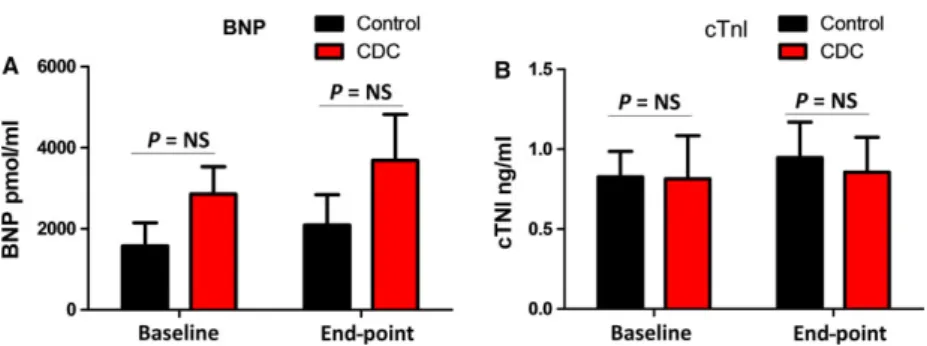
groups. The control and CDC treatment groups had similar brain
natriuretic peptide (BNP) (Fig. 6A) and cardiac troponin I (cTnI)
(Fig. 6B) levels at baseline and end-point. This was measured to
ensure the cell infusion did not exacerbate myocardial damage.
Allogeneic CDC infusion does not engraft or
cause immune rejection in the heart
Autopsy on hearts from CDC-treated, and control, dogs were sliced
for gross inspection (Fig. 7A). Survival rates were similar for each
group (Fig. 7B). No tumour formation was detected. Representative
FISH staining (Fig. 7C) revealed no male donor cells in the female
recipient heart. Haematoxylin and eosin staining shows the lack of
concentration of cell nuclei (Fig. 7D), when compared to control heart
(Fig. 7E), or a healthy (normal) heart (Fig. 7F), suggesting the
allo-geneic CDC infusion did not elicit an immune response from the
heart. This was consistent from our previous findings in rat and
human allogeneic CDC transplantations.
Discussion
The last decade witnessed a burst of cell therapy trials for ischaemic
cardiomyopathy. For the last 7 years, our laboratory has been
study-ing CDCs and recently showed the regenerative potential of CDCs in a
mouse model of induced DCM [20]. Results from a recent clinical
trial also indicated that infusion of autologous CDCs in patients with
mild-to-moderate myocardial infarction reduced scar but increased
viable tissue [8]. A phase II clinical trial is ongoing to test the
regener-ative potential of allogeneic CDCs in patients with recent MI [21].
Domestic dogs suffer from a variety of spontaneously occurring
heart diseases. In Doberman pinschers, the autosomal dominant
inheritance pattern of DCM described in some families is similar to
that of DCM in humans [7, 22]. Expected survival time in Dobermans
is strikingly short, and current treatment is symptomatic and
pallia-tive. This provides us with an excellent opportunity to use the
Dober-man pinscher as a naturally occurring model of DCM for CDC
therapy.
In the present study, we demonstrate that cCDCs can be derived
from adult dog hearts and that they are phenotypically similar to
human and rodent CDCs (Fig. 1). Similar to human CDCs [20], cCDCs
are positive for CD105 but have low expressions of CD90 and ckit.
Recent studies have shown that ckit expression is irrelevant to the
overall therapeutic benefit of CDCs, while CD90 expression
undermi-nes the regenerative potential of CDCs [23, 24]. Allogeneic CDCs have
proven to be safe in both rat models of myocardial infarction [25] and
in an ongoing human trial [23], and the results of using allogeneic
cCDCs derived from a Beagle dog donor for treating Doberman
pin-scher dogs with DCM appear to confirm this finding in dogs as well.
Before the cell infusion procedure, lot release criteria testing was
performed to ensure the cell therapy product was free of bacterial
agents, mycoplasma and endotoxin. In addition, we performed a
storage stability assay to check for how long can the cells remained
viable while being stored in the infusion solution at 4
°
C. Our data
indicated that cell viability was
>
80% up to 5 hrs after collection
Fig. 2Cell infusion procedure. (A) Viability of CDCs stored at 4°C. (B) Intracoronary cell infusion design. (C) Coronary angiography showing catheter placement in left main and RCA. (D) Schematic diagram showing the infusion dose.
(Fig. 2A), which provided abundant time for the myocardial
distribu-tion and infiltradistribu-tion of viable stem cells, as well as maintained
secre-tion of growth factors for treatment. In addisecre-tion, any normal delay in
patient preparation for infusion would have little adverse effects on
cell viability in clinical.
As DCM induces widespread myocardial dysfunction, it is
essen-tial to distribute large number of therapeutic stem cells globally. We
designed a two-vessel infusion protocol to cover the entire heart: 20
million cells into the left main artery and 10 million cells into the RCA
(Fig. 2C and D). To ensure a fast and safe treatment, we devised a
‘wash
–
cell
–
wash’ infusion plan that allowed for an infusion to take
less than 20 min. as well as ensuring no excessive cell accumulation
in the vessel (Fig. 2B). The infusion scheme used here has also been
applied to human patients. Previous studies have investigated the
car-diac benefits of stem cells through intramyocardial injection in rodent
models successfully [26, 27], but this method is invasive and limited
to local areas of myocardium. Catheter-based intra-arterial infusion of
stem cell therapies delivered at the time of myocardial reperfusion is
emerging as a promising candidate to improve LV dysfunction in
por-cine model of MI [28, 29]. In our present study, we applied
intracoro-nary infusion by two vessels which involved left main artery and RCA,
which we hope ensured the global distribution of therapeutic stem
cells. In addition, delivering cells by ‘wash
–
cell
–
wash’ method may
reduce the retention of stem cells in the coronary vessel, presumably
promoting beneficial effects in remote areas of the heart.
DCM is characterized by progressive ventricular dilatation and
contractile dysfunction. While there was no significant change in
LVDd and LVDs from baseline to end-point for both control and CDC
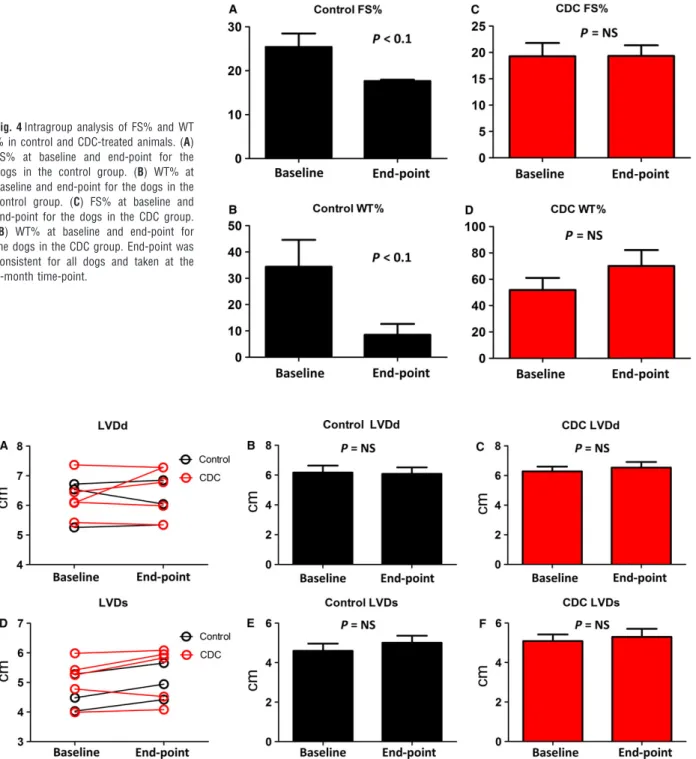
groups (Fig. 5), our results revealed a consistent protection of FS%
and WT% by the CDC therapy (Fig. 3). CDC therapy may also mitigate
the progression of ventricular enlargement and deterioration of
myocardial systolic function (Fig. 4). According to previous studies
[10, 30], CDCs could promote cardiomyocyte proliferation and
pro-tect myocytes from antioxidant, antifibrotic and anti-inflammatory
injury. Cardiac stretch indicators (NT-BNP) and cell injury markers
(cTNI) showed no significant difference between the control and CDC
groups (Fig. 6), suggesting cell infusion had no benefit, but also did
not exacerbate myocardial stretch or damage as measured by these
biomarkers.
Compared to autologous cell therapy, allogeneic cell products
offer several benefits, namely the short time required for
produc-tion and the low cost per dosage. In addiproduc-tion, patient-specific tissue
harvesting and cell processing may introduce possible variations in
cell potency related to patient age and disease [31]. One major
concern of allogeneic therapy is the potential risk of host immune
response. Previous studies have investigated the safety of
allo-geneic CDC transplantation in rats and pigs with myocardial
infarction [25, 28], but the safety and efficacy of allogeneic CDCs
in DCM models have not been explored. Here, we tested the
speci-fic hypothesis that allogenic CDCs could not engraft permanently in
Fig. 4Intragroup analysis of FS% and WT % in control and CDC-treated animals. (A) FS% at baseline and end-point for the dogs in the control group. (B) WT% at baseline and end-point for the dogs in the control group. (C) FS% at baseline and end-point for the dogs in the CDC group. (B) WT% at baseline and end-point for the dogs in the CDC group. End-point was consistent for all dogs and taken at the 3-month time-point.
Fig. 5Left ventricle dimensions. (A) Comparison of LVDd change over the time between control and CDC groups. (B) LVDd at baseline and end-point for the dogs in the control group (C) LVDd at baseline and end-point for the dogs in the CDC group. (D) Comparison of LVDs change over the time between control and CDC groups. (E) LVDs at baseline and end-point for the dogs in the control group. (F) LVDs at baseline and end-point for the dogs in the con-trol group. End-point was consistent for all dogs and taken at the 3-month time-point.
transplanted myocardium, but could still exert therapeutic effects.
No immune cell infiltration was observed in the recipient heart
(Fig. 7), which attested the safety of allogeneic cell therapy in the
DCM model [25].It has been reported that there were no circulating
antidonor antibodies after allogeneic CDC transplantation in rats
with MI [25]. In addition, the amount and volume of CDC therapy
are relatively small compared to those in blood transfusion, and it
has also been shown that injected CDCs do not persist beyond
3 weeks in the heart [25]. Thus, the absence of such sensitization
may explain why allogeneic cells could be survived in recipient.
These results open the door to many different allogeneic treatments
that can be tested in the future.
In summary, we derived cCDCs from adult dog hearts and showed
their safety in an allogeneic canine DCM model.
Limitations
There are some limitations to this study. The use of client-owned
mals that matched criteria for study limited the total number of
ani-mals that could be used. This limitation in sample size prevented our
ability to find true significance in many factors that were trending
towards significance. Another limitation is that only one cell donor
was used for all cell recipients.
Acknowledgements
This work was supported by National Institute of Health, an intramural grant from NC State College of Veterinary Medicine, and a pilot grant from NC State Comparative Medicine Institute. J.T. is supported by China Scholarship Council.
Conflicts of interest
The authors confirm that there are no conflict of interests.
References
1. Mozaffarian D, Benjamin EJ, Go AS,et al. ;on behalf of the American Heart Associ-ation Statistics Committee and Stroke Statistics Subcommittee. Heart disease and stroke statistics— 2015 update: a report from the American Heart Associa-tion [published online ahead of print December 17, 2014]. Circulation 2015; 131: e29–e322. doi: 10.1161/CIR.0000 000000000152.
2. Hazebroek M, Dennert R, Heymans S. Idio-pathic dilated cardiomyopathy: possible trig-gers and treatment strategies.Neth Heart J. 2012; 20: 332–5.
3. Hensley MT, Andrade J, Keene B, et al. Cardiac regenerative potential of cardio-sphere-derived cells from adult dog hearts.
JCMM. 2015; 19: 1805–13.
4. Cheng K, Malliaras K, Li TS,et al.Magnetic enhancement of cell retention, engraftment and functional benefit after intracoronary delivery of cardiac-derived stem cells in a rat model of ischemia/reperfusion.Cell Trans-plant. 2012; 21: 1121–35.
5. Cesselli D, Jakoniuk I, Barlucchi L, et al. Oxidative stress-mediated cardiac cell death is a major determinant of ven-tricular dysfunction and failure in dog dilated cardiomyopathy. Circ Res. 2001; 89: 279–86.
6. Dukes-McEwan J, Borgarelli M, Tidholm A, et al.Proposed guidelines for the diagnosis of canine idiopathic dilated cardiomyopathy.
J Vet Cardiol. 2003; 2: 7–19.
7. Smucker ML, Kaul S, Woodfield JA,et al. Naturally occurring cardiomyopathy in the doberman pinscher: a possible large animal model of human cardiomyopathy?J Am Coll Cardiol. 1990; 16: 200–6.
8. Makkar RR, Smith RR, Cheng K, et al. Intracoronary cardiosphere-derived cells for heart regeneration after myocardial
infarc-tion (CADUCEUS): a prospective,
randomised phase 1 trial.Lancet. 2012; 379: 895–904.
9. Malliaras K, Makkar RR, Smith RR,et al. Intracoronary cardiosphere-derived cells after myocardial infarction: evidence of ther-apeutic regeneration in the final 1-year results of the CADUCEUS trial (CArdio-sphere-Derived aUtologous stem CElls to reverse ventricUlar dySfunction).J Am Coll Cardiol. 2014; 63: 110–22.
10. Aminzadeh M, Tseliou E, Sun B,et al. Ther-apeutic efficacy of cardiosphere-derived cells in a transgenic mouse model of non-ischaemic dilated cardiomyopathy.Eur Heart J. 2014; 36: 751–562. http://dx.doi.org/10. 1093/eurheartj/ehu196
11. Gallet R, de Couto G, Simsolo E,et al. Car-diosphere-derived cells reverse heart failure with preserved ejection fraction (HFpEF) in rats by decreasing fibrosis and inflamma-tion. JACC Basic Transl Sci. 2016; 1: 14–28.
12. Shen D, Cheng K, Marban E. Dose-depen-dent functional benefit of human cardio-sphere transplantation in mice with acute myocardial infarction.J Cell Mol Med. 2012; 16: 2112–6.
13. Smith RR, Barile L, Cho HC,et al. Regener-ative potential of cardiosphere-derived cells expanded from percutaneous endomyocar-dial biopsy specimens. Circulation. 2007; 115: 896–908.
14. Li TS, Cheng K, Malliaras K,et al.Direct comparison of different stem cell types and subpopulations reveals superior paracrine potency and myocardial repair efficacy with cardiosphere-derived cells. J Am Coll Car-diol. 2012; 59: 942–53.
15. Thomas W, Gaber C, Jacobs G, et al. Recommendations for standards in transthoracic two-dimensional echocardiog-raphy in the dog and cat. Echocardiogra-phy Committee of the Specialty of
Cardiology, American College of Veterinary Internal Medicine.J Vet Intern Med. 1993; 7: 247–52.
16. Greenberg B, Massie B, Bristow D,et al. Long-term vasodilator therapy of chronic aortic insufficiency. Circulation. 1998; 78: 92–103.
17. Weil BR, Suzuki G, Leiker MM, et al. Comparative efficacy of intracoronary allo-geneic mesenchymal stem cells and car-diosphere-derived cells in swine with hibernating myocardium.Circulation. 2015; 117: 634–44.
18. Breen M, Jouquand S, Renier C, et al. Chromosome-specific single-locus FISH probes allow anchorage of an 1800-marker integrated radiation-hybrid/linkage map of the domestic dog genome to all chromo-somes. Genome Res. 2001; 11: 1784–95. doi:10.1101/gr.189401.
19. Breen M, Bullerdiek J, Langford CF. The DAPI banded karyotype of the domestic dog (Canis familiaris) generated using chromo-some-specific paint probes. Chromosome Res. 1999; 7: 401–406. doi:10.1023/A: 1009224232134.
20. Li TS, Cheng K, Lee ST, et al. Cardio-spheres recapitulate a niche-like microenvi-ronment rich in stemness and cell-matrix interactions, rationalizing their enhanced functional potency for myocardial repair.
Stem Cells. 2010; 28: 2088–98.
21. ClinicalTrials.gov [Internet]. Bethesda (MD): Allogeneic Heart Stem Cells to Achieve Myocardial Regeneration (ALL-STAR); 2011 [updated 2014 July 14; cited 2015 July 05]. Available from: https://clinical trials.gov/ct2/show/NCT01458405. 22. Meurs KM, Fox PR, Norgard M, et al.A
prospective genetic evaluation of familial dilated cardiomyopathy in the Doberman pinscher. J Vet Intern Med. 2007; 21: 1016–20.
humans and in a mouse model of myocar-dial infarction.J Am Heart Assoc. 2014; 3: e001260. doi:10.1161/JAHA.114.001260. 24. Gago-Lopez N, Awaji O, Zhang Y, et al.
THY-1 receptor expression differentiates cardiosphere-derived cells with divergent cardiogenic differentiation potential. Stem Cell Reports. 2014; 2: 576–91.
25. Malliaras K, Li TS, Luthringer D, et al. Safety and efficacy of allogeneic cell therapy in infarcted rats transplanted with mis-matched cardiosphere-derived cells. Circula-tion. 2012; 125: 100–12.
26. Cheng K, Blusztajn A, Shen D, et al. Functional performance of human
cardio-27. Cheng K, Shen D, Smith J,et al. Transplan-tation of Platelet Gel Spiked with Cardio-sphere-Derived Cells Boosts Structural and Functional Benefits Relative to Gel Trans-plantation Alone in Rats with Myocardial Infarction.Biomaterials. 2012; 33: 2872–9. 28. Kanazawa H, Tseliou E, Dawkins JF,et al.
Durable benefits of cellular postconditioning: long-term effects of allogeneic cardio-sphere-derived cells infused after reperfu-sion in pigs with acute myocardial infarction.
J Am Heart Assoc. 2016; 5: e002796. doi:10.1161/JAHA.115.002796.
29. Kanazawa H, Tseliou E, Malliaras K,et al. Cellular postconditioning: allogeneic
cardio-acute myocardial infarction.Circ Heart Fail. 2015; 8: 322–332. doi:10.1161/CIRCHEART FAILURE.114.001484.
30. Yee K, Malliaras K, Kanazawa H, et al. Allogeneic cardiospheres deliveredvia per-cutaneous transendocardial injection increase viable myocardium, decrease scar size, and attenuate cardiac dilation in por-cine ischemic cardiomyopathy. PLoS ONE. 2014; 9: e113805. doi:10.1371/journal. pone.0113805.