Hormone-dependent control
of developmental timing through
regulation of chromatin accessibility
Christopher M. Uyehara,
1,2,3,4,6Spencer L. Nystrom,
1,2,3,4,6Matthew J. Niederhuber,
1,2,3,4Mary Leatham-Jensen,
1,2,4Yiqin Ma,
5Laura A. Buttitta,
5and Daniel J. McKay
1,2,4 1Department of Biology,2Department of Genetics,3Curriculum in Genetics and Molecular Biology,4Integrative Program for Biological and Genome Sciences, The University of North Carolina at Chapel Hill, Chapel Hill, North Carolina, 27599, USA; 5
Department of Molecular, Cellular, and Developmental Biology, University of Michigan, Ann Arbor, Michigan 48109, USA
Specification of tissue identity during development requires precise coordination of gene expression in both space and time. Spatially, master regulatory transcription factors are required to control tissue-specific gene expression programs. However, the mechanisms controlling how tissue-specific gene expression changes over time are less well understood. Here, we show that hormone-induced transcription factors control temporal gene expression by regu-lating the accessibility of DNA regulatory elements. Using theDrosophilawing, we demonstrate that temporal changes in gene expression are accompanied by genome-wide changes in chromatin accessibility at temporal-spe-cific enhancers. We also uncover a temporal cascade of transcription factors following a pulse of the steroid hormone ecdysone such that different times in wing development can be defined by distinct combinations of hormone-in-duced transcription factors. Finally, we show that the ecdysone-inhormone-in-duced transcription factor E93 controls temporal identity by directly regulating chromatin accessibility across the genome. Notably, we found that E93 controls enhancer activity through three different modalities, including promoting accessibility of late-acting enhancers and decreasing accessibility of early-acting enhancers. Together, this work supports a model in which an extrinsic signal triggers an intrinsic transcription factor cascade that drives development forward in time through regulation of chromatin accessibility.
[Keywords: temporal gene regulation; open chromatin; ecdysone; pioneer transcription factor; genomics]
Supplemental material is available for this article.
Received February 28, 2017; revised version accepted April 26, 2017.
A defining feature of metazoan development is the organi-zation of cells into tissues. The physiological function of a given tissue is determined by the identity of its constitu-ent cells as well as their arrangemconstitu-ent within the tissue. As a result, building tissues during development requires precise spatial control of gene expression over extended periods of time. Whereas many of the genes required for the development of different cell and tissue types have been identified, the mechanisms through which spatial information is coordinated with temporal information re-main incompletely understood.
Spatially, a select and conserved group of transcription factors, sometimes termed“master”transcription factors, often specifies the distinct identities of different cell and tissue types (Mann and Carroll 2002; Mullen et al. 2011). Genetic studies from a range of organisms show
that loss of function of a given master transcription factor can result in the loss of a given cell type or tissue. Con-versely, ectopic expression of a given master transcription factor can result in transformation of identities. Hence, master transcription factors are major determinants of cell fate. Consistent with their importance in develop-ment, the dysregulation of master transcription factors is associated with a range of diseases. Thus, understanding the mechanisms through which these factors function is an important goal in biomedical research.
One proposed mechanism to explain the distinctive power of master transcription factors is that they control where other transcription factors bind in the genome by regulating chromatin accessibility (Fakhouri et al. 2010; Mullen et al. 2011; Pham et al. 2013). In vivo, DNA is wrapped around histone proteins to make nucleosomes, the basic unit of chromatin. Due to their tight as-sociation with DNA, nucleosomes act as barriers to 6These authors contributed equally to this work.
Corresponding author: [email protected]
Article published online ahead of print. Article and publication date are online at http://www.genesdev.org/cgi/doi/10.1101/gad.298182.117. Free-ly available online through the Genes & Development Open Access option.
transcription factor binding. For a given transcription fac-tor to bind DNA, a nucleosome must be moved or evict-ed, creating a site of“open” or“accessible” chromatin. Several lines of evidence support an important role for chromatin accessibility in transcription factor targeting in the genome. Chief among these are the observations that only a small fraction of transcription factor DNA-binding motifs is occupied at a given point in time (Li et al. 2008) and that many sites of transcription factor binding do not contain a recognizable DNA-binding mo-tif (Kvon et al. 2012). Thus, regulation of chromatin ac-cessibility plays a potentially pivotal role in controlling cell identity by determining where transcription factors can bind in the genome and hence the sets of genes that are expressed.
If nucleosomes prevent transcription factors from ac-cessing DNA, then how do transcription factors come to occupy their binding sites? Biochemical studies have identified a class of transcription factors termed“pioneer” factors that have the unique ability to bind nucleosomal DNA and subsequently enable binding by other tran-scription factors (Zaret and Mango 2016). The prototype pioneer factor is FoxA1, a master regulator of liver devel-opment (Lee et al. 2005). FoxA1 has also been shown to play an important role in controlling targeting of the estro-gen and androestro-gen receptors in breast and prostate cancer cells, respectively (Jozwik and Carroll 2012). More recent-ly, the master transcription factors of embryonic stem cell identity—Oct4, Sox2, and Klf4—were shown to have pio-neering activity during induction of pluripotency in in-duced pluripotency stem (iPS) cells (Soufi et al. 2015). While pioneers have the potential to be pivotal regulators of gene expression programs, much remains to be learned about their function. For example, it is not clear why they exhibit pioneering activity in only a subset of the cells in which they are expressed. Pioneers also may not be the only factors that control chromatin accessibility. Other transcription factors can work together to compete nucle-osomes off DNA, consistent with earlier in vitro work on transcription factor binding to nucleosomal templates (Taylor et al. 1991).
In addition to spatial control, gene expression patterns are also temporally regulated in development. For exam-ple, in a variety of animals, neural stem cells produce daughter cells with distinct identities at different times of development to create the vast diversity of neurons and glia found in the nervous system (Kohwi and Doe 2013). InDrosophilaembryos, an intrinsic cascade of tran-scription factor expression specifies the distinct temporal identities of neural stem cell progeny (Isshiki et al. 2001). A similar mechanism using a different transcription factor cascade diversifies neural identities in theDrosophila lar-val brain (Erclik et al. 2017). In contrast to stem cell line-ages, coordinating the timing of gene expression across fields of cells, such as a tissue, often involves the use of se-creted signals. For example, thyroid hormone controls the initiation and progression of metamorphosis in frogs (Shi 2013), whereas the sex hormones control the development of secondary sex traits during adolescence in mammals (Romeo 2003).
InDrosophilaand other insects, developmental timing is controlled by the steroid hormone ecdysone (Ashburner 1990; Thummel 2002). Secreted by the prothoracic gland at stereotypical stages of development, ecdysone travels through the hemolymph to reach target tissues, where it binds to its receptor, the ecdysone receptor (EcR) (King-Jones and Thummel 2005). Like other nuclear hormone re-ceptors, EcR is a transcription factor that differentially reg-ulates gene expression in the presence and absence of ligand. Studies initially performed in the larval salivary gland revealed that, upon binding ecdysone, EcR activates transcription of a set of early genes, many of which are transcription factors (Ashburner 1990). The early gene products then work with EcR to activate a set of late genes, which encode the proteins that mediate the physiological response to hormone signaling (e.g., the glue proteins made by the salivary gland that adhere the pupa to a sub-strate during metamorphosis). Transcriptional profiling from a diverse collection of cell lines showed that the re-sponse to ecdysone is both widespread and highly cell type-specific (Stoiber et al. 2016). Mapping of hormone-re-sponsive enhancers in cultured cells recently revealed that tissue-specific responses to ecdysone are influenced by motif content in DNA regulatory elements (Shlyueva et al. 2014). Despite these efforts, the precise mechanisms through which ecdysone signaling controls temporal-spe-cific gene expression inDrosophilaremain elusive.
To ask how spatial and temporal information are inte-grated by regulatory DNA during specification of tissue identities, we recently performed open chromatin profil-ing at two stages ofDrosophilaappendage development (McKay and Lieb 2013). In flies, the distinct identity of each appendage is determined by the expression of differ-ent master transcription factors with differdiffer-ent DNA-bind-ing domains. For example, leg identity is determined by the homeodomain transcription factorDistallessand the zinc finger transcription factor Sp1 (Estella and Mann 2010). In contrast, dorsal appendage identities, including the wing and haltere, are specified by vestigial and its TEA domain-containing DNA-binding partner,scalloped (Halder et al. 1998). Despite the differences in master transcription factor identities between these tissues and contrary to our expectations, we found that the open chro-matin profiles in wings, legs, and halteres are nearly the same, with the exception of the master regulator loci themselves, which exhibit differential accessibility be-tween the appendages (McKay and Lieb 2013). The similar-ity in appendage open chromatin profiles indicates that the master transcription factors are not the sole determinants of chromatin accessibility, if they do so at all. This leaves the question of which factors are responsible for control-ling chromatin accessibility in the appendages.
the imaginal discs. This indicates that a coordinate change in chromatin accessibility occurs during append-age development and also suggests that passappend-age through developmental time has a greater impact than cell lineage on chromatin accessibility. Because the appendages are not in physical contact with each other inside developing flies, we reasoned that a systemic signal, such as ecdy-sone, contributes to control of chromatin accessibility.
Here, we examined the mechanisms controlling tempo-ral gene regulation inDrosophila. Using a time course of wing development that encompasses the transition be-tween larval and pupal stages, we used RNA sequencing (RNA-seq) to show that gene expression is temporally dy-namic as wings differentiate and undergo the complex morphogenetic events that create the adult appendage. We then carried out open chromatin profiling and trans-genic reporter analysis to show that these changes in gene expression are accompanied by genome-wide chang-es in the accchang-essibility of temporal-specific transcriptional enhancers. Finally, we used ChIP-seq (chromatin immu-noprecipitation [ChIP] combined with high-throughput sequencing) and loss-of-function analyses to show that the ecdysone-induced transcription factor E93 is required to drive the normal sequence of chromatin accessibility changes. Importantly, E93 is required for not only increas-ing the accessibility of late-actincreas-ing enhancers but also decreasing the accessibility of early-acting enhancers.
Together, these findings demonstrate that E93 specifies temporal identity by directly regulating accessibility of temporal-specific transcriptional enhancers. More broad-ly, this work helps to explain how hormone signaling can influence tissue-specific gene expression programs to drive development forward in time.
Results
Gene expression is temporally dynamic in pupal wings
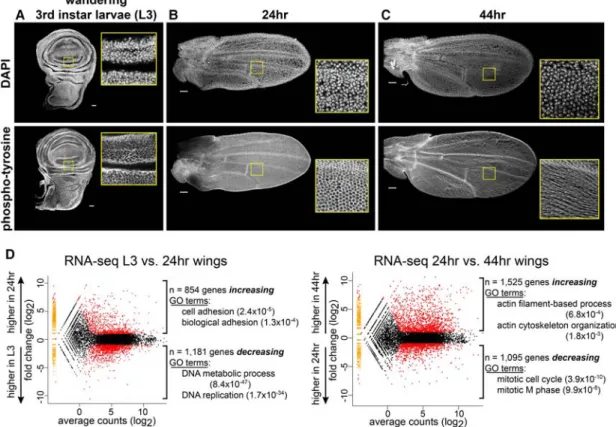
To examine the mechanisms underlying temporal regula-tion of gene expression, we focused on the early stages of Drosophilapupal wing development. By the end of larval development (Fig. 1A), the wing disc consists of∼50,000 cells, cell fates along the proximal–distal axis have been patterned, and precursors of adult structures such as wing veins and sensory organs are being specified (Cohen 1993). During the next 2 d of pupal development (Fig. 1B, C), cell fates continue to be more finely determined, while the wing undergoes a final round of cell division (Guo et al. 2016). This time is also characterized by dramatic mor-phological changes at both the tissue and cellular levels: Changes in cell shape drive eversion of the wing pouch, and changes in cell adhesion allow the apposed dorsal and ventral surfaces of the wing epithelium to form the upper and lower layers of the wing blade. Cytoskeletal
changes also result in extrusion of the cell membrane to produce a single cuticular hair (trichome) from each wing blade epithelial cell (Fig. 1C, bottom row; Adler et al. 2000). Not surprisingly, these developmental chang-es are associated with widchang-espread changchang-es in gene exprchang-es- expres-sion. To quantify these changes, we performed RNA-seq on wing discs dissected from wandering third instar larvae (Fig. 1A,“L3”) and wings dissected from flies 24 h (Fig. 1B, “24 h”) and 44 h (Fig. 1C,“44 h”) after puparium forma-tion (Guo et al. 2016). Pairwise comparisons between successive time points revealed thousands of genes both increasing and decreasing between each time point (edgeR false discovery rate [FDR] <0.05; fold change great-er than or equal to twofold for expressed genes) (Fig. 1D; Supplemental Table S1). Gene ontology (GO) analysis showed enrichment for biological processes known to oc-cur at these times (Huang da et al. 2009; Supek et al. 2011). For example, genes increasing between L3 and 24 h in-clude those involved in cell adhesion (P-value 2.4 × 10⁻⁵), whereas genes increasing between 24 and 44 h in-clude those involved in actin regulation (P value-6.8 × 10⁻⁴). Conversely, genes decreasing between L3 and 24 h include those involved in DNA replication (P-value 1.7 × 10⁻³⁴), whereas genes decreasing between 24 and 44 h include those involved in mitosis (P-value 3.9 × 10⁻¹⁰) (Fig. 1D;Supplemental Fig. S1). Thus, the first 2 d of pupal wing development are marked by temporally dy-namic changes in gene expression.
Open chromatin profiles are temporally dynamic in pupal wings
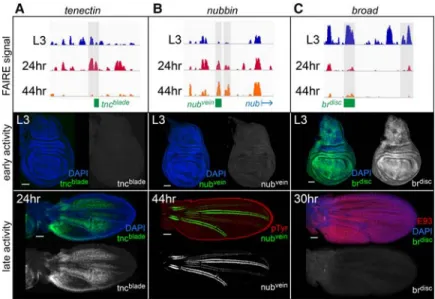
We next sought to examine the mechanisms underlying the temporal changes in gene expression that we observed in pupal wings. Due to the competition between transcrip-tion factors and nucleosomes for DNA binding, methods that identify nucleosome-depleted regions, also known as open chromatin sites, can be used as a proxy to identify sites of transcription factor binding in the genome. To map open chromatin sites genome-wide, we performed FAIRE-seq (formaldehyde-assisted identification of regulatory el-ements [FAIRE] combined with sequencing) (Giresi et al. 2007) on L3, 24-h, and 44-h wings (Fig. 2). We found that open chromatin profiles in early pupal wings are highly dy-namic between time points, with changes in open chroma-tin occurring at genes that change expression between time points (Supplemental Fig. S2A). For example, the ten-ectingene (tnc), which encodes a constituent of the extra-cellular matrix that bindsα-PS2 integrin (Fraichard et al. 2010), exhibits multiple open chromatin changes between L3, 24-h, and 44-h wings (Fig. 2A). These changes coincide with a strong increase intncexpression between L3 and 24-h wings (Fig. 2A). Similarly, theexpansionlocus, which encodes a protein involved in chitin biosynthesis (Sobala and Adler 2016), contains multiple open chromatin sites that become accessible specifically between 24 h and 44 h. The timing of this chromatin opening coincides with an increase inexpansionRNA levels (Fig. 2A) and the pro-duction of chitin by wing epidermal cells during cuticle secretion at this stage of development (Sobala and Adler
dynamic open chromatin sites (78%–89%) is located distal to gene promoters (Supplemental Fig. S2D). Finally, plots of the average FAIRE signal in temporally dynamic open chromatin indicate that many temporally dynamic open chromatin sites are used transiently in development. For example, sites closing between L3 and 24 h tend to stay closed, and sites opening between 24 h and 44 h tend to be closed at L3 (i.e., prior to 24 h) (Fig. 2C). Thus, the dy-namic gene expression exhibited by early pupal wings co-incides with dynamic changes in chromatin accessibility.
Temporally dynamic open chromatin sites correspond to temporal-specific transcriptional enhancers
Open chromatin sites are highly correlated with function-al DNA regulatory element activity (McKay and Lieb 2013). Our findings above suggest that temporally dynam-ic open chromatin sites may be transiently used promoter-distal enhancers in pupal wings. To test this directly, we cloned open chromatin sites from three genes for use in transgenic reporter assays. These sites were chosen because they exhibit temporally dynamic accessibility, and the neighboring genes are required for proper wing de-velopment. Candidate enhancers were cloned into report-er constructs and integrated into the genome as single copies via ΦC31-mediated site-specific recombination. Altogether, we cloned six temporally dynamic open chro-matin sites. Each of these six sites corresponds to a tempo-rally regulated transcriptional enhancer. We discuss each of them in turn.
We first examined two candidate enhancers from the tnclocus. As mentioned above,tncencodes an extracellu-lar matrix protein involved in cell adhesion. Consistent with a role for tnc in mediating adhesion between the dorsal and ventral surfaces of the wing pouch, RNAi-mediated knockdown of tnc results in defects in wing morphology (Fraichard et al. 2010). We cloned two tempo-rally dynamic open chromatin sites located ∼40 kb up-stream of the tnc promoter. Our FAIRE-seq data show that these sites increase in accessibility between the L3
and 24-h time points and subsequently decrease in acces-sibility between 24 h and 44 h (Fig. 3A;Supplemental Figs. S3A, S4A). While neither reporter is active in L3 wing discs, there is activity in 24-h wings. We termed these the tncblade (blade) and tncwv (wing vein) enhancers. tncbladeis active most strongly in the interveins between the first and second and between the fourth and fifth lon-gitudinal veins and in cells near the proximal posterior margin. It is also active at lower levels in the intervein be-tween the third and fourth longitudinal veins (Fig. 3A). tncwvis active most strongly near the first, fifth, and sixth longitudinal veins and at lower levels in the third longitu-dinal vein (Supplemental Fig. S4A). Thus, tncblade and tncwvare active in complementary domains of the 24-h pupal wing. Sincetncis expressed nearly ubiquitously at this stage of wing development, these open chromatin sites likely correspond to bona fide transcriptional en-hancers that interpret different spatial inputs.
We next examined two candidate enhancers from the nubbin(nub) locus, which encodes a transcription factor required for proximal-distal axis and vein development in wings (Cifuentes and Garcia-Bellido 1997). The cloned candidate enhancers are located∼5 and 6.5 kb upstream of thenub promoter. Our FAIRE-seq data show that these sites progressively increase in accessibility between the L3 and 44-h time points (Fig. 3B; Supplemental Figs. S3B, S4B). Immunofluorescence experiments show that a reporter carrying the distal site is not active in L3 wing discs. By 44 h, it shows strong activity in the L3 and L5 wing veins and weaker activity in the L2 and L4 veins (Fig. 3B). We thus designated this as thenubveinenhancer. Consistent with the nubvein activity pattern, hypomor-phicnuballeles show defects in wing vein development (Cifuentes and Garcia-Bellido 1997). Immunostaining of the more proximal site, which we named nubmargin, shows reporter activity near the wing margin and the posterior cross-vein of 44-h wings (Supplemental Fig.
S4B), again consistent with defects observed innub
hypo-morphic alleles (Cifuentes and Garcia-Bellido 1997). Thus, temporally dynamic open chromatin sites identify
Figure 3. Temporally dynamic open chromatin cor-responds to temporal-specific enhancer activity. (Top
row) Browser shots of FAIRE-seq signal from thetnc
functionally relevant enhancers with temporal-specific activity.
Last, we examined two candidate enhancers from the broad(br) locus, which encodes a family of transcription factors active in third instar and early prepupal tissues, in-cluding the wing (Kiss et al. 1988; Guo et al. 2016). Using our FAIRE-seq data, we identified open chromatin sites at thebrlocus that are accessible in L3 wing discs but sub-sequently decrease in accessibility by 24 h and 44 h (Fig.
3C; Supplemental Figs. S3C, S4C). These candidate
en-hancers were cloned upstream ofGAL4to allow for flex-ibility in the reporters used. Crossing theseGAL4drivers to flies containing UAS-GFP revealed that both open chromatin sites are transcriptional enhancers active in L3 wing discs. Thebrdiscenhancer is located∼40 kb up-stream of the br promoter. Similar to Br protein, brdisc is active nearly ubiquitously in wing imaginal disc epithe-lial cells, with higher levels along the anterior–posterior and dorsal–ventral boundaries in the wing pouch (Fig. 3C). We next sought to determine whether the decrease in accessibility ofbrdiscbetween L3 and 24 h coincides with a decrease in enhancer activity. Since there are a lim-ited number of cell divisions in pupal wings, GFP signal can persist even after an enhancer turns off. Therefore, we used a destabilized GFP reporter, reasoning that in-creased GFP degradation may make the reporter more sensitive to the enhancer’s activity state even if GAL4 persists. Consistent with the timing ofbrdiscclosing, we found that it shuts off between L3 and 24 h (Fig. 3C). Thus, the timing ofbrdiscclosing coincides with the tim-ing of it turntim-ing off. We identified a secondbrenhancer, which we termedbrade(Supplemental Fig. S4C). This en-hancer is located∼30 kb upstream of thebrpromoter and is active in L3 wing discs in a pattern similar to the ade-pithelial cells located in the notum of the wing. Like thebrdiscenhancer, there is no sign ofbradereporter activ-ity in the wing blade by 24 h, consistent with expecta-tions, since the adepithelial cells remain in the notum to form the indirect flight muscles. Notably,bris required for proper differentiation of these cells into adult muscles (Lovato et al. 2005). Together, these findings support the premise that temporally dynamic open chromatin sites correspond to temporal-specific transcriptional en-hancers and that genes use different DNA regulatory ele-ments to control their expression at different stages of development.
A temporal cascade of ecdysone-induced transcription factors is expressed in pupal wings
The above findings suggest that temporal changes in gene expression are driven by temporal changes in the accessi-bility of transcriptional enhancers. We next sought to identify factors that could be involved in controlling the accessibility of these enhancers. We reasoned that ecdy-sone signaling may be involved, since it controls develop-mental transitions in insects (Thummel 2001; King-Jones and Thummel 2005), and our previous work suggested that an extrinsic signal may coordinate temporal changes in chromatin accessibility between the appendages
(McKay and Lieb 2013). We performed RNA-seq at six time points in pupal wings (Guo et al. 2016). Consistent with the Ashburner model of ecdysone signaling (Fig. 4A; Ashburner 1990), we observed a clear temporal cas-cade of ecdysone-induced transcription factor expression such that each time point in early pupal wing develop-ment can be defined by a distinct combination of these transcription factors (Fig. 4B; Supplemental Table S2). Moreover, the timing of each factor’s expression coincides with the timing of its requirement inDrosophila develop-ment. For example,bris required for the transition from larval to prepupal stages (Kiss et al. 1988), and we found that it is expressed specifically at the L3 time point in wings. Likewise,ftz-f1is required for the transition from prepupal to pupal stages (Broadus et al. 1999), and we found that it is expressed specifically at the 6-h time point in wings. Finally, the transcription factorE93is expressed at the 18-h and 24-h time points, when it is required for bract development in pupal legs (Mou et al. 2012). Thus, a temporal cascade of ecdysone-induced transcription fac-tors occurs in early pupal wings.
If ecdysone-induced transcription factors control chro-matin accessibility, one may expect to find their
binding motifs to be overrepresented in temporally dy-namic open chromatin sites. To ask this question, we looked for enrichment of known DNA-binding motifs (Zhu et al. 2011) for a set of ecdysone-induced transcrip-tion factors (Supplemental Table S3) in temporally dy-namic FAIRE peaks relative to temporally static FAIRE peaks. We observed significant enrichment (P< 0.05) for multiple motifs in FAIRE peaks that open or close be-tween successive time points (Fig. 4C). In contrast, we did not find any enrichment in temporally dynamic peaks for the motif of Scalloped (Sd), the DNA-binding partner of the wing master transcription factor Vestigial (Halder et al. 1998). We also looked for enrichment of the motif for GAGA factor (GAF), a transcription factor often associ-ated with transcriptional enhancers and open chromatin sites (Fuda et al. 2015). We found that the GAF motif was enriched in both dynamic and static FAIRE peaks, thus causing no relative motif enrichment and suggesting that GAF is not responsible for the temporal dynamics. Together, these findings are consistent with a role for ec-dysone-induced transcription factors in regulating tempo-rally dynamic open chromatin sites.
The motif for the ecdysone-induced transcription factor E93 was strongly overrepresented in open chromatin sites that close between L3 and 24 h as well as those that open between 24 h and 44 h (Fig. 4C). We therefore sought to determine whetherE93plays a role in wing development. E93 encodes a pipsqueak domain-containing transcription factor that was first identified as an ecdysone target required for autophagy of the larval salivary gland (Baeh-recke and Thummel 1995; Lee et al. 2000). More recently, E93was shown to act as a competence factor for temporal-specific gene regulation in the pupal leg (Mou et al. 2012). Our RNA-seq data show thatE93is transcribed at high levels in pupal wings at the 18- and 24-h time points (Fig. 4B). To ask whether E93 is required for normal wing development, we compared the morphology of wild-type andE93mutant wings. At the L3 stage, wild-type and E93 mutant wings are indistinguishable (Fig. 4D), consistent with expectations, since E93 is not ex-pressed at this time. At 24 h, whenE93is expressed at high levels,E93mutant wings display defects in cell adhe-sion between the dorsal and ventral surfaces of the wing epithelium (data not shown). At 96 h, following the period of E93 expression, E93 mutant wings are dramatically smaller than wild-type wings, with significant defects in vein development (Fig. 4D). Thus, E93 is essential for proper wing development, and the appearance of defects inE93mutants is commensurate with the timing of its ex-pression in pupal wings.
ChIP-seq reveals that E93 binds open chromatin sites in pupal wings
The above findings reveal that the temporal changes in gene expression that occur during pupal wing develop-ment coincide with temporal changes in the accessibility of thousands of open chromatin sites, many of which could be transcriptional enhancers. We next sought to examine the role of E93 in this process. As a first step, we performed
ChIP-seq to identify sites in the genome to which E93 binds. We used an E93protein trap fly strain generated by the Drosophila Gene Disruption Project (Venken et al. 2011). In this strain, the endogenousE93gene has a transposon inserted within an intron that is shared by all annotatedE93isoforms. The transposon carries an“ artifi-cial exon”cassette with the coding sequence for GFP and other epitope tags in the same reading frame as E93, flanked by splice acceptor and donor sites. Upon tran-scription and translation, an E93 fusion protein is ex-pressed (referred to here as E93GFSTF) that can be
immunoprecipitated with antibodies to GFP. Importantly, the E93GFSTFchromosome complements a deletion en-compassing theE93 locus [Df(3R)93FX2], demonstrating that the fusion protein is functional. Supporting this func-tionality, immunostaining ofE93GFSTFflies shows clear fusion protein expression in 24-h and 44-h wings (Supple-mental Fig. S5).
We performed ChIP-seq for E93 on dissected 24-h pupal wings (Fig. 5A). Peak calling with MACS2 identified 8477 significantly bound sites genome-wide. De novo motif dis-covery analysis (Bailey 2011) identified a sequence en-riched in E93 ChIP peaks that is very similar to an E93 motif derived from a bacterial one-hybrid screen for Dro-sophilatranscription factors (Fig. 5B; Zhu et al. 2011), sup-porting the quality of the data. Overall, E93 binding corresponds well with 24-h open chromatin in pupal wings (Fig. 5C,D); 50% of E93 ChIP peaks are contained within the top 6225 24-h FAIRE peaks, and 96% of E93 ChIP peaks are contained within all 24-h FAIRE peaks (Fig. 5C). While there is good correspondence between E93 binding and open chromatin, not all 24-h FAIRE peaks are bound by E93 (Supplemental Fig. S6A), demonstrating that the E93 ChIP signal is specific and not simply an in-direct consequence of open chromatin. This is further sup-ported by differences in the distribution of E93 ChIP and 24-h FAIRE peak locations across the genome: E93 binds preferentially to promoter-distal sites in the genome, whereas FAIRE peaks overlap proximal promoter regions with greater frequency (Supplemental Fig. S6B). We next examined the relationship between E93 binding and tem-porally dynamic open chromatin in pupal wings. Fifty-one percent of FAIRE peaks that change in accessibility be-tween L3 and 24 h are directly bound by E93 at 24 h. Likewise, 51% of FAIRE peaks that change in accessi-bility between 24 h and 44 h are directly bound by E93 at 24 h (Fig. 5E). In contrast, only 14% of temporally dy-namic FAIRE peaks in early embryos (McKay and Lieb 2013) are bound by E93 in 24-h pupal wings. Thus, E93 directly binds a significant majority of open chromatin sites that change accessibility (opening or closing) be-tween L3 and 44 h.
E93 binding is required for temporally dynamic open chromatin changes
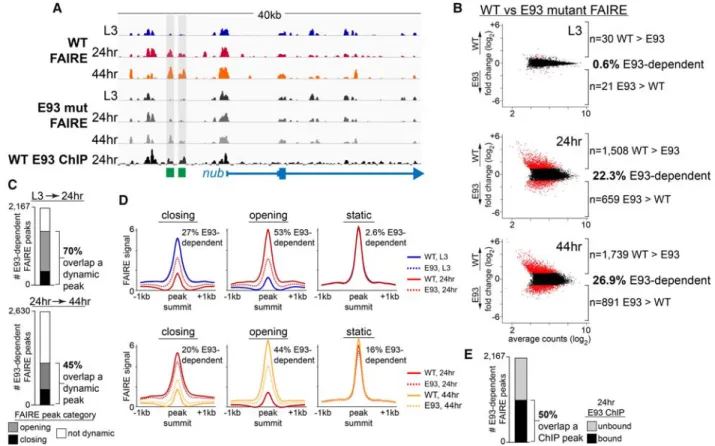
hypothesis, we performed FAIRE-seq inE93mutant wings at L3, 24 h, and 44 h (Fig. 6A). In L3 wings, we observed very few changes in open chromatin between wild-type andE93mutants (Fig. 6B), consistent with expectations, since E93 is not yet expressed at this time. In contrast, we observed thousands of changes in open chromatin be-tween wild-type andE93 mutant wings at 24 h and 44 h. For example, 1508 FAIRE peaks out of the top 7699 peaks from each pair of data sets are more open in wild-type wings than inE93mutants at 24 h (Fig. 6B), demon-strating that E93 is required for accessibility at these sites. Surprisingly, 659 FAIRE peaks are more open inE93 mu-tant wings than in wild type at 24 h, indicating that E93 is not required to promote accessibility at these sites; in-stead, it is required for the opposite: promoting nucleo-some occupancy. Thus, loss of E93 results in not only the loss of accessibility at thousands of sites in the ge-nome but also the inappropriate presence of accessible chromatin at hundreds of additional sites.
We next asked whether sites that depend on E93 for proper chromatin accessibility correspond to temporally dynamic FAIRE peaks. Indeed, 70% of E93-dependent FAIRE peaks are temporally dynamic between L3 and 24 h in wild-type wings (Fig. 6C). This includes 53% of sites that normally open between L3 and 24 h in wild-type wings but fail to open inE93mutants and 27% of sites that normally close between L3 and 24 h in wild-type
wings at 24 h are as similar to those of wild-type wings at L3 as they are to those of wild-type wings at 24 h (Supple-mental Fig. S8).
E93 controls temporal-specific enhancer activity through three distinct mechanisms
The results described above suggest that the developmen-tal defects observed inE93mutants are due to a failure to make temporally required changes in the accessibility of DNA regulatory elements genome-wide. To directly test this hypothesis, we examined the consequences of E93 loss-of-function on the activity of the temporally dynamic transcriptional enhancers that we identified above. ChIP-seq shows that thenubveinenhancer is directly bound by E93 at 24 h, and FAIRE-seq in wild-type wings shows that nubveinprogressively opens after the L3 stage (Fig. 7). The timing of this accessibility coincides with increas-ingnubveinenhancer activity in wing veins (Fig. 4). FAIRE-seq fromE93mutant wings reveals that this enhancer is dependent on E93 for its accessibility: It fails to open at 24 h and remains closed at 44 h in the absence of E93 (Fig. 7). Using the GAL4-UAS system to drive an E93
RNAi construct specifically in the posterior compartment of the wing withEn-GAL4, we observed a strong loss of nubveinactivity upon E93 knockdown specifically in the regions where the RNAi was expressed (Fig. 7). The en-hancer remains active in only a few cells in the proximal wing after E93 knockdown, and most RNAi-expressing cells show complete loss of GFP. Thus, the failure to open thenubveinenhancer inE93mutant flies correlates with a failure to activate the enhancer in transgenic re-porter assays.
We next examined thebrdiscenhancer, which is open and active in L3 wings but closed and inactive in 24-h and 44-h wings (Fig. 3). ChIP-seq reveals that E93 is directly bound to this enhancer, and FAIRE-seq shows that it remains persistently open at 24 h and 44 h inE93 mutant wings (Fig. 7). Consistent with this persistent ac-cessibility, brdisc is expressed in E93 mutants at 24 h, when it would normally be off in wild-type wings (Fig. 7). Thebrdiscpattern in 24-h E93 mutant wings is nearly ubiquitous, similar to its pattern earlier in L3 wings. Thus, E93 is required to close this enhancer after the L3 stage, and failure to do so results in its aberrant expression at later developmental stages.
Figure 6. E93 binding is required for temporally dynamic open chromatin changes. (A) Browser shot showing FAIRE-seq signal from wild-type andE93mutant wings. E93 ChIP-seq signal from wild-type 24-h wings is shown in black. Thenubveinandnubmarginenhancers are
Finally, we examined the tncbladeenhancer, which is open and active in 24-h wings (Fig. 3). ChIP-seq shows that E93 is directly bound totncblade(Fig. 7). However, de-spite this binding,tncbladedoes not significantly change in accessibility in E93 mutant wings, demonstrating that E93 is not required for promoting the accessibility of this enhancer. Nevertheless, RNAi-mediated knockdown of E93 in the anterior compartment of the wing using Ci-GAL4results in loss oftncbladeactivity in RNAi-express-ing cells. Thus, while thetncbladeenhancer is not depen-dent on E93 for its accessibility, it is still dependepen-dent on E93 for its activity. Importantly, the mutual dependence of thenubveinandtncbladeenhancers on E93 for transcrip-tional activity, combined with the specific dependence of nubveinon E93 for accessibility, suggests that distinct bio-chemical mechanisms underlie E93 function at these enhancers.
Discussion
The mechanisms controlling transcription factor target-ing in the genome are incompletely understood, particu-larly in the context of animal development. Here, we
show that the hormone-induced transcription factor E93 plays a direct role in controlling temporal changes in chro-matin accessibility in the developing Drosophila wing. Together with our previous findings, this work supports a model in which two axes of information regulate en-hancer activity in developing appendages: Temporal infor-mation is provided by hormone-induced transcription factors that regulate accessibility of transcriptional en-hancers, and spatial information is provided by the ap-pendage master transcription factors that differentially regulate the activity of these enhancers.
Transcription factor targeting and temporal gene regulation
The importance of master transcription factors in specify-ing spatial identity durspecify-ing development suggests that they may control where other transcription factors bind in the genome. One prediction of this model is that tissues whose identities are determined by different master tran-scription factors would exhibit different genome-wide DNA-binding profiles. However, we found recently that the Drosophila appendages (wings, legs, and halteres), Figure 7. E93 controls temporal-specific enhancer activity through three distinct modalities. (A) Browser shots of FAIRE-seq and ChIP-seq signal from wild-type andE93mutant wings at the indicated loci. (B,C) Immunostaining of reporter activity for each indicated enhanc-er. (B) Reporter activity in control or wild-type wings. (C) Reporter activity (green) in wings expressing E93 RNAi under control of Ci-GAL4(tncblade) orEn-GAL4(nubvein) or inE93mutant wings (brdisc). The dotted lines indicate the boundary between RNAi-expressing
which use different transcription factors to determine their identities, share nearly identical open chromatin profiles. Moreover, these shared open chromatin profiles change coordinately over developmental time. There are two possible explanations for these findings. Either (1) different transcription factors produce the same open chromatin profiles in different appendages or (2) transcrip-tion factors shared by each appendage control open chro-matin profiles instead of the master transcription factors of appendage identity. We favor the second model for several reasons. Since the appendage master transcription factors possess different DNA-binding domains with dis-tinct DNA-binding specificities, it is unlikely for them to bind the same sites in the genome. Supporting this expectation, ChIP for Scalloped and Homothorax, two transcription factors important for appendage identity, shows clear tissue-specific binding in both the wing and eye–antennal imaginal discs (Slattery et al. 2013). We also prefer the second model because it provides a relative-ly straightforward mechanism for the observed temporal changes in open chromatin: By changing the expression of the shared temporal transcription factor over time, the open chromatin profiles that it controls would change as well. In contrast, expression of appendage master tran-scription factors is relatively stable over time, making it unlikely for them to be sufficient for temporal changes in open chromatin.
We propose that control of chromatin accessibility in the appendages is mediated at least in part by transcrip-tion factors downstream from ecdysone signaling. Accord-ing to this model, a systemic pulse of ecdysone initiates a temporal cascade of hormone-induced transcription fac-tor expression in each of the appendages. We thus refer to these as “temporal” transcription factors. Temporal transcription factors can directly regulate the accessibility of transcriptional enhancers by opening or closing them, thereby conferring temporal specificity to their activity and driving development forward in time. Master tran-scription factors then bind accessible enhancers depend-ing on their DNA-binddepend-ing preferences (or other means of binding DNA) and differentially regulate the activity of these enhancers to control spatial patterns of gene expres-sion, thus shaping the unique identities of individual appendages.
Our experiments with E93 provide direct support for this model. In wild-type wings, thousands of changes in open chromatin occur after the large pulse of ecdysone that triggers the end of larval development. InE93 mu-tants,∼40% of these open chromatin changes fail to oc-cur. Importantly, nearly three-quarters of sites that depend on E93 for accessibility correspond to temporally dynamic sites in wild-type wings. Thus, chromatin acces-sibility is not grossly defective across the genome; instead, defects occur specifically in sites that change in accessi-bility over time. This finding, combined with the large fraction of temporally dynamic sites that depend on E93 for accessibility, indicates that E93 controls a genome-wide shift in the availability of temporal-specific tran-scriptional enhancers. Supporting this hypothesis, we show that temporal-specific enhancers depend on E93
for both accessibility and activity. Since we propose that the response to ecdysone is shared across the appendages, we predict that similar defects occur in appendages be-sides the wing. It remains to be seen whether other ecdy-sone-induced transcription factors besides E93 control accessibility of enhancers at different developmental times. It also remains to be seen how the temporal scription factors work with the appendage master tran-scription factors to control appendage-specific enhancer activity.
Mechanisms of temporal transcription factor function
Our findings suggest that E93 controls temporal-specific gene expression through three different modalities that potentially rely on three distinct biochemical activities. The enrichment of E93 motifs and binding of E93 to tem-porally dynamic sites indicate that it contributes to this regulation directly. We propose that these combined ac-tivities drive development forward in time by turning off early-acting enhancers and simultaneously turning on late-acting enhancers.
First, as in the case of thetncbladeenhancer, E93 appears to function as a conventional activator. In the absence of E93,tncbladefails to express at high levels, but the acces-sibility of the enhancer does not measurably change. This suggests that binding of E93 totncbladeis required to re-cruit an essential coactivator. Importantly, this finding demonstrates that E93 is not solely a regulator of chroma-tin accessibility. E93 binds many open chromachroma-tin sites in the genome without regulating their accessibility and thus may regulate the temporal-specific activity of many other enhancers. In addition, since thetncbladeenhancer opens between L3 and 24 h even in the absence of E93 (Fig. 7A), there must be other factors that control its acces-sibility, perhaps, for example, transcription factors in-duced by ecdysone earlier in the temporal cascade.
Second, as in the case of thenubveinenhancer, E93 is re-quired to promote chromatin accessibility. In this capaci-ty, E93 may function as a pioneer transcription factor to open previously inaccessible chromatin. Alternatively, E93 may combine with other transcription factors, such as the wing master transcription factors, to compete cleosomes off DNA. Testing the ability of E93 to bind nu-cleosomal DNA will help to discriminate between these two alternatives. In either case, we propose that this func-tion of E93 is necessary to activate late-acting enhancers across the genome. Since only half of E93-dependent en-hancers are directly bound by E93 at 24 h (Fig. 6E), it is also possible that E93 regulates the expression of other transcription factors that control chromatin accessibility. Alternatively, if E93 uses a“hit and run”mechanism to open these enhancers, our ChIP time point may have been too late to capture E93 binding at these sites.
to turn off early-acting enhancers is clearly an important requirement in developmental gene regulation. It may also be an important contributor to diseases such as can-cer, which exhibits widespread changes in chromatin ac-cessibility relative to matched normal cells (Stergachis et al. 2013). Thus, this role of E93 may represent a new functional class of transcription factor (“reverse pioneer”) or conventional transcriptional repressor activity. Addi-tional work is required to decipher the underlying mech-anisms. Notably, recent work on the temporal dynamics of iPS cell reprogramming suggest a similar role for Oct4, Sox2, and Klf4 in closing open chromatin to inacti-vate somatic enhancers (Chronis et al. 2017).
Materials and methods
Drosophilaculture and genetics
Flies were grown at 25°C under standard culture conditions. The genotype of the wild-type strain was w1118/yw, hs-FLP. Late wan-dering third instar larvae were used for the L3 stage. White prepu-pae were used as the 0-h time point for pupal staging. The following genotypes were also used: UAS-E93 RNAi (Vienna
DrosophilaResource Center, no. 104390),E93 protein trap( Dro-sophilaGene Disruption Project, BloomingtonDrosophilaStock Center [BDSC], no. 43675),UAS-nls-GFP(chromosome 2; BDSC, no. 4775),UAS-nls-GFP(chromosome 3; BDSC, no. 4776),E934
(gift of Craig Woodard),Df(3R)93Fx2(gift of Eric Baehrecke), and
UAS-destabilized-GFP(gift of Brian McCabe).
Sample preparation for high-throughput sequencing
A minimum of 40 wings were dissected from staged female flies in 1× PBS and transferred to ice for subsequent processing. RNA was prepared as described previously (Guo et al. 2016), and the KAPA stranded mRNA-seq kit was used for library construction. FAIRE-seq was performed as described previously (McKay and Lieb 2013), and the Rubicon Thruplex DNA-seq kit was used for library construction. ChIP-seq was performed on 24-h ± 1-h manually dissected wings (n= 717 Rep1; n= 1280 Rep2) from both male and female E93 protein trap flies. Wings were dissected in 1× PBS and kept on ice. Batches of wings from 20 pupae were fixed in 4% paraformaldehyde, 50 mM HEPES, 100 mM NaCl, 1 mM EDTA, and 0.5 mM EGTA for 20 min at room temperature followed by quenching with 125 mM glycine in 1× PBS and 0.01% Triton. Fixed wings were dounce-homogenized in 10 mM HEPES, 10 mM EDTA, 0.5 mM EGTA, 0.25% Triton, and 1 mM PMSF. Nuclei were pelleted at 4500gfor 20 min and resuspended in 10 mM HEPES, 200 mM NaCl, 1 mM EDTA, 0.5 mM EGTA, 0.01% Triton, and 1 mM PMSF. After nutating for 10 min at 4° C, nuclei were pelleted again and resuspended in 140 mM NaCl, 10 mM HEPES, 1 mM EDTA, 0.5 mM EGTA, 1 mM PMSF, and 0.1% SDS followed by sonication on ice with a Bran-son Bran-sonifier until the average chromatin fragment size was 200 base pairs. The soluble chromatin fraction was used for ChIP. Briefly, extracts were precleared with protein A Dynabeads for 2 h at 4°C, and cleared extracts were incubated with 5 µg of rabbit anti-GFP antibody (Abcam, ab290) overnight at 4°C. Bead pull-down was performed for 3 h the following day. Antibody–bead complexes were washed successively and then eluted with 1% SDS, 250 mM NaCl, 10 mM Tris, and 1 mM EDTA. Samples were treated with RNase A and proteinase K and heated overnight at 65°C to reverse cross-links, and purified DNA was recovered by phenol-chloroform/ethanol precipitation. Rubicon Thruplex
DNA-seq kit was used for library construction. All samples were sequenced on an Illumina HiSeq 2500 at the University of North Carolina High-Throughput Sequencing Facility. Addition-al details are available on request.
Sequencing data analysis
Sequencing reads were aligned to the dm3 reference genome. RNA-seq analysis was performed as described previously (Guo et al. 2016). We defined differentially expressed genes as those having a logCPM >2 in at least one sample and changing by at least twofold between pairwise time points. GO analysis was per-formed using DAVID (Database for Annotation, Visualization, and Integrated Discovery) (Huang da et al. 2009) and REViGO (re-duce and visualize GO) (Supek et al. 2011). FAIRE-seq analysis and peak calling were performed as described previously (McKay and Lieb 2013; Schulz et al. 2015). FAIRE-seq and ChIP-seq data were visualized using Integrative Genomics Viewer (Robinson et al. 2011).Z-scores were calculated using the mean and standard deviation per chromosome arm. To focus on a high-confidence set of peaks, we chose a MACS2−log10-adjustedP-value of 40 from the 44-h wild-type data set and selected an equivalent num-ber of peaks (n= 7699) from the remaining data sets. edgeR (Rob-inson et al. 2010) was used for differential peak calling, as described previously (Schulz et al. 2015). Briefly, BedTools (Quin-lan and Hall 2010) was used to calculate read depth for each set of peaks. FAIRE peaks with an FDR <0.05 that changed greater than twofold were defined as differentially accessible. We defined E93-dependent peaks as those called as differentially accessible (open or closed) in E93 mutant wings relative to wild type. Heat maps were generated using deepTools version 2.4.0 (Ramirez et al. 2014). Average signal line plots were generated fromZ -normal-ized data using the Bioconductor packages rtracklayer version 1.32.2 (Lawrence et al. 2009), GenomicRanges version 1.24.3 (Lawrence et al. 2013), and Genomation version 1.4.2 (Akalin et al. 2015) along with custom R scripts (available on request). DNA-binding motifs used for enrichment analysis were obtained from FlyFactorSurvey (Zhu et al. 2011), and enrichment was mea-sured using the AME tool (McLeay and Bailey 2010) in MEME (Bailey et al. 2015) by comparing temporally dynamic peaks in each category with static peaks (defined as those changing <1.3-fold between consecutive time points). Only motifs with an ad-justedP-value <0.05 were plotted, and only the lowestP-value was reported for each transcription factor to remove redundancy. Data are available from Gene Expression Omnibus under the ac-cession number GSE97956.
Transgenic reporter analysis and immunofluorescence
Candidate enhancers were cloned from wild-typey; cn, bw, sp ge-nomic DNA based solely on open chromatin data. Gateway (Invi-trogen) cloning was used to move candidate enhancers into destination vectors. Injections were performed at BestGene. The brdisc andbrade enhancers were cloned into the pφUGG
GAL-4 destination vector (Jiang et al. 2010) and integrated into theattP40site on chromosome 2; this vector was chosen to allow different reporters to be driven by GAL4 (e.g., UAS-destabilized GFP). Thenubveinandnubmarginenhancers were cloned into a
modified pDEST-HemmarG vector (Han et al. 2011) in which the CD4 transmembrane domain was replaced with an SV40 nu-clear localization signal (PKKKRKV). Thetncwvandtncblade
with existing GFP-marked GAL4 drivers. Eachnubandtnc en-hancer was integrated into theattP2site on chromosome 3. Inte-gration of each reporter into its respectiveattPsite was confirmed by PCR. Immunostaining and confocal imaging were performed as described previously (McKay and Lieb 2013). The following antibodies were used: rabbit anti-GFP (1:1000; Abcam, ab290), mouse anti-phospho-tyrosine (1:1000; Fisher Scientific, clone 4G10), and rabbit E93 (1:2500; this study). Polyclonal anti-bodies to E93 were raised in rabbits using amino acid sequences 271–520 of the E93-PA isoform, which is present in all annotated E93 isoforms. In some cases, 30-h wings were used in figure imag-es due to their ease of mounting relative to 24-h wings. In all cas-es, reporter analysis was also conducted at 24 h, and no significant differences in reporter pattern were observed between 24 h and 30 h. All primer sequences and vectors are available on request.
Acknowledgements
Transgenic fly stocks were obtained from the ViennaDrosophila
Resource Center (VDRC; http://www.vdrc.at). Stocks obtained from the BloomingtonDrosophilaStock Center (National Insti-tutes of Health P40OD018537) were used in this study. This work was supported by start-up funds provided by The Uni-versity of North Carolina at Chapel Hill to D.J.M. C.M.U. was supported in part by National Institutes of Health grant T32GM007092.
References
Adler PN, Liu J, Charlton J. 2000. Cell size and the morphogenesis of wing hairs inDrosophila.Genesis28:82–91.
Akalin A, Franke V, Vlahovicek K, Mason CE, Schubeler D. 2015. Genomation: a toolkit to summarize, annotate and visualize genomic intervals.Bioinformatics31:1127–1129.
Ashburner M. 1990. Puffs, genes, and hormones revisited.Cell61: 1–3.
Baehrecke EH, Thummel CS. 1995. TheDrosophilaE93 gene from the 93F early puff displays stage- and tissue-specific reg-ulation by 20-hydroxyecdysone.Dev Biol171:85–97. Bailey TL. 2011. DREME: motif discovery in transcription factor
ChIP-seq data.Bioinformatics27:1653–1659.
Bailey TL, Johnson J, Grant CE, Noble WS. 2015. The MEME suite.Nucleic Acids Res43:W39–W49.
Broadus J, McCabe JR, Endrizzi B, Thummel CS, Woodard CT. 1999. TheDrosophilaβFTZ-F1 orphan nuclear receptor pro-vides competence for stage-specific responses to the steroid hormone ecdysone.Mol Cell3:143–149.
Chronis C, Fiziev P, Papp B, Butz S, Bonora G, Sabri S, Ernst J, Plath K. 2017. Cooperative binding of transcription factors or-chestrates reprogramming.Cell168:442–459 e420.
Cifuentes FJ, Garcia-Bellido A. 1997. Proximo-distal specification in the wing disc ofDrosophilaby the nubbin gene.Proc Natl Acad Sci94:11405–11410.
Cohen SM. 1993. Imaginal disc development. InThe develop-ment ofDrosophila melanogaster (ed. Bate M, Martinez Arias A), pp. 747–841.Cold Spring Harbor Laboratory Press, Cold Spring Harbor, NY.
Estella C, Mann RS. 2010. Non-redundant selector and growth-promoting functions of two sister genes, buttonhead and Sp1, inDrosophilaleg development.PLoS Genet6:e1001001. Fakhouri TH, Stevenson J, Chisholm AD, Mango SE. 2010. Dy-namic chromatin organization during foregut development
mediated by the organ selector gene PHA-4/FoxA.PLoS Genet
6:e1001060.
Fraichard S, Bouge AL, Kendall T, Chauvel I, Bouhin H, Bunch TA. 2010. Tenectin is a novelαPS2βPS integrin ligand required for wing morphogenesis and male genital looping in Droso-phila.Dev Biol340:504–517.
Fuda NJ, Guertin MJ, Sharma S, Danko CG, Martins AL, Siepel A, Lis JT. 2015. GAGA factor maintains nucleosome-free regions and has a role in RNA polymerase II recruitment to promoters.
PLoS Genet11:e1005108.
Giresi PG, Kim J, McDaniell RM, Iyer VR, Lieb JD. 2007. FAIRE (Formaldehyde-Assisted Isolation of Regulatory Elements) isolates active regulatory elements from human chromatin.
Genome Res17:877–885.
Guo Y, Flegel K, Kumar J, McKay DJ, Buttitta LA. 2016. Ecdysone signaling induces two phases of cell cycle exit inDrosophila
cells.Biol Open5:1648–1661.
Halder G, Polaczyk P, Kraus ME, Hudson A, Kim J, Laughon A, Carroll S. 1998. The Vestigial and Scalloped proteins act to-gether to directly regulate wing-specific gene expression in
Drosophila.Genes Dev12:3900–3909.
Han C, Jan LY, Jan YN. 2011. Enhancer-driven membrane mark-ers for analysis of nonautonomous mechanisms reveal neu-ron-glia interactions inDrosophila.Proc Natl Acad Sci108: 9673–9678.
Huang da W, Sherman BT, Lempicki RA. 2009. Systematic and in-tegrative analysis of large gene lists using DAVID bioinfor-matics resources.Nat Protoc4:44–57.
Isshiki T, Pearson B, Holbrook S, Doe CQ. 2001.Drosophila neu-roblasts sequentially express transcription factors which spec-ify the temporal identity of their neuronal progeny.Cell106: 511–521.
Jiang L, Pearson JC, Crews ST. 2010. Diverse modes ofDrosophila
tracheal fusion cell transcriptional regulation.Mech Dev127: 265–280.
Jozwik KM, Carroll JS. 2012. Pioneer factors in hormone-depen-dent cancers.Nat Rev Cancer12:381–385.
King-Jones K, Thummel CS. 2005. Nuclear receptors—a perspec-tive fromDrosophila.Nat Rev Genet6:311–323.
Kiss I, Beaton AH, Tardiff J, Fristrom D, Fristrom JW. 1988. Inter-actions and developmental effects of mutations in the Broad-Complex ofDrosophila melanogaster.Genetics118:247–259. Kohwi M, Doe CQ. 2013. Temporal fate specification and neural progenitor competence during development.Nat Rev Neuro-sci14:823–838.
Kvon EZ, Stampfel G, Yanez-Cuna JO, Dickson BJ, Stark A. 2012. HOT regions function as patterned developmental enhancers and have a distinctcis-regulatory signature.Genes Dev26: 908–913.
Lawrence M, Gentleman R, Carey V. 2009. rtracklayer: an R pack-age for interfacing with genome browsers.Bioinformatics25: 1841–1842.
Lawrence M, Huber W, Pages H, Aboyoun P, Carlson M, Gentle-man R, Morgan MT, Carey VJ. 2013. Software for computing and annotating genomic ranges. PLoS Comput Biol 9: e1003118.
Lee CY, Wendel DP, Reid P, Lam G, Thummel CS, Baehrecke EH. 2000. E93 directs steroid-triggered programmed cell death in
Drosophila.Mol Cell6:433–443.
Lee CS, Friedman JR, Fulmer JT, Kaestner KH. 2005. The initia-tion of liver development is dependent on Foxa transcripinitia-tion factors.Nature435:944–947.
and inactive regions in theDrosophilablastoderm.PLoS Biol
6:e27.
Lovato TL, Benjamin AR, Cripps RM. 2005. Transcription of myocyte enhancer factor-2 in adultDrosophilamyoblasts is induced by the steroid hormone ecdysone. Dev Biol 288: 612–621.
Mann RS, Carroll SB. 2002. Molecular mechanisms of selector gene function and evolution. Curr Opin Genet Dev 12: 592–600.
McKay DJ, Lieb JD. 2013. A common set of DNA regulatory ele-ments shapesDrosophilaappendages.Dev Cell27:306–318. McLeay RC, Bailey TL. 2010. Motif enrichment analysis: a uni-fied framework and an evaluation on ChIP data.BMC Bioin-formatics11:165.
Mou X, Duncan DM, Baehrecke EH, Duncan I. 2012. Control of target gene specificity during metamorphosis by the steroid response gene E93.Proc Natl Acad Sci109:2949–2954. Mullen AC, Orlando DA, Newman JJ, Loven J, Kumar RM,
Bilo-deau S, Reddy J, Guenther MG, DeKoter RP, Young RA. 2011. Master transcription factors determine cell-type-specific re-sponses to TGF-βsignaling.Cell147:565–576.
Pham TH, Minderjahn J, Schmidl C, Hoffmeister H, Schmidhofer S, Chen W, Langst G, Benner C, Rehli M. 2013. Mechanisms of in vivo binding site selection of the hematopoietic master transcription factor PU.1.Nucleic Acids Res41:6391–6402. Quinlan AR, Hall IM. 2010. BedTools: a flexible suite of utilities
for comparing genomic features.Bioinformatics26:841–842. Ramirez F, Dundar F, Diehl S, Gruning BA, Manke T. 2014. deep-Tools: a flexible platform for exploring deep-sequencing data.
Nucleic Acids Res42:W187–W191.
Robinson MD, McCarthy DJ, Smyth GK. 2010. edgeR: a Biocon-ductor package for differential expression analysis of digital gene expression data.Bioinformatics26:139–140.
Robinson JT, Thorvaldsdottir H, Winckler W, Guttman M, Land-er ES, Getz G, Mesirov JP. 2011. Integrative genomics viewLand-er.
Nat Biotechnol29:24–26.
Romeo RD. 2003. Puberty: a period of both organizational and activational effects of steroid hormones on neurobehavioural development.J Neuroendocrinol15:1185–1192.
Schulz KN, Bondra ER, Moshe A, Villalta JE, Lieb JD, Kaplan T, McKay DJ, Harrison MM. 2015. Zelda is differentially re-quired for chromatin accessibility, transcription factor bind-ing, and gene expression in the early Drosophila embryo.
Genome Res25:1715–1726.
Shi YB. 2013. Unliganded thyroid hormone receptor regulates metamorphic timing via the recruitment of histone deacety-lase complexes.Curr Top Dev Biol105:275–297.
Shlyueva D, Stelzer C, Gerlach D, Yanez-Cuna JO, Rath M, Boryn LM, Arnold CD, Stark A. 2014. Hormone-responsive enhanc-er-activity maps reveal predictive motifs, indirect repression, and targeting of closed chromatin.Mol Cell54:180–192. Slattery M, Voutev R, Ma L, Negre N, White KP, Mann RS. 2013.
Divergent transcriptional regulatory logic at the intersection of tissue growth and developmental patterning.PLoS Genet
9:e1003753.
Sobala LF, Adler PN. 2016. The gene expression program for the formation of wing cuticle in Drosophila. PLoS Genet12: e1006100.
Soufi A, Garcia MF, Jaroszewicz A, Osman N, Pellegrini M, Zaret KS. 2015. Pioneer transcription factors target partial DNA motifs on nucleosomes to initiate reprogramming.Cell161: 555–568.
Stergachis AB, Neph S, Reynolds A, Humbert R, Miller B, Paige SL, Vernot B, Cheng JB, Thurman RE, Sandstrom R, et al. 2013. Developmental fate and cellular maturity encoded in human regulatory DNA landscapes.Cell154:888–903. Stoiber M, Celniker S, Cherbas L, Brown B, Cherbas P. 2016.
Diverse hormone response networks in 41 independent Dro-sophilacell lines.G3 (Bethesda)6:683–694.
Supek F, Bosnjak M, Skunca N, Smuc T. 2011. REViGO summa-rizes and visualizes long lists of gene ontology terms.PLoS One6:e21800.
Taylor IC, Workman JL, Schuetz TJ, Kingston RE. 1991. Facilitat-ed binding of GAL4 and heat shock factor to nucleosomal tem-plates: differential function of DNA-binding domains.Genes Dev5:1285–1298.
Thummel CS. 2001. Molecular mechanisms of developmental timing inC. elegansandDrosophila.Dev Cell1:453–465. Thummel CS. 2002. Ecdysone-regulated puff genes 2000.Insect
Biochem Mol Biol32:113–120.
Venken KJ, Schulze KL, Haelterman NA, Pan H, He Y, Evans-Holm M, Carlson JW, Levis RW, Spradling AC, Hoskins RA, et al. 2011. MiMIC: a highly versatile transposon insertion re-source for engineeringDrosophila melanogastergenes.Nat Methods8:737–743.
Zaret KS, Mango SE. 2016. Pioneer transcription factors, chroma-tin dynamics, and cell fate control.Curr Opin Genet Dev37: 76–81.