BE CAREFUL WHAT YOU ASK FOR: HOW HIGHLY INCLUSIVE LEADERS DIMINISH
UPWARD COMMUNICATION QUALITY
John J. Sumanth
A dissertation submitted to the faculty of the University of North Carolina at Chapel Hill in fulfillment of the requirements for the degree of Doctor of Philosophy in the Kenan-Flagler Business School (Dept. of Organizational Behavior).
Chapel Hill 2011
Approved by:
Daniel M. Cable
Alison R. Fragale
Adam M. Grant (Co-Chair)
David A. Hofmann (Chair)
iii
ABSTRACT
JOHN J. SUMANTH: Be Careful What You Ask For: How Highly Inclusive Leaders Diminish Upward Communication Quality
(Under the direction of David A. Hofmann and Adam M. Grant)
As organizations have come to realize the value of having employees offer ideas,
suggestions, and observations that can improve organizational effectiveness, scholars have
sought to better understand how leaders can cultivate higher levels of upward communication
within their organizations. To date, research has shown that leaders who signal inclusiveness
and openness to their followers’ ideas and concerns are able to create a psychologically safe
environment that encourages individuals to take the risk of communicating upwards.
However, an implicit and untested assumption across this literature is that inclusive
leadership also has a similar positive effect on the quality of communication subordinates
provide. In this dissertation, I challenge conventional wisdom that “more is better” by
suggesting that highly inclusive leaders may elicit a higher quantity of upward
communication from their followers, but potentially a lower quality. Drawing from
established literatures on motivation, social exchange and self-censorship, I propose and find
evidence for an inverted U-shaped relationship between inclusive leadership and individuals’
upward communication quality, such that both highly exclusive and highly inclusive leaders
negatively influence the quality of comments individuals provide. In doing so, I advance
established theory by providing conceptual and empirical guidance on how managers should
iv
v
ACKNOWLEDGEMENTS
To the casual observer, a doctoral dissertation may appear to be a solitary endeavor.
However, to complete a project of this magnitude requires a broad network of support, and I
am indebted to many people for helping, inspiring and encouraging me along the way. First,
I am profoundly grateful to my dissertation chair, Dave Hofmann, co-chair, Adam Grant, and
the members of my dissertation committee – Alison Fragale, Dan Cable and Joshua Margolis
– for the countless hours of time and energy they invested in my growth and development as
both a researcher and teacher these past several years. Their continual guidance,
encouragement and challenging feedback have sharpened and expanded my thinking in
numerous ways, and without their help, I would not have reached this significant milestone.
I am also thankful to the entire Organizational Behavior (OB) faculty and staff here at the
Kenan-Flagler Business School for their support and commitment to me these past five years,
and to my fellow OB doctoral students who have helped to make this shared experience both
rewarding and memorable. And, last but not least, I am especially grateful to my family –
my parents, David and Chaya, whose encouragement and prayers have sustained me, my
wife Jaya, whose love and innumerable sacrifices have enabled me to pursue this lifelong
dream, and my beautiful daughter Miah, whose life is a gift from God that I am in awe of
vi
TABLE OF CONTENTS
LIST OF TABLES...ix
LIST OF FIGURES...xi
LIST OF ABBREVIATIONS AND SYMBOLS……...xii
Chapter I. INTRODUCTION ...1
II. THEORIES OF LEADERSHIP AND INCLUSIVENESS ...11
Transformational Leadership ...13
Participative Leadership...16
Empowering Leadership ...17
Shared Leadership ...19
III. THEORIES OF UPWARD COMMUNICATION ...22
Employee Voice ...22
Issue-selling and Issue-crafting ...26
Upward Influence...29
Upward Feedback ...30
IV. UPWARD COMMUNICATION: MOVING FROM QUANTITY TO QUALITY ...32
V. THE INFLUENCE OF INCLUSIVE LEADERSHIP ON THE QUANTITY AND QUALITY OF UPWARD COMMUNICATION ...38
Hypothesis 1 ...39
vii
Hypothesis 3 ...49
Hypothesis 4 ...51
Hypothesis 5 ...53
Hypothesis 6 ...53
Hypothesis 7 ...56
Hypothesis 8 ...56
Hypothesis 9 ...57
Hypothesis 10 ...60
Hypothesis 11 ...61
Hypothesis 12 ...61
Hypothesis 13 ...64
Hypothesis 14 ...64
VI. STUDY 1 ...66
Sample ...66
Measures ...68
Results ...70
Discussion ...74
VII. STUDY 2 ...76
Sample ...76
Measures ...78
Tested Mediators ...79
Results ...81
viii
Analytic Approach to Testing Mediation ...85
Tests of Mediation – Results ...86
Discussion ...89
VIII. STUDY 3 ...95
Sample ...95
Study Design ...96
Measures ...97
Tested Mediators ...98
Results ...100
Tests of Mediation – Results ...102
Discussion ...109
Supplemental Analysis ...112
IX. GENERAL DISCUSSION ...123
X. FUTURE RESEARCH ...129
ix
LIST OF TABLES
Table
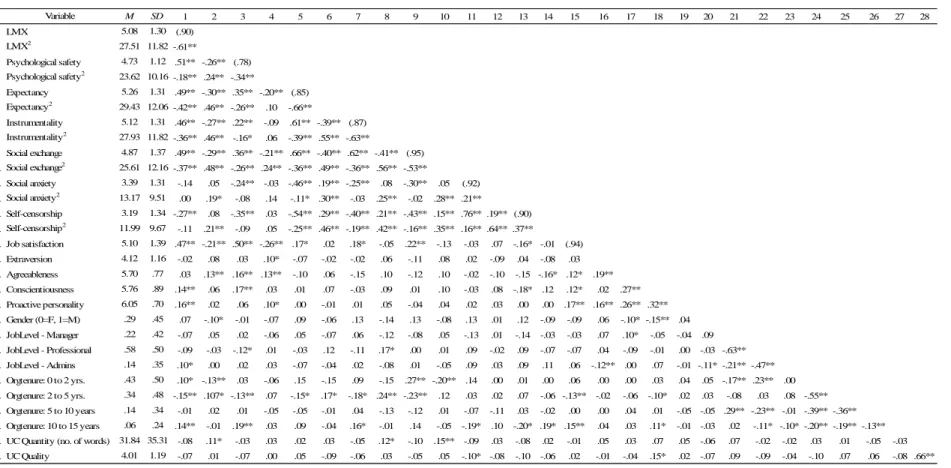
1. Study 1 - Means, Standard Deviations and Correlations Among
All Tested Variables………...70
2. Study 1 - Results of Hierarchical Regression Analysis with Student Satisfaction as a Predictor of Upward Communication (UC) Quantity and Upward Communication (UC) Quality..…….………...….73
3. Study 1 - Results of Hierarchical Regression Analysis without Student Satisfaction as a Predictor of Upward Communication (UC) Quantity and Upward Communication (UC) Quality..………...73
4. Study 2 – Mean Differences in Upward Communication Quantity and Quality across Low, Moderate and High Inclusive Leadership Conditions…...82
5. Study 2 – Tests of Mediation (Hypotheses 3a-6b)………...92
6. Study 2 – Tests of Mediation (Hypotheses 7-10)…..…………...93
7. Study 2 – Tests of Mediation (Hypotheses 11a-14)………...94
8. Study 3 - Means, Standard Deviations and Correlations Among All Tested Variables………..…..101
9. Study 3 - Results of Hierarchical Regression Analysis Predicting Upward Communication (UC) Quantity and Upward Communication (UC) Quality……….………..…..102
10.Study 3 - Tests of Mediation (Hypotheses 3a -8)………...…...107
11.Study 3 – Tests of Mediation (Hypotheses 9a-14………...……...108
x
13.Study 3 - Supplemental Analysis: Results of Hierarchical Regression Analysis – LMX Predicting Upward Communication (UC) Quantity and Upward Communication (UC) Quality………...118
14.Study 3 – Supplemental Analysis: Tests of Mediation (Hypotheses 3a -8)………….………...………...119
xi
LIST OF FIGURES
Figure
1. The Influence of Inclusive Leadership on Upward Communication Quantity and Quality...65
2. Study 1 - MBA Students’ Upward Communication Quality as a Function of Faculty Members’ Perceived Inclusiveness.……...74
xii
LIST OF ABBREVIATIONS AND SYMBOLS
LMX Leader-Member Exchange
OB Organizational Behavior
UC Upward Communication
α Cronbach’s Alpha
b Unstandardized regression coefficient β Standardized regression coefficient
I. INTRODUCTION
“Too much of a good thing can be taxing.” ~ Mae West
As the global economy continues to become increasingly competitive and
knowledge-based, organizations have sought to leverage their human capital more effectively by
encouraging frontline employees to “speak up” with new ideas that may help enhance
organizational effectiveness (Van Dyne & LePine, 1998; George, 2007; Pfeffer, 1998;
Powell & Snellman, 2004). Unfortunately for firms, getting employees to share their
insights with management is not always an easy task. Research suggests that the fear of
negative repercussions (Kish-Gephart, Detert, Treviño & Edmondson, 2009; Morrison &
Milliken, 2000; Ryan & Oestrich, 1998; Dutton & Ashford, 1993) prevents many employees
from communicating openly and honestly with management, causing them to remain silent
across a wide variety of important organizational issues (e.g., Cortina & Magley, 2003;
Detert & Treviño, 2010; Miceli, Near, & Dworkin, 2008).
Given this widespread and pervasive problem of organizational silence (Morrison &
Milliken, 2000), scholars have sought to better understand how organizational leaders can
minimize followers’ fears and encourage them to communicate their ideas, observations and
concerns. Research suggests that one of the best ways leaders can encourage upward
communication – defined as “openly stating one’s views or opinions about workplace
matters, including the actions or ideas of others, suggested or needed changes, or alternative
2
Bedeian, 2003, p.1538) – is by developing a psychologically safe environment.
Psychologically safe environments are characterized by high levels of mutual respect among
members and help individuals take the interpersonal risk of expressing differences openly
and honestly (Edmondson, 1996, 1999, 2003; Detert & Burris, 2007). Perhaps
unsurprisingly, empirical evidence has shown that these safe, inclusive environments provide
numerous organizational and individual benefits, including greater learning among
colleagues (Carmeli & Gittell, 2009; Carmeli, Brueller, & Dutton, 2009; Edmondson, 1999),
higher employee engagement and job satisfaction (Vogelgesang, 2008; Edmondson, 1996;
Nembhard & Edmondson, 2006) improved decision-making (De Dreu & West, 2001;
Roberto, 2002), enhanced innovation and creativity (West, 1990; Mumford & Gustafson,
1988; Edmondson, 2004), reduced accidents and safer workplaces (Christian, Bradley,
Wallace, & Burke, 2009; Hofmann & Stetzer, 1996) and stronger financial performance
(Baer & Frese, 2003; Lockwood, 2007). In this way, employees who communicate their
ideas and concerns to powerful decision-makers can be an important and valuable source of
change within their organizations (Frohman, 1997; Zhou & George, 2001; Dutton, Ashford,
O’Neill, & Lawrence, 2001).
For these reasons, understanding how leaders can create work environments that
encourage upward communication is a question of growing importance for both scholars and
practitioners alike. Recent perspectives suggest that one way leaders can do this effectively
is by being inclusive and open to employees’ ideas and concerns (Edmondson, 1999;
Nembhard & Edmondson, 2006; Detert & Burris, 2007; Carmeli, Reiter-Palmon, & Ziv,
2010). For example, in studying a team-based neonatal medical unit, Nembhard and
3
they defined as “words and deeds by a leader or leaders that indicate an invitation and
appreciation for others’ contributions,” predicted higher levels of employee engagement in
process improvement work through the mechanism of psychological safety. In addition, in a
large-scale field study of restaurant employees and managers, Detert and Burris (2007)
showed that managers’ openness to employees’ ideas and suggestions was positively
associated with employees’ frequency of speaking up. Building on these works, Carmeli,
Reiter-Palmon, and Ziv (2010) recently demonstrated that inclusive leadership predicted
individuals’ engagement in creative work. Specifically, they found that “…when leaders are
open, accessible, and available to discuss new ideas with employees, they cultivate a social
context in which people feel that they are psychologically safe to voice, speak up, and come
up with novel and useful solutions” (p.256). Together, this emerging body of empirical
evidence suggests that a leader’s willingness to be receptive, inclusive and open to others’
ideas can help create psychological safety for followers, which in turn, helps them take the
risk of communicating upwards in ways that may challenge the organizational status quo.
Yet, despite the positive impact highly inclusive leaders seemingly have on increasing
the amount of ideas and suggestions subordinates provide, questions remain as to whether or
not such leaders also receive better ideas from their followers. To date, scholars have
focused primarily on understanding how leaders affect the quantity of subordinates’ upward
communication, without paying sufficient attention to the quality of this communication.
This oversight is both surprising and unfortunate particularly in light of organizations’
perpetual need for high quality ideas (Tushman & O’Reilly, 2002) and the extensive amount
of time, energy and resources they spend designing systems and processes with quality
4
and early 1980s ushered in the era of total quality management (TQM), Six Sigma, Kaizen
and a host of other quality control measurement systems (Goldman, 2005; Hackman &
Wageman, 1995), an emphasis on increasing quality across products, processes, and
resources has been at the center of leaders’ stated goals. This focus on increased quality has
more recently found its way down to an idea level of analysis as a necessary precursor for
innovation. For instance, Terwiesch and Ulrich (2009) argued that leaders must not simply
rely on identifying raw opportunities or ideas for organizational improvement. Rather,
leaders must invest in a more systematic evaluation and refining of those ideas to achieve
innovative, quality solutions.
Yet, perhaps due to the fuzzy nature of “quality” as an easily definable and
observable construct, this quality-first mindset has yet to pervade scholarly thinking on a
wide variety of organizational issues, including upward communication. As Grant and
Ashford (2008) observed in their review of the proactivity literature, scholars have spent a
disproportionate amount of time and effort on predicting the frequency and volume of
employees’ proactive behaviors, while little to no attention has been paid to understanding
whether or not these behaviors are ultimately useful or effective. One glaring example of this
myopia is the implicit and untested assumption throughout the upward communications’
literature that the more open and inclusive the leader is to subordinates’ input, the better.
However, both anecdotal and research evidence seem to suggest that a leader’s
inclusiveness may actually have a ‘dark side,’ offering positive returns only up to a certain
inflection point before these benefits start to diminish. For instance, on one end of the
inclusiveness spectrum, leaders who are not particularly open or receptive to their followers’
5
opportunities to make their opinions known (Korsgaard & Roberson, 1995; Cook, Kramer,
Thom, Stepanikova, Mollborn, & Cooper, 2004). This kind of exclusive leader can fuel
individuals’ fear and anxiety about communicating upward, leading them to generate
poorer-quality ideas (e.g., Staw, Sandelands, & Dutton, 1981). When individuals are fearful about
speaking up, they may experience greater pressure to perform and may not be able to
concisely articulate their point of view to management. As a result, the overall quality of
communication they share with their supervisor may be poorer. Less inclusive leaders may
also lower individuals’ quality of upward communication by increasing their apprehension
about being evaluated, even if employees have good ideas worth sharing (e.g., Leary, 1983;
Paulus & Yang, 2000). By making it uncomfortable for employees to speak up, leaders may
find their followers unwilling to challenge management and/or prevailing organizational
assumptions. As a result, leaders may only end up hearing what they want to hear, rather
than what they need to hear (Van Dyne, Ang, & Botero, 2003). In this way, leaders who are
unwilling to consider and/or act upon their followers’ input are likely to find that the quality
of upward communication they receive is generally lower because of individuals’
unwillingness to express creative, unconventional ideas that challenge prevailing
organizational norms.
At the other end of the inclusiveness spectrum, however, leaders face a far different
challenge. Highly inclusive leaders who invite and appreciate others’ input (Nembhard &
Edmondson, 2006) may unintentionally create a work climate where psychological safety is
so rampant that individuals relax their standards and tendencies towards self-censorship to
the point that they frequently express irrelevant, ill-formed comments and suggestions that do
6
perceived risk of speaking up and reinforces individuals’ belief that there are no negative
consequences for doing so, individuals may be less motivated to put forth the cognitive effort
necessary to provide high quality input. Given that individuals are often prone to take the
path of least cognitive resistance (e.g., Taylor & Fiske, 1978; Latané, Williams, & Harkins,
1979) highly inclusive leaders may find that encouraging and inviting upward
communication may not actually produce very many novel or useful ideas that truly enhance
organizational effectiveness. Instead, leaders may get a large muddy pool of thoughts and
suggestions that have no clear relevance or strategic benefit for the organization.
To illustrate, consider the case of BP, which encouraged the public to submit their
ideas and suggestions on how to stop the massive oil well leak in the Gulf of Mexico last
summer. Although part of the motive behind opening up this idea forum may have been
driven by public relations concerns on the part of BP’s leadership (particularly in light of
their CEO’s numerous and untimely verbal gaffes), the results of BP’s online suggestion box
produced over 35,000 ideas, of which 99 percent never received serious consideration for
implementation (Crandell, 2010). Instead of securing a few well-conceived ideas that may
have held greater promise, taking a highly inclusive approach produced a large number of
bad ideas that cost the company significant time and money by diverting important resources
away from the core problem.
This example illustrates the very real and practical conundrum leaders’ face in trying
to determine just how inclusive they should be. Although, highly inclusive leaders can help
to alleviate individuals’ fears about speaking up, in doing so they may simultaneously reduce
individuals’ motivation to engage in effortful cognitive processing and self-filtering of ideas
7
inclusive style may actually be harmful to the organization’s goal of obtaining high quality
comments that effectively address workplace issues.
In light of this evidence pointing to how both low and high levels of inclusive
leadership can produce a lower overall quality of upward communication, a logical question
emerges – does an optimal “sweetspot” of inclusive leadership exist? While existing
research on the topic is still sparse, both classical and emerging perspectives on human
behavior and an observance of curvilinear relationships across various psychological
constructs provide general support for such a possibility. For example, years ago Coombs
and Avrunin (1977, p. 224) used a series of mathematical functions to make the simple, but
profound argument that “good things satiate, bad things escalate.” They argued that whereas
positive influences for human survival, such as food, water, and even sexual activity, reach a
tipping point at which they no longer satisfy individuals’ hedonistic desires, bad things, such
as a dripping faucet or monotonous music can increase irritation and frustration to no end.
This perspective suggests that although inherently good things momentarily placate and
satisfy individuals’ needs and desires, they do not continue ad infinitum. Echoing these
concerns, Grant and Schwartz (2011) more recently highlighted the danger of scholars’
overreliance on predicting linear relationships in psychological research, arguing instead for
further exploration and investigation into more complex, inverted U-shape functions. As
evidence for why monotonic relationships may under represent organizational phenomenon,
Grant and Schwartz (2011) suggested that well-established psychological virtues, such as
wisdom and knowledge, humanity and love, courage and justice, all exhibit serious costs that
8
Drawing upon this logic for the study of inclusive leadership and upward
communication suggests that leaders who are open and accessible may find only limited
benefits of their inclusive approach beyond an optimal midpoint. This view has been
generally supported in field research by Ames and Flynn (2007), who demonstrated an
inverted U-shaped relationship between assertiveness and perceptions of leadership
effectiveness. Across multiple field studies, they found that moderate levels of assertiveness
facilitated the achievement of organizational outcomes, but high levels of assertiveness
fostered negativity in interpersonal relationships, which reduced perceived leadership
effectiveness. This evidence suggests that inherently effective leadership approaches, such
as assertiveness or inclusiveness, may be detrimental at the far ends of the continuum. In
addition, Fleishman and Harris (1962) showed that increased leader consideration or
decreased structure did not predict lower turnover rates among a sample of production
foreman. Rather, grievances and turnover were found to increase most markedly at the
extreme ends of the leader consideration (low end) and structure (high end) scales, further
suggesting that the relationship between leadership, grievances and turnover was curvilinear,
rather than linear.
In short, this body of work suggests that neither a very low, nor a very high level of
inclusive leadership will yield optimal results if a leader’s goal is to get the highest quality of
ideas from his/her workforce. Rather, a more moderate level of inclusiveness may be the
optimal strategy for leaders to adopt if they are to obtain high quality input that truly helps
their organizations innovate and gain a competitive advantage. For these reasons, the strong
positive association between leader inclusiveness and upward communication found in prior
9
Therefore, a more thorough investigation into the form of the relationship between inclusive
leadership and upward communication is needed to provide greater conceptual clarity around
how inclusive leadership influences individuals’ motivation to speak up well.
In this dissertation, I challenge conventional wisdom that “more is better” by arguing
that highly inclusive leaders may elicit a higher quantity of ideas from their followers, but
potentially a lower quality of ideas as well. Drawing from well-established theories on
motivation, social exchange, and self-censorship, I propose and test an inverted U-shaped
relationship between inclusive leadership and upward communication quality across three
separate studies (archival, lab and field), in an effort to provide triangulated evidence
(Campbell & Fiske, 1959) for this phenomenon. In doing so, I contribute to the growing
upward communication and leadership literatures in three important ways: (a) first, by
shifting researchers’ sole focus away from the quantity of upward communication leaders
receive towards a more holistic view of both quantity and quality, (b) second, by
demonstrating how important contextual forces, such as inclusive leadership, that are
conducive to increasing the quantity of individuals’ upward communication, may have more
mixed implications for the quality of this communication, and (c) third, by highlighting the
hidden costs and pitfalls associated with inclusive leadership.
I begin this discussion by first reviewing the expansive literatures on leadership and
upward communication. Specifically, I highlight several specific leadership constructs that
are related to the broader conceptual idea that leaders can be open and receptive to input from
others, as well as several upward communication-related constructs that closely mirror the
broader idea of leader-directed input. Next, I highlight the different ways in which the
10
prior research, and how this evidence and related social psychological work might inform my
predictions about inclusive leadership and upward communication quality. Third, I
empirically test my conceptual model and hypotheses across three different studies (archival,
lab and field) in an effort to provide triangulated evidence for how high levels of inclusive
leadership can lower followers’ quality of upward communication at both low and high
levels. Finally, I discuss the strengths and limitations of this research, discuss the
implications of this work for both theory and practice and suggest avenues for future
II. THEORIES OF LEADERSHIP AND INCLUSIVENESS
The idea that leaders can be inclusive, open and receptive to employee input is not a
new one, given the numerous theoretical perspectives that have emerged on the topic over the
past several decades (e.g., Avolio, Walumbwa, & Weber, 2009; Yukl, 1994; Vroom &
Yetton, 1973). However, recent conceptualizations of leader inclusiveness and how they
relate specifically to individuals’ propensity to express upward communication to
management have arisen primarily from two empirical studies by Nembhard and Edmondson
(2006) and Detert and Burris (2007). Despite the theoretical advances made through this
work, the concept of leader inclusiveness remains elusive, as research has only begun to
scratch the surface of what it actually means to be inclusive as a leader and the specific
behaviors followers perceive as inclusive or not.
According to Nembhard and Edmondson (2006), leader inclusiveness can be defined
as “words and deeds by a leader or leaders that indicate an invitation and appreciation for others’ contributions” (p.947). In providing justification for how this construct differs from
existing perspectives, Nembhard and Edmondson (2006) offer the following explanation:
“Leader inclusiveness captures attempts by leaders to include others in discussions and decisions in which their voices and perspectives might otherwise be absent. It is related to team leader coaching behavior, which describes team leader behaviors that facilitate group process and provide clarification and feedback (Baron, 1990;
12
In other words, for leaders to be inclusive there must be some perceived difference in
formal status and authority that makes their acts of inclusiveness stand out when juxtaposed
against their hierarchical position. Yet, despite the intuitive nature of this definition that
suggests applicability to a variety of contexts, Nembhard and Edmondson (2006) defined the
construct of leader inclusiveness specifically for a medical environment, using items adapted
from Shortell and colleagues’ (1991) physician leadership scale. Thus, this raises questions
as to whether or not Nembhard and Edmondson’s (2006) conceptualization of leader
inclusiveness is generalizable across a broader set of industries, jobs and work settings.
In an effort to build upon this work, Detert and Burris (2007) offered a related construct they
called leader openness, defined as “subordinates’ perceptions that their boss listens to them,
is interested in their ideas, gives fair consideration to the ideas presented, and at least
sometimes takes action to address the matter raised” (p.871). Although similar to Nembhard
and Edmondson’s (2006) leader inclusiveness construct, this definition of leader openness
provides subtle, but important distinctions. For instance, while leader inclusiveness focuses
more on the participative and emotional aspects of leaders’ behaviors (i.e., does the leader
involve others in decisions by seeking and appreciating their input), leader openness goes
beyond this by emphasizing leaders’ fairness in evaluating ideas, and highlighting the degree
to which they act upon employees’ suggestions. In this way, leader openness mirrors prior
work on management openness (Ashford, Rothbard, Piderit, & Dutton, 1998; House &
Rizzo, 1972) that looks at specific behaviors top management teams take to create a
favorable context for raising issues and expressing ideas. However, an important limitation
of Detert and Burris’ (2007) definition is that leader openness is constrained to subordinates’
13
other work-relationships (e.g., project teams, informal committees, etc.) and organizational
structures (e.g., matrix organizations) where leadership is more emergent and not solely
defined by the dyadic leader-member interaction (Morgeson, DeRue, & Karam, 2010; Bell &
Kozlowski, 2002).
Given these small, but important conceptual distinctions between these constructs, I
seek to bridge these gaps by offering an integrated definition of leader inclusiveness and
leader openness that potentially offers greater generalizability and utility for researchers
going forward. Specifically, I define inclusive leadership as: “Individuals’ perceptions that a
leader is receptive to feedback and input, as demonstrated by behaviors and acts of communication (both written and verbal) that show a willingness to listen to individuals’ ideas, to consider them fairly, and to potentially act upon them.”
One benefit of viewing leader inclusiveness from this slightly broader perspective is
that individuals’ perceptions of leaders’ inclusiveness are not limited solely to the views of
subordinates, as they are in the definition of leader openness, but can be expanded to
consider multiple sources in future research, such as subordinates, peers, customers or
supervisors. In this way, multiple measures of leader inclusiveness can be aggregated
together to form a more robust assessment of whether or not a leader is truly inclusive.
Having provided my operational definition of inclusive leadership, I now highlight other
closely related leadership constructs that help fill the nomological net of inclusive leadership.
Transformational Leadership
Ever since Burns (1978) and Bass (1985) signaled the need to shift the focus of
leadership research from more transactional models of leadership to more charismatic,
14
grown into one of the most frequently researched theories over the past 20 years (Avolio,
2005; Lowe & Gardner, 2000; Bono & Judge, 2004). Although this theory is
multi-dimensional and suggests that transformational leaders provide their followers with
intellectual stimulation, inspirational motivation and idealized influence (e.g., Avolio, 1999;
Bass, 1985; Conger & Kanungo, 1998; Howell & Hall-Merenda, 1999), perhaps most
relevant for our understanding of how transformational leadership relates specifically to
inclusive leadership is its fourth dimension of individualized consideration.
When transformational leaders provide individualized consideration, they tend to
their followers’ individual and collective needs, act as a mentor/coach and listen to their
followers’ concerns and suggestions. In the language of inclusive leadership,
transformational leaders “invite and appreciate” input from others. By providing empathy
and support for their followers and by keeping the lines of communication open,
transformational leaders help individuals feel cared for and respected. By doing so, leaders
can encourage their followers to be more loyal, committed and devoted to them (Johns &
Saks, 2005). Although transformational leadership has provided equivocal results as a
positive predictor of individuals’ performance in the past (e.g., Dvir, Eden, Avolio, &
Shamir, 2002; Barling, Weber, & Kelloway, 1996; McNatt & Judge, 2004; Bono & Judge,
2003; Kirkpatrick & Locke, 1996), it has been shown to be positively associated with several
organizationally-important outcomes, including individuals’ citizenship behaviors
(Podsakoff, MacKenzie, Moorman, & Fetter, 1990), and leaders’ effectiveness and
productivity (Judge & Piccolo, 2004).
Recently, scholars have begun to investigate the effects of transformational leadership
15
found empirical support for the positive association of transformational leadership with
speaking out (voice toward peers) and speaking up (voice toward the supervisor) across a
sample of 191 Chinese employees in different organizations. Similarly, Detert and Burris
(2007) tested the association of transformational leadership on individuals’
improvement-oriented communication across a national restaurant chain, arguing that the individualized
consideration transformational leaders provide fosters two-way communication, while their
inspirational motivation helps to increase followers’ engagement in resolving workplace
issues. Despite the intuitive nature of these hypotheses, the authors did not find support for a
significant predictor of managers’ perceived transformational leadership on employees’
upward communication behavior. This lack of a direct association between transformational
leadership and upward communication raises interesting questions and the possibility that the
positive impact of transformational leaders may be limited and bounded by numerous
conditions that researchers have yet to uncover.
Other work has also begun to explore the underlying mechanisms driving the positive
relationship between transformational leadership and employee behavior. Researchers have
demonstrated that transformational leaders are effective at influencing subordinates’ behavior
because they are able to increase followers’ commitment, satisfaction, identification, and
perceptions of fairness (e.g., Liao & Chuang, 2007; Walumbwa, Avolio, & Zhu, 2008). They
do this by enhancing perceptions of leader trustworthiness (e.g., Wang, Law, Hackett, Wang,
& Chen, 2005) and perceptions of individual- and group-efficacy, potency and cohesiveness
(e.g., Bass, Avolio, Jung, & Berson, 2003; Bono & Judge, 2003; Schaubroeck, Lam, & Cha,
16
In short, this body of work suggests that transformational leaders who are open and
receptive to their subordinates’ ideas can motivate and encourage their followers to do things
they may have never envisioned before, such as taking the risk of communicating up to the
boss with challenging dissent or constructive criticism (Bass & Steidlmeier, 1999; Shamir,
House, & Arthur, 1993). Going forward, teasing apart the individualized consideration
dimension of transformational leadership as a proxy for inclusive leadership may produce
valuable dividends for scholars seeking to better understand how inclusive leaders can
enhance both the quantity and quality of upward communication within their organizations.
Participative Leadership
Although transformational leadership is perhaps the most well-known modern
leadership construct in management circles, its broad focus on visionary goal-setting makes it
slightly more tangential to the core premise of inclusive leadership. One leadership
perspective that more closely shares the basic idea of openness and receptivity to subordinate
input is participative leadership. The theory of participative leadership suggests that leaders
can encourage greater employee involvement and engagement in their organizations by
adopting a participative leadership style. According to Yukl (1994), participative leadership
is “the use of various decision procedures that allow other people some influence over the
leader’s decision” (p.157). Often described as consultation, joint decision-making, power
sharing, decentralization or democratic management, participative leadership is typically
used as a way to involve others in the decision-making process (Johns & Saks, 2005; Yukl,
1994). As defined here, participation is not a fixed or absolute property, but rather a relative
concept. In fact, the manner in which leaders can go about trying to gain subordinate
17
autocratic decision-making) to high influence (i.e., delegating full authority) (Heller & Yukl,
1969; Strauss, 1977; Tannenbaum & Schmidt, 1958; Vroom & Yetton, 1973).
Research suggests that participative leadership offers tangible benefits to the
organization, including (a) improving the quality of a decision when participants have
information and knowledge that the leader lacks and (b) enhancing individuals’ commitment
to the decision (Yukl, 1994; Yukl, Gordon, & Taber, 2002). Furthermore, when individuals
have an opportunity to communicate their concerns about organizational issues, they often
feel a greater sense of procedural justice (Korsgaard & Roberson, 1995). In addition,
participation is likely to yield favorable results when employees are open to engaging in the
process and the task is complex enough to make participation useful (Miller & Monge, 1986;
Wagner & Gooding, 1987a; Wagner & Gooding, 1987b). In this way, participative
leadership is a strategy leaders can use to signal inclusiveness by encouraging followers to
communicate upwards with ideas, observations and concerns and enabling them to
participate in organizational decision-making.
Empowering Leadership
Although similar to participative leadership in its emphasis on encouraging individual
participation and engagement within organizations, empowering leadership differs from
participative leadership in its exclusive focus on leader actions that share power or give more
autonomy and responsibility to employees (Kirkman & Rosen, 1997; 1999; Strauss, 1963).
In their empirical paper testing the effects of empowering leadership on team performance,
Srivastava, Bartol and Locke (2006) defined empowering leadership as “behaviors whereby
18
Some of the behaviors that empowering leaders engage in when adopting such a
leadership style include leading by example, participative decision-making, coaching,
informing, and showing concern (Arnold, Arad, Rhoades, & Drasgow, 2000). By actively
soliciting employees’ input on organizational matters and explicitly communicating to them
that such input is welcome and of value to both the leader and the organization, empowering
leaders can help increase followers’ motivation to actively participate in solving
organizational problems. At a time when employees are highly cynical and distrustful of
organizations, government, and leaders in general (Kohut, 2010;Garlick, 2010), empowering
leadership can be a powerful antidote to the widespread lack of employee engagement seen
within organizations today (cf., Robison, 2010), despite its inherent limitations (Fineman,
2006).
In fact, in a recent large-scale field investigation of professional Chinese workers,
Zhang and Bartol (2010) found that empowering leadership predicted individuals’
psychological empowerment, which in turn predicted both their intrinsic motivation and
involvement in creative work. Across a much different, but still relevant organizational
context (i.e., public high schools) Vecchio, Justin, and Pearce (2010) showed that
empowering leadership was associated with higher levels of employee satisfaction and
performance, as well as reduced dysfunctional resistance. More specific to the focus of the
current investigation, Srivastava and colleagues (2006) demonstrated that empowering
leaders helped to improve team performance by increasing team members’ efficacy and
knowledge-sharing – the latter being a key measure of whether or not individuals actually
19
In short, by providing their subordinates with the autonomy and flexibility to be able
to share their ideas and concerns with management, empowering leaders convey an openness
and receptivity to upward communication – a key marker of inclusive leadership behavior.
Shared Leadership
A final leadership perspective that shares conceptual overlap with the idea of
inclusive leadership is shared leadership. Often described as “collective” or “distributed”
leadership, shared leadership has been conceptualized as a team emergent state that develops
over the lifespan of a team, whereby team members collectively lead each other, rather than
relying on a single individual to lead the team (Day, Gronn, & Salas, 2004). This model of
reciprocal influence helps to reinforce and develop positive relationships among team
members (Carson, Tesluk, & Marrone, 2007). According to Pearce and Conger (2003, p.1),
shared leadership is “a dynamic, interactive, influence process among individuals in groups
for which the objective is to lead one another to the achievement of group or organizational goals or both.” Klein, Ziegert, Knight and Xiao (2006) describe this process of shared
leadership within teams as dynamic delegation, in which senior leaders are able to delegate
active leadership roles to more experienced members, while providing junior members with
opportunities to develop skills and learn over time.
In this way, shared leadership differs greatly from earlier leadership models focused
on hierarchical authority (Pearce & Sims, 2002). Because shared leadership implicitly
discounts status differences within the team in an effort to make it more egalitarian,
employees are freer to communicate their ideas, observations and concerns both laterally, as
well as upwards. Particularly in team situations where relative status differences between the
20
creating a psychologically safe environment that encourages interpersonal risk taking
(Nembhard & Edmondson, 2006).
Although empirical work on shared leadership is scarce, initial studies tend to support
the view that shared leadership predicts higher levels of team effectiveness (e.g., Avolio &
Bass, 1995; Pearce & Sims, 2002). However, too much shared leadership may not
necessarily work well under all conditions. For example, Edwards and Jabs (2009) recently
conducted a study within a multinational corporation’s R&D facility in the western United
States to understand the impact of bureaucratic control and shared governance on workplace
safety culture. They found that safety protocols, rules, and rhetoric, combined with efforts
to give workers more shared responsibility for safety in the workplace, actually predicted
tendencies toward worker alienation, shame with regard to injuries, complacency, and a fear
of bureaucratic processes. Although these findings need to be replicated in future work, they
do suggest that leaders’ efforts to create a strong culture of shared leadership may backfire if
not implemented correctly. Thus, additional research is needed to understand the impact
shared leadership can have on employee outcomes, both intended and unintended. Given
that no work to date has tested the relationship between shared leadership and upward
communication, this offers an interesting and important avenue for future research
particularly in light of the growing organizational trend towards team-based work structures
(cf. O’Toole & Lawler, 2006).
In summary, each of these unique, but related leadership perspectives – leader
inclusiveness, leader openness, transformational leadership, participative leadership,
empowering leadership and shared leadership – provide general support for the idea that
21
and at least sometimes, act upon their input, are often seen by others as “inclusive” leaders.
Although future research is needed to empirically validate this proposed nomological
network, this discussion provides an initial theoretical framework from which to begin such
efforts.
I now turn my attention to briefly reviewing the upward communication literature,
focusing specifically on a variety of constructs (e.g., voice, issue-selling, issue-crafting,
upward influence, upward feedback) that much like the leadership literature, share
conceptual overlap with one another. In discussing these various forms of upward
communication, I specifically focus only on the interpersonal and contextual antecedents of
upward communication, rather than taking a more procedural justice view that explores the
opportunity individuals have for upward communication as well as the various outcomes that
III. THEORIES OF UPWARD COMMUNICATION
Just as the leadership literature includes a host of constructs that share conceptual
overlap around the idea that leaders can be inclusive and open to their followers’ ideas and
concerns, so too do numerous theories of upward communication provide a broad foundation
from which to argue that individuals “speak up” to management in a variety of ways.
Although theoretically distinct in the conceptual space they occupy, each of these forms of
upward communication – employee voice, issue-selling, issue-crafting, upward influence and
upward feedback – are perhaps more accurately identified as unique forms of a broader
construct of upward communication. In the following section, I briefly review these
literatures, highlighting their shared commonalities around the broader schema of
management-directed, upward input.
Employee Voice
Since Hirschman (1970) first conceptualized the idea that employees speak up when
they recognize some source of dissatisfaction or opportunity to improve their own and/or
their organization’s well-being, scholars have taken a greater interest in understanding this
phenomenon, as evidenced by a growing body of work examining the many antecedents,
moderators, mediators and consequences of voice in the workplace. As originally
conceptualized, employee voice is a proactive, discretionary behavior (Van Dyne, Cummings
& McLean Parks, 1995; Van Dyne & LePine, 1998) that individuals express upward in the
23
& Botero, 2003). In this way, voice shares conceptual overlap with a family of other
challenge-oriented constructs, including issue-selling (Dutton & Ashford, 1993; Dutton,
Ashford, O’Neill & Lawrence, 2001), speaking up (Premeaux & Bedeian, 2003), issue
crafting (Sonenshein, 2006), prosocial rule breaking (Morrison, 2006), tempered radicalism
(Meyerson & Scully, 1995), whistleblowing (Miceli, Near & Dworkin, 2008), and taking
charge (Morrison & Phelps, 1999). A common theme running through each of these
behaviors is that individuals are motivated to speak up out of a desire to help and improve the
organization, even if it means sometimes having to upset established norms and
organizational practices.
Given that voice can sometimes be perceived as a challenge to management’s
authority, expressing voice carries inherent challenges and risks for organizational actors,
since it may or may not be well received by the powerful individual toward whom it is
directed. In fact, several studies demonstrate the inherent difficulties in getting employees to
speak up honestly (e.g., Detert, 2003; Milliken, Morrison & Hewlin, 2003; Ryan & Oestrich,
1998), since many individuals conclude that it is better to “bite your tongue and be a good
soldier,” rather than risk upsetting the boss and facing negative repercussions. To maximize
the likelihood that their expressions of voice are welcomed, rather than frowned upon,
individuals are thought to engage in a cost-benefit mental calculus when deciding whether or
not to speak up (Chiaburu, Van Dyne & Marinova, 2008; Dutton et al., 2001; Ashford et al.,
1998; Morrison & Milliken, 2000). This cognitive process involves weighing the personal,
professional and social repercussions individuals may experience as a consequence of
24
In light of the potential challenges associated with upward voice, scholars have
attempted to better understand who voices, why they choose to voice, and what
organizational conditions facilitate voice (cf., Van Dyne & LePine, 1998; Burris, Detert &
Chiaburu, 2008; Tangirala & Ramanujam, 2008a, 2008b; Detert & Burris, 2007). In
developing theories around each of these questions, three broad lines of research on voice
have emerged. First, scholars have spent considerable time systematically examining
demographic and personality differences as correlates of voice (Crant, 2003; LePine & Van
Dyne, 2001). For instance, studies have shown that voice is more common among
employees high in conscientiousness and extraversion (LePine & Van Dyne, 2001), low in
agreeableness and neuroticism (LePine & Van Dyne, 2001), and high in proactive personality
(Seibert, Kraimer, & Crant, 2001; for meta-analytic reviews, see Fuller & Marler, 2009, and
Thomas, Whitman, & Viswesvaran, 2010). Recent work has also begun to examine the
personality correlates of voice in cross-cultural samples. For instance, across a sample of
Greek workers, Nikolaou, Vakola, and Bourantas (2008) found that compared to other
personality traits such as extraversion, openness, and agreeableness, individuals who were
high in conscientiousness and emotional stability were more likely to express voice to their
supervisor.
A second body of work, based primarily on Hirschman’s (1970) exit, voice and
loyalty model, suggests that individuals’ attitudes towards their work environment (e.g., job
satisfaction, supervisors, organization, etc.) drives their decision to speak up or remain silent
(Rusbult, Farrell, Rodgers, & Mainous, 1988; Withey & Cooper, 1989). This perspective
takes the view that individuals’ attitudes and beliefs about their job and supervisor shape
25
dissatisfied with their current work conditions, they seek to restore equity in the relationship
by expressing their dissatisfaction vocally and making their views known to management
(Withey & Cooper, 1989; Zhou & George, 2001). Scholars in other research domains have
also sought to understand how employee attitudes might impact voice behavior. For
instance, marketing scholars have shown that individuals’ attitudes to the responsiveness of
their organization across a variety of service-oriented contexts (e.g., automotive repair,
medical care, banking services) have a significant influence on whether or not they chose to
voice their complaints or not (Singh & Wilkes, 1996).
The third primary stream of research within the voice literature centers on
understanding how various organizational contextual factors, such as psychological safety,
voice climate, and leadership, influence individuals’ decision to voice (Morrison,
Wheeler-Smith, & Kamdar, 2011; Detert & Treviño, 2010; Edmondson, 2006; Detert & Burris, 2007;
Nembhard & Edmondson, 2006; Hofmann & Stetzer, 1996). This literature makes the
implicit assumption that over and above personal characteristics and specific work-related
attitudes, individuals are likely to gauge the “temperature in the room” before determining
whether or not to make their thoughts and ideas publicly known (Dutton, Ashford, O’Neill,
Hayes, & Wierba, 1997; Ashford, Rothbard, Piderit & Dutton, 1998; Milliken, Morrison, &
Hewlin, 2003; Ryan & Oestrich, 1998; Withey & Cooper, 1989). That is, individuals make
general attributions about the perceived risks of speaking up in a particular social context,
and take their behavioral cues from organizational leaders who explicitly or implicitly
convey to their followers that expressions of voice are welcome or not. In this way, a
26
influence on whether or not individuals feel comfortable speaking up about challenging or
controversial issues (Ashford, 1998).
In summary, the employee voice literature has been instrumental in helping to bring
to the forefront an important and relevant issue for both scholars and practitioners alike –
specifically, how leaders can encourage individuals to speak up to management for the
betterment of their organizations. Yet, despite the significant contributions scholars have
made to this body of work, much of this research has focused exclusively on trying to get
leaders to obtain more voice, not necessarily better voice from their followers. Thus, going
forward, understanding how managers can reap both a high quantity and high quality of
voice from their subordinates is a promising avenue for future research.
Issue-selling and Issue-crafting
Another popular and well-established form of upward communication that scholars
have explored in-depth is issue-selling. In their seminal paper introducing the concept,
Dutton and Ashford (1993) defined issue-selling as “individuals’ behaviors that are directed
towards affecting others’ attention to and understanding of issues” (p.398). At its core,
issue-selling is concerned with understanding how middle managers can effectively direct senior
leaders’ attention towards issues or concerns they deem worthy of attention. In this way,
issue-selling is a process through which middle managers attempt to influence the
identification phase of organizational decision making (Dutton & Ashford, 1993). According
to Mintzberg, Raisinghani and Théorét (1976), this identification stage involves issue
recognition, where “opportunities, problems, and crises are recognized and evoke decision
activity” as well as diagnosis, in which “management seeks to comprehend the evoking
27
ability to identify important issues among the many that vie for managers’ attention can be a
valuable resource for leaders seeking to adapt their strategies to enhance organizational
effectiveness (Dutton et al., 2001; Dutton & Ashford, 1993; Grant, Parker, & Collins, 2009).
However, despite the importance of identifying critical issues within organizations,
comparatively little work has examined the contextual influences that shape issue-sellers’
behavior over time, and how issue-selling can be a mechanism of organizational change
(Dutton & Ashford 1993; Dutton, Ashford, Lawrence, & Miner-Rubio, 2002). In an effort to
address this shortcoming, scholars have taken greater interest in examining how individuals
go about selling issues to management to achieve maximum impact. For example, in their
study of hospital workers and top management teams, Dutton, Ashford, O’Neill and
Lawrence (2001) found that successful issue-sellers used a variety of strategic moves, such as
packaging, involvement, and timing to amplify their chances that senior leaders will be
receptive to their concerns. Research has shown that these tactics are generally effective
because they help issue-sellers thoughtfully demonstrate how their idea or concern fits in
with the leader’s broader goals and constraints (Ashford, et al., 1998; Dutton & Ashford,
1993; Sonenshein, 2006). By framing issues as ‘win-win’ solutions, individuals can make a
more compelling case to management for why their ideas and concerns should be acted upon
(Bansal, 2003; Savitz, 2006). As a case in point, Howard-Grenville (2007) used
ethnographic, archival and interview data over a six-year period to better understand how a
high-tech manufacturer came to implement environmental considerations into their core
manufacturing processes. Through this longitudinal effort, she found that striking the right
balance between the novelty of the issue and an appeal to dominant schemas within the
28
research illustrates how the linguistic strategies issue-sellers employ can potentially mean the
difference between success and failure.
In an effort to expand the portfolio of linguistic tactics described in the issue-selling,
sensegiving, and influence tactics literatures, as well as work on discourse theory (Grant,
Hardy, Oswick, & Putnam, 2004), Sonenshein (2006) introduced the concept of
issue-crafting, which he defined as “the intentional use of public language to portray an issue in a
way that differs from an individual’s private understanding of that issue” (p.1158). Although
issue-crafting differs from issue-selling in that it lacks a clearly defined communicator (e.g.,
middle managers are the onesconsidered issue-sellers), as well as a clearly defined target of
communication (e.g., senior leaders are the target of issue-sellers), in many ways the two
constructs share much in common. For instance, just as issue-sellers seek to gain support for
their views by framing their issues as vital to the organization’s success, issue-crafters use
the domain of public opinion to position their concerns as legitimate (Hardy, Palmer, &
Phillips, 2000). Furthermore, in the same way that issue-sellersseek to frame their
arguments in a way that management finds most palatable and persuasive
(Howard-Grenville, 2007), issue-crafters construct public justifications that have broader legitimacy
with important others, and portray issues as being congruent with the target’s values and
mental schema (Creed, Scully, & Austin, 2002). In this way, issue-crafters can also gain the
ear of powerful leaders who have the ability to enact change, particularly when the issues are
difficult to talk about openly (e.g., social issues).
Taken together, this collective stream of research provides important insight into how
individuals can draw senior leaders’ attention to important organizational issues and improve
29
these subtle, but powerful framing and communication techniques, employees can increase
their chances of getting their specific issue(s) heard and acted upon by powerful
decision-makers, thus setting the stage for improved organizational effectiveness. By adopting
specific linguistic strategies that help to frame their contribution as germane and legitimate,
issue-sellers and issue-crafters can provide their leaders with ideas and suggestions that they
perceive as high quality upward communication (e.g., Savitz, 2006).
Upward Influence
Upward influence is a third form of upward communication that is closely related to
the aforementioned constructs of employee voice, issue-selling and issue-crafting. This line
of research is primarily concerned with how power affects the techniques individuals use to
influence others (Kipnis, Schmidt, & Wilkinson, 1980; Yukl & Falbe, 1990; Yukl, Falbe, &
Youn, 1993; Yukl & Tracey, 1992). Specifically, Kipnis and colleagues offer six different
strategies individuals can use to influence those situated higher in the organizational
hierarchy – namely, ingratiation, assertiveness, administrative sanction, exchange, rationality,
and appealing to higher levels of authority. Although this line of research, much like the
work on issue-selling and issue-crafting, is most concerned with the tactics individuals use to
gain the attention of powerful individuals, it also speaks more generally to the phenomenon
that individuals look for ways to make their voices heard and known within organizational
settings. Although individuals’ motives for speaking up in the first place may sometimes be
suspect (Bolino, 1999), the fact that individuals take the time to consider how best to
influence their superiors – be it through ingratiation, rational appeal or other verbal
techniques – suggests that sharing views and opinions with management is something
30
communication, whether through proactive, discretionary expressions of voice or more
calculated issue-selling, issue-crafting or upward influence tactics, can serve as a powerful
testament to the desire individuals have to express their thoughts, ideas and suggestions up
through the organizational ranks.
Upward Feedback
A fourth and final theoretical perspective that can be subsumed under the broader
conceptual umbrella of upward communication is upward feedback. As described by
Atwater and colleagues (2000) “upward feedback is a process that involves the rating of
supervisors by their respective subordinates on various behavioral dimensions, combined
with formal feedback of the results to the supervisors” (p.275). This form of upward
communication enables subordinates and peers to offer their leader constructive guidance
and insight into how he/she is performing. In this way, upward feedback can be a tool
organizational actors use to communicate their ideas and suggestions to management, while
also providing leaders with helpful input on how to improve their perceived performance. As
suggested by research, this upward feedback can have a tangible positive impact on how
leaders’ behave, and subsequent perceptions of their effectiveness (Atwater, Rousch, &
Fischthal, 1995). For this reason, providing upward input to managers about their
performance can help improve overall organizational functioning.
In summary, this review is intended to highlight how the dominant forms of upward
communication discussed in the organizational literature, such as employee voice,
issue-selling, issue-crafting, upward influence and upward feedback all conceptually revolve
around the broader idea that individuals are motivated to make their thoughts and opinions
31
should explore in greater depth how these purportedly unique forms of inclusive leadership
and upward communication are theoretically and empirically related to one another, given
the conceptual similarities these different constructs share.
Having reviewed the extensive literatures on both inclusive leadership and upward
communication, I now turn attention to highlighting the need for scholars to consider quality
implications in their assessments of individuals’ upward feedback to management. Such a
focus is sorely needed, given that much of the literature to date has focused exclusively on
quantity-based arguments for why inclusive leadership is consequential. Thus, in an effort to
help move both the leadership and upward communication literatures forward and to invite
new thinking on the topic, in the following section I introduce the concept of upward
IV. UPWARD COMMUNICATION: MOVING FROM QUANTITY TO QUALITY
As the pace of business has dramatically increased over the last quarter century
(Gates, 1999), organizations have begun to place a greater premium on designing high
quality products and services that can compete effectively in the global marketplace. Despite
the significant amounts of time, money and effort required to design systems, products and
processes with quality considerations in mind (Yong & Wilkinson, 2001; Powell, 1995),
many organizations have come to realize that this investment in quality is often well-spent,
given its positive association with higher financial performance (McInerney & White, 1995;
Germano, 1992; Kearns & Nadler, 1992; Koska, 1990).
At a more micro-level, however, researchers have also considered the notion of
quality, but primarily from an idea generation and information flow standpoint. For instance,
creativity scholars have spent a considerable amount of time and effort investigating the
processes through which individuals generate and evaluate novel and creative solutions for
their organizations (e.g., Amabile, 1983, 1996; Elsbach & Kramer, 2003). This research has
attracted a great deal of interest, since highly creative ideas can be a significant source of
competitive advantage for both individuals and organizations (Amabile, 1988, 1996; Oldham
& Cummings, 1996; Shalley, 1991; Zhou, 2003). For instance, companies like Ideo and
Google have developed reputations as some of the most innovative places to work (Fast
Company, 2010), in part, because of their commitment to helping employees share
challenging, creative ideas with management. Rather than stifling upward communication,
33
many cases, these employee-driven ideas often become the fuel for new products and
innovations for these leading organizations (Elgin,2005; Kelley & Littman, 2001). An
added benefit of this innovation culture, and the positive press that results from it, is that
highly talented job seekers line up to be recruited by such firms. In this way, reputable firms
like Google and Ideo are better positioned to hire the best and the brightest employees (e.g.,
Turban & Cable, 2003), which further strengthens their competitive advantage (Hitt,
Bierman, Bierman, Shimizu, & Kochhar, 2001; Kang, Morris, & Snell, 2007).
Yet, despite the numerous benefits associated with higher levels of organizational
quality at both a micro- and macro-level, management researchers have yet to broadly adopt
this “quality-first” mindset in their research, perhaps in part due to the ambiguous nature of
quality as a theoretical construct. In their extensive review of the proactivity literature, Grant
and Ashford (2008) lamented that researchers have spent the bulk of their time and effort
predicting the amount and frequency of individuals’ proactive behaviors, such as voice, while
failing to consider whether or not such behaviors are ultimately beneficial or effective.
Unfortunately, the majority of studies that have been done in recent years exploring the
impact of contextual forces, such as leadership and psychological safety, have only measured
either increases in the amount of upward feedback individuals offer (e.g., Nembhard &
Edmondson, 2006) or increases in the frequency of this behavior (e.g., Detert & Burris,
2007). Although such a focus on the quantity of upward communication behaviors is
understandable, given scholars’ interest in helping organizations break the spirals of silence
that keep many employees from speaking up in the first place (Bowen & Blackmon, 2003;
Kish-Gephart, et al., 2009; Morrison & Milliken, 2000), this lack of focus on the
34
addressed. Without a more holistic understanding of how important contextual influences,
such as inclusive leadership, are related to individuals’ quantity and quality of upward
communication, our knowledge of upward communication and leadership remains
incomplete and lacking theoretical precision. Thus, in an effort to take a first step towards
addressing this shortcoming, I introduce the term upward communication quality to describe
how managers and researchers alike can more effectively consider and evaluate the content
of individuals’ spoken and/or written forms of upward feedback. Drawing from the
employee voice literature, I define upward communication quality as “leader-directed
feedback that attempts to clarify, improve and/or challenge the organizational status quo.”
Although this definition captures essential elements of previous descriptions of voice,
such as an improvement-orientation and organizational-level focus (e.g., Van Dyne &
LePine, 1998), this proposed definition of upward communication quality is noticeably
broader – in large part, based on prior guidance from the creativity literature. Although a
host of literatures speak directly to how individuals assess the effectiveness of individuals’
upward communication to management (e.g., issue selling, issue crafting, persuasion and
upward influence), creativity scholars have been engaged in a vigorous debate and at the
forefront of trying to understand how individuals make judgments about what constitutes a
high quality, “creative” idea.
Despite the fact creativity scholars agree that creativity can be defined as the extent to
which an idea is both novel and useful (Amabile, 1996; George, 2007; Zhou & Shalley,
2008), they have been much more divided in their beliefs about how creativity should be
evaluated. Although some scholars have argued that creativity judgments can be measured