TOWARD ROBUST VIDEO EVENT DETECTION AND RETRIEVAL UNDER ADVERSARIAL CONSTRAINTS
Yi Xu
A dissertation submitted to the faculty of the University of North Carolina at Chapel Hill in partial fulfillment of the requirements for the degree of Doctor of Philosophy in the Department of
Computer Science.
Chapel Hill 2016
©2016 Yi Xu
ABSTRACT
Yi Xu: Toward Robust Video Event Detection and Retrieval Under Adversarial Constraints (Under the direction of Jan-Michael Frahm and Fabian Monronse)
The continuous stream of videos that are uploaded and shared on the Internet has been leveraged by computer vision researchers for a myriad of detection and retrieval tasks, including gesture detection, copy detection, face authentication, etc. However, the existing state-of-the-art event detection and retrieval techniques fail to deal with several real-world challenges (e.g.,low resolution, low brightness and noise) under adversary constraints. This dissertation focuses on these challenges in realistic scenarios and demonstrates practical methods to address the problem of robustness and efficiency within video event detection and retrieval systems in five application settings (namely, CAPTCHA decoding, face liveness detection, reconstructing typed input on mobile devices, video confirmation attack, and content-based copy detection).
Specifically, for CAPTCHA decoding, I propose an automated approach which can decode moving-image object recognition (MIOR) CAPTCHAs faster than humans. I showed that not only are there inherent weaknesses in current MIOR CAPTCHA designs, but that several obvious countermeasures (e.g.,extending the length of the codeword) are not viable. More importantly, my work highlights the fact that the choice of underlying hard problem selected by the designers of a leading commercial solution falls into a solvable subclass of computer vision problems.
human face. I demonstrate that such VR-based spoofing attacks constitute a fundamentally new class of attacks that point to a serious weaknesses in camera-based authentication systems.
For reconstructing typed input on mobile devices, I proposed a method that successfully transcribes the text typed on a keyboard by exploiting video of the user typing, even from significant distances and from repeated reflections. This feat allows us to reconstruct typed input from the image of a mobile phone’s screen on a user’s eyeball as reflected through a nearby mirror, extending the privacy threat to include situations where the adversary is located around a corner from the user.
To assess the viability of a video confirmation attack, I explored a technique that exploits the emanations of changes in light to reveal the programs being watched. I leverage the key insight that the observable emanations of a display (e.g., a TV or monitor) during presentation of the viewing content induces a distinctive flicker pattern that can be exploited by an adversary. My proposed approach works successfully in a number of practical scenarios, including (but not limited to) observations of light effusions through the windows, on the back wall, or off the victim’s face. My empirical results show that I can successfully confirm hypotheses while capturing short recordings (typically less than 4 minutes long) of the changes in brightness from the victim’s display from a distance of 70 meters.
ACKNOWLEDGEMENTS
I would like to thank my advisors, Jan-Michael Frahm and Fabian Monrose, for their input and guidance.
I would also like to thank my committee members, Tamara L. Berg, Enrique Dunn, and David Crandall, for their feedback and advice.
Additionally, I would like to thank my labmates, as their company and discussion made my time more fruitful and enjoyable: Akash Bapat, Sangwoo Cho, Pierre Fite-Georgel, Jeremy Graham, Jared Heinly, Yunchao Gong, Rohit Gupta, Shubham Gupta, Xufeng Han, Junpyo Hong, Yi-Hung Jen, Dinghuang Ji, Alex Keng, Hadi Kiapour, Hyo Jin Kim, Wei Liu, Jie Lu, Vicente Ord´o˜nez-Rom´an, David Perra, True Price, Rahul Raguram, Patrick Reynolds, Johannes Sch¨onberger, Meng Tan, Joseph Tighe, Sirion Vittayakorn, Ke Wang, Yilin Wang, Hongsheng Yang, and Enliang Zheng.
TABLE OF CONTENTS
LIST OF TABLES . . . xi
LIST OF FIGURES . . . xiii
LIST OF ABBREVIATIONS . . . .xviii
LIST OF SYMBOLS . . . xix
1 Introduction . . . 1
1.1 Thesis Statement . . . 3
1.2 List of Innovations . . . 4
1.2.1 Decoding Codewords from Motion-based Captchas . . . 4
1.2.2 Defeating Face Liveness Detection with Virtual Models . . . 5
1.2.3 Reconstructing Typed Input from Repeated Reflections . . . 6
1.2.4 Inferring TV Content from Light Effusions . . . 7
1.2.5 Detecting Copies from Large Video Collections . . . 8
2 Background and Related Work . . . 10
2.1 Video Event Detection and Retrieval . . . 10
2.1.1 Video Event Detection . . . 10
2.1.2 Video Event Retrieval . . . 12
2.2 The Security of Moving Object CAPTCHAs . . . 13
2.2.1 Adversary Modeling . . . 14
2.2.2 Related Work . . . 16
2.3.1 Adversary Modeling . . . 19
2.3.2 Related Work . . . 20
2.3.3 Remaining Challenges . . . 21
2.3.3.1 Online Photos and Face Authentication . . . 22
2.3.3.2 Defeating Facial Liveness Detection by Building Virtual Models From Public Photos . . . 23
2.4 Compromising Optical Emanation. . . 25
2.4.1 Adversary Modeling . . . 27
2.4.1.1 Reconstructing Typed Input from Repeated Reflections . . . 27
2.4.1.2 Inferring TV Content from Light Effusions . . . 31
2.4.2 Most Related Works . . . 35
2.4.2.1 Related Work in Security . . . 36
2.4.2.2 Related Work in Recognition and Retrieval . . . 38
2.4.3 Remaining Challenges . . . 40
2.5 Content-Based Copy Detection (CBCD) . . . 40
2.5.1 Adversary Modeling . . . 41
2.5.1.1 Findings . . . 43
2.5.1.2 Assumptions . . . 45
2.5.2 Related Work . . . 45
2.5.2.1 Spatial Features . . . 46
2.5.2.2 Temporal Features . . . 48
2.5.2.3 Indexing . . . 48
2.5.2.4 Video Quality Assessment . . . 49
2.5.2.5 Audio Matching . . . 50
3 Decoding Codewords from Motion-based Captchas . . . 51
3.1 Introduction . . . 51
3.2.1 A Na¨ıve Attack . . . 54
3.2.2 Exploiting Temporal Information . . . 56
3.2.3 Codeword Extraction and Classification . . . 62
3.3 Evaluation . . . 64
3.3.1 Results . . . 64
3.3.2 Mitigation . . . 65
3.3.2.1 Results . . . 69
3.3.2.2 Discussion . . . 70
3.4 User study . . . 72
3.4.1 Methodology . . . 72
3.4.2 Data Collection . . . 74
3.4.3 Analysis . . . 74
3.5 Summary and Concluding Remarks . . . 79
4 Defeating Face Liveness Detection with Virtual Models . . . 81
4.1 Introduction . . . 81
4.2 Our Approach . . . 84
4.2.1 Facial Landmark Extraction . . . 85
4.2.2 3D Model Reconstruction . . . 85
4.2.3 Facial Texture Patching . . . 88
4.2.4 Gaze Correction . . . 90
4.2.5 Adding Facial Animations . . . 92
4.2.6 Leveraging Virtual Reality . . . 92
4.3 Evaluation . . . 94
4.3.1 Evaluating System Robustness . . . 99
4.3.1.1 Blurry, Grainy Pictures Still Say A Lot . . . 99
4.3.1.3 For Want of a Selfie . . . 101
4.3.2 Seeing Your FaceIsEnough . . . 102
4.4 Defense in Depth . . . 103
5 Reconstructing Typed Input from Repeated Reflections . . . 106
5.1 Introduction . . . 106
5.2 Automated Transcription . . . 108
5.3 Evaluation . . . 120
5.3.1 Results . . . 122
5.3.1.1 Password Guessing . . . 126
5.3.1.2 Runtime Performance . . . 129
5.4 Mitigations. . . 129
5.5 Conclusions . . . 130
6 Inferring TV Content from Light Effusions . . . 131
6.1 Introduction . . . 131
6.2 Overview . . . 133
6.3 Automated Video Retrieval . . . 134
6.3.1 Feature Extraction . . . 134
6.3.2 Creating the Reference Library . . . 136
6.3.3 Locating the Best Matching Sequences . . . 136
6.4 Illuminati: Efficient Attacks using Compromising Effusions . . . 139
6.4.1 Peak-feature Extraction . . . 139
6.4.2 Efficient Searching . . . 141
6.5 Evaluation . . . 143
6.5.1 Lights On . . . 147
6.5.2 Impact of Screen Size . . . 148
6.5.4 As Seen From Outdoors . . . 151
6.6 Mitigations. . . 152
6.7 Conclusion and Future Work . . . 154
7 Detecting Copies from Large Video Collections . . . 157
7.1 Introduction . . . 157
7.2 Approach . . . 159
7.2.1 Derivative Feature Extraction . . . 160
7.2.2 Local Feature Extraction . . . 161
7.2.3 Indexing and Retrieval . . . 162
7.2.4 Detecting Copied sub-sequences . . . 163
7.3 Evaluation . . . 164
7.4 Conclusion . . . 171
8 Discussion . . . 173
APPENDIX . . . 178
A Parameters for video generation . . . 178
B Comments from User Study . . . 178
C Multi-Image Facial Model Estimation . . . 178
D Anisotropic Diffusion . . . 180
E Vanishing Points . . . 181
F Translation Alignment . . . 182
LIST OF TABLES
2.1 RRED index score statistics for copy-reference pairs in the IACC and VCDB
dataset, compared with the result from random videos . . . 43
2.2 RRED index score statistics for copy-reference pairs in IACC and VCDB dataset, compared with result from random different videos . . . 49
3.1 Reconstruction accuracy for various attacks. . . 64
4.1 Summary of the face authentication systems evaluated. The second column lists how each system acquires training data for learning a user’s face, and the third column shows the number approximate number of installations or reviews each system has received according to (1) the Google Play Store, (2) the iTunes store, or (3) softpedia.com. BioID is a relatively new app and does not yet have customer reviews on iTunes. . . 96
4.2 Success rate for 5 face authentication systems using a model built from (second column) an image of the user taken in an indoor environment and (third and fourth columns) images obtained on users’ social media accounts. The fourth column shows the average number of attempts needed before successfully spoofing the target user. . . 98
4.3 Number of testing samples classified as real users. Values in the first column represent true positive rates, and the second and third columns represent false positives. Each row shows the classification results after training on the classes in the first column. The results were averaged over four trials. . . 103
5.1 Specifications of the cameras used in my evaluation. . . 120
5.2 Example reconstructions. [C1]: Using Canon 60D DSLR($700) with 400mm Lens($1340). [C2]: Using Canon VIXIA HG21 Camcorder($1000). . . 122
5.3 Expected number of guesses required to identify user passwords given a rank-ing, by decreasing confidence, of candidates. . . 128
5.4 Runtime performance of my approach. . . 129
6.1 Retrieval success rate with random start point. . . 145
6.2 Worst case capture length with different illumination settings. . . 147
6.3 Worst case capture length with different screen size. . . 149
LIST OF FIGURES
2.1 Copy-reference pairs in the VCDB dataset . . . 42
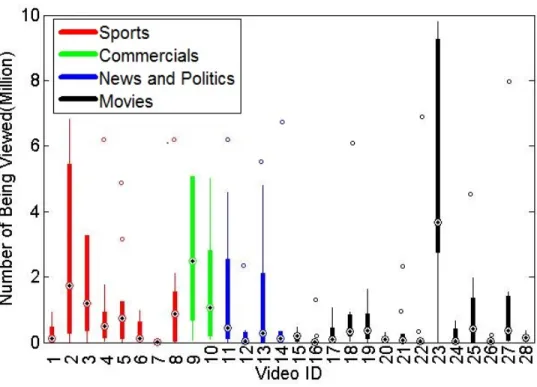
2.2 Viewership statistics for the videos in the VCDB dataset . . . 44
3.1 Example moving-image object recognition (MIOR) CAPTCHAs from Nu-Captcha (see http://nucaptcha.com/demo). . . 54
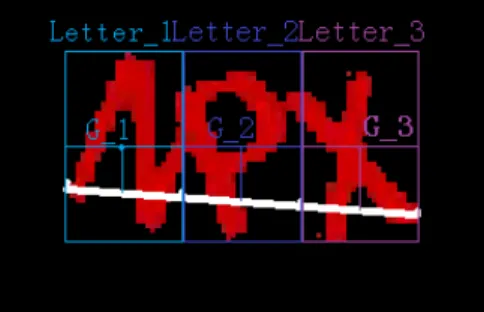
3.2 Na¨ıve attack: Based on the foreground pixels, I find the longest horizontal dis-tance (white line) and the mean value of vertical area (the respective bounding boxes above). . . 55
3.3 High-level overview of my attack. (This, and other figures, are best viewed in color.) . . . 57
3.4 The circles depict salient features. These salient features are usually corners of an object or texture areas. . . 58
3.5 (Top): Initial optical flow. (Middle): salient points with short trajectories in background are discarded. (Lower): Trajectories on non-codeword characters are also discarded. . . 60
3.6 Example foreground extraction. . . 61
3.7 re-running tracking with a lower threshold on corner quality: Left: before modification. Right: after modification. . . 61
3.8 Left: before segmentation. Right: trajectories are marked with different colors and bounding boxes are calculated based on the center of the trajectories and the orientation of the points. The red points denote areas with no trajectories. . . 62
3.9 Iterative decoding of a CAPTCHA. . . 63
3.10 Extended case. Top: scrolling; bottom: in-place. . . 66
3.11 Overlapping characters (with ratio = 0.49). . . 67
3.12 Semi-transparent: 80% background to 20% foreground pixel ratio. (Best viewed in color.) . . . 67
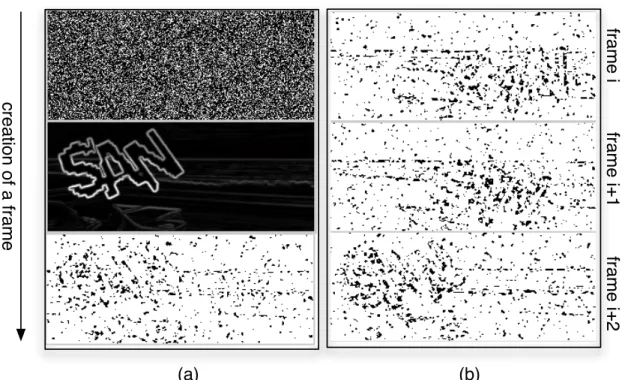
3.13 Emerging CAPTCHA. (a) Top: noisy background frame. Middle: derivative of foreground image. Bottom: single frame for an Emerging CAPTCHA. (b) Successive frames. . . 68
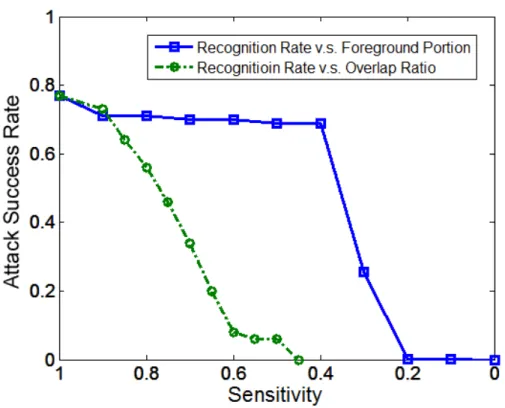
3.15 Attack success rate againstOverlappingandSemi-Transparentdefenses. Sen-sitivity refers to the overlap ratio (circles) or the background-to-foreground
ratio (squares). . . 71
3.16 Three backgrounds used for the challenges, shown for theSemi-Transparentvariant. . . . 72
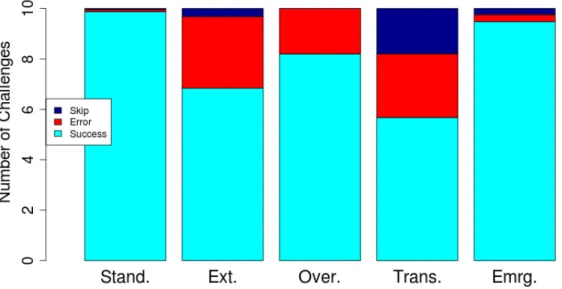
3.17 Mean number of success, error, and skipped outcomes forStandard, Extended, Overlapping, Semi-Transparent and Emergingvariants, respectively. . . 75
3.18 Time taken to solve the MBOR CAPTCHAs. . . 77
3.19 Location of errors within the codewords. . . 78
3.20 Likert-scale responses: 1 is most negative, 10 is most positive. . . 78
4.1 Overview of my proposed approach. . . 84
4.2 Examples of facial landmark extraction . . . 86
4.3 Illustration of identity axes (heavy-set to thin) and expression axes (pursed lips to open smile). . . 87
4.4 3D facial model (right) built from facial landmarks extracted from four images (left). . . 89
4.5 Na¨ıve symmetrical patching (left); Planar Poisson editing (middle); 3D Poisson editing (right). . . 91
4.6 Animated expressions. From left to right: smiling, laughing, closing the eyes, and raising the eyebrows. . . 92
4.7 Example setup using virtual reality to mimic 3D structure from motion. The authentication system observes a virtual display of a user’s 3D facial model that rotates and translates and the device moves. To recover the 3D translation of the VR device, an outward-facing camera is used to track a marker in the surrounding environment. . . 94
4.8 Spoofing success rate with texture taken from photos of different resolution. . . 100
5.1 Some example threat scenarios that we investigated. Top left: Through reflec-tion from sunglasses and toaster; Top right: Through reflecreflec-tion from eyeball and mirror; Bottom left: Through reflection from sunglasses; Bottom Right: Direct long-distance view. Note: As with the remaining figures in this work,
this image is best viewed in color. . . 107 5.2 Overall design depicting the stages of my approach. First I track the motion of
the mobile device (StageÊ). Then the mobile device is aligned to a template (StageË). In the stabilized image the finger is extracted (Stage Ì) and its fingertip trajectory is computed (Stage Í). From the trajectories the likely pressed keys are identified (StageÎ). As an optional step, I apply a language
model to improve the quality of the reconstructed text (StageÏ). . . 109 5.3 The captured image showing a reflection (of the victim’s screen) as observed
in the eyeball. . . 110 5.4 Cropped image (left) and alignment result (right) from StageË(overlaid with
a reference device layout). . . 113 5.5 Input aligned image (left) and finger region extraction (right). Shown in the
right image is the ellipse fitting (blue ellipse), segmentation (cyan), points with high curvature (yellow), detected fingertip (red circle), and an overlaid
reference device layout. . . 115 5.6 Fingertip trajectory (left) and line modeling (right). The red circles indicate
stopping positions for the word “hello”, where the size of the circle corresponds
to uncertainty in the stopping position. . . 116 5.7 METEOR scores for my approach, broken down by scenario. . . 121 5.8 Left: the cellphone image reflects from the user’s sunglasses, off the toaster’s
surface, and is then captured by the camera. Right: the cellphone image reflects
from user’s eyeball, off the mirror, and then is captured by the camera. . . 123 5.9 Example double-reflection from sunglasses and a toaster. Left: Captured
image; Right: (correctly) identified keypress (T, with confidence 0.55). The brightness of the detected image (right) is adjusted for viewing convenience
and has been overlaid with a reference device layout. . . 124 5.10 Plot of captured RMS contrast versus METEOR score for the three different
scenarios (direct, single-reflection, and repeated reflections). . . 125 5.11 Example double-reflection from an eyeball and mirror. Left: Captured image;
Right: candidate keys (Iwith confidence 0.10,Lwith confidence 0.07, and the correct key Owith confidence 1.00). The right image has been overlaid
5.12 Example single reflection from 10m. Left: Single reflection from 10m (cor-rectly predictingIwith confidence 1.0). Right: Direct view from 50m (cor-rectly predictingTwith confidence 1.0). Both images have been overlaid with
a reference device layout. . . 127
6.1 The high-level workflow of my approach. Features are extracted from the captured video and then compared with features from reference videos in a database. The reference video with the most similar feature is output as the most probable candidate. . . 133
6.2 The intensity signal (top) and respective features (middle and bottom). For illustrative purposes, the sequences are manually aligned. Noises occur as peaks or masked out peaks in the feature sequence . . . 135
6.3 Depiction of a sliding window for extracting the peak-descriptor. To suppress noise related peaks, peaks below a predefined threshold are ignored. Effective peaks pairs create a histogram and the cumulation is used as the descriptor of the window. . . 140
6.4 Lab environment (left) and home environment setting (right) . . . 144
6.5 The median ratio within the dataset of 54,000 references. . . 145
6.6 Rank of correct video in the best case (blue) and worst case (red). . . 146
6.7 Ratio to second-best under different illumination conditions. . . 148
6.8 Boxplot of the second-best ratio w.r.t. different screen sizes. . . 148
6.9 Rank of correct video among libraries of size 1,000 and 4,000. . . 150
6.10 Rank of correct video (among 54,000 videos). . . 150
6.11 TV reflection in the room is captured from a distance of 13.5 meters (left). The worst case results (right) are illustrated for different types of videos: TV shows, music and film from top to bottom. All segments longer than 180s were successfully retrieved. . . 151
6.12 TV reflection in the room is captured from a distance of 70.9 meters(top). The camera and the window are labelled in red(top right). The required capture length is compared with direct view and 13.5 meter reflection (bottom). It takes longer for successful retrieval with longer distance. . . 153
7.1 Copy-reference pairs in the VCDB dataset . . . 159 7.2 Overview of the proposed approach . . . 159 7.3 Left : sliding window on derivative feature. Left middle: local feature with
bounded uncertainty w.r.t. temporal adjustments. Right middle: local feature
in uploaded video and (right) its closest neighbor in the reference set. . . 162 7.4 Final result of comparing the uploaded video and the selected reference video.
Green: matched segment; Blue: Unmatch segment; Red: reference sequence. . . 164 7.5 Left: the Precision-Recall curve of my approach and TNP on the VCDB
+50,000 dataset., Right: The Precision-Recall curve for TNP and my approach
for different genres of videos. . . 165 7.6 Left: Precision-Recall curve for my approach with(red)/without(purple)3×3
tiling, Xuet al. (Xu et al., 2014a) (green) and TNP (blue). Right:
LIST OF ABBREVIATIONS
3DMM 3D morphable model
AFSA American Forces Security Agency
CAPTCHA Completely Automated Public Turing Test to Tell Computers and Humans Apart CBCD Content-based copy detection
COG Cognitive-based
CQT Constant-Q transforms CR Character-recognition
DTW Dynamic time warping
FFT Fast Fourier transformation HCI Human-computer interface
IR Image-recognition
MIOR Moving-image object recognition NBS National Bureau of Standards
NIST National Institutes of Standards and Technology OCR Optical character recognition
OTT One-time tapes
LIST OF SYMBOLS
Aidi Identity principal axes Aexpi Expression principal axes
Icap Intensity of the video frame that is captured
Iref Intensity of the video frame that is displayed on the screen Inoise Intensity of noise
P0 Unit area emanation power Sscreen Size of the screen
si,j Point coordinate on captured image Si,j Point coordinate on 3D object
P Projection matrix
Rj 3D rotation matrix tj Translation vector
αcap Percentage of light captured by the camera αcam Sensitivity of camera sensor
CHAPTER 1: INTRODUCTION
Video analysis and video surveillance are active areas of computer vision research. Video analysis techniques are widely used in a wide range of tasks, including recognizing license plate numbers, detecting pedestrians, and identifying copyright infringement. Nowadays, staggering amounts of videos were captured and uploaded to the internet. For example, in 2015, over 300 hours of video are uploaded to YouTube every minute (Youtube, 2015), the number of video posts per Facebook user has increased by more than 75 percent in the past year alone, and nearly 70 million photos and videos are posted on Instagram each day1. Analysis of these video datasets is an important and financially lucrative task for both online video companies and their customers. For instance, in 2015, YouTube reported that more than 5,000 partners use Content ID (a large-scale copy detection application for online videos), and the service has led to over $1 billion in payouts to creators and rights holders since its launch in 2007.
The staggering amount of video data also posts serious challenges for computer vision tech-niques and received much attention from academia. Two key tasks for large scale video analysis and surveillance are video-based event detection and large-scale video event retrieval. The goal of video event detection is to localize and identify spatio-temporal patterns in video, such as characters (Bhardwaj and Mahajan, 2015), key strokes (Balzarotti et al., 2008a), moving vehicles (Jazayeri et al., 2011) and pedestrians (Dollar et al., 2012). While event detection approaches extract event information from each video, it still remains a difficult task to examine a large-scale dataset and find a particular a certain video event, which is called “event retrieval”. Given the astronomic amount of online video resources, sophisticated fingerprint extraction and indexing schemes must be designed for efficient video event retrieval.
For video event detection, the traditional approach is to track the targets, stabilize tracking results, and then recognize them (Efros et al., 2003; Ikizler and Forsyth, 2007; ˙Ikizler and Forsyth, 2008). The detected action is recognized by the subtle changes in the stabilized local frame patches, which are usually noisy and of low resolution, resulting in limited detection accuracy. Other approaches utilize spatial-temporal volumes to recognize action patterns (Ke et al., 2010; Rodriguez et al., 2008; Derpanis et al., 2010; Laptev and P´erez, 2007; Ke et al., 2007; Jiang et al., 2006, 2010; Seo and Milanfar, 2009). These approaches treat the temporal dimension of the video in the same manner as the spatial dimensions and develop volume features in the high-dimensional space. They rely on sliding windows to perform exhaustive searching for events, which is computationally expensive for large-scale datasets.
For video event retrieval, the traditional approach is to utilize spatial features such as SIFT/SURF (Gengembre et al., 2008; Ke et al., 2004; Zhang and Chang, 2004) to match individual frames in the target video and frames from the dataset. However, spatial features are sensitive to spatial-transformations, noise, and resolution changes, making them less usable in certain scenarios such as copy detection (Jiang et al., 2014). Moreover, the approaches using spatial features require matching of every key frame, making these less efficient for large-scale datasets.
Moreover, in some adversarial settings the existing techniques fail to deal with practical challenges. For instance, if the adversary only acquires views of the victim through multiple reflections or eyeball reflections, the event detection scheme will have to deal with extremely low resolution, high noise and significant occlusion, which is beyond the scope of traditional event detection methods. In these cases, I extend existing approaches or seek novel ideas that are more robust and efficient. Towards this goal, I also make contributions in the computer vision domain by introducing cues and features that improve the robustness of existing techniques.
To summarize, in my research (Chapter 3 to Chapter 7), I have investigated realistic security settings for both video event detection and retrieval. For video event detection, I robustly detect codewords from moving-object CAPTCHAs (Completely Automated Public Turing Test to Tell Computers and Humans Apart) and reconstruct typed input from repeated reflections. I also propose a novel technique that defeats existing face liveness detection systems. For video event retrieval, from the attacker’s perspective, I utilize temporal cues to infer TV content from light effusions. On the other hand, from the defender’s perspective, I use similar video retrieval techniques to retrieve copies from large video collections. In each of these scenarios, I analyze the advantages and limitations of the adversary and develop robust computer vision techniques to meet various challenges.
1.1 Thesis Statement
1.2 List of Innovations
In summary, the primary contributions of this dissertation are as follows:
1.2.1 Decoding Codewords from Motion-based Captchas
In Chapter 2, given a moving-image-object-recognition (MIOR) CAPTCHA, I extract the motion contained in the video using the concept of salient features. To infer the motion of the salient feature points, I apply object tracking techniques. With a set of salient features at hand, I then use these features to estimate the color statistics of the background. Next, to account for the fact that all characters of the codewords move independently, I segment the foreground intonsegments as in the na¨ıve attack. I select each image patch containing a candidate character and evaluate the patch using a neural network based classifier (Simard et al., 2003). The classifier outputs a likelihood score that the patch contains a character. As a final enhancement, I incorporate a feedback mechanism in which I use high confidence inferences to improve low-confidence detections of other patches. The net effect is that I reduce the distractions caused by mutually overlapping characters. Once all segments have been classified, I output a hypothesis for all the characters in the codeword.
Contributions in computer vision. My attack inherently leverages temporal information in the moving-image object recognition (MIOR) CAPTCHAs and also exploits the fact that only recognition of known objects is needed. My methods also rely on a reasonably consistent appearance or slowly varying appearance over time. That said, they can be applied to any set of known objects or narrowly defined objects under affine transformations that are known to work well with detection methods in computer vision (Viola and Jones, 2001).
Publications. Xu, Y., Reynaga, G., Chiasson, S., Frahm, J.-M., Monrose, F., and van Oorschot, P. C. (2012). Security and usability challenges of moving-object captchas: Decoding codewords in motion. InUSENIX Security Symposium, Bellevue, WA, pages 49–64,
Xu, Y., Reynaga, G., Chiasson, S., Frahm, J.-M., Monrose, F., and van Oorschot, P. C. (2014b). Security analysis and related usability of motion-based captchas: Decoding codewords in motion. Dependable and Secure Computing, IEEE Transactions on, 11(5):480–493.
1.2.2 Defeating Face Liveness Detection with Virtual Models
In Chapter 4, I introduce a novel approach to bypass modern face authentication systems. More specifically, by leveraging a handful of pictures of the target user taken from social media, I show how to create realistic, textured, 3D facial models that undermine the security of widely used face authentication solutions. My framework makes use of virtual reality (VR) systems, incorporating along the way the ability to perform animations (e.g.,raising an eyebrow or smiling) of the facial model, in order to trick liveness detectors into believing that the 3D model is a real human face. The synthetic face of the user is displayed on the screen of the VR device, and as the device rotates and translates in the real world, the 3D face moves accordingly. To an observing face authentication system, the depth and motion cues of the display match what would be expected for a human face. This work was submitted to the 25th USENIX Security Symposium, 2016.
Contributions in security. I argue that such VR-based spoofing attacks constitute a fundamentally new class of attacks that point to a serious weaknesses in camera-based authentication systems: unless they incorporate other sources of verifiable data, systems relying on color image data and camera motion are prone to attacks via virtual realism. To demonstrate the practical nature of this threat, I conduct thorough experiments using an end-to-end implementation of my approach and show how it undermines the security of several face authentication solutions, including both motion-based and liveness detectors.
1.2.3 Reconstructing Typed Input from Repeated Reflections
In Chapter 5, I propose a method that successfully transcribes the text typed on a keyboard by exploiting video of the user typing, either directly or through up to two reflections from nearby objects. To do so, I devise techniques that are resistant to low resolution, blurring, and noise. I take as input a recording of the target device while the user types on its keyboard. First, I roughly estimate the location of the device in the image. Next, the image of the device is aligned to a known reference template of the device’s keyboard layout. Then, the fingertips are identified in the video and the locations of the fingertips over the video frames are combined into trajectories. These trajectories are then analyzed to identify the pressed keys. From these pressed keys I then reconstruct the typed text. Finally, as an optional post-processing step, I apply a language model in order to improve the readability of the final text. Aside from some initial input in the tracking stage to identify the first frame containing the target device, the entire process is fully automated.
In addition, I propose a novel method for identifying fingertip trajectories based on robust estimation.
Contributions in security. Tracking fingers, rather than recognizing displayed images, broadens the class of vulnerable devices to include Apple’s iPad and similar ones, which do not use any pop-out effect. Moreover, my approach is capable of operating at significant distances from the victim (e.g., up to 50 meters away with a camcorder). Perhaps most importantly, my approach operates effectively even forrepeated reflections, i.e.,reflections of reflections
in nearby objects. This feat allows us to reconstruct typed input from the image of a mobile phone’s screen on a user’s eyeball as reflected through a nearby mirror, extending the privacy threat to include situations where the adversary is locatedaround a cornerfrom the user.
Publication Xu, Y., Heinly, J., White, A. M., Monrose, F., and Frahm, J.-M. (2013). Seeing double: reconstructing obscured typed input from repeated compromising reflections. In
Proceedings of the 2013 ACM SIGSAC conference on Computer & communications security,
Berlin, Germany, pages 1063–1074. ACM
1.2.4 Inferring TV Content from Light Effusions
Contributions in computer vision. The key contribution in this work lies in the techniques I use to take advantage of temporal information to find matches among reference and capture signals, even in the face of significant noise and signal distortions. To do this, I extend tradi-tional correlation measures to utilize temporal information when computing similarity scores between sequences. The resulting strategy significantly outperforms traditional correlation measures (e.g., Greveler et al. (2012)).
Contributions in security. My proposed approach works successfully in a number of practical scenarios, including (but not limited to) observations of light effusions through the windows, on the back wall, or off the victim’s face. My empirical results show that I can successfully confirm hypotheses while capturing short recordings (typically less than 4 minutes long) of the changes in brightness from the victim’s display from a distance of 70 meters.
Publication Xu, Y., Frahm, J.-M., and Monrose, F. (2014a). Watching the watchers: Automatically inferring tv content from outdoor light effusions. InProceedings of the 2014 ACM SIGSAC Conference on Computer and Communications Security, Scottsdale, AZ, pages 418–428. ACM
1.2.5 Detecting Copies from Large Video Collections
that is robust to temporal transformations. In that way, the local features of a transformed video will be equivalent to those in the corresponding original video. To make finding matches more efficient, a K-d tree index structure is built upon the local features of all reference videos. Then, the detection stage is used to determine if the video under examination contains infringing material. In this phase, the derivative features and the local temporal features of the uploaded video are computed. The local features are then used as a first approximation. The collection of possible matches is then considered for further scrutiny using full video information. This work was submitted to ECCV’16.
Contributions in computer vision. I propose a novel copy-detection system utilizing temporal in-formation. Our large-scale empirical results show that my approach achieves higher accuracy and recall rate on real-world videos from the VCDB dataset than contemporary approaches. I am able to achieve improved accuracy because I am able to leverage observations regarding temporal consistency for practical content-based copy detection, which is difficult to thwart without significantly degrading the user’s viewing experience. My approach is more robust against spatial transformations and commonly used temporal transformations.
CHAPTER 2: BACKGROUND AND RELATED WORK
My work spans four different security scenarios: the security of moving object CAPTCHAs (Completely Automated Public Turing Test to Tell Computers and Humans Apart), the security of face liveness detection, compromising optical emanation, and content-based video copy detection. In each of these scenarios, both the adversary and the defender have different constraints and challenges. To better understand the problems, in the following sections, I first review the related work in video event detection and retrieval. Then, I provide a review of background and related work in each adversary constraint.
2.1 Video Event Detection and Retrieval
Before diving into specific scenarios, I first review general developments in video event detection and retrieval.
2.1.1 Video Event Detection
networks and Principal Component Analysis were also introduced for behavior understanding. Since different scenarios may have dramatically different constraints and requirements for video event detection, in subsequent research efforts this framework was further developed to adapt to different scenarios.
For behavior analysis in video surveillance for security, the framework can be modified by adding a person identification component (Ko, 2008). After detecting a human target, the person’s image can be automatically fed into an indexing scheme for identification. Then, the movement trajectory of the target is analyzed for abnormality. This application is particularly useful for security and abnormal behavior detection.
For pedestrian behavior analysis, Geronimo et al. (2009) discussed recent developments in pedestrian detection systems. The main challenge in this scenario is the variety of human appearance (e.g., different clothes, changing size, aspect ratio, and dynamic shape) and the unstructured environment. The basic structure in this scenario still follows the one proposed by Wang et al. (2003), which consists of background segmentation, classification, and tracking. Due to the requirement of robustness, refinement techniques are often used to improve the result from the object classification phase. For instance, by analyzing the movement patterns of a pedestrian, the system can automatically identify abnormal behavior, and further analyze if it is a mis-classification or not.
Lastly, human-computer interfaces (HCI) are also a widely discussed topic in video event detection. Pantic et al. (2007) reviewed the latest developments in this field. Techniques such as expression recognition, face recognition, and gesture detection all have significant applications in HCI. Fortunately, in these cases, the human is more or less cooperating with the computer, making it possible to assume a relatively predictable environment,e.g.,with sufficient resolution and brightness level.
repeated reflections (Section 2.4.1.1). On the other hand, I also explore the potential security weakness of existing face authentication systems by proposing a novel adversary model (Section 2.3).
2.1.2 Video Event Retrieval
Video event retrieval first originated in the 1990s when techniques were proposed that index video events by detecting visual objects and assigning icons for each shot (Aslandogan and Yu, 1999). However, these approaches rely on the results of video event detection and are limited to targets that can be robustly detected and tracked.
In 2007, Jiang et al. (2007) proposed to use bag-of-features for semantic video retrieval. With their approach, videos of similar topics can be retrieved, not limited to certain objects. However, Jiang et al. (2007) failed to take temporal information into consideration, which means their approach does not distinguish between different temporal events. For instance, the proposed system cannot tell the difference between an object moving left and an object moving right. This fact restrains Jiang et al. (2007)’s approach to temporally irrelevant events only.
Later, Jones and Shao (2013) extended the bag-of-features approach (Jiang et al., 2007). Temporal information was taken into consideration using their proposed technique called spatial-temporal pyramid, which includes spatial-temporal information in the indexing structure. Their approach achieved over 95% retrieval accuracy on the UCF Sports dataset (Soomro and Zamir, 2014). However, the accuracy is lower than 30% on the HOHA2 dataset (Marszałek et al., 2009), partly because of the frequent scene switches.
Lastly, copy detection is also a hot topic in video event retrieval. Interestingly, while much work claiming near perfect results on synthetic datasets, I show that these techniques do not work well on real-world data. I return to this later in Section 2.5.
In my work, I use temporal features only for video retrieval. In this way, my proposed system is immune to distortions, noise, and most spatial transformations, and maintaining a superior processing speed. I first propose this technique to automatically infer TV content from light effusions (Section 2.4.1.2). Later I extend this technique to content-based video copy detection (Section 2.5). In the remainder of this chapter, I discuss the specific background for each of the four scenarios: (i) the security of moving object CAPTCHAs (Section 2.2); (ii) the security of face liveness detection (Section 2.3); (iii) compromising optical emanation (Section 2.4); (iv) content-based video copy detection (Section 2.5).
2.2 The Security of Moving Object CAPTCHAs
CAPTCHAs (Completely Automated Public Turing Test to Tell Computers and Humans Apart) first came into place in 2003, when Von Ahn et al. (2003) used distorted letters to distinguish between computers and humans. Once invented, it quickly became popular for websites to avoid attacks such as automated spamming and brute force password guessing.
case of NuCaptcha, users are shown a video with a series of characters (so-called randomcodewords) moving across a dynamic scene, and solve the CAPTCHA by identifying the characters of the codeword. For enhanced security, the codewords are presented among adversarial clutter (Mori and Malik, 2003) (e.g., moving backgrounds and other objects with different trajectories), and consecutive characters may even overlap significantly.
In this section, I first review the adversary model in this scenario and the underlying assumption for moving object CAPTCHA to work. Then, I review related work that covers the standard approaches of CAPTCHA decoding. Finally, I analyse the remaining challenges for the security of moving object CAPTCHAs.
2.2.1 Adversary Modeling
The potential adversary in this scenario acquires a video CAPTCHA, which consists of a sequence of video frames, and intends to decode the CAPTCHA and extract the codewords auto-matically. For moving object CAPTCHA to be secure, the underlying assumption is that attacks based on state-of-the-art computer vision techniques are likely to fail at uncovering these challenges within video sequences, whereas real users will be able to solve the challenges with little effort.
To further understand this assumption, I review some basic concepts in human visual cognition. In the human brain, it is generally assumed that an image is represented by the activity of “units” tuned to local features (e.g., small line and edge fragments). It is also widely believed that objects appearing in a consistent or familiar background are detected more accurately, and processed more quickly, than objects appearing in an inconsistent scene (Oliva and Torralba, 2007). In either case, a person must somehow separate as much as possible of the image once they see it. This feat is believed to be done via asegmentationprocess that attempts to find different objects in the image that “go together” (Ullman, 2000).
evidence that human vision contains processes that perform grouping and segmentation prior to, and independent of, subsequent recognition processes, the exact processes involved are still being debated (Oliva and Torralba, 2007).
Given the complexity of the visual system, it is widely believed that this feat remains unmatched by computer vision algorithms. One of the many reasons why this task remains elusive is that perception of seemingly simple spatial relations often requires complex computations that are difficult to unravel. This is due, in part, to the fact that object classification (that is, the ability to accurately discriminate each object of an object class from all other possible objects in the scene) is computationally difficult because even a single individual object can already produce an infinite set of different images (on the retina) due to variations in position, scale, pose, illumination, etc. Discriminating objects of a certain class is further complicated by the often very large inner class variability, which significantly changes the appearance beyond the factors encountered for a single object. Hence, vision operates in a high-dimensional space, making it difficult to build useful forms of visual representation.
In computer vision, the somewhat simpler process of recognizing known objects is simulated by first analyzing an image locally to produce an edge map composed of a large collection of local edge elements, from which we proceed to identify larger structures. In my work, I am primarily interested in techniques for object segmentation and tracking. In its simplest form,object tracking
In video, this correspondence can be achieved by building a representation of the scene (called the background model) and then finding deviations from the model for each incoming frame. Intuitively, any significant change in the image region from the background model signifies a moving object. The pixels constituting the regions undergoing change are marked for further processing, and a connected component algorithm is applied to obtain connected regions. This process is typically referred to asbackground subtraction. At this point, all that is needed is a way to partition the image into perceptually similar regions, and then infer what each of those regions represent.
2.2.2 Related Work
Most CAPTCHAs in commercial use today are character-recognition (CR) CAPTCHAs in-volving still images of distorted characters; attacks essentially involve building on optical character recognition advances. Audio CAPTCHAs (AUD) are a distinct second category, though unrelated to my present work. A third major category, image-recognition (IR) CAPTCHAs, involves classifi-cation or recognition, of images or objects other than characters. A well-known example, proposed and then broken, is the Asirra CAPTCHA (Elson et al., 2007; Golle, 2008) which involves object classification (e.g., distinguishing cats from other animals such as dogs). CR and IR schemes may involve still images (CR-still, IR-still), or various types of dynamic images (CR-dynamic, IR-dynamic). Dynamic text and objects are of main interest of my work, and contribute to a cross-class category: moving-image object recognition (MIOR) CAPTCHAs, involving objects in motion through animations, emergent-image schemes, and video (NuCaptcha, 2011; Liao and Chang, 2004; Cui et al., 2009; Shirali-Shahreza and Shirali-Shahreza, 2008; Cui et al., 2010a,b; Mitra et al., 2009). A fourth category, cognitive-based CAPTCHAs (COG), include puzzles, questions, and other challenges related to the semantics of images or language constructs. I include here content-based video-labeling of YouTube videos (Kluever and Zanibbi, 2009).
also note other summaries: for defeating classes of AUD CAPTCHAs, Soupionis (Soupionis and Gritzalis, 2010) and Bursztein et al. (Bursztein and Bethard, 2009; Bursztein et al., 2011a); for defeating CR CAPTCHAs, Yan et al. (Yan and Ahmad, 2007; Yan and El Ahmad, 2011) and Bursztein (Bursztein et al., 2011b); for a systematic treatment of IR CAPTCHAs and attacks, Zhu et al. (Zhu et al., 2010), as well as for robustness guidelines.
Usability has also been a central focus, for example, including a large user study of CR and AUD CAPTCHAs involving Amazon Mechanical Turk users (Bursztein et al., 2010), a user study of video-tagging (Kluever and Zanibbi, 2009), usability guidelines and frameworks related to CR CAPTCHAs (Yan and Ahmad, 2008b). Chellapilla et al. (Chellapilla et al., 2005b,a) also address robustness. Hidalgo et al. (Hidalgo and Alvarez, 2011) and Bursztein et al. (Bursztein et al., 2011b) also review evaluation guidelines including usability. Research on underground markets for solving CAPTCHAs (Motoyama et al., 2010), and malware-based CAPTCHA farms (Egele et al., 2010), raise interesting questions about the long-term viability of CAPTCHAs.
2.2.3 Remaining Challenges
In general, CAPTCHAs are challenges that are difficult for computer and easy for human. However, with the rapid developments in computer algorithms, the ability of a computer is surpassing or getting close to a human’s level almost in every domain. This trend is making challenges that used to be hard for computers become feasible, which generates potential vulnerabilities in existing CAPTCHAs. Therefore, it is always an important task to re-evaluate the security of contemporary CAPTCHAs, using the latest developments in computer algorithms.
For moving object CAPTCHAs particularly, although it is still widely believed that the cognitive perception of human is beyond the ability of current computer algorithms, it remains unclear whether the current state of moving object CAPTCHAs utilizes this gap successfully. Namely, are the current moving object CAPTCHAs challenges hard for computers while easy for humans? Additionally, with possible variations of moving object CAPTCHA (e.g.,extending codeword length, increasing overlapping), will they better satisfy the goal of telling humans and computers apart? The answer to these questions leads to a comprehensive study in both the security and the usability of moving object CAPTCHAs, which is a contribution of my work.
2.3 The Security of Face Liveness Detection
While fingerprints has long been utilized as an authentication method since as early as 500 B.C. (Jain and Kumar, 2010), modern automatic biometric systems only emerge in the 1890s when the automated fingerprint systems were first used for criminal identification. Legal standards were eventually established in 1986 by The National Bureau of Standards (NBS), now the National Institutes of Standards and Technology (NIST) (Karu and Jain, 1996).
recognition has been a hot topic in computer vision. In 2014, Lu and Tang (2014)’s work already surpassed human performance in precision and recall. Most recently, recent advances with deep learning algorithms (Taigman et al., 2014; Parkhi et al., 2015) have pushed the boundary even further. However, how to use well-developed face recognition techniques in face authentication is still an open problem, with no formal standard or well-acknowledged approaches. Lenovo, Asus, and Toshiba have all made attempts to use face authentication for authenticating users on desktop computers. However, at the Black Hat security conference in 2009, Duc and Minh (2009) demonstrated that all these systems can be bypassed with photographs and fake pictures of faces. Similar weaknesses have been shown with Android OS, which augmented its face authentication approach in 2012 to require users to blink while authenticating (i.e.as a countermeasure to still-image spoofing attacks). Unfortunately, this approach was also shown to provide little protection, and can be easily bypassed by presenting the system with two alternating images — one with the user’s eyes open, and one with her eyes closed.
Despite these failure attempts, face authentication is still a hot research topic. Researchers have realized that the main barrier of face authentication approach is to prevent ”spoofing attacks” as shown earlier. As a result, the latest designs of face authentication systems all contain aface liveness detection componentthat distinguishes real faces from spoofed ones. In the rest of this section, I review the current developments in face liveness detection, and their adversary model and assumptions.
2.3.1 Adversary Modeling
video of the victim’s moving face in an attempt to trick the system into falsely recognizing motion as an indication of liveness. The 3D-mask-based approach, wherein 3D-printed facial masks are used, was recently explored by Erdogmus and Marcel (2014).
2.3.2 Related Work
Given the three prominent classes of spoofing attacks mentioned earlier, it should be clear that while still-image-based attacks are the easiest to perform, they can be easily countered by detecting the 3D structure of the face. Video-based spoofing is more difficult to accomplish because facial videos of the target user may be harder to come by; moreover, such attacks can also be successfully defeated, for example, using the recently suggested techniques of Li et al. (2015) (which I discuss in more detail later). 3D-mask-based approaches, on the other hand, are harder to counter. That said, building a 3D mask is arguably more time-consuming and also requires specialized equipment. Nevertheless, because of the threat this attack vector poses, much research has gone into detecting the textures of 3D masks (Erdogmus and Marcel, 2014).
Just as new types of spoofing attacks have been introduced to fool face authentication systems, more advanced methods for countering these attacks have been developed. Nowadays, the most popular liveness detection techniques can be categorized as either texture-based approaches, motion-based approaches, or liveness assessment approaches. I discuss each in turn.
techniques often require training on every possible spoofing material, which is not practical for real systems.
Motion-based approaches (Kim et al., 2013; Bao et al., 2009; Kollreider et al., 2005; Lagorio et al., 2013; Wang et al., 2013) detect spoofing attacks by using the motion of the user’s head to infer 3D shape. Techniques such as optical flow and focal-length analysis are typically used. The basic assumption is that structures recovered from genuine faces usually contain sufficient 3D information, whereas structures from fake faces (photos) are usually planar in depth. For instance, the approach of Li et al. (2015) checks the consistency of movement between the mobile device’s internal motion sensors and the observed change in head pose computed from the recorded video taken while the claimant attempts to authenticate herself to the device. Such 3D reasoning provides a formidable defense against both still-image and video-based attacks.
Lastly, liveness assessment techniques (Jee et al., 2006; Sun et al., 2007; Kollreider et al., 2007, 2008) require the user to perform certain tasks during the authentication stage. For the systems I evaluated, the user is typically asked to follow certain guidelines during registration, and to perform a random series of actions (e.g.,eye movement, lip movement, and blinking) at login. The requested gestures help to defeat contemporary spoofing attacks.
Take-away: For real-world systems, liveness detection schemes are often combined with motion-based approaches to provide better security protection than either can provide on its own. With these ensemble techniques, traditional spoofing attacks can be reliably detected. For that reason, the combination of motion-based systems and liveness detectors has gained traction and is now widely adopted in many commercial systems, including popular face authentication systems offered by companies like KeyLemon, Rohos, and Biomids.
2.3.3 Remaining Challenges
yet to be discovered, which would require face authentication systems to be redesigned to be safe against the attack.
In my work, I show the reality of such hazards by proposing a novel spoofing approach that undermines all the existing face liveness detection techniques. More specifically, by leveraging a handful of pictures of the target user taken from social media, I show how to create realistic, textured, 3D facial models that undermine the security of widely used face authentication solutions. My framework makes use of virtual reality (VR) systems, incorporating along the way the ability to perform animations (e.g. raising an eyebrow or smiling) of the facial model, in order to trick liveness detectors into believing that the 3D model is a real human face. The synthetic face of the user is displayed on the screen of the VR device, and as the device rotates and translates in the real world, the 3D face moves accordingly. To an observing face authentication system, the depth and motion cues of the display match what would be expected for a human face.
In the rest of this section, I list additional related works in the security of users’ online photos and 3D reconstruction of human faces.
2.3.3.1 Online Photos and Face Authentication
It should come as no surprise that personal photos from online social networks can compromise privacy. Major social network sites advise users to set privacy settings for the images they upload, but the vast majority of these photos are often accessible to the public or set to ‘friend-only viewing’ (Liu et al., 2011; Kim et al., 2012b; Golder, 2008). Users also do not have direct control over the accessibility of photos of themselves posted by other users, although they can remove (‘un-tag’) the association of such photos with their Facebook account.
could be applied to a user’s public photos to discover their social relationships and solve 22% of SA tests automatically.
Given that one’s online photo presence is not entirely controlled by the user alone — but by their collective social circles — many avenues exist for an attacker to uncover the facial appearance of a user, even when the user makes private their own personal photos. In an effort to curb such easy access, work by Ilia et al. (2015) has explored the automatic privatization of user data across a social network. This method uses face detection and photo tags to selectively blur the face of a user when the viewing party does not have permission to see the photo. In the future, such an approach may help decrease the public accessibility of users’ personal photos, but it is unlikely that an individual’s appearance can ever be completely obfuscated from attackers across all social media sites and image stores on the Internet.
Clearly, the availability of online user photos is a boon for an adversary tasked with the challenge of undermining face authentication systems. The most germane on this front is the work of Li et al. (2014). There, the authors proposed an attack that defeated commonly used face authentication systems by using photos of the target user gathered from online social networks. Li et al. (2014) reported that 77% of the users in their test set were vulnerable to their proposed attack. However, their work is targeted at face recognition systems thatdo not incorporate face liveness detection. In modern face authentication software, sophisticated liveness detection approaches are already in use, and these techniques thwart still-image spoofing attacks of the kind performed by Li et al. (2014).
2.3.3.2 Defeating Facial Liveness Detection by Building Virtual Models From Public Photos
both (Suwajanakorn et al., 2015). For pedagogical reasons, I briefly review concepts that help the reader better understand my approach.
The most popular facial model reconstruction approaches can be categorized into three classes: shape from shading (SFS), structure from motion (SFM) combined with dense stereoscopic depth estimation, and statistical facial models. The SFS approach (Kemelmacher-Shlizerman and Basri, 2011) uses a model of scene illumination and reflectance to recover face structure. Using this technique, a 3D facial model can be reconstructed from only a single input photo. SFS relies on the assumption that the brightness level and gradient of the face image reveals the 3D structure of the face. However, the constraints of the illumination model used in SFS require a relatively simple illumination setting and, therefore, cannot typically be applied to real-world photo samples, where the configuration of the light sources is unknown and often complicated.
As an alternative, the structure from motion approach (Fidaleo and Medioni, 2007) makes use of multiple photos to triangulate spatial positions of 3D points. It then leverages stereoscopic techniques across the different viewpoints to recover the complete 3D surface of the face. With this method, the reconstruction of a dense and accurate model often requires many consistent views of the surface from different angles; moreover, non-rigid variations (e.g.,facial expressions) in the images can easily cause SFM methods to fail. In my scenario, these requirements make such an approach less usable: for many individuals, only a limited number of images might be publicly available online, and the dynamic nature of the face makes it difficult to find multiple images having a consistent appearance (i.e.the exact same facial expression).
on a continuum and capture both expression (e.g.,a frowning-to-smiling spectrum) and identity (e.g.,a skinny-to-heavy or a male-to-female spectrum). In 3DMM and its derivatives, both 3D shape and texture information are cast into a high-dimensional linear space, which can be analyzed with principal component analysis (PCA) (Jolliffe, 2002). By optimizing over the weights of different eigenvectors in PCA, any particular human face model can be approximated. Statistical facial models have shown to be very robust and only require a few photos for high-precision reconstruction. For instance, the approach of Baumberger et al. (2014) achieves good reconstruction quality using only two images.
To make the process fully automatic, recent 3D facial reconstruction approaches have relied on a few facial landmark points instead of operating on the whole model. These landmarks can be accurately detected using the supervised descent method (SDM) (Xiong and De la Torre, 2013) or deep convolutional networks (Sun et al., 2013). By first identifying these 2D features in an image and then mapping them to points in 3D space, the entire 3D facial surface can be efficiently reconstructed with high accuracy. In this process, the main challenge is the localization of facial landmarks within the images, especially contour landmarks (along the cheekbones) which are half-occluded in non-frontal views; I introduce a new method for solving this problem when multiple input images are available.
2.4 Compromising Optical Emanation
was rediscovered in 1951 by the CIA during tests with the very same mixer. They were able to intercept plain text transmissions half a mile along a communications line. The American Forces Security Agency (AFSA) further investigated the problem and discovered an even more serious problem: crypto equipment, connected to radio transmitters, emitted very weak plain text signals. These signals were picked up by the nearby transmitter and modulated onto the transmitted radio waves. The plain text piggy-backed on the transmitters powerful radio waves, making it possible to filter out and read the plain text at distances of tens or hundreds of miles. This was by far the most serious security issue. In early 1960’s, after numerous unsuccessful experiments, the Navy Research Laboratory proposed to reduce the voltage and signal amplitude as the final cure of the problem, which led to TEMPEST (not an acronym but sometimes written out as Telecommunications Electronics Material Protected from Emanating Spurious Transmissions). TEMPEST refers to a whole set of technical recourses, standards and regulations to protect communications equipment against unwanted radiation of signals that might be intercepted, analyzed, and exploited by the adversary.
While TEMPEST regulations effectively protect a user’s privacy from compromising electrical emanations, researchers soon discovered that acoustic emanations, electromagnetic emanations and optical emanations are also potential sources of information leakage:
Acoustic emanation. Acoustic emanations from keyboards have been found to be excellent sources of disguised information. Since most encrypted systems utilize keyboards as input devices, acoustic emanations are compromising at best if reconstructed. An acoustic emanation can be decoded with feature matching using a single microphone (Marquardt et al., 2011) or with triangulation using multiple microphones (Fiona, 2006). Fortunately, the risk of acoustic eavesdropping decreases when the microphone is far away from the keyboard; with accuracy quickly dropping to random guesses at a distance of one foot.
reveal their little secrets with the EM spectra. This EM radiation is not merely interfering, but informative or compromising depending on one’s attitude towards secrecy. Again, electro-magnetic emanation is captured at close distances of less than one foot, with electroelectro-magnetic interference devices attached to the power line (Mo et al., 2013).
Optical emanation. In contrast to acoustic emanation, optical emanation focuses on commonly used output devices,i.e.the device’s display. While there are multiple kinds of screens (e.g. CRT, LCD, LED), all of them allow the user to view content from certain angles. Using a camcorder within these angles will allow the adversary to acquire informative emanations. Unlike acoustic and electromagnetic emanation, optical emanation can be captured as far as 70 meters away (Xu et al., 2014a).
While optical emanation shows a superior attack range compared to acoustic and electro-magnetic emanations, it is constrained by the viewing angle since visible light signals travel in straight lines. To overcome this limitation, reflections and effusions can be often utilized instead of observing the device screen directly.
2.4.1 Adversary Modeling
To better understand the problem and the challenges I face, I first analyze the properties of two specific reflection and effusion scenarios: (i) reconstructing typed input from repeated reflections; (ii) inferring TV content from light effusions. Although my adversary model is analyzed under such specific scenarios, it is worth noting that the analysis (e.g.,image size, noise, and impact of diffraction) can be generalized to similar situations.
2.4.1.1 Reconstructing Typed Input from Repeated Reflections
range of the victim (e.g., to ensure that pop-out events in reflections in the victim’s sunglasses can be discerned (Raguram et al., 2011)) or close enough to the target to avoid the use of expensive telescopes (Backes et al., 2009).
In my work, I consider a broader and more challenging adversary model: devices with any type of virtual or physical keyboard, without direct line-of-sight, at distances farther away from the victim than previously thought possible and even from reflections on the eye-ball. In these scenarios, the video captured by the adversary is noisy and the resolution is so low that visual cues such as the “pop-out” effect are no longer usable, completely defeating the existing attacks.
Captured Size of the Object. Obviously, the size of the object in the captured images is of critical importance and naturally depends on the size of the object itself. Other factors are the focal length and sensor resolution of the camera. Loosely speaking, the size of the object in the image for direct line-of-sight can be computed as:
SizeDirect =
Sensor Resolution Sensor Size
| {z }
pixel scale
· T arget DistanceObject Size
F ocal Length −1
| {z }
size on sensor
(2.1)
In addition to the physical object size, the size of the object on the image sensor also depends on the presence and shape of any reflecting surfaces between the observer and the object. For instance, if the reflecting object is convex (e.g., a pair of sunglasses or the human eyeball), the size of the observed object will be much smaller than if observed with direct line-of-sight. When an object is viewed via a reflection, the final observed size can be computed as:
SizeRef lection =SizeDirect∗
1
2Distance f rom Surf ace Curvature Radius + 1
(2.2)
Thus, the curvature of the reflecting surface is an important factor in the observed size. The more curved the reflecting surface is, the more the light will be bent. For convex surfaces, the bending of the light will result in a smaller observed object size. Lastly, the distance between the reflecting surface and the target object itself (Distance f rom Surf ace) naturally affects the observed object size.
Takeaway. One way to acquire a larger observed size is to simply reduce the distance to the target object. However, from an adversarial point of view, it is desirable to be as far away as possible from the victim. Hence, a better solution would be to use a lens with a long focal length. For similar reasons, cameras with higher pixel density in their sensors are preferred. Finally, the curvature of any reflecting surface must be taken into account. For example, the human eyeball has a typical curvature of about 8 mm (Backes et al., 2008). Hence, when people look at an object 25 cm away, the reflection in their eyeball will be about 60 times smaller than with direct line-of-sight.
The maximum effective size of the observed object (M ax Size) can be approximated as:
M ax Size= Aperture/W avelength 1.22T arget Distance ∗
Object Size 2Distance f rom Surf ace
Curvature Radius + 1
(2.3)
Notice that the actual amount of diffraction is impacted by the wavelength of the light (W avelength). While the adversary has no control over this factor, I include it here for com-pleteness (along with the well-known constant scale factor of1/1.22for circular apertures (Stelzer, 1998)). However, the adversary can select a lens with an appropriate aperture (i.e., opening of the lens), which lets the desired amount of unobstructed light pass through the lens.
Takeaway. The larger the aperture of the lens, the smaller the amount of diffraction. It is for precisely this reason that prior work (e.g., (Kuhn and Kuhn, 2003; Backes et al., 2008, 2009)) resorted to the use of telescopes. However, lenses with large apertures are typically very expensive, costing well over $1,000 per square cm (Backes et al., 2008), and are difficult to conceal.
Impact of Noise. A very significant factor that affects the quality of the acquired image of the target object is imaging noise. Noise is a random variation in each pixel’s intensity, causing the image to appear speckled. As noted by Nakamura (2005), there can be several types of background noise in the captured image, each with a constant noise level. To avoid visual impact on the image quality by the noise, the exposure time is typically chosen so that the overall amount of light overwhelms the background noise, making it hardly noticeable. However, for video capture, the exposure is naturally limited to the time of a frame, which for darker scenes makes the background noise more noticeable. The resulting noise causes significant challenges in identifying fine detail.
Typically, cameras with large sensors are more resistant to noise, as their pixels are usually larger and can capture more photons of light. For that reason, the larger sensors provided in digital SLR cameras (as opposed to cellphones or point-and-shoot cameras) are desirable for photography even though they provide a smaller number of pixels on the object.
reconstruction of typed input from repeated reflections. For instance, the recently used technique of identifying salient feature points (Raguram et al., 2011, 2013) within the image in order to facilitate alignment will fail because the poor image resolution does not provide the required details for the salient feature points. The approach suggested by (Maggi et al., 2011) faces similar challenges. Additionally, low image quality (e.g., as acquired from a reflection in the eyeball) prevents the detection of fine detail.
2.4.1.2 Inferring TV Content from Light Effusions
In this scenario, a potential adversary captures a video of the flickering light caused by changes in brightness on the device display and tries to confirm the video content being watched. This is a challenging task because the light signal from device display is weakened and distorted by reflections and effusions. The interference of nearby vehicle and road light might also be sources of noise. Because of heavy obfuscation, many of us may not have given a second thought to the amount of information these flickering patterns might reveal about the programs we watch.
The ability to confirm which video is being watched based off compromising diffusions of changes in light hinges on several factors, including (i) the quality of the captured information (i.e., the signal-to-noise ratio), (ii) the entropy of the observed information (i.e., the amount of variation in the captured signal), (iii) the length of the captured signal (e.g., short clips have more ambiguity), and (iv) the amount of information required for successfully matching the unknown and reference signals, which is related to the size of the adversary’s reference library and the distinctiveness of its contents I discuss each in turn.