AN IN-DEPTH LOOK AT UNEMPLOYMENT REPLACEMENT RATE CONVERGENCE AMONG 21 OECD COUNTRIES
Nathan Douglas Tarte
A thesis submitted to the faculty of the University of North Carolina at Chapel Hill in partial fulfillment of the requirements for the degree of Master of Arts in the Department of the Transatlantic Masters Program.
Chapel Hill 2013
ii
ABSTRACT
NATHAN DOUGLAS TARTE: An In-Depth Look at Unemployment Replacement Rate Convergence among 21 OECD Countries
(Under the direction of John Stephens)
This master’s thesis examines convergence of unemployment replacement rates among 21 OECD member-states. Past literature has focused on the welfare state as a whole and/or several welfare state policies. While analyzing the welfare state as a whole, these articles ignored looking at certain policies in depth. By focusing solely on unemployment
iii
TABLE OF CONTENTS
LIST OF TABLES………iv
LIST OF FIGURES………...v
I. Introduction………..1
II. Welfare State Convergence: A Review of the Literature………2
III. Brief Review of Unemployment Insurance……….4
IV. Tested Hypotheses………...7
V. Methodology and Dataset………..10
VI. Empirical Analysis……….13
European Union and OECD Convergence………13
Welfare State Typologies………...19
Effects of Unemployment Rates and Trade Union Density…...25
VII. Conclusion………...27
iv
LIST OF TABLES
Table
1. Years of introduction of first laws providing for unemployment
benefits at the national level in eighteen OECD countries……...7 2. Unemployment replacement rates in 22 countries, 1980-2009………..14 3. Country-specific unemployment replacement rate distances
to Australia, 1980-2009………..17 4. Unemployment replacement rate standard deviation by welfare
state typology, 1980-2009………..21 5. Unemployment replacement rate standard deviation of Carroll’s
unemployment insurance typologies, 1980-2009………...25
v
LIST OF FIGURES
Table
1. Unemployment replacement rate standard deviation for EU and OECD without EU, 1980-2009………...15
2. Unemployment replacement rate mean for EU and
OECD without EU, 1980-2009………..15
3. Average annual replacement rate growth, 1980-2009………19
4. Unemployment replacement rate standard deviation by
Introduction
Convergence has become an increasingly popular subject of study within the political science arena in the past decade. In the simplest terms convergence is the process of two or more entities becoming more similar over time. The study of convergence of nations first became popular as Barro and Sala-i-Martin’s seminal work in macroeconomics explored a type of catch-up by poorer countries or regions (Barro and Sala-i-Martin 1992). Since then much research has been done, both in economics and political science, trying to pinpoint whether convergence is occurring among certain countries.
In the field of international and comparative politics, affluent democracies with extensive welfare states have been a popular subject for convergence testing. Many of these studies focus on various aspects of these countries and whether there is an increasing similarity among all of the countries. International political science studies seek to find convergence among these states’ welfare states. ‘Have relatively similar problem pressures given rise to obvious signs of cross-national convergence of welfare states and, if so, where is that convergence trend leading us?’ (Starke et al.: 2008: 975).
2
interested in the topic of convergence within the OECD, it also hopes to find other sources outside of the OECD that may contribute to countries becoming more similar in their unemployment benefit levels.
This master’s thesis is organized as follows. The section following the
introduction will review recent developments in convergence testing literature and briefly review results of convergence testing on the welfare state. As this thesis focuses on unemployment insurance, a section is also dedicated to past research into the history of unemployment insurance within most of the OECD countries. After the sections on the background, the thesis discusses methodology, variables, and the dataset used to carry out the calculations. Finally the thesis ends with the results of the convergence statistical models, discussion of the findings, and the conclusion.
Welfare State Convergence: Review of the Literature
There is no shortage of convergence literature in comparative political science research. ‘While first studies date back to the early 1960s, the academic popularity of the topic
3
topic of convergence, Christopher Knill admits that his research on the matter ‘clearly shows that we still have a rather limited understanding of the phenomenon of policy convergence’ (Knill 2005: 765).
However, in recent years we have seen academic responses within the field of political science that attempt to take a holistic approach to locating areas of welfare state convergence, focusing on the OECD group of developed democracies. Researchers such as Peter Starke, Herbert Obinger, Francis G. Castles, and Carina Schmitt are intent on answering the question of convergence as it applies to the OECD countries. Do we see welfare state convergence within these countries in recent decades? If we do indeed find convergence, what areas of the welfare state have converged and what caused the convergence? Countries within the OECD face similar challenges and problems stemming from maturing industrialized
economies. Coupled with globalization which has opened trade between countries, it is not surprising that testing for convergence among these nations has become increasingly popular.
While Christopher Knill attempted to find consensus on the issue of convergence within the field of comparative politics, Peter Starke, Herbert Obinger and Francis G. Castles sought to use that starting point as an impetus for comprehensive convergence testing of welfare states. Testing OECD welfare states from 1980 through 2003, Starke, Obinger, and Castles found convergence of welfare state expenditure due in large part to a statistically significant ‘catch-up’ by countries with lower initial levels of welfare spending. In looking at sickness
4
cross-national similarity in social expenditure and unemployment replacement rates but stops short of exploring the issue further.
Carina Schmitt and Peter Starke’s article on convergence published in 2011 expanded on the general idea of welfare state convergence among OECD states using error correction models to successfully identify ‘very strong convergence across all categories of social expenditure when conditional factors are taken into account’ (Schmitt and Starke 2011: 120). In their research Schmitt and Starke find ‘globalization, membership of the European Union (EU) and the structure of the social programmes in question’ (Schmitt and Starke 2011: 121) to be particularly important in explaining convergence. ‘When taking important conditional factors into account, convergence exists both at the aggregate level of the ‘whole’ welfare state and at the disaggregated levels of the main spending categories’ (Schmitt and Starke 2011: 131).
This current literature successfully moves convergence research ahead in a way that Christopher Knill envisioned when he put together his special issue in the Journal of European Public Policy. We have a better grasp of the causes of welfare state convergence and how welfare states among the OECD member states are becoming more alike. What we still lack are closer inspections into the different areas of the welfare state in relation to convergence testing.
Brief Review of Unemployment Insurance
5
conflicting values on work and the causes of unemployment, as well as the role of states, markets, families, and the third sector’ (Sjöberg et al. 2010:420). As opposed to
Employment Protection Legislation (EPL), in which both the OECD and EU agree on a more liberal policy model, there are no ‘best practices’ when it comes to the suggested level of unemployment benefits within the OECD countries.
Clearly there is no ‘correct’ answer, as each nation seeks to find the perfect balance in supporting those with no income and ensuring that they enter back into the labor force in a timely manner. ‘An important factor underlying the controversies surrounding the
introduction and subsequent reforms of unemployment benefit schemes is the belief that the generosity and duration of such benefits will have a detrimental effect on aggregate
unemployment rates and labour supply’ (Sjöberg et al. 2010: 432). It is argued that higher unemployment benefits are responsible for demotivating unemployed workers from willingly entering back into the labor force.
The key issue is whether the long-term unemployment causes demotivation and demoralization, or whether it is simply that the least enthusiastic and energetic people have most difficulty in finding jobs, and therefore the long-term unemployed consist largely of people with such characteristics. Studies both in Britain and the USA find evidence of the adverse effect of prolonged spells of unemployment on motivation and morale (Laylard et al. 2005: 259). However there is no consensus, academic or otherwise, on how unemployment benefits should be structured, leading to distinct difference in unemployment schemes among countries.
6
this study, as this thesis will also account for the Southern European states, a ‘sub-protective regime’ (Ozkan 2013: 6) will also be included in the typologies.
Voluntary state-subsidized insurance was the first institutional type of unemployment insurance used in a number of Scandinavian and Continental European states. ‘The basis on which the unemployed are entitled to benefits is membership in the funds. Historically, benefits have been paid as flat-rate daily benefits, but have increasingly been paid out also in earnings-related forms’ (Sjöberg et al. 2010: 421).
Targeted programs consist of means-tested unemployment insurance. In these systems benefits are paid out at minimum levels and ‘entitlement is judged on the basis of assets held, need of support demonstrated at the time unemployment, or of income earned in/prior to unemployment’ (Sjöberg et al. 2010: 422). Compulsory insurance was first instituted in the United Kingdom in 1911 and entails
comprehensive insurance, though benefits are usually flat-rate or very weakly graduated by income.
Corporatist insurance makes up the last type of Carroll’s unemployment insurance regimes. ‘Its institutional characteristics include state insurance regimes
differentiated along occupational lines, as well as these regimes’ joint administration by employer and employee representatives’ (Sjöberg et al. 2010: 422). Unlike the
7
However the Southern European states have drastically improved coverage and benefit levels in the past two decades.
By breaking down unemployment insurance programs into these five categories, we are left with a better understanding as to why certain countries may group together in terms of benefit levels. According to Alber in his 1981 study, ‘the original cross-national diversities in the design of unemployment insurance schemes have, in important respects, persisted to the present day’ (Sjöberg et al. 2010: 423).
Table 1 Years of introduction of first laws providing for unemployment benefits at the national level in eighteen OECD countries
Voluntary state-subsidized Targeted Programmes Comprehensive insurance Corporatist insurance
Australia -- 1944 -- --
Austria -- 1920 -- 1949
Belgium 1920 -- -- 1944
Canada -- -- 1940 --
Denmark 1907 -- -- --
Finland 1917 -- -- --
France 1905 1940 -- 1967
Germany -- -- -- 1927
Ireland -- -- 1911 --
Italy -- -- -- 1919
Japan -- -- -- 1947
Netherlands 1916 1943 -- 1949
New Zealand -- 1938 -- --
Norway 1906 -- 1938 --
Sweden 1934 -- -- --
Switzerland 1924 -- 1976 --
Great Britain -- -- 1911 --
United States -- -- 1935 --
Source: Sjöberg et al. 2010: 423.
8
H1: Due to findings in past literature, there should be convergence within the OECD
members.
Past literature has shown convergence in welfare state policy among the OECD states. The OECD helps support policy transfer and global integration among these member states. The argument is summed up well in the efficiency hypothesis. According to this hypothesis,
Governments are held to ransom by mobile capital, the price is high, and punishment for non-compliance is swift. If the policies and institutions of which the financial markets approve are not found in a country, money will hemorrhage unless and until they are. In turn, financial capital is usually thought to disapprove of all government policies that distort markets, and welfare state spending and large and progressive systems of taxation are among the most prominent villains (Garrett and Mitchell 2001: 151).
With OECD convergence it would be expected that mean replacement rates would decrease as increased global competition forces governments to reduce safety nets.
H2: The EU should act as a convergence club, converging towards the middle.
9
2002: 740). This practice of cross-national policy transfer within the EU should encourage policy convergence among the EU members.
H3: Convergence should be stronger among the different welfare state typologies than all of
Europe or OECD.
If the EU is seen as a potential convergence club, so too should the different welfare typology groups. These four groups (liberal, continental, southern, and Nordic) have
developed similar welfare states over time. Liberal welfare states should be more inclined to offer a lower mean replacement rate level, while Nordic and Southern European states should offer higher levels due to the nature of their welfare states. Path dependence is an important factor in determining the differences in the welfare state among the different typologies. Much of the difference expected to be found among OECD members can be attributed to ‘past national power constellations and distinct historical paths’ (Starke et al. 2008: 983).
H4: Southern European states should be the least alike of the welfare typologies while the
continental states should be most resilient to change.
10
the most amount of resistance to change should be found in the Continental states. These countries use ‘earmarked social contributions instead of general tax revenue’ (Schmitt and Starke 2011: 123) to finance the social provisions such as pensions, sickness, and
unemployment benefits. Just as it is difficult to reform pay as you go pension systems, it is difficult to change systems in which social contributions have been allocated to certain aspects of the safety net.
H5: High historical unemployment will lead to less generous unemployment benefits.
Countries with historically high unemployment rates will naturally place more strain on their welfare state from this chronically high rate of unemployed citizens. It has also been argued that ‘the generosity and duration of such benefits [unemployment benefits] will have a detrimental effect on aggregate unemployment rates and labour supply. According to so-called job-search models… unemployment benefits will raise the reservation wage of the unemployed and therefore allow them to be relatively more discriminating about job offers’ (Sjöberg et al. 2010: 432). This line of thought could prompt countries with higher levels of unemployed citizens to reduce benefits in hopes of combatting chronic and long-term unemployment.
Methodology and Dataset
11
β-convergence (beta-convergence). ‘While s-convergence focuses on cross-sectional dispersion, β- convergence denotes an inverse relationship between the initial value of a particular policy indicator and its subsequent growth rate or change’ (Starke et al. 2008: 980). β-convergence is useful in identifying the catch-up process in countries where the policies
being tested are less developed. ‘A simple test for β -convergence is to regress the starting value of a particular policy indicator on its subsequent growth rate (or change) for the period of interest. If the estimated coefficient for the initial value has a negative sign and is
statistically significant, there is evidence of β -convergence’ (Starke et al. 2008: 980). In economics for example, β-convergence is expected to be found due to developing countries growing at a faster rate than already developed countries. Countries like China and India can grow at a faster rate than more developed countries such as the United States and Germany, thus contributing to β-convergence. In regard to unemployment replacement rates, countries with lower levels of unemployment replacement rates should increase their benefits at a faster rate than those countries which have long had higher replacement rates. β – convergence can also be viewed if countries are converging towards the middle or when countries are converging towards the bottom.
12
The dataset, ‘Unemployment Replacement Rates Dataset among 34 Welfare States, 1971-2009, an Update, Extension and Modification of the Scruggs’ Welfare State Entitlements
Data Set’ (VanVliet and Caminada 2012) is used to calculate any potential convergence in unemployment benefits. This information is located within the “NEUJOBS Special Report No. 2/January 2012”. The dataset consists of net unemployment replacement rates for 34 welfare states, ranging from 1971 through 2009. Convergence is tested using net
replacement rates of unemployment benefits to determine generosity. ‘Replacement rates are particularly helpful when the object of analysis is the development of social rights of
citizenship and individual protection levels. It is often claimed that replacement rate data gives a much better picture of policy changes than social expenditure since the latter may be driven by demand factors such as unemployment and demographic change’ (Starke and Schmitt 2011: 125).
For the purpose of this thesis, convergence will be tested between the years of 1980 and 2009 due to missing data before 1980 in Luxembourg, Spain, and Portugal. The analysis begins at this time due to the availability of information and ‘by the fact that the Golden Age of welfare capitalism is widely seen to have peaked at or around that time’ (Starke et al. 2008: 976). Van Vliet and Caminada’s dataset defines net unemployment replacement rates as: ‘(Cash Benefits - Taxes) out of work / (Wages - Taxes) in work where taxes include net social charges (compulsory contributions to social insurance program less cash transfers). The calculations assume a worker, aged 40, who earns the average production worker wage’ (Van Vliet and Caminada 2012: 5-6). Because this thesis aims to analyze convergence among OECD
13
Van Vliet and Caminada’s dataset ‘provide unemployment benefit replacement rates for a single worker and for a family, the latter defined as a household with a dependent spouse, two children and a head of household drawing the unemployment benefit. Benefits for families include child benefits, including means tested benefits’ (Van Vliet and Caminada 2012: 6). For the purposes of this thesis, the single worker replacement rate and the family replacement rate will be averaged out to one single replacement rate variable. Convergence testing for this thesis will be carried out with this new combined country net replacement rate variable.
Empirical Analysis
European Union and OECD Convergence
Unemployment Replacement Rate Sigma-Convergence
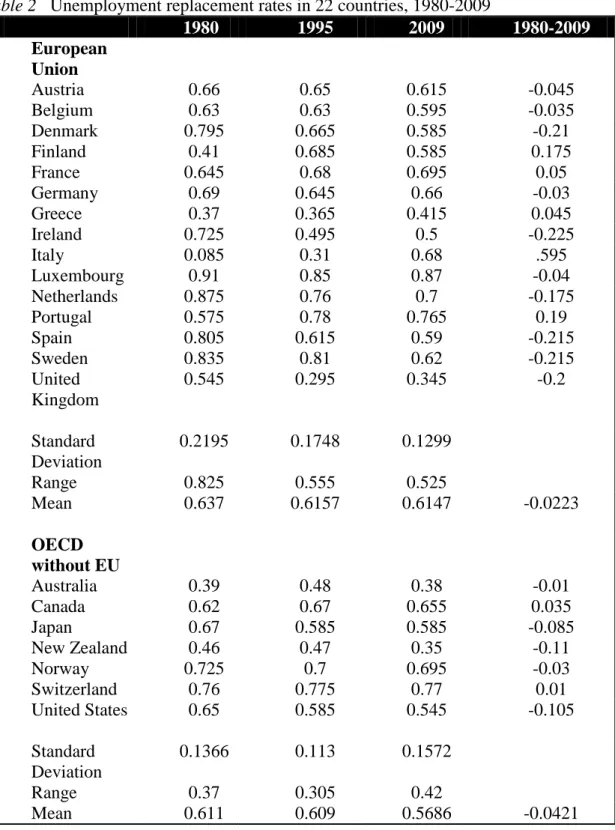
Past literature in welfare state convergence agrees that the OECD countries’ unemployment benefits policies are becoming more similar. However, what this statement fails to show is the countries outside of the EU becoming less similar over time. In a simple sigma-convergence test the EU countries are becoming much more similar over time, while the remaining OECD countries’ (outside of the EU) unemployment benefit levels are actually diverging.
This simple test for sigma-convergence highlights the EU states’ unemployment replacement levels converging by 40.82 percent. The other seven OECD states during the same time have diverged by 15.08 percent. The OECD is converging as it pertains to unemployment
14
is indeed a convergence club. The ‘EU social policy actively encourages learning processes through the Open Method of Co-ordination (OMC)’ (Starke and Schmitt 2011: 123).
Table 2 Unemployment replacement rates in 22 countries, 1980-2009
1980 1995 2009 1980-2009
European Union
Austria 0.66 0.65 0.615 -0.045
Belgium 0.63 0.63 0.595 -0.035
Denmark 0.795 0.665 0.585 -0.21
Finland 0.41 0.685 0.585 0.175
France 0.645 0.68 0.695 0.05
Germany 0.69 0.645 0.66 -0.03
Greece 0.37 0.365 0.415 0.045
Ireland 0.725 0.495 0.5 -0.225
Italy 0.085 0.31 0.68 .595
Luxembourg 0.91 0.85 0.87 -0.04
Netherlands 0.875 0.76 0.7 -0.175
Portugal 0.575 0.78 0.765 0.19
Spain 0.805 0.615 0.59 -0.215
Sweden 0.835 0.81 0.62 -0.215
United Kingdom
0.545 0.295 0.345 -0.2
Standard Deviation
0.2195 0.1748 0.1299
Range 0.825 0.555 0.525
Mean 0.637 0.6157 0.6147 -0.0223
OECD without EU
Australia 0.39 0.48 0.38 -0.01
Canada 0.62 0.67 0.655 0.035
Japan 0.67 0.585 0.585 -0.085
New Zealand 0.46 0.47 0.35 -0.11
Norway 0.725 0.7 0.695 -0.03
Switzerland 0.76 0.775 0.77 0.01
United States 0.65 0.585 0.545 -0.105
Standard Deviation
0.1366 0.113 0.1572
Range 0.37 0.305 0.42
15
Schmitt and Starke go on to hypothesize that there should be a difference in the rate of convergence between members and non-members. This hypothesis also holds true for
Figure 1 Unemployment replacement rate standard deviation for EU and OECD without EU, 1980-2009
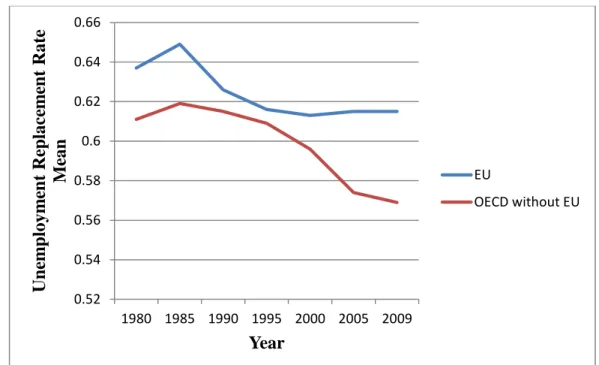
Figure 2 Unemployment replacement rate mean for EU and OECD without EU, 1980-2009
0 0.05 0.1 0.15 0.2 0.25
1980 1985 1990 1995 2000 2005 2009
Unem p loym en t Re p lace m en t Rat e S tand ar d De viation Year EU
OECD without EU
0.52 0.54 0.56 0.58 0.6 0.62 0.64 0.66
1980 1985 1990 1995 2000 2005 2009
Unem p loym en t Re p lace m en t Rat e M ean Year EU
16
unemployment replacement rates. EU states are converging, while the remaining OECD states have become less similar between 1980 and 2009.
Globalization negatively affecting European safety nets has been a particular point of concern for social scientists such as Walter Korpi and Joakin Palme, who made a case for the retrenchment of unemployment insurance:
It can be hypothesized that the role of welfare-state institutions for the formation of identities and socioeconomically based interest groups will be greatest with respect to aging and sickness, where risks are universally shared. In contrast, risks for unemployment, work accidents, and poverty have
traditionally been socially skewed to such an extent that institutions limited to these specific areas are likely to be of less relevance for wide-based interest group formation… the risk for unemployment has traditionally been
socioeconomically skewed to the disadvantage of manual workers to an extent making it unlikely that unemployment insurance programs can mobilize more broad-based support against cutbacks (Korpi and Palme 2003: 431).
Figure 2illustrates the mean unemployment replacement rate of the EU and
17
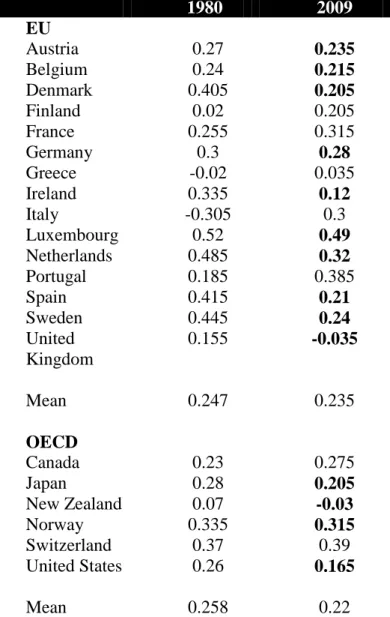
When running the test for delta-convergence, the effects of the convergence to the middle within the EU members can be seen. Of the twenty one countries, fourteen have decreased their unemployment replacement rate levels. The countries decreasing their levels have had historically high replacement rates, with only the liberal New Zealand and UK (both starting at lower levels) decreasing their levels to below that of Australia.
Table 3 Country-specific unemployment replacement rate distances to Australia, 1980-2009
1980 2009
EU
Austria 0.27 0.235
Belgium 0.24 0.215
Denmark 0.405 0.205
Finland 0.02 0.205
France 0.255 0.315
Germany 0.3 0.28
Greece -0.02 0.035
Ireland 0.335 0.12
Italy -0.305 0.3
Luxembourg 0.52 0.49
Netherlands 0.485 0.32
Portugal 0.185 0.385
Spain 0.415 0.21
Sweden 0.445 0.24
United Kingdom
0.155 -0.035
Mean 0.247 0.235
OECD
Canada 0.23 0.275
Japan 0.28 0.205
New Zealand 0.07 -0.03
Norway 0.335 0.315
Switzerland 0.37 0.39
United States 0.26 0.165
18
European countries still favor their welfare state safety net, and the data confirms this analysis. Some European states may be decreasing their levels of unemployment benefits, but outside of the two liberal nations, they are not reducing levels to those of Australia or New Zealand. The averages seem to be coalescing around the 0.58-0.62 mark, indicating a convergence towards the middle instead of a race to the bottom. In many cases the levels remain well above this mark, as countries such as France, Luxembourg and Portugal have maintained levels well above both the European and OECD averages. It remains to be seen if the global financial crisis will lead to further reductions in unemployment benefit levels, as governments look to first cut back in areas with little to no formal interest group support. But as of 2009 the fears of globalization do not seem to be taking hold in terms of the unemployment replacement rate in OECD members.
EU and OECD Beta-Convergence
β-convergence levels are not as clear as the sigma-convergence levels. While there is
evidence of β-convergence, the ‘catch-up’ is not as clear as other researchers have discovered in welfare state spending in general. β-convergence is first calculated for just the EU. Italy, which is an outlier due to its extremely low replacement levels in 1980, is removed from the β-convergence calculations. β-convergence is tested with a simple bivariate regression of the
19
by the ‘catch-up’ process of countries with lower levels of unemployment replacement rates catching up to the countries that have had higher benefit levels.
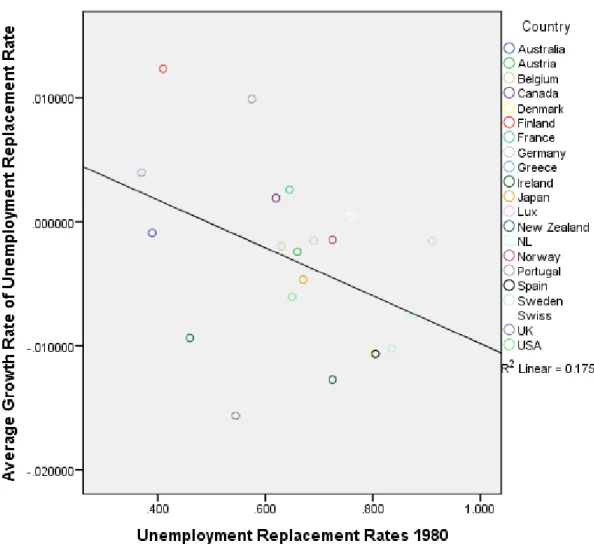
When the β-convergence is tested for all OECD countries, the ‘catch-up’ process is even less pronounced (figure 3). Excluding Italy as it is still an outlier, the calculation produces
Figure 3 Average annual replacement rate growth, 1980-2009
20
the culprit, as only 17.5 percent of OECD unemployment replacement rate convergence can be explained by this catch up process.
Welfare State Typologies
Simple Sigma-Convergence and Mean Testing
As the European Union can be considered a convergence club, it is also necessary to determine if the welfare state typologies categorized by Gøsta Esping-Andersen in his influential Three Worlds of Welfare Capitalism, apply to unemployment insurance, and if they still hold together today1. Including the Southern European typology, the European countries are categorized into either the Nordic, Continental, or Liberal welfare state regime type. For the purpose of these calculations, the non-European countries (excluding Japan as it does not fit within the typologies) are placed into their liberal category.
As verified by the β-convergence test of European countries, the largest gains in unemployment policy convergence between 1980 and 2009 occurred in the Southern European states. ‘In contrast to the notion that Southern European countries have
underdeveloped formal unemployment compensation systems, Southern European countries have improved coverage and generosity levels…over the last 15 years to the point where they reach or exceed those of Liberal countries’ (Ozkan 2013: 6).
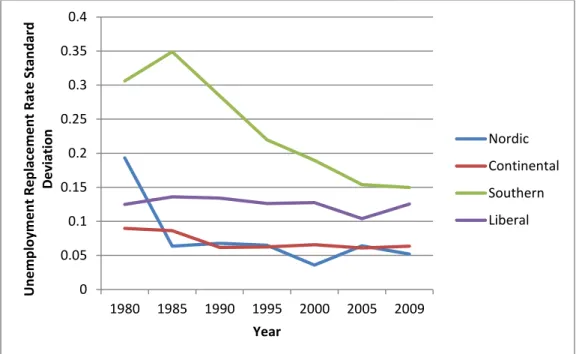
The data shows that not only have the Southern states as a group caught up to the Liberal countries in terms of replacement rate levels, they are actually more similar to the Nordic and Continental systems. When observed as a group, there is strong evidence that the Southern
1 Continental: Austria, Belgium, France, Germany, Luxembourg, Netherlands, and Switzerland. Nordic: Denmark,
21
European states consist of policy laggards converging towards the levels found in the majority of EU states. However when the unemployment replacement rates are viewed individually, the consensus of these countries being laggards is questioned (both Spain and Portugal have unemployment replacement rates above the EU mean in 1980).
Just as Italy skewed the data for the β-convergence tests, it does so as well when testing Table 4 Unemployment replacement rate standard deviation by welfare state typology, 1980-2009
1980 1995 2009 Change
Standard Deviation
Continental 0.0896 0.0624 0.0636 -0.026
Liberal 0.1248 0.1261 0.1253 0.0005
Nordic 0.1929 0.0649 0.0519 -0.141
Southern 0.306 0.2196 0.1498 -0.1562
Mean
Continental 0.715 0.69 0.673 -0.042
Liberal 0.565 0.499 0.463 -0.102
Nordic 0.691 0.715 0.621 -0.07
Southern 0.459 0.518 0.613 0.154
Source: Van Vliet and Caminada 2012.
for convergence within the Southern European states. Removing Italy, the 2009 replacement rate mean stays very similar, dropping only to 0.59 (from 0.613). The amount of
22
can still be seen, but clearly Italy accounts for the majority of the policy convergence and ‘catch-up’ witnessed.
The second greatest degree of variance in unemployment replacement rates between countries is found among the liberal countries. As these countries are the most
geographically diverse, and the liberal regime is the only typology that includes countries outside of Europe, it is not surprising that there is more variance and less convergence among nations. However the data show that out of the four regime types, only in the liberal regime is there absolutely no evidence of convergence. Unlike the Nordic and Continental countries, no clear trend among all countries can be found. The liberal countries operate and maintain their policies completely independently of one another, leading to neither a divergence nor convergence in policy. The most noticeable datum in this set is the liberal regime’s mean,
Figure 4 Unemployment replacement rate standard deviation by welfare state typology, 1980-2009
Source: Van Vliet and Caminada 2012.
0 0.05 0.1 0.15 0.2 0.25 0.3 0.35 0.4
1980 1985 1990 1995 2000 2005 2009
23
which has decreased from 0.565 to 0.463, indicating retrenchment within the liberal states. Unsurprisingly, the largest amount of retrenchment is found within the liberal set of
countries.
Of the four regime types, the Continental countries show the second least amount of variance just behind the Nordic countries. Unlike the Nordic countries, the Continental type has stayed relatively static, as the standard deviation has declined 29.02 percent compared to the Nordic’s decrease of 73.09 percent. Similar to the Nordic regime type, the Continental countries’ convergence occurred more sharply between 1980 and 1995 than between 1995 and 2009. The data suggest that replacement rates in Continental countries settled towards a state of stability in the years following the ‘peak’ of the ‘Golden Age’ (Scharpf 2000). Reaching this stable rate during the 80s and 90s led to convergence that has since slowed as countries have fallen into paths dependent on current and past policy rates. These results fall in line with the conclusions reached by Starke and Schmitt, that ‘Corporatist’ and
Bismarckian states are less prone to policy change and reform because ‘financing is largely based on earmarked social contributions instead of general tax revenue’ (Starke and Schmitt 2011: 123). This conclusion is also supported by the average mean rate of Continental countries, which has consistently remained high compared to both the OECD and Europe.
Lastly the Nordic countries show the greatest amount of convergence towards the average European levels. Cross-national variance dropped drastically between 1980 and 1985, as Finland increased their rates during this time in order to catch up to the other Nordic
countries. This catch up would lead to a slightly increased regime-wide mean in 1995 before an almost uniform decrease in rates through 2009. The greatest evidence of the OMC
24
average EU levels in Denmark, Finland, and Sweden, while Norway has remained almost unaffected, only showing a -0.03 drop in replacement rates. The same trend can be seen within the Continental countries with Switzerland (0.01 change) but is much less
pronounced, as the Continental countries are much more stable than the other three regime types. The analysis supports the conclusion drawn by Starke, Obinger, and Castles, that the convergence levels and replacement rate suggest ‘a convergence to the centre’ (Starke et al. 2008: 992).
Carroll’s Unemployment Typology
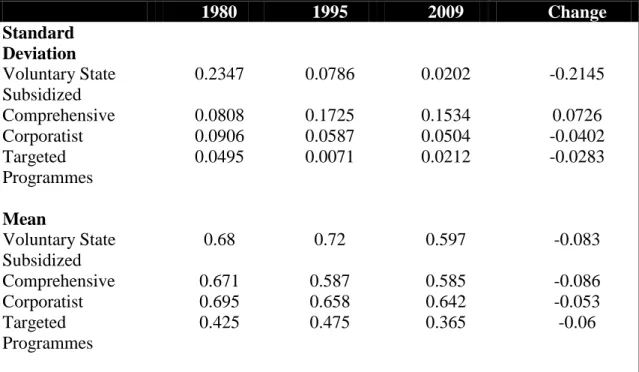
As well as analyzing Esping-Andersen’s welfare typologies, I will also conduct a simple sigma-convergence test for Eero Carroll’s unemployment insurance typologies in order to understand if these typologies constitute a convergence club. For this analysis the countries are placed into their respective categories based on Eero Carroll’s unemployment insurance categorization. Once again Italy has been removed from the analysis, as it is an outlier. The most striking convergence takes place within the voluntary state subsidized type, as the standard deviation declines an astounding 91.4 percent. These three countries (Denmark, Sweden, and Finland) are also classified within the Nordic welfare state typology and reside close to one another geographically. Similar levels of variance in 2009 can be found in the targeted programs group, as it consists of only Australia and New Zealand, two liberal
25
Esping-Andersen’s typology, as all the countries come from the Continental regime type except for Japan.
Overlap between the two typologies can clearly be seen. Liberal regime types are more likely to employ comprehensive unemployment insurance with the exception of Australia and New Zealand, which are the only two countries to still use targeted programs. Table 5 Unemployment replacement rate standard deviation of Carroll’s unemployment insurance typologies, 1980-2009
1980 1995 2009 Change
Standard Deviation Voluntary State Subsidized
0.2347 0.0786 0.0202 -0.2145
Comprehensive 0.0808 0.1725 0.1534 0.0726
Corporatist 0.0906 0.0587 0.0504 -0.0402
Targeted Programmes
0.0495 0.0071 0.0212 -0.0283
Mean
Voluntary State Subsidized
0.68 0.72 0.597 -0.083
Comprehensive 0.671 0.587 0.585 -0.086
Corporatist 0.695 0.658 0.642 -0.053
Targeted Programmes
0.425 0.475 0.365 -0.06
Source: Van Vliet and Caminada 2012.
Corporatist insurance is largely seen as being exclusive to the Continental countries, while three of the four Nordic states use a voluntary state subsidized system of unemployment insurance. This is not surprising, since countries categorized to have similar welfare states in general will be more likely to also have similar unemployment insurance systems. Overall these results fall in line with the results seen with the welfare state typologies.
26
Finally I incorporate unemployment rates and trade union density for the countries, in an attempt to find any evidence of these factors influencing replacement rate levels among OECD members. The unemployment rate used in the correlation analysis is the OECD’s ‘Unemployment Rate (Harmonised) average for each country from 1980-2009 (countries
with missing years are averaged for years where they have reported unemployment rates). The ‘unemployment rates represent unemployed persons as a percentage of the labour force (the total number of people employed plus unemployed)’ (oecd.org/glossary). Once again Italy is removed from the calculations as it is an outlier. Since there are no OECD
unemployment rate data for Switzerland, they too are removed from this analysis. I first begin with a Pearson’s bivariate regression between the initial replacement rate levels in 1985 and the annual growth rate of unemployment replacement rate levels (same test run for beta-convergence). The Pearson correlation is -0.444 and is significant at the 0.05 level. Next I run a partial correlation with the same two variables, while controlling for the average unemployment rate for each country. This correlation analysis produces a correlation of -0.451 but is no longer significant at the 0.05 level.
When controlling for the average unemployment rate, there is almost no change in the correlation between the initial replacement rate levels in 1980 and the annual growth rate of unemployment replacement rate levels. Countries that have historically higher
27
encourage higher unemployment is an issue for a different article. However governments have not taken steps to reduce unemployment through decreased benefit levels.
Similar results are found when inserting trade union data into the equations. In this analysis I insert Switzerland back in the dataset, as there are recorded trade union levels for Switzerland during this time period. As with the unemployment data, trade union density levels are averaged out for each country to produce a single mean variable. The simple bivariate correlation between the initial replacement rate levels at 1980 and the annual growth rate of unemployment replacement rate levels produces a correlation of -0.427 with a significance of 0.060. When controlling for the average labor union density, the correlation changes to -0.418 with a significance of 0.059. The hypothesis that suggests that trade unions which have no interest in unemployment benefits will have no effect on the
unemployment benefits seems to be supported by the data. Countries with high trade union representation are no more likely to offer high unemployment replacement rates than countries with little trade union support.
Conclusion
28
While other literature has often been limited in its depth, analyzing many facets of the welfare state across OECD nations, this thesis explores the idea that convergence may be occurring more rapidly within these different convergence clubs. Previous research has found unemployment insurance convergence within the OECD members. Those findings while factually correct, do not analyze or try to decipher why the OECD members as a single unit are converging. The main contribution of this master’s thesis is that unemployment replacement rate levels are converging at a much faster rate within the EU and the welfare state typologies. Since 1990 the EU member-states have steadily converged, while the remaining OECD members have actually diverged in their mean replacement rate levels. Essentially we are not seeing a convergence among these OECD members but instead seeing convergence within the EU. Researchers find OECD convergence but fail to see the data that shows it is driven primarily by European states becoming more alike, while the rest of the OECD members diverge.
Different amounts of convergence can be seen within the four welfare state typologies. The Southern states understandably have the greatest amount of variation in their
29
their levels to be more in line with the rest of the EU. Finally the liberal states have the greatest amount of variance, supporting the hypothesis that the EU is a convergence club, as many liberal states reside outside of Europe.
Logically high historical unemployment in a country could lead the government to enacting less generous unemployment benefits. However the data suggest that there is no correlation between these two variables, and countries with high historical unemployment averages are as likely to offer lower benefits as those with low unemployment levels. The same conclusion can be drawn for the influence of trade unions on unemployment
replacement rates. Trade unions have little interest in unemployment benefits, as they are only worried about the core interests of their members and thus do not influence legislators to enact more generous replacement rates (Ness 1998).
30
Moving forward, it seems as though the notion of convergence clubs should be tested more thoroughly. Starke, Obinger, and Castles mentioned these groupings in passing as an avenue for further research, while Schmitt and Starke concluded that the EU did indeed fit the criteria of a convergence club, accelerating ‘the speed of convergence within its member states’ (Schmitt and Starke 2011: 131). Globalization also seems a promising field of research when analyzing cross-national convergence. Currently no consensus can be had on whether globalization is affecting the welfare state, and if so, which areas are being
31
BIBLIOGRAPHY
Garrett, G., & Mitchell, D. (2001). Globalization, government spending and taxation in the OECD. European Journal of Political Research, 145-177.
Hodson, D., & Maher, I. (2001). The Open Method as a New Mode of Governance: The Case of Soft Economic Policy Co-ordination. Journal of Common Market Studies, 719-746.
Holzinger, K., & Knill, C. (2007). Causes and conditions of cross-national policy convergence. Journal of European Public Policy, 775-796.
Jordan, A. (2007). Policy convergence: a passing fad or a new integrating focus in Eurpean Union studies? Journal of European Public Policy, 944-953.
Knill, C. (2007). Introduction: Cross-national policy convergence: concepts, approaches and explanatory factors. Journal of European Public Policy, 764-774.
Korpi, W., & Palme, J. (2003). New Politics and Class Politics in the Context of Austerity and Globalization: Welfare State Regres in 18 Countries, 1975-95. American Political Science Review, 425-446.
Layard, R., Nickell, S., & Jackman, R. (2005). Job Search: the Duration of Unemployment. In R. Layard, S. Nickell, & R. Jackman, Unemployment: Macroeconomic
Performance and the Labour Market (pp. 216-295). Oxford: Oxford University Press. Ness, I. (1998). Trade unions and the betrayal of the unemployed: labor conflicts during the
1990s. New York: Garland Pub.
OECD. (2009, January 16). Glossary of Statistical Terms. Retrieved March 13, 2013, from Stats.OECD: http://stats.oecd.org/glossary/detail.asp?ID=2795
Ozkan, U. R. (2013). Comparing Formal Unemployment Compensation Systems in 15 OECD Countries. Social Policy & Administration, 1-23.
Scharpf, F. (2000). The viability of advanced welfare states in the international economy: vulnerabilities and options. Journal of European Public Policy, 190-228.
Schmitt, C., & Starke, P. (2011). Explaining convergence of OECD welfare states: a conditional approach. Journal of European Social Policy, 120-135.
32
Starke, P., Obinger, H., & Castles, F. G. (2008). Convergence towards where: in what ways, if any, are welfare states becoming more similar? Journal of European Policy, 975-1000.