Miscellaneous
The effect of using a pre-dive checklist on the
incidence of diving mishaps in recreational
scuba diving: a cluster-randomized trial
Shabbar I Ranapurwala,
1,2,3* Petar J Denoble,
2Charles Poole,
1Kristen L Kucera,
4Stephen W Marshall
1and Steve Wing
11
Department of Epidemiology, University of North Carolina, Chapel Hill, NC, USA,
2Divers Alert
Network, Durham, NC, USA,
3Injury Prevention Research Center, University of Iowa, Iowa City, IA, USA
and
4Department of Exercise and Sports Science, University of North Carolina, Chapel Hill, NC, USA
*Corresponding author. Injury Prevention Research Center, 2198 Westlawn, University of Iowa, Iowa City, IA 52242, USA. E-mail: [email protected]
Accepted 5 October 2015
Abstract
Background
: Scuba diving mishaps, caused by equipment problems or human errors,
increase the occurrence of injuries and fatalities while diving. Pre-dive checklists may
mitigate mishaps. This study evaluated the effect of using a pre-dive checklist on the
inci-dence of diving mishaps in recreational divers.
Methods
: A multi-location cluster-randomized trial with parallel groups and allocation
concealment was conducted between 1 June and 17 August 2012. The participants had
to be at least 18 years of age, permitted to dive by the dive operator and planning to dive
on the day of participation. They were recruited at the pier and dive boats at four
loca-tions. The intervention group received a pre-dive checklist and post-dive log. The control
group received a post-dive log only. The outcomes, self-reported major and minor
mis-haps, were prompted by a post-dive questionnaire. Mishap rates per 100 dives were
compared using Poisson regression with generalized estimating equations.
Intent-to-treat, per-protocol and marginal structural model analyses were conducted.
Results
: A total of 1043 divers (intervention
¼
617; control
¼
426) made 2041 dives, on 70
location-days (intervention
¼
40; control
¼
30) at four locations. Compared with the
con-trol group, the incidence of major mishaps decreased in the intervention group by 36%,
minor mishaps by 26% and all mishaps by 32%. On average, there was one fewer mishap
in every 25 intervention dives.
Conclusions
: In this trial, pre-dive checklist use prevented mishaps which could lead to
injuries and fatalities. Pre-dive checklists can increase diving safety and their use should
be promoted.
Trial Registration
: ClinicalTrials.gov ID NCT01960738.
Key words: Injury prevention, sports diving, safety, intervention, human factors
VCThe Author 2015; all rights reserved. Published by Oxford University Press on behalf of the International Epidemiological Association 223 doi: 10.1093/ije/dyv292
Advance Access Publication Date: 3 November 2015 Original article
Introduction
A checklist is a simple and effective tool used to reduce human error and equipment malfunction that may cause in-jury. In aviation, checklists have played a dominant role in the safety culture for more than seven decades. Pilots and crew members of military and commercial airliners are required to complete pre-flight checklists for equipment, pro-cedures and even individual health and mental status, leading to safer flights. This also provides an opportunity for continu-ous scrutiny and amendment of flying procedures.1–3In
sur-gery, preoperative and postoperative checklists substantially reduce postoperative mortality and morbidity.4
In recreational scuba diving, pre-dive checklists are mostly,used during training dives. There is no gold-standard pre-dive checklist, and training agencies use dif-ferent checklists, none of which has been systematically evaluated for effectiveness. The prevalence of written pre-dive checklist use in recreational scuba diving is not known, but is assumed to be low.
Recreational scuba diving is a popular sport. In 2000 there were about 2.5 million scuba divers in the USA.5The mainly self-regulated industry of recreational scuba diving includes training agencies, dive operators, dive resorts and equipment and travel industries. The Professional Association of Diving Instructors alone certified more than 11.5 million divers during 1999–2008.6 Many training
agencies set the minimum age limit for diving in open water at 12 years with no upper limit. Commonly, training in div-ing physiology, equipment and management of pressure changes is provided in small modules, and divers are certi-fied for life after the first basic module; neither advanced training nor periodic re-certification are mandatory.
In a recent Divers Alert Network (DAN) study, the overall self-reported injury rate among recreational scuba divers was 3/100 dives.7Diving injuries amount to a significant financial
burden on the diving community and healthcare providers, with limited resources due to treatment costs, residual disabil-ity, loss of productivity and/or death.8DAN reports 80–90 diving-related deaths among the US and Canadian divers every year.9 The diving-related fatality rate among DAN membership is estimated at 16.4/100 000 person-years.9
Reconstructions of diving fatalities suggest that many are triggered by preventable mishaps.10,11Mishaps are
un-planned and unwanted events that increase the risk of an injury. They are caused by human errors,12–14 equipment
failures15–17 and adverse environmental factors.18 In one study, the incidence of three common mishaps—low to out of air, rapid ascent, loss of buoyancy control—was 2.17/ 100 dives.19 Forgetting, omitting or neglecting adequate
pre-dive preparation, coupled with increasing levels of stress13,20,21 and complexity of equipment15–17,21,22 may
lead to mishaps and injuries. Interventions aimed at pre-venting mishaps may reduce injuries and fatalities.10–12
The authors evaluated the effect of using a pre-dive checklist on the incidence of scuba diving mishaps among recreational divers.
Methods
A cluster-randomized trial design was used to assess the ef-fect of using a pre-dive checklist on the incidence of diving mishaps in recreational scuba divers. Participants were cluster-randomized by location-day, that is, on each day enrolled participants at the same location were all in the control or intervention group. Cluster-randomization pre-vented cross-contamination of the intervention; however, the participants diving on the same location-day may not have independent outcomes.
The study was conducted by DAN research assistants at participating dive shops in North Carolina, Cozumel and the Cayman Islands between 1 June 2012 and 17 August 2012. DAN is a not-for-profit membership organization that provides medical assistance and education to divers and conducts diving medical research. Four trained DAN research assistants, one each in North Carolina and Cayman and two in Cozumel, recruited participants and collected data at seven partnering dive shops.
There were four study instruments: the intervention form (pre-dive checklistþpost-dive log), the control form (post-dive log), contact-information form and outcomes questionnaire (intervention and control form are available as online supplementsat IJE online, and copies of other
Key Messages
• In this trial, the use of pre-dive checklists decreased the incidence of mishaps in recreational scuba diving.
• Training agencies, dive shops, instructors and other diving industry partners should promote the use of pre-dive
checklists in the diving community.
• A widespread adoption of pre-dive checklists in recreational scuba diving has the potential to prevent a substantial
number of diving-related injuries and fatalities and the associated financial burden to the diving community.
materials are available upon request). The contact-information form was used to enrol and track participants and record their age, sex and racial/ethnic background. The outcomes questionnaire included a list of potential mishaps identified by experts using the ‘diving incident re-port form’ from an ongoing DAN Asia Pacific study,22 brief medical history, diving history, height and weight. It was given to both the groups at the end of their dives.
For each location, separate packets of study materials were assembled. Half of the packets were intervention. Each packet contained 30 sets of consent forms, laminated intervention or control forms, outcomes questionnaires, marker pens and one contact-information form. Packets were randomized beforehand at DAN using an SAS ran-dom number generator, and then sequentially numbered. The study arm of each randomly numbered packet was noted on a spreadsheet for cross-checking at the end of data collection. Interns who administered the study picked up a sequentially numbered packet every day to enrol the participants.
A participating diver had to: have a valid diver certifica-tion, be 18 years of age or older, be planning to dive on the day of recruitment, be deemed fit for diving by the dive op-erator and have working knowledge of English. The divers were briefed about the study on the dive boat or pier; those agreeing to participate were asked to sign the consent to participate and provide demographic information. The participants received either the intervention form or the control form and instructions on how to use them. When the participants completed their dives, or upon their return to the pier, interns collected the study forms and asked the participants to answer the outcomes questionnaire. Each diver’s participant number was recorded on their interven-tion or control forms, outcomes quesinterven-tionnaire and contact information form, which allowed linking their records. The interns entered the data online. Data were monitored weekly by the principal investigator for completeness and accuracy.
The estimated sample size to achieve 90% power and detect a 50% reduction in the incidence of mishaps, at 10/ 100 dives baseline mishap rate and alpha of 0.05, with an intervention to control allocation ratio of one, while ac-counting for within-location day and between location-day variance for clustering of dives, was 2193 dives (1097 intervention and 1097 control). The within-diver clustering of dives was not accounted for.
The research hypothesis was not disclosed to the partici-pants during the consent. They were not told that they were participating in an intervention trial or that they were being randomly assigned to use the pre-dive checklist, be-cause disclosing this information could have changed their behaviour and may have obscured the effect of the
checklist.23,24The trial had allocation concealment: the
in-terns were only allowed to allocate the envelopes in the predetermined randomized order.25 They did not know which envelope was intervention or control until they opened it on subsequent recruitment days.
This study was approved by the institutional review boards (IRB) of DAN # 009-12 on 27 March 2012 and the University of North Carolina (UNC) # 12-1051 on 29 May 2012, and further renewed by DAN IRB and UNC IRB in 2013, 2014, and 2015.
Statistical methods
Diving experts at DAN classified the mishaps as major or minor based on their potential to lead to serious injury. The rates of major mishaps, minor mishaps and all mis-haps (major plus minor) were reported as the number of mishaps per 100 dives.
Each participant reported the number of dives and the number of mishaps cumulatively for their participation day. Hence, mishap information is available for each indi-vidual, rather than for each dive. Since the unit of exposure is a dive, mishap rates are calculated per dive and not per diver. Poisson regression was used to compare the inci-dence rates of mishaps in the intervention and control groups. The non-independence of observations within a lo-cation-day cluster was addressed using generalized estimat-ing equations (GEE).26
Intent-to-treat (ITT) analysis was used to estimate the effect of receiving the checklist. Per-protocol (PP) analysis and marginal structural models (MSM) were used to esti-mate the effect of using the checklist. The crude incidence rate of mishaps for both intervention and control groups, rate difference and rate ratios were estimated. The crude ‘number needed to treat’ (NNT), that is number of dives using the checklist needed to reduce the number of mishaps by 1, was calculated as 1/ crude-rate-difference.
Adjusted measures of the intervention effect were calcu-lated because randomization only balances potential con-founders on average.27 The potential confounders were sex, age, body mass index (BMI), race, poor visibility, high current, animal attack, average annual dives, use of a diver’s own written checklist (hereafter referred to as self-checklist) and years of diving certification. A parsimonious set of adjustment variables to control confounding was derived by backward elimination. Any variable seen fa-vourably in precision-validity trade-off was retained in the model. Specifically, a covariate was retained in the model if the change in the estimated variance of the treatment co-efficient was negative upon adjustment for that covariate or positive but smaller than the squared change in the esti-mate of the treatment coefficient. At each step, change was
measured in relation to the initial model containing all the selected covariates.
Based on the precision-validity trade-off, the final ad-justed models controlled for sex (male/ female), race (White/ non-White), poor visibility (yes/no), high current (yes/no), animal attack (yes/no), average annual dives (lin-ear quadratic) and the use of a self-checklist (yes/no).
We evaluated interaction between the intervention and divers’ use of self-checklist. We reported ratio of rate ratios, their 95% confidence intervals and corresponding P-value from the regression models as a measure of multi-plicative interaction. Ratio of rate ratios can be calculated as (R11/R01)/(R10/R00); here R11¼rate of mishaps in the intervention participants who reported using self-checklist, R01¼rate of mishaps in the controls who reported using self-checklist, R10¼rate of mishaps in the intervention par-ticipants who reported not using self-checklist and R00¼rate of mishaps in the controls who reported not using a self-checklist. We also reported two measures of additive interaction: (i) the difference of rate differences, also known as interaction contrast (IC), calculated as (R11 - R01)-(R10 - R00); and (ii) the relative excess rate due to interaction (RERI), also known as interaction constant ratio, calculated as (R11/R00) -(R01/R00) -(R10/R00)þ1 or IC/R00.28Hosmer Lemeshow additive interaction calcula-tor was used to calculate the 95% confidence interval (CI) for RERI.30
Poor adherence could reduce the impact of the interven-tion. To address this, an adherence variable was developed using three criteria. First, a diver must have noted the start-ing tank pressure of their first dive on the checklist. Next, the diver must have indicated a written pre-dive gas man-agement plan on the checklist. Last, the diver must have checked at least 10 checkboxes on the checklist. All control group participants were considered adherent because they dived as usual. Crude and adjusted per protocol analyses were conducted by removing the non-adherent divers from the analysis.
Marginal structural models were used to account for non-adherence. Inverse probability weights for adherence were calculated for all intervention group participants, whereas the control group participants were given a weight of one.29The adherence weighting among the intervention
group participants is given by:
w¼P(adherence) / P (adherence j gender, age, race, poor visibility, high current, animal attack, average an-nual dives, history of hypertension, history of high cholesterol)
where w¼weight,P¼probability.
The adherence probabilities were derived using logistic regression. Crude and adjusted Poisson regression models
were then weighted using these inverse probability weights. All statistical analyses were conducted using SAS 9.3 (SAS Institute, Cary, NC, USA).
Results
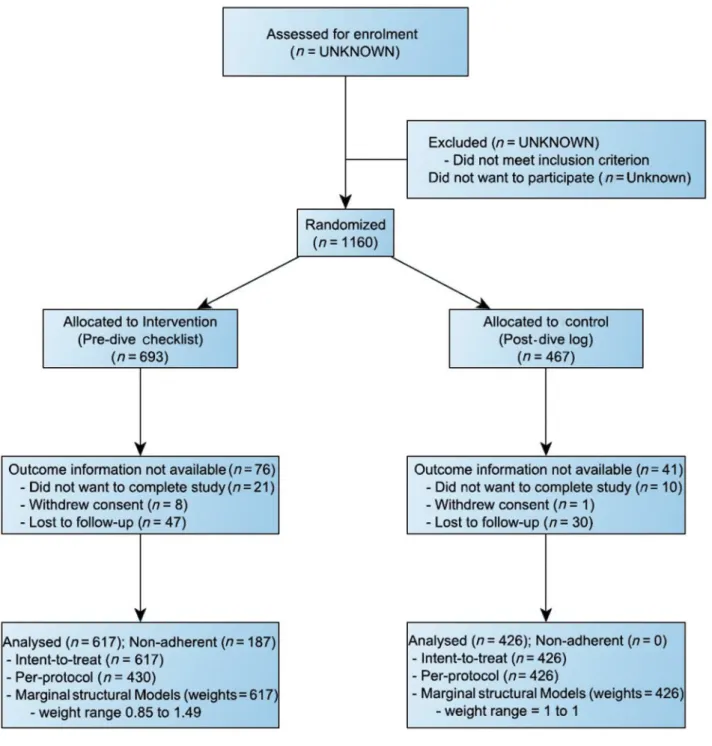
Participants were enrolled on 40 intervention and 30 con-trol location-days (intervention allocation ratio: 1.33). A total of 1160 participants were enrolled, of whom 9 withdrew, 31 were excluded because they did not plete the study, 77 were lost to follow-up and 1043 com-pleted the study (Figure 1). Participants who withdrew, did not complete the study or were lost to follow-up, did not complete the outcomes questionnaire and did not turn in the intervention/control form. These participants (10.1%) were excluded from the analysis. The mishap rate in this group is unknown because of lack of outcome information.
Although the trial was designed to have equal sample sizes in the intervention and control groups, the total num-bers of location-days, divers and dives were greater in the intervention than the control group (Figure 1andTable 1). The imbalance in number of location-days occurred at two locations (Supplementary Table 1, available as Supplementary dataatIJEonline) because each DAN re-search assistant received a different randomized sequence of intervention and control location-days. By chance, the randomization sequence at location 1 and 2 had more intervention days in the beginning and we had to stop re-cruiting at 1200 divers (IRB regulation), at which time lo-cations 1 and 2 had collected more intervention location-days. The numbers of divers and dives in the two groups differed at all locations because the number of recruited di-vers varied between 8 and 25 didi-vers per day (mean¼15.4), and the number of dives made by divers varied between 0 and 6 per diver (mean¼2.0).
Over two-thirds of the participants were males, 94.8% were White, and the median age was 43 years (Table 1). Only 6.6% of all participants reported regularly using a self-checklist. Divers made a total of 2041 dives ranging from 0 to 6 dives per day; 89.5% dived twice; and 43 di-vers chose to not dive, 22 of whom were in the control group and 21 in the intervention group.
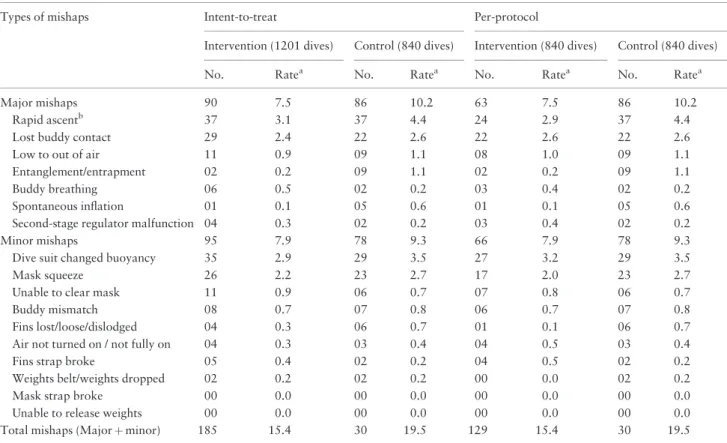
About a quarter of all participants (n¼260) reported one or more major or minor mishap, ranging from 1 to 7 per person. The overall rate of major mishaps was 8.6/100 dives. Rapid ascent (3.6/100 dives), lost buddy contact (2.5/100 dives) and low to out of air (1.0/100 dives) were the most common. The overall rate of minor mishaps was 8.5/100 dives. Changed buoyancy (3.1/100 dives), mask squeeze (2.4/100 dives) and being unable to clear the mask
(0.8/100 dives) were the most common. None of the en-rolled divers was injured during the study (Table 2).
The crude ITT rates of major mishaps were 7.5 per 100 dives in the intervention group and 10.2 per 100 dives in the control group (Table 2), yielding a crude rate difference of 2.7 mishaps per 100 dives and an adjusted ITT rate ratio (RR) of 0.64 (95% CI: 0.46, 0.87) (Table 3).
The number needed to treat (NNT) was 37 dives, indi-cating that one major mishap was prevented by using the checklist beforehand in 37 dives. The crude ITT rate of all mishaps in the intervention group was 15.4 per 100 dives,
and 19.5 per 100 dives in the control group, producing a crude rate difference of 4.1 mishaps per 100 dives and an adjusted ITT RR of 0.68 (95% CI: 0.50, 0.93); the NNT was 24.4 dives.
The intervention effect on major mishaps differed between divers who did and did not use their own self-checklist in both the ITT and MSM analyses on the multi-plicative scale (Table 3), and on the additive scale (Supplementary Table 2, available asSupplementary data atIJEonline). The ITT and MSM analyses suggest that the intervention reduced the incidence of major mishaps by
Figure 1.Distribution of participants based on the assigned group.
42% and the incidence of all mishaps by 36%, among those who did not use self-checklists. However, among those who used self-checklists, those in the intervention group reported twice as many mishaps as those in the con-trol group (RR: 2.03, 95% CI: 0.72, 5.69) (Table 3). The incidence of major mishaps and all mishaps in the doubly exposed, i.e. those in the intervention group who reported using their own checklist, was similar to the doubly unex-posed, i.e. those who did not receive the intervention and did not have their own checklist (Supplementary Table 2).
Discussion
To our knowledge, this is the first randomized trial evalu-ating the ability of a pre-dive checklist to reduce diving mishaps among recreational divers. In a population of di-vers from four sites in North Carolina, Cayman and Mexico, the intervention group experienced approximately 36% fewer major mishaps, 26% fewer minor mishaps and 32% fewer major and minor mishaps combined, compared with the control group. Although the generalizability of the effectiveness of this intervention in other populations, locations and diving conditions is unknown, the trial re-sults support the use of pre-dive checklists to promote safety in recreational diving. Diving studies have long noted that a large number of injuries occur as a result of
preventable mishaps.9,10,12 A pre-dive checklist
encom-passes basic safety principles and may prevent diving-spe-cific and non-spediving-spe-cific injuries by reducing the incidence of diving mishaps. The potential benefits of promoting pre-dive checklists are due, in part, to the low frequency of self-checklist use in recreational scuba diving.
The NNT for major mishaps was 37, suggesting that had the intervention group not received the intervention, they would have experienced 32 additional major mishaps. The NNT for major and minor mishaps combined suggests that 49 total mishaps were prevented in the intervention group.
From the interaction analyses, we see that the interven-tion has a preventive effect among participants without self-checklist, but among participants with self-checklist the intervention group has a higher incidence of mishaps than the control group (Table 3). However, this may be an arte-fact due to small sample size and to over-reporting of mis-haps as a result of the heightened awareness among divers who already used some form of checklist and were then given an intervention checklist. This hypothesis may be fur-ther supported by the fact that only 14% doubly-exposed divers were non-compliant with the intervention checklist as opposed to 31% non-compliant among those who were exposed to intervention only. Furthermore, we see that the rate of mishaps in the intervention group participants with self-checklist (doubly exposed) was similar to the control
Table 1.Diver demographics based on analysis approach and trial arm
Intent-to-treat Per-protocol
Intervention Control Intervention Control
Total divers 617 426 430 426
Dives
Total 1201 840 840 840
Location 1 243 181 184 181
Location 2 423 170 320 170
Location 3 281 268 196 268
Location 4 254 221 140 221
Mean (median) Mean (median) Mean (median) Mean (median)
Average annual dives 22.8 (10) 37.0 (10) 24.6 (10) 37.0 (10)
BMI 26.4 (26) 26.6 (26) 26.4 (26) 26.6 (26)
Age (years) 41.5 (43) 42.4 (44) 42.1 (43) 42.4 (44)
% % % %
Males 66.1 70.4 67.7 70.4
White 93.8 96.2 94.7 96.2
Self-checklist 5.8 7.7 7.2 7.7
Animal attack 0.5 0.2 0.5 0.2
High current 18.8 17.8 17.9 17.8
Poor visibility 9.9 6.8 9.1 6.8
Location 1, Cayman Islands; location 2, Cozumel 1; Location 3, Cozumel 2; Location 4, North Carolina; %, per 100 divers; BMI, body mass index.
group participants without self-checklist (doubly unexposed), suggesting a cancelling of protective effects of the interven-tion and self-checklist (Supplementary Table 2).28
Scuba diving became a popular recreational activity after WWII. Injury prevention efforts in this sport have tradition-ally targeted severe injuries such as decompression sickness (DCS), pulmonary barotrauma and arterial gas embolism (AGE). These prevention efforts include diving education and use of dive computers, oxygen-enriched-air, flying after div-ing guidelines, conservative divdiv-ing practices, first-aid surface oxygen and banning emergency free ascent during training dives.31–36However, most fatalities occur due to causes other than DCS or AGE.8,10Behavioral interventions allow divers
to actively participate in ensuring their own safety. Promotion of conservative diving to mitigate DCS is the only behavioural diving intervention adopted thus far.34
Limitations
There was unequal distribution of intervention and control location-days at locations 1 and 2, which could have been avoided to some extent by blocked-randomization, which was not used. We conducted sensitivity analyses to explore the effect of this unequal distribution in our study. The
crude and adjusted results (Supplementary Tables 3and4, available as Supplementary dataatIJEonline) suggest that our results are not sensitive to this imbalance, which is to say that we would have still observed similar results had there been no imbalance.
Intervention was randomized by location-days to elimin-ate cross-contamination; however, it introduced clustering. GEE was used to control the within-location-day clustering. However, there was also clustering on the level of the diver because 92% of the divers dived more than once. This is a limitation that we could not address because outcome infor-mation was collected at the diver level, not separately for each dive; doing so would have disclosed the study hypothesis at the risk of contaminating the results. Similarly, informa-tion about environmental factors that may vary by dive, such as sea current and visibility, is not available for each dive.
The study was conducted in the warm Atlantic and Caribbean waters, during summer, in daytime and only among recreational scuba divers. The current, visibility and wild animal populations in other regions may vary greatly, and diving conditions differ greatly during other seasons, which limits generalizability. Similarly, the results cannot be generalized to technical divers, seafood har-vesters, navy divers or night dives.
Table 2.Number of mishaps and crude incidence rates of mishaps based on the analysis approach and trial arm
Types of mishaps Intent-to-treat Per-protocol
Intervention (1201 dives) Control (840 dives) Intervention (840 dives) Control (840 dives)
No. Ratea No. Ratea No. Ratea No. Ratea
Major mishaps 90 7.5 86 10.2 63 7.5 86 10.2
Rapid ascentb 37 3.1 37 4.4 24 2.9 37 4.4
Lost buddy contact 29 2.4 22 2.6 22 2.6 22 2.6
Low to out of air 11 0.9 09 1.1 08 1.0 09 1.1
Entanglement/entrapment 02 0.2 09 1.1 02 0.2 09 1.1
Buddy breathing 06 0.5 02 0.2 03 0.4 02 0.2
Spontaneous inflation 01 0.1 05 0.6 01 0.1 05 0.6
Second-stage regulator malfunction 04 0.3 02 0.2 03 0.4 02 0.2
Minor mishaps 95 7.9 78 9.3 66 7.9 78 9.3
Dive suit changed buoyancy 35 2.9 29 3.5 27 3.2 29 3.5
Mask squeeze 26 2.2 23 2.7 17 2.0 23 2.7
Unable to clear mask 11 0.9 06 0.7 07 0.8 06 0.7
Buddy mismatch 08 0.7 07 0.8 06 0.7 07 0.8
Fins lost/loose/dislodged 04 0.3 06 0.7 01 0.1 06 0.7
Air not turned on / not fully on 04 0.3 03 0.4 04 0.5 03 0.4
Fins strap broke 05 0.4 02 0.2 04 0.5 02 0.2
Weights belt/weights dropped 02 0.2 02 0.2 00 0.0 02 0.2
Mask strap broke 00 0.0 00 0.0 00 0.0 00 0.0
Unable to release weights 00 0.0 00 0.0 00 0.0 00 0.0
Total mishaps (Majorþminor) 185 15.4 30 19.5 129 15.4 30 19.5
aRate per 100 dives.
bIncludes diver-reported and computer-recorded rapid ascent.
It is also possible that the act of filling out a pre-dive form onboard a boat, regardless of its substance, could produce seasickness, distraction or changes in conscious-ness about diving safety. A trial evaluating these possibil-ities would require use of a sham intervention. Future studies could adopt such an approach if difference between use of a pre-dive checklist and use of other types of forms is considered to be of interest.
Conclusions
This trial suggests that use of a pre-dive checklist prevented 30–40% of mishaps. If this effect is generalizable and pre-dive checklists were widely used in recreational diving, a substantial reduction in injuries and fatalities could be achieved. We recommend that dive training agencies, in-structors, shops, operators and boat captains promote the use of pre-dive checklists among recreational divers. Future research could evaluate best practices for checklist design, promotion and use. Pre-dive checklists should be-come a cornerstone of the scuba diving safety culture.
Supplementary Data
Supplementary dataare available atIJEonline.
Funding
This work was supported by private donations to Divers Alert Network, and the Dan and Betty Orr foundation. The first author
also received funding through the Society of Public Health Education (SOPHE) / Center of Disease Control and Prevention (CDC) Unintentional/ Intentional Injury Prevention Fellowship.
Acknowledgements
The authors thank Jeanette Moore, Research Specialist, Divers Alert Network and Divers Alert Network summer 2012 interns—Patrick Dolezal, Samuel Hurley, Devon Donohue and Marie-Claire Joseph—for their help in data collection and entry. Authors extend gratitude towards all participating dive shops and participant divers.
Conflicts of interest: None declared.
References
1. Hales B, Pronovost P. The checklist—a tool for error manage-ment and performance improvemanage-ment. J Crit Care 2006;21:
231–35.
2. Helmreich R. On error management: Lessons from aviation.
BMJ2000;320:781–85.
3. Scriven M. The logic and methodology of checklists. http:// www.wmich.edu/sites/default/files/attachments/u350/2014/logic% 26methodology_dec07.pdf. 2000. (15 October 2015, date last accessed).
4. Haynes A, Weiser T, Berry Wet al. A surgical safety checklist to reduce morbidity and mortality in a global population. N Engl J Med2009;360:491–99.
5. US Census Bureau. Parks, recreation, and travel: Participation in sports activity statistics: 1998, table no. 435. http://www.all-countries.org/uscensus/435_participation_in_selected_sports_ activities.html (2 December 2011, date last accessed).
6. Richardson D. Training scuba divers: A fatality and risk analysis. In Vann RD, Lang MA (eds). Proceedings of Recreational Table 3.Adjusted rate ratios for the effect of intervention on the incidence of mishaps
Outcomes Analysis
approach
Adjusted RRa
(95% CI) All intervention vs all controls
Adjusted intervention vs control RRb(95% CI) Ratio of rate
ratiosd(95% CI)
P-value for interaction Among participants
without self-checklist
Among participants with self-checklistc
Major mishaps ITT 0.62 (0.45, 0.87) 0.57 (0.41, 0.80) 2.48 (0.74, 8.31) 4.35 (1.24, 15.31) 0.023
PP 0.64 (0.46, 0.90) 0.61 (0.43, 0.86) 1.82 (0.47, 1.95) 3.00 (0.73, 12.33) 0.129
MSM 0.63 (0.46, 0.87) 0.58 (0.41, 0.80) 2.41 (0.71, 8.18) 4.19 (1.17, 14.97) 0.029
Minor mishaps ITT 0.74 (0.48, 1.13) 0.71 (0.46, 1.08) 1.50 (.32, 7.00) 2.11 (0.48, 9.37) 0.327
PP 0.74 (0.48, 1.15) 0.71 (0.46, 1.10) 1.45 (0.27, 7.69) 2.04 (0.40, 10.45) 0.397
MSM 0.74 (0.48, 1.12) 0.71 (0.46, 1.08) 1.50 (0.33, 6.92) 2.11 (0.49, 9.22) 0.321
All mishaps ITT 0.68 (0.50, 0.93) 0.64 (0.46, 0.88) 2.03 (0.72, 5.69) 3.19 (1.14, 8.90) 0.028
PP 0.69 (0.50, 0.95) 0.66 (0.47, 0.91) 1.71 (0.54, 5.41) 2.60 (0.82, 8.21) 0.106
MSM 0.68 (0.50, 0.93) 0.64 (0.46, 0.88) 1.98 (0.70, 5.60) 3.10 (1.10, 8.74) 0.033
RR, rate ratio; ITT, intent-to-treat; PP, per-protocol; MSM, marginal structural models.
aAdjusted for sex (binary), race (binary—White/ non-White), poor visibility (binary), high current (binary), animal attack (binary), average annual dives (linear
quadratic) and use of a written self-checklist other than the intervention checklist (binary).
bAdjusted for sex (binary), race (binary—White/ non-White), poor visibility (binary), high current (binary), animal attack (binary), average annual dives (linear
quadratic), use of a written self-checklist other than the intervention checklist (binary) and interaction between intervention and self-checklist.
cBased on 36 intervention divers and 69 intervention dives, and 33 control divers who used written self-checklists and 59 control dives.
dDefined as adjusted intervention vs control rate ratio among participants with self-checklist divided by adjusted intervention vs control rate ratio among
par-ticipants without self-checklist.
Diving Fatalities Workshop. Durham, UK: Divers Alert Network, 2010.
7. Ranapurwala S, Bird N, Vaithiyanathan P, Denoble P. Scuba diving injuries among divers alert network members in 2010– 2011.Diving Hyperb Med2014;44:79–85.
8. Buzzacott P. The epidemiology of injury in scuba diving. In: Heggie T, Caine D (eds).Epidemiology of Injury in Adventure and Extreme Sports. Basel: Karger, 2012.
9. Denoble P, Pollock N, Vaithiyanathan P, Caruso J, Dovenbarger J, Vann RD. Scuba injury death rate among insured DAN mem-bers.Diving Hyperb Med2008;38:182–88.
10. Denoble P, Caruso J, Dear G, Pieper CF, Vann R. Common causes of open-circuit recreational diving fatalities. Undersea Hyperb Med2008;35:393–406.
11. Lippmann J. Diving deaths down under. In Vann RD, Lang MA (eds).Proceedings of Recreational Diving Fatalities Workshop. Durham, UK: Divers Alert Network, 2010.
12. Willamson A, Feyer A. Behavioural epidemiology as a tool for accident research.J Occup Accid1990;12:207–22.
13. Acott C. Diving incidents: Errors divers make. SPUMS J
1995;25:155–62.
14. Edmonds C, Walker D. Scuba diving fatalities in Australia and New Zealand. Part 1. The human factor.SPUMS J1989;19:
94–104.
15. Acott C. An evaluation of buoyancy jacket safety in 1,000 diving incidents.SPUMS J1996;26:89–94.
16. Acott C. Equipment malfunction in 1,000 diving incidents.
SPUMS J1999;29:122–26.
17. Edmonds C, Walker D. Scuba diving fatalities in Australia and
New Zealand. Part 3. The equipment factor. SPUMS J
1991;21:2–4.
18. Edmonds C, Walker D. Scuba diving fatalities in Australia and
New Zealand. Part 2. The environmental factor SPUMS J
1990;20:2–4.
19. Buzzacott P, Denoble P, Dunford R, Vann R. Dive problems and
risk factors for diving morbidity. Diving Hyperb Med
2009;39:205–09.
20. Sexton J, Thomas E, Helmreich R. Error, stress, and teamwork in medicine and aviation: Cross sectional surveys. BMJ
2000;320:745–49.
21. Jablonski E.Flying fortress: The Illustrated Biography of the B-17s and the Men Who Flew Them. Garden City, NY: Doubleday, 1965.
22. Acott C. Recreational scuba diving equipment problems, mor-bidity and mortality: An overview of the diving incident moni-toring study and project stickybeak.SPUMS J2003;33:26–37. 23. Wolfson J. Estimating causal effect with RCTs.Epidemiology
2014;25:162.
24. Shrier I. Estimating causal effect with RCTs. Epidemiology
2014;25:162–63.
25. Altman D, Schulz K. Statistics notes: Concealing treatment allo-cation in randomised trials.BMJ2001;323:446–47.
26. Hanley J, Negassa A, Forrester J. Statistical analysis of correlated data using generalized estimating equations: An orientation.Am J Epidemiol2003;157:364–75.
27. Rothman K. Epidemiologic methods in clinical trials.Cancer
1977;39:1771–75.
28. Greenland S, Lash TJ, Rothman KJ. Concepts of interaction. In
Rothman KJ, Greenland S, Lash TJ (eds). Modern
Epidemiology. 3rd edn. Philadelphia, PA: Lippincott Williams & Wilkins, 2008.
29. Gill KS. Correcting for non-adherence in a randomized study of hip protectors to prevent fractures. Dissertation. University of North Carolina at Chapel Hill, Department of Epidemiology, 2010. https://cdr.lib.unc.edu/indexablecontent/uuid:147f69f5-faaf-46ed-af35-ece2ab61db50 (15 October 2015, date last accessed). 30. Hosmer DW, Lemeshow S. Confidence interval estimation of
interaction.Epidemiology1992;3:452–56.
31. Wilmshurst P. Technological advances in scuba diving do not al-ways increase safety.Br J Sports Med1998;32:4.
32. Hamilton R. Mixed-gas diving. In: Bove A, Davis J (eds).Bove and Davis’ Diving Medicine. 4th edn. Philadelphia, PA: W. B. Saunders, 2004.
33. Lafe`re P, Germonpre´ P, Balestra C. Pulmonary barotrauma in di-vers during emergency free ascent training: Review of 124 cases.
Aviat Space Environ Med2009;80:371–75.
34. Klingmann C, Rathmann N, Hausmann D, Bruckner T, Kern R. Lower risk of decompression sickness after recommendation of con-servative decompression practices in divers with and without vascu-lar right-to-left shunt.Diving Hyperb Med2012;42:146–50. 35. Vann R, Gerth W, Denoble P, Pieper C, Thalmann E. Experimental
trials to assess the risks of decompression sickness in flying after div-ing.Undersea Hyperb Med2004;31:431–44.
36. Vann R, Pollock N, Freiberger J, Natoli M, Denoble P, Pieper C. Influence of bottom time on preflight surface intervals before fly-ing after divfly-ing.Undersea Hyperb Med2007;34:211–20.