EXHUMATION MECHANISMS OF ECLOGITE IN THE SOUTHERN APPALACHIANS AND EVIDENCE FOR POST-CHEROKEE OROGENY MOVEMENT
James L. Bridgeman III
A thesis submitted to the faculty at the University of North Carolina at Chapel Hill in partial fulfillment of the requirements for the degree of Master of Science in the Department of
Geological Sciences.
Chapel Hill 2015
© 2015
ABSTRACT
James L. Bridgeman III: Exhumation Mechanisms of Eclogite in the Southern Appalachians and Evidence for Post-Cherokee Orogeny Movement
(Under the direction of Kevin G. Stewart)
The Bakersville, NC eclogite bodies in the southern Appalachians record peak
ACKNOWLEDGEMENTS
I would like to thank my advisor, Kevin Stewart, his advice and guidance was invaluable to this thesis. My committee members, Drew Coleman and Jim Hibbard, also provided excellent feedback and conversations that have greatly improved this work. Thank you also to Jesse Hill and John DeDecker for their assistance with field work, as well as Connor Lawrence, Ryan Frasier and Ryan Mills for their help with zircon preparation and dating. This research was supported by the Martin fund and Jesse Davis travel funds.
I would also like to thank Mark Adams for providing me the opportunity to work in Spruce Pine, NC and his mentorship in Blue Ridge geology. He introduced me to the Bakersville eclogite roadcut several years ago, which sparked an interest that has culminated into this thesis.
TABLE OF CONTENTS
LIST OF TABLES ... vii
LIST OF FIGURES ... viii
LIST OF ABBREVIATIONS ... ix
INTRODUCTION ... 1
EXHUMATION MODELS ... 5
GEOLOGIC SETTING ... 8
METHODS ... 11
SAMPLING STRATEGY ... 12
ZIRCON PREPARATION ... 12
THERMOMETRY ... 14
PETROLOGY ... 17
ZIRCON MORPHOLOGY ... 21
U-PB DATES... 21
ZIRCON REE PATTERNS ... 24
THERMOMETRY ... 27
DISCUSSION ... 31
TECTONIC MODEL... 37
CONCLUSIONS... 40
APPENDIX A: HAND SAMPLE DESCRIPTIONS AND LOCATIONS ... 41
APPENDIX B: LASER-ABLATION TI-IN-ZIRCON THERMOMETRY AND U-PB AGES . 43 APPENDIX C: RARE EARTH ELEMENT ABUNDANCE ... 54
APPENDIX D: ID-TIMS U-PB DATES ... 59
APPENDIX E: LASS-ICMPS U-PB Dates ... 60
LIST OF TABLES
LIST OF FIGURES
Figure 1. Generalized Regional Geological Map ... 2
Figure 2. Exhumation Models... 6
Figure 3. Sample Location Map... 13
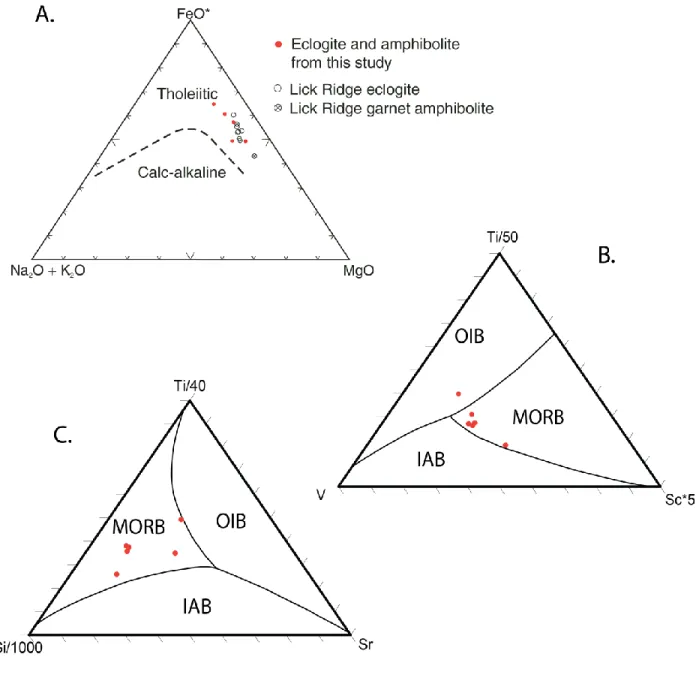
Figure 5. Tectonic Discrimination Diagrams. ... 20
Figure 6. Zircon Cathodoluminescence Images... 22
Figure 7. U-Pb dates. ... 23
Figure 8. REE Patterns ... 25
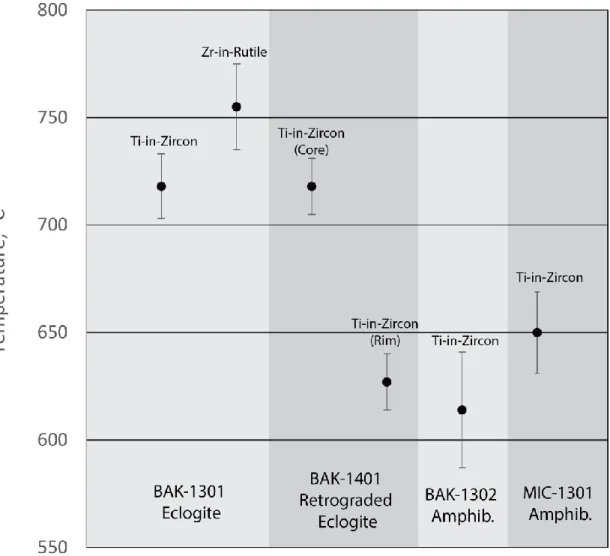
Figure 9. Temperature Ranges. ... 26
Figure 10. Temperature-Time Plot. ... 29
LIST OF ABBREVIATIONS
INTRODUCTION
The Ashe Metamorphic Suite is a metamorphosed accretionary wedge in the Eastern Blue Ridge province of the southern Appalachians (Rankin, 1970; Abbot and Raymond, 1984; Figure 1). It contains amphibolite-facies schist, gneiss, amphibolite, minor ultramafic bodies, and rare eclogite (Abbott and Raymond, 1984). Lenses of eclogite, as large as 1000 m by 100 m and up to 300 m thick, occur near Bakersville, NC (Willard and Adams, 1994; Adams et al., 1995). There are also small cm-scale layers of retrograded eclogite north of Boone, NC that lie in the same structural position in the Ashe Metamorphic Suite as the Bakersville eclogite, but are separated by the Grandfather Mountain window (Abbott and Greenwood, 2001). It remains unclear how these bodies of eclogite were exhumed to the surface.
There are many models of exhumation that have been proposed for eclogite bodies, which can be generally grouped into two types—those that exhume individual eclogite blocks into lower-grade rocks, and those that exhume large, regional-scale eclogite terranes.
Mechanisms that bring up individual blocks of eclogite have circulatory flow within the
accretionary wedge or subduction channel, which pushes the high-pressure rocks up into a lower-grade matrix. The exhumation of regional-scale eclogite terranes is caused by the reversal of subduction, driven by forces including buoyancy or slab breakoff.
F
igu
re
1
.
Ge
olo
g
ica
l m
ap of the
B
lue Ri
d
g
e
Alle
g
hani
an thr
ust comp
lex
showing
the loc
ations of
the B
ak
ersvill
e e
clo
g
it
e f
rom W
il
lar
d a
nd Ada
ms (1994)
a
nd the
B
oone
re
trogr
ade
d
ec
lo
g
it
e f
rom
Abbott and G
re
enwood (
2001)
. AMS
-
Ashe
Me
ta
morphic Sui
te. Modifie
d fr
om Trupe
e
t al. (
2004)
the relationship can become ambiguous if the high-pressure terranes experienced retrograde conditions. For example, thePohorje Mountains in the Eastern Alps have in situ eclogite hosted by lower-grade metapelites and gneisses. The only evidence of previous eclogite-facies
conditions in the lower-grade rocks are eclogite-facies mineral inclusions and REE patterns in the zircons (Janak et al., 2009).
The Bakersville eclogite has characteristics compatible with both sets of models that either exhume individual blocks or regional eclogite terranes. The accretionary-wedge setting supports subduction channel back-flow, but Syvertsen (2006) determined that the scattered eclogite blocks preserved parallel alignment of the eclogite-facies fabric. Her study found alignment within the blocks, which suggests they came up as a coherent slab, typical of exhumation within a larger terrane (Syvertsen, 2006). Retrograded eclogite near Boone, NC could represent another isolated block, or could suggest that a large area of the Ashe
Metamorphic Suite experienced eclogite-facies conditions.
To test which exhumation style is most likely for the Bakersville eclogite, we examined the surrounding amphibolite bodies to see if they contain evidence of eclogite-facies conditions. Retrograded eclogite and amphibolite are petrologically indistinguishable in the Blue Ridge (Adams et al., 1995). Both rock types have similar mineralogy, MORB geochemical signature, and texture (Miller et al., 2010; Adams et al., 1995). To tell if the amphibolite bodies that
EXHUMATION MODELS
F
igu
re
2
.
Dia
g
rams sho
wing
mod
els of
ex
hum
ati
on. Mo
dels that bring
up
small ec
log
ite blocks: (
a)
C
orne
r f
low mo
del wh
er
e
the
downg
oin
g
slab dr
iv
es c
irc
ulator
y
flow
a
nd c
arr
ie
s bl
oc
ks up i
n the a
cc
re
ti
ona
ry
méla
n
g
e. Modi
fi
ed
fr
om C
loos (1982)
. (b)
Dr
ive
n
ca
vit
y
flow
, whe
re
upw
ar
d flow
is driven b
y
tra
cti
on of
the subduc
ti
ng
pl
ate. D
rive
n c
avit
y
flow
is s
im
il
ar to c
orne
r f
low, but
oc
cu
rs a
t
g
re
ate
r de
pths wi
thi
n the subduc
ti
on c
ha
nne
l and i
nvolves the f
low of
se
rpe
nti
nit
e ra
ther
than a
cc
re
ti
ona
ry
we
d
ge
se
dim
ents
.
The
thre
e
edd
y
flow
s a
re
a
t (1
) 0
-3
0 km, (2)
30
-70 km, and
(3)
80
-120 km. M
odifie
d
fr
om B
urov
(2001
). (
c)
P
lung
er
-d
rive
n e
x
pulsi
on oc
curs
whe
n a
more
ri
g
id bod
y
e
nter
s the subduc
ti
on c
h
anne
l and e
x
pe
ls hot
ter
, w
ea
ke
r m
ater
ial. Modi
fie
d
fr
om W
arr
en
et al. (
2008
). Mode
ls
that e
x
hume la
rg
er sc
al
e
ec
lo
g
it
e ter
ra
ne
s: (d)
Ex
trusion or buo
y
ant cr
ust
model, whe
re
e
clo
g
it
e is
surr
ounde
d b
y
more
buo
y
an
t ro
cks
that pull
the e
clog
it
e to t
he
surf
ac
e. Modi
fie
d
fr
o
m Ha
cke
r
et al. (
2013)
.
(E)
Educ
ti
on oc
cu
rs w
he
n
slab br
ea
kof
f tr
igg
ers
re
bound of
the
subduc
ti
ng
plate
, pull
in
g
lar
ge
e
clog
it
e
fa
ci
es ter
ra
ne
s fr
om depth. Modi
fie
d
fr
om B
ru
ec
kn
er a
nd C
ut
hbe
rt (
2013)
. (
F
) T
ra
nspr
essi
on
oc
curs w
h
en hig
h p
re
ssur
e mate
ria
l i
s squee
ze
d up
wa
rd f
rom de
pth b
y
obli
que
c
oll
isi
on of
strike
-sli
pping
plate
s. Modi
fie
d
fr
o
m
C
amac
ho a
nd Mc
Dou
g
al
l (2000)
Regional eclogite-facies terranes, like the Western Gneiss region of Norway or the Dabie Sulu orogen in China expose >10,000 km2 of eclogite-facies rocks (Sabau and Massonne, 2003; Kylander-Clark et al., 2012; Brueckner and Cuthbert, 2013) and cannot be exhumed by
subduction channel cycling due to their large size. Mechanisms that have been proposed to exhume these large terranes include slab extrusion and eduction. Slab extrusion can occur when the eclogite is embedded within more-felsic crust and brought to the surface by the buoyancy of the surrounding rocks (Ernst, 1997; Figure 2D), and is sometimes driven by a slab-breakoff event (Hynes, 2002; Brueckner and Cuthbert, 2013). Eduction is the reversal in subduction direction of the slab, caused by isostatic rebound after slab-breakoff (Warren, 2013; Figure 2E). Eduction differs from slab extrusion in that the high-pressure terrane remains attached to its original substrate.
Transpression can also bring up eclogite as part of a large eclogite-facies terrane. Transpression commonly results from oblique collision of tectonic plates, which can exhume material that is forced up between the blocks (Thompson et al., 1997; Figure 2F). The Musgrave Range of central Australia is an inter-cratonic terrane that was uplifted through a crustal-scale transpressional flower-structure (Camocho and McDougall, 2000). Blocks of eclogite were brought to the surface from depths of at least 40 km through oblique collision and erosion along the Mann strike-slip fault (Camocho and McDougall, 2000). Another transpressionally exhumed eclogite body occurs on the Island of Margarita, Venezuela (Maresch et al., 2009). Here, the eclogites along with metapelites, marbles and gneisses were metamorphosed together, as shown by their matching P-T history, then exhumed at least 50 km as the Caribbean plate
GEOLOGIC SETTING
The Blue Ridge of the southern Appalachians consists predominantly of Mesoproterozoic crystalline basement rocks with Neoproterozoic-to-early Paleozoic cover sequences that have been metamorphosed and deformed into a series of stacked thrust sheets through several major orogenic events (Horton et al., 1989; Trupe et al., 2004). The structurally highest Fries thrust sheet contains both 1.1 Ga Laurentian basement gneisses and younger metasedimentary-metavolcanic sequences, separated by the Burnsville fault, which is a Devonian dextral strike-slip fault (Adams et al., 1995; Trupe et al., 2003; Trupe et al., 2004; Figure 1). These
metasedimentary and metavolcanic rocks make up the Ashe Metamorphic Suite (Rankin, 1970; Abbot and Raymond, 1984).
The protoliths for the Ashe Metamorphic Suite are an assemblage of basalt, shale, impure sandstone, and ultramafic rock of mantle origin (Abbott and Raymond, 1984). The basalts are geochemically diverse and include MORB-type oceanic crust, ocean island basalts, and subduction-related arc basalts (Misra and Conte, 1991). The eclogite and surrounding amphibolites have a MORB protolith (Miller et al., 2010). These protoliths, as well as local block-in-matrix structures, have led many workers to conclude that the Ashe Metamorphic Suite is an accretionary wedge (Abbott and Raymond, 1984; Raymond et al., 1989; Abbott and
Greenwood, 2001; Willard and Adams, 1994).
et al., 1997). The Cherokee orogeny occurred next, which marks the docking of Carolinia with the Laurentian margin (Hibbard et al., 2010). The Carboniferous-Permian Alleghanian orogeny was caused by the collision of Laurentia and Gondwana and resulted in greenschist-facies metamorphism and formation of thrust sheets that were stacked and imbricated into the Blue Ridge thrust complex (Stewart et al., 1997; Trupe et al., 2004; Miller et al., 2006).
Eclogite bodies occur near the structural base of Ashe Metamorphic Suite, interpreted from increasing P-T conditions along a traverse perpendicular to the regional strike of the Ashe Metamorphic Suite towards the Burnsville fault (Hewitt, 1999). The eclogite is surrounded by amphibolites and amphibolite-grade schists and gneiss (Willard and Adams, 1994). Retrograded eclogite was later mapped north of the Grandfather Mountain window, near Boone, NC (Abbott and Raymond, 1997). The Boone retrograded eclogites are garnet amphibolites that contain cm-scale layers of diopside and plagioclase symplectite (Adams et al., 1995; Abbott and Raymond, 1997). This symplectite formed from the breakdown of omphacite, which suggests that the rock was once eclogite (Abbott and Raymond, 1997). The Boone retrograded eclogite lies in the same structural position in the Ashe Metamorphic Suite as the Bakersville eclogite, but is separated from it by the Grandfather Mountain window (Bryant and Reed, 1970; Abbott and Greenwood, 2001).
2007), and retrograde conditions of 0.85-1.2 GPa at 650-730 ºC (Willard and Adams, 1994). In contrast, the schists and amphibolites of the Ashe Metamorphic Suite record only upper
amphibolite conditions with peak P-T estimates of 0.6–1.0 GPa and 580–750 °C (Abbott and Raymond, 1984; McSween et al., 1989; Willard and Adams, 1994; Adams et al., 1995; Adams and Trupe, 1997; Hewitt, 1999; Trupe et al., 2004).
Miller et al. (2010) dated zircons from the Bakersville eclogite and reported a
crystallization age of 459 +1.5/–0.6 Ma, which fits into the timing of Taconic metamorphism (~460 to 455 Ma) in the southern Appalachians (Moecher et al., 2004; Hatcher, 2010). Farther southwest, near Franklin, NC, rocks from Winding Stair Gap record granulite-facies
METHODS
In order to determine if the rocks surrounding the eclogite show evidence of eclogite-facies conditions, we collected and analyzed zircons from nearby amphibolite bodies. We sampled from amphibolite bodies for two reasons: First, the amphibolite bodies contain
metamorphic zircons, whereas the schists and paragneisses contain detrital zircons with 1.1 Ga cores (Fullager, 2002). These detrital zircons have thin metamorphic rims that can be difficult to date separately from the cores. The metamorphic zircons in the amphibolites are more likely to only record ages and conditions of their metamorphism. Second, the amphibolites in the area are petrologically indistinguishable from retrograded eclogite, which makes them the best candidate to test for retrogression of a widespread eclogite-facies terrane (Adams et al., 1995). The eclogite and amphibolite both have MORB protoliths and similar geochemical signatures (Miller et al., 2010). During retrogression from eclogite to amphibolite, the eclogite-facies minerals
recrystallize, but the zircons are preserved because they are stable over a wide range of pressure-temperature conditions. Therefore, the zircons can record the pressure-pressure-temperature path of their host rock through several metamorphic events.
eclogite before their host rock retrograded into amphibolite. Additionally, U-Pb ages can tell us when the zircon crystallized and the Ti concentrations can be used to find the temperature of crystallization. These data can be used together to define a time-temperature path.to determine whether the eclogite and surrounding rocks crystallized under the same conditions and the same times. A similar time-temperature path between the bodies would suggest that the eclogite was exhumed with the amphibolites but did not retrograde. Divergent time-temperature paths would indicate that the eclogite body crystallized separately and was later emplaced into the
surrounding rocks.
Sampling Strategy
Four amphibolites were sampled along roadcuts to the southwest and southeast of the eclogite. The closest samples were collected 1.7 km from the Bakersville eclogites and the most distant were 16 km away. This sampling strategy allowed us to gauge the extent of previous eclogite-facies conditions. The sites are located within the Bakersville, Micaville and Burnsville, NC USGS 7.5’ quadrangles (Figure 3). Of the four amphibolites, only two contained zircons abundant enough to be separated out. We also sampled a known retrograded eclogite from the margin of one of the Bakersville eclogite bodies, to further distinguish between the eclogite and amphibolite.
Zircon Preparation
Zircons were extracted by crushing, magnetic separation, heavy liquids separation, then
Figure 3. Map of sample locations and simplified geology. Geology from Adams
Nu Plasma HR multi-collector ICPMS for U-Pb dating and a Nu AttoM single collector ICPMS for elemental abundances, including REEs and Ti content. Samples of known retrograded eclogite were analyzed at Virginia Polytechnic Institute and State University (VPI) using their GeoLas Pro laser and an Agilent 7500 ICPMS. Because laser ablation ages have large errors, additional zircons were analyzed with Isotopic Dilution Thermal Ionization Mass Spectrometry (ID-TIMS), which has a lower analytical error. ID-TIMS analyses were performed at the University of North Carolina at Chapel Hill on at VG Sector 54 mass spectrometer.
Samples for major- and trace-element geochemistry were crushed in a jaw crusher and then powdered in an aluminum-oxide ceramic rotary mill. The sample powders were fused using a Katanax K1 for major-element analysis, and powders were mixed with elvacite and pressed with 25 tons of pressure into disks for minor-element analysis. The disks were analyzed by x-ray fluorescence at UNC on a Rigaku Supermini 3230 XRF.
Thermometry
To calculate zircon crystallization temperature, we used the Ti-in-zircon thermometer of Ferry and Watson (2007). This thermometer has been calibrated through analysis of both natural and synthetic zircons (Watson et al., 2006), and is based on Ti exchange in the reaction:
ZrSiO4 + TiO2 = ZrTiO4 + SiO2 (1) Zircon, in the presence of Ti, will exchange a Si ion for a Ti ion, producing Ti-bearing zircon and quartz. The presence of rutile, or another Ti-bearing mineral, and quartz in the rock allows us to assume that the activities of quartz and rutile, aSiO2 and aTiO2, are 1, meaning they are present in sufficient concentrations to readily substitute into the mineral structures. The
The reference states for aSiO2 and aTiO2 are α-quartz and rutile at the P and T of interest (Ferry and Watson, 2007). A typical range of Ti concentration in zircons is around 0.3–50 ppm which would correspond to ~500–900°C (Watson et al., 2006). Our samples had Ti concentrations of 1.1-23.3 ppm. The thermometer has been calibrated at experimental conditions of 1 GPa and requires a pressure correction for higher-pressure rocks to account for the limited substitution caused by the lowered molar volume of the zircon (Ferriss et al., 2008).
Zr-in-rutile thermometry was applied to the eclogite sample, BAK-1301. The principles of this thermometer are similar to that of Ti-in-zircon, but a Zr ion substitutes for a Ti ion in the rutile structure (Watson et al., 2006). Ferry and Watson (2007) calibrated the relationship between Zr concentration and temperature as:
log(ppm Zrrutile) = (7.420 ± 0.105) −4530±111 𝑇(𝐾) − log𝑎𝑆𝑖𝑂2 (3)
A pressure corrected Zr-in-rutile thermometer has been calibrated by Tomkins et al. (2007) through a wide range of experimental pressures. The equation under the α-quartz field is:
𝑇(°𝐶) = 0.1428−𝑅𝑙𝑛𝜙83.9+0.410𝑃 − 273 (4)
and in the β-quartz field:
𝑇(°𝐶) = 0.1453−𝑅𝑙𝑛𝜙85.7+0.473𝑃 − 273 (5)
where ϕ is ppm Zr, P is in kbar and R is the gas constant, 0.0083144 kJ K-1 (Tomkins et al. 2007).
PETROLOGY
The eclogite, BAK-1301, is massive to weakly foliated with grain sizes up to 1.5 mm. It contains mostly garnet, omphacite and quartz, with minor rutile and retrograde amphibole and plagioclase (Figure 4A). Retrograded eclogite, BAK-1401, was collected near a pegmatite vein, which appears to have caused the retrogression. The sample contains poikiloblastic amphiboles up to 10 mm with inclusions of garnet, plagioclase and quartz. The amphiboles occur along discontinuous bands through the rock.
The amphibolite samples (BAK-1302, MIC-1301, MIC-1302, BUR-1301; Figures 4B-4E) are foliated and nematoblastic. Amphibolite mineralogy includes amphibole, plagioclase, and quartz. Grain size varies between 0.5-3 mm in the samples, with MIC-1301 containing layers of very coarse amphiboles up to 20 mm. Most samples have low felsic mineral content, but sample BUR-1301 is much lighter in color and contains ~20% plagioclase and quartz.
Figure 4. Photomicrographs of A) eclogite BAK-1301, B) amphibolite BAK-1302, C) amphibolite MIC-1301, D) amphibolite MIC-1302, E) amphibolite BUR-1301.
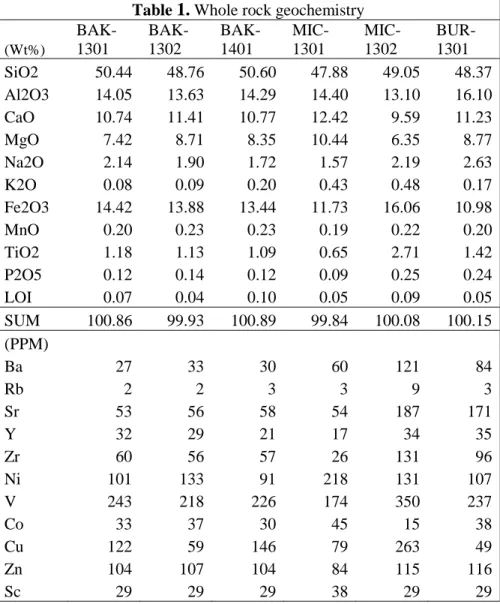
Table 1. Whole rock geochemistry
(Wt%)
BAK-1301
BAK-1302
BAK-1401
MIC-1301
MIC-1302
BUR-1301
SiO2 50.44 48.76 50.60 47.88 49.05 48.37
Al2O3 14.05 13.63 14.29 14.40 13.10 16.10
CaO 10.74 11.41 10.77 12.42 9.59 11.23
MgO 7.42 8.71 8.35 10.44 6.35 8.77
Na2O 2.14 1.90 1.72 1.57 2.19 2.63
K2O 0.08 0.09 0.20 0.43 0.48 0.17
Fe2O3 14.42 13.88 13.44 11.73 16.06 10.98
MnO 0.20 0.23 0.23 0.19 0.22 0.20
TiO2 1.18 1.13 1.09 0.65 2.71 1.42
P2O5 0.12 0.14 0.12 0.09 0.25 0.24
LOI 0.07 0.04 0.10 0.05 0.09 0.05
SUM 100.86 99.93 100.89 99.84 100.08 100.15
(PPM)
Ba 27 33 30 60 121 84
Rb 2 2 3 3 9 3
Sr 53 56 58 54 187 171
Y 32 29 21 17 34 35
Zr 60 56 57 26 131 96
Ni 101 133 91 218 131 107
V 243 218 226 174 350 237
Co 33 37 30 45 15 38
Cu 122 59 146 79 263 49
Zn 104 107 104 84 115 116
Zircon Morphology
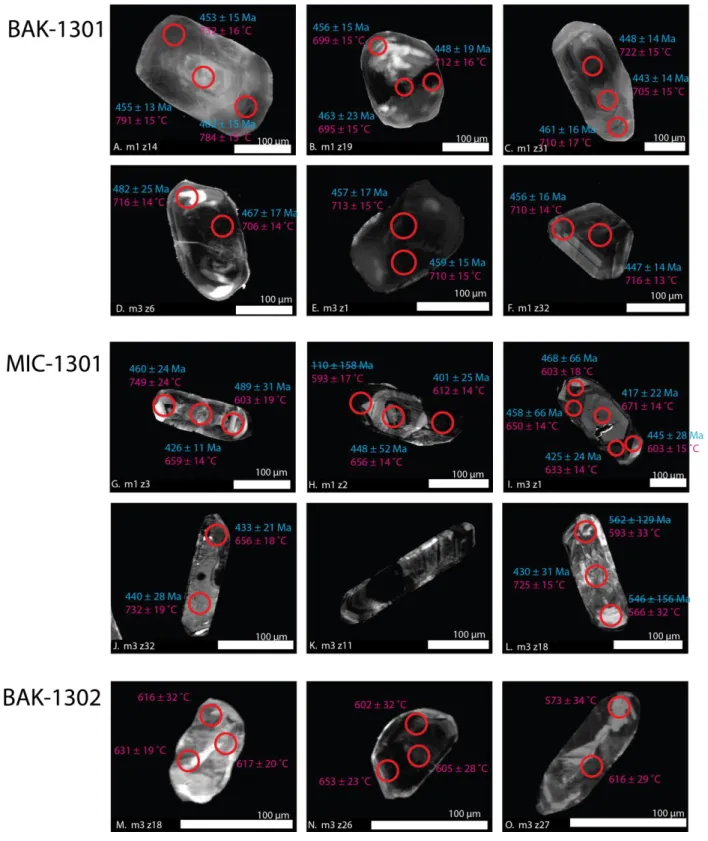
Zircons in the eclogite BAK-1301 and retrograded eclogite BAK-1401 are abundant and large—up to 300 μm in length. The crystals are commonly rounded with moderate-to-poor contrast between zones in cathodoluminescence (CL) images. Some zircons have sector zoning and bright patches (Figures 6B and 6D). Zircons in amphibolite MIC-1301 are less abundant and tend to be smaller (up to 200 μm in length) and more elongated than the eclogite zircons. Zones in the zircons are chaotic (Figures 6G and 6L) and include patches of fir-tree zoning (Figure 6I), sector zoning (Figure 6H) and some recrystallization (Figure 6J). Chaotic and fir tree zoning can be indicative of fluctuating growth rates (Corfu et al., 2003). Amphibolite sample BAK-1302 contains few zircons; only 10 were found after exhaustive searching. The zircons were small (up to 150 μm in length) and broken. Amphibolites MIC-1302 and BUR-1301 yielded no zircons.
U-Pb dates
The eclogite and amphibolite samples were dated by laser-ablation ICPMS to take advantage of the split-stream analysis capabilities at UC Santa Barbara. Additional zircons were dated with ID-TIMS at UNC to refine the dating precision. Eclogite BAK-1301 yielded laser-ablation ICPMS ages of 460.7 ± 3.2 Ma with Mean Square Weighted Deviation (MSWD) =0.95 (Figure 7A). These laser-ablation results overlap within error with the 459 +1.5/-0.6 Ma ID-TIMS ages from the same eclogite body reported by Miller et al. (2010). The retrograded eclogite, BAK-1401, was not dated as it is presumed to be the same age as the eclogite.
age becomes 418 ± 8 Ma with a MSWD=0.99. ID-TIMS dating of MIC-1301 yielded an age of 414.5 ± 3.8 Ma with a MSWD=0.92 (Figure 7C). Amphibolite BAK-1302 zircons did not have enough U or Pb to produce a reliable LASS-ICPMS age. Only two zircons from this sample yielded an ID-TIMS date, but with large errors. One zircon gave an age of 466 ± 21 Ma, and another 292 ± 28 Ma (Figure 7D). The younger age might indicate resetting or growth during Alleghanian thrusting, but we are hesitant to draw any conclusions from a single zircon measurement with such large error.
Th/U ratios can help distinguish between primary igneous zircons and metamorphic zircon (Hoskin and Ireland, 2000). Generally, zircons with Th/U ratios <0.1 are metamorphic and zircons with Th/U >0.1 crystallized from a melt (Williams et al., 1996; Hoskin and Ireland, 2000). In high-grade metamorphic rocks that have undergone partial melting, however, the Th/U ratio in zircon can vary widely, from < 0.1 to > 3.0 (Möller et al., 2002; Harley et al., 2007). The sampled zircons for this study have Th/U ratios ranging from 0.00 to 0.41, with the average at 0.07 and the majority < 0.1. The few outlier values that are > 0.1 may result from the low U content of the zircons. Overall, the Th/U values suggest that the zircons are metamorphic, which ensures that the ages and temperatures measured are representative of metamorphic conditions rather than their igneous protolith conditions.
Zircon REE patterns
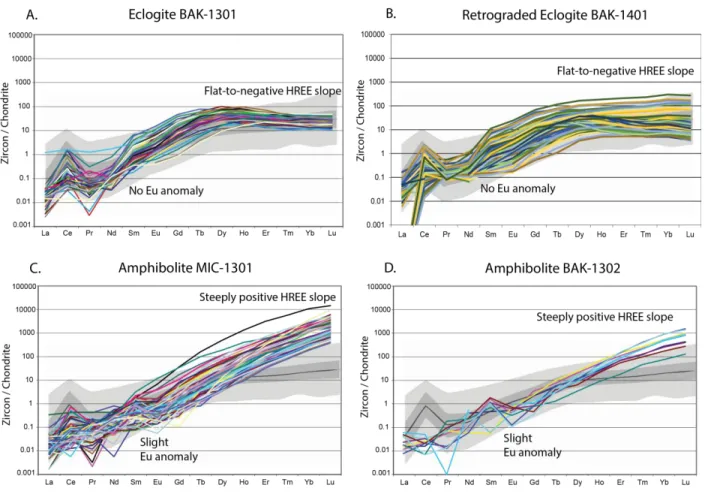
Figure 7. A-B, Eclogite and retrograded eclogite zircon REE patterns with low, flat HREE slopes suggesting concurrent growth with garnet at eclogite-facies conditions. C-D,
Amphibolite MIC-1301 and BAK-1302 zircon REE patterns with high, steep HREE slopes and slight Eu anomaly. This pattern suggests zircon growth with plagioclase and no garnet present. All values are normalized to chondrite after McDonough and Sun (1995). The gray background pattern comes from a global average of 877 eclogite bodies
region of Norway (Kylander-Clark et al., 2013), and the Sesia–Lanzo Zone of the Western Alps (Rubatto, 2002). The flat-to-negative HREE slopes indicate that the zircons grew in the presence of garnet, because the HREEs are incorporated preferentially into garnet during crystallization (Rubatto, 2002; Hoskin and Schaltegger, 2003; Kylander-Clark et al., 2013). Garnet is a primary eclogite mineral, suggesting that the zircons grew during eclogite-facies conditions.
The amphibolite zircons have depleted LREE and MREE, a small Eu anomaly, and enriched HREE with a steep, positive slope (Figures 8C and 8D). In these samples, a positive HREE slope indicates garnet was not growing concurrently with the zircons. The negative Eu anomaly suggests that the zircons crystallized with plagioclase present because the Eu will incorporate preferentially into the plagioclase, reducing its availability for the zircon crystals (Hoskin and Ireland, 2000; Rubatto, 2002; Kylander-Clark et al., 2013). Plagioclase is not stable at eclogite facies, and only occurs in the eclogite as a breakdown product of omphacite at lower pressures (Mysen and Griffen, 1973; Anderson and Moecher, 2007). The amphibolite REE patterns indicate that the zircons grew in the presence of plagioclase and not in the presence of garnet. Therefore, the amphibolites did not experience eclogite-facies conditions and cannot be retrograded eclogite.
Thermometry
Ti-in-zircon thermometry uses the Ti-concentration in zircon to estimate a temperature of crystallization (Watson et al., 2006). The thermometer was calibrated at experimental conditions of 1 GPa, with an estimated pressure correction of 50°C/GPa required for higher-pressure rocks (Ferry and Watson, 2007). Ferriss et al. (2008) found that this pressure correction was
thermometer will underestimate temperatures at higher-pressure conditions. Their study found that a pressure correction of 100°C/GPa is required to account for the lower-than-expected Ti-substitution at higher pressures.
The pressure estimate for peak conditions of the eclogite is 1.7 GPa (Willard and Adams, 1994; Page et al., 2003; Anderson and Moecher, 2007), which is 0.7 GPa higher than the
conditions used to calibrate the thermometer. Therefore, a pressure correction of 70°C was applied to the results based on the Ferriss et al. (2008) calculations. We analyzed 100 spots on 75 eclogite zircons with Ti concentrations ranging from 1.67-22.3 ppm. The Ti-in-zircon
thermometry results for the eclogite BAK-1301 yielded an average crystallization temperature of 718 ± 15°C. The retrograded eclogite BAK-1401 had 70 analyses on 46 zircons with Ti
concentration ranging from 1.1-9.6 ppm. The retrograded eclogite yielded an average
uncorrected temperature of 639 ± 13°C, but had distinct values for core and rim. The rim average was 627 ± 14°C and the core average was 648 ± 14°C. The core average requires a pressure correction of 70°C, bringing it up to 718 ± 14°C because the core crystallized at depth while the rim retrograded at lower pressure conditions (Figure 9).
The amphibolite MIC-1301 had Ti concentrations of 1.26-10.7 ppm from 72 analyses on 32 zircons. This amphibolite yielded an average Ti-in-zircon temperature of 650 ± 19°C. A pressure correction was not applied because the amphibolites are estimated to have formed at 0.7-1 GPa (Adams and Trupe, 1997), which is close to the 1 GPa calibration of the thermometer.
Amphibolite BAK-1302 had an average temperature of 614 ± 27°C, but only had three zircons analyzed
4) and 757 ± 20 °C for the β-quartz stability fields (Eq. 5). The pressure variable was set at 1.7 GPa after estimates from Willard and Adams (1994) and Anderson and Moecher (2007). The high pressures make it ambiguous whether the eclogite would host α- or β-quartz, but the difference in the results is negligible at only four degrees. Rutile is a primary eclogite mineral, crystallizing during peak metamorphic conditions. The Zr-in-rutile temperatures are about 50°C hotter than the Ti-in-zircon thermometer, indicating that the zircons likely crystallized during cooling shortly after peak conditions. Because of this temperature difference, the 459 Ma zircon age of the eclogite that was thought to represent the timing of peak metamorphic conditions of the eclogite (Miller et al., 2010) may actually record zircon crystallization after the eclogite began to cool. Unfortunately, U-Pb ages on rutile (Miller et al., 2010) record Alleghanian cooling and not eclogite-facies conditions.
These findings are consistent with other studies where Zr-in-rutile thermometry recorded peak temperatures, while Ti-in-zircon thermometry recorded lower cooling temperatures (e.g. Baldwin et al., 2007; Liu et al., 2010; Ewing et al., 2013). The Ewing et al. (2013) investigation of granulite-facies metapelites from the Ivrea-Verbano Zone of northern Italy found that the Zr-in-rutile thermometry recorded temperatures 100-200°C higher than the Ti-in-zircon. They attributed this temperature difference to a delay in metamorphic zircon crystallization until Zr became saturated in the anatectic melt fraction of the granulite.
The split-stream analysis performed at UCSB allowed us to get a simultaneous U-Pb date and a Ti-concentration measurement (Figure 6), which can be plotted together to get the
DISCUSSION
The zircon and rutile thermometry results are consistent with previous estimates of peak conditions for the area. Pressure-temperature estimates from the Bakersville eclogite body range from 1.3-1.7 GPa and 625-800ºC (Willard and Adams, 1994; Page et al., 2003; Anderson and Moecher, 2007). The schists and amphibolites of the Ashe Metamorphic Suite record upper-amphibolite conditions of around 0.6–1.2 GPa and 580–750 °C (Abbott and Raymond, 1984; McSween et al., 1989; Willard and Adams, 1994; Adams et al., 1995; Trupe et al., 2004). Our zircon and rutile thermometry results range from 703-775 °C for the eclogite and 614-669 °C for the amphibolites, which fall within the range of previous estimates.
The eclogite records temperatures that are about 100°C hotter than the amphibolites and the zircon crystallization ages are 40-45 Ma older. The amphibolite zircon REE patterns indicate that the zircons grew in the presence of plagioclase and not in the presence of garnet, and therefore did not grow at eclogite conditions. These crucial differences between the eclogite and
By limiting the extent of eclogite-facies conditions, we limit the viability of the extrusion and eduction models for eclogite exhumation (Figures 1D and 1E). These models call for the subduction and exhumation of regional-scale blocks, which would cause the amphibolite bodies that we sampled to experience eclogite-facies conditions. Transpression is also not a likely driver of exhumation. Transpression along the Devonian Burnsville fault has been documented in the vicinity of the Bakersville eclogite (Waters-Tormey and Stewart, 2010), resulting in kilometer-scale synformal folding, however, the timing is different and there is no evidence of uplift associated with the Burnsville fault.
Corner-flow, driven cavity, and plunger-driven models are consistent with the
accretionary wedge origin of the Ashe Metamorphic Suite. These accretionary-wedge circulation models result in isolated blocks of eclogite surrounded by lower-grade material. The corner-flow model of Cloos (1982) was developed to explain exhumation of eclogite bodies in the Franciscan complex of California, which are low temperature eclogites (450-590°C, Krogh, 1988) exhumed as meter- and decimeter-scale blocks in a serpentinite and shale matrix (e.g., Coleman et al., 1965; Coleman and Lanphere, 1971; Ernst and Liou, 1995). Corner-flow is generally limited to eclogite blocks < 50 m in size. This size limitation is governed by Stokes Law, which gives the settling velocity of dense objects within a less-dense viscous fluid. The settling velocity, Vs, is given as (Turcotte and Schubert, 1982):
cannot account for exhumation of blocks as large as the 100x1000x300 m body of Bakersville eclogite, which has a volume equivalent to a sphere with a ~200 m radius.
The driven cavity model circulates material up from depths where sediments from the accretionary wedge pinch out and temperatures are hotter. Circulation from depths of 30-70 km is achieved by hydration of the mantle wedge into serpentinite, which can be driven into cyclic flow as well as lubricate the exhumation of the eclogite (Burov et al., 2001; Guillot et al., 2001). This depth of circulation yields eclogites with temperatures of up to 700°C, which is similar to our results of 703-775 °C (Burov et al., 2001). A matrix composed of serpentinite rather than accretionary-wedge sediments will change the properties of Stokes Law that limits the size of blocks that can be exhumed. A serpentinite matrix viscosity of 1019 poise and a density contrast of 0.8 g/cm3 will allow the maximum radius of an exhumed block to rise as high as 700 m, well over the size of the largest Bakersville eclogite block (Schwartz et al. 2001).
Plunger-driven expulsion works in a similar way to the driven cavity model, but rather than traction along the subducting plate driving the eddy flow, thick and cold continental crust enters the subduction channel and forces downward flow of the hotter, weaker channel material which then hits a ‘control point’ (Figure 1C). This control point limits the amount of material that can be pushed downward and forces return flow back up in the subduction channel, carrying blocks of eclogite with it (Warren et al., 2008). Plunger-driven expulsion can be difficult to prove in ancient collisional settings because of the deformation associate with continued
collision (Warren, 2013), but at least one pulse can expected with the subduction of a continental margin (Warren et al., 2008).
are brought into the channel (Warren et al., 2008; Warren, 2013). Also, eclogites exhumed through this driven cavity serpentinite channel, like the Tso Morari eclogitic unit in the Himalayas (Guillot et al., 2001), or the Monviso eclogite of the western Alps (Schwartz et al., 2001), are still contained in serpentinite units. The Bakersville eclogite bodies are not encased in a serpentinite or peridotite matrix and the Ashe Metamorphic Suite only contains small scattered pods of ultramafic bodies, however, the serpentinite-eclogite unit could have been dismembered later though faulting or mélange mixing.
Silurian-Devonian metamorphic event
The MIC-1301 amphibolite body records an amphibolite-facies event at 414.5 ± 3.8 Ma with temperatures up to 650 ± 19°C. A Silurian-Devonian metamorphic event has not been previously recognized for this part of the southern Appalachians, yet several rocks dated from around the Bakersville area record ages circa 420-415 Ma. Miller et al. (2000a) reported a 420 ± 15 Ma age on zircon rims from retrograded eclogite, however large errors and irreproducibility make this value suspect. Goldberg and Dallmeyer (1997) reported a hornblende Sm-Nd isochron age of 423 ± 14 Ma for a mylonitic garnet amphibolite in the vicinity of Bakersville, NC and a 394 ± 2 Ma Rb-Sr isochron age for another amphibolite body. In partially retrograded
Bakersville eclogite, Miller et al. (2010) found titanite ages of 393.5 ± 3.5 Ma, which could record cooling ages from the 415 Ma event recorded in the amphibolite body MIC-1301.
Outside of the Bakersville area, there is little evidence for a Silurian-Devonian
thrust sheets were stacked (Trupe et al., 2004), and might not be related. Miller et al. (2000b) dated zircon rims from a trondhjemite dike 10 km north of Asheville which yielded ages of 417 ± 9 Ma and 414 ± 17 Ma. Confidence in these dates is questionable because they come from thin rims on zircons that have large cores that date to 1.0-1.15 Ga, preserved by rapid heating that caused growth of the rims but did not reset the cores of the zircons (Miller et al., 2000b). The Spruce Pine Intrusive Suite is often cited as being circa 377 Ma based on a U-Pb ages from Chalk Mountain and other pegmatites (Johnson et al., 2001; Trupe et al., 2003), but several samples yield Silurian-Devonian ages. Uraninite ages from three pegmatite mines in Spruce Pine record ages of 378-411 Ma, 389-432 Ma, and 418-460 Ma (Warner et al., 2008). Kish (1983) measured whole rock Rb-Sr ages of 435 ± 14 Ma, 404 ± 14 Ma, and 392 ± 15 Ma on three Spruce Pine pegmatites. Moecher et al. (2011) dated detrital zircons and monazite from tributary streams draining the Ashe Metamorphic Suite in the Canton, NC quadrangle. They dated several zircons with a metamorphic rims of 417-425 ± 12 Ma. Unfortunately, the detrital nature of the zircons makes it difficult to identify their source. Based on the current sampling and dating of the Ashe Metamorphic Suite, we cannot say how widespread this Silurian-Devonian metamorphic might be.
either the promontory-embayment geometry allowed for simultaneous collision and extension, or that sinistral strike-slip motion from deflecting collision off the promontories created pull-apart basins.
The Silurian-Devonian event in the southern Appalachians could be related to the
Cherokee orogeny, which is the tectonic equivalent to the Salinic Orogeny (Hibbard et al., 2010). The Cherokee orogeny started around 450 Ma and records the docking of the Carolina terrane with the Laurentian margin (Hibbard et al., 2010). The cessation of Ordovician-Silurian
magmatism in the southern Appalachians around 430 Ma suggests that subduction stopped and the Laurentian margin became a transform margin (Hibbard et al., 2010). Silurian clastic wedges in the central Appalachians and the Lay Dam and Cat Square basins in the Piedmont may be evidence of tectonic loading between 440-423 Ma (Hibbard et al., 2010). There is not, however, a major clastic wedge associated with Silurian-Devonian uplift in the southern Appalachians.
The lack of a major clastic wedge in the southern Appalachians suggests that Carolinia collided with Laurentia in the central Appalachians, and then migrated southward (Hibbard and Waldron, 2009). Evidence for this includes the Salinic clastic wedge in the central Appalachians showing a progressive southwestward migration (Ettensohn and Brett, 2002). Dennis (2007) proposes a series of rifting and collisional events between Carolinia and Laurentia, with crustal thickening occurring as Carolinia moves southward down the orogen. Transtensional plutons in the Charlotte terrane of Carolinia have U-Pb ages of 416 ± 5.5 Ma and 415 ± 6 Ma (Hibbard et al., 2012), thought to be formed by extension in response to strike-slip motion as Carolinia was transported southward (Dennis, 2007). One of these collisions between Carolinia and Laurentia could bury this portion of the Blue Ridge sufficiently to create amphibolite-facies conditions.
rocks to amphibolite-facies depths, then zircons could continue to crystallize until uplift and erosion caused the temperatures to fall below the zircon closure temperatures. Movement along the Burnsville fault may have driven the uplift or maybe erosion alone was sufficient. This alternative hypothesis may explain some of the scatter that we see in the ages of the zircons as they could have crystallized over a longer period of time. However, it is not clear how the eclogite did not retrograde during 45 Ma of amphibolite-facies conditions.
Tectonic Model
Convergence began in the Early Ordovician as the ocean basin separating Laurentia and the Piedmont terrane started subducting into an east-dipping subduction zone (Stewart et al., 1997; Miller et al., 2006; Hibbard et al., 2007). The Ashe Metamorphic Suite took shape as sediments were scraped from the subducting plate to form an accretionary wedge. The
Bakersville eclogite was likely formed from this subducting oceanic crust at depths of 50-70km (Figure 11A). Rutile recorded peak temperatures of up to 775° C, while the zircons, which were dated to 460 Ma, recorded temperatures as high as 718° C.
The Laurentian margin entered into the subduction channel in the late Middle to early Late Ordovician (Ettensohn, 2004). This earliest phase of collision is recorded by the Blountian clastic wedge between the Virginia and Alabama Promontories (Ettensohn, 2004). The Blountian clastic wedge consists primarily of turbidites that were deposited on a Cambrian-Ordovician carbonate shelf (Anderson, 1994). The basin shows a significant influx of volcanic sediments, interpreted to result from colliding terranes (Anderson, 1994). We propose driven cavity or plunger-driven circulation exhumed the eclogite to mid-upper crustal levels and into the accretionary mélange (Figure 11B). We speculate that the eclogite was surrounded by
brought into the accretionary mélange of marine sediments, mudstones, and blocks of oceanic crust. Mixing within the mélange could have separated the eclogite from its serpentinite “capsule”, resulting in the scattered blocks of ultramafic bodies throughout the Ashe
Metamorphic Suite. Swanson and Raymond (2010) demonstrate that the ultramafic bodies of the Spruce Pine area show evidence of being dehydrated from serpentinite. The Taconic orogeny occurred as the collision between the Piedmont and Laurentia continued (Figure 11C). Amphibolite MIC-1301 does not record Taconic metamorphism, and may not have been at amphibolite-facies depths during the Taconic orogeny.
Simultaneous with the peak of the Taconic orogeny at around 460 Ma, subduction switched to west-dipping after accretion of the Piedmont, and the Iapetus Ocean began to be consumed followed by collision between Carolinia and Laurentia (Hibbard, 2000). Around 430 Ma, collision ended between Carolinia and Laurentia in the central Appalachians, followed by dextral strike-slip translation of Carolinia (Hibbard et al., 2010; Dennis, 2007; Figure 11D). Collision and extension with the promontory-embayment geometry of Laurentia created crustal thickening and pull-apart basins as it migrated down the orogen. The Ashe Metamorphic Suite locally reached amphibolite-facies conditions of up to 669°C as recorded in the amphibolites. The proto-Ashe Metamorphic Suite accretionary mélange may have been further mixed as it was compressed and metamorphosed, allowing some deeper rocks that recorded Taconic conditions to be incorporated with the rocks that do not. The translation of eastern Blue Ridge, the
CONCLUSIONS
APPENDIX A: HAND SAMPLE DESCRIPTIONS AND LOCATIONS
Sample: BAK-1301
Rock Type: Eclogite
Location: Redwood Road, Bakersville, NC
UTM 17S 0396695E/3987059N Elevation: 769m
Distance From Eclogite: 0 km
Hand Sample Description:
Omphacite and garnet rich Eclogite, some retrogression to pyroxene/amphibole. Not pervasively foliated, moderate weathering rind, dusky orange, fresh rock in center, red and green with some black. Grain size is roughly 0.5-1mm. Very dense.
Sample: BAK-1302
Rock Type: Amphibolite
Location: Dallas Young Rd, Bakersville, NC
UTM 17S 0398199E/3987871N Elevation: 840m
Distance From Eclogite: 1.7 km
Hand Sample Description:
Well foliated, nematoblastic amphibolite. Some isoclinal folding of the felsic layers. Grain size is fine-medium grained (0.5-2mm). Overall low-mod felsic content, ~10-15%. Hard and fresh sample, no weathering. Quartz, plag and amphibole. Garnets observed in one sample when cutting thin sections.
Sample: MIC-1301
Rock Type: Amphibolite
Location: Railroad cut by the Toe Cane River, south of intersection with Roses Branch Rd
UTM 17S 0392641E/ 3983299N Elevation: 714m
Distance From Eclogite: 5.5 km
Hand Sample Description:
Well foliated, nematoblastic amphibolite. Grain size .5-3 mm with layers of larger amphibolite crystals up to 20 mm. Overall low felsic content, ~7%. Very fresh outcrop, hard and unweathered. Quartz, plag and amphibole, no garnet observed.
Sample: MIC-1302
Rock Type: Amphibolite
Location: Conley Ridge Road near Wing, NC
UTM 17S 0398002E/3977697N Elevation: 785m
Hand Sample Description:
Well foliated, nematoblastic amphibolite. Grain size is fine-medium grained (0.5-1mm). Hard and fresh sample, no weathering. Overall low felsic content, ~7%. Quartz, plag and amphibole, no garnet observed. Some fracturing with epidote, limonite and MnO
staining.
Sample: BUR-1301
Rock Type: Amphibolite
Location: Green Mountain Drive, Burnsville, NC
UTM 17S 0383847E/3976686N Elevation: 860m
Distance From Eclogite: 16.4 km
Hand Sample Description:
Well foliated, nematoblastic amphibolite. Moderately weathered, plag-> kaolinite. Fairly soft and crumbles under hammer. Higher felsic content, ~20%. Medium grained, 1-3mm. Quartz, plag, kaolinite, and amphibole, no garnet observed.
Sample: BAK-1401
Rock Type: Retrograded Eclogite
Location: 572 Redwood Road, Bakersville, NC
UTM 17S 0396544E/3986933N Elevation: 784m
Distance From Eclogite: 0 km
Hand Sample Description:
APPENDIX B: LASER-ABLATION TI-IN-ZIRCON THERMOMETRY
AND U-PB AGES
Sample, zircon #
Zircon Mount number
Ti ppm Ti 2σ error
Ti-in-Zircon Temp °C
Monte Carlo Temp, °C
Std Dev
Pressu re Correc tion
U-Pb Age
2σ error
MIC1301 z01
Mount1 run3.d
2.27 0.57 623.38 622.62 15.91 468 54
MIC1301 z01
Mount1 run3.d
2.82 0.49 639.44 639.18 14.18 504 67
MIC1301 z02
Mount1 run3.d
1.97 0.41 613.19 612.44 14.38 401 25
MIC1301 z02
Mount1 run3.d
3.5 0.76 656.01 656.33 15.57 448 52
MIC1301 z02
Mount1 run3.d
1.51 0.46 594.68 593.28 16.68 110 158
MIC1301 z03
Mount1 run3.d
1.72 0.63 603.65 603.05 19.04 489 31
MIC1301 z03
Mount1 run3.d
3.62 0.68 658.66 659.13 15.20 426 11
MIC1301 z03
Mount1 run3.d
10.7 3.6 752.36 749.88 24.23 460 24
MIC1301 z08
Mount1 run3.d
4 0.64 666.56 667.01 14.24 409 14
MIC1301 z09
Mount1 run3.d
2.2 0.39 621.11 621.52 13.21 443 13
MIC1301 z09
Mount1 run3.d
3.02 0.45 644.63 644.39 13.48 433 16
MIC1301 z03
mount3 run 1.d
0.93 0.91 562.87 548.75 51.13 301 191
MIC1301 z03
mount3 run 1.d
3.1 1.5 646.63 644.01 25.43 401 18
MIC1301 z03
mount3 run 1.d
0.98 0.95 566.19 6 112
MIC1301 z04
mount3 run 1.d
2.17 0.79 620.12 618.72 19.59 425 196
MIC1301 z04
mount3 run 1.d
3.75 0.82 661.44 661.39 15.93 410 14
MIC1301 z04
mount3 run 1.d
1.52 0.84 595.13 591.02 25.79 415 51
MIC1301 z06
mount3 run 1.d
1 1.6 567.48 -18 65
MIC1301 z06
mount3 run 1.d
2.87 0.97 640.77 639.90 19.09 459 34
MIC1301 z09
mount3 run 1.d
2.7 1 636.18 634.61 20.60 135 213
MIC1301 z09
mount3 run 1.d
11 1.4 754.99 754.92 15.90 99 175
MIC1301 z10
mount3 run 1.d
1.88 0.96 609.88 607.55 24.32 177 263
Sample, zircon #
Zircon Mount number
Ti ppm Ti 2σ error
Ti-in-Zircon Temp °C
Monte Carlo Temp, °C
Std Dev
Pressu re Correc tion
U-Pb Age
2σ error
z11 1.d
MIC1301 z11
mount3 run 1.d
1.7 1.2 602.83 596.73 32.81 69 157
MIC1301 z12
mount3 run 1.d
0.2 1.7 475.80 437 268
MIC1301 z12
mount3 run 1.d
2.7 1 636.18 635.26 20.18 389 12
MIC1301 z13
mount3 run 1.d
4.1 1.9 668.54 666.41 25.70 -28 67
MIC1301 z14
mount3 run 1.d
3.8 1.1 662.48 662.02 18.15 497 62
MIC1301 z15
mount3 run 1.d
7.7 2.3 721.98 721.87 20.76 394 32
MIC1301 z15
mount3 run 1.d
2.7 1.1 636.18 633.73 21.71 478 72
MIC1301 z17
mount3 run 1.d
1.8 1.2 606.82 601.78 31.34 245 303
MIC1301 z17
mount3 run 1.d
1.8 1 606.82 603.65 26.25 444 39
MIC1301 z17
mount3 run 1.d
1.21 0.65 579.85 576.54 23.95 -281 360
MIC1301 z18
mount3 run 1.d
1.7 1.2 602.83 598.19 33.27 562 129
MIC1301 z18
mount3 run 1.d
8.1 1 726.53 725.33 14.99 430 31
MIC1301 z18
mount3 run 1.d
1.07 0.78 571.83 566.00 31.66 546 156
MIC1301 z19
mount3 run 1.d
3.9 1.5 664.54 664.12 22.06 417 18
MIC1301 z19
mount3 run 1.d
2 1.9 614.26 599.73 53.47 473 67
MIC1301 z26
mount3 run 1.d
2.05 0.89 616.03 613.18 21.10 483 219
MIC1301 z26
mount3 run 1.d
2.3 1.6 624.34 617.61 34.10 435 22
MIC1301 z27
mount3 run 1.d
4.5 1.2 676.07 675.68 17.59 550 67
MIC1301 z28
mount3 run 1.d
3.5 1.1 656.01 654.80 18.65 453 48
MIC1301 z28
mount3 run 1.d
1.3 1.2 584.60 574.15 47.72 425 133
MIC1301 z30
mount3 run 1.d
6.6 2.5 708.35 705.52 23.18 477 17
MIC1301 z30
mount3 run 1.d
4.2 1.6 670.48 668.70 22.56 1 7
MIC1301 z31
mount3 run 1.d
5.8 1.2 697.22 697.32 15.92 425 16
MIC1301 z31
mount3 run 1.d
2.3 1.2 624.34 622.01 25.44 422 22
Sample, zircon #
Zircon Mount number
Ti ppm Ti 2σ error
Ti-in-Zircon Temp °C
Monte Carlo Temp, °C
Std Dev
Pressu re Correc tion
U-Pb Age
2σ error
MIC1301 z32
mount3 run 1.d
3.5 1.1 656.01 655.78 18.37 433 21
MIC1301 z33
mount3 run 1.d
3.4 1.1 653.76 651.33 18.73 415 23
MIC1301 z33
mount3 run 1.d
1.8 1 606.82 603.72 26.98 408 37
MIC1301 z35
mount3 run 1.d
6.8 2.2 710.96 709.90 21.26 450 29
MIC1301 z35
mount3 run 1.d
1.5 1.1 594.23 589.26 35.02 -60 1269
MIC1301 z35
mount3 run 1.d
4.3 1.4 672.38 669.90 19.99 523 189
MIC1301 z36
mount3 run 1.d
3.4 1.2 653.76 652.95 20.01 735 148
MIC1301 z36
mount3 run 1.d
2.5 1.5 630.45 626.22 29.56 436 24
MIC1301 z36
mount3 run 1.d
3 1.5 644.13 641.03 26.13 423 21
MIC1301 z36
mount3 run 1.d
2.3 1.8 624.34 615.31 40.00 492 34
MIC1301 z37
mount3 run 1.d
0.03 0.84 390.49 0 #VAL
UE! MIC1301
z37
mount3 run 1.d
3 1.7 644.13 639.92 30.46 435 45
MIC1301 z37
mount3 run 1.d
6.8 2.1 710.96 709.91 20.55 432 25
MIC1301 z37
mount3 run 1.d
1.2 1.4 579.30 281 169
MIC1301 z01
Mount3 run2.d
1.75 0.64 604.85 603.29 18.18 468 66
MIC1301 z01
Mount3 run2.d
3.26 0.45 650.50 650.22 14.14 458 15
MIC1301 z01
Mount3 run2.d
4.23 0.66 671.05 670.70 14.33 417 22
MIC1301 z01
Mount3 run2.d
2.61 0.54 633.65 633.16 14.47 425 24
MIC1301 z01
Mount3 run2.d
1.71 0.44 603.24 603.24 15.05 445 28
MIC1301 z05
Mount3 run2.d
1.26 0.56 582.52 580.59 21.16 410 22
MIC1301 z05
Mount3 run2.d
4.39 0.74 674.06 673.97 15.31 414 18
MIC1301 z05
Mount3 run2.d
1.68 0.53 602.01 601.76 17.04 421 29
MIC1301 z05
Mount3 run2.d
2.63 0.4 634.21 633.93 12.82 422 20
MIC1301 z05
Mount3 run2.d
Sample, zircon #
Zircon Mount number
Ti ppm Ti 2σ error
Ti-in-Zircon Temp °C
Monte Carlo Temp, °C
Std Dev
Pressu re Correc tion
U-Pb Age
2σ error
Sample, zircon #
Zircon Mount number
Ti ppm Ti 2σ error
Ti-in-Zircon Temp °C
Monte Carlo Temp, °C
Std Dev
Pressu re Correc tion
Age 2σ error
BAK1301 z03
Mount1 run4.d
2.11 0.36 618.10 618.39 13.98 688.10 470 25
BAK1301 z03
Mount1 run4.d
2.98 0.77 643.62 642.29 16.30 713.62 454 18
BAK1301 z03
Mount1 run4.d
2.58 0.48 632.79 633.29 14.42 702.79 485 14
BAK1301 z04
Mount1 run4.d
2.80 0.80 638.90 638.01 17.43 708.90 463 13
BAK1301 z05
Mount1 run4.d
3.00 0.82 644.13 643.91 16.66 714.13 555 344
BAK1301 z05
Mount1 run4.d
3.30 0.55 651.44 652.24 14.25 721.44 553 36
BAK1301 z06
Mount1 run4.d
2.05 0.54 616.03 615.54 16.47 686.03 453 22
BAK1301 z06
Mount1 run4.d
4.00 1.10 666.56 665.41 17.45 736.56 456 20
BAK1301 z06
Mount1 run4.d
4.17 0.71 669.90 669.90 14.68 739.90 457 27
BAK1301 z07
Mount1 run4.d
3.24 0.49 650.02 649.28 13.82 720.02 443 32
BAK1301 z07
Mount1 run4.d
3.96 0.73 665.76 665.23 14.74 735.76 509 58
70.00
BAK1301 z08
Mount1 run4.d
2.73 0.61 637.00 636.68 15.18 707.00 459 14
BAK1301 z08
Mount1 run4.d
2.14 0.71 619.11 616.61 18.11 689.11 455 115
BAK1301 z10
Mount1 run4.d
11.80 2.40 761.75 761.45 18.11 831.75 464 29
BAK1301 z10
Mount1 run4.d
3.81 0.72 662.69 661.63 14.92 732.69 456 12
BAK1301 z11
Mount1 run4.d
2.24 0.59 622.41 621.83 15.83 692.41 522 330
BAK1301 z13
Mount1 run4.d
3.15 0.34 647.86 647.66 13.22 717.86 426 15
BAK1301 z14
Mount1 run4.d
7.07 0.96 714.39 714.19 14.80 784.39 462 15
BAK1301 z14
Mount1 run4.d
7.70 1.10 721.98 721.03 15.25 791.98 455 13
BAK1301 z14
Mount1 run4.d
3.81 0.87 662.69 661.69 15.76 732.69 453 15
BAK1301 z15
Mount1 run4.d
3.00 0.36 644.13 644.30 13.13 714.13 438 42
BAK1301 z15
Mount1 run4.d
2.64 0.43 634.50 634.01 13.48 704.50 460 68
Sample, zircon #
Zircon Mount number
Ti ppm Ti 2σ error
Ti-in-Zircon Temp °C
Monte Carlo Temp, °C
Std Dev
Pressu re Correc tion
U-Pb Age
2σ error
BAK1301 z16
Mount1 run4.d
3.74 0.57 661.22 661.55 14.27 731.22 444 16
BAK1301 z16
Mount1 run4.d
2.16 0.69 619.78 618.68 17.99 689.78 443 15
70.00
BAK1301 z18
Mount1 run3.d
1.80 0.49 606.82 606.41 15.61 676.82 378 222
BAK1301 z18
Mount1 run3.d
1.99 0.41 613.91 613.72 14.28 683.91 520 150
BAK1301 z18
Mount1 run3.d
2.13 0.64 618.77 617.42 17.10 688.77 422 300
BAK1301 z18
Mount1 run3.d
1.92 0.30 611.37 611.28 13.23 681.37 541 97
BAK1301 z19
Mount1 run3.d
2.91 0.68 641.81 641.76 16.10 711.81 448 19
BAK1301 z19
Mount1 run3.d
2.33 0.50 625.28 624.75 14.88 695.28 463 23
BAK1301 z19
Mount1 run3.d
2.45 0.58 628.96 628.55 15.48 698.96 456 15
BAK1301 z22
Mount1 run3.d
22.30 2.10 827.34 826.98 16.29 897.34 462 11
BAK1301 z22
Mount1 run3.d
10.66 0.62 752.00 751.48 14.34 822.00 462 11
BAK1301 z24
Mount1 run3.d
2.07 0.84 616.72 614.98 20.48 686.72 450 16
BAK1301 z24
Mount1 run3.d
1.96 0.69 612.83 610.64 18.66 682.83 455 17
BAK1301 z24
Mount1 run3.d
2.38 0.48 626.83 626.23 14.28 696.83 455 17
BAK1301 z24
Mount1 run3.d
3510.0 0
510.0 0
1944.25 1941.1
4
60.91 2014.2
5
582 216
BAK1301 z26
Mount1 run3.d
6.36 0.88 705.14 705.00 14.85 775.14 453 14
BAK1301 z26
Mount1 run3.d
3.98 0.96 666.16 664.47 16.37 736.16 438 27
BAK1301 z30
Mount1 run3.d
2.48 0.64 629.86 629.82 16.28 699.86 458 14
BAK1301 z31
Mount1 run3.d
3.36 0.65 652.84 652.48 14.84 722.84 448 14
BAK1301 z31
Mount1 run3.d
2.65 0.43 634.78 634.80 13.65 704.78 443 14
BAK1301 z31
Mount1 run3.d
2.86 0.82 640.50 639.88 17.44 710.50 461 16
BAK1301 z32
Mount1 run3.d
3.08 0.46 646.13 645.68 13.47 716.13 447 14
BAK1301 z32
Mount1 run3.d
2.86 0.44 640.50 640.49 13.76 710.50 456 15
BAK1301 z33
Mount1 run3.d
1.67 0.44 601.60 601.16 14.87 671.60 489 43
Sample, zircon #
Zircon Mount number
Ti ppm Ti 2σ error
Ti-in-Zircon Temp °C
Monte Carlo Temp, °C
Std Dev
Pressu re Correc tion
U-Pb Age
2σ error
z33 run3.d
BAK1301 z34
Mount1 run3.d
1.64 0.32 600.35 600.60 13.39 670.35 160 196
BAK1301 z35
Mount1 run3.d
4.29 0.56 672.19 672.28 14.07 742.19 456 18
BAK1301 z35
Mount1 run3.d
3.45 0.91 654.89 654.46 17.04 724.89 459 19
70.00
BAK1301 z39
Mount3 run2.d
5.39 0.73 691.01 690.98 14.19 761.01 461 14
BAK1301 z38
Mount3 run2.d
3.04 0.56 645.14 644.49 14.03 715.14 603 240
BAK1301 z37
Mount3 run2.d
2.06 0.33 616.38 615.47 13.22 686.38 463 13
BAK1301 z37
Mount3 run2.d
3.87 0.47 663.93 663.67 13.39 733.93 455 13
BAK1301 z36
Mount3 run2.d
2.98 0.63 643.62 643.98 14.83 713.62 447 18
BAK1301 z35
Mount3 run2.d
9.00 1.20 736.15 734.97 15.85 806.15 452 12
BAK1301 z34
Mount3 run2.d
2.08 0.54 617.07 616.37 16.21 687.07 485 32
BAK1301 z34
Mount3 run2.d
2.22 0.54 621.76 620.78 15.39 691.76 599 114
BAK1301 z33
Mount3 run2.d
2.20 0.36 621.11 620.22 13.15 691.11 476 30
BAK1301 z33
Mount3 run2.d
1.82 0.53 607.60 607.02 16.86 677.60 485 32
BAK1301 z32
Mount3 run2.d
2.71 0.38 636.45 636.36 12.92 706.45 464 16
BAK1301 z31
Mount3 run2.d
3.62 0.55 658.66 658.60 14.18 728.66 449 16
BAK1301 z30
Mount3 run2.d
2.65 0.64 634.78 634.56 15.98 704.78 491 38
BAK1301 z29
Mount3 run2.d
3.36 0.49 652.84 652.98 13.64 722.84 457 14
BAK1301 z28
Mount3 run2.d
1.95 0.43 612.46 611.33 14.89 682.46 466 35
BAK1301 z28
Mount3 run2.d
2.50 0.56 630.45 629.89 15.42 700.45 306 142
BAK1301 z26
Mount3 run2.d
2.57 0.49 632.50 632.23 14.50 702.50 453 17
BAK1301 z26
Mount3 run2.d
3.96 0.54 665.76 665.39 14.01 735.76 458 13
BAK1301 z25
Mount3 run2.d
2.31 0.35 624.65 624.01 12.56 694.65 464 17
BAK1301 z24
Mount3 run2.d
11.60 1.50 760.10 760.22 15.91 830.10 456 14
BAK1301 z23
Mount3 run2.d