103| P a g e
ISSN 2223-7062 Proceedings and re por ts of the 6th UbuntuNet Alliance annual confere nce, 2013, pp 103-109
Use of Electronic Medical Records System to
Enforce Adherence to Maternal and Infant
Health Treatment Protocol in Malawi: A Pilot
Case Study at at Bwaila Maternity Hospital
Patricia KHOMANI1, Chimwemwe MPUTENI1, Oliver GADABU1,1
Baobab Health Trust, Barron Avenue, Area 3/13, P.O. Box 31979, Lilongwe, Malawi Tel: + 265 1 750 605, Fax: + 265 1 , Email: [email protected]
Abstract
Technology continues to present opportunities of being used in different settings to meet
information needs. Healthcare has been an emerging area in which this need has manifested itself with several initiatives being carried out in resource constrained settings.
This paper describes the design, development and implementation of an electronic medical record system in a busy ante-natal and maternity clinic in Sub-Saharan Africa in Malawi. The development of the EMR follows agile paradigm with the Heeks reality gap model to improve the features in the system.
The system has now been deployed at the Bwaila maternity wing and has recorded over 6,400 deliveries since April 2013. The system has embedded ante-natal and maternal protocols and presents an opportunity to improve care outcomes.
Key words: Maternal health, treatment protocols, Electronic Medical Record Syste ms, Point of Care.
1.
Introduction
With a population of 13 million (Malawi Demographic and Health Survey, 2010), Malawi's health indicators still remain discouraging. Maternal mortality rate is at 675 per 100,000 cases, whereas infant mortality rate remains at 66 per 1000 live births (Malawi DHS Survey, 2010) with a ratio of 2 doctors for every 100,000 patients.
High maternal and infant mortality rates have been exacerbated by HIV/AIDS, poor health care access and services among other. Furthermore, limited use of treatment protocols by health care workers (Rowe et al., 2005) against high number of patients that need care, inadequate patient information for health care workers to make informed decisions about patient's health status still remain a huge challenge.
104| P a g e
ISSN 2223-7062 Proceedings and re por ts of the 6th UbuntuNet Alliance annual confere nce, 2013, pp 103-109
With an objective to improve maternal and child health care outcomes and enhance continuum of care from antenatal care, maternity to under 5 clinic, Baobab Health Trust (BHT), a local
Malawian NGO, in collaboration with Ministry of Health and its partners, have been using Information and Communication Technology(ICT) point of care Electronic Medical Records System (EMRS) as a solutions to assist in enforcement and adherence of treatment protocol in the Antenatal clinic (ANC) and Maternity clinics. The use of EMRS was adopted from the lessons learnt in use of EMRS in Malawi's ART programme.
2.
Method
The agile software development paradigm was used to provide an Antenatal and Maternity EMRS aimed at addressing adherence challenges at Bwaila Ma ternity wing( a pilot site) in Lilongwe District between 2010 to 2013. This approach encourages involvement of users throughout the development process. In order to gather requirements, desk research, key informant interviews and focus group discussions were carried out.
2.1 Gathering Key System Requirements
As stated above, key informant interviews were used in order to define the high level
requirements of the EMR. Information gathered from these key informants was then synthesized with data collection tools that were available at Bwaila maternity wing. This process resulted in developing a maternity registration module for the Bwaila maternity wing. This EMR was launched at Bwaila maternity wing with the goal of modifying it based on user feedback.
2.2 Refining the Maternity EMR
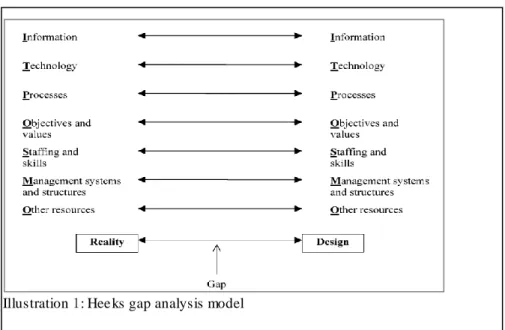
Experience with the launched maternity EMR revealed that the system was not being used as expected. This called for a need of evaluating the EMR as implemented at the facility in order to understand further the requirements as defined by the EMR. A gap analysis framework as proposed by Heeks (2008) ( Illustration 1) was thus used. This framework is recommended for situations where an EMR does not meet expected goals and deliverables.
105| P a g e
ISSN 2223-7062 Proceedings and re por ts of the 6th UbuntuNet Alliance annual confere nce, 2013, pp 103-109
The depicted elements above were thus assessed based on the initial design of the EMR in order to improve the usability of the EMR.
Key finding of the gap analysis was the need for approaching the maternity EMR from an earlier point before a pregnant woman reaches the maternity wing; which is the antenatal clinic (ANC). It was also observed that the health facility had many first time users of the EMR and hence needed to have an easy work flow embedded in the system and seen in illustration 2.
Illustration 2: Patient Dashboard Illustration 1: Hee ks gap analysis model
106| P a g e
ISSN 2223-7062 Proceedings and re por ts of the 6th UbuntuNet Alliance annual confere nce, 2013, pp 103-109 2.3 Technology gap considerations
Implementing technology in resource limited settings usually meets the challenges of power and technology literacy. These were problems that were encountered also with the implementation of the Maternity EMR. Low power equipment was thus used in order to have a power back up system that could be used for up to 24 hours for an installation with up to 10 workstations (Douglas et al.,2010) when there is a power failure from the national power grid. The power back consists of 4 deep cycle batteries producing 48 vo lts for powering clinical workstations as seen in illustration 3 below.
3.
Resulting EMR after redesign
The gap analysis provided a basis of redesign of the EMR to encompass workflow related issues. Specifically the EMR included automated workflow in order to make use of the system easier for users that mostly are first time users of technology.
The gap analysis also revealed areas where information needed to be streamlined with processes on the ground which were missed in the initial design of the EMR.
107| P a g e
ISSN 2223-7062 Proceedings and re por ts of the 6th UbuntuNet Alliance annual confere nce, 2013, pp 103-109 3.1 Key features of the EMR
The approach used to develop the EMRS and the design reality gap analysis provided the following opportunities for users in the clinics to adhere to treatment protocol:
Unique identification of a client from ANC to Maternity care.
A schedule of visits to patients in order to achieve focused Antenatal care
Nutrition support through calculating BMI
Strengthening health systems through integrated service delivery of HIV positive patients within the ANC ( Option B+).
Access to ANC generated patient history in the maternity clinic .
Enforcing the collection of patient information through alerts that have an impact on the patient and baby outcome before proceeding with other tasks.
Reporting features for health facility use and national reporting as seen in illustration number 4.
3.2 Streamlining Work-flow
In order to make the system as effective as possible, a key aspect has been streamlining the features of the system to different roles and privile ges of health care providers at the facility. The roles and privileges have thus been mapped according to the setups of the different clinics, that is the maternity and ante-natal clinics. Streamlining the workflow according to roles and privileges ensures that required information is available at the required time and hence frees up scarce skills
108| P a g e
ISSN 2223-7062 Proceedings and re por ts of the 6th UbuntuNet Alliance annual confere nce, 2013, pp 103-109
for essential tasks only. The illustration below depicts how the workflow is streamlined in the ANC clinic.
4.
Conclusion
The work done at Bwaila maternity wing around the EMRS demonstrates that it is feasible to implement an EMRS in a busy resource- constrained setting. The deployed EMRS provides an opportunity to improve adherence to care through the reminders and alerts that are in the system. The system also provide an opportunity for continuity of patient care once patients are managed through it. However more assessment needs to be done to examine the impact of the system on patient care outcomes.
References
Douglas, G.P., Gadabu, O.J., Joukes, S., Mumba, S., McKay, M.V., Ben-Smith, A., Jahn, A., Schouten,E.J., Landis Lewis, Z., van Oosterhout, J.J., Allain, T.J., Zachariah, R., Berger, S.D., Harries, A.D. & Chimbwandira, F. (, 2010). Using touchscreen electronic medical record systems to support and monitor national scale-up of antiretroviral therapy in Malawi. PLoS medicine, 7(8).
Heeks R.(2008) eGovernment for Development - eHealth - eHealth Project Risk Assessment: Design-Reality Gap Technique. http://www.egov4dev.org/health/techniques/assessment.shtml
109| P a g e
ISSN 2223-7062 Proceedings and re por ts of the 6th UbuntuNet Alliance annual confere nce, 2013, pp 103-109
[accessed December 13, 2008].National Statistics Office,2010, Malawi Demographic Health Survey. Zomba : NSO.
Rowe, A.K., Savigny, D. de, Lanata, C.F. & Victoria, C.G., (2005.) How can we achieve and maintain high-quality performance of health workers in low resource settings. The Lancet.366 (9490) pp. 1026-35
Biographies
Patricia M. Khomani
Patricia Khomani is a Senior Projects Coordinator at Baobab Health trust with a Social Sciences background responsible for maternal and child health system liaison with the Ministry of Health and health facilities. Patricia has actively participated in the design and evolution of the MCH EMR in different health facilities. She has particularly advocated for tightly coupling the
electronic medical record system to care processes in order to improve maternal and infant birth outcomes. Patricia holds a certification in Medical Informatics.
Chimwe mwe Mputeni
Chimwemwe Mputeni is a Support and Deployment officer with 4 years of implementing EMR in resource constrained settings. She has been pivotal to the streamlinining of workflows at Bwaila Maternity wing as well as training and mentoring health care workers in the health facilities. Chimwemwe Mputeni holds a BSc in Computer Engineering and a certification in Medical Informatics.
Olive r J. Gadabu
Oliver J. Gadabu is director of informatics at Baobab Health trust with 7 years of experience designing, developing, implementing and supporting electronic medical record systems. Oliver currently directs the design and evaluation efforts of electronic medical record systems at Baobab Health Trust and represents Baobab in key informatics organizations in the country. Oliver has a BSc in Computer Science and Statistics and a Certification in Operational Research.