Universal Design for Learning in Postsecondary
Education: Reflections on Principles
and their Application
David H. Rose
Center for Applied Special Technology (CAST), and Harvard University
Wendy S. Harbour
Catherine Sam Johnston
Samantha G. Daley
Linda Abarbanell
Harvard University
Abstract
Authored by the teaching staff of T-560: Meeting the Challenge of Individual Differences at the Harvard Graduate School of Education, this article reflects on potential applications of universal design for learning (UDL) in university courses, illustrating major points with examples from T-560. The article explains the roots of UDL in cognitive neuroscience, and the three principles of UDL: multiple means of representing information, multiple means of expressing knowledge, and multiple means of engagement in learning. The authors also examine the ways UDL has influenced their course goals and objectives, media and materials, teaching methods, and assessment techniques, including discussion groups, lectures, textbooks, and the course website. The authors emphasize the ongoing developmental nature of the course and UDL principles as tools or guidelines for postsecondary faculty, rather than a set of definitive rules. UDL is proposed as a way to address diversity and disabilities as constructs of individuals and their environment in higher education classrooms.
Universal design, although well established in archi-tecture and other domains, is relatively new to K-12 edu-cation and even newer to higher eduedu-cation. Universal design involves designing products, buildings, or envi-ronments so they can be used readily by the widest pos-sible range of users. Although, this concept of universal design is now familiar to many educators, its application in education lags far behind its application in the built environment. We believe this lag reflects an important reality: The idea of universal design transfers readily from the built environment to the learning environment, but its principles and techniques do not.
In this paper, we will clarify the differences between applying universal design in these two contexts, illus-trating the principles of what we call universal design for learning. To illustrate some of these principles in action in higher education, we will describe the university course
for which the authors are the faculty and teaching assis-tants. First, however, we will make some distinctions between terms that are sometimes confused: assistive technology, universal design, and universal design for learning.
Assistive technologies are technologies that are spe-cifically designed to assist individuals with disabilities in overcoming barriers in their environment. Some rela-tively “low-tech” assistive technologies (e.g., canes, wheelchairs, eyeglasses) have been in place for over a century, but the addition of “high-tech” assistive tech-nologies over the last three decades has often provided the most dramatic impact on higher education experiences for students with disabilities, while capturing the atten-tion of the public. Examples of these newer technologies include such devices as electronic mobility switches and alternative keyboards for individuals with physical
dis-abilities; computer screen enlargers and text-to-speech readers for individuals with visual disabilities; electronic sign language dictionaries and cochlear implants for in-dividuals who are hard of hearing or deaf; and calcula-tors, digital talking books, and spell-check devices for individuals with learning disabilities. Because they are designed for individual use, assistive technologies can be carefully engineered, fitted, and adapted to the spe-cific strengths and functional limitations of an individual student. In that regard they are unique, personal (they travel with the individual), customized, and dedicated. While some of these assistive technologies are also popu-lar with nondisabled members of the general public, they are typically designed to increase access and learning among people with disabilities and to remedy barriers or limitations in the built environment (e.g., the classroom, computers, printed books). Further the term assistive technology is rarely used to describe technology or equip-ment for nondisabled consumers.
Universal design focuses on eliminating barriers through initial designs that consider the needs of diverse people, rather than overcoming barriers later through in-dividual adaptation. Because the intended users are whole communities, universally designed environments are en-gineered for flexibility and designed to anticipate the need for alternatives, options, and adaptations to meet the chal-lenge of diversity. In that regard, designs are often mal-leable and variable rather than dedicated. They are not unique or personal, but universal and inclusive. Univer-sal design is an ideal that is not yet met completely in practice.
Universal design for learning (UDL)is one part of the overall movement toward universal design. The term emphasizes the special purpose of learning environ-ments—they are not created only to transmit information or to shelter, but are created to support and foster the changes in knowledge and skills that we call learning. While providing access to information or to materials is often essential to learning, it is not sufficient. UDL re-quires that we not only design accessible information, but also an accessible pedagogy. In general terms, peda-gogy is the science of teaching and learning—the educa-tional methods that skilled educators use to highlight criti-cal features, emphasize big ideas, clarify essential rela-tionships, provide graduated scaffolds for practice, model expert performance, and guide and mentor the appren-tice (or student). All of these and more are what teaching is, and the measure of their success is what we call learn-ing. The framework for UDL is based in findings from cognitive neuroscience that tell us about the needs of in-dividual learners. It embeds accessible pedagogy into three specific and central considerations in teaching: the
means of representing information, the means for stu-dents’ expression of knowledge, and the means of en-gagement in learning (for further details, see Rose and Meyer, 2002, and Rose, Meyer, and Hitchcock, 2005).
UDL Principles
The distinction between UDL and other domains of universal design is its focus on learning. The principles that are central to UDL reflect that focus, because they address access to the dynamic processes of teaching and learning, not access to the fixed structures of buildings, or even to information. As a result, the principles are dif-ferent from the well-known principles for making the physical environment universally designed, as developed by Ron Mace (Bowe, 2000). While the idea of universal design shares the same ideological foundation in both learning environments and built environments, the prin-ciples and techniques for achieving universal design re-flect the differences between them.
It should be noted that the principles of UDL are not guidelines. For the last three years, as part of a coopera-tive agreement with the U.S. Department of Education, the Center for Applied Special Technology (CAST) has been developing guidelines for UDL based on three overarching principles. Because CAST is a non-profit research and development organization dedicated to wide-spread implementation of universal design in education, the three principles and the UDL guidelines they support are derived not from architecture or product design, but from learning. The guidelines will soon be released pub-licly and may be found at http://www.cast.org.1 The
prin-ciples of UDL that underlie these guidelines are discussed below.
Principle One: Multiple Means of Representation Students differ in the ways that they perceive and comprehend information presented to them. At the ex-treme are students with disabilities (e.g., those who are blind or deaf), for whom some forms of presentation are completely inaccessible. More prevalent are students who, because of their particular profile of perceptual or cogni-tive strengths and deficits, find information in some for-mats much more accessible than others (e.g., students with dyslexia, aphasia, mental retardation). Even more com-mon are students with atypical backgrounds in the domi-nant language, cognitive strategies, culture, or history of the average classroom who, therefore, face barriers in accessing information when presented in a manner that assumes a common background among all students. There is no common optimal means of representing informa-tion to address these diverse learners’ needs.
But making information accessible is not enough. The goal of education is not only to make information more accessible; that is a goal for librarians, publishers, or en-gineers of popular search engines. The goal of education is to teach students how to work with information, in-cluding finding, creating, using, and organizing informa-tion. There is an important distinction between access-ing information and usaccess-ing it. As a result, the first prin-ciple of UDL applies also to the methods and techniques for teaching, ensuring that the means for highlighting critical features, emphasizing big ideas, connecting new information to background knowledge, modeling inquiry, and so forth, are fully accessible to all students.
The first principle reflects the fact that there is no one way of presenting information or transferring knowl-edge that is optimal for all students. Multiple means of representation are key.
Principle Two: Multiple Means of Expression
Students differ in the ways they can navigate a learn-ing environment and express what they know. Students do not share the same capacities for action within or across domains of knowledge. Some students have specific motor disabilities (e.g., cerebral palsy) that limit the kinds of physical actions they can take, as well as the kinds of tools that they can use to respond to or construct knowl-edge. Other students have adequate motor control but lack the ability to integrate action into skills (e.g., stu-dents with dysgraphia or the spelling challenges associ-ated with dyslexia). Still others are skillful within a do-main but lack the strategic and organizational abilities required to achieve long-term goals (e.g., students with executive function disorders or attention deficit disorder/ attention deficit hyperactivity disorder [ADD/ADHD]). Moreover, many students are able to express themselves much more skillfully in one medium than in another (us-ing draw(us-ing tools or video edit(us-ing as opposed to writ(us-ing and reading print, for example).
Making sure there are alternatives for students’ means of expression is only one aspect of UDL as applied to expression. It is also essential to ensure that there are accessible alternatives in the various scaffolds and sup-ports provided for student learning. That means provid-ing alternatives in mentorprovid-ing, modelprovid-ing various scaffold-ing that can gradually be released as students gain com-petency, and feedback that is essential to learning and growth. For example, scaffolds and supports at the postsecondary level can include review sessions, oppor-tunities for students to receive feedback on project top-ics before they are submitted, and optional readings to address learners with different levels of prior knowledge (i.e., readings providing either background information or advanced discussion of course topics).
Thus, the second principle reflects the fact that there is no one means of expression that will be optimal for all students, nor one kind of scaffolding or support that will help them as they learn to express themselves. Multiple means are essential.
Principle Three: Multiple Means of Engagement Students also differ markedly in the ways in which they are engaged or motivated to learn. Some students are highly engaged by spontaneity and novelty (e.g., stu-dents with ADD/ADHD), but others are disengaged or even frightened by those aspects in a learning environ-ment (e.g., students with Asperger’s Syndrome or autism). Similarly, some students are engaged by risk and chal-lenge in a learning environment, while others seek safety and support. Some are attracted to dynamic social forms of learning, and others shy away and recede from social forms. There is no one means of engaging students that will be optimal across the diversity that exists.
Lastly, it is not enough to merely engage students by external means. Students must develop the internal stan-dards and motivation that will prepare them for success-ful work and future learning. The ways in which faculty teach the discipline and curiosity that their fields require, the often subtle rewards of accomplishment and choice, and many other aspects of disciplinary self-regulation— these too need to be modeled and supported in ways that are attainable by students with very different emotional and attitudinal histories.
The third principle reflects the fact that not all stu-dents are engaged by the same extrinsic rewards or con-ditions, nor do they develop intrinsic motivation along the same path. Therefore, alternative means of engage-ment are critical.
The Basis for the Principles
Why these three principles? The three principles re-flect the basic neurology of the learning brain as described by many (see, e.g., Cytowic, 1996, and Luria, 1973). Broadly speaking, the principles reflect three general components: one that learns to recognize objects or pat-terns in the external environment, one that learns to gen-erate effective patterns of action or response, and one that learns to evaluate the significance or importance of the possible patterns we encounter or generate. Each of these components is involved not only in learning gener-ally, but in the functions that we call memory, language processing, problem solving, and thinking. A brief ex-pansion of the three networks follows.
Recognition networks. Most of the posterior (back) half of the brain’s cortex is devoted to recognizing pat-terns (see, e.g., Farah, 2000, and Mountcastle, 1998).
Pattern recognition makes it possible to identify objects and events in the world on the basis of the visual, audi-tory, tactile, and olfactory stimuli that reach our recep-tors. For example, through these networks we learn the distinctive patterns that constitute a book, a dog’s bark, the smell of burning leaves, and so on. When we read, to take a more cognitive example, we recognize the patterns in letters, words, sentences, and even in an author’s style. When recognition systems in the posterior cortex are dam-aged or undeveloped, the brain’s capacity to know what things are - to recognize the meaning of objects, sym-bols, or signs - is compromised. From a neurological perspective there are many names for recognition prob-lems, including the receptive aphasias (difficulty recog-nizing spoken words), the visual agnosias (difficulty ognizing objects that are seen), dyslexias (difficulty rec-ognizing written words), amusia (difficulty recrec-ognizing the patterns in music), and so forth. Imaging studies on many types of recognition problems, including recent work on dyslexia, have revealed atypical patterns of pos-terior activation (Shaywitz, 2005).
Strategic networks. The strategic networks are areas of the brain that underlie our ability to plan, execute, and monitor skills and actions. They include those areas of-ten referred to as “executive functioning.” The anterior part of the brain (the frontal lobes) primarily comprises the networks responsible for knowing how to do things, such as holding a pencil, riding a bicycle, speaking, read-ing a book, plannread-ing a trip, or writread-ing a narrative. Ac-tions, skills, and plans are highly patterned activities, re-quiring the frontal brain systems to generate such pat-terns. Working in concert with posterior recognition sys-tems, frontal systems allow us to learn to read actively, to write, to solve problems, as well as to plan, execute, and complete compositions and projects (Fuster, 2002; Goldberg, 2002; Jeanerrod, 1997; Stuss & Knight, 2002). Damage or weakness in these frontal regions leads to problems that are called apraxias or dyspraxias in the neurological literature (i.e., problems in action or in plan-ning for action). But these frontal systems are also criti-cal for learning how to act on information. In reading, for example, one has to know how to look for patterns: how to look at the critical features of letters, how to “sound out” an unfamiliar word, how to look for the antecedent of a pronoun, and how to look for an author’s point of view. Not surprisingly, the frontal cortex lights up in skilled readers when they are reading texts (Sandak & Poldrack, 2004; Shaywitz & Shaywitz, 2004).
Affective networks. At the core of the brain (the ex-tended limbic system) lie networks responsible for emo-tion and affect. Neither recognizing nor generating terns per se, these networks determine whether the
pat-terns we perceive matter to us and whether they are im-portant, and then they help us decide which actions and strategies to pursue. They are not so critical in knowing how to recognize an apple, but in knowing whether an apple is important to us at the moment (see, e.g., Damasio, 1994; Lane & Nadel, 2000; LeDoux, 2003; Ochsner, Bunge, Gross, & Gabrieli, 2002; Panksepp, 1998). The affective networks, like strategic and recognition net-works, are distinctive parts of a distributed system for learning and knowing (Lane & Nadel, 2002; LeDoux, 2003).
Under normal circumstance, like viewing a picture, affective networks underlie the fact that different aspects of the picture will strike different individuals as signifi-cant or meaningful. Those features will attract more at-tention, and be remembered better than others. For ex-ample, men and women differ in the details of what they attend to and remember in complex pictures (Barbarotto, Laiacona, Macchi, & Capitani, 2002). Every individual has a unique history, which affects somewhat what is important about a picture. Damage to the affective net-works can impair the ability to establish priorities, select what we value or want, focus attention, or prioritize ac-tions. These affective factors are a critical part of any act of learning (see Damasio, 1994, for example).
All three networks work together in learning, each contributing an essential part. What is important about this basic framework is that it continually reminds us of what must be done to ensure that learning is accessible to students. It is not enough merely to make classrooms or textbooks accessible. Successful learning environments require attention to three things: providing information and informational supports that are accessible to all stu-dents, providing ways of acting on information that are accessible to all students, and providing ways of engag-ing and motivatengag-ing learnengag-ing that are accessible to all stu-dents. The UDL principles reflect those three aspects in the design of learning environments.
Applications of UDL in a University Course
In this section we will illustrate attempts to apply the principles of UDL in an ongoing university course. De-spite recent attention to universal design in higher edu-cation research and the Association on Higher Eduedu-cation And Disability (AHEAD, a professional organization for disability services providers), there has been a general lack of interdisciplinary attention on the part of postsecondary faculty. In particular, research and appli-cation still lags behind theory, and prevalent models are generally rooted in architectural principles of universal design rather than pedagogical and neuropsychological
research (see, e.g., McGuire, Scott, & Shaw, 2004). Dis-cussion of UDL application in higher education courses is rare, especially at the graduate level. With these issues in mind, we will address four areas: the goals and objec-tives of the course, the media and materials that are used in the course, the course discussion groups, and the ways in which student progress is assessed.
We will describe our semester-long course called T-560: Meeting the Challenge of Individual Differences, offered at the Harvard Graduate School of Education. In the 2004-2005 academic year, 93 graduate students were registered (mostly master’s students but also some doc-toral students), an enrollment that is quite large for Harvard’s school of education. The students who take the course are diverse in background and interests, and a significant number have cross-registered from other col-leges (e.g., law, public health) or other universities (e.g., the Massachusetts Institute of Technology). In general, however, the majority of students come from three areas within the graduate school of education: human develop-ment (especially those interested in mind, brain, and edu-cation); technology in education; and teaching and cur-riculum development. Many students interested in dis-abilities and special education also take the course, al-though there are no particular degree programs or con-centrations in those subjects at Harvard University.
From the outset, we acknowledge that T-560 is not a perfect demonstration of UDL. Many aspects of the course would fail to meet any standard for UDL. Like UDL itself, the course is a work in progress, not a destination. We offer our observations merely as travelers on a jour-ney, and we look forward to your suggestions as fellow travelers. Furthermore, we encourage readers not to take our observations as rules or steps to follow. UDL emerges differently in different contexts. The ideas here are merely a set of starter tools, not a complete vision, and we ex-pect to learn a great deal as we travel ahead and incorpo-rate additional advice, research, and experiences. Goals of T-560
Like many postsecondary courses, T-560 began with goals that were largely ambiguous. Set in the context of a university, the implicit goal was to teach information and ideas, specifically about applying neuroscience to edu-cation. Its methods were completely traditional, includ-ing lectures and readinclud-ings that were selected to transfer facts and ideas from the instructor and authors to eager (and sometimes not so eager) students.
Over time that course content migrated somewhat, as did its instructional methods, and finally its goals. The current course description reads as follows:
In the era of No Child Left Behind and IDEA, the challenge of individual differences faces every
teacher, administrator, and curriculum designer. The media and materials of the general education cur-riculum, once designed primarily for a narrow and illusive group of “regular” students, must now en-sure results for students with a much wider range of abilities and disabilities. This course will explore recent advances that are critical to meeting this chal-lenge. The first half of the course will address recent research in the neuroscience of learning—providing a new framework for understanding the range of in-dividual differences that must be addressed. The sec-ond half will address recent advances in the design of educational media and technologies—advances that meet the challenge of individual differences through universal design.
With this basic information about the outline of the course, it is instructive to consider its goals from a UDL perspective, including consideration of three aspects of the goals, following the three primary principles of UDL. First, there is the obvious goal: teaching information. The course is clearly intended to teach information on a variety of topics: neuroscience, learning in the brain, in-dividual differences in the way our brains learn, the lim-its and strengths of various educational media for teach-ing, as well as the ways in which they can be individual-ized. This goal has remained fairly consistent over the last decade. The first principle of UDL reminds us that information must be presented in multiple ways in order for that goal to be achieved for a wide range of students. But the UDL framework requires a broader under-standing of goals and objectives. The framework reminds us that it is not enough for students to acquire informa-tion; they must also have some way to express what they have learned, and some way to apply that information as knowledge. Only in its expression is knowledge made useful. Thus, the goals for the course must also have an expressive component. It is not only important that stu-dents have information, but that they know how to apply the information in appropriate settings, including the kinds of work they will likely perform during their lives ahead. Thus, the second principle reminds us that there must be multiple means for expressing their knowledge, and mul-tiple means for learning the skills that will underlie that expression.
The third UDL principle reminds us also that there is also an affective component to reaching any goal. While the explicit goals of a course tend to focus on the first two principles - the knowledge students will learn and the skills to express that knowledge - the third is just as critical. Students will never use knowledge they don’t care about, nor will they practice or apply skills they don’t find valuable. So, another goal of the course is affective. We want students to be fully engaged in learning the
con-tent, to be eager to apply what they know, to leave the course wanting to learn even more, and to want to apply their knowledge everywhere. Unfortunately, we currently do not evaluate this third goal systematically enough. As members of the teaching staff for T-560, we do conduct regular weekly “check-in” discussions with each other before and after classes to talk about our individual ob-servations, engagements, or motivations with that week’s material, as well as any feedback or concerns from stu-dents. We informally assess student engagement through observation during classes and discussions, as well as through formal written course evaluations mandated by the Harvard Graduate School of Education. Yet, ongo-ing evaluation of engagement and motivation remains a challenge.
Applying UDL Principles to Course Lectures
Typical courses in universities are dominated by two types of media: lectures and textbooks. It is legitimate to ask whether such a prominent position is warranted: are lectures and textbooks effective media for instruc-tion? Not surprisingly the answer is: it depends. While lectures and textbooks play an important role in instruc-tion everywhere, both of them are ineffective for some students in all content areas, and for all students in some content areas.
While that caution is worth stating at the outset, we are not going to try to slay that dragon here. At this time, and for the immediate future, it is a given that universi-ties will use lectures and textbooks as the predominant means of mass instruction. And so lectures and books are very central to T-560, too. For that reason, we will begin our discussion of the course materials with them, high-lighting how they are modified and used within the con-text of UDL. But it is important to clarify that lectures and books are presented within a somewhat different overall context in our course. The lectures and readings, and other media and activities as well, are embedded within a course website that forms the primary “container” or “backbone” of the course. Elements of this site will be described throughout this section, and the site itself is discussed in more detail later.
First, it is important to reflect on the strengths of lec-tures. Why are they important in postsecondary educa-tion? What is important to capture or save in any form of alternative representation? The strengths of a lecture are derived from the enormous expressivity of the human voice. It is not the content or language itself - neither the semantics nor syntax - that is uniquely powerful; in fact, those aspects of a lecture are often conveyed more acces-sibly in a printed version of the lecture. What sets
lec-tures apart is the enormous expressive capacity of spo-ken language, including its ability to stress what is sig-nificant and important, to clarify tone and intent, to situ-ate and contextualize meaning, and to provide an emo-tional background. The feeble use of graphic equiva-lents to indicate significance (e.g., exclamation points and italics) cannot match the ability of spoken language to convey affect, such as irony or scorn, or to emphasize for clarity. This is why in reading a printed speech, the power of language usually evaporates for any audience (unless the speaker is a gifted reader or actor). Speech coaches usually discourage public speakers from reading speeches because the natural expressivity of spoken speech is dif-ficult to mimic when text has been provided in written form. It is not only the sounds of speech that lend mean-ing, clarity, and emphasis. Many speeches and lectures are embedded in a full multimodal display. Good lectur-ers also use facial expression, gesture, and body motion to further convey meaning and affect. Moreover, lectur-ers frequently combine voice with additional media, such as slides from PowerPoint. Altogether, this is a rich mul-timedia experience that overpowers the expressive strength of written text.
For these reasons, and to meet the expectations of students and the university, lectures play an important role in T-560. Nevertheless, their limitations as an in-structional medium are obvious. For some students (es-pecially deaf students) they are, in their raw form, com-pletely inaccessible. For many others the words are ac-cessible because they can be heard and their meanings recognized, but they raise barriers of different kinds, stem-ming principally from high demands on linguistic and cognitive abilities, including memory, attention, and the amount of background knowledge they assume. We use multiple strategies in our efforts to overcome the limita-tions and differential demands that lectures present.
First, in deference to the first principle of UDL, we provide alternative representations of the lectures. We provide several types of alternatives differing in the kinds of problems they seek to address, the ease of implemen-tation, and the kinds of technologies they require (from no tech to high tech). For example, the lecture’s content is made available in alternate sensory modalities. The university provides sign language interpreters whenever there is a deaf student or teaching assistant in the class (as there has been for the last three years). Good inter-preters not only capture the semantics of what they hear, but through body movements, facial expressions, and gestures, they capture the affect and stress as well. The lecturer also attempts to also orally describe visuals. At this time, this is the only real adaptation of the lecture provided for students who are visually impaired or blind.
Second, we videotape each lecture in its entirety and place the video on the course website where it can be accessed at any time. This permanent recording of the lecture is an alternative representation that has several uses. For many students it is a minor convenience to be able to access the recording of the lecture at any time of day or night, and a good backup if they are late or absent from class. For other students, the information in online lectures is much more accessible than the live version. Students for whom English is a second language, or stu-dents with a wide variety of language-based disabilities, for example, find that the linguistic demands of under-standing a live lecture are steep. For some of them, the flexibility of the video version is superior because it can be reviewed at any time to fill in gaps, stopped and started to hear difficult segments repeated, and even replayed in its entirety. Finally, for other students, the length and passivity of lectures and their demand for sustained at-tention and concentration are significant barriers that ren-der lectures ineffective. Lectures are inherently evanes-cent and impermanent. The linear, one-time-only stream of a lecture is highly demanding on concentration and executive abilities. Lapses are inevitable and create dif-ficult-to-repair gaps in a lecture’s structure and meaning. For some students, therefore, the online video presenta-tion is especially helpful because it allows them to ar-ticulate the larger whole of the lecture into manageable chunks, or to replay segments that have been missed dur-ing lapses in concentration or attention. In truth, how-ever, the videos of lectures are not used that much by the typical student in T-560. They are a fallback that is es-sential for some students, but way too time consuming, low in quality, and passive for most. It is interesting and important to note, for example, that in spite of all lec-tures being available on the course website (and thus very convenient for viewing anytime any where), students overwhelmingly come to class anyway.
Third, and perhaps most interesting, we collect stu-dent notes from the lecture and display them for every-one enrolled in T-560. This may seem both time con-suming and redundant (especially in light of the online video availability), but we have found this very simple technique to be enormously beneficial, and a wonderful example of the unexpected benefits of universal design. While it is possible to have volunteer or paid notetakers as an accommodation for students with disabilities, we have found that to be unsatisfactory in many instructive ways. In brief, “professional notetaker” is a misnomer, given that notetakers are typically first-time students in the course and their own skills at making sense of things are highly variable. Since their background knowledge, interests, and learning preferences often differ consider-ably from those of the “disabled” student for whom they
are taking notes, their notes are often poorly directed, sampled, or leveled. Instead, we have hit upon a very simple alternative. Each week, several students (in our case, five or six per lecture) are responsible for taking notes of the lecture, including whatever discussion takes place. Within several days after the lecture, they are required to send their notes to a teaching assistant, who posts them on the course website. The notes are then available to everyone, whether a student has a disability or not. While the notes are not graded, they are required as part of students’ participation grades.
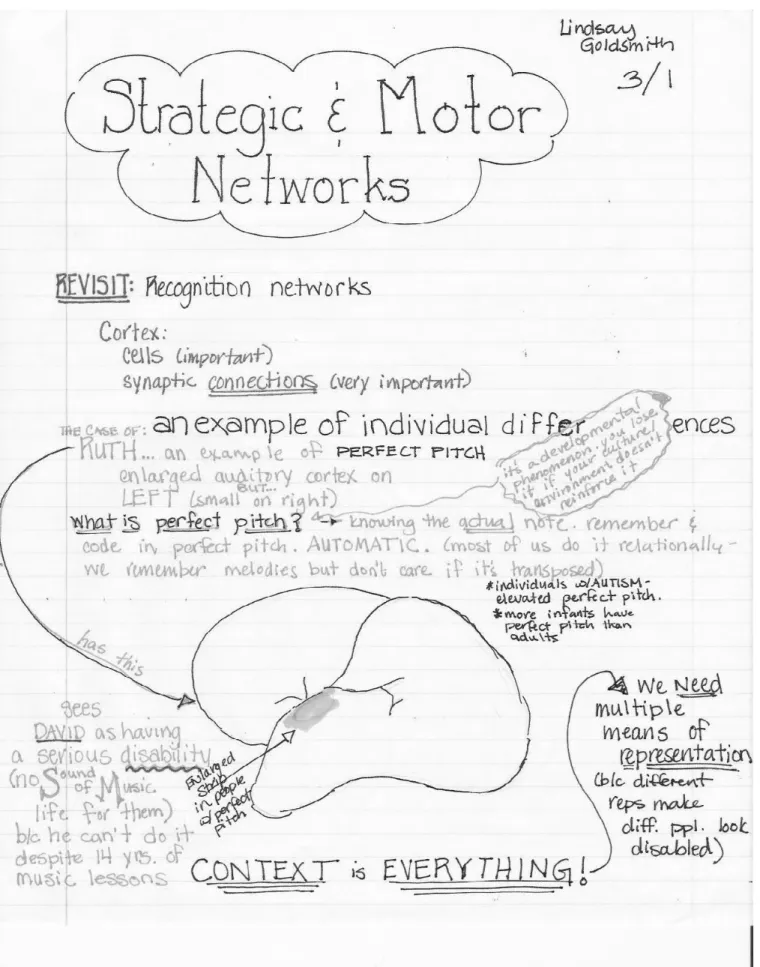
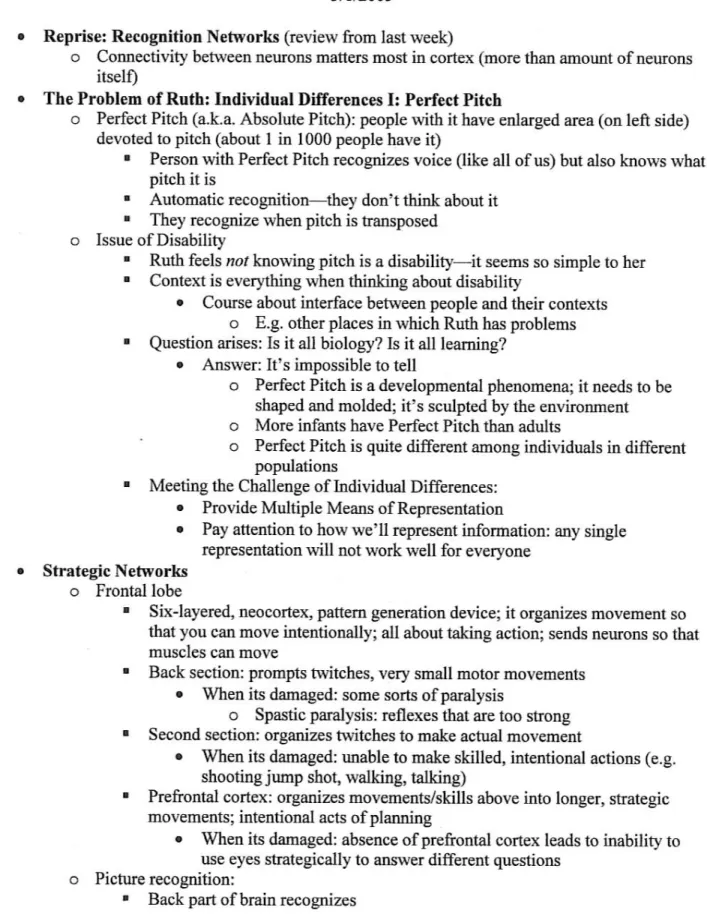
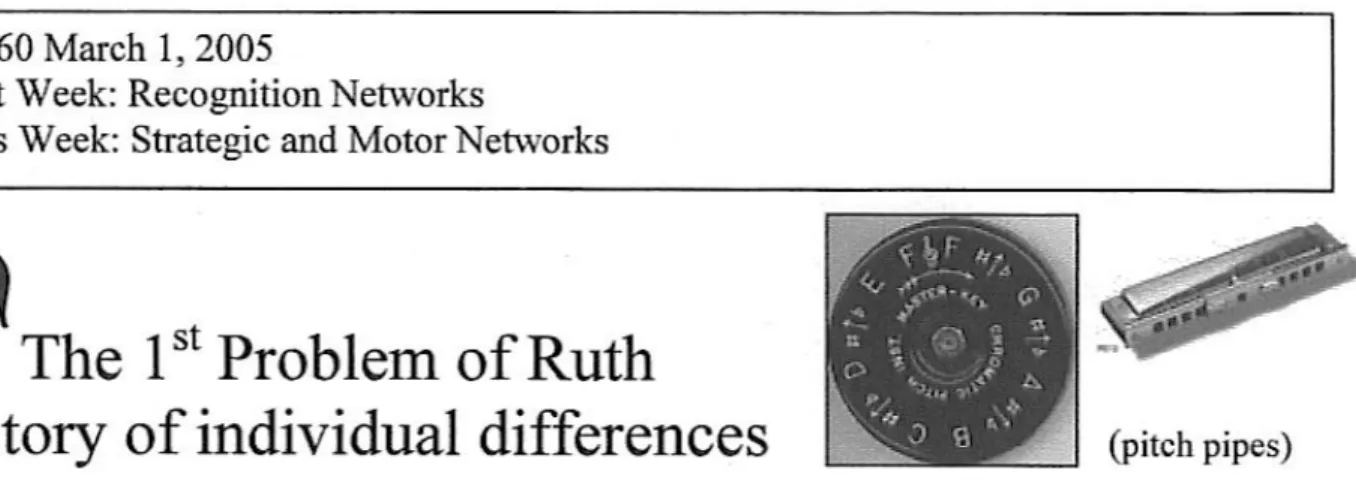
There are several unexpected benefits of this notetaking process. First, the notes are more universally designed than the lecture itself; that is to say, different students capture and express very different content from the lecture and they represent it in very different ways. In addition, despite being ungraded, students are highly engaged with the notes, responding to student notes in online discussions on the course website and using them as examples during class lecture. The variance in T-560 notes is astonishing. Some students post notes that are almost perfect linear outlines of the lecture. Some are very short and succinct with bullet outlines only, while others are much longer, more expressive, and expansive. Others are different in kind. For example, some students do not outline the talk at all and are much more anecdotal than taxonomic, capturing more of the “stories” of the lecture than its structure. That is only the beginning of the variation. Some students take very graphic notes in-stead of ones that rely primarily on text. Their notes range from doodles that accompany text, to heavy use of illus-tration and visual highlighting that clarify and connect parts of the text, to notes that are literally superimposed on the PowerPoint slides of the lecture, to full-scale vi-sual representations of the main ideas and concepts in the lecture that have almost no words, just labels. The latter are often a big hit with other students, who find them immediately a strong complement to the outline view. With students’ permission, we use Figures 1, 2, and 3 to show samples of student notes from the same lecture on strategic and motor networks; they illustrate some of the diversity of student notetaking in T-560.
A second benefit derives from the public posting of the notes. Students, seemingly already engaged with the notes, recognize that their notes are about to become pub-lic to their peers. As a result, they often enhance the notes in various ways: bringing in additional informa-tion, commentary, or questions; adding images or draw-ings; adding multimedia (like video or sound); or prepar-ing the notes in a particularly cogent and clear way. We never have requested this kind of enhancement. Instead, there is a natural contagion of enthusiasm among the notetakers who, of course, view notes from the previous
Figure 2.
Example of student notes displaying notetaking with a traditional typed outline and bullet-point
style.
Figure 3.
Example of student notes displaying a style of notetaking that mixes clip art graphics, Internet
links, and typed text..
lecture as a way of preparing to take their own. They learn, in fact, to take better notes by informally mentoring each other.
Lastly, the point of universal design becomes clear to every student quickly, as the kinds of notes they take and what they “learn” from a given lecture often differ greatly from the person sitting next to them. Even though the lecture conveys ostensibly the exact same content for all 93 students, its reception is highly variable. Students perceive, understand, and prioritize very different things within the same lecture. This is often especially interest-ing (and a big relief) to students who have been told they “cannot” take notes because of a disability (e.g., having a learning disability or brain injury, being deaf or hard of hearing). While initially dreading this aspect of the course requirement because of preexisting beliefs about what constitutes “good” or “acceptable” notes, they often quickly realize that their notes will be as “good” as their classmates’ notes. Last year, one student told a T-560 teaching assistant that she felt more like a true member of the class, learned a lot about herself, and gained new insights into her learning disability and what it meant for her learning, simply because of the T-560 notetaking sys-tem.
Thus far, we have talked about three different repre-sentations of the lecture: an alternative sensory presenta-tion, like ASL; a re-viewable alternative in the form of web-based videos; and multiple notes shared among stu-dents. There are many other ways to provide alternative means of support within a lecture. We will provide one more example.
Cognitively, a lecture places many demands on stu-dents. For example, a lecture’s structure is generally much more implicit than its textual counterpart. Missing are the explicit reviewable divisions into visible chunks like sentences, paragraphs, and chapters; the structural sup-port provided by explicit and multiple levels of headers; and the use of white spaces and page layouts to empha-size structure. Good lecturers use a variety of techniques to make their structure more explicit and memorable, and to reduce the cognitive load in other ways (e.g., by using a great deal more repetition than editors of written text would tolerate, by explicitly stating the structure of the talk early and often, and by explicitly summarizing where the argument has come so far).
In T-560, as in other courses, we seek to provide cog-nitive and structural supports during the lecture. PowerPoint slides, for example, are a nearly constant accompaniment. We use slides in two primary ways. First, the slides are used to clarify and make explicit the structure of the talk. Most teachers of public speaking rightly criticize the overuse of slides in “bullet point”
mode, where speakers essentially read their slides to the audience, often to the detriment of content and meaning (for a discussion of these concerns, see Tufts, 2003). Even though we are sometimes guilty of that as well, PowerPoint slides are most frequently used in T-560 to introduce a new topic or to summarize a previous sec-tion. That is, they provide the structure, but not the sub-stance of the presentation.
During the main part of lecture presentations, the slides are primarily graphic or visuals: They are an alter-nate representation of the content and a complement to it, rather than a restatement of what has been said ver-bally. In particular, we attempt to use slides that capture the power of graphic images over text, including the abil-ity to clarify and emphasize relationships between facts, concepts, ideas, principles, and processes. The primary power of images is exemplified well in a graph. A quick glance at a graph provides a rich and explicit exposition of the relationships between several variables or sets of things. Providing that same exposition through words is extremely labor intensive, and often too opaque. Other images, a photograph or video, have the same privileged capacity to convey relationships of interest. For example, an elephant’s size relative to a zebra’s is much easier to convey in an image than in words. In addition, we try to provide a structural context within slides – a header at the top of a graphic slide, for example. The header is a reminder, an element of structure, to students that we are looking at examples of “good website design” or “the limits of sound.” In a more subtle way than bullet points, in this way we hope to provide structural supports that help students follow and make meaning of the presenta-tion.
These and other means are used to make lectures more accessible to a wide variety of students. In our impres-sion, most students like these alternatives, whether or not they have any disabilities that require their use. In that way, they are good universal designs when taken as a whole.
Discussion Groups and UDL
Discussions are often seen as a supplement to lec-tures or a complement to assigned texts. For some stu-dents, especially students with learning disabilities, the format of small-group discussions is more accessible than lectures or books. The highly interactive nature of small groups (when facilitated correctly) overcomes the pas-sivity of lectures and books, makes material more rel-evant and engaging for many, and provides the potential for complex active group-based construction of knowl-edge rather than simple delivery of information. For those reasons, and many others, it is beneficial to provide
dis-cussion groups as components in any course – both as a complement and as an alternative to the other media. Yet small group discussions are a limited medium for some students. With this in mind, we apply UDL principles to discussion groups using the approaches discussed below. First, students may choose among different discus-sion groups offered during the week. In addition, all dis-cussion groups are optional – students may choose any, all, or none, although it is one of several ways to fulfill participation requirements (notetaking, as mentioned above, is another). In practice, some students come to many sessions, some to only a few, and some to none. The sessions differ in several cognitively meaningful re-spects; however, we have noticed that some students base their choices on the entirely social aspects of who is in the group or who is leading it.
There are “review” sessions, where new information is not typically presented, but where students have an opportunity to ask questions about the material for the week, participate in guided review discussions of the week’s content, discuss implications or highlights of the material, express concerns, and so forth. These are ideal for students who find the content of readings or lectures either too challenging or too abstract. It is also a good place for students to inquire about gaps in background knowledge they are missing (e.g., some students who are not K-12 teachers may want to know more about lesson plans when we talk about designing curricula).
An alternative is sessions that are called “advanced.” In the advanced sessions, the teaching staff assume stu-dents have already read and understood the material for the week and, therefore, discuss something that extends or challenges that material, connecting it more deeply to other knowledge or ideas. In these sessions an additional relevant reading is assigned that is provocative, new, stimulating, controversial, or even contrary to material otherwise presented in the course. Students must read the extra reading before coming to class. Typically about 10 – 15 percent of students show up for these kinds of sessions in a given week, although about 25 percent of students participate in them over the course of the se-mester. These are ideal sessions for students who find the lectures or readings too elementary or concrete.
Another way in which the discussions differ is in the medium for participation. Each week students may choose to join either a face-to-face group or an entirely online discussion group (offered as a component of the course website). Students differ significantly in terms of the kinds of discussions they consistently prefer. Some students join only face-to-face groups, never participat-ing online. Others choose just the opposite. And some come randomly or “attend” both types.
We have not done research to understand the basis of students’ choices. Some things seem obvious though. Students with dyslexia tend to come to face-to-face ses-sions, rather than writing online. Students who are con-stitutionally or culturally “shy” seem to choose the online discussions. What is clear is that the medium very sig-nificantly biases student participation. Without the op-portunity to participate in discussions online, many stu-dents are underrepresented in their ability to show what they know, or they experience barriers to engaging in meaningful dialogues about the course material.
By providing options, multiple means for those dis-cussions, we have found higher rates and quality of en-gagement in these aspects of the course. In our review of the past year, we came to the conclusion that all our ses-sions, live and online, would be enhanced by providing specific topics or activities that made them more coher-ent. As a result, for next year, we will try to use the dis-cussion sections to emphasize an alternative way of en-gaging in the course content by using case studies. Textbooks and Universal Design for Learning
Books (and other texts) are not a promising founda-tion for UDL because they are inherently inflexible. The product of mass production, they are designed with a uniform display and identical content for every student. In addition, most books are delivered to colleges and universities in print, a technology that is particularly dif-ficult to modify, and thus, to meet the needs of many stu-dents with disabilities. As a result, books as they are presently delivered create barriers rather than opportuni-ties for many students. Nevertheless, they are popular in universities (and we like them for their virtues, not their liabilities), so in T-560 we use books. For the most part, we use books in typical ways: Three or four books are assigned and suggested for purchase, with others on a recommended list. Two are textbooks, and the others are trade books or topical readings on education, media, and neuroscience.
When the reading list is distributed, students notice one thing immediately - the two textbooks seem to cover the same exact topic of introductory cognitive neuro-science. Moreover, the syllabus recommends that stu-dents purchase and read only one of them. But which one? That choice is left to each student. This is the first place in the course where students typically begin to con-front alternatives (while developing an understanding of UDL from a first-hand perspective). Some are charmed by the choice of alternatives, others become alarmed. For some, the fact that either book will suffice does not square with the ways in which they have been taught to use text-books. While there is likely considerable overlap between
the books, every student knows that there will clearly be topics, ideas, names, facts, experiments, or methods in one that are not included in the other. One of the books is even much thicker than the other, so how can one even think about buying the thinner one – for fear critical in-formation is left out?
Students soon note, and we also point out, that the books are different not only in the content they present, but in the way they present the content. One book by Banich (2004) has a great deal more words (it is also much thicker). It is a highly literate, well-written and researched book that is authoritative and scholarly, with occasional illustrations. The main thrust is clearly the text. The other book, by Carter (1998), is highly visual, loaded with drawings and diagrams. It is a thinner book, with many fewer words but with many more diagrams, illustrations, color, graphics, and maps. Having noticed the difference, students are encouraged to buy the one that seems best for them. Typically, Carter’s book sells a bit more, but many students buy Banich. Students are encouraged to borrow each other’s books, to compare them and to get the best of both, and some do that. A few buy both books. Regardless, this first choice sets the stage for the course. It is not that either book is perfect, has the “truth” of cognitive neuroscience, or has the right way of presenting information for all students. Instead, students are confronted right from the start with the fact that they might not all like their information presented in the same way. It’s a start.
Later there are other choices about books. One of the books, Teaching Every Student in the Digital Age: Universal Design for Learning (Rose & Meyer, 2002), is available at the bookstore and library as usual. With the permission of the publisher, the entire book is also avail-able on the web absolutely free at http://www.cast.org. Nonetheless most students choose to purchase it in print. For most students, reading a whole book online is not a positive experience. The print version is more conve-nient, more readable in the long run, and more familiar. Most of the students in this class are adult graduate stu-dents, immigrants to the land of digital books instead of natives. However, some students who are very pleased to read the book entirely online. These students, students with dyslexia or students who are blind, for example, do not find that the print version is more convenient, more readable or more comfortable. For them it is much bet-ter to read the book online using a talking browser. Other students, like those with ADD/ADHD or those who are computer-savvy, prefer the online book because they en-joy exploring the format, especially embedded links, which foster connections to relevant material that may not be as easy to access through a print version.
Not all the course books are available in this alterna-tive fashion yet. As a result, students who have dyslexia typically approach the Disability Services Office to scan the printed books into digital versions that they can use. This is an unfortunate, time-consuming, and expensive workaround to overcome the limitations of print, but that will soon change.
Earlier this year, the U.S. Department of Education endorsed, both houses of Congress passed, and President Bush approved a revision of IDEA that included a new policy: the National Instructional Materials Accessibil-ity Standard (NIMAS). NIMAS stipulates that publish-ers must provide a digital source file of their printed text-books to a national repository at the time of distributing print versions. Furthermore, states must distribute ac-cessible versions of those source files to their students in a timely fashion. NIMAS is valuable because it speci-fies the format (an XML base with DAISEY tags) in which the textbooks must be provided, making it vastly faster and easier to generate many types of accessible and digi-tal versions, and the format is consistent for all publish-ers and for all states and districts.
Officially, NIMAS only applies to preschool, elemen-tary, and secondary education. However, the popularity of NIMAS among states and publishers alike has led many colleges and state systems, as well as publishers, to con-sider adopting the NIMAS standard for postsecondary use as well. However, these ideas have yet to be imple-mented in any formal or systemic way. Soon, we believe that there will be readily available textbooks in both print and digital accessible versions.
Multimedia, the Course Website, and Universal Design for Learning
Text and textbooks are a limited presentation medium. In the T-560 course, we include a richer set of media as alternatives. The use of video for lectures is an example, but the simplest expansion of media comes from using the web as the basic skeleton for the course.
The course website is central to the course in many ways. It serves as a frame that holds the syllabus, the assignments, the discussion groups, the projects, the class notes, the class videos, the PowerPoint slides for the lec-tures, and much more. For each week, there are also links to many websites that are presented as additional repre-sentations of the topic for the week, or as scaffolds and supports for student learning.2
While, in general, there are many low quality mate-rials on the web, some websites are extremely informa-tive and relevant to our class. An advantage of websites is the rich set of media out of which they are constructed. As an example, one of the course lectures draws heavily
on understanding optical illusions. While, there are typi-cal examples of illusions in both textbooks, there are several extraordinary websites devoted entirely to under-standing illusions. These websites have extensive col-lections with accompanying explanations. Moreover, the range of illusions is far more extensive and dramatic than those available in print. For example, illusions of move-ment or sound cannot be captured in text. During the lecture, which is always conducted with a live connec-tion to the web, some of these more dramatic illusions are exhibited and discussed.
In the course website, the multimedia syllabus con-veys not only the text “readings” for the week, but also the websites and other media, all available for easy ac-cess through simple clicks of a mouse. These alterna-tives are mildly engaging for some students, but for oth-ers this chance to explore course ideas in a broader and richer context is very important. In fact, for some stu-dents who were born in a different generation than their professors, this use of contemporary media seems essen-tial for relevance and comprehensive understanding. Assessment Methods for the Course
It is not enough to use the framework of UDL only when considering how to present and teach methods in-formation or skills. It is also essential to consider UDL as a framework to guide the design of another critical element of instruction: assessment. In considering as-sessment, we will focus on the second principle of UDL: providing multiple means of action and expression. While the other principles are also part of assessment, for brev-ity we will focus on the obvious fact that assessment draws heavily on the ways in which students are required to demonstrate and express what they know. From a UDL perspective, it is essential to provide multiple means for that expression.
There are many assessment techniques, the choice of which should be aligned with, and constrained by, the goals of the course. In our course, we want to develop students who are not only able to recognize UDL in prac-tice, but who can also express that knowledge in action. Whether they are designing a curriculum or a workshop, choosing from among a number of curricular options, or preparing to teach a single unit or lecture, we need to know whether they can effectively apply what they have learned. Is it usable knowledge? Administering mul-tiple-choice tests or essay questions is not likely to be an adequate measure of those abilities, nor is writing a tra-ditional paper about how they might apply what they have learned. As a result, we require that students complete two projects on which they are graded.
Midway through the course, students prepare and
submit a midterm project that requires them to review the research literature on one type of learner (of any age level, including adults) and to create a website. Students are encouraged to choose an atypical learner as their fo-cus. While “atypical” is usually associated with a dis-ability of some kind (dyslexia, autism, ADD/ADHD, Turner’s Syndrome, William’s syndrome, etc.), past projects have focused on other types of atypical learners, including those for whom English is a second language and students with gender dysphoria. Students research current neuropsychological literature to identify what is known about the underlying neurology of that type of learner, and to articulate their resulting strengths and weaknesses for that learner in a specific subject or edu-cational setting (e.g., dyslexic students in a 5th-grade
sci-ence lab).
Traditionally, the results of such student research is presented via a 10-page paper. However, the second prin-ciple of the UDL framework encourages greater flexibil-ity in the means students can use to express what they have learned. As a result, students in T-560 can not only use text, but also images, sound, video, the web, and so forth. To stimulate their choices, we artificially limit the word count to approximately 1,500. We do that because most students, left on their own, tend to limit themselves to text because it is most familiar to them as an academic medium; with a low word limit, they must rely on alter-native means to convey very complex reviews of neurop-sychological research and their conclusions. For some students an expansion of possibilities is a bit threatening, for others the broader palette is very appealing.
When finished, all students must submit their projects in the form of a website that then becomes part of an online learning network where all students’ websites are linked up to each other. This manner of submitting their work is very challenging for some students, and many have never created anything on the web before. We have nonetheless chosen to use the web, rather than paper, as the vehicle for presentation for several reasons.
First, the web provides a rich and flexible founda-tion for using multiple media. Students can use text but also a rich variety of other media. Second, the web pro-vides a way for students to learn from each other’s work. Whereas papers have a limited audience of the professor or teaching assistant, the projects on the website can be accessed by all members of the class. Not only is this more motivating for students, it is more instructive. Each year we see tremendous learning derived from this abil-ity to view each other’s work. In fact, we now empha-size this type of collaborative learning by encouraging students to link their projects to those of other students. Particularly in the final projects, in which students
de-sign a lesson or curriculum that considers the profile of the learner in their first projects (and reflects the prin-ciples of UDL), students take great advantage of other students’ work as part of their background research for their own projects. But even more apparent is the explo-sive effect of particularly strong projects, especially ones that take advantage of the multiple media. The conta-gion of “best practices” is easily apparent, as high-qual-ity projects serve as terrific, highly relevant models to emulate and learn from.
How are these projects, so public and non-traditional, graded? Each year students ask anxiously if we will grade on presentation or layout (as opposed to content). Most hope that we will not, primarily because they realize that some students in the class have highly developed skills as web or media designers. (There are students in the class who are majoring in media design.) Thus, some students may be at a considerable advantage in their pre-sentation skills. This realization usually sparks an im-portant dialogue in the class. Inevitably some students, usually students with dyslexia or English as a second lan-guage, raise the opposite point of view, hoping that pre-sentation will indeed “count.” For them, the increased palette has “leveled the playing field” for the first time in their academic careers, and they are delighted to finally have an outlet that is more accurately reflective of their abilities.
Eventually, they learn that presentation does count. Certainly, we are forgiving for beginners, but we stress that even beginners can make good choices about the kinds of media that are optimal for expressing different kinds of knowledge. And we provide, in a UDL way, many different ways in which students can get support in making their presentations effective; that is, multiple ways to support expression.
Three types of support are customary. First, we pro-vide plenty of models. For the first project, models are typically provided from the previous year’s class. For the second project, there are plenty of models from the first projects of their peers. Second, we provide multiple scaffolds. We offer labs or sections where students can come to learn the basics of both web design and the use of databases to find relevant literature. This year for the first time, we encouraged the students with advanced web design skills to offer these labs (as part of their participa-tion credit), which was a big hit for both instructors and students. All the labs are at different skill levels so stu-dents can learn from any level of prior knowledge. We also encourage students to work collaboratively, and they do, even though they each are responsible for their own website. Students who are skilled at media design, even though they may not be knowledgeable in neuroscience
or skilled in writing, turn out to be very popular as peer collaborators with educators and researchers who may know how to read a web page, but have never designed one. Complementarily, students who have excellent back-grounds in education, neuroscience, or research are popu-lar collaborators for media designers struggling with the class content. The two projects - presenting research and then planning a lesson - draw on the varied strengths of students in the class, giving everyone a chance to have background knowledge rise to the fore.
Affect and Engagement in T-560
From a UDL standpoint, there is a final concern: Does the course succeed affectively, engaging the students? Does it engage different kinds of students? Does engage-ment sustain itself into changes in practice? Overall, there are indications that the course engages a reasonably broad range of students. For one thing, the course is popular. This is especially notable because it requires a consider-able amount of work in difficult subjects, the course is not required for any degree concentration, and there is no special education major at Harvard. What attracts stu-dents?
We believe that one of the significant attractions of the class is its attempt to respond to individual differ-ences, providing multiple ways of presenting informa-tion and allowing students to respond. Of particular im-portance, especially for adult learners, is the ability to make choices (e.g., Cordova & Lepper, 1996).
In the course, as we have noted, students experience choice in almost every arena: choices in the textbooks they choose to read, the kinds of media they prefer to learn from, the timing and level of discussion groups, the media mix they use for their projects, the format for dis-cussions, the amount of support they prefer, and the ways to interact with materials. For some students there are still not enough choices, and for some there are too many. But overall, the mere availability of choice is a tremen-dous source of attraction and motivation in the course.
There is a second way in which choice is important, and it addresses the faculty and teaching assistants. Be-cause there are multiple means of interaction in the course, there are choices for the faculty as well. At the begin-ning and throughout the course, we emphasize the differ-ent areas in which we as members of the teaching staff have strengths and weaknesses (in content areas, web design, pedagogical strategies, etc.). This “distributed intelligence” eliminates having to be everything to ev-eryone. It also models for students the value of collabo-rative teaching and learning. To some extent, the instruc-tors choose the kinds of interactions with which they are
most comfortable, and at times they choose situations where they will be challenged to learn relatively new in-formation or skills with the support of other instructional staff, placing them in the best positions to succeed and to feel engaged.
Lastly, it is important to emphasize a secondary ben-efit of universal design. Because there is a richer media mix in the course than in many others, there are opportu-nities to specialize. It is very clear that, over the last five years during which the alternative media became more prominent, the lectures have become better. Essentially, just as radio differentiated from television and became more popular in the process, the lectures have been able to differentiate themselves from the other course media. The lectures are used less for information dispensation and more for teaching, modeling, emphasizing, and con-necting. They are used more for the kinds of things for which they are optimal.
Conclusion and Recommendations
There are two broad kinds of solutions for address-ing the “problems” of individual students, includaddress-ing those with disabilities. On the one hand, the problems can be considered “individual” problems (e.g., the student has a disability that interferes with his or her ability to access the content of the course, to express knowledge, or to engage optimally in it). Such a view fosters solutions that address weaknesses in the individual. On the other hand, the issues can be considered “environmental” problems in the design of the learning environment. For example, the typical overreliance on printed text for presenting content and evaluating students clearly, and differentially, raises barriers to achievement for some students while privileging others. Such an environmental view fosters solutions that address the limitations of the learning en-vironment rather than the limitations of the student, while making the student less of a problem, and more a part of diversity within the course. The advantage of such uni-versal solutions is that, as with such approaches in built environments, they are likely to be useful for many indi-viduals; built once, applied many times.
We believe that both approaches are important from a pedagogical standpoint. In their intersection, moreover, we will find solutions that are not only more economical, but also more ecological. They reflect the fact that so-called disabilities always reflect mismatches between the environment and the individual. Right now, we believe that universities place too much emphasis on the disabili-ties in students, not enough on the disabilidisabili-ties in the learn-ing environment. Accommodations and access issues are largely addressed on an individual basis, rather than on
Endnotes
1. Additional resources for teaching and learning about UDL may be found at CAST’s website at http:// www.cast.org. The book Teaching Every Student in the Digital Age: Universal Design for Learning (Rose & Meyer, 2002), which provides background for the principles and applications of UDL, may be found on the CAST website in an accessible format and free of charge. The website includes additional resources and templates, including PowerPoint presentations to as-sist individuals who are teaching UDL to faculty or other interested parties.
2. The website for the course described in this paper may be accessed at http://my.gse.harvard.edu/icb/ icb.do?course=gse-t560. Some sections of the website are not available to the general public to protect copy-righted material and the privacy of students who have contributed their work and words.
the level of courses, departments, or universities. Uni-versal design presents other options and perspectives on access that will ultimately benefit all students, disabled and nondisabled.
References
Banich, M. (2004). Cognitive neuroscience andneuropsychology (4th ed.). Boston: Houghton Mifflin.
Barbarotto, R., Laiacona, M., Macchi, V., & Capitani, E. (2002). Picture reality decision, semantic categories and gender: A new set of pictures, with norms and an experimental study.
Neuropsychologia, 40, 1637-1653.
Bowe, F. G. (2000). Universal design in education: Teaching nontraditional students. Westport, CT: Bergin and Garvey.
Carter, R. (1998). Mapping the mind. Berkeley: University of California Press.
Cordova, D. I., & Lepper, M. R. (1996). Intrinsic motivation and the process of learning: Beneficial effects of contextualization, personalization, and choice. Journal of Educational Psychology, 88, 715-730.
Cytowic, R. E. (1996). The neurological side of neurospychology. Cambridge, MA: MIT Press. Damasio, A. R. (1994). Descartes’ error: Emotion,
reason, and the human brain. New York: Putnam. Farah, M. J. (2000). The cognitive neuroscience of
vision. Malden, MA: Blackwell Publishing, Inc. Fuster, J. M. (2002). Cortex and mind: Unifying
cognition. New York: Oxford University Press. Goldberg, E. (2002). The executive brain: Frontal
lobes and the civilized mind. New York: Oxford University Press.
Jeannerod, M. (1997). The cognitive neuroscience of action. Malden, MA: Blackwell Publishing, Inc. Lane, R.D., & Nadel, R. (Eds.). (2000). Cognitive
neuroscience of emotion. New York: Oxford University Press.
LeDoux, J. (2003). Synaptic self: How our brains become who we are. New York: Penguin Group. Luria, A. R. (1973). Working brain: An introduction to
neuropsychology. New York: Basic Books.
McGuire, J. M., Scott, S. S., & Shaw, S. F. (2004). Universal design for instruction: The paradigm, its principles, and products for enhancing instructional access. Journal of Postsecondary Education and Disability, 17(1), 10-20.
Mountcastle, V. B. (1998). Perceptual neuroscience: The cerebral cortex. Cambridge, MA: Harvard University Press.
Ochsner, K.N., Bunge, S.A., Gross, J.J., & Gabrieli, J.D. (2002). Rethinking feelings: An FMRI study of the cognitive regulation of emotion. Journal of Cognitive Neuroscience, 14(8), 1215-1229. Panksepp, J. (1998). Affective neuroscience: The
foundations of human and animal emotions. New York: Oxford University Press.
Rose, D. H., & Meyer, A. (2002). Teaching every student in the digital age: Universal design for learning. Alexandria, VA: Association for Supervi-sion and Curriculum Development (ASCD). (Also available in digital format at http://www.cast.org). Rose, D. H., Meyer, A., & Hitchcock, C. (2005). The
universally designed classroom: Accessible curricu-lum and digital technologies. Cambridge, MA: Harvard Education Press.
Sandak, R., & Poldrack, R. A. (Eds.). (2004). The cognitive neuroscience of reading: A special issue of scientific studies of reading. Mahwah, NJ:
Lawrence Erlbaum Associates, Inc.
Shaywitz, S. (2005). Overcoming dyslexia: A new and complete science-based program for reading prob-lems at any level. New York: Random House. Shaywitz, S.E., & Shaywitz, B.A. (2004). Reading
disability and the brain. Educational Leadership, 61(6), 6-11.
Stuss, D. T., & Knight, R. T. (2002). Principles of frontal lobe function. New York: Oxford University Press.
Tufts, E. R. (2003). The cognitive style of PowerPoint. Chesire, CT: Graphics Press.