Research Project - Phase IV
September 1999 to August 2000
School for Professional Studies New Ventures
Regis University
Prepared by Raymond J. Wlodkowski, Ph.D. Luis Iturralde-Albert, M.B.A.
Jennifer Mauldin, M.S.
Purpose
This report presents the findings of the fourth phase of a research project conducted by Regis University. The purpose of the project is to conduct ongoing studies to:
1. assess the academic quality of accelerated courses 2. assess the value of accelerated courses to students
3. to investigate the effects of time in class and length of course on student learning and attitudes 4. link these research findings to recommendations for improving instruction, academic programs, and
professional development
5. contribute locally and globally to the knowledge base for adult learning in general and to accelerated learning in particular
The research reported in Phase 4 replicates a study conducted in Phase 2 (1997-1998) at Regis University. The Phase 4 study, conducted in the Spanish language, compared student perceptions and learning in accelerated courses (5 weeks, 20 contact hours) and conventional courses (16 weeks, 40 contact hours). This is the first study to investigate the effectiveness of an accelerated format in higher education in a country other than the United States and in a language other than English.
Information presented here is intended to contribute to academic quality at Regis University, particularly in the School for Professional Studies and New Ventures’ Partner Schools.
Institutions and Organizations Participating in the Research Project
1. Regis University is a Jesuit University located in Denver, Colorado. The School for Professional Studies serves primarily adult learners and offers classroom-based accelerated courses (5- and 8-week formats) as well as on-line education courses and guided independent study. The school has a variety of both Bachelor and Master degree programs.
2. New Ventures of Regis University is a program that assists higher education institutions in developing their own accelerated degree-completion programs for working adults.
3. New Ventures’ Partner Schools are colleges and universities who have entered into a formal relationship with Regis University to establish an accelerated undergraduate or graduate program. There are 18 partner schools in the United States and four international partner schools. The three colleges that participated in Phase 4 are Colegio Universitario del Este, Universidad del Turabo, and Universidad Metropolitana. These institutions are part of the Ana G. Méndez University System in Puerto Rico.
Introduction and Background
In recent years both the School for Professional Studies (SPS) and New Ventures have enjoyed remarkable growth. Over 10,000 students are enrolled in the SPS, and 28 colleges and universities have participated in the New Ventures Program. Operating within the central values of the Jesuit tradition, these two university
units offer experienced adults a post-secondary education that is responsive to the realities of their
communities and professional lives. The key element of academic structure for both of these systems is the accelerated course. In the Fall Semester of 1999, the SPS offered 800 accelerated courses ranging from philosophy, accounting, and computer science to adult spiritual life and growth.
Although accelerated courses (often referred to as intensive courses) have been offered by colleges and universities for many years, they remain somewhat controversial. Conventional academic thinking often regards such courses as too compressed to produce consistent educational value (Scott and Conrad, 1992). Still other higher education pundits critique them as sacrificing breadth and reflection, resulting in learning that is crammed and poorly developed. Empirical research, however, finds substantial support for the accelerated format. In their comprehensive critique of accelerated courses, Scott and Conrad (1992, page 443) conclude, “… the large number of studies across all fields with no preference between compressed and traditional formats suggest that all courses– regardless of field –can utilize intensive course designs without diminishing educational outcomes.” Most studies find students to be favorably inclined toward accelerated courses (Scott and Conrad, 1992; Shafer, 1995). They appreciate the convenience and effectiveness, the opportunity for concentrated and uninterrupted study, and the strong interest this intensity cultivates. Adult learners, in particular, generally prefer a relevant and efficient format to accomplish pragmatic educational goals (Kirby-Smith, 1987; Grimes and Niss, 1989, Wlodkowski, 1999).
How then might one explain the apparent effectiveness of accelerated courses? What factors, other than time in class, might contribute to knowledge acquisition in a course? Certainly, student motivation would be an influence. Research consistently shows a strong positive relationship between student motivation and learning (Pintrich and Schunk, 1996). A key assumption in adult learning theory is that adults strive to be more self-directed and autonomous (Brockett and Hiemstra, 1991). This personal attribute would be an asset to learning in the intense and relatively short accelerated course. Also, Stratil (1988) finds that adults as a group, when compared to younger college students, are more willing to make sacrifices to achieve academically. Theory and research suggest that adult students are more self-directed and self-motivated than younger traditional college students. These characteristics may enable adults to do the concentrated, independent study required in accelerated courses. In addition, many adult students have the benefit of extended professional work experience where they have honed their writing and critical thinking skills. These attributes would also contribute to their academic success.
In 1996, Bill Husson, (Vice President, SPS) and Tom Kennedy (Vice-President, New Ventures) initiated a research study under the direction of Raymond Wlodkowski to evaluate accelerated courses. This work has become a longitudinal research project focusing on the quality and improvement of learning models in SPS and New Ventures. In August 2000, after four years of continuing research, Regis University established
The Center for the Study of Accelerated Learning. The mission of this institute is to research adult learning, to evaluate instruction, to document student outcomes, and to provide ongoing education in order to assure the quality and success of accelerated programs.
Phase I:
In 1996-1997, a study was conducted to investigate the quality of undergraduate accelerated courses at Regis University and a representative sample of New Ventures’ Partner Schools. Researchers surveyed current students and alumni from Davenport College, Emmanuel College, and Regis University to assess their perceptions of and value for accelerated courses. The findings for both groups documented their strong satisfaction with the motivational appeal and instructional effectiveness of accelerated courses. As one example of many, 84 percent of current students and 82 percent of alumni indicated they would return to their respective colleges if they could start college again.
The researchers also assessed the learning of current students with summative, performance-based problems and case studies. Using criteria-referenced standards, faculty experts found that on the average, for all courses, students demonstrated more than satisfactory learning and very good writing skills. Phase II:
In 1997-1998, a study was conducted to investigate the effects of time in class and length of course on student perceptions and learning when accelerated courses are compared to traditional courses. Researchers compared the perceptions and learning of students in accelerated courses (5 weeks, 20
contact hours) with the perceptions and learning of students in traditional courses (16 weeks, 40 contact hours) at Regis University. There were no trends or significant differences favoring either format. In
accelerated and traditional courses, students had very positive attitudes toward their courses and, according to criteria referenced standards, they were more than satisfactorily learning what was required of them in both formats.
Phase III:
In 1998-1999, researchers replicated the study that was conducted in Phase 1 (1996-1997), but this time with St. Ambrose University, Rosemont College and Regis University. This study allowed researchers to compare the perceptions and learning between students in Phase 1 and Phase 3. The findings from both Phase 1 and Phase 3 indicate that current students and alumni have very positive attitudes toward accelerated courses. Students in both phases on the average demonstrate more than satisfactory learning that meets the challenge of college coursework. However, student learning of research and theory, particular to courses in Management and Management of Human Resources, is less than satisfactory in Phase 3. To improve these matters, researchers recommended that the professional development of instructors in these courses include emphasis on active methods to teach theory and research as well as further revision of the teaching modules for these courses.
Research Conducted in 1999-2000, Phase 4
This research, as well as the studies that precede it, is learner-centered emphasizing the perspective and the academic, personal, and professional growth of the learner. The purpose of this study is to investigate the effectiveness of the accelerated learning model in another culture, specifically, Puerto Rico where Spanish is the primary language.
This investigation of adult students in accelerated courses documents their learning and attitudes and compares them with the learning and attitudes of students enrolled in traditional versions of the same courses. The operational research question for this study was: If the same instructor teaches a traditional version (16 weeks, 40 contact hours) and an accelerated version (5 weeks, 20 contact hours) of the same course using the same texts, the same tests, and covering the same learning objectives with very similar teaching methods, will there be a significant difference in learning or attitude between students in the traditional class and students in the accelerated class? See Figure 1 for a graphic representation of the study design.
Since the classes were held as normally scheduled and in their customary college environments, the student populations for each course could not be made equivalent. In other words, student characteristics, such as age, gender, family income, work experience, etc. could not be controlled in order to have the student
populations in each class format as similar as possible. Therefore, it was understood that differences in student characteristics might influence the outcomes of this study and therefore, must be directly assessed and considered. These differences were investigated and are discussed later in this report. However, since the intuitive notion among many college faculty and administrators is that the traditional semester, by virtue of its length and allotted contact hours, directly supports learning, a key question is whether changing the format can account for differences in learning when student characteristics are not held constant. And, if there are differences, which student characteristics might operate to make a shorter course length and less contact hours an effective format for learning?
This is a formative study. Practical considerations limited the scope of the investigation to four courses with their existing, non-controlled and non-equivalent student populations. However, care was taken to develop a valid measure of how well students appear to be mastering course content and to assess student
perceptions of their experiences within each of the course formats: traditional 16-week and 5-week accelerated format. Information gained should provide a better understanding of ways to strengthen course formats and assist on-going efforts to enhance student learning, growth and development.
This study primarily investigated two indicators of course quality: 1) current perceptions of students and 2) current performance of students as viewed by faculty experts in each subject. These measures provide a comparison of student satisfaction with these courses and demonstrate how well these students meet the major learning objectives of the courses.
Method to Research Current Student Perceptions
Luis Iturralde-Albert worked with Dr. Wlodkowski as the on-site Associate Director of the Research Project. The first step in the investigation was selecting four undergraduate courses to be part of the study: Introduction to Economics (Econ 121), History of Puerto Rico (Hist 251), Human Relations in Business (Mana 131), and Labor Relations (Mana 404). These courses were chosen for the following reasons:
1. They utilized experienced faculty who teach in both the traditional and accelerated programs at their respective colleges.
2. In content, they represented a variety of disciplines: economics, history, social science, organizational development, and business management.
3. Each course could be arranged to have the same instructor teach a traditional and an accelerated version of the course during the Spring semester of 2000.
4. They are often part of the curriculum for both the traditional and accelerated programs within the Ana G. Méndez University System.
The courses, their locations, and enrollments were as follows:
School Course Traditional (n) Accelerated (n) Universidad Metropolitana Econ 121 12 26
Colegio Universitario del Este Hist 251 30 21
Universidad del Turabo Mana 131 30 20
Colegio Universitario del Este Mana 404 20 22
A total of 181 students participated in the study, 92 in traditional programs and 89 in accelerated classes. As part of this research design, it was considered important to have an equal number of performance
assessments from each section of an individual course (e.g. equal numbers of performance assignments from the traditional and accelerated versions of each course). Thus, random selection techniques were used to delete the required number of student responses (both survey and performance assessments) from the larger of each pair of classes. After the researchers had completed this procedure, there were a total of 144 students in the study with 72 students representing the traditionally scheduled courses and 72 students representing the accelerated courses.
Before the courses were taught, each instructor participated in a dialogue with the Associate Director to establish the parameters for the courses and to make the traditional and accelerated versions of each course as similar as possible. All instructors signed a letter of agreement (See Appendix A) that outlined the expectations for the courses and the essential conditions of the research. These expectations and
conditions were identical for all courses. Follow-up interviews with the faculty confirmed that all agreements had been maintained throughout the courses.
Since 1996, we have used a 22 item self-report survey (See Appendix B) to assess student perceptions. This instrument combines items from the Motivational Framework for Culturally Responsive Teaching (Wlodkowski and Ginsberg, 1995) with indicators of instructional quality and a holistic model directly
applicable to learning in college courses. The major underlying theoretical premise of this survey is that most people are highly motivated to learn when they feel included (respected within the learning group), have a positive attitude (find the subject matter relevant), can make learning meaningful (find learning engaging and challenging), and are becoming competent (effective at what they value). Responses to this survey provide an understanding of whether students perceive the conditions for learning as intrinsically motivating. Research consistently shows a strong positive relationship between student motivation and student learning (Pintrich and Schunk, 1996). For this population the Cronbach’s alpha for the entire scale is .92.
Findings for Current Student Perceptions and Characteristics
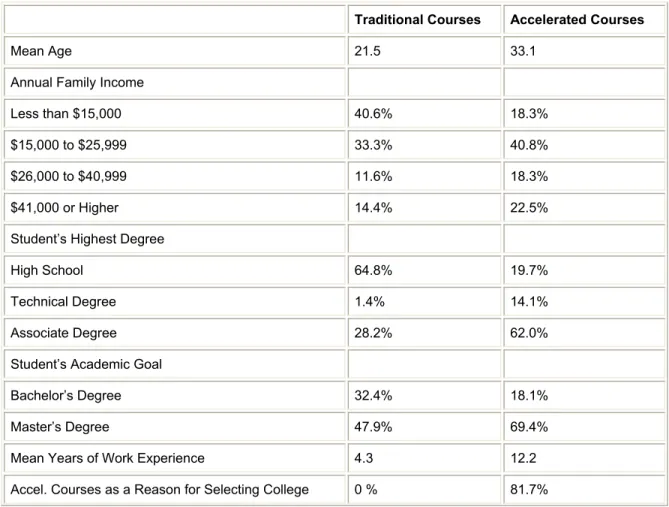
The self-report survey was administered to the students in the last two hours of the final class session. From a demographics sheet (see Appendix B) which was attached to the self-report survey, the researchers found the following significant differences between the students in the traditional and accelerated courses (See Appendix E for details of student characteristics):
Table 1: Student Characteristics
Traditional Courses Accelerated Courses
Mean Age 21.5 33.1
Annual Family Income
Less than $15,000 40.6% 18.3%
$15,000 to $25,999 33.3% 40.8%
$26,000 to $40,999 11.6% 18.3%
$41,000 or Higher 14.4% 22.5%
Student’s Highest Degree
High School 64.8% 19.7%
Technical Degree 1.4% 14.1%
Associate Degree 28.2% 62.0%
Student’s Academic Goal
Bachelor’s Degree 32.4% 18.1%
Master’s Degree 47.9% 69.4%
Mean Years of Work Experience 4.3 12.2
Choose this College Again?
Definitely/Probably Yes 72.2% 88.9%
Uncertain 13.9% 9.7%
Definitely/Probably No 13.9% 1.4%
In the survey, response categories offered four choices: strongly agree, agree, disagree, and strongly disagree. Appendix F provides a comparison of students’ perceptions and attitudes in traditional and accelerated courses for each of the 22 questions on the survey.
Student responses to survey items of particular importance to motivation were: 4. Overall, this course was a valuable learning experience.
Traditional: Strongly Agree: 63.9% + Agree: 34.7% = 98.6% Accelerated: Strongly Agree: 69.4% + Agree: 29.2% = 98.6% 7. The teacher did not respect student opinions and ideas. Traditional: Strongly Disagree: 86.1% + Disagree: 9.7% = 95.8% Accelerated: Strongly Disagree: 86.1% + Disagree: 6.9% = 93.0% 8. I have used information or skills that I have learned in this course. Traditional: Strongly Agree: 41.7% + Agree: 54.2% = 95.9%
Accelerated: Strongly Agree: 50% + Agree: 43.1% = 93.1% 10. This course was relevant to my goals.
Traditional: Strongly Agree: 34.3% + Agree: 55.7 = 90% Accelerated: Strongly Agree: 54.9% + Agree: 38.0 = 92.9% 11. This course helped me to be effective at what I value. Traditional: Strongly Agree: 47.2% + Agree: 50% = 97.2% Accelerated: Strongly Agree: 64.3% + Agree: 32.9% = 97.2%
12. The classroom climate for this course was friendly and respectful. Traditional: Strongly Agree: 76.4% + Agree: 28% = 97.2%
Accelerated: Strongly Agree: 88.9% + Agree: 11.1% = 100% 14. This course challenged me to think.
Traditional: Strongly Agree: 61.1% + Agree: 34.7% = 95.8% Accelerated: Strongly Agree: 77.8% + Agree: 19.4% = 97.2% 19. In this course I felt included.
Traditional: Strongly Agree: 56.3% + Agree: 39.4% = 95.7% Accelerated: Strongly Agree: 74% + Agree: 26.8% = 97.2%
20. This course was meaningful for me.
Traditional: Strongly Agree: 43.1% + Agree: 47.2% = 93% Accelerated: Strongly Agree: 63.9% + Agree: 34.7% = 98.6%
When strongly agree and agree categories were combined including the transposing of response categories for items 4, 7, and 16, the average agreement for the above nine items for students in the traditional courses was 95.1 percent while the average for students in the accelerated courses was 96.5 percent. For all 22 items in the survey, the average agreement for students in traditional courses was 96.0 percent compared to 91.6 percent for students in the accelerated courses.
A second tier of items addressed instruction and materials. Many research studies have found that the interaction between motivational conditions and the quality of instruction strongly influences student achievement (Wlodkowski, 1999). These items and student responses follow:
2. Course text was a good resource for achieving the course objectives. Traditional: Strongly Agree: 44.4% + Agree: 41.7% = 86.1%
Accelerated: Strongly Agree: 56.9% + Agree: 37.5% = 94.4% 4. The teacher was not a skilled instructor.
Traditional: Strongly Disagree: 93% + Disagree: 8.3% = 98.6% Accelerated: Strongly Disagree: 87.5% + Disagree: 8.3 % = 95.8%
6. Course module and/or syllabus served as an effective learning guide. Traditional: Strongly Agree: 63.9% + Agree: 29.2% = 93.1%
Accelerated: Strongly Agree: 44.9% + Agree: 57% = 95.6% 16. This course was not well taught.
Traditional: Strongly Disagree: 83.3% + Disagree: 16.7% = 100% Accelerated: Strongly Disagree: 83.1% + Disagree: 11.3% = 94.4% 17. The teaching methods in this course helped me to learn. Traditional: Strongly Agree: 56.9% + Agree: 38.9% = 95.8% Accelerated: Strongly Agree: 64.8% + Agree: 28.2% = 93.0%
18. Grading standards for this course required college level performance. Traditional: Strongly Agree: 45.8% + Agree: 51.4% = 97.2%
Accelerated: Strongly Agree: 62.5% + Agree: 31.9% = 94.4%
21. The way I have been evaluated in this course, thus far, seems fair. Traditional: Strongly Agree: 61.1% + Agree: 37.5% = 98.6%
Accelerated: Strongly Agree: 65.3% + Agree: 34.7% = 100%
22. The way I have been evaluated in this course, thus far, seems sensitive to my capabilities. Traditional: Strongly Agree: 45.8% + Agree: 52.8% = 98.6 %
When strongly agree and agree categories were combined, the average percent agreement for these eight items for students in the traditional courses was 96.0 percent while the average for students in the
accelerated courses was 95.6 percent.
Discussion of Current Student Perceptions
Nearly two thirds of the students in both the traditional courses and the accelerated courses are women. However, students in the accelerated courses are significantly different from students in the traditional courses on several other dimensions. They are, on the average, 12 years older with 8 years more work experience. In addition, the students in the accelerated courses have more advanced education and training. While 62 percent of the students in the accelerated courses have associate degrees, only 28 percent of the students in the traditional courses have associate degrees. This advantage also carries over to technical degrees where 14 percent of students in accelerated courses have them while only one percent of the students in traditional courses report holding them. Finally, the family income of students in traditional courses is significantly lower than for the students in the accelerated courses. Approximately, 41 percent of students in traditional courses reported an annual income of less than $15,000 compared to 18 percent of students in accelerated courses. See Table 1 for this data.
When student perception ratings for the four accelerated courses were compared to ratings for the four traditional courses, the only significant difference (Chi-square P=.05) found among the 22 survey questions (See Appendix F) was for item #20: This course was meaningful for me. While 93 percent of the students in traditional courses strongly agreed or agreed with this item, 98.6 percent of the students in accelerated courses strongly agreed or agreed with the same item. This difference, while significant, was small. Since no trends in student perception favor either format, and no other statistically significant differences in perception exist, this single significant difference appears due to chance.
An average of 96.0 percent of students in the traditional courses and an average of 96.1 percent of students in the accelerated courses strongly agree or agree across 22 items of the survey. Although students' demographic characteristics in the traditional courses are different from those in the accelerated courses, both groups of students have very positive and very similar attitudes toward their courses. Their responses indicate that the motivational conditions for inclusion, positive attitude, meaning and competence are being met along with quality instruction and relevant materials in both formats.
While 88.9 percent of the students in accelerated courses indicate they would return to their respective colleges if they could start college again (See Appendix E), 72.2 percent of the students in traditional courses indicate they would return to their respective colleges if they could start college again. The 16.7 percent difference between these two groups is significant (Chi -square analysis, P = .01). As in previous research findings (Phase 2, 1997-1998), a possible reason for this is developmental differences between the two groups.
The older age, advanced education, and work experience of the students in the accelerated courses probably converge to support more confident decisions about school selection. Whereas the younger age, less advanced education, less work experience, and more limited economic circumstances among students in the traditional courses may converge to create relatively less certainty about school selection.
Nonetheless, nine out of ten students in both traditional and accelerated courses report a high level of satisfaction with these courses. The evidence indicates they regard these courses as having been supportive of their motivation and instructionally sound. Not surprisingly, college student evaluations of courses generally are positive and indicative of student satisfaction (Astin, 1993), so the results here may not be necessarily due to qualities unique to the courses being examined. However, the results do suggest that the students in the accelerated courses perceive them at least as favorably as the students in the traditional courses.
Method to Assess Student Performance
Three faculty experts were selected to participate in the assessment of the students' performance. Each team of three faculty experts had at least one faculty member from the traditional college and one faculty
member from the accelerated program. Each faculty expert taught in the discipline represented by the course.
The three faculty experts who assessed Economics 121 were Marcelino Rivera, Zulma Vázquez, and José Toral. The three faculty experts who assessed History 251 were Emilio Muñoz, Iris María Piñeiro, and Néstor Suro. Mildred Arbona, Pablo Claudio, and Eulalia Márquez assessed Management 131 and Gabriel Díaz, Lourdes Morales-Figueroa, and Angel Fuentes-Valentín assessed Management 404. All faculty experts are affiliated with the Ana G. Méndez University System.
For the four courses selected for this investigation – Introduction to Economics (Econ 121), History of Puerto Rico (Hist 251), Human Relations in Business (Mana 131), and Labor Relations (Mana 404) – faculty experts created summative questions and case studies (See Appendix C) based on two or more of the major objectives of these courses. These questions and case studies were administered to the students according to a standardized script in the last two hours of the final class session. The instructors were not aware of the contents of the questions and case studies until the third week of the five-week courses. The course instructors, independent of the faculty experts’ evaluation, graded these final performance
assessments. However, none of these assessments could be counted for more than 20 percent of a student’s final grade. Neither the instructors’ assessments nor the students’ grades were included in the learning measures used in this study, nor was this information available to the faculty experts.
For each course, faculty experts created the dimensions of performance, the related questions, problems, or case studies, and the criteria for assessment; they also assessed the students’ written responses to the assessment items. The faculty experts worked collaboratively reviewing course modules and objectives to develop their case studies and assessments. Researchers facilitated these processes, but were careful to make certain all assessment items and the criteria and their application were strictly governed by the mutual dialogue and eventual agreement of the faculty experts themselves. The faculty experts were not aware of any of the demographics (age, gender, etc.) of the students nor the course format (traditional or accelerated) from which the student papers were selected.
Each assessment required students to demonstrate critical thinking, writing skills, and apply a learned knowledge base. Students had to analyze the cases, find the most pertinent issues and evidence, relate this understanding to theory, and offer recommendations or resolve problems.
The faculty experts created dimensions of performance and criteria to assess the quality of student responses (See Appendix D). The dimensions of performance were:
Dimensions of Performance by Course
Dimension Economics 121 History 251 MANA 131 MANA 404
Critical Thinking X X X X
Knowledge Base X X X*
Writing Skills X X X X
* Labor relations and collective bargaining
Findings for Current Student Performance
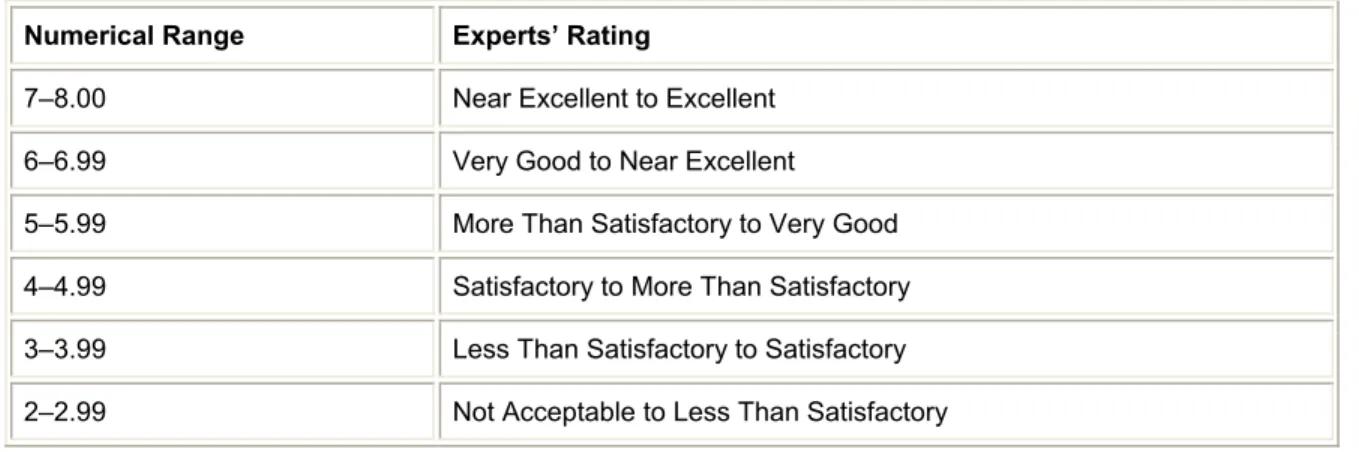
Three faculty experts assessed each student response for each dimension of performance. The scoring system for the criteria was 4 points for excellent, 3 points for very good, 2 points for satisfactory, and 1 point for not acceptable. In order to avoid confusion with the distinctly different meaning of grades or grade point averages, the average rating of the three faculty experts for each dimension of performance was multiplied by a factor of 2. Using a paired comparison method, interrater reliability for each course was 90 percent or higher. Table 2 indicates the numerical range of scores and their corresponding qualitative values.
Table 2: The Numerical Range and Corresponding Qualitative Values for Faculty Expert Ratings Numerical Range Experts’ Rating
7–8.00 Near Excellent to Excellent 6–6.99 Very Good to Near Excellent
5–5.99 More Than Satisfactory to Very Good 4–4.99 Satisfactory to More Than Satisfactory 3–3.99 Less Than Satisfactory to Satisfactory 2–2.99 Not Acceptable to Less Than Satisfactory
Table 3 indicates the average score attained for all students for a particular dimension of performance in each course (and its related format) as rated by the three faculty experts.
Table 3: Comparison of Students' Dimensions of Performance Averages for Traditional and Accelerated Courses
Students in: Sig.
Traditional Courses Non-traditional Courses (2-tailed)
Economics 121 n=11 n=11 Critical Thinking 3.28 4.60 .072 Writing Skills 2.90 4.54 .025 History 251 n=21 n=21 Critical Thinking 4.20 5.74 .000 Writing Skills 3.88 5.24 .001 Knowledge Base 3.96 5.68 .000 Management 131 n=20 n=20 Critical Thinking 5.60 6.90 .025 Writing Skills 5.60 7.06 .011 Knowledge Base 5.66 6.96 .018 Management 404* n=20 n=20 Critical Thinking 4.94 5.54 .221
Writing Skills 4.86 5.76 .062 Knowledge Base-Labor Relations 4.46 4.80 .478 Knowledge Base-Collective Bargaining 3.96 5.00 .058 * This traditional course was an evening section. The mean age of traditional students in this course was 25.8, which is significantly different from non-traditional students’ mean age of 35.7. However, mean age of MANA 404 traditional students is significantly different from traditional students from MANA 131 (18.6) and HIST 251 (22) courses.
For each criterion in the four courses investigated, the performance averages of the students in the non-traditional (accelerated) courses are higher than the performance averages of the students in the non-traditional courses. The differences for seven of the twelve applied criteria are statistically significant (p<.05).
The average for the 72 students in traditional courses across all applied dimensions of performance is 4.46 (satisfactory). The average for the 72 students in accelerated courses across all applied dimensions of performance is 5.72 (very good). The difference between these averages is statistically significant. (p<.000). Table 4: Students Averages Across All Applied Dimensions of Performance for Traditional and Accelerated Courses
Range of Averages (Experts' Ratings) Students in:
Traditional Courses Non-traditional Courses
7.00 - 8.00 (Near Excellent to Excellent) 6.9% 29.2% 6.00 - 6.99 (Very Good to Near Excellent) 12.5% 19.4% 5.00 - 5.99 (More Than Satisfactory to Very Good) 19.4% 16.7% 4.00 - 4.99 (Satisfactory to More Than Satisfactory) 19.4% 18.1% 3.00 - 3.99 (Less Than Satisfactory to Satisfactory) 22.2% 9.7% 2.00 - 2.99 (Not Acceptable to Less Than Satisfactory) 19.4% 6.9%
Base 72 72
Note: Significance .002
While 58.4 percent of the students in traditional courses average 4.0 (satisfactory) or better across all applied dimensions of performance, 83.4 percent of the students in accelerated courses average 4.0 or better across all applied dimensions of performance. The difference between these proportions is statistically significant (p< .002).
Discussion of Student Performance
The criteria for the experts’ assessment were rigorous. For example, in Introduction to Economics 121, students had to compare and evaluate individual aspects of different markets, demonstrate understanding of economic principles, and propose a critical analysis with articulate writing skills (See Appendices C and D). Although students were allowed to use their textbooks, they had to respond individually, without use of a word processor or dictionary, and with little chance for revising their answers given the time limit and breath and scope of the answers required.
The remaining courses, History 251, Management 131, and Management 404 required critical thinking and application of a learned knowledge base. Whether essay questions or case studies (See Appendices C and D), students had to analyze the material, find the most pertinent issues and evidence, relate this
understanding to theory or historical fact, and offer carefully reasoned explanations or solutions.
For the traditional version (16 weeks, 40 contact hours) and the accelerated version (5 weeks, 20 contact hours) of each course in this investigation, the same instructor used the same texts, the same tests, and covered the same learning objectives with very similar teaching methods. When student performance averages for the accelerated version of each course were compared with the traditional version of that same course, the students in the accelerated course demonstrated higher levels of learning. For all applied criteria in History 251 and Management 131 the performance averages of the students in the accelerated courses were significantly higher (p<.03). In Economics 121, for writing skills, the performance average of the students in the accelerated course was also significantly higher (p<.03) than the performance average of the students in the traditional course. While the average for the students in the traditional courses across all applied dimensions of performance was 4.46 (satisfactory), the average for the students in the accelerated courses across all applied dimensions of performance was 5.72 (very good). The difference between these averages is statistically significant as well (p<.000).
The performance evidence suggests that students in accelerated courses demonstrate learning that is distinguishable from the learning of students in traditional courses. Thus, the differences in time between the traditional courses (16 weeks, 40 contact hours) and the accelerated courses (5 weeks, 20 contact hours) are related to a discernible difference in learning for the same course, with the same instructor, texts and tests, and very similar instructional methods.
However, the students in the accelerated courses are different from the students in the traditional courses. They are, on the average, 13 years older with 8 years more work experience. They have higher family incomes and more advanced degrees. Their higher income and greater work experience as well as their more extensive education may provide them with opportunities to develop better writing skills than the younger students in the traditional program. Also work experience tends to develop self-regulation skills such as self-direction and monitoring one’s own work for quality. These skills may allow students in the accelerated courses to read and study at rates that compensate for the shorter duration of accelerated courses. In addition, proximal goals are far more achievable than distal goals (Locke and Latham, 1990). Learners in accelerated courses have only to concentrate on one course at a time for five weeks at a time, unlike traditional students who face four or five courses and must allocate their time over 16 weeks. Both the accelerated and the traditional program have open-admissions policies. They do not use grade point averages, College Board aptitude test scores, and high school ranking to eliminate particular
applicants from enrollment. In addition, approximately one fourth of Ana G. Méndez University System first-time freshmen students (most of which attend the traditional college) are admitted with a high school GPA of less than 2.0 Thus, the older, more educated, and more professionally experienced students in the
accelerated programs may enter school with greater academic skills and more developed study (work) habits than the younger students in the traditional programs. Given these relative advantages, it is reasonable that the older students may learn and perform better in college.
It is also possible that the relationship between student learning and student time involved in learning is far more complex than we have imagined it to be. The findings of this study suggest that factors such as motivation, concentration, work experience, self-regulation, and, paradoxically, an abbreviated learning experience, may actually catalyze learning. As a result when it comes to learning accomplishment, time itself may not matter as much as one might think.
A shortcoming of this study is that it was not possible to compare the performance or attitudes of younger students in accelerated formats with younger students in traditional formats of the same courses. Nor could it compare adult learners in these same circumstances. No courses offered large enough samples (adults in traditional courses or younger students in accelerated courses) to make these comparisons. These studies need to be done.
For the academic year of 1999-2000, the School for Professional Studies and New Ventures at Regis University initiated Phase 4 of an evaluation research study under the direction of Dr. Raymond Wlodkowski. This investigation is a replication of the study conducted in Phase 2 (1997-1998) with Regis University. The purposes of the current investigation were: 1) to assess the academic quality of accelerated courses, 2) to assess the value of accelerated courses to students, and 3) to investigate the effects of time in class and length of course on student perceptions and learning when accelerated courses (5 weeks, 20 contact hours) are compared to traditional courses (16 weeks, 40 contact hours). This research, conducted in Spanish in the Ana G. Méndez University System in Puerto Rico, is the first study to investigate the effectiveness of an accelerated format in higher education in a country other than the United States and in a language other than English.
By investigating the effects of time in class and length of course on student learning and attitudes, one has a better understanding of whether the number of contact hours a course offers and the number of weeks a course is held affects course quality. In this regard, the main research question for this study was: If the same instructor teaches a traditional version (16 weeks, 40 contact hours) and an accelerated version (5 weeks, 20 contact hours) of the same course using the same texts, the same tests, and covering the same learning objectives with very similar teaching methods, will there be a significant difference in learning or attitude between students in the traditional class and students in the accelerated class?
Four popular courses were chosen for the study: Introduction to Economics (Econ 121), History of Puerto Rico (Hist 251), Human Relations in Business (Mana 131), and Labor Relations (Mana 404). Although student populations could not be controlled, the traditional and the accelerated version of each course had the same instructor using the same text, tests, materials, and very similar methods. For the 72 students included in the study from the traditional courses, the mean age was 21.5, with an average of 4 years work experience, and 63 percent of the group being women. For the 72 students included in the study from the accelerated courses, the mean age was 33, with an average of 12 years work experience, and 62 percent of the group being women.
The major findings from this investigation are:
1. For each dimension of performance in the four courses, the performance averages of the students in the accelerated courses are higher than the performance averages of the students in the traditional courses. The differences for seven of the twelve dimensions of performance are statistically significant (p < .05).
2. The average for the 72 students in the traditional courses across all applied dimensions of performance is 4.46 (satisfactory). The average for the 72 students in accelerated across all applied dimensions of performance is 5.72 (very good). The difference between the averages is statistically significant (p < .000).
3. While 58.4 percent of the students in traditional courses average 4.0 (satisfactory) or better across all applied dimensions of performance, 83.4 percent of the students in the accelerated courses average 4.0 or better across all applied dimensions of performance. The difference between the averages is statistically significant (p < .002).
4. Comparison of students’ perceptions and attitudes in traditional and accelerated courses yields no significant differences. Both groups of students perceive their courses very positively, e.g., Overall this course was a valuable learning experience (percent of students in traditional courses, Strongly Agree + Agree = 98.6; percent of students in accelerated courses, Strongly Agree + Agree = 98.6). 5. There are significant demographic and personal differences between the students in the
accelerated courses and the students in the traditional courses. The students in the accelerated courses are older, more educated, more work experienced, and come from families with a higher family income.
6. While 88.9 percent of the students in the accelerated courses indicate they would choose their respective college again, 72.2 percent of the students in the traditional college make the same indication.
It must be noted that four courses are a very small percentage of the total courses offered by the Ana G. Méndez University System. For the evidence at hand, students in both the accelerated and traditional formats have very positive attitudes and perceptions toward their courses. However, students in the accelerated courses demonstrate higher levels of learning than students in the traditional courses, even though the duration and amount of class time for learning in their courses are significantly less. This result appears to be related to the fact that the students in the accelerated courses are older, more educated,
more work experienced, and come from families with higher incomes than the students in the traditional courses. These characteristics may have provided the older adults in the accelerated courses with opportunities to develop writing skills, work and study habits, and self-regulation skills that combine to improve their capability for learning in college. In general, the findings from this study indicate that on the average older adults in the accelerated courses are more than satisfactorily meeting the challenge of college course work and at a higher level of learning than younger students in traditional courses.
The findings of two modest but similar comparison studies conducted at Regis University (1997-1998) and at the Ana G. Méndez University System (1999-2000) in English and Spanish respectively support the
effectiveness of the accelerated learning format for college courses. Comparison of student attitudes and learning according to course format, traditional (40 contact hours over 16 weeks) and accelerated (20 contact hours over 5 weeks) yielded the following results: a) students in both the traditional and accelerated formats had very positive perceptions of their courses; b) on the average adult students in the accelerated courses demonstrated learning that was more than satisfactory; and c) adult students in accelerated courses learned as well (Regis University) or better (Ana G. Méndez University System) than younger students in traditional courses. There is initial evidence that accelerated college courses can be effective learning formats for adults in societies where English or Spanish is the primary language.
Issues for Further Study
A shortcoming of this evaluation is it did not compare the performance or attitudes of younger students in accelerated formats with younger students in traditional formats of the same courses. Nor did it compare adult learners in these same circumstances. No courses at Ana G. Méndez University System offered large enough samples (adults in traditional courses or younger students in accelerated courses) to make these comparisons. These studies need to be done.
The work habits and self-regulation skills of the students in the accelerated courses were assumed based on inference. Direct measures and comparisons of the work habits and self-regulation skills of current students in accelerated and traditional courses should be conducted to ascertain if significant differences in these characteristics exit between these two groups of students.
Extensive studies of accelerated college courses and programs in international settings should be conducted to further investigate the potential of this format for learning.
References
Brockett, R.G. and Hiemstra, R. Self-Direction in Adult Learning: Perspectives on Theory, Research, and Practice. London and New York: Routledge, 1991.
Eccles, J. S. “Interest and Enjoyment as Components of Task Value.” Presentation at the National Conference of the American Educational Research Association, San Diego: April 13, 1998.
Grimes, P.W. and Niss, J.F. “Concentrated Study Time and Improved Learning Efficiency: An Experiment Using Economics U$A.” Journal of Economic Education, 1989, 20, 133-138.
Heit, K. Report from the Regis Operations Improvement Group ad hoc Task Force on Diversity. Denver: Regis University, 1997
Kirby-Smith, J. P. “Effects of Intensive College Courses on Student Cognitive Achievement, Academic Standards, Student Attitudes, and Faculty Attitudes.” Unpublished Doctoral Dissertation, University of Southern California, 1987.
Locke, E. A., and Latham, G. P. A Theory of Goal Setting and Task Performance. Englewood Cliffs, New Jersey: Prentice Hall, 199
Merriam, S. B. and Caffarella, R. S. Learning in Adulthood. San Francisco: Jossey-Bass, 1991.
Pintrich, P. R. and Schunk, D. H. Motivation in Education: Theory, Research, and Applications. Englewood Cliffs, New Jersey: Prentice Hall, 1996.
Schafer, D. W. “A qualitative study of adult and traditional college students’ perceptions of a compressed and traditional length college course.” Unpublished Doctoral Dissertation. Boston University, 1995.
Scott, P. A. and Conrad, C. F. “A Critique of Intensive Courses and an Agenda or Research.” In J. C. Smart (Ed.), Higher Education: Handbook of Theory and Research, Vol. 8, New York: Press, 1992.
Stratil, M. College Student Inventory. Iowa City, IA: Noel/Levitz, 1988.
Wlodkowski, R. J. and Ginsberg, M. B. Diversity and Motivation: Culturally Responsive Teaching. San Francisco: Jossey-Bass, 1995.
Wlodkowski, R. J. Enhancing Adult Motivation to Learn. (Revised Edition) San Francisco: Jossey-Bass, 1999.