ASA JP Morgan 401k Plan
ResearchCasey T. Smith
678-905-4450 www.wiserinvestor.com
Change is Good, Right?
By now you have received notice that there are some changes happening within the ASA JPMorgan 401k plan. The good news is some of the funds are getting cheaper. The frustrating part is this should and could have happened a long time ago. It should also be known that your ALPA Retirement Committee was not made aware of these changes any earlier than your receipt of the JP Morgan Letter. This is frustrating as the pilot group is the largest contributor to the ASA 401k plan and should have input into their retirement choices.
Despite the secretive and abrupt nature of this change, I will help you dissect these changes and help you figure out what actions you should consider.
Closures
On the “no longer available to us list” are the American Century Ultra and American Funds Growth Fund of America funds. These funds have recently underperformed their peers and or the S&P 500. The replacement for these funds is the JP Morgan Large Cap Growth R6 fund. There are some key measurements that we can look at to dissect if this change is in the participants’ favor.
Alpha – This is the fund manager’s ability to beat the index. In this case the index would be the Russell 1000 or the S&P 500. The higher Alpha, the better. A negative Alpha means the manager has earned too little based on the risk of the investment.
Sharpe Ratio – Most fund managers take on additional risk outside of their assigned index in order to beat the index. Sharpe Ratio does not mean a whole lot by itself. When comparing two funds you want the one with the higher Sharpe Ratio. This means that the additional risk has paid off.
Standard Deviation – This measures the volatility (risk) of the fund from its average rate of return. Ideally an investor wants a high rate of return with little standard deviation, which is hard to find. One certainly does not want a low return with a high standard deviation; this means that risk is not being rewarded with return.
Using the key indicators above we can compare our new JP Morgan Growth Fund R6 to the two outgoing mutual funds.
ASA JP Morgan 401k Plan
ResearchCasey T. Smith
678-905-4450 www.wiserinvestor.com
The data above shows that the mandatory transition from Ultra and Growth Fund of America is not a bad move. Notice how the standard deviation (risk) is virtually the same for all funds yet the end results are very different. This reflects the portfolio managers’ stock picking ability. The American Century Ultra fund has been an underperformer for years. American Funds Growth Fund of America has good ten years risk/reward data; however, it has under performed its peers in the last three years.
As a side note, over the long term 10 + years very few managers actually beat their assigned index. This is why 401k plans that offer Vanguard Index Funds are very desirable. Currently Fed Ex, Hawaiian, SouthWest and United offer 401k plans with a Vanguard Index tier as additional investment options.
Holdings
JP Morgan Large Cap Growth Fund holds 68 total stocks, compared to 310 in Growth Fund of America and 81 in Ultra. The JP Morgan fund has bought and sold (turned over) 84% of its portfolio over the last 12 months compared to 33% in Growth Fund of America and 24% in Ultra. The turnover percent within a fund is important as for every 100% in turnover adds 1.0 – 1.5% in fees paid by the participants.
The top five holdings (as of 9/30/2011) within each fund are as follows:
JP Morgan Growth Fund American Century Ultra Growth Fund of America
1. Apple 1. Apple 1. Apple
2. Amazon 2. Google 2. Oracle
3. JP Morgan Money Mkt 3. Amazon 3. Amazon
4. IBM 4. Exxon Mobile 4. Apache
5. Cognizant Technology 5. Schlumberger 5. Union Pacific Data by Morningstar Office Edition as of 9/30/2011
Ten Year
Name Return Standard
Deviation Sharpe Ratio Alpha Cost (yr.) JP Morgan Large Cap Growth R6 1.02% 16.61 0.18 1.02 0.8
0%
American Century Ultra 2.09% 16.04 0.09 -‐0.59 1.00
% America Funds Growth Fund of America 4.43% 16.23 0.23 1.66 0.68
%
ASA JP Morgan 401k Plan
Research Casey T. Smith 678-905-4450 www.wiserinvestor.com Fee ChangesOther funds within the ASA 401k plan had fee changes and new tickers assigned.
Current Name Current Ticker
Current Cost
New Fund Name New Ticker
New Cost American Century
Equity Income-‐Inv TWEIX 0.97% American Century Equity Income-‐ Inst
ACIIX 0.77%
American Century
Value-‐Inv TWVLX 1.00% American Century Value-‐Inst AVLIX 0.80% JP Morgan Equity
Index -‐ Select HLEIX 0.20% JPMCB Equity Index-‐CF 0.10% American Century International Growth-‐Inv TWIEX 1.35%
⇒
American Century International Growth-‐Inst TGRIX 1.15%
The new fees average out to be 0.15% in average reductions with the largest change being 0.20% in three mutual funds. In all the funds listed above, the holdings,
investment objective and managers remain the same. Only the share class (fee structure) changed. I will note here that the JP Morgan letter shows the JP Morgan Equity Index fee as going from 1.19% to 0.10% in the new index. This has to be a typo as the old fee is published as 0.20%.
Why Did the Changes Take Place?
I have taken many phone calls from plan participants asking why these changes have taken place and what this means to them. The why part is very simple. JP Morgan has been collecting annually an estimated $356,000 in administration fees ($88 per plan participant), which is included in $1,234,000 in fund fees (avg 0.79%). These fees are not terribly out of line with a plan of our size; currently 155 million in assets.
In my opinion these fees could have been lowered years ago. However, the company certainly has more leverage recently because of the purchase of Express Jet. A joint ASA ExpressJet 401k plan is valued at $400+ million. JP Morgan wants that business and as a result has lowered its fees. With our new fee structure, JP Morgan will still be collecting $238,918 in administration fees ($59 per participant), which is
included in $1,072,000 in fund fees (avg 0.69%) just on the ASA 401k, not including Express Jet’s 401k.
ASA JP Morgan 401k Plan
ResearchCasey T. Smith
678-905-4450 www.wiserinvestor.com
This is where competition and larger plan assets benefit the plan participant (you). While this is great news, there is still work to be done. Even though our fund
expenses have dropped, we can still do much better.
Three Ways to Invest
There are three ways to invest in the stock market. I love Coca Cola, so lets use cola as an investment example.
I. Stock
Let’s say we invest $5,000 into Coke stock. Then the evil people at Pepsi infiltrate Coke and poison the syrup. People are now dying of Coke. What is your Coke stock worth? $0. This is called company risk. We want to diversify away from company risk such as Enron, Global Crossing and many other bad companies in good industries. This is where mutual funds enter the picture.
II. Mutual Fund
Investing in a mutual fund is pooling investor’s money together and hiring a fund manager to manage your money. In our cola example, let’s say that there are 50 cola companies in the US. The mutual fund does not know your personal objectives but does operate under a published objective. A mutual fund objective could be to invest in large cap US stocks or foreign bonds. In our example the fund manager is looking for the 20 best cola companies out of an industry of 50. This gives the investor diversification from company specific risk. The funds goal is to beat the index of 50 cola companies.
While very popular, mutual funds have drawbacks. Many of the mutual funds in the ASA 401k plan have over 100% in annual turn over. This means that the fund manager is buying and selling a lot through out the year. For every 100% in turnover we see an added 1.0 – 1.5% in fees. In our cola example, our fund manager would be buying and selling the cola stocks on a regular basis in an attempt to beat the cola index. This type of investing is considered “active” management.
III. Index Fund
In today’s society we are programmed to think that we are all “winners.” In fact if you think that you are not a winner then you may be depressed
ASA JP Morgan 401k Plan
ResearchCasey T. Smith
678-905-4450 www.wiserinvestor.com
and a doctor can proscribe you a pill for that. Applying this thinking to investing can create poor investing behavior. We see this in a study by the University of Maryland “False Discoveries in Mutual Fund Performance: Measuring Luck in Estimated Alphas” showing that only 0.06% of mutual funds beat their assigned index from 1975 to 2007. This draws us to our third choice of investing, indexing.
Through Index Mutual Funds or Exchange Traded Funds investors now have the ability to purchase entire asset classes (large, mid or small caps) or sectors (US energy, foreign, real estate, etc.). In our example we could purchase the entire cola index through an index mutual fund or exchange traded fund. Index funds do not have fund managers as the fund is simply purchasing companies chosen by the index provider such as S&P or Russell. This type of investing is considered “passive” investing
A real world example of indexing would be purchasing the entire S&P 500 (500 US companies) through an index versus buying the JP Morgan Large Cap fund that only holds 68 companies. The JP Morgan Large Cap Fund has an expense ratio of 0.80%. The Vanguard S&P 500 Index Fund costs 0.05%. This cost savings adds up to significantly more money in the plan participants’ pocket at retirement. In this comparison the performance difference over the last 10 years is in the favor of the index fund. History and research show that for time periods greater than ten years, indexing continues to be favored.
Currently the ASA JP Morgan 401k plan has one Index fund -‐ the JP Morgan Equity Index Select. It should be noted that in time periods under ten years, we could usually find good performing actively managed mutual funds. However, most of you are saving for time periods greater than 10 years. For you, keeping costs low,
maintaining diversification and investing long term are your keys to success.
The current line-‐up of ASA Mutual Funds are some of the best performing actively managed funds to choose from. However, during our research we found that a low cost index portfolio using Vanguard index mutual funds is very competitive, especially with the cost savings.
Wiser Wealth recently researched 401k options that could be available to ASA and Express Jet employees. We found that switching 401k plan providers entirely should be considered as JP Morgan provides very poor guidance to ASA plan participants. However after the recent changes with JP Morgan, Sky West/ ASA seems committed to JP Morgan. This leads us to a less known option.
ASA JP Morgan 401k Plan
ResearchCasey T. Smith
678-905-4450 www.wiserinvestor.com
Vanguard Indexing Within the JP Morgan 401k Plan
ASA/Express Jet has the ability to add an “index tier” to the ASA JP Morgan 401k Plan. This simply means that in addition to the current line up of mutual funds plan participants would also be able to choose index funds representing cash, US Bonds, US large caps, US mid caps, US small caps, international developed markets and international emerging markets.
The benefit of an index tier is that it gives 401k participants (you) access to industry leading index funds, low cost investing, plan reduction of active manager risk and historically better performance. The company benefits, as well, in that offering index funds within a plan reduces their litigation risk. A recent court case suggests that having index funds within the plan lower the litigation risk for all plan fiduciaries.
Mike Lucci of Vanguard states,
“Probably the biggest trend that we've seen recently is the idea of plan sponsors adding additional index funds to their fund lineup within their defined contribution plans, and in many cases actually pulling the index funds out away from the active funds to have a stand-alone index tier. So if you think back historically, plans have had, in many cases, a large-cap index, often times the S&P 500. What we're seeing now are plan sponsors adding additional index funds to cover the fixed income area, round out the domestic equity area, and include an international fund as well to have that full lineup of index exposure across the entire fund lineup.
So I'd say the trend isn't surprising given the increased scrutiny that we're seeing from Congress and the Department of Labor. Plan sponsors are really trying to balance their fiduciary role with the needs of their participants, and adding this index tier is a great way to lower the overall costs of the program.
Now I think we all realize that you can't completely eliminate the risks associated with this, but an index tier does greatly reduce the manager risk associated with the plan, and, for participants, it provides broadly diversified, low-cost options within the plan”.
In closing, Wiser Wealth likes it anytime a plan sponsor (ASA/Express jet) lowers the cost of investing. The recent changes by the company were done with your best interests in mind. We hope that they would consider the benefits of adding indexing to the 401k plan. With a combined $400 million in 401k assets, government
encouragement and a fiduciary responsibility to work in the best interest of all plan participants, there is certainly no reasonable rational anyone could say no.
Building blocks of a well-balanced portfolio > 1
Recent developments in the marketplace are making the case for expanding the number of index investment options within 401(k) and other defined contribution (DC) plans. Perhaps the most important trend is increased attention to plan fees. Plan sponsors are increasingly conscious of the need to reconsider plan costs, especially given the growing scrutiny by Congress, the Department of Labor, and the courts. A second development is the ongoing concern about increasing the diversification, transparency, and effectiveness of a plan’s lineup—a concern that reemerged in the recent 2008–2009 market decline.
In response to these developments, Vanguard believes that plan sponsors would be well served to consider including a separate index tier as the heart of their plan investment menus.
Often called the passive or index core, an index tier is a comprehensive set of diversified index funds communicated as a distinct part of the plan lineup. An index tier can offer advantages for both sponsors and participants. For sponsors, it means a simpler investment selection and monitoring process, lower plan costs, enhanced manager predictability, and the potential for above-average returns. It can
also reduce the potential for second guessing of plan sponsors by regulators and the courts over investment returns and plan fees. Participants’ benefits include the possibility of tailoring a complex portfolio using low-cost funds and reduced active manager risk (i.e. the risk that active managers will underperform their respective benchmarks)—leading to potentially more favorable retirement outcomes over time.
Connect with Vanguard®>institutional.vanguard.com Summer 2010
Building blocks of a
2
Why
indexing
works
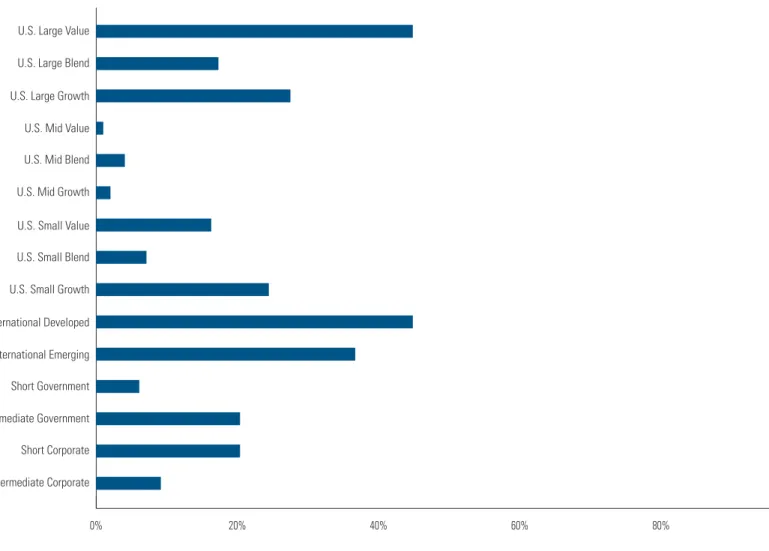
Indexing remains a compelling investment strategy for both plan sponsors and participants. Given the significant time horizons most participants face as they save for retirement, the benefits of indexing compound. For example, when looking at a longer time horizon such as the last 15 years, a majority of actively managed funds have failed to beat their respective benchmarks in most of the common investment categories (see Figure 1). The benefits of indexing are well-known in highly efficient markets, such as the market for U.S. large-capitalization stocks. Yet the performance advantage of indexing extends even to
small-cap and international mandates—after accounting for survivorship bias (the removal of closed funds from performance databases) and style drift (the tendency of managers’ holdings to “drift” from one asset class or investment style to another).
Why have actively managed funds generally failed to measure up? Investing is a zero-sum game. For every buyer, there must be a seller, and for every dollar that wins, there must be a dollar that loses. In aggregate, before costs, the sum of all these positions constitutes an investment market.
However, security transactions incur costs, and managers charge fees for service. The result: after accounting for these costs, a majority of investment dollars underperform the costless market. And because actively managed portfolios generally incur significant costs, it is not surprising that, on average, high-cost actively managed funds underperform a costless index over time.
An indexed strategy seeks to track a costless benchmark at minimal expense, thereby benefiting from the zero-sum game while offering investors the highest degree of transparency and the broadest level of diversification. These advantages represent a significant hurdle for an active manager to overcome just to break even with a low-cost index strategy over time, in any market. That is why index funds can make sense as the core of a long-term portfolio.
Building blocks of a well-balanced portfolio > 3
0% 20% 40% 60% 80% 100%
0
10
20
30
40
50
U.S. Large Value U.S. Large Blend U.S. Large Growth U.S. Mid Value U.S. Mid Blend U.S. Mid Growth U.S. Small Value U.S. Small Blend U.S. Small Growth International Developed International Emerging Short Government Intermediate Government Short Corporate Intermediate Corporate
Sources: Vanguard calculations using data from Morningstar, Standard & Poor’s, MSCI, and Barclays Capital. U.S.-style benchmark represented by the following indexes: Large Blend: S&P 500: 1/1995–11/2002, MSCI Prime Market 750: 12/2002–Current; Large Value: S&P 500 Value: 1/1995–11/2002, MSCI Prime Market 750 Value: 12/2002–Current; Large Growth: S&P 500 Growth 1/1995–11/2002, MSCI Prime Market 750 Growth 12/2002–Current; Mid Blend: S&P Midcap 400: 1/1995–11/2002, MSCI Mid Cap 450: 12/2002–Current; Mid Value: S&P Midcap 400 Value: 1/1995–11/2002, MSCI Mid Cap 450 Value: 12/2002–Current; Mid Growth: S&P Midcap 400 Growth: 1/1995–11/2002, MSCI Mid Cap 450 Growth: 12/2002–Current; Small Blend: S&P Small Cap 600: 1/1995–11/2002, MSCI Mid Cap 1750: 12/2002–Current; Small Value: S&P Small Cap 600 Value: 1/1995–11/2002, MSCI Small Cap 1750 Value: 12/2002–Current; Small Growth: S&P Small Cap 600 Growth: 1/1995–11/2002, MSCI Small Cap 1750 Growth: 12/2002–Current. International benchmarks represented by the following MSCI indexes: All Country World Index; EAFE Index. Fixed income benchmarks represented by the following Barclays Capital Indexes: U.S. 1–5 Year Government Bond Index, U.S. 1–5 Year Credit Bond Index, U.S. Intermediate Government Bond Index, and U.S. Intermediate Credit Bond Index.
Figure 1: Percentage of actively managed funds outperforming benchmark: 15 years ended December 31, 2009
4
What is
an index
tier?
Historically most plan sponsors have responded to the case for indexing by including at least one low-cost large-capitalization U.S. stock index fund in their investment lineup. Yet given the ongoing scrutiny of plan costs, as well as the benefits of indexing in other asset classes, Vanguard believes that every 401(k) plan should consider offering a comprehensive set of index options that spans most liquid and accessible global capital markets. This is the idea of the index tier—a comprehensive set of index options presented and communicated distinctly to participants.
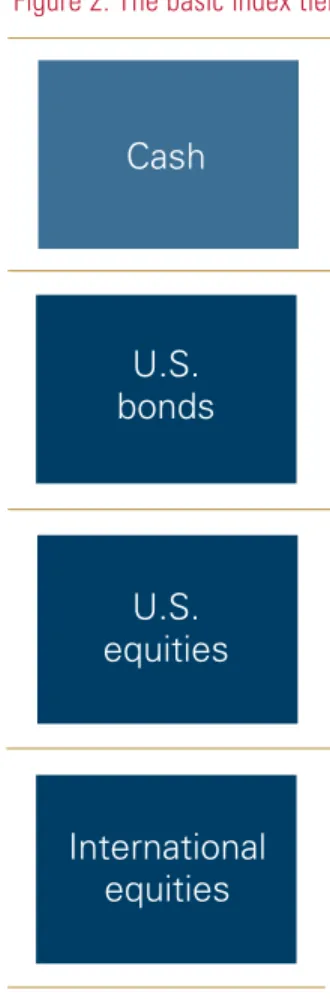
What investment options should plan fiduciaries include within the index tier? A minimalist approach might be to include four very broadly diversified options:
U.S. equity market.
•
Non-U.S. equity market.
•
U.S. taxable bond market.
•
Cash reserves
• 1.
An index tier that includes just these four options can offer a highly efficient and simple set of investment choices (see Figure 2).
Figure 2: The basic index tier
Source: Vanguard. 1Actively managed. U.S. bonds Cash U.S. equities International equities
Building blocks of a well-balanced portfolio > 5
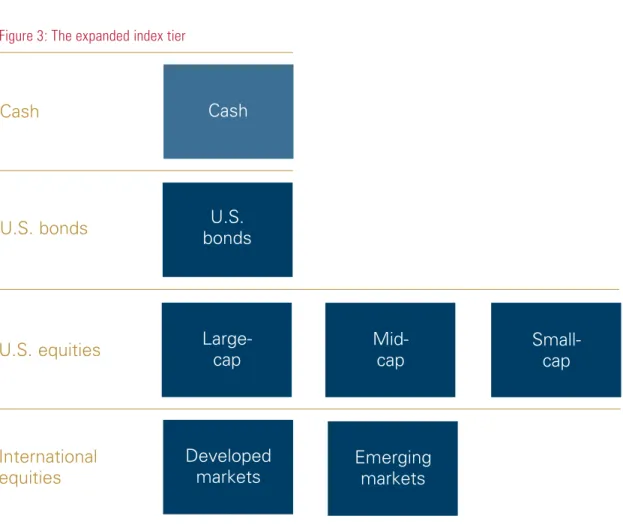
However, many sponsors have expanded the number of options within the index tier for participants who want to tailor their portfolios to meet their individual beliefs about risk. As a result, one strategy might be to offer separate U.S. equity options by capitalization—including large-, mid-, and small-cap funds. On the non-U.S. side, a similar approach would be to offer separate developed and emerging market options (see Figure 3).
Source: Vanguard.
Figure 3: The expanded index tier
In deciding what component options to include in the index tier, sponsors will want to balance both expanded choice and complexity. Additional options allow more experienced participants to tailor their portfolio strategies in distinct ways. But at some point, too many passive options might add to complexity and confusion among participants striving to create their own portfolios using the index tier. Cash Cash U.S. bonds U.S. bonds
Large-cap Mid-cap Small-cap
U.S. equities
Developed
markets Emergingmarkets
International equities
6
Introducing an
index tier into
your plan
Introducing an index tier into an existing plan lineup poses a number of considerations. First, if index options are simply listed with other active plan options, the ability to communicate the merits of indexing is hindered. The idea of an index tier is that it should be a highlighted element of the investment menu.
Second, research over the past decade confirms that a long list of investment options, including both active and index funds, is too complex for many participants to understand and effectively use. They need all-in-one portfolio solutions as part of the investment menu.
The solution to these challenges is to use a tiering strategy for organizing and communicating the investment menu. The first level of that tiered menu should be an
asset allocation tier for one-stop decision-making by participants. A second tier should be devoted to index options for participants who want to design their own portfolios.
Tiered investment menus. If participants are presented with a long list of investment options, one possible risk is choice overload— an inability for most participants to make comparative choices among the 20, 30, or more options offered in the plan investment menu. A simple solution to this problem is to create logical groupings, or tiers, of investment options in the menu, streamlining participant choices to two or three logical possibilities, not 30.
Asset allocation tier. A well-known education challenge is that regardless of the size of the menu, many participants lack the investor experience or the time and inclination to build effective portfolios. As a result, all-in-one portfolio solutions have emerged as an important development in 401(k) plans–not just as default investments, but also for participants making their own choices. The most common type of all-in-one strategy is the target-date fund (TDF), although some plans may use risk-based life-cycle funds as an alternative. Sponsors can employ these two tiering concepts to help simplify participants’ investment decision-making and to highlight the benefits of the index tier within the plan. In a simple tiered menu, a sponsor might offer passive target-date funds as the first tier, and the index core options as the second tier. The first tier would be communicated as the one-stop investment solution, while the second tier would be directed at participants looking to design their own portfolios.
A second example, perhaps more relevant for most 401(k) plans today, would be a three-tiered structure: a target-date fund tier, an index core tier, and an active tier. This structure allows sponsors to communicate the benefits of indexing versus active management— a distinction that is lost in a generic list of “core” options. The issue of costs and active management risk becomes central to the presentation of the investment menu (see Figure 4).
Building blocks of a well-balanced portfolio > 9
Laying the foundation
for success
Vanguard TRFs reinforce the importance of passive investment strategies At Vanguard, our target-date funds (TDFs), better known as Vanguard Target Retirement Funds (TRFs), are drawn specifically from our long list of diversified index funds. Our baseline menu design calls for having TDFs that include many of the same options as your index tier.
Because our TRFs are composed mostly of Vanguard index funds, participants get the added benefit of having their TDF tier pulling in options from the index core. The result is that participants benefit from having two index-oriented tiers prominently featured in the plan menu—the TDF tier and the index tier. This approach further encourages lower costs and increased predictability.
Adding an index tier to 401(k) plans can benefit both plan sponsors and participants. By offering an index tier, plan sponsors can benefit in a variety of ways, including:
The ability to offer broad-based diversified
•
portfolios through a handful of funds. Fiduciary comfort attributable to simple,
•
transparent, low-cost investment options. The ability to expand and benchmark your
•
plan for a broader range of investment options, including target-date funds and actively managed portfolios.
For participants, a tiered lineup anchored by an index tier helps simplify the investment decision-making process and produces a low-cost plan lineup that is more efficient, transparent, and diversified, with the potential to increase shareholder wealth and improve retirement security.
10
Disclosures
For more information about Vanguard funds, visit Vanguard.com, or call 800-523-1036, to
•
obtain a prospectus. Investment objectives, risks, charges, expenses, and other important information about a fund are contained in the prospectus; read and consider it carefully before investing.
All investments, including a portfolio’s current and future holdings, are subject to risks, which may
•
result in the loss of principal.
Past performance is not a guarantee of future results.
•
Diversification does not ensure a profit or protect against a loss in a declining market.
•
Investments in Target Retirement Funds are subject to the risks of their underlying funds. The
•
year in the Fund name refers to the approximate year (the target date) when an investor in the Fund would retire and leave the work force. The Fund will gradually shift its emphasis from more aggressive investments to more conservative ones based on its target date. An investment in the Target Retirement Fund is not guaranteed at any time, including on or after the target date. Investments in bond funds are subject to interest rate, credit, and inflation risk.
•
Prices of mid- and small-cap stocks often fluctuate more than those of large-company stocks.
•
Foreign investing involves additional risks including currency fluctuations and political uncertainty. The funds or securities referred to herein are not sponsored, endorsed, or promoted by MSCI,
•
and MSCI bears no liability with respect to any such funds or securities. For any such funds or securities, the prospectus or the Statement of Additional Information contains a more detailed description of the limited relationship MSCI has with The Vanguard Group and any related funds. Vanguard Marketing Corporation, Distributor.