The role of satisfaction and website usability in developing customer loyalty and positive word-of-mouth in the e-banking services
Casaló, Luis V.; Flavián, Carlos; Guinalíu, Miguel (University of Zaragoza, Spain)
Abstract
Customer loyalty and positive word-of-mouth (WOM) have been traditionally two main goals aimed at by managers. Due to their importance, this work analyzes the role of satisfaction and website perceived usability in developing customer loyalty and positive WOM in the e-banking business. The data showed that customer satisfaction with previous interactions with the bank website had a positive effect on both customer loyalty and positive WOM. In addition, website perceived usability was found to have a positive effect on customer satisfaction and, as expected, loyalty was also significantly related to positive WOM. Finally, thanks to these results, several conclusions, managerial implications and possibilities for future research arise.
Keywords: e-Banking, Satisfaction, Loyalty, Word-Of-Mouth, Usability, Rival Models Strategy
1. INTRODUCTION
The development of customer loyalty and positive word-of-mouth (WOM) are two of the main objectives aimed at by managers. To be precise, customer loyalty favours greater future purchase intention (Flavián et al., 2006) and WOM exerts a
strong influence on consumer choice, so that companies have a good opportunity to increase their market share by developing positive WOM among customers (Chung and Darke, 2006).
Thus, marketing practitioners have traditionally recognized the general importance of both concepts and due to this relevance, marketing literature has widely analyzed both the concept of loyalty (e.g. Hallowell, 1996; Dick and Basu, 1994; Oliver, 1999; Andreassen and Lindestad, 1998) and WOM (e.g. Bansal and Voyer, 2000; Chung and Darke, 2006). In addition, the increasing competitiveness in electronic business is motivating an exponential growth in the number of studies that analyze loyalty development (e.g. Auh et al., 2007; Flavián and Guinalíu, 2006; Harris and
Goode, 2004; Srinivasan et al., 2002), and customer advocacy and WOM (e.g.
Kozinets, 2002; Smith et al., 2005; Brown et al., 2007; Sen and Lerman, 2007) in the
online context.
However, there is still a lack of studies that analyze the formation of both concepts when the context of analysis is to be found in the relationships between customers and banks over the Internet. Thus, there is a call for studies that will help us to understand how customer loyalty and positive WOM are formed in this context in greater detail. With the aim of moving on this topic, this study puts forward a descriptive model that characterizes customer loyalty and positive WOM in the context of electronic banking. Based on an in-depth review of relevant literature, we can say that satisfaction in terms of previous interactions is considered a key antecedent of customer loyalty and positive WOM about an online financial services provider. Besides, we propose a positive effect of loyalty on WOM. Lastly, perceived website usability, which has been found to be a crucial factor in the development of e-commerce (Flavián et al., 2006), is also associated with the level of satisfaction with previous
loyalty and positive WOM through satisfaction, which is therefore seen as a strategic mediating variable in the achievement of these main goals for most of the organizations. As a result, this study presents three main contributions: (1) satisfaction and usability are looked at as antecedents of loyalty and positive WOM in the e-banking business, (2) satisfaction is proposed to have a mediating role in the relationship between usability and profitable consumer behaviours such as loyalty and positive WOM, and (3) the loyalty-WOM relationship is analyzed in the e-banking (this relationship has received very little attention in the online context). Indeed, most of the studies on these concepts have been carried out in the context of traditional distribution channels (e.g. Swan and Oliver, 1989; Mizerski, 1982; Hallowell, 1996; Knox and Denison, 2000) and, as a result, this article tackles an interesting topic of research which has not yet been dealt with by the literature concerning the distribution of financial services via the Internet.
Bearing these considerations in mind, the paper is structured as follows: Firstly, we carry out an in-depth review of the relevant literature concerning the four variables included in the study. Secondly, we formalize the hypotheses. Thirdly, we explain the process of data collection and measures validation and afterwards, we present the main results and compare the hypothesized model with a rival one. Lastly, we show the main conclusions of the study, and outline possibilities for future research.
2. LITERATURE REVIEW
In this section, we review the relevant literature on the concept of satisfaction, its consequences (loyalty and WOM), and one of its main antecedents in the online context: usability.
2.1. Satisfaction
Satisfaction has been analyzed in-depth in the marketing literature (e.g. Oliver, 1980; Oliver, 1981; Johnson and Fornell, 1991; Edvardsson et al., 2000; Gustafsson et al., 2005). Oliver (1981, p. 29) firstly defined it in the consumption context as “the summary psychological state resulting when the emotion surrounding disconfirmed
expectations is coupled with the customer’s prior feelings about the consumption experience”. In other words, we may say that satisfaction reflects a post-purchase
evaluation of product quality given pre-purchase expectations (Kotler 1991).
Focusing attention on services, satisfaction may be defined as an affective customer condition that results from a global evaluation of all the aspects that make up the customer relationship with the service provider (Severt, 2002). More specifically, the concept can be divided into two distinct perspectives (Geyskens et al., 1999). The
first perspective considers satisfaction as an affective predisposition sustained by economic conditions, such as the volume of sales or profit margins obtained. The second vision, known as non-economic satisfaction, considers the concept using more psychological factors, such as a partner fulfilling promises or the ease of relationships with the aforementioned partner. Indeed, this project will concentrate more on this psychological perspective due to the fact that most definitions on the concept of satisfaction highlight a psychological or affective state (Bhattacherjee, 2001). In this line, satisfaction is understood as a global evaluation or attitude that evolves over time (Eshghi et al., 2007) resulting from the interactions produced by the customer and the
organization in the relationship. Thus, customer satisfaction is not the result of a specific transaction, but that of a global evaluation of the relationship history between the parties.
2.2. Outcomes of satisfaction
2.2.1. Loyalty
In general, loyalty development has been an objective traditionally aimed at by managers (Andreassen, 1999) since it enables higher future purchase intention. To be precise, loyalty may be defined as a customer’s intention or predisposition to purchase from the same organization again (Edvardsson et al., 2000), that result from the
conviction that the value received from one seller is greater than the value available from other alternatives (Hallowell, 1996). As a consequence, loyalty has been considered to be a key factor in order to achieve company success and sustainability over time (Flavián et al., 2006; Keating et al., 2003), and several authors have proposed
lower price sensibility (Lynch and Ariely, 2003) and more stable and bigger incomes (Knox and Denison, 2000).
More specifically, loyalty may be considered as a non-random behaviour, expressed over time, which depends on psychological processes and closeness to brand commitment (Flavián et al., 2006), and it has been analyzed from two different
perspectives: attitudinal and behavioural (Bloemer and de Ruyter, 1998; Hallowell,
1996; Eshghi et al., 2007). This fact implies that the concept of loyalty includes a
psychological link, based on customer feelings that motivate a general attachment to the people, products or services of an organization (Hallowell, 1996), and a behavioural component, based on aspects such as the frequency of visits to a store or the percentage of expense (Nilson and Olsen, 1995). In this work, we focus on attitudinal loyalty since: (1) it refers to the customers’ intentions to stay with and be committed to the organization (Auh et al., 2007), and (2) the behavioural dimension is simply the
manifestation of that affective state (Eshghi et al., 2007).
2.2.2. WOM
In general, WOM may be defined as an informal type of communication between private parties concerning the evaluation of goods and services (Dichter, 1966) and it has been considered to be one of the most powerful forces in the market place (Bansal and Voyer, 2000). Indeed, WOM has been found to facilitate the sale of several products, such as movies (Mizerski, 1982) or automobiles (Swan and Oliver, 1989).
To be precise, the importance of WOM resides in the fact that consumer choice is usually influenced by WOM, especially when the purchase in important (Lutz and Reilly, 1973). This is explained due to the fact that consumers prefer to rely on informal and personal communication sources (e.g. other consumers) in making purchase decisions instead of on formal and organizational sources such as advertising campaigns (Bansal and Voyer, 2000). Indeed, WOM is extremely effective since the source of the information has nothing to gain from the consumer’s subsequent actions (Schiffman and Kanuk, 1997) and, as a result, fellow consumers are considered as more objective information sources (Kozinets, 2002). That is, consumers appreciate WOM because it is seen as more reliable and trustworthy than other information sources (Day, 1971).
2.3. Antecedents of Satisfaction
2.3.1. Usability
In general, we may define the concept of usability as the effort required to use a computer system. For instance, Nielsen (1994) suggests that usability concerns several aspects such as the ease with which the user is capable of learning to manage the system, the ease of memorizing the basic functions, the grade of efficiency with which the site has been designed, the degree of error avoidance and the general satisfaction of the user in terms of manageability. Therefore, greater levels of usability will be associated to lower levels of difficulty to manage that functionality (Davis, 1989) and, as a result, usability has been traditionally considered a key factor for predicting intentions to use a system (e.g. Davis, 1989; Teo et al., 2003).
More specifically, focusing attention on the Internet, website usability reflects the perceived ease of navigating the site or making purchases through the Internet and it is considered a critical factor on the development of electronic commerce (Flavián et al., 2006). According to the recommendations of these authors, we consider the
following factors to measure the concept of website usability:
• The ease of understanding the structure of a system, its functions, interface and the contents that can be observed by the user.
• The simplicity of use of the website in its initial stages.
• The speed with which the users can find what they are looking for.
• The perceived ease of site navigation in terms of time required and action necessary in order to obtain the desired results.
• The ability of the users to control what they are doing, and where they are, at any given moment.
3. HYPOTHESES FORMULATION
Traditionally, several authors have stated that satisfaction leads to an increased probability that consumers will say positive things about an organization and
recommend the firm to other customers (Dabholkar 1995; Bettencourt 1997; Dolen et al., 2007). Broadly speaking, we can say that satisfied customers may be effective
promoters of the organization’s products and services (Dolen et al., 2007). Therefore, it
seems reasonable to think that satisfied customers of a financial services provider website will be more likely to promote the website, thanks to positive comments about it made to fellow customers, rather than dissatisfied users. Bearing these considerations in mind, we propose our first hypothesis:
H1: Greater customer satisfaction is directly and positively related to greater levels of positive WOM with respect of a website in the e-banking business.
In marketing literature, it has been traditionally considered that a greater degree of customer satisfaction leads to a greater degree of individual loyalty (e.g. Petrick and Backman, 2002; Anderson and Sullivan, 1993; Hallowell, 1996; Yoon and Kim, 2000). More specifically, satisfaction has also emerged as a strong predictor of loyalty in the context of the new information and communication technologies (e.g. Kim and Yoon, 2004; Methlie and Nysveen, 1999). In general terms, if customers perceive that an organization fulfils the agreed conditions, they will feel satisfied and believe that this behaviour will continue in the future. Consequently their predisposition to develop the relationship with the organization will increase. At the same time the alternatives in the market will be less attractive. In other words, satisfaction becomes a mechanism by which the customer differentiates between businesses and what they offer.
Therefore, it is reasonable to think that, in the context of electronic banking, the fulfilment of the expectations will lead to an increase in the intention to use the financial services on offer in that website in the future, so that the user will visit the website more frequently and spend more. Thus, we propose our second hypothesis:
H2: Greater customer satisfaction is directly and positively related to greater levels of loyalty in the e-banking business.
Loyalty reflects favourable attitudes toward the brand or organization (e.g. Dick and Basu, 1994; Evanschitzky et al., 2006). In this respect, one aspect associated to
customers usually promote the firm by emphasizing the main attributes of its products and services. This is motivated by the fact that loyalty is the result of the individual’s beliefs that the quantity of value received from consuming a product or service is greater than the value of non-consuming (Hallowell, 1996). Thus, in response to this greater value obtained, the individual is motivated to remain loyal to the firm and to promote it by, for instance, positive WOM behaviours. Therefore, taking these considerations into account, we propose that loyalty may favour positive WOM in the e-banking business:
H3: Greater customer loyalty is directly and positively related to greater levels of positive WOM with respect of a website in the e-banking business.
Website design or usability is one of the most important factors for determining the quality of a website (e.g. Loiacono et al., 2000; Aladwani and Palvia, 2002; Yang
and Fang, 2004; Yang et al., 2005) and therefore, it may influence the levels of
customer satisfaction. For instance, Spiller and Loshe (1998) point out the influence of website design on the degree of consumer satisfaction in the online context.
More specifically, perceived usability of a website promotes the user’s familiarity with this website and it increases the ability to bring forward the website behaviour in the future. Furthermore, website usability helps to make information transparent, favors communication and interaction between the parties, simplifies the transaction process, and allows users to find what they are looking for at any given moment in a simple manner (Corritore et al., 2003).
In sum, greater usability favours minor searching costs (e.g. Bakos, 1997) and a better comprehension of the contents and tasks in a website, and therefore, it may help to reduce possible errors, which is a key aspect when providing online banking services. As a consequence, we propose in our last hypothesis that website usability may have a direct influence on customer satisfaction:
H4: Website usability has a direct and positive influence on customer satisfaction in the e-banking business.
4. DATA COLLECTION
Data were collected thanks to a web survey using Spanish-speaking subjects. This method of collecting the data is consistent with the habitual research practice in the online context (e.g. Steenkamp and Geyskens, 2006). In order to obtain the responses several banners and posts were included on heavy traffic online media websites, email distribution lists and well-known electronic forums. The selection of the media to promote the research was founded on: (1) the level of awareness among the Spanish-speaking community, (2) traffic level and (3) availability. Banners were published for one month and posts were realized twice in a month. Potential interviewees were linked to a specific website where they could answer the questionnaire and obtain all the information about the research project.
We followed the recommendations of Roberts et al. (2003) -to allow subjects to
choose the website to analyze- as the objective of this project was to understand online consumer behaviour regardless of what type of financial service was being distributed. However, it was a pre-requisite that the subject had made transactions through the website selected several times during the previous year. The websites selected by the interviewees were well-known and included important financial services providers such as BBVA, Deutsche Bank, La Caixa or ING among others. Subjects had to respond to several questions about their levels of satisfaction and loyalty to the online financial services provider they had selected as well as about the perceived usability of its website and the positive WOM they provide to fellow customers. All questions were measured on a seven-point Likert scale.
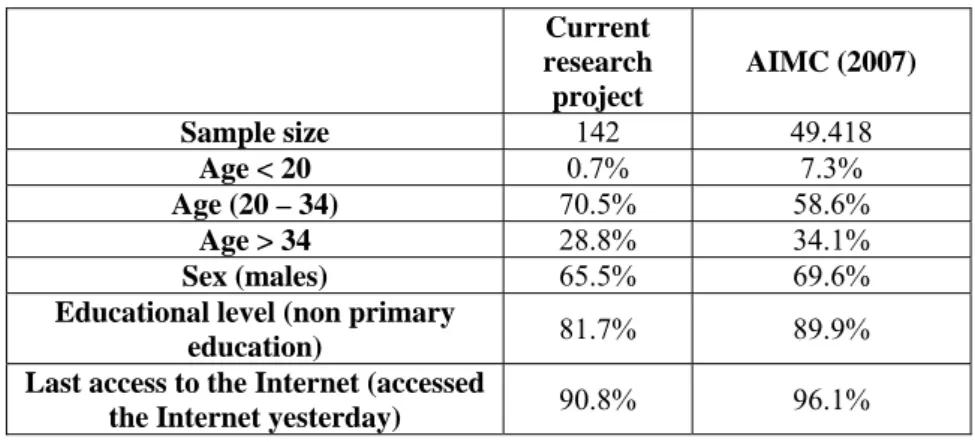
Our non-random method of collecting the data (volunteer sampling) generated 142 valid questionnaires (atypical cases, repeated responses and incomplete questionnaires were controlled). As it is not possible to statistically assess the reliability or possible bias of non-random samples, we compared some of our sample characteristics with available information about the population. Thus, we compared the socio-demographical characteristics of our sample with one of the most important studies on the online Spanish-speaking population (AIMC, 2007). Table 1 shows a comparison of the three studies. The results are very similar.
TABLE 1. THE REPRESENTATIVE NATURE OF THE DATA COLLECTED Current research project AIMC (2007) Sample size 142 49.418 Age < 20 0.7% 7.3% Age (20 – 34) 70.5% 58.6% Age > 34 28.8% 34.1% Sex (males) 65.5% 69.6%
Educational level (non primary
education) 81.7% 89.9%
Last access to the Internet (accessed
the Internet yesterday) 90.8% 96.1%
5. MEASURES VALIDATION
The process of validation included the following stages:
5.1. Content and face validity
Scale development was based on the review of the most relevant literature on relationship marketing and the recent advances in e-marketing (see Table 2).
TABLE 2. CONTENT VALIDITY
Variable Adapted from
Usability Flavián et al. (2006); Roy et al. (2001) and Kirakowski et al. (1998)
Satisfaction Brockman (1998); Servet (2002); Janda(1997) et al.(2002); and Smith and Barclay
Loyalty Algesheimer et al. (2005); and Teo et al. (2003)
WOM Dolen et al. (2007), Maxham III (2001)
From the literature review an initial set of items was proposed. However, due to the lack of valid scales adapted to electronic the e-banking context, it was necessary to adapt the initial scales. This adaptation had the objective of guaranteeing the face validity of the measurement instruments. Face validity is defined as the degree that respondents judge that the items are appropriate to the targeted construct and is habitually confused with content validity. Nevertheless, content validity is the degree to which items correctly represent the theoretical content of the construct and it is guaranteed by the in-depth literature review undertaken. Face validity was tested through a variation of the Zaichkowsky method (1985), whereby each item is qualified
by a panel of experts as “clearly representative”, “somewhat representative” or “not representative” of the construct of interest. In line with Lichtenstein et al. (1990) an
item was retained if a high level of consensus was observed among the experts.
5.2. Exploratory analysis of reliability and dimensionality
The validation process started with an initial exploratory analysis of reliability and dimensionality (Churchill, 1979; Anderson and Gerbing, 1988). The Cronbach alpha indicator was used to assess the initial reliability of the scales, considering a minimum value of .7 (Cronbach, 1970; Nunnally, 1978). The item-total correlation was used to improve the levels of the Cronbach alpha, considering a minimum value of .3 (Nurosis, 1993). All items were adjusted to the required levels.
We then proceeded to evaluate the unidimensionality of the proposed scales. Factor extraction was based on the existence of eigenvalues higher than 1. In addition, it was required that factorial loadings were higher than .5 points and a significant total explained variance. Only one factor was extracted from each scale: usability, satisfaction, loyalty and WOM.
5.3. Confirmatory Analysis of Dimensionality
A confirmatory model development strategy was followed to confirm the
dimensional structure of the scales, as well as to allow for a stringent test of convergent and discriminatory validity (Steenkamp and Geyskens, 2006). We employed the statistical software EQS version 6.1. As an estimation method we chose Robust Maximum Likelihood, since it affords more security in samples which might not present multivariate normality. We followed the criteria proposed by Jöreskog and Sörbom (1993):
- The weak convergence criterion means eliminating indicators that do not show significant factor regression coefficients (t student > 2.58; p= .01).
- The strong convergence criterion involves eliminating non-substantial indicators, those indicators whose standardized coefficients are lower than .5.
- According to the suggestion of Jöreskog and Sörbom, we also eliminated the indicators that least contribute to the explanation of the model, taking R2 < .3 as a cut-off point.
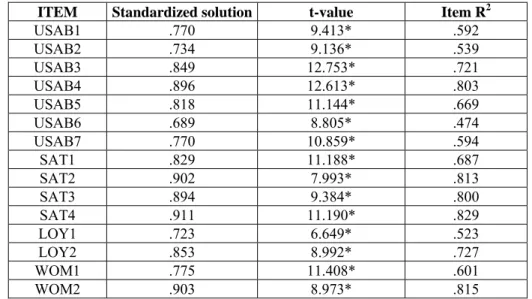
Due to these recommendations, we did not have to eliminate any item and we finally obtained high levels of convergence, R² (see table 3) and a good model fit: Chi-square = 156.340, 84 d.f., p < .01; Bonett Normed Fit Index =.879; Bentler-Bonett Nonnormed Fit Index =.941; Comparative Fit Index (CFI) =.952; Bollen (IFI) Fit Index =.953; Root Mean Sq. Error of App. (RMSEA) =.062; 90% Confidence Interval of RMSEA (.040, .083).
TABLE 3. CONFIRMATORY ANALYSIS OF RELIABILITY AND DIMENSIONALITY
ITEM Standardized solution t-value Item R2
USAB1 .770 9.413* .592 USAB2 .734 9.136* .539 USAB3 .849 12.753* .721 USAB4 .896 12.613* .803 USAB5 .818 11.144* .669 USAB6 .689 8.805* .474 USAB7 .770 10.859* .594 SAT1 .829 11.188* .687 SAT2 .902 7.993* .813 SAT3 .894 9.384* .800 SAT4 .911 11.190* .829 LOY1 .723 6.649* .523 LOY2 .853 8.992* .727 WOM1 .775 11.408* .601 WOM2 .903 8.973* .815
Note: (*) expresses that coefficients are significant at the level of .01.
5.4. Composite Reliability
Although the Cronbach alpha indicator is the most frequent test to assess reliability, some authors consider that it underestimates reliability (e.g. Smith, 1974). Consequently, the use of composite reliability has been suggested (Jöreskog, 1971), using a cut-off value of .6 (Nunnaly and Bernstein, 1994). The results, which are shown in Table 4, were satisfactory.
Construct validity was assessed by considering two types of criteria: convergent and discriminatory validity:
a- Convergent validity. This shows if the items that compose a determined scale
converge on only one construct. This was tested by checking that the factor loadings of the confirmatory model were statistically significant (level of .01) and higher than .5 points (Sanzo et al., 2003). Results (see table 3)
showed that all the indicators loaded significantly (p < .001) and substantively (all factor loadings went beyond .5) on their proposed constructs, providing evidence of convergent validity of the measures (Steenkamp and Geyskens, 2006). In addition, we used the Average Variance Extracted or AVE to contrast convergent validity (Ping, 2004). Fornell and Larker (1981) have suggested that adequately convergent validity measures should contain less than 50% error variance (AVE should be .5 or above). Results were satisfactory, as shown in Table 4.
TABLE 4. COMPOSITE RELIABILITY AND CONVERGENT VALIDITY
Construct reliability Average Variance Extracted
Usability .88 .51
Satisfaction .87 .63
Loyalty .70 .51
WOM .73 .57
b- Discriminatory validity. This verifies if a determined construct is
significantly distinct from other constructs that are not theoretically related to it. We tested discriminatory validity in two ways. Firstly, we checked that the correlations between the variables in the confirmatory model were not higher than .8 points (Bagozzi, 1994). Secondly, we checked that the value 1 did not appear in the confidence interval of the correlations between the different variables. Results showed an acceptable level of discrimination, as can be seen in Table 5, since all pairs of constructs satisfied both criteria.
TABLE 5. DISCRIMINATORY VALIDITY
Pair of constructs Correlation Confidence interval 95%
USAB-SAT .640* .49692 .78308 USAB-LOY .411* .24244 .57956 USAB-WOM .497* .35196 .64204
SAT-LOY .533* .31936 .74664 SAT-WOM .576* .45056 .70144 LOY-WOM .651* .4746 .8274
Note: (*) expresses that coefficients are significant at the level of .01.
6. RESULTS
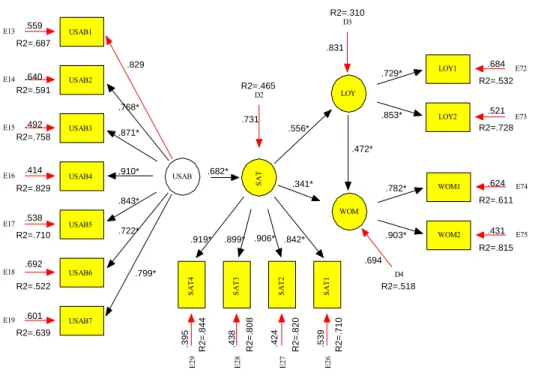
With the objective of testing the proposed hypothesis we developed a structural equations model that can be seen in figure 1. We observed that the four hypotheses were supported at the .01 level. Similarly, model fit was also acceptable (Chi-square = 165.432, 84 d.f., p < .01; Bentler-Bonett Normed Fit Index =.891; Bentler-Bonett Nonnormed Fit Index =.957; Comparative Fit Index (CFI) =.966; Bollen (IFI) Fit Index =.966; Root Mean Sq. Error of App. (RMSEA) =.053; 90% Confidence Interval of RMSEA (.027, .074); normed Chi-Square= 1.969).
It was also notable that this model allows us to explain positive WOM (R2 = .518) at a very high level by: (1) the direct effects of customer satisfaction (β = .341) and loyalty (β = .472), confirming H1 and H3 respectively, and (2) the indirect effects of satisfaction on WOM through loyalty and usability on WOM through satisfaction. At the same time, customer loyalty in the e-banking was partially explained (R2 = .310) by: (1) the direct effect of customer satisfaction (β = .556), so that H2 was proofed, and (2) the indirect effect of usability on loyalty through satisfaction. Lastly, H4 was also supported since we found a positive and significant effect of website perceived usability on customer satisfaction (β = .682). As a result, satisfaction could be also clearly explained (R2 = .465) by using only one antecedent: perceived usability. Thus, taking all these results into account, it is possible to say that satisfaction exerts a mediating role in the development of customer loyalty and positive WOM in the e-banking business.
FIGURE 1. STRUCTURAL EQUATION MODEL USAB USAB1 E13 USAB2 E14 USAB3 E15 USAB4 E16 USAB5 E17 USAB6 E18 USAB7 E19 SA T SA T 1 E2 6 SA T 2 E2 7 SA T 3 E2 8 SA T 4 E2 9 LOY LOY1 E72 LOY2 E73 WOM WOM1 E74 WOM2 E75 D2 D3 D4 .829 .768* .871* .910* .843* .722* .799* .682* .556* .341* .472* .729* .853* .782* .903* .694 .831 .731 .559 .640 .492 .414 .538 .692 .601 .684 .521 .842* .919* .899* .906* .624 .431 .395 .438 .424 .539 R2=.687 R2=.591 R2=.758 R2=.829 R2=.710 R2=.522 R2=.639 R2=.532 R2=.728 R2=.611 R2=.815 R 2 = .844 R 2 = .808 R 2 = .820 R 2 = .710 R2=.518 R2=.310 R2=.465
Note: (*) expresses that coefficients are significant at the level of .01.
6.1 Rival Model
In addition, to check the mediating role of satisfaction, we also compared our proposed model with a rival one. Indeed, it has been traditionally agreed that researchers should contrast rival models and not just evaluate the performance of a proposed one (Bagozzi and Yi, 1988; Morgan and Hunt, 1994; Bloemer and Odekerken, 2003; Algesheimer et al., 2005). Concerning our model, it is important to note that
satisfaction is a key mediating variable. Thus, according to Morgan and Hunt (1994), a rival view of the moderating role of a variable would be a model allowing only direct paths from the precursors to the outcomes. Therefore, the rival model does not include any indirect effect, so that satisfaction is not mediating any of the relationships. Broadly speaking, in the rival model, both usability and satisfaction are considered direct antecedents of loyalty and WOM.
Thus, based upon Morgan and Hunt (1994), we compare our model with its rival on the following terms: (1) overall fit, as measured by the CFI indicator1 (Morgan and Hunt, 1994; Bloemer and Odekerken, 2003); (2) parsimony, as measured by the ratio of chi-square to degrees of freedom2 (Bloemer and Odekerken, 2003); (3) percentage of the model paths that were statistically significant; and (4) the ability to explain the variance of the endogenous constructs. Indeed, one of the advantages of structural equation modelling is that it allows the comparison of several models (e.g. Mitchell, 1992).
Firstly, results show that all the proposed paths are significant in the hypothesized model whereas one of the paths in the rival model (the direct effect of usability on loyalty) is not significant (β = .125). Secondly, we also saw that the proposed model fits better than the rival one:
• The CFI of the rival model (.893) was lower than that of the proposed model (.966).
• The rival model’s ratio of chi-square to degrees of freedom was much higher than that of the proposed model (3.039 vs. 1.969).
In addition, loyalty and WOM were explained at a very similar level in both the proposed model (R2LOY = .310; R2WOM = .518) and in its rival (R2LOY = .295; R2WOM =
.491). Broadly speaking, we may say first that the direct effect of satisfaction plus the indirect effect of usability in the hypothesized model are even a bit greater than the two direct effects proposed in the rival model in explaining the consumer loyalty to a financial services website. In addition, the direct effects of satisfaction and loyalty plus the indirect effect of usability in the research model are, at least, equally strong to the three direct effects proposed in the rival model in explaining the development of positive WOM.
Therefore, these findings allow us to conclude that satisfaction is a key mediating factor in the development of loyalty and positive WOM in the online banking context. Indeed, according to Bloemer and Odekerken (2003), the comparison of the
1 Recommended values for the CFI indicator are near to 1 (Flavián
et al., 2006) taking .9 as a cut-off
point (Bansal and Boyer, 2000).
2 To achieve a good level of parsimony, the ratio of chi-square to degrees of freedom, also known as normed Chi-Square, must be in the range between 1 and 2 (Bansal and Boyer, 2000; Hair et al., 1998).
hypothesized model with a rival one may also serve to strengthen the support we found for the meaningfulness and robustness of our proposed model.
7. CONCLUSIONS
The results of this research have helped to remedy, to a certain extent, the lack of empirical studies that analyze customer loyalty and positive WOM development in the e-banking context. Indeed, the analysis of WOM in this context is especially relevant since WOM is more important and influential in the services context because of their intangibility and therefore, greater perceived risk (Murray and Schlacter, 1990).
Specifically, in this study, we first have seen that customer loyalty to the website of a financial services provider is closely linked to the levels of satisfaction with previous interactions with that website. This relationship is consistent with previous literature on marketing that has shown a strong link between these two constructs (Petrick and Backman, 2002; Anderson and Sullivan, 1993; Hallowell, 1996; Yoon and Kim, 2000). Secondly, our analyses have shown that perceived customer loyalty and satisfaction are two key determinants of positive WOM development in the e-banking context. In addition, we have also seen that perceived usability is an indirect antecedent of both costumer loyalty and positive WOM through satisfaction. This is caused by the fact that the usability helps to satisfy the consumer needs in terms of manageability of the website and, as a result, greater levels of loyalty and positive WOM will be created. Besides, thanks to the comparison between the hypothesized model and a rival one, we have also verified this mediating role of satisfaction in the development of customer loyalty and positive WOM in the online banking context. Thus, all these effects have allowed us to clearly explain both customer loyalty (R2 = .310) and positive WOM (R2 = .518) in the context of electronic banking.
To sum up, we may conclude that, in the context of e-banking, the development of satisfaction and perceived usability directly affects the effective customer behaviour, in terms of company preference for future interactions and recommendation to fellow customers, which may therefore affect the level of profitability provided by each customer to the company.
7.1. Managerial Implications
Due to the strong effect that WOM exerts on customer choice, companies should try to develop positive WOM about their products (Chung and Darke, 2006). However, this is not usually easy to do since consumers are knowledgeable about a great number of products and services, but only give WOM about some of them (Chung and Darke, 2006). In addition, due to the high costs every company has to face in order to win new customers, it is increasingly necessary to increase the loyalty levels of current customers. In this respect, this research offered several alternatives to improve the levels of customer loyalty and to develop positive WOM in the e-banking business.
Firstly, we think that banks that operate through the Internet should try to maximize the satisfaction of their customers with their previous interactions through the bank’s website. Customer satisfaction will be generated if the customer’s expectations
about the relationship are met. Therefore, banks should try to identify the needs of their online customers (e.g. in terms of services offered, design of the website, etc.) in order to offer them what they want in an efficient way.
Secondly, banks should also manage their website perceived usability. Indeed, the most effective website may not be the most sophisticated one, but the most easy to use. In other words, marketers must prioritize ease-of-use in website development. Indeed, greater perceived usability favours improved comprehension of the contents and tasks which are required and offers more security to website users as well as a more comfortable atmosphere, which may help to satisfy the customer needs and, as a consequence, increase his/her loyalty and the likelihood to say good things about the website to fellow customers.
Thus, the improvement of the levels of satisfaction and usability will promote the customer loyalty and positive WOM. As a consequence, the retention-rate and profits of the e-banking business will be also increased.
Firstly, an interesting route to extend this research would be to analyze the effects of new Internet access methods (e.g. mobile phone, etc.) on customer loyalty and positive WOM when individuals and banks interact by means of these new technologies. Secondly, it would a good idea to repeat the study using a wider sample of customers. To be precise, the sample should represent a greater diversity of nationalities, so that we would be able to investigate possible differences in customers’ behaviour from different nationalities in the online banking context.
Finally, although we have found support for all the hypotheses proposed in the study, the number of antecedents of customer loyalty and positive WOM could be larger. For instance, factors such as perceived reputation, trust, security or privacy, among others, could also increase the level of loyalty and positive WOM in the e-banking context. Therefore, we should analyze the process of loyalty and positive WOM development in more detail.
ANNEX 1: MEASUREMENT SCALES
The individual was asked to grade from 1-7 their level of agreement with the following statements in relation to the selected website.
USABILITY
USAB1 In this website everything is easy to understand
USAB2 This website is simple to use, even when using it for the first time.
USAB3 It is easy to find the information I need from this website.
USAB4 The structure and contents of this website are easy to understand.
USAB5 It is easy to move within this website.
USAB6 The organization of the contents of this site makes it easy for me to know where I am when navigating it.
USAB7 When I am navigating this site, I feel that I am in control of what I can do.
SATISFACTION
SAT1 I think that I made the correct decision to use this website.
SAT2 The experience that I have had with this website has been satisfactory
SAT3 In general terms, I am satisfied with the way that this website has carried out transactions
SAT4 In general, I am satisfied with the service I have received from the website.
LOYALTY
LOY1 I have the intention to continue my relationship with this website
LOY2 Based on my experience, I am very likely continue my relationship with this website in the next months
POSITIVE WOM
WOM1 I will recommend this website to other customers
WOM2 I will point out the positive aspects of this website if anybody criticize it