Multi-Dimensional Range Query over Encrypted Data
∗Elaine Shi
John Bethencourt
T-H. Hubert Chan
Dawn Song
Adrian Perrig
Carnegie Mellon University
Abstract
We design an encryption scheme called Multi-dimensional Range Query over Encrypted Data (MRQED), to address the privacy concerns related to the sharing of network audit logs and various other applications. Our scheme allows a network gateway to encrypt summaries of network flows before sub-mitting them to an untrusted repository. When network intru-sions are suspected, an authority can release a key to an au-ditor, allowing the auditor to decrypt flows whose attributes (e.g., source and destination addresses, port numbers, etc.) fall within specific ranges. However, the privacy of all irrele-vant flows are still preserved. We formally define the security for MRQED and prove the security of our construction un-der the decision bilinear Diffie-Hellman and decision linear assumptions in certain bilinear groups. We study the practi-cal performance of our construction in the context of network audit logs. Apart from network audit logs, our scheme also has interesting applications for financial audit logs, medical privacy, untrusted remote storage, etc. In particular, we show that MRQED implies a solution to its dual problem, which en-ables investors to trade stocks through a broker in a privacy-preserving manner.
1
Introduction
Recently, the network intrusion detection community has made large-scale efforts to collect network audit logs from different sites [25, 35, 24]. In this application, a network gate-way or an Internet Service Provider (ISP) can submit network traces to an audit log repository. However, due to the pres-ence of privacy sensitive information in the network traces, the gateway will allow only authorized parties to search their audit logs. We consider the following four types of entities: a gateway, an untrusted repository, an authority, and an audi-tor. We design a cryptographic primitive that allows the gate-way to submit encrypted audit logs to the untrusted reposi-tory. Normally, no one is able to decrypt these audit logs. ∗This research was supported in part by CyLab at Carnegie Mellon under
grant DAAD19-02-1-0389 and Cyber-TA Research grant No. W911NF-06-1-0316 from the Army Research Office, and grants 0433540 and 0448452 from the National Science Foundation, and a grant from GM. The views and conclusions contained here are those of the authors and should not be interpreted as necessarily representing the official policies or endorsements, either express or implied, of ARO, CMU, GM, NSF, or the U.S. Government or any of its agencies.
However, when malicious behavior is suspected, an auditor may ask the authority for a search capability. With this search capability, the auditor can decrypt entries satisfying certain properties, e.g., network flows whose destination address and port number fall within a certain range. However, the privacy of all other flows should still be preserved. Note that in prac-tice, to avoid a central point of trust, we can have multiple parties to jointly act as the authority. Only when a sufficient number of the parities collaborate, can they generate a valid search capability.
We name our encryption scheme Multi-dimensional Range Query over Encrypted Data (MRQED). In MRQED, we encrypt a message with a set of attributes. For example, in the network audit log application, the attributes are the fields of a network flow, e.g., source and destination addresses, port numbers, time-stamp, protocol number, etc. Among these at-tributes, suppose that we would like to support queries on the time-stampt, the source addressa and the destination port number p. Our encryption scheme provides the following properties:
• Range query on attributes. An authority can issue a
decryption key for all flows whose(t, a, p)falls within a certain range: t ∈ [t1, t2] and a ∈ [a1, a2] and p ∈ [p1, p2]. Notice that range query implies equality and greater-than (smaller-than) tests, e.g.,t ≥ t1 and a=a1andp≤p1. With this decryption key, all flows whose(t, a, p)tuple falls within the above range can be decrypted.
• Security requirement. Normally, no one can learn any
information from the ciphertexts. Under special circum-stances, however, an auditor may obtain a decryption key from an authority for some ranget ∈ [t1, t2] and a∈[a1, a2]andp∈[p1, p2]. For any flow, if at least one attribute amongt, a, plies outside the specified range, the auditor fails to decrypt it. The auditor inevitably learns that the(t, a, p) tuple of this flow does not lie within the given range. However, apart from this in-formation, the auditor cannot learn anything more about the flow. For example, the auditor cannot learn anything about attributes other thant, a, p; in addition, she cannot decide whethert < t1ort > t2, etc.
Our results and contributions. We are among the earliest
to study the problem of point encryption, range query, and conditional decryption of matching entries. We propose a provably secure encryption scheme that allows us to achieve
Scheme Pub. Key Size Encrypt. Cost CT Size Decrypt. Key Size Decrypt. Cost Security Model BonehWaters06 [13] O(D·T) O(D·T) O(D·T) O(D) O(D) MC Naive AIBE-based scheme O(1) O((logT)D) O((logT)D) O((logT)D) O((logT)D)
MR Our scheme O(D·logT) O(D·logT) O(D·logT) O(D·logT) O((logT)D)
MR
Table 1.Performance of different approaches.Ddenotes the number of dimensions andTthe number of points in each.
The naive AIBE-based scheme is described in Section 4.3. MC and MR refer to the match-concealing and match-revealing security models respectively as defined in Section 3.
these properties. Table 1 summarizes the asymptotic perfor-mance of our scheme in comparison with other approaches. Please refer to Section 2 for a detailed comparison between our scheme MRQED, and the concurrent work BonehWa-ters06 [13]. We study the practical performance of MRQED, and show that it makes the encrypted network audit log appli-cation feasible. We also study the dual problem to MRQED, where one encrypts under a hyper-range in multi-dimensional space, and decrypts under a point. We show that MRQED im-plies a solution to its dual problem, which enables investors to trade stocks through a broker in a privacy-preserving manner.
Paper organization. In the remainder of this section, we
give more example applications of MRQED. We review re-lated work in Section 2, and formally define the MRQED problem in Section 3. In Section 4, we demonstrate some initial attempts at constructing MRQED; while in Section 5, we describe our novel construction which we consider the main contribution of this paper. We note that the purpose of Section 4 is not only to exhibit straw-man schemes, but also to better motivate our design of MRQED as described in Section 5. In particular, some of the primitives introduced in Section 4 will later be used in Section 5 when we explain our novel construction. Due to limit of space, formal security proofs of security are provided in the online technical report version [43]. In the proof, we borrow techniques from the AHIBE scheme of Boyen and Waters [15]. As a result, the security of our construction is likewise based on the hardness of Decision Bilinear Diffie-Hellman problem and the Deci-sion Linear problem. In Section 7, we consider the practical performance of the scheme in the context of network audit logs. We show that MRQED implies a solution to its dual problem in Section 8, and show that the dual problem is of particular interest to investors who would like to trade stocks through a broker in a privacy-preserving manner.
1.1
Application to Network Audit Logs
We briefly mentioned network audit logs at the beginning of this section. Throughout the paper, we will keep using this example to motivate the design of MRQED. To provide context for the remainder of the paper, we now describe this application in greater detail.Firewalls and network intrusion detection systems (NIDS) such as Snort [44], Emerald [40], and Bro [39] produce logs summarizing detected or blocked activities suspected to be malicious. Log entries typically correspond to either a sin-gle packet (perhaps rejected by a firewall) or an established flow deemed suspicious. Each entry normally includes fields such as source and destination IP address and port, date and
time, protocol (e.g., TCP, UDP, or ICMP), and, in the case of NIDS, the type of rule causing an alert. Sharing and com-paring such logs across organizations is a method for gaining broader information about malicious activities on the Internet so that administrators may better protect their systems. Cur-rent large scale efforts to collect and aggregate network au-dit logs for this purpose include DShield [25], myNetWatch-man [35], and Deepsight [24].
However, sharing of network audit logs is hampered by the presence of security and privacy sensitive information. By en-crypting each log entry before sending it to another party, the source can allay these concerns. Later, the source may release a decryption key for a carefully specified set of log entries deemed currently relevant. For example, suppose a particular host with IP addressa1is determined to have been compro-mised at timet1and later involved in scanning other hosts for vulnerabilities on a certain range of ports[p1, p2]. A trusted authority may then choose to release a key decrypting any entries at timet, with source addressa, connecting to portp such thatt≥t1,a=a1, andp1≤p≤p2. Note that to avoid a central point of trust, we can have multiple parties jointly act as the authority. Using techniques from secure multi-party computation [27], only when a sufficient number of them col-laborate, can they generate a valid decryption key. The source would then have precise guarantees about the privacy of their network while providing useful information to other individ-ual organizations or a global monitoring effort. The public key nature of the scheme would allow distributed, encrypted submissions to a central monitoring organization possessing the master private key and giving out decryption keys as nec-essary. There have been some previous attempts to protect the security of audit logs through encryption or anonymiza-tion while allowing limited queries [47, 23, 33], but in no previous scheme has it been possible to issue keys for con-junctions of ranges over multiple attributes while maintaining the secrecy of the attributes. In particular, we are not aware of any previous method supporting queries such as our example of(t≥t1) ∧ (a=a1)∧ (p1≤p≤p2)that does not require either revealing the attribute values or issuing an exponential number of key components.
1.2
Other Applications
Apart from the network audit log application, and the stock-trading application described in Section 8, we men-tion here some other potentially interesting applicamen-tions of MRQED.
Financial audit logs. Financial audit logs contain
scheme allows financial institutions to release audit logs in encrypted format. When necessary, an authorized auditor can obtain a decryption key from a trusted authority. With this decryption key, the auditor can decrypt certain transactions that may be suspected of fraudulent activities. However, the privacy of all other transactions are preserved.
Medical privacy. Consider a health monitoring program.
When Alice moves about in her daily life, a PDA or smart-phone she carries automatically deposits encrypted crumbs of her trajectory at a storage server. Assume that each crumb is of the form((x, y, t), ct), where(x, y)represents the loca-tion,trepresents time, andctis Alice’s contact information. During an outbreak of an epidemic, Alice wishes to be alerted if she was present at a site borne with the disease during an incubation period, i.e., if(x, y, t)falls within a certain range. However, she is also concerned with privacy, and she does not wish to leak her trajectory if she has not been to a site borne with the disease.
Untrusted remote storage. Individual users may wish to
store emails and files on a remote server, but because the stor-age server is untrusted, the content must be encrypted before it is stored at the remote server. Emails and files can be clas-sified with multi-dimensional attributes. Users may wish to perform range queries and retrieve only data that satisfy the queries.
Using biometrics in anonymous IBE. The MRQED scheme
can also be used in biometric-based Anonymous Identity-Based Encryption (AIBE). Using biometrics in identity-based encryption first appeared in the work by Sahai and Wa-ters [41]. In this application, a person’s biometric features such as finger-prints, blood-type, year of birth, eye color, etc., are encoded as a pointXin a multi-dimensional lattice. Per-sonal data is encrypted using the owner’s biometric features as the identity, and the encryption protects both the secrecy of the personal data and the owner’s biometric identity. Due to potential noise each time a person’s biometric features are sampled, a user holding the private key for biometric identity
Xshould be allowed to decrypt data encrypted underX′, iff
X′ andXhave small distance. In particular, the SahaiWa-ters04 construction [41] considered the set-overlap distance (or the Hamming distance); and their encryption scheme does not hide the identity of the user. Our construction allows a user with the private key for identityX, to decrypt an en-try encrypted underX′, iff ℓ∞(X,X′) ≤ ǫ. Here ℓ∞ de-notes theℓ∞ distance betweenXandX′, and is defined as
max{|x1−x′
1|, . . . ,|xD−x′D|}. In this case, the
decryp-tion region is a hyper-cube in multi-dimensional space. One can also associate a different weight to each dimension, in which case the decryption region becomes a hyper-rectangle.
2
Related Work
Search on encrypted data. The problem of search on
en-crypted data (SoE) was introduced in the symmetric key set-ting by Song et al. [45] and has had some recent improve-ments in security definitions and efficiency [21]. Boneh
et al. [10] later proposed Public Key Encryption with Key-word Search (PEKS), in which any party possessing the pub-lic key can encrypt and the owner of the corresponding pri-vate key can generate keyword search capabilities. Both SoE and PEKS can be trivially extended to support one-dimensional range queries; the extension is similar to the MRQED1 scheme described in Section 4.2. However, it is not clear that either can be used to construct a scheme sup-porting range queries over multiple attributes. Recent work on traitor-tracing systems [14, 12] allows a more specialized sort of range query. Given a ciphertext C with attributes
X= (x1, x2, . . . , xD), a master key owner can issue a token
for some valuex′that allow us to decide whetherx
d≤x′for
all1 ≤d ≤D withO(√T)ciphertext size and token size. Applications of searchable encryption have been studied by the database community [30, 22, 2]. Other works related to searches on encrypted data include oblivious RAMs [37, 28], and private stream searching [5, 38].
IBE. The notion of Identity-Based Encryption (IBE) was
in-troduced by Shamir [42]. Several IBE schemes [20, 11, 7, 6, 18, 46, 36], hierarchical IBE (HIBE) schemes [31, 26, 8, 48], and applications [41, 29] were proposed since then. In par-ticular, the HIBE scheme proposed by Boneh, Boyen, and Goh [8] can be extended to multiple dimensions (M-HIBE) efficiently and in a collusion-resistant1manner. The resulting scheme can be used to solve a problem similar to MRQED, but lacking the third property in the previous discussion. That is, when using M-HIBE it would not be possible to hide the attribute values associated with a ciphertext.
Anonymous IBE. Recently, researchers have proposed
anonymous IBE and HIBE schemes (AIBE, AHIBE) [15, 1]. The notion of anonymity is also related to key privacy [4, 3]. Like the HIBE scheme mentioned above, the AHIBE scheme of Boyen and Waters [15] can be extended to multiple dimen-sions in a collusion-resistant manner, resulting in a Multi-dimensional AHIBE (M-AHIBE) scheme. An M-AHIBE scheme could be used to implement MRQED (including the third property), but applying it directly would have a serious drawback. Because the encryption is anonymous and hides the attributes used as the public key, at time of decryption one would need to try all possible decryption keys on a given ciphertext. This incurs O(TD)decryption cost on a single
ciphertext, where T is the number of possible values each attribute may assume and may be quite large. Nevertheless, on a technical level, this AHIBE scheme and its extension to M-AHIBE are the most closely related work to ours. In par-ticular, we prevent collusion in the same way the M-AHIBE construction does. Since we do not require the key delegation property of HIBE schemes, however, we are able to improve decryption cost to be logarithmic inT.
Recent developments. Concurrent to our work, Boneh and
Waters [13] propose another construction (BonehWaters06 in Table 1) for complex queries over encrypted data. They propose a primitive called Hidden Vector Encryption, and 1Collusion-resistance, in this sense, means that two parties who have been
issued different decryption keys cannot combine their keys in some way to allow decryption of ciphertexts that neither could decrypt previously.
use it in conjunctive range and subset queries. When ap-plied to multi-dimensional range query, their scheme results inO(DT)encryption time, ciphertext size, and public key size, andO(D)decryption key size and decryption cost. As in Table 1,DandTare the number of attributes and the num-ber of discrete values for each attribute. Their scheme is more expensive in terms of public key size, encryption cost and ci-phertext size; but saves on decryption key size and decryption cost. In applications with large T and smallD (e.g., net-work audit logs, and the stock trading application mentioned in Section 8), our approach is more appropriate. In particu-lar, for network audit logs,T = 232 for an IP address, and D may range from 2 to4. In other applications whereD is large andT is small, the BonehWaters06 construction is more appropriate. We also would like to note that the Bone-hWaters06 construction achieves a stronger notion of secu-rity. Their construction hides the attribute values, even when the message is successfully decrypted. This stronger secu-rity property is a key difference from our construction, in which the attribute values are revealed upon successful de-cryption. In Section 3, we name these two different security models match-concealing security and match-revealing secu-rity respectively. For applications like encrypted network au-dit logs, it is acceptable to reveal the attributes of a message when it is successfully decrypted. By relaxing the security definition to allow this possibility, we achieve O(DlogT)
encryption time, ciphertext size, and public key size. This makes applications such as the encrypted network audit logs possible. However, one may conceive of other applications where the stronger security notion is necessary.
3
Problem Definition and Preliminary
3.1
Problem Definition
In the network audit log application, a gateway encrypts network flows, and submits them to an untrusted repository. When necessary, an auditor may ask an authority for a key that allows the decryption of all flows whose attributes fall within a certain range; while the privacy of all irrelevant flows are still preserved. There is a geometric interpretation to these multi-attribute range queries. Suppose that we would like to allow queries on these three fields: time-stampt, source ad-dressa, and destination portp. The tuple(t, a, p)can be re-garded as a pointXin multi-dimensional space. Now sup-pose we query for all flows whoset,a,pfalls within some range: t ∈ [t1, t2], a ∈ [a1, a2] and p ∈ [p1, p2]. Here the “hyper-range”[t1, t2]×[a1, a2]×[p1, p2]forms a hyper-rectangleBin space. The above range query is equivalent to testing whether a pointXfalls inside the hyper-rectangleB.
We now formally define these notions mentioned above. Assume that an attribute can be encoded using discrete inte-ger values1 throughT. For example, an IP address can be encoded using integers1through 232. We use the notation
[T]to denote integers from1toT, i.e.,[T] ={1,2, . . . , T}. LetS≤T be integers, we use[S, T]to denote integers from StoT inclusive, i.e.,[S, T] ={S, S+ 1, . . . , T}. Through-out this paper, we assume thatT is a power of 2, and denote
log2 as simply log. Suppose that we would like to support range queries onDdifferent attributes, each of them can take on values in[T1],[T2], . . . ,[TD]respectively. We formally
define aD-dimensional lattice, points and hyper-rectangles below.
Definition 1 (D-dimensional lattice, point, hyper-rectan-gle). Let ∆ = (T1, T2, . . . , TD). L∆ = [T1] ×[T2] × . . . ×[TD] defines a D-dimensional lattice. A D-tuple
X = (x1, x2, . . . , xD)defines a point inL∆, wherexd ∈
[Td](∀d ∈ [D]). A hyper-rectangle B in L∆ is defined as B(s1, t1, s2, t2, . . . , sD, tD) = {(x1, x2, . . . , xD)
∀d ∈
[D], xd∈[sd, td]}(∀d∈[D],1≤sd≤td≤Td).
A MRQED scheme consists of four (random-ized) polynomial-time algorithms: Setup, Encrypt,
DeriveKey and QueryDecrypt. In the network audit log example, an authority runs Setup to generate public parameters and a master private key; a gateway runs the
Encrypt algorithm to encrypt a flow. Encryption is performed on a pair (Msg,X). The message Msg is an arbitrary string, andXis a point in multi-dimensional space, representing the attributes. For example, suppose that we would like to support queries on the following three attributes of a flow: time-stamp t, source addressa, and destination portp. The tuple(t, a, p)then becomes the pointX, and the entire flow summary forms the message Msg. Whenever necessary, the authority can run theDeriveKeyalgorithm, and compute a decryption key allowing the decryption of flows whose attributes fall within a certain range. Given this decryption key, an auditor runs the QueryDecrypt
algorithm over the encrypted data to decrypt the relevant flows. We now formally define MRQED.
Definition 2 (MRQED). An Multi-dimensional Range Query
over Encrypted Data (MRQED) scheme consists of the fol-lowing polynomial-time randomized algorithms.
1. Setup(Σ,L∆): Takes a security parameterΣandD
-dimensional latticeL∆and outputs public keyPKand master private keySK.
2. Encrypt(PK,X,Msg): Takes a public keyPK, a pointX, and a messageMsgfrom the message space
Mand outputs a ciphertextC.
3. DeriveKey(PK,SK,B): Takes a public keyPK, a master private keySK, and a hyper-rectangleBand out-puts decryption key for hyper-rectangleB.
4. QueryDecrypt(PK,DK,C): Takes a public key
PK, a decryption keyDK, and a ciphertextCand out-puts either a plaintextMsgor⊥, signaling decryption failure.
For each messageMsg ∈ M, hyper-rectangleB ⊆L∆, and pointX ∈ L∆, the above algorithms must satisfy the following consistency constraints:
QueryDecrypt(PK,DK,C) =
Msg ifX∈B
⊥ w.h.p., ifX∈/B
(1) where C = Encrypt(PK,X,Msg) and DK =
3.2
Security Definitions
Suppose that during time[t1, t2], there is an outbreak of a worm characteristic by the port numberp1. Now the trusted authority issues a key for the ranget ∈ [t1, t2]andp = p1 to a research group who has been asked to study the worm behavior. With this key, the research group should be able to decrypt only flows whose time-stamp and port number fall within the given range. The privacy of all other flows should still be preserved. Informally, suppose that a com-putationally bounded adversary has obtained decryption keys for regionsB0,B1, . . . ,Bq. Now given a ciphertextC =
Encrypt(PK,X,Msg) such that X ∈/ B0,B1, . . . ,Bq,
the adversary cannot learnXor Msgfrom C. Of course, since the adversary fails to decryptCusing keys for regions
B0,B1, . . . ,Bq, the adversary inevitably learns that the point
X encrypted does not fall within these regions. But apart from this fact, the adversary cannot learn more information aboutXorMsg.
We now formalize this intuition into a selective security game for MRQED. Here, the selective security notion is sim-ilar to the selective-ID security for IBE schemes [16, 17, 6]. We prove the security of our construction in the selective model. A stronger security notion is adaptive security, where the adversary does not have to commit to two points in the
Init stage of the security game defined below. In the technical
report version [43], we give a formal definition for adaptive security, and state how it is related to the selective security model.
Definition 3 (MR-selective security). An MRQED scheme is
selectively secure in the match-revealing (MR) model if all polynomial-time adversaries have at most a negligible advan-tage in the selective security game defined below.
• Init: The adversary submits two pointsX∗0,X∗1 ∈ L∆ where it wishes to be challenged.
• Setup: The challenger runs the Setup(Σ,L∆)
algo-rithm to generatePK,SK. It givesPKto the adver-sary, keepingSKsecret.
• Phase 1: The adversary adaptively issues decryption
key queries for hyper-rectanglesB1,B2, . . . ,Bq0.
Fur-thermore,X∗0 andX∗1 are not contained in any hyper-rectangles queried in this phase, i.e., for0 < i ≤ q0,
X∗0∈/ Bi, andX∗1∈/ Bi.
• Challenge: The adversary submits two equal length
messages Msg0,Msg1 ∈ M. The challenger flips a random coin,b, and encryptsMsgbunderX∗b. The ci-phertext is passed to the adversary.
• Phase 2: Phase 1 is repeated. The adversary adap-tively issues decryption key queries for hyper-rectangles
Bq0+1,Bq0+2, . . . ,Bq. As before, all hyper-rectangles
queried in this stage must not containX∗0andX∗1. • Guess: The adversary outputs a guessb′ofb.
An adversaryA’s advantage in the above game is defined asAdvA(Σ) =
Pr[b=b′] −1
2 .
We would like to note that a stronger notion of security is possible as defined by Boneh and Waters in their concur-rent work [13]. We call this stronger security notion match-concealing (MC) security, since it requires that the attribute values (i.e., the pointX) remain hidden even when an entry matches a query. MC-selective security can be formally de-fined through the following game between an adversary and a challenger.
Definition 4 (MC-selective security [13]). An MRQED
scheme is selectively secure in the match-concealing (MC) model if all polynomial-time adversaries have at most a neg-ligible advantage in the selective security game defined be-low.
• Init: The adversary submits two pointsX∗0,X∗1 ∈ L∆
where it wishes to be challenged.
• Setup: The challenger runs the Setup(Σ,L∆) algo-rithm to generatePK,SK. It givesPKto the adver-sary, keepingSKsecret.
• Phase 1: The adversary adaptively issues decryption
key queries for hyper-rectanglesB1,B2, . . . ,Bq0,
sat-isfying the condition that for all 0 < i ≤ q0, either
(X∗0∈Bi)∧(X∗1∈Bi), or(X∗0∈/ Bi)∧(X∗1∈/Bi). • Challenge: The adversary submits two equal length
messagesMsg0,Msg1 ∈ M. If in Phase 1, there
ex-ists some0< i≤q0such that(X∗0∈Bi)∧(X∗1∈Bi),
thenMsg0 = Msg1. The challenger flips a random coin,b, and encryptsMsgbunderX∗b. The ciphertext is passed to the adversary.
• Phase 2: Phase 1 is repeated. The adversary adap-tively issues decryption key queries for hyper-rectangles
Bq0+1,Bq0+2, . . . ,Bq, satisfying the condition that for
allq0 < i ≤ q, either(X∗0 ∈ Bi)∧(X∗1 ∈ Bi), or
(X∗
0 ∈/ Bi)∧(X∗1 ∈/ Bi). In addition, if in the
Chal-lenge stage,Msg0 6=Msg1, then for allq0 < i ≤q,
(X∗0∈/ Bi)∧(X∗1∈/Bi).
• Guess: The adversary outputs a guessb′ofb.
Likewise, an adversaryA’s advantage in the above game is defined asAdvA(Σ) =Pr[b=b′]−12.
In this paper, we use the MR security model, i.e., we do not protect the privacy of the attributes if an entry is matched by the query. This security notion suffices for applications such as network audit logs, and the stock-trading application as described in Section 8.
3.3
Preliminary: Bilinear Groups
A pairing is an efficiently computable, non-degenerate function,e : G×Gb → G′, satisfying the bilinear property that e(gr,bgs) = e(g,bg)rs. G, Gb andG′ are all groups of prime order. g, bg ande(g,bg) are generators ofG, Gb and
G′ respectively. Although our MRQED scheme can be con-structed using asymmetric pairing, for simplicity, we describe our scheme using symmetric pairing in the remainder of the paper, i.e.,G=Gb.
We name a tupleG= [p,G,G′, g,e]a bilinear instance, whereGandG′are two cyclic groups of prime orderp. We assume an efficient generation algorithm that on input of a security parameterΣ, outputsG←R Gen(Σ)wherelog2p=
Θ(Σ).
We rely on the following complexity assumptions:
Decision BDH Assumption: The Decision Bilinear DH
as-sumption, first used by Joux [32], later used by IBE sys-tems [11], posits the hardness of the following problem: Given [g, gz1, gz2, gz3, Z]
∈ G4 × G′, where exponents z1, z2, z3 are picked at random from Zp, decide whether
Z=e(g, g)z1z2z3.
Decision Linear Assumption: The Decision Linear
assump-tion, first proposed by Boneh, Boyen and Shacham for group signatures [9], posits the hardness of the following problem: Given[g, gz1, gz2, gz1z3, gz2z4, Z]
∈G6, wherez1, z2, z3, z4 are picked at random fromZp, decide whetherZ=gz3+z4.
4
A First Step towards MRQED
In this section, we first show a trivial construction for MRQED which has O(T2D) public key size, O(T2D)
en-cryption cost and ciphertext size, O(1)decryption key size and decryption cost. Then in Section 4.2, we show that using AIBE, we can obtain an improved one-dimension MRQED scheme. Henceforth, we refer to a one-dimension MRQED scheme as MRQED1 and refer to multi-dimension MRQED as MRQEDD. The AIBE-based MRQED1 construction has O(1)public key size, O(logT)encryption cost, ciphertext size, decryption key size and decryption cost. While de-scribing the AIBE-based MRQED1 construction, we intro-duce some primitives and notations that will later be used in our main construction in Section 5. In Section 4.3, we demonstrate that a straightforward extension of the AIBE-based MRQED1 scheme into multiple dimensions results in O (logT)Dencryption cost, ciphertext size, decryption key
size and decryption cost. The AIBE-based MRQED1 con-struction aids the understanding of our main concon-struction in Section 5. By contrast, details of the AIBE-based MRQEDD scheme are not crucial towards the understanding of our main construction. Therefore, we only highlight a few important definitions and give a sketch of the scheme in Section 4.3. We give the detailed description of the AIBE-based MRQEDD scheme in the technical report version [43].
4.1
Trivial Construction
We first give a trivial construction for one-dimensional range query over encrypted data. We refer to one-dimensional range query over encrypted data as MRQED1where the su-perscript represents the number of dimensions.
In the trivial MRQED1 construction, we make use of any secure public key encryption scheme. We first generate O(T2)public-private key pairs, one for each range[s, t] ⊆
[1, T]. To encrypt a messageMsgunder a pointx, we pro-duceO(T2)ciphertexts, one for each range[s, t]
⊆ [1, T]. In particular, ifx∈ [s, t], we encryptMsgwith public key
pks,t; otherwise, we encrypt an invalid message⊥withpks,t. The decryption key for any range[s, t]is thensks,t, the
pri-vate key for[s, t]. In the technical report version [43], we give a formal description of this trivial construction.
One can extend this idea into multiple dimensions. The resulting MRQEDD scheme requires that one encrypt δB(Msg,X)for all hyper-rectanglesBin space. Therefore, the trivial MRQEDD scheme has O(T2D) public key size,
O(T2D)encryption cost and ciphertext size,O(1)decryption
key size andO(1)decryption cost.
4.2
Improved
MRQED
1Construction
Based on AIBE
We show an improved MRQED construction based on Anonymous Identity-Based Encryption (AIBE). For clarity, we first explain the construction for one dimension. We call the scheme MRQED1where the superscript denotes the num-ber of dimensions. We note that the primitives and notations introduced in this section will be used in our main construc-tion.
4.2.1 Primitives: Efficient Representation of Ranges
To represent ranges efficiently, we build a binary interval tree over integers1throughT.
Definition 5 (Interval tree). Lettr(T)denote a binary inter-val tree over integers from1toT. Each node in the tree has a pre-assigned uniqueID. For convenience, we definetr(T)to be the set of all nodeIDs in the tree. Each node intr(T) rep-resents a range. Letcv(ID)denote the range represented by nodeID ∈ tr(T). Definecv(ID)as the following: LetID be theithleaf node, thencv(ID) =i. Otherwise, whenID
is an internal node, letID1andID2denote its child nodes, thencv(ID) =cv(ID1)∪cv(ID2). In other words,cv(ID)
is the set of integers that correspond to the leaf descendants ofID.
Given the interval treetr(T), we define theP(x)ofIDs covering a pointx∈ [1, T], and the setΛ(x)of IDs repre-senting a range[s, t]⊆[1, T].
• Set ofIDs covering a pointx. For a pointx∈ [1, T]
and some node ID ∈ tr(T), we say that ID covers the point x if x ∈ cv(ID). Define P(x) to be the set ofIDs covering pointx. Clearly, P(x)is the col-lection of nodes on the path from the root to the leaf node representingx. As an example, in Figure 1 (a),
P(x) ={ID1, ID2, ID3, ID4}.
• Range as a collection ofIDs. A range[s, t] ⊆ [1, T]
is represented by a collection of nodes:Λ(s, t)⊆tr(T). We defineΛ(s, t)to be the smallest of all subsetsV ⊆
tr(T)such thatSID∈Vcv(ID) = [s, t]. It is not hard to see that for any [s, t] ⊆ [1, T], Λ(s, t) is uniquely defined, and its size|Λ(s, t)|is at mostO(logT). We will make use of the following properties in our AIBE-based construction: Ifx∈[s, t], thenP(x)∩Λ(s, t)6=∅; in addition,P(x)andΛ(s, t)intersect at only one node. Other-wise, ifx /∈[s, t], thenP(x)∩Λ(s, t) =∅.
x T
1 . . . .
replacements
ID4
ID3
ID2
ID1
(a) The path from a leaf to the root.
c
4
c
3 2
c
c
1
IDB
IDA
IDC
x
T
1 . . . 1 . . . 3
T
[3,7] . . . 7
k
k k
(b) A ciphertext and a decryption key in MRQED1
. Figure 1.An MRQED1
scheme. (a) Path from the leaf node representingx ∈[T]to the root. P(x) = {ID1, ID2, ID3, ID4}. (b) Encryption under the pointx= 3and the keys released for the range[3,7].
4.2.2 AIBE-Based MRQED1Scheme
AIBE encrypts a messageMsgusing an identityIDas the public key. Given the private key forID, one can success-fully decrypt all messages encrypted by identityID. The encryption scheme protects both the secrecy of the message
Msgand the identityIDin the following sense: Given ci-phertextC, which is an encryption ofMsgby identityID0, and given decryption keys for identitiesID1, ID2, . . . , IDq
but not forID0, a computationally bounded adversary cannot learn anything aboutMsgor aboutID0from the ciphertext
C. Researchers have successfully constructed secure AIBE schemes [15, 1] withO(1)cost in all respects: in public pa-rameter size, encryption cost, ciphertext size, decryption key size and decryption cost.
Given a secure AIBE scheme, we can construct an MRQED1 scheme based on the following intuition. To en-crypt the messageMsgunder pointx, we encryptMsg un-der allIDs inP(x). To release the decryption key for a range
[s, t] ⊆ [1, T], we release the keys for all IDs in Λ(s, t). Now ifx∈[s, t], thenP(x)∩Λ(s, t)6=∅. SupposeP(x)and
Λ(s, t)intersect at nodeID. Then we can apply the decryp-tion key atIDto the ciphertext encrypted underID, and ob-tain the plaintext messageMsg. Otherwise, ifx /∈[s, t], then
P(x)∩Λ(s, t) =∅. In this case, the security of the underlying AIBE scheme ensures that a computationally bounded adver-sary cannot learn any information about the messageMsg
or the pointx, except for the obvious fact (since decryption fails) thatx /∈[s, t].
Example. In Figure 1(b), we show a ciphertext C en-crypted under the point x. LetL = O(logT) denote the height of the tree,Cis composed ofO(logT)components: {c1, c2, . . . , cL}. On the right, we show the decryption keys
for the range[3,7]. Since[3,7]can be represented by the set of nodesΛ(3,7) = {IDA, IDB, IDC}, the decryption key
for[3,7]consists of three sub-keys,kIDA,kIDBandkIDC.
The AIBE-based construction has O(1) public key size, O(|P(x)|) encryption cost and ciphertext size, and O(|Λ(s, t)|)decryption key size. Since|P(x)| =O(logT), and|Λ(s, t)| = O(logT), we get O(logT) in encryption cost, ciphertext size, and decryption key size. Later, we will show that decryption can be done inO(logT)time as well.
Stated more formally, given a secure AIBE scheme
Setup∗(Σ), DeriveKey∗(PK,SK, ID),
Encrypt∗(PK, ID,Msg), Decrypt∗(PK,DK,C)
,
one can construct a secure MRQED1scheme as below: • Setup(Σ,T) calls Setup∗(Σ) and outputsPK and
SK.
• Encrypt(PK,x,Msg) encrypts the message Msg
under every ID ∈ P(x). In other words, Encrypt
yields C = cID
ID∈P(x) , where cID = Encrypt∗(PK, ID,Msg||0m′
). To check whether a decryption is valid, prior to encryption, we appendm′ trailing 0s denoted0m′
to messageMsg∈ {0,1}m.
• DeriveKey(PK,SK,[s, t])releases a decryption key kID for each ID ∈ Λ(s, t). kID is computed as
kID = DeriveKey∗(PK,SK, ID). The entire
de-cryption key for the range[s, t]is then the setDKs,t=
kID
ID∈Λ(s, t) .
• QueryDecrypt(PK,DK,C)tries each key kID ∈
DKs,ton each ciphertextcID′ ∈C. IfID=ID′, then Decrypt∗(PK,kID, cID′) yields result of the form \
M SG||0m′
. In this case, we accept the result and exit theQueryDecryptalgorithm. If all trials fail to yield result of the form M SG\||0m′
, QueryDecrypt out-puts⊥, indicating failure to decrypt.
Note that in the AIBE-based construction, if we simply try all decryption keys over all ciphertexts, then decryption would requireO(|P(x)| · |Λ(s, t)|)time; and since|P(x)| =
O(logT),|Λ(s, t)| = O(logT), decryption would require O(log2T)time. However, observe that it is not necessary to trykID oncID′, ifIDandID′ are at different depth in
the tree; since then,ID andID′ cannot be equal. Thus we only need to trykIDoncID′ ifIDandID′are at the same
depth in the tree, which requires knowledge of the depth of ID′ for ciphertext c
ID′. Of course, we cannot directly
re-leaseID′ for ciphertextc
ID′, since the encryption is meant
to hideID′. However, since each ciphertextChas a portion at every depth of the tree, we can give out the depth ofID′for eachcID′ ∈ Cwithout leaking any information aboutID′.
In this way, we reduce the decryption cost toO(logT)rather thanO(log2T).
We emphasize that using AIBE as the underlying encryp-tion scheme is crucial to ensuring the security of the de-rived MRQED1scheme. In particular, a non-anonymous IBE scheme is not suitable to use as the underlying encryption scheme, since IBE hides only the messageMsgbut not the attributex.
4.3
AIBE-Based MRQED
DConstruction
The same idea can be applied to construct an MRQEDD scheme, resulting inO(1)public key size,O (logT)D
en-cryption cost, ciphertext size, deen-cryption key size, and de-cryption cost. Since the details of this construction is not cru-cial to the understanding of our main construction, we only give a sketch here and leave the full description of the scheme to the technical report version [43]. However, we highlight a few important definitions here, including the notion of a simple hyper-rectangle, and the definition ofΛ×(B). These definitions will later be used in our main construction.
We buildDbinary interval trees, one for each dimension. We assign a globally uniqueIDto each node in theDtrees.
Representing a hyper-rectangle. We represent an arbitrary
hyper-rectangle as a collection of simple hyper-rectangles. To illustrate this idea, we first give a formal definition of a simple hyper-rectangle, and then state how to represent an arbitrary rectangle as a collection of simple rectangles. Simply put, a simple rectangle is a hyper-rectangleB0 in space, such that B0 can be represented by a single node in the tree of every dimension. More specif-ically, a hyper-rectangle B(s1, t1, . . . , sD, tD) in space is
composed of a range along each dimension. If for all1 ≤
d ≤ D, |Λ(sd, td)| = 1, i.e., [sd, td] is a simple range
in thedth dimension, then we say that the hyper-rectangle
B(s1, t1, . . . , sD, tD)is a simple hyper-rectangle. A simple
hyper-rectangle can be defined by a single node from each dimension. We can assign a unique identity to each simple-rectangleB0(s1, t1, . . . , sD, tD)in space. Define
idB0= (ID1, ID2, . . . , IDD),
whereIDd(1 ≤ i ≤D)is the node representing[sd, td]in
thedthdimension.
Definition 6 (Hyper-rectangle as a collection of
sim-ple hyper-rectangles). Given an hyper-rectangle
B(s1, t1, . . . , sD, tD), denote Λd(B) := Λ(sd, td) for
d ∈ [D]. Λ(B) is the collection of nodes representing range [sd, td] in the dth dimension. The hyper-rectangle
B can be represented as a collection Λ×(B) of simple hyper-rectangles:
Λ×(B) = Λ1(B)×Λ2(B)×. . .×ΛD(B)
In particular, for everyid∈Λ×(B),idis a vector of the form
(ID1, ID2, . . . , IDD), whereIDd (d ∈ [D]) is a node in
the tree corresponding to thedthdimension. Therefore, id
uniquely specifies a simple hyper-rectangleB0in space. Clearly, |Λ×(B)
| = O (logT)D; in addition, Λ×(B) can be efficiently computed. Given the above definitions, we briefly describe the AIBE-based MRQEDDconstruction. The detailed description is provided the technical report ver-sion [43].
Encryption. Suppose that now we would like to encrypt a
message Msg and the point X = (x1, x2, . . . , xD). We
encrypt the messageMsgunder all simple hyper-rectangles
that contain the pointX = (x1, x2, . . . , xD). This is
equiv-alent to encryptingMsgunder the cross-product of D dif-ferent paths to the root. Specifically, for d ∈ [D], denote
Pd(X) := P(xd). Pd(X) is the path from the root to the leaf node representingxd in thedthdimension. Define the
cross-product of allDdifferent paths to the root:
P×(X) =P
1(X)×P2(X)×. . .×PD(X).
Then, to encrypt Msg and X, we use AIBE to en-crypt Msg under every id ∈ P×(X). Since
|P×(X) | =
O (logT)D, both encryption cost and ciphertext size are
O (logT)D.
Key derivation and decryption. To issue decryption keys
for a hyper-rectangle B, we issue a key for every id ∈
Λ×(B). Since
|Λ×(B)
| = O (logT)D, the decryption
key has sizeO (logT)D. Now ifX ∈ B, thenP×(X) ∩
Λ×(B)
6
=∅; in addition,P×(X)andΛ×(B)intersect at ex-actly one simple hyper-rectangleidB0, where the keys and the
ciphertexts overlap. In this case, we use the key foridB0 to
decrypt the ciphertext foridB0. Otherwise, ifX ∈/ B, then
P×(X)
∩Λ×(B) =
∅. In this case, the security of the under-lying AIBE schemes ensures the security of the MRQEDD
constructions. In the technical report version [43], we show that the cost of decryption is alsoO (logT)D.
5
Our MRQED
DConstruction
In Section 4, we showed an AIBE-based MRQEDD con-struction withO(1) public key size, O (logT)D
encryp-tion cost and ciphertext size, O (logT)Ddecryption key
size and decryption cost. In this section, we propose a new MRQEDD construction with O(DlogT) public key size, O(DlogT)encryption cost and ciphertext size,O(DlogT)
decryption key size, andO (logT)Ddecryption cost.
5.1
Intuition
We buildDinterval trees over integers from1toT, each representing a separate dimension. Assume each tree node has a globally uniqueID. In the previous section, we showed a naive construction for MRQEDDbased on AIBE. The naive construction encrypts Msg under the O((logT)D) simple
hyper-rectangles that contain the point X; and releases de-cryption keys for theO((logT)D)simple hyper-rectangles
that compose a hyper-rectangle B. Our goal is to reduce the ciphertext size and decryption key size toO(DlogT) in-stead. However, as we will soon explain, naively doing this introduces the collusion attack as shown in Figure 2 (b). Our main technical challenge, therefore, is to devise ways to se-cure against the collusion attack.
Reducing the ciphertext size. In other words, rather than
en-cryptionMsgfor each simple hyper-rectangle inP×(X) =
P1(X)×. . .×PD(X), we would like to encryptMsgfor each tree node in the the union of theseDdifferent paths:
P∪(X) =P
c 1
c 5
c 6
c 7
c 8
c 4
c 3 c
2
1
5
T
. . .
. . .
IDA
IDB IDC
IDF IDE IDD
1. . . 3 . . . T 1 2 . . . 6 . . .T
1
T
7 3
. . .
. . .
x
k k
k
k k k
(a) A ciphertext and a decryption key in MRQED2
.
R1 R2
R3 R4
kx1 kx2
ky1
ky2
(b) Collusion.
Figure 2.An MRQED2scheme. (a) Encryption under the pointx= (3,5)and the keys released for the range[2,6]×[3,7]. (b) With decryption keyskx1,ky1for regionR1andkx2,ky2for regionR4, regionsR2andR3are compromised.
Reducing the decryption key size. Instead of representing
an arbitrary hyper-rectangle using the collection of simple hyper-rectangles, we can represent a simple hyper-rectangle
Bas the collection of disjoint intervals over different dimen-sions:
Definition 7 (Hyper-rectangle as a collection of nodes). A
hyper-rectangleB ⊆ L∆gives a collection of nodes corre-sponding to disjoint intervals over different dimensions:
Λ∪(B) = Λ1(B)∪Λ2(B)∪. . .∪ΛD(B)
Note that for all hyper-rectangleB ⊆ L∆, |Λ∪(B) | =
O(DlogT); in addition,Λ∪(B)can be computed efficiently. Using the above definition, rather than releasing keys for each simple hyper-rectangle in Λ×(B) = Λ
1(B)×. . .×
ΛD(B), we would like to release keys for each ID in
Λ1(B)∪. . .∪ΛD(B).
Example. Figure 2 (a) is an example in two dimensions. To
encrypt under the point(3,5), we find the path from the leaf node3to the root in the first dimension, and the path from the leaf node5to the root in the second dimension. We then produce a block in the ciphertext corresponding to each node on the two paths. In the first dimension, we produce blocks c1, c2, c3andc4. In the second dimension, we produce blocks c5, c6, c7 and c8. To release decryption keys for the range
[2,6]×[3,7], we find a collectionΛ(2,6)of nodes covering the range[2,6]in the first dimension; and a collectionΛ(3,7)
of nodes covering[3,7]in the second dimension. We issue a block in the decryption key corresponding to each node inΛ(2,6)and in Λ(3,7). In the first dimension, we create blockskIDA,kIDB, andkIDC; and in the second dimension,
we create blockskIDD,kIDE, andkIDF.
Preventing the collusion attack. Unfortunately, naively doing the above is equivalent to applying the AIBE-based MRQED1scheme independently in each dimension. As we demonstrate in Figure 2 (b), such a scheme is susceptible to the collusion attack. Suppose that Figure 2 (b), every rect-angle is a simple rectrect-angle. Now suppose that an adversary were given the decryption keys for regionR1 andR4, then
the adversary would have collected keyskR1 = {kx1,ky1}, kR4 ={kx2,ky2}. With these, the adversary would be able to reconstruct the keys for R2 andR3: kR2 = {kx2,ky1}, kR3 = {kx1,ky2}. Hence, our major challenge is to find a way to secure against the collusion attack without incur-ring additional cost. We use a binding technique to prevent the collusion attack: we use re-randomization to tie together the sub-keys in different dimensions. For example, in Fig-ure 2 (b), when we release the decryption key for regionR1, instead of releasing{kx1,ky1}, we release{eµxkx1,µeyky1}, where µex and µey are random numbers that we pick each
time we issue a decryption key. Likewise, when releasing the key for regionR4, we release{eµ′
xkx2,µe′yky2}, whereeµ′x
andµe′
y are two random numbers picked independently from
e
µxandµey. Of course, in the real construction,µexandµey (
e µ′
x andµe′y) also need to satisfy certain algebraic properties
(e.g., µexeµy = µe′xµe′y =some invariant) to preserve the
in-ternal consistency of our scheme. In this way, components in the decryption key forR1cannot be used in combination with components in the decryption key forR4.
5.2
The Main Construction
We are now ready to describe our construction. Define L = O(logT) to represent the height of a tree. Assume that nodeIDs are picked fromZ∗
p. We append a message
Msg∈ {0,1}mwith a series of trailing zeros,0m′
, prior to encryption. Assume that{0,1}m+m′
⊆G′.
Setup(Σ,L∆)To generate public parameters and the
mas-ter private key, the setup algorithm first generates a bilinear instanceG = [p,G,G′, g,e] R
← Gen(Σ). Then, the setup algorithm does the following.
1. Select at random the following parameters from
Z8DL+1
p :
ω,αϕ,1, αϕ,2, βϕ,1, βϕ,2, θϕ,1, θϕ,2, θ′ϕ,1, θϕ,′ 2
ϕ=(d,l) ∈[D]×[L] In addition, we require that the α’s and the β’s be
forcibly non-zero. At this point, we give a brief expla-nation of our notation. The variableϕis used to index a tuple(d, l)∈[D]×[L], whereddenotes the dimension andl denote the depth of a node in the corresponding tree.
2. PublishGand the following public parametersPK ∈ G′×G8DL:
Ω←e(g, g)ω,
aϕ,1←gαϕ,1θϕ,1, aϕ,2←gαϕ,2θϕ,2, a′
ϕ,1←gαϕ,1θ
′
ϕ,1, a′
ϕ,2←gαϕ,2θ
′
ϕ,2,
bϕ,1←gβϕ,1θϕ,1, bϕ,2←gβϕ,2θϕ,2, b′
ϕ,1←gβϕ,1θ
′
ϕ,1, b′
ϕ,2←gβϕ,2θ
′
ϕ,2,
ϕ=(d,l)∈ [D]×[L]
3. Retain a master private keySK∈G8DL+1comprising the following elements:
e ω←gω,
aϕ,1←gαϕ,1, aϕ,2←gαϕ,2, bϕ,1←gβϕ,1, bϕ,2←gβϕ,2, yϕ,1←gαϕ,1βϕ,1θϕ,1, yϕ,2←gαϕ,2βϕ,2θϕ,2, y′
ϕ,1←gαϕ,
1βϕ,1θϕ,′ 1, y′
ϕ,2←gαϕ,
2βϕ,2θ′ϕ,2
ϕ=(d,l) ∈[D]×[L]
Notice that in the public parameters and the master key, we have different versions of the same variable, e.g., aϕ,1, aϕ,2, a′ϕ,1, a′ϕ,2. Although they seem to be redun-dant, they are actually need to provide sufficient degrees of randomness for our proof to go through. The reasons for having these different versions will become clear once the reader has gone over the detailed proof pro-vided in the technical report version [43].
DeriveKey(PK,SK,B)The following steps compute the decryption key for hyper-rectangleB, given public keyPK
and master private keySK.
1. PickO(D·L)random integers fromGD×Z2|Λ
∪
(B)|
p :
e
µdd∈[D], [λID,1, λID,2]ID∈Λ∪(B)
such thatQd∈[D]µed = ωe. The reason for having an
overhead tilde for the variableµedis to associate it with
the variableωe, since they both belong to the groupG, and they satisfy the condition thatQd∈[D]µed =ωe. We
note that the randomeµd’s generated in this stage are later
used to re-randomize the components of the decryption key. In this way, components in different dimensions are tied to each other; and components from one decryp-tion key cannot be used in combinadecryp-tion with components from another decryption key. This is how we prevent the collusion attack as shown in Figure 2 (b).
2. Compute and release a decryption key DK ∈ G5|Λ∪
(B)|. DK is composed of a portion DK(ID) for eachID ∈ Λ∪(B). In the following definition for
DK(ID),ϕ = (d, l) = Φ(ID)represents the dimen-sion and depth of nodeID; without risk of ambiguity,
denoteλ1 = λID,1, λ2 = λID,2. DK(ID)is defined below:
e
µd yϕ,ID1y′ϕ,1 λ1
yID ϕ,2yϕ,′ 2
λ2
, a−λ1
ϕ,1 , b−λ
1
ϕ,1, a−λ
2
ϕ,2 , b−λ
2
ϕ,2
Observe that we release a portion of the decryption key for each node inΛ∪(B), as opposed to for each hyper-rectangle inΛ×(
B). In this way, the size of the private key isO(DL), instead ofO(LD). Also observe that we
multiply the first element ofDK(ID)byµed. This
illus-trates the binding technique used to tie together compo-nents in different dimensions. In this way, compocompo-nents in one decryption key cannot be used in combination with components in another decryption key; therefore, we successfully prevent the collusion attack.
Encrypt(PK,X,Msg)We create a block in the ciphertext for everyID ∈P∪(X). Equivalently, for each dimensiond and depthl, denoteϕ= (d, l), we create a portion of the ci-phertext corresponding to the nodeIϕ, residing in thedthtree
at depthl, on the pathPd(X)to the root. We now describe
theEncryptalgorithm in the following steps:
1. Select2DL+ 1random integers: selectr∈RZp, select
[rϕ,1, rϕ,2]ϕ=(d,l)∈[D]×[L] ∈RZ2pDL.
2. Forϕ = (d, l) ∈ [D]×[L], defineIϕ = Iϕ(X), i.e.,
the node at depthlinPd(X)in thedthdimension. Now
compute and output the following ciphertextC∈G′ ×
G4DL+1:
(Msg||0m′
)·Ω−r, gr,
"
(bϕ,1Iϕb′ϕ,1)
rϕ,1
, (aϕ,1Iϕa′ϕ,1)
r−rϕ,1
,
(bϕ,2Iϕb′ϕ,2)
rϕ,2
, (aϕ,2Iϕa′ϕ,2)
r−rϕ,2
#
ϕ=(d,l)∈ [D]×[L]
QueryDecrypt(PK,DK,C) We first give an overview on how QueryDecryptworks. Recall that a decryption key DK = DK(ID)ID∈Λ∪(B) is composed of a portion DK(ID) for each ID ∈ Λ∪(B). We now re-construct a decryption key for each simple hyper-rectangle idB0 ∈Λ
×(B)as below. We grab fromDKa sub-key from each dimension: for eachd∈[D], grab a sub-keyDK(IDd)
from thedth dimension, whereID
d ∈ Λd(B). The
collec-tion of sub-keys {DK(ID1),DK(ID2), . . . ,DK(IDD)}
can now be jointly used to decrypt a message encrypted under the simple hyper-rectangleidB0 = (ID1, . . . , IDD).
We also need to find the correct blocks in the ciphertext to apply this key foridB0. Recall that the ciphertext is of
the formC = c, c0,[cϕ,1, cϕ,2, cϕ,3, cϕ,4]ϕ=(d,l)∈[D]×[L]
. For convenience, denote cϕ := [cϕ,1, cϕ,2, cϕ,3, cϕ,4] for ϕ = (d, l) ∈ [D]×[L]. cϕ is the block in the ciphertext
corresponding to a node in thedthdimension and at depthl
of the tree. DefineΦ(ID) := (d, l)to extract the dimension and depth of the nodeID. Now for a sub-keyDK(ID), de-fineϕ = Φ(ID), it is not hard to see thatDK(ID)should be used in combination with the blockcϕin the ciphertext.
The following algorithm iterates through the simple hyper-rectangles in Λ×(B) and checks if the ciphertext can de-crypt to a valid message under each simple hyper-rectangle inΛ×(B).
For each simple hyper-rectangle Λ×(B
0) = {(ID1, ID2, . . . , IDD)} ⊆Λ×(B),
(1) LetDK(IDd) = (kIDd,0,kIDd,1,kIDd,2,kIDd,3,kIDd,4)
represent the element inDKforIDd, whered∈[D].
(2) Try to decrypt C under B0 with the collection {DK(ID1),DK(ID2), . . . ,DK(IDD)}of sub-keys:
V ←c· Y
d∈[D], ϕd=Φ(IDd)
e(c0,kIDd,0)·e(cϕd,1,kIDd,1)
·e(cϕd,2,kIDd,2)·e(cϕd,3,kIDd,3)·e(cϕd,4,kIDd,4)
IfV is of the formMsg[||0m′
, then outputMsg[ as the decrypted plaintext and exit.
If for all simple hyper-rectangles inΛ×(B), the previous step fails to produce the plaintext, then output⊥.
When done naively, the above QueryDecrypt algo-rithm takesO(D(logT)D)time. However, if one saves
in-termediate results, it can be done inO((logT)D)time with
O(DlogT)storage. The above numbers takes into account all group operations, include multiplication, exponentiation and bilinear pairing. However, since a pairing operation is typically more expensive than exponentiation (and far more expensive than multiplication) in known bilinear groups, we are particularly interested in reducing the number of pair-ings at time of decryption. Notice that we can precompute all pairings e(c0,kIDd,0) and pairings e(cϕd,i,kIDd,i) for
1 ≤ i ≤ 4, and store the results in a look-up table. There-fore, the decryption algorithm requiresO(DlogT)pairings in total.
6
Consistency, Security
The following two theorems state the consistency and se-curity of our MRQED construction.
Theorem 6.1 (Internal consistency). The above defined
MRQED construction satisfies the consistency requirement posed by Equation (1).
Theorem 6.2 (Selective security). The above defined
MRQED construction is selectively secure against polynomial-time adversaries.
Below we give an overview of the techniques used in the security proof. The detailed proofs of Theorem 6.1 and Theorem 6.2 are provided in the online technical report ver-sion [43]. To prove the selective security of our MRQEDD construction, we decompose the selective MRQED game into two games: a selective confidentiality game and a selective anonymity game. By the hybrid argument, if no polynomial-time adversary has more than negligible advantage in either
the confidentiality game or the anonymity game, then no polynomial-time adversary has more than negligible advan-tage in the combined selective MRQED game.
In the proof, we build a simulator that leverages an MRQED adversary to solve the BDH problem or the D-Linear problem. The simulator inherits parameters specified by the D-BDH/D-Linear instance, hence, it has incomplete information about the master key. Therefore, the crux of the proof is how to simulate the key derivation algorithm with-out knowing the complete master key. In comparison, the anonymity proof is more complicated than the confidentiality proof, because it involves a hybrid argument containing2DL steps. In step(d1, l1, n1)of the hybrid argument,yϕ1,n1 and
yϕ′1,n1(ϕ1= (d1, l1))in the master key contain unknown
pa-rameters inherited from the D-Linear instance. Therefore, we need to condition on the relative position betweenX∗and the
(d1, l1)in question. Our proof techniques are similar to that presented in the AHIBE paper [15].
7
Practical Performance
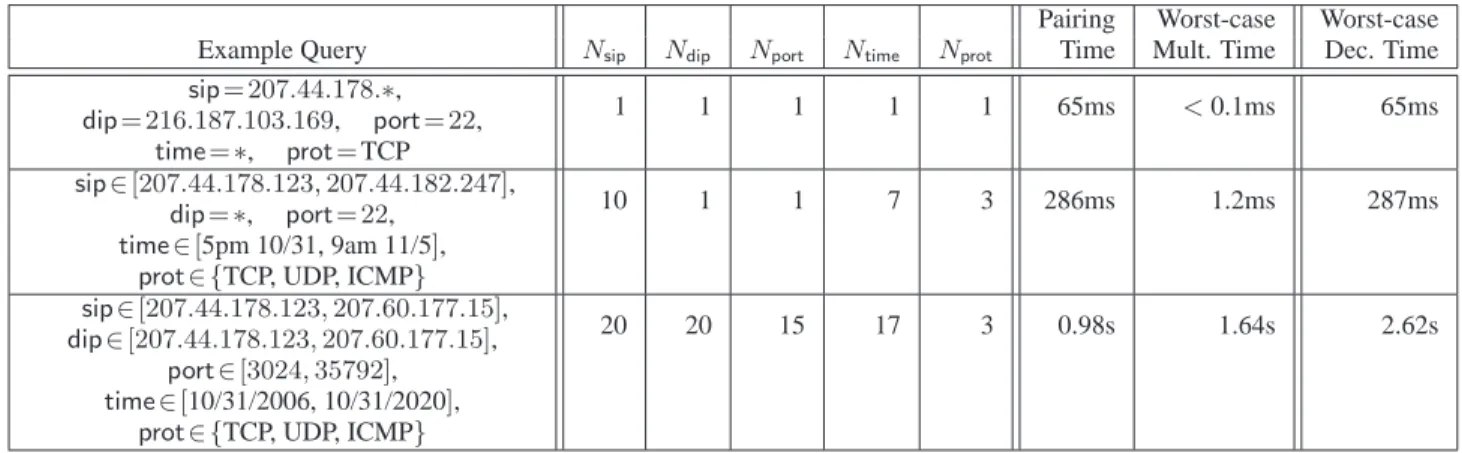
In this section, we give a detailed analysis of the perfor-mance of the MRQEDD scheme given in Section 5 in prac-tical scenarios. We use the conditional release of encrypted network audit logs as our motivating application.
Assumptions. To evaluate the scheme of Section 5 in this
ap-plication, we detail a set of scenarios regarding the searchable fields present in the logs. We assume log entries contain the fields listed in Table 2. The 17-bit time field is sufficient to distinguish times over a period of about 15 years with a one hour resolution, or about three months at a one minute resolu-tion. More precise times may be stored in the non-searchable portion of the message if desired. The protocol field
cor-Field Abbr. Range Distinct Values Source IP sip [0, Tsip −1] Tsip = 232
Dest. IP dip [0, Tdip −1] Tdip = 232
Port port [0, Tport −1] Tport = 216
Time time [0, Ttime −1] Ttime = 217
Protocol prot [0, Tprot −1] Tprot = 28 Table 2. Fields appearing in a network audit log and their possible values.
responds to the actual bits of the corresponding field in an IP header (where, for example, 6 denotes TCP and 133 de-notes Fibre Channel). Various subsets of these fields may be included as searchable attributes in MRQEDD. Other fields and any additional associated data such as a payload may be included as the encrypted message. Regardless of message length, we need only use the MRQEDD scheme to encrypt a single group element, which may be a randomly generated symmetric key (e.g., for AES) used to encrypt the message.
Benchmarks for the selected pairing were run on a modern workstation. The processor was a 64-bit, 3.2 Ghz Pentium 4. We used the Pairing-Based Cryptography (PBC) library [34],

![Figure 1. An MRQED 1 scheme. (a) Path from the leaf node representing x ∈ [T ] to the root](https://thumb-us.123doks.com/thumbv2/123dok_us/8437673.2245207/7.918.128.799.66.205/figure-mrqed-scheme-path-leaf-node-representing-root.webp)
![Figure 2. An MRQED 2 scheme. (a) Encryption under the point x = (3, 5) and the keys released for the range [2, 6]×[3, 7]](https://thumb-us.123doks.com/thumbv2/123dok_us/8437673.2245207/9.918.125.795.64.304/figure-mrqed-scheme-encryption-point-keys-released-range.webp)
![Table 3. Group arithmetic and pairing performance bench- bench-marks on a modern workstation [34].](https://thumb-us.123doks.com/thumbv2/123dok_us/8437673.2245207/12.918.152.371.190.305/table-group-arithmetic-pairing-performance-bench-modern-workstation.webp)