Towards Linear-time Incremental Structure from Motion
Changchang Wu
University of Washington
Abstract
The time complexity of incremental structure from
mo-tion (SfM) is often known as O(n4) with respect to the
number of cameras. As bundle adjustment (BA) being sig-nificantly improved recently by preconditioned conjugate gradient (PCG), it is worth revisiting how fast incremen-tal SfM is. We introduce a novel BA strategy that provides good balance between speed and accuracy. Through al-gorithm analysis and extensive experiments, we show that
incremental SfM requires only O(n) time on many
ma-jor steps including BA. Our method maintains high ac-curacy by regularly re-triangulating the feature matches
that initially fail to triangulate. We test our algorithm
on large photo collections and long video sequences with various settings, and show that our method offers state of the art performance for large-scale reconstructions. The presented algorithm is available as part of VisualSFM at
http://homes.cs.washington.edu/˜ccwu/vsfm/.
1. Introduction
Structure from motion (SfM) has been successfully used for the reconstruction of increasingly large uncontrolled photo collections [8,2, 5,4,7]. Although a large photo collection can be reduced to a subset of iconic images [8,5] or skeletal images [15,2] for reconstruction, the commonly knownO(n4)cost of the incremental SfM is still high for
large scene components. Recently an O(n3)method was
demonstrated by using a combination of discrete and con-tinuous optimization [4]. Nevertheless, it remains crucial for SfM to achieve low complexity and high scalability.
This paper demonstrates our efforts for further improving the efficiency of SfM by the following contributions:
• We introduce a preemptive feature matching that can re-duce the pairs of image matching by up to95%while still recovering sufficient good matches for reconstruction.
• We analyze the time complexity of the conjugate gra-dient bundle adjustment methods. Through theoretical analysis and experimental validation, we show that the bundle adjustment requiresO(n)time in practice.
• We show that many sub-steps of incremental SfM,
including BA and point filtering, require onlyO(n)time in practice when using a novel BA strategy.
• Without sacrificing the time-complexity, we introduce a re-triangulation step to deal with the problem of accumulated drifts without explicit loop closing. The rest of the paper is organized as follows: Section2
gives the background and related work. We first introduce a preemptive feature matching in Section3. We analyze the time complexity of bundle adjustment in Section4and pro-pose our new SfM algorithms in Section5. The experiments and conclusions are given in Section6and Section7.
2. Related Work
In a typical incremental SfM system (e.g. [14]), two-view reconstructions are first estimated upon successful feature matching between two images, 3D models are then reconstructed by initializing from good two-view recon-structions, repeatedly adding matched images, triangulating feature matches, and bundle-adjusting the structure and motion. The time complexity of such an incremental SfM algorithms is commonly known to beO(n4)fornimages,
and this high computation cost impedes the application of such a simple incremental SfM on large photo collections.
Large-scale data often contains lots of redundant infor-mation, which allows many computations of 3D recon-struction to be approximated in favor of speed, for example:
Image Matching Instead of matching all the image to each other, Agarwal et al. [2] first identify a small number of candidates for each images by using the vocabulary tree recognition [11], and then match the features by using approximate nearest neighbor. It is shown that the two-folded approximation of image matching still preserves enough feature matches for SfM. Frahm et al. [5] exploit the approximate GPS tags and match images only to the nearby ones. In this paper, we present a preemptive feature matching to further improve the matching speed.
Bundle Adjustment Since BA already exploits linear approximations of the non-linear optimization problem, it is often unnecessary to solve the exact descent steps. Recent algorithms have achieved significant speedup by using Pre-conditioned Conjugate Gradient (PCG) to approximately
solve the linear systems [2,3,1, 16]. Similarly, there is no need to run full BA for every new image or always wait until BA/PCG converges to very small residuals. In this paper, we show that linear time is required by bundle adjustments for large-scale uncontrolled photo collections.
Scene Graph Large photo collections often contain more than enough images for high-quality reconstructions. The efficiency can be improved by reducing the number of images for the high-cost SfM. [8,5] use the iconic images as the main skeleton of scene graphs, while [15,2] extract skeletal graphs from the dense scene graphs. In practice, other types of improvements to large-scale SfM should be used jointly with scene graph simplifications. However, to push the limits of incremental SfM, we consider the reconstruction of a single connected component without simplifying the scene graphs.
In contrast to incremental SfM, other work tries to avoid the greedy manner. Gherard et al. [6] proposed a hierarchi-cal SfM through balanced branching and merging, which lowers the time complexity by requiring fewer BAs of large models. Sinha et al. [13] recover the relative camera rota-tions from vanishing points, and converts SfM to efficient 3D model merging. Recently, Crandall et al. [4] exploit GPS-based initialization and model SfM as a global MRF optimization. This work is a re-investigation of incremental SfM, and still shares some of its limitations, such as initial-izations affecting completeness, but does not rely on addi-tional calibrations, GPS tags or vanishing point detection.
Notations We use n, p and q to respectively denote the number of cameras, points and observations during a reconstruction. Given that each image has a limited number of features, we havep =O(n)andq = O(n). Since this paper considers a single connected scene graph, nis also used as the number of input images with abuse of notation.
3. Preemptive Feature Matching
Image matching is one of the most time-consuming steps of SfM. The full pairwise matching takes O(n2)time for
n input images, however it is fine for large datasets to compute a subset of matching (e.g. by using vocabulary tree [2]), and the overall computation can be reduced to
O(n). In addition, image matching can be easily paral-lelized onto multiple machines [2] or multiple GPUs [5] for more speedup. Nevertheless, feature matching is still one of the bottlenecks because typical images contain several thousands of features, which is the aspect we try to handle. Due to the diversity of viewpoints in large photo collec-tions, the majority of image pairs do not match (75%−98%
for the large datasets we experimented). A large portion of matching time can be saved if we can identify the good pairs robustly and efficiently. By exploiting the
scales of invariant features [10], we propose the following preemptive feature matching for this purpose:
1. Sort the features of each image into decreasing scale order. This is a one-timeO(n)preprocessing.
2. Generate the list of pairs that need to be matched, either using all the pairs or a select a subset ( [2,5]).
3. For each image pair (parallelly), do the following: (a) Match the firsthfeatures of the two images. (b) If the number of matches from the subset is smaller
thanth, return and skip the next step.
(c) Do regular matching and geometry estimation. wherehis the parameter for the subset size, andth is the
threshold for the expected number of matches. The feature matching of subset and full-set uses the same nearest neighbor algorithm with distance ratio test [10] and require the matched features to be mutually nearest.
Letk1andk2be the number of features of two images,
andk= max(k1, k2). Letmp(h)andmi(h)be the number
of putative and inlier matches when using up tohtop-scale features. We define the yield of feature matching as
Yp(h) =
mp(h)
h andYi(h) = mi(h)
h . (1)
We are interested in how the yields of the feature subset cor-relate with the final yieldYi(k). As shown in Figure1(a), the distributions of Yp(h) and Yi(h) are closely related to Yi(k) even for very smallhsuch as 100. Figure 1(b)
shows that the chances of have a match within the top-scale features are on par with other features. This means that the top-scale subset has roughly h/kchance to preserve a match, which is much higher than the h2/(k1k2)chance
of random samplinghfeatures. Additionally, the matching time for the majority is reduced to a factor of h2/(k
1k2)
along with better caching. In this paper, we chooseh= 100 with consideration of both efficiency and robustness.
The top-scale features match well for several reasons: 1) A small number of top-scale feature can cover a relatively large scale range due to the decreasing number of features on higher Gaussian levels. 2) Feature matching is well structured such that the large-scale features in one image often match with the large-scale features in another. The scale variation between two matched features is jointly determined by the camera motion and the scene structure, so the scale variations of multiple feature matches are not independent to each other. Figure1(c)shows our statistics of the feature scale variations. The feature scale variations of an image pair usually have a small variance due to small viewpoint changes or well-structured scene depths. For the same reasons, we use up to 8192 features for the regular feature matching, which are sufficient for most scenarios. While large photo collections contain redundant views and features, our preemptive feature matching allows putting most efforts in the ones that are more likely to be matched.
0.4 0.3 0.2 0.1 0
The final inlier yield Yi(k)
0.5 0
Yields when using subsets
0.2
0.1 0.4
0.3 Median of Yi(50)
Median of Yi(400) Median of Yp(100) Median of Yi(200) Median of Yi(100)
0.5
(a) Yield when using subset of features
10K 20K
0 100 200 600 1000 5000 30K
40K 50K 60K
Histogram divided into three parts [0-200][200-1000][1000-]
(b) Histogram of max index of a feature match
-1 0 1 2 3
0
-3 -2
0.2 0.4 0.6 0.8 1
Difference of log2 scales
Deviations from means Mean of each image pair
(c) The distribution of feature scale variations Figure 1. (a) shows the relationship between the final yield and the yield from a subset of top-scale features. For each set of image pairs that have roughly the same final yield, we compute the median of their subset yield for differenth. (b) gives the histogram of the max of two indices of a feature match, where the index is the position in the scale-decreasing order. We can see that the chances of matching within top-scale features are similar to other features. (c) shows two distributions of the scale variations computed from130M feature matches. The mean scale variations between two images are given by the red curve, while the deviations of scale variation from means are given by the blue one. The variances of scale changes are often small due to small viewpoint changes or structured scene depths.
4. How Fast Is Bundle Adjustment?
Bundle adjustment (BA) is the joint non-linear opti-mization of structure and motion parameters, for which Levenberg-Marquardt (LM) is method of choice. Recently, the performance of large-scale bundle adjustment has been significantly improved by Preconditioned Conjugate Gradient (PCG) [1,3,16], hence it is worth re-examining the time complexity of BA and SfM.
Letxbe a vector of parameters andf(x)be the vector of reprojection errors for a 3D reconstruction. The opti-mization we wish to solve is the non-linear least squares problem:x∗= arg minxkf(x)k2. LetJ be the Jacobian of
f(x)andΛa non-negative diagonal vector for regulariza-tion, then LM repeatedly solves the following linear system
(JTJ+ Λ)δ=−JTf,
and updates x ← x+δ ifkf(x+δ)k < kf(x)k. The matrixHΛ=JTJ+ Λis known as the augmented Hessian
matrix. Gaussian elimination is typically used to first obtain a reduced linear system of the camera parameters, which is calledSchur Complement.
The Hessian matrix require O(q)=O(n) space and time to compute, while Schur complement requiresO(n2)
space and time to compute. It takes cubic time O(n3)or
O(p3)to solve the linear system by Cholesky factorization. Because the number of cameras is much smaller than the number of points, the Schur complement method can reduce the factorization time by a large constant factor. One impressive example of this algorithm is Lourakis and Argyros’ SBA [9] used by Photo Tourism [14].
For conjugate gradient methods, the dominant compu-tation is the matrix-vector multiplications in multiple CG iteration, of which the time complexity is determined by the size of the involved matrices. By using only theO(n)space Hessian matrices and avoiding the Schur complement, the
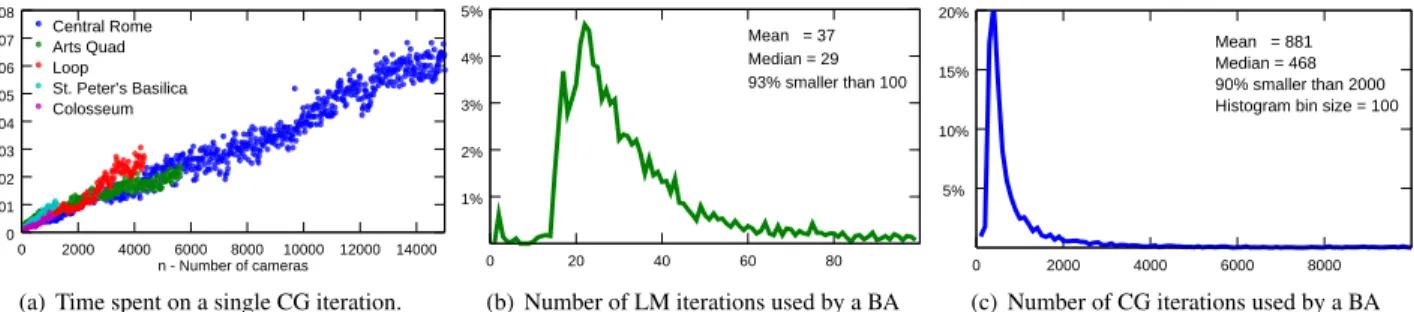
CG iteration has achieved O(n) time complexity [1, 3]. Recently, the multicore bundle adjustment [16] takes one step further by using implicit multiplication of the Hessian matrices and Schur Complements, which requires to construct only the O(n) space Jacobian matrices. In this work, we use the GPU-version of multicore bundle adjustment. Figure2(a)shows the timing of CG iterations from our bundle adjustment problems, which exhibits linear relationship between the timeTcgof a CG iteration andn.
In each LM step, PCG requiresO(√κ)iterations to ac-curately solve a linear system [12], whereκis the condition number of the linear system. Small condition numbers can be obtained by using good pre-conditioners, for example, quick convergence rate has been demonstrated with block-jacobi preconditioner [1, 16]. In our experiments, PCG uses an average of20iterations solve a linear system.
Surprisingly, the time complexity of bundle adjustment has already reached O(n), provided that there are O(1)
CG iterations in a BA. Although the actual number of the CG/LM iterations depends on the difficulty of the input problems, the O(1) assumption for CG/LM iterations is well supported by the statistics we collect from a large number of BAs of varying problem sizes. Figure2(b)gives the distribution of LM iterations used by a BA, where the average is37and93%BAs converge within less than100
LM iterations. Figure2(c)shows the distribution of the total CG iterations (used by all LM steps of a BA), which are also normally small. In practice, we choose to use at most100
LM iterations per BA and at most100CG iterations per LM, which guarantees good convergence for most problems.
5. Incremental Structure from Motion
This section presents the design of our SfM that practi-cally has a linear run time. The fact that bundle adjustment can be done in O(n)time opens an opportunity of
push-6000 8000 10000 12000 Colosseum
0 2000 4000
St. Peter’s Basilica Loop Arts Quad Central Rome
0 0.01 0.02 0.03 0.04 0.05 0.06 0.07
n - Number of cameras
14000
Tcg (second)
0.08
(a) Time spent on a single CG iteration.
40 60 80
1% 2% 3%
0 20
4% 5%
Mean = 37 Median = 29 93% smaller than 100
(b) Number of LM iterations used by a BA
4000 6000 8000
5% 10% 15%
0 2000
20%
Mean = 881 Median = 468 90% smaller than 2000 Histogram bin size = 100
(c) Number of CG iterations used by a BA Figure 2. Bundle adjustment statistics. (a) shows thatTcg is roughly linear tonregardless of the scene graph structure. (b) and (c) show the distributions of the number of LM and CG iterations used by a BA. It can be seen that BA typically converges within a small number of LM and CG iterations. Note that we consider BA converges if the mean squared errors drop to below0.25or cannot be decreased.
ing incremental reconstruction time closer to O(n). As illustrated in Figure 3, our algorithm adds a single image at each iteration, and then runs either a full BA or a partial BA. After BA and filtering, we take another choice between continuing to the next iteration and a re-triangulation step.
Add Camera
Full BA Partial BA
Filtering Re-triangulation & Full BA
Figure 3. A single iteration of the proposed incremental SfM, which is repeated until no images can be added to reconstruction.
5.1. How Fast Is Incremental SfM?
The cameras and 3D points normally get stabilized quickly during reconstruction, thus it is unnecessary to optimize all camera and point parameters at every iteration. A typical strategy is to perform full BAs after adding a constant number of cameras (e.g. α), for which the accumulated time of all the full BAs is
bn/αc X
i
TBA(i∗α) =O
bn/αc X
i
(i∗α)=On
2
α
, (2)
when using PCG. This is already a significant reduction from theO(n4)time of Cholesky factorization based BA.
As the models grow larger and more stable, it is affordable to skip more costly BAs, so we would like to study how much further we can go without losing the accuracy.
In this paper, we find that the accumulated time of BAs can be reduced even more to O(n) by using a geomet-ric sequence for full BAs. We propose to perform full optimizations only when the size of a model increases relatively by a certain ratior(e.g. 5%), and the resulting time spent on full BAs approximately becomes
∞ X
i
TBA
n
(1 +r)i
=O ∞ X
i
n
(1 +r)i
=On r
. (3)
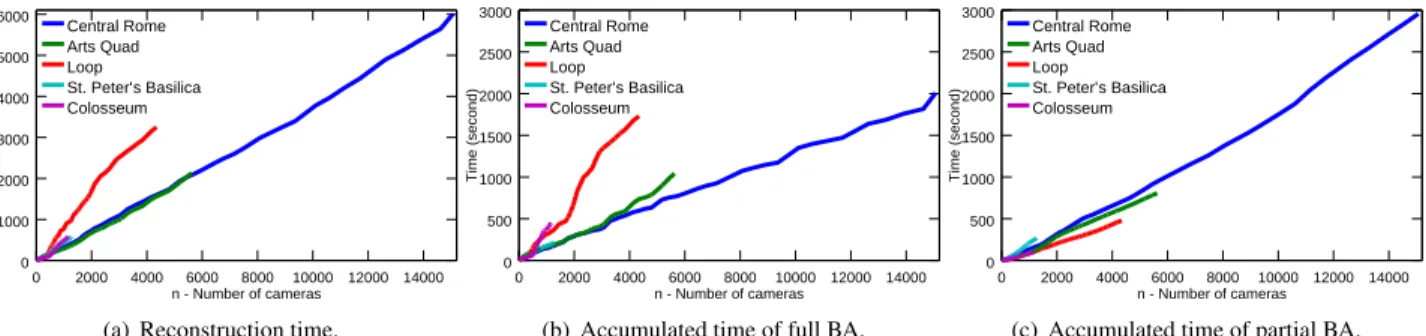
Although the latter added cameras are optimized by fewer full BAs, there are normally no accuracy problems because the full BAs always improve more for the parts that have larger errors. As the model gets larger, more cameras are added before running a full BA. In order to reduce the ac-cumulated errors, we keep running local optimizations by using partial BAs on a constant number of recently added cameras (we use20) and their associated 3D points. Such partial optimizations involveO(1)cameras and points pa-rameters, so each partial BA takesO(1)time. Therefore, the time spent on full BAs and partial BAs adds toO(n), which is experimentally validated by the time curves in Figure6.
Following the BA step, we do filtering of the points that have large reprojection errors or small triangulation angles. The time complexity of a full point filtering step is O(n). Fortunately, we only need to process the 3D points that have been changed, so the point filtering after a partial BA can be doneO(1)time. Although each point filtering after a full BA takesO(n)time, they add to onlyO(n)due to the geometric sequence. Therefore, the accumulated time on all point filtering is alsoO(n).
Another expensive step is to organize the resection candi-dates and to add new cameras to 3D models. We keep track of the potential 2D-3D correspondences during SfM by using the feature matches of newly added images. If each image is matched toO(1)images, which is a reasonable as-sumption for large-scale photo collections, it requiresO(1)
time to update the correspondence information at each iter-ation. AnotherO(1)time is needed to add the camera to the model. The accumulated time of these steps is againO(n). We have shown that major steps of incremental SfM contribute to anO(n)time complexity. However, the above analysis ignored several things: 1) finding the portion of data for partial BA and partial filtering. 2) finding the subset of images that match with a single image in the resection stage. 3) comparison of cameras during the resection stage. These steps requireO(n)scan time at each step and add to
O(n2)time in theory. It is possible to keep track of these
since the O(n) part dominates the reconstruction in our experiments (up to15K, see Table 2for details), we have not tried to further optimize theseO(n2)steps.
5.2. Re-triangulation (RT)
Incremental SfM is known to have drifting problems due to the accumulated errors of relative camera poses. The constraint between two camera poses is provided by their triangulated feature matches. Because the initially estimated poses and even the poses after a partial BA may not be accurate enough, some correct feature matches may fail to triangulate for some triangulation threshold and filtering threshold. The accumulated loss of correct feature matches is one of the main reasons of the drifting.
To deal with this problem, we propose to re-triangulate (RT) the failed feature matches regularly (with delay) dur-ing incremental SfM. A good indication of possible bad rel-ative pose between two cameras is a low ratio between their common points and their feature matches, which we call
under-reconstructed. In order to wait until the poses to get more stabilized, we re-triangulate the under-reconstructed pairs under a geometric sequence (e.g. r0=25%when the size of a model increases by25%). To obtain more points, we also increase the threshold for reprojection errors during RT. After re-triangulating the feature matches, we run full BA and point filtering to improve the reconstruction. Each RT step requires O(n) time and accumulates to the same
O(n)time thanks to the geometric sequence.
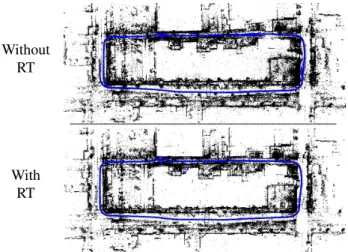
The proposed RT step is similar to loop-closing, which however deals with drifts only when loops are detected. By looking for the under-reconstructed pairs, our method is able to reduce the drift errors without explicit loop detec-tions, given that there are sufficient feature matches. In fact, the RT step is more general because it works for the relative pose between any matched images, and it also makes loop detection even easier. Figure4shows our incremental SfM with RT on a4K image loop, which correctly reconstruct the long loop using RT without explicit loop closing.
6. Experiments
We apply our algorithms on five datasets of different sizes. The Central Rome dataset and the Arts Quad datasets are obtained from the authors of [4], which contain 32768 images and 6514 images respectively. The Loop dataset are 4342 frames of high resolution video sequences of a street block. The St. Peter’s Basilica and Colosseum datasets have 1275 and 1164 images respectively. We run all the reconstructions on a PC with an Intel Xenon 5680 3.33Ghz CPU (24 cores), 12GB RAM, and an nVidia GTX 480 GPU.
6.1. Feature Matching
To allow experiment on the largest possible model, we have tried to first match sufficient image pairs. The
Without RT
With RT
Figure 4. Our reconstruction of the Loop dataset of 4342 frames (the blue dots are the camera positions). Our algorithm correctly handles the drifting problem in this long loop by using RT.
full pair-wise matching is computed for the St. Peter’s Basilica and Colosseum dataset. For the Arts Quad and Loop datasets, each image is matched to the nearby ones according to GPS. For the Central Rome dataset, our preemptive matching withh=100andth=4is applied.
We then run our incremental SfM with the subset of image matches that satisfy the preemptive matching for
h= 100and differentth. Table1shows the statistics of the
feature matches and the reconstructed number of cameras of the largest reconstructed models. With the preemptive matching, we are able to reconstruct the larges SfM model of15065cameras for Rome and complete models for other datasets. Preemptive matching is able to significantly re-duce the number of image pairs for regular matching and still preserve a large portion of the correct feature matches. For example,43%feature matches are obtained with6%of image pairs for the St. Peter’s. It is worth noting that it is ex-tremely fast to match the top100features. Our system has an average speed of73K pairs per second with24threads.
The preemptive matching has a small chance of losing weak links when using a large threshold. Complete models are reconstructed for all the datasets whenth=2. However,
forth=4, we find that one building in Arts Quad is missing
due to occlusions, and the Colosseum model breaks into the interior and the exterior. We believe a more adaptive scheme of preemptive matching should be explored in the future.
6.2. Incremental SfM
We run our algorithm with all computed feature matches for the five datasets using the same settings. Table2 summa-rizes the statistics and time of the experiment forr=5%and
r0=25%. Figure4,5and7show the screenshots of our SfM models. Our method efficiently reconstructs large, accurate and complete models with high point density. In particular, the two 1K image datasets are reconstructed in less than 10
Without Preemptive Matching Using Preemptive Matching (h= 100) Dataset Pairs to Pairs With Feature n th
Pairs to Pairs With Feature
n
Match 15+ Inliers Matches Match 15+ Inliers Matches
Central Rome N/A N/A N/A N/A 4 13551K 540K 67M 15065
Arts Quad 15402K 192K 32M 5624 4 521K, 3% 62K, 32% 25M, 78% 4272
2 4308K, 28% 121K, 63% 29M, 91% 5393 Loop 709K 329K 158M 4342 4 269K, 38% 235K, 71% 150M, 95% 4342
8 151K, 21% 150K, 46% 135M, 85% 4342 St. Peter’s 812K 217K 21M 1267 4 46K, 6% 38K, 18% 9.1M, 43% 1211
8 220K, 27% 100K, 46% 14M, 67% 1262 Colosseum 677K 54K 6.8M 1157 4 23K, 3% 13K, 24% 4.1M, 60% 517+426
2 149K, 22% 28K, 52% 5.4M, 79% 1071
Table 1. Reconstruction comparison for different feature matching. We first tryth= 4, and then tryth= 8of the result is complete, or tryth= 2if the resulting reconstruction is incomplete. Comparably complete models are reconstructed when using preemptive matching, where only a small set of image pairs need to be matched. All reconstructions use the same settingr= 5%andr0= 25%.
Dataset Input Cameras Points Observa- Timet Time Time Time Time Images n p tionsq Overall Full BA Partial BA Adding Filtering Central Rome 32768 15065 1660415 12903348 6010 2008 2957 549 247
Arts Quad 6514 5624 819292 5838784 2132 1042 807 122 57
Loop 4342 4342 1101515 7195960 3251 1731 478 523 47
St. Peter’s 1275 1267 292379 2706250 583 223 268 48 20
Colosseum 1164 1157 293724 1759136 591 453 100 19 9
Table 2. Reconstruction summary and timing (in seconds). Only the reconstruction of largest model is reported for each dataset. The reported time of full BA includes the BAs after the RT steps. The “adding” part includes the time on updating resection candidates, estimating camera poses, and adding new cameras and points to a 3D model.
(a) Sparse reconstruction of Central Rome (15065 cameras) (b) Overlay on the aerial image
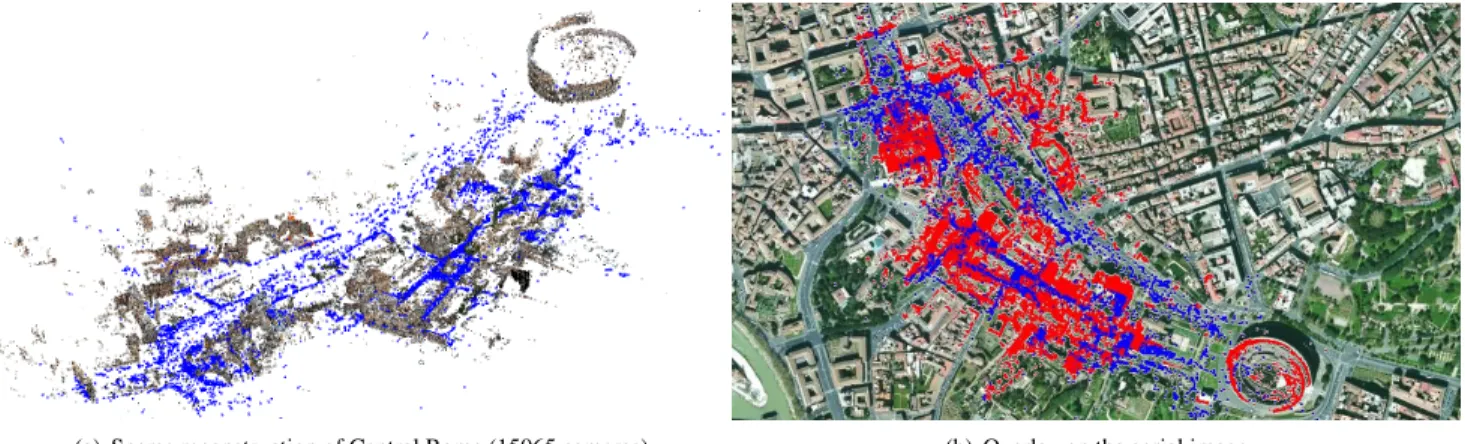
Figure 5. Our Rome reconstruction (the blue dots are the camera positions). The recovered structure is accurate compared to the map.
minutes, and the15K camera model of Rome is computed within1.67hours. Additional results under various settings can be found in Table3and the supplemental material.
The timing in Table 2 shows that BAs (full + partial) account for the majority of the reconstruction time, so the time complexity of the BAs approximates that of the incre-mental SfM. We keep track of the time of reconstruction and the accumulated time of each step. As shown in Fig-ure6, the reconstruction time (as well as the accumulated
time of full BAs and partial BAs) increases roughly linearly as the models grow larger, which validates our analysis of the time complexity. The Loop reconstruction has a higher slope mainly due to its higher number of feature matches.
6.3. Reconstruction Quality and Speed
Figure 4, 5 and7 demonstrate high quality reconstruc-tions that are comparable to other methods, and we have also reconstructed more cameras than DISCO [4] for both
2000 1000
n - Number of cameras 0
6000 5000 4000 3000
14000 12000 10000 8000 Central Rome
Arts Quad Loop St. Peter’s Basilica Colosseum
6000 4000 2000 0
Time (second)
(a) Reconstruction time.
500
n - Number of cameras 0
14000 2500
2000 1500 1000
12000 10000 8000 Central Rome
Arts Quad Loop St. Peter’s Basilica Colosseum
6000 4000 2000 0
Time (second)
3000
(b) Accumulated time of full BA.
500
n - Number of cameras 0
14000 2500
2000 1500 1000
12000 10000 8000 Central Rome
Arts Quad Loop St. Peter’s Basilica Colosseum
6000 4000 2000 0
Time (second)
3000
(c) Accumulated time of partial BA. Figure 6. The reconstruction time in seconds as the 3D models grow larger. Here we report the timing right after each full BA. The reconstruction time and the accumulated time of full BAs and partial BAs increase roughly linearly with respect to the number of cameras. Note the higher slope of the Loop reconstruction is due to the higher number of feature matches between nearby video frames.
(a) Arts Quad (5624 cameras) (b) St. Peter’s Basilica (1267 cameras) (c) Colosseum (1157 cameras) Figure 7. Our reconstruction of Arts Quad, St. Peter’s Basilica and Colosseum.
Central Rome and Arts Quad. In particular, Figure5shows the correct overlay of our15065camera model of Central Rome on an aerial image. The Loop reconstruction shows that the RT steps correctly deal with the drifting problem without explicit loop closing. The reconstruction is first pushed away from local minima by RT and then improved by the subsequent BAs. The robustness and accuracy of our method is due to the strategy of mixed BA and RT.
We evaluate the accuracy of the reconstructed cameras by comparing their positions to the ground truth locations. For the Arts Quad dataset, our reconstruction (r=5%and
r0=25%) contains261out of the348images whose ground truth GPS location is provided by [4]. We used RANSAC to estimate a 3D similarity transformation between the261
camera locations and their Euclidean coordinates. With the best found transformation, our 3D model has a mean error of 2.5 meter and a median error of 0.89 meter, which is smaller than the1.16meter error reported by [4].
We evaluate the reconstruction speed by two measures:
• t/n The time needed to reconstruct a camera.
• t/q The time needed to reconstruct an observation. Table3shows the comparison between our reconstruction under various settings and the DISCO and bundler recon-struction of [4]. While producing comparably large models, our algorithm normally requires less than half a second to reconstruct a camera in terms of overall speed. By
t/n, our method is 8-19X faster than DISCO and 55-163X faster than bundler. Similarly byt/q, our method is 5-11X faster than DISCO and 56-186X faster than bundler. It is worth pointing out that our system uses only a single PC (12GB RAM) while DISCO uses a 200 core cluster.
6.4. Discussions
Although our experiments show approximately linear running times, the reconstruction takes O(n2) in theory and will exhibit such a trend the problem gets even larger. In addition, it is possible that the proposed strategy will fail for extremely larger reconstruction problems due to larger accumulated errors. Thanks to the stability of SfM, mixed BAs and RT, our algorithm works without quality problems even for15Kcameras.
This paper focuses on the incremental SfM stage, while the bottleneck of 3D reconstruction sometimes is the image matching. In order to test our incremental SfM algorithm on the largest possible models, we have matched up to
O(n2) image pairs for several datasets, which is higher
than the vocabulary strategy that can choose O(n) pairs to match [2]. However, this does not limit our method from working with fewer image matches. From a different angle, we have contributed the preemptive matching that can significantly reduce the matching cost.
Dataset Full BA Partial BA RT n q t t/n t/q r= 5% Every Image r0= 25% 15065 12903K 1.67hour 0.40s 0.47ms
r= 25% Every Image r0= 50% 15113 12958K 1.32hour 0.31s 0.37ms Central Rome r= 5% Every 3 Images r0= 25% 14998 12599K 1.03hour 0.25s 0.29ms DISCO result of [4] 14754 21544K 13.2hour 3.2s 2.2ms Bundler result of [4] 13455 5411K 82hour 22s 54ms
r= 5% Every Image r0= 25% 5624 5839K 0.59hour 0.38s 0.37ms
r= 25% Every Image r0= 50% 5598 5850K 0.42hour 0.27s 0.26ms
Arts Quad r= 5% Every 3 Images r0= 25% 5461 5530K 0.53hour 0.35s 0.35ms
DISCO result of [4] 5233 9387K 7.7hour 5.2s 2.9ms Bundler result of [4] 5028 10521K 62hour 44s 21ms
r= 5% Every Image r0= 25% 4342 7196K 3251s 0.75s 0.45ms Loop r= 25% Every Image r0= 50% 4342 7574K 1985s 0.46s 0.26ms
r= 5% Every 3 Images r0= 25% 4341 7696K 3207s 0.74s 0.41ms
r= 5% Every Image r0= 25% 1267 2706K 583s 0.46s 0.22ms St. Peter’s r= 25% Every Image r0= 50% 1267 2760K 453s 0.36s 0.16ms
r= 5% Every 3 Images r0= 25% 1262 2668K 367s 0.29s 0.14ms
r= 5% Every Image r0= 25% 1157 1759K 591s 0.51s 0.34ms Colosseum r= 25% Every Image r0= 50% 1087 1709K 205s 0.19s 0.12ms
r= 5% Every 3 Images r0= 25% 1091 1675K 471s 0.43s 0.28ms Table 3. The statistics of our reconstructions under various settings. We reconstruct larger models than DISCO and bundler under the various settings, and our method also runs significantly faster. Additional results will be presented in the supplemental material.
7. Conclusions and Future Work
This paper revisits and improves the classic incremental SfM algorithm. We propose a preemptive matching method that can significantly reduce the feature matching cost for large scale SfM. Through algorithmic analysis and exten-sive experimental validation, we show that incremental SfM is ofO(n2)time complexity, but requires onlyO(n)
time on its major steps while still maintaining the recon-struction accuracy using mixed BAs and RT. The practical run time is approximately O(n)for large problems up to
15K cameras. Our system demonstrates state of the art performance by an average speed of reconstructing about2
cameras and more than2000features points in a second for very large photo collections.
In the future, we wish to explore a more adaptive pre-emptive feature matching and guide the full BAs according to the accumulation of reprojection errors.
References
[1] S. Agarwal, N. Snavely, S. Seitz, and R. Szeliski. Bundle adjustment in the large. InECCV, pages II: 29–42, 2010.2,3
[2] S. Agarwal, N. Snavely, I. Simon, S. M. Seitz, and R. Szeliski. Building Rome in a day. InICCV, 2009.1,2,7
[3] M. Byrod and K. Astrom. Conjugate gradient bundle adjustment. InECCV, pages II: 114–127, 2010.2,3
[4] D. Crandall, A. Owens, N. Snavely, and D. P. Huttenlocher. Discrete-continuous optimization for large-scale structure from motion. InCVPR, 2011.1,2,5,6,7,8
[5] J. Frahm, P. Fite Georgel, D. Gallup, T. Johnson, R. Ragu-ram, C. Wu, Y. Jen, E. Dunn, B. Clipp, S. Lazebnik, and M. Pollefeys. Building rome on a cloudless day. InECCV, pages IV: 368–381, 2010.1,2
[6] R. Gherardi, M. Farenzena, and A. Fusiello. Improving the efficiency of hierarchical structure-and-motion. In CVPR, pages 1594–1600, 2010. 2
[7] A. Kushal, B. Self, Y. Furukawa, C. Hernandez, D. Gallup, B. Curless, and S. Seitz. Photo tours. In3DimPVT, 2012.1
[8] X. Li, C. Wu, C. Zach, S. Lazebnik, and J. Frahm. Modeling and recognition of landmark image collections using iconic scene graphs. InECCV, 2008.1,2
[9] M. A. Lourakis and A. Argyros. SBA: A Software Package for Generic Sparse Bundle Adjustment. ACM Trans. Math. Software, 36(1):1–30, 2009. 3
[10] D. G. Lowe. Distinctive image features from scale-invariant keypoints.IJCV, 60:91–110, 2004.2
[11] D. Nister and H. Stewenius. Scalable recognition with a vocabulary tree. InCVPR, pages 2161–2168, 2006.1
[12] J. R. Shewchuk. An introduction to the conjugate gradient method without the agonizing pain, 1994.3
[13] S. N. Sinha, D. Steedly, and R. Szeliski. A multi-stage linear approach to structure from motion. InECCV RMLE workshop, 2010.2
[14] N. Snavely, S. Seitz, and R. Szeliski. Photo tourism: exploring photo collections in 3D. InSIGGRAPH, pages 835–846, 2006.1,3
[15] N. Snavely, S. M. Seitz, and R. Szeliski. Skeletal graphs for efficient structure from motion. InCVPR, 2008.1,2
[16] C. Wu, S. Agarwal, B. Curless, and S. M. Seitz. Multicore bundle adjustment. InCVPR, 2011.2,3