I
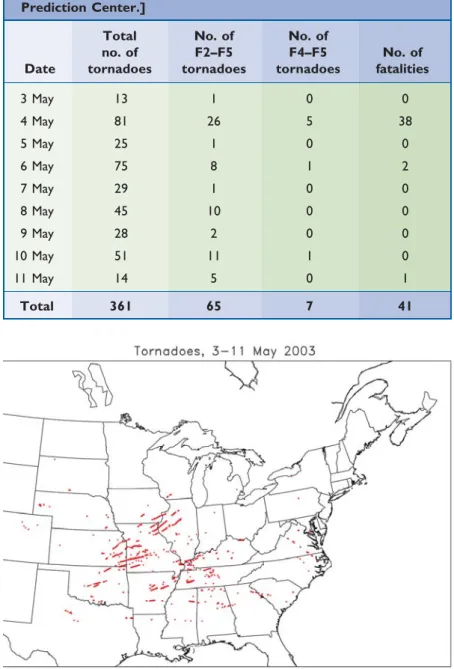
n May 2003 there was a very destructive extended outbreak of tornadoes across the central and eastern United States. More than a dozen torna-does struck each day from 3 to 11 May 2003 (Table 1, Fig. 1; and more information can be found online at http://dx.doi.org/10.1175/BAMS-86-4-HamillA), with one or more tornadoes in 26 different states. This out-break caused 41 fatalities, 642 injuries, and approxi-mately $829 million of property damage. More than 2300 homes and businesses were destroyed, and 11, 200 sustained damage.This extended outbreak was unusual in several as-pects. First, the outbreak set a record for the most tor-nadoes ever reported in a week1 (334 between 4 and 10 May) and contributed to more tornadoes being re-corded in May 2003 than any previous month in his-tory, totaling 559—361 of which occurred during the 9-day extended outbreak. Second, strong tornadoes (F2+, i.e., F2 or greater on the Fujita scale; Fujita 1971) occurred in an unbroken sequence of nine straight days. Third, tornadoes hit similar regions of the United States on different days of the outbreak, and even on successive days. Last, the center of the area of greatest tornado frequency during the 3–11 May period was located north and east of the average high-est frequency position for strong tornadoes in May (Fig. 2; Concannon et al. 2000). Fortunately, despite this being one of the largest extended outbreaks of tornadoes on record, it did not cause as many fatali-ties as in the few comparable past outbreaks, which is due, in large measure, to the warning efforts of the National Weather Service (NWS), television, and pri-vate-company forecasters, and the smaller number of violent (F4–F5) tornadoes.
We attempt to answer several questions in the rest of the paper. First, in the section titled “What weather AFFILIATIONS: HAMILLAND DOLE—NOAA-CIRES Climate
Diagnostics Center, Boulder, Colorado; SCHNEIDER—Storm Prediction Center, NWS/NCEP, Norman, Oklahoma; BROOKS—National Severe Storms Laboratory, Norman, Oklahoma; FORBES—The Weather Channel, Atlanta, Georgia; BLUESTEIN—School of Meteorology, University of Oklahoma, Norman, Oklahoma; STEINBERG— AccuWeather, State College, Pennsylvania; MELÉNDEZ—Office of Science and Technology, NOAA/NWS, Silver Spring, Maryland Supplements A and B to this article are available online (Hamill-A; DOI:10.1175/BAMS-86-4-Hamill-B)
CORRESPONDING AUTHOR: Dr. Thomas M. Hamill, NOAA– CIRES, Climate Diagnostics Center, Boulder, CO 80305-3328 E-mail: [email protected]
DOI:10.1175/BAMS-86-4-531
In final form 25 October 2004 ©2005 American Meteorological Society
THE MAY 2003 EXTENDED
TORNADO OUTBREAK
BY THOMAS M. HAMILL, RUSSELL S. SCHNEIDER, HAROLD E. BROOKS, GREGORY S. FORBES,HOWARD B. BLUESTEIN, MICHAEL STEINBERG, DANIEL MELÉNDEZ, AND RANDALL M. DOLE
An extended outbreak occurred in early May 2003, producing strong tornadoes on nine straight days. What caused this outbreak, and how unusual was it?
1Such statistics, however, are somewhat misleading, as weaker tornadoes were underreported in previous decades (see the section “How unusual was this outbreak?” and Fig. 5).
conditions fostered the extended outbreak?,” we ex-plore the unusual and persistent tornado-favorable conditions. In the section “How unusual was this ex-tended outbreak?,” we look back at past outbreaks and reanalysis data and attempt to quantify just how un-usual this outbreak was. In the section “How predict-able was this outbreak?,” we explore the extent to which this event was forecastable, and we present con-clusions in the “Summary.”
WHAT WEATHER CONDITIONS
FOS-TERED THE EXTENDED OUTBREAK? The
development of supercells that are the parent storm of most strong tornadoes requires the following two simultaneous factors: 1) an unstable thermodynamic environment that supports strong thunderstorm up-drafts (e.g., Miller 1972), and 2) vertical wind shear (horizontal vorticity) that the thunderstorm updrafts can tilt and stretch to generate supercell rotation (e.g., Rotunno and Klemp 1985). Why some supercells produce torna-does and others do not is still not well understood. Field experi-ments (Rasmussen et al. 1994) in-dicated that the production of a strong mesocyclone at low levels, a common feature in mature supercells, is not in itself a suffi-cient condition for tornado-genesis (Wakimoto and Atkins 1996; Wakimoto et al. 1998; Wakimoto and Liu 1998; Trapp 1999; Ziegler et al. 2001; Dowell and Bluestein 2002a,b; Wakimoto et al. 2004). More recently, several studies have indicated that several other environmental factors, such as low lifting condensation levels (e.g.,Rasmussen and Blanchard 1998; Markowski et al. 2002) and large vertical shear and moisture near the surface (Thompson et al. 2003), are often associated with the formation of strong torna-does. Enhanced buoyancy and shear low to the ground may be especially important contributors to the formation of low-level ver-tical vorticity through stretching and tilting.
Figure 3 illustrates a concep-tual model of the stereotypical synoptic features and the region where instability and shear may be ample enough to support the development of supercells; simi-lar models were proposed in Miller (1972) and Barnes and Newton (1983). In this model, a southerly low-level jet in advance of a strong surface low pressure system transports warm, moist air from the Gulf of Mexico ahead of
3 May 13 1 0 0 4 May 81 26 5 38 5 May 25 1 0 0 6 May 75 8 1 2 7 May 29 1 0 0 8 May 45 10 0 0 9 May 28 2 0 0 10 May 51 11 1 0 11 May 14 5 0 1
Total 361 65 7 41
TABLE 1. Number of tornadoes and tornado fatalities per day
between 3 and 11 May 2003, and the number of strong (F2–F5) and violent (F4–F5) tornadoes, rated using the Fujita scale (Fujita 1971). [Data are from National Weather Service Storm Prediction Center.]
Total No. of No. of
no. of F2–F5 F4–F5 No. of
Date tornadoes tornadoes tornadoes fatalities
FIG. 1. Tornado tracks arising from the May 2003 outbreak from 1801 UTC (1201 CST) 3 May 2003 through 1759 UTC (1159 CST) 11 May 2003, comprising eight 24-h periods.
a dryline and cold front. Aloft, strong southwesterly winds prevail ahead of an approaching upper-level trough with very cold air. This configuration may superpose colder air aloft overtop of the warm, moist air, creating instability. A triangular region between the dryline and the warm front typically contains the most favorable combination of instability and wind shear necessary for supercell and tornado formation (though favorable shear and instability may occur even in the absence of this particular pattern).
Large tornado outbreaks require the presence of sufficient instability and favorable wind shear over a wide geographic region. Typically, several times dur-ing a sprdur-ing month such a pattern may exist for one or two consecutive days as a low pressure system moves east from the Rocky Mountains. What was re-markable about early May 2003 was that the tornado-favorable pattern was present for so many days in a row in the same part of the central United States.
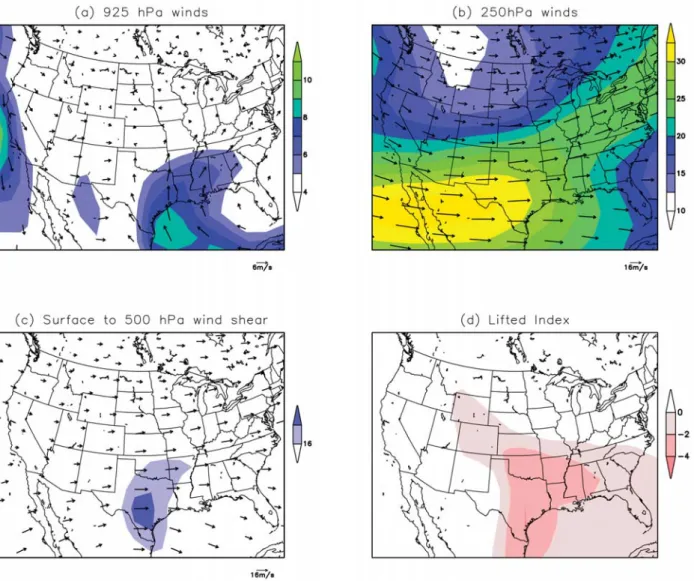
A pattern that is quite similar to the idealized one of Fig. 3 occurred each day from 3 through 11 May 2003. In fact, the time-averaged atmospheric features of this 9-day period were very similar to this ideal pattern (individual daily maps are presented online at http://dx.doi.org/10.1175/BAMS-86-4-HamillA). Figure 4a shows the 925-hPa winds averaged from 0000 UTC 4–11 May 2003. These winds flow north-ward from southeast Texas tonorth-ward Missouri; during this period, boundary layer mixing ratios were anomalously large in the warm sector, commonly ex-ceeding 16 g kg–1. This persistent flow controlled the location of the warm, moist unstable air that is needed for severe thunderstorms, and, consequently, the lo-cation of greatest tornado incidence, which was cen-tered slightly north and east of the climatological maximum for tornado activity during early May (Fig. 2). The moist flow at times reached farther inland from the Gulf of Mexico than was shown in the aver-age pattern (see online at http://dx.doi.org/10.1175/ BAMS-86-4-HamillA for daily maps). Another signifi-cant feature in Fig. 4a is the absence of northerly winds coming from Canada. During this period, no strong cold fronts entered the United States, which would have displaced the unstable air mass from the region and terminated the outbreak. This factor played a key role in the longevity of this event.
Figure 4b shows the average upper-level jet stream at 250 hPa. The highest wind speeds in the jet sweep in an arc from southern California to Arizona and New Mexico, then across Oklahoma, Kansas, and Missouri. As in Fig. 3, the upper-level jet crosses over the low-level jet over Oklahoma, Kansas, and Mis-souri. Figure 4c shows that strong vertical wind shear
was present over Oklahoma, central and east Kansas, Missouri, and western portions of Illinois, Kentucky, and Tennessee, where most of the tornadoes oc-curred. Strong shear was also present over parts of Texas and northern Arkansas, but other unfavorable weather factors inhibited thunderstorms from form-ing or tappform-ing this rotation source there.
Figure 4d shows the average lifted indices2 (LIs; Galway 1956; Bluestein 1993, p. 447) for the period. The area of exceptionally low LIs (in red) covers the Central and Southern Plains and the Gulf Coast states. Most of the extended outbreak tornadoes fell within
FIG. 2. Relative climatological threat of F2 or stronger
tornadoes for the week centered on 6 May, analyzed from tornado data from 1980 to 2002.
FIG. 3. Conceptual model of synoptic conditions
typi-cally associated with a large tornado outbreak. Red area indicates region of expected tornadoes. [Courtesy of AccuWeather, Inc.]
2Convective available potential energy (CAPE; Bluestein 1993, p. 444) is a more common diagnostic of instability. For the re-analysis and forecast data used in this study, CAPE was not available, so instability was diagnosed instead from LIs.
these bounds, but even areas farther northeast had tornadoes on a day or two when warm, moist air reached farther inland from the Gulf of Mexico. Because of the averaging of some unstable and some stable days in these regions, the average LI appears to be more moderate.
This persistence of the patterns illustrated in Fig. 3 was key to the longevity of the outbreak. Nevertheless, through this period the jet stream also contained a series of shortwave troughs (information online at http://dx.doi.org/10.1175/BAMS-86-4-HamillA). As one trough moved east, which normally would have carried the tornado threat east as well, another trough moved in from the eastern Pacific. This succession helped to regenerate tornadoes in the same region. What caused this repeated series of short waves is unclear, but they appeared within a slowly evolving
long-wave pattern that was very favorable for torna-does in the United States.
HOW UNUSUAL WAS THIS EXTENDED OUTBREAK? The frequent occurrence of strong tornadoes for nine straight days was clearly unusual, but just how unusual was it? The most straightforward way to examine this is to look to the climatological record of tornadoes to see how frequently similar events occurred. Comparisons of recent events with historic tornado records are complicated by signifi-cant shortcomings in earlier records. The National Weather Service did not begin collecting data on weaker tornadoes until 1950, and rigorous day-to-day tornado reporting did not begin until the late 1970s. Population increases, new radar technology, an im-proved storm-spotting network, and a number of
FIG. 4. Average analyzed (true) wind and lifted indices from 0000 UTC 4 May 2003 to 0000 UTC 11 May 2003, using only 0000 UTC data. (a) Wind direction and magnitude at 925 hPa, (b) wind direction and magnitude at 250 hPa, (c) wind shear, the vector difference between surface winds and winds at 500 hPa, and (d) lifted index (°C).
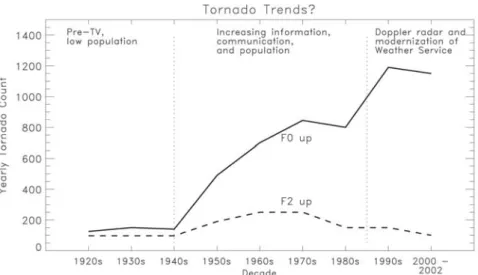
other factors now result in the detection and reporting of a much greater number of weak tornadoes (F0 and F1) than in the past (Fig. 5). Conversely, historic reports of “strong” (F2+) tornadoes were based on a variety of sources and are of a com-paratively high quality back to 1916 (Grazulis 1993). Figure 5 shows no long-term upward trend in the frequency of F2+ tornado occurrence. Hence, we will compare only the strong tornado statistics from this outbreak to the similar sta-tistics from past outbreaks.
Outbreaks with at least 50 strong tornadoes were examined back to 1916. Table 2 includes the five other such events that were roughly comparable to May 2003. Three events (1917, 1930, 1949) were qualita-tively of the same scale in terms of duration and the number of strong tornadoes as occurred in the 2003 extended outbreak, although only the 1949 extended outbreak matches 2003 with having strong tornadoes on each day somewhere in the country. There were also fewer “violent” (F4–F5) tornadoes and deaths in the May 2003 event than in the other events.
The 2003 extended outbreak was geographically displaced to the east of the 1930 and 1949 extended outbreaks (Fig. 6). The 1917 event, which had devas-tating tornadoes in central Illinois and western Ten-nessee, covered much of the same area as the May 2003 outbreak.
Other than May 2003, there have been no recorded long (1 week or longer) outbreak sequences with at least 50 strong tornadoes since 1949. However, there are two notable events with over 50 strong tornadoes that occurred over a shorter period of only a few days (Table 2). In particular, the single 24-h period of 3– 4 April 1974 actually produced more strong tornadoes and deaths than the whole May 2003 extended out-break. Hence, a better way of gauging outbreak sever-ity is to consider tornado counts over a given period of time, regardless of whether the tornadoes were spread uniformly over a week or concentrated in a day or two. Figure 7 shows the maximum number of strong tornadoes that were recorded during any con-secutive 9-day period for each year from 1916 to 2003. The six highest values were actually associated with the six sequences in Table 2. The 1917, 1930, 1949,
and 2003 peaks were extended outbreak sequences, while the 1965 and 1974 outbreaks were shorter sequences.
The nine consecutive days in May 2003 with an F2+ tornado was the longest consecutive sequence of such days since record keeping began in 1916. Is it possible to estimate the likelihood of such an unusu-ally extended sequence of days with severe tornadoes? Evaluating the statistical likelihood of events that have occurred once or twice in the period of record is problematic. However, a return frequency can be estimated from related but less rare events. Figure 8 provides evidence that events like this occur roughly from once in a decade to once in a century. On this figure, the green dots indicate the frequency of oc-currence per century of five or more F2+ tornadoes
FIG. 5. Yearly count of tornadoes by decade. Strong tornadoes (F2 and higher) are shown in dashed curve. Yearly total count of all tornadoes is shown in solid curve.
1917 (7 of 8) 63 15 383 1930 (7 of 9) 67 13 110 1949 (8 of 8) 73 9 66 1965 (5 of 5) 51 21 256 1974 (4 of 4) 103 30 309 2003 (9 of 9) 65 7 41
TABLE 2. Summary of four long-sequence
outbreaks and two short-sequence outbreaks. Parenthetical values after each year are the number of days with at least one strong tornado out of the total days in the sequence.
No. of No. of
strong violent
(F2–F5) (F4–F5) No. of
each day in a 9-day period (esti-mated from a 74-yr tornado record). There were approximately 330 days with more than five F2+ tornadoes for at least 1 day during the 9-day period, approximately 72 instances where 2 out of the 9 days had at least five F2+ tornadoes, 33 instances with 3 of the 9 days having at least five F2+ tornadoes, 8 instances with 4 of the 9 days having at least five F2+ tornadoes, and approximately 2.66 days per century with 5 out of the 9 days having at least five F2+ tornadoes. The green line provides a regression line that is a best fit to these data. Using the data in the third column of Table 1, for the 2003 outbreak we can see that 5 of the 9 days had at least five F2+ torna-does, thus, indicating that such an event would be expected to recur only 2.7 times a century (plotted with a green double circle). A simi-lar analysis can be repeated for the occurrence of 8 tornadoes per day over a 7-day period (data in red), and 10 tornadoes per day in a 7-day period (data in blue). The 2003 out-break had 3 days with at least 10 tor-nadoes during a 7-day period, with the fitted regression indicating about four occurrences per century. There were 4 days in 2003 with at least 8 tornadoes in a 7-day period, which is estimated from the regres-sion equation to occur only slightly
FIG. 6. Map of areas affected by outbreak sequences in 1917, 1930, and
1949.
FIG. 7. Maximum number of strong tornadoes during any 9-day pe-riod each year from 1916 to 2003 (through May). Number of F2+ tornadoes in the May 2003 sequence (horizontal black line). Note that the 2003 number was exceeded in several prior years and was ap-proached in many others; the six dates in Table 2 are denoted by red dots.
FIG. 8. Observed (colored symbols) and
fitted regression lines for different series of large number of daily F2+ tornadoes occurring on several days during a short period of time. Green symbols and lines associated with having at least 5 tornadoes on a day in a 9-day period, red for having at least 8 tornadoes in a 7-day period, and blue associated with at least 10 torna-does in a 7-day period. Double circles represent estimated recurrence fre-quency for observed reports in May 2003, in events per century. Raw data from Grazulis (1993) for period of 1921–93.
more than once a century. Hence, generalizing from all of these results, similar events occur from once a decade to once a century, depending on the metric. These results are consistent with the previous finding of six roughly comparable out-breaks over the past 88 yr.
Three of the four ex-tended outbreak sequences occurred between 1917 and 1949, followed thereafter by an absence of such se-quences until 2003. We be-lieve that this is most likely explained by the underly-ing event rarity and ran-domness rather than some long-term decreasing trend in the frequency of extended outbreaks.
As opposed to examin-ing the tornado record, we could also evaluate the event rarity by determining how unusual it was for tor-nado-favorable conditions to exist for many days over the same region. To do this, we examined the instability and wind parameters that are similar to those de-scribed above for each day in April and May for the period of 1979 through 2003, and developed a quantitative model for tor-nado risk based on this and observational data (see a de-scription of this technique online at http://dx.doi.org/ 1 0 . 1 1 7 5 / B A M S 8 6 4 -HamillB). Figure 9 shows the
resulting daily time series for each year of the fraction of an area in the central and eastern United States at elevated risk for tornadoes based on this analysis. Peaks on the diagrams indicate times when large ar-eas were at elevated risk of tornadoes based on sta-bility and shear conditions. The broad peak in early May 2003 shows that weather conditions on these days were more persistently favorable for tornadoes
over a large area than they were during any other April or May during the last 25 yr. It is important to note that while this simple measure helps to identify conditions that are favorable for supercell thunder-storms, such conditions do not always result in large tornado outbreaks because other factors are also in-volved (e.g., the peak in April 2001 was not accom-panied by a major outbreak).
FIG. 9. Time series of the fraction of the area within the central and
southeast-ern United States with conditions that are favorable for tornado outbreaks as obtained from large-scale meteorological analyses. Data are plotted for Apr and May from 1979 to 2003 (information online at http://dx.doi.org/10.1175/ BAMS-86-4-HamillB). Favorable areas are established by the presence of suf-ficient wind shear and instability. A larger fraction indicates a larger area with tornado-favorable conditions. Days with greater than 20% coverage are highlighted with red.
HOW PREDICTABLE WAS THIS OUT-BREAK? Did the NWS Storm Prediction Center (SPC) do a creditable job of providing more accurate forecasts many days in advance of the outbreak and, more specifically, warnings as the outbreak drew closer? Yes.
Consider the official NWS forecasts for the start of this extended outbreak, specifically 4 May 2003, in particular, the day with the most strong tornadoes and fatalities. Five days in advance, forecasters noted that severe weather was possible over a large area of the
central and eastern United States over a several day period (Fig. 10a). As this target day approached, fore-casters were able to narrow their predictions of where the severe weather was likely to occur (Figs. 10b–c). On 4 May they issued watches (see Fig. 10d)3 with an average of over 2-h lead time before the incidence of the first tornado (Department of Commerce 2004,
a) b)
c) d)
e)
FIG. 10. (a) NOAA hazards assessment issued 30 Apr 2003 for increased risk of severe thunderstorms for the period 2–6 May 2003. (b) NOAA forecast probability of severe
weather (within 25 miles of any location) issued 1200 UTC 2
May for the period 1200 UTC 4 May to 1200 UTC 5 May 2003. Yellow, orange, and red colors enclose 5%, 15%, and 25% probability contours, respectively. (c) NOAA forecast probability of tornadoes issued 1600 UTC on 4 May 2003 for the period 1630 UTC 4 May to 1200 UTC 5 May 2003. Green, yellow, orange, and red colors enclose 2.5%, 5%, 15%, and 25% probability contours, respectively. (d) NOAA severe thunderstorm (purple) and tornado (red) watch boxes issued on 4 May 2003; and (e) NOAA tornado warnings issued on 4 May 2003 with observed tornado tracks.
3Several regions outside the region plotted in Figs. 10d–e also were covered by watches and warnings.
p. 11). The Weather Forecast Office warnings (Fig. 10e) were issued with an average of a 19-min lead time, and all fatalities occurred within watch and warning regions (Department of Commerce, p. 2). And, of course, though terribly destructive, the actual
tornado paths covered only a relatively small geo-graphic area (Fig. 10e).
The skillful severe weather outlook area 5 days in advance reflects the improving skill of National Weather Service numerical forecasts. Figure 11
pre-FIG. 11. (top) Analyses, (middle) 2-day forecasts, and (bottom) 5-day forecasts all valid at 0000 UTC 5 May 2003. The maps depict sea level pressure (hPa), 500-hPa geopotential height (m), LI (°C), and surface to 500-hPa wind shear (m s–1). The top panels are determined from NCEP–NCAR reanalyses and the middle and bottom panels
sents the analyzed conditions, as well as the 2- and 5-day National Centers for Environmental Prediction (NCEP) Medium-Range Forecast (MRF) model en-semble mean forecasts (Toth and Kalnay 1997), which are valid on 0000 UTC 5 May 2003. As indicated, even the 5-day forecasts provided reasonably accurate guid-ance on the potential for tornado-favorable conditions in the central United States, which is, in this case, simi-lar in accuracy to the 2-day forecast. Simisimi-lar maps for other days during the outbreak, as well as the daily tornado tracks, are available online (http://dx.doi.org/ 10.1175/BAMS-86-4-HamillA).
Figure 12 shows the NCEP MRF ensemble mean forecast wind and instability fields, corresponding to those observed in Fig. 4, that are averaged for 4– 11 May 2003 and started from a forecast on 28 April (a 6- to 13-day forecast). The forecasts showed a very
strong upper-level jet streak (see Fig. 12b) entering Texas and a large low-level wind shear centered over Texas (Fig. 12c). Ensemble mean forecast instability was not as pronounced as that observed, but a broad area of unstable conditions was forecast from the Rockies to the east coast of the United States (Fig. 12d). Comparing forecasts against observed val-ues shows that forecast instability was lower than ob-served and was located about 200–500 km southwest of the observed peak. While the subsynoptic details were not correctly forecast, this longer-lead forecast still indicated a favorable jet stream configuration, suggest-ing that the potential for severe weather in the central United States was significantly higher than average.
SUMMARY. In May 2003 there was an unusual ex-tended tornado outbreak, with multiple F2+
torna-FIG. 12. As in Fig. 4, but here for a 15-member ensemble mean forecast starting 0000 UTC 28 April 2003, and
valid for the period from 0000 UTC 4 May 2003 to 0000 UTC 11 May 2003, (a 6- to 13-day forecast). (a) Wind direction and magnitude at 925 hPa, (b) wind direction and magnitude at 250 hPa, (c) wind shear, the vector difference between surface winds and winds at 500 hPa, and the (d) lifted index (°C).
does on each day from 3 to 11 May. This outbreak was destructive, deadly, and costly in terms of property damage. Yet the loss of life was smaller when com-pared to the few similar prior outbreaks, which is probably a result of useful tornado warnings and re-sponses and a somewhat smaller percentage of F4 and F5 tornadoes than in the few other comparable out-breaks.
The unusual string of successive days with torna-does was the result of a quasi-stationary weather pat-tern that was conducive to tornadoes. This patpat-tern produced a continual flow of low-level warm, moist air from the Gulf of Mexico up the Mississippi River valley, overridden by stronger, west-southwest winds aloft. No cold fronts from Canada intruded into the central United States during this period, which would have stabilized the atmosphere and terminated the outbreak.
An analysis of the outbreak showed that events of a similar severity tallied over a 9-day period have oc-curred five other times in the last 88 yr. None of these prior outbreaks had strong tornadoes each of the 9 days, and no time within the last 25 yr had such a long sequence of tornado-favorable conditions per-sisted over a large fraction of the United States.
While it is not possible to fully mitigate the dam-age from strong tornadoes, with adequate warning and training, the loss of life can be minimized. The reduced loss of life during this outbreak can, in part, be attributed to the good weather forecasts. These, in turn, reflect efforts of the meteorology community— the researchers, providing an improved understand-ing of severe weather dynamics; the numerical mod-elers, producing relatively accurate numerical guidance many days in advance; instrument developers, permit-ting the real-time monitoring of the dangerous weather; and, especially, the nation’s severe weather forecast-ers, who worked diligently and nearly nonstop for nine straight days through the extended outbreak.
ACKNOWLEDGMENTS. Andres Roubicek, Xue Wei, Jeff Whitaker, and especially Cathy Smith at the NOAA– CIRES Climate Diagnostics Center are thanked for their hard work in preparing many of the figures. The sugges-tions from two anonymous reviewers substantially im-proved the quality of this manuscript.
REFERENCES
Barnes, S. L., and C. W. Newton, 1983: Thunderstorms in the synoptic setting. Thunderstorm Morphology and Dynamics, E. Kessler, Ed., University of Okla-homa, 75–112.
Bluestein, H. B., 1993: Synoptic-Dynamic Meteorology in Midlatitudes. Vol. II, Oxford University Press, 594 pp. ——, 1999: Tornado Alley: Monster Storm of the Great
Plains. Oxford University Press, 180 pp.
Concannon, P. R., H. E. Brooks, and C. A. Doswell III, 2000: Climatological estimates of the threat of strong and violent tornadoes. Preprints, Symp. on Applied Climatology, Long Beach, CA, Amer. Meteor. Soc., 212–219.
Department of Commerce, 2004: Service assessment: Record tornado outbreaks of May 4–10, 2003. 58 pp. [Available from National Weather Service, 1325 East-West Highway, W/OS52, Silver Spring, Mary-land 20910-3283, or online at www.nws.noaa.gov/ om/assessments/record_may.pdf.]
Dowell, D. C., and H. B. Bluestein, 2002a: The 8 June 1995 McLean, Texas storm. Part I: Observations of cyclic tornadogenesis. Mon. Wea. Rev., 130, 2626– 2648.
——, and ——, 2002b: The 8 June 1995 McLean, Texas storm. Part II: Cyclic tornado formation, maintenance, and dissipation. Mon. Wea. Rev., 130, 2649–2670. Fujita, T. T., 1971: Proposed characterization of
torna-does and hurricanes by area and intensity. Univer-sity of Chicago SMRP Research Paper 91, 42 pp. [Available from Wind Engineering Research Center, Texas Tech University, P.O. Box 41023, Lubbock, TX 79409-1023.]
Galway, J. G., 1956: The lifted index as a predictor of la-tent instability. Bull. Amer. Meteor. Soc., 37, 528–529. Grazulis, T. P., 1993: Significant Tornadoes, 1680–1991.
Environmental Films, 1326 pp.
Markowski, P. M., J. M. Straka, and E. N. Rasmussen, 2002: Direct surface thermodynamic observations within rear-flank downdrafts of nontornadic and tornadic supercells. Mon. Wea. Rev., 130, 1692–1721. Miller, R. C., 1972: Notes on the analysis and severe-storm forecasting procedures of the Air Force Glo-bal Weather Central. AWS Tech Rep. 200 (revised February 1975), 182 pp. [Available from Air Force Combat Climatology Center Library, 151 Patton Ave., Room 120, Asheville, NC 28801-5002.] Rasmussen, E. N., and D. O. Blanchard, 1998: A baseline
climatology of sounding-derived supercell and tornado forecast parameters. Wea. Forecasting, 13, 1148–1164. ——, R. Davies-Jones, C. A. Doswell, F. H. Carr, M. D. Eilts, D. R. MacGorman, and J. M. Straka, 1994: Veri-fication of the origins of rotation in tornadoes experi-ment: VORTEX. Bull. Amer. Meteor. Soc., 75, 995– 1006.
Rotunno, R., and J. B. Klemp, 1985: On the rotation and propagation of simulated supercell thunderstorms. J. Atmos. Sci., 42, 271-292.
Thompson, R. L., R. Edwards, J. A. Hart, K. L. Elmore, and P. Markowski, 2003: Close proximity soundings within supercell environments obtained from the Rapid Update Cycle. Wea. Forecasting, 18, 1243–1261. Toth, Z., and E. Kalnay, 1997: Ensemble forecasting at NCEP and the breeding method. Mon. Wea. Rev.,
125, 3297–3319.
Trapp, R. J., 1999: Observations of nontornadic low-level mesocyclones and attendant tornadogenesis failure
during VORTEX. Mon. Wea. Rev., 127, 1693–1705.
Wakimoto, R. M., and N. T. Atkins, 1996: Observations on the origins of rotation: The Newcastle tornado during VORTEX 94. Mon. Wea. Rev., 124, 384–407.
——, and Liu, 1998: The Garden City, Kansas, storm during VORTEX 95. Part II: The wall cloud and tor-nado. Mon. Wea. Rev., 126, 393–408.
——, ——, and H. Cai, 1998: The Garden City, Kansas, storm during VORTEX 95. Part I: Overview of the storm’s life cycle and mesocyclogenesis. Mon. Wea. Rev., 126, 372–391.
——, H. V. Murphey, and H. Cai, 2004: The San Angelo, Texas, supercell of 31 May 1995: Visual observations and tornadogenesis. Mon. Wea. Rev., 132, 1269–1293. Ziegler, C. L., E. N. Rasmussen, T. R. Shepherd, A. I. Watson, and J. M. Straka, 2001: The evolution of low-level rotation in the 29 May 1994 Newcastle-Graham, Texas, storm complex during VORTEX. Mon. Wea. Rev., 129, 1339–1368.