How To Write Shared Libraries
Ulrich Drepper
December 10, 2011
Abstract
Today, shared libraries are ubiquitous. Developers use them for multiple reasons and create them just as they would create application code. This is a problem, though, since on many platforms some additional techniques must be applied even to generate decent code. Even more knowledge is needed to generate optimized code. This paper introduces the required rules and techniques. In addition, it introduces the concept of ABI (Application Binary Interface) stability and shows how to manage it.
1
Preface
For a long time, programmers collected commonly used code in libraries so that code could be reused. This saves development time and reduces errors since reused code only has to be debugged once. With systems running dozens or hundreds of processes at the same time reuse of the code at link-time solves only part of the problem. Many processes will use the same pieces of code which they import for libraries. With the memory management systems in modern operating systems it is also possible to share the code at run-time. This is done by loading the code into physical memory only once and reusing it in multiple processes via virtual memory. Libraries of this kind are called shared libraries.
The concept is not very new. Operating system designers implemented extensions to their system using the infras-tructure they used before. The extension to the OS could be done transparently for the user. But the parts the user directly has to deal with created initially problems. The main aspect is the binary format. This is the for-mat which is used to describe the application code. Long gone are the days that it was sufficient to provide a mem-ory dump. Multi-process systems need to identify differ-ent parts of the file containing the program such as the text, data, and debug information parts. For this, binary formats were introduced early on. Commonly used in the early Unix-days were formats such asa.out or COFF. These binary formats were not designed with shared li-braries in mind and this clearly shows.
Copyright c2002-2010, 2011 Ulrich Drepper All rights reserved. No redistribution allowed.
1.1
A Little Bit of History
The binary format used initially for Linux was ana.out variant. When introducing shared libraries certain design decisions had to be made to work in the limitations of a.out. The main accepted limitation was that no reloca-tionsare performed at the time of loading and afterward. The shared libraries have to exist in the form they are used at run-time on disk. This imposes a major restric-tion on the way shared libraries are built and used: every shared library must have a fixed load address; otherwise it would not be possible to generate shared libraries which do not have to be relocated.
The fixed load addresses had to be assigned and this has to happen without overlaps and conflicts and with some future safety by allowing growth of the shared library. It is therefore necessary to have a central authority for the assignment of address ranges which in itself is a ma-jor problem. But it gets worse: given a Linux system of today with many hundred of DSOs (Dynamic Shared Objects) the address space and the virtual memory avail-able to the application gets severely fragmented. This would limit the size of memory blocks which can be dy-namically allocated which would create unsurmountable problems for some applications. It would even have hap-pened by today that the assignment authority ran out of address ranges to assign, at least on 32-bit machines. We still have not covered all the drawbacks of thea.out shared libraries. Since the applications using shared li-braries should not have to be relinked after changing a shared library it uses, the entry points, i.e., the function and variable addresses, must not change. This can only be guaranteed if the entry points are kept separate from the actual code since otherwise limits on the size of a function would be hard-coded. A table of function stubs which call the actual implementation was the solution used on Linux. The static linker got the address of each
function stub from a special file (with the filename ex-tension.sa). At run-time a file ending in.so.X.Y.Z
was used and it had to correspond to the used.safile. This in turn requires that an allocated entry in the stub table always had to be used for the same function. The allocation of the table had to be carefully taken care of. Introducing a new interface meant appending to the ta-ble. It was never possible to retire a table entry. To avoid using an old shared library with a program linked with a newer version, some record had to be kept in the applica-tion: theX andY parts of the name of the.so.X.Y.Z
suffix was recorded and the dynamic linker made sure minimum requirements were met.
The benefits of the scheme are that the resulting program runs very fast. Calling a function in such a shared li-braries is very efficient even for the first call. It can be implemented with only two absolute jumps: the first from the user code to the stub, and the second from the stub to the actual code of the function. This is probably faster than any other shared library implementation, but its speed comes at too high a price:
1. a central assignment of address ranges is needed; 2. collisions are possible (likely) with catastrophic
re-sults;
3. the address space gets severely fragmented.
For all these reasons and more, Linux converted early on to using ELF (Executable Linkage Format) as the binary format. The ELF format is defined by the generic spec-ification (gABI) to which processor-specific extensions (psABI) are added. As it turns out the amortized cost of function calls is almost the same as fora.out but the restrictions are gone.
1.2
The Move To ELF
For programmers the main advantage of the switch to ELF was that creating ELF shared libraries, or in ELF-speak DSOs, becomes very easy. The only difference be-tween generating an application and a DSO is in the final link command line. One additional option (--sharedin the case of GNU ld) tells the linker to generate a DSO instead of an application, the latter being the default. In fact, DSOs are little more than a special kind of binary; the difference is that they have no fixed load address and hence require the dynamic linker to actually become ex-ecutable. With Position Independent Executable (PIEs) the difference shrinks even more.
This, together with the introduction of GNU Libtool which will be described later, has led to the wide adoption of DSOs by programmers. Proper use of DSOs can help save large amounts of resources. But some rules must be followed to get any benefits, and some more rules have to
be followed to get optimal results. Explaining these rules will be the topic of a large portion of this paper.
Not all uses of DSOs are for the purpose of saving re-sources. DSOs are today also often used as a way to structure programs. Different parts of the program are put into separate DSOs. This can be a very powerful tool, especially in the development phase. Instead of relink-ing the entire program it is only necessary to relink the DSO(s) which changed. This is often much faster. Some projects decide to keep many separate DSOs even in the deployment phase even though the DSOs are not reused in other programs. In many situations it is cer-tainly a useful thing to do: DSOs can be updated indi-vidually, reducing the amount of data which has to be transported. But the number of DSOs must be kept to a reasonable level. Not all programs do this, though, and we will see later on why this can be a problem.
Before we can start discussing all this some understand-ing of ELF and its implementation is needed.
1.3
How Is ELF Implemented?
The handling of a statically linked application is very simple. Such an application has a fixed load address which the kernel knows. The load process consists sim-ply of making the binary available in the appropriate ad-dress space of a newly created process and transferring control to the entry point of the application. Everything else was done by the static linker when creating the exe-cutable.
Dynamically linked binaries, in contrast, are not com-plete when they are loaded from disk. It is therefore not possible for the kernel to immediately transfer con-trol to the application. Instead some other helper pro-gram, which obviously has to be complete, is loaded as well. This helper program is thedynamic linker. The task of the dynamic linker is it, to complete the dynamically linked application by loading the DSOs it needs (the de-pendencies) and to perform the relocations. Then finally control can be transferred to the program.
This is not the last task for the dynamic linker in most cases, though. ELF allows the relocations associated with a symbol to be delayed until the symbol is needed. This lazy relocation scheme is optional, and optimizations dis-cussed below for relocations performed at startup imme-diately effect the lazy relocations as well. So we ignore in the following everything after the startup is finished.
1.4
Startup: In The Kernel
Starting execution of a program begins in the kernel, nor-mally in theexecvesystem call. The currently executed code is replaced with a new program. This means the
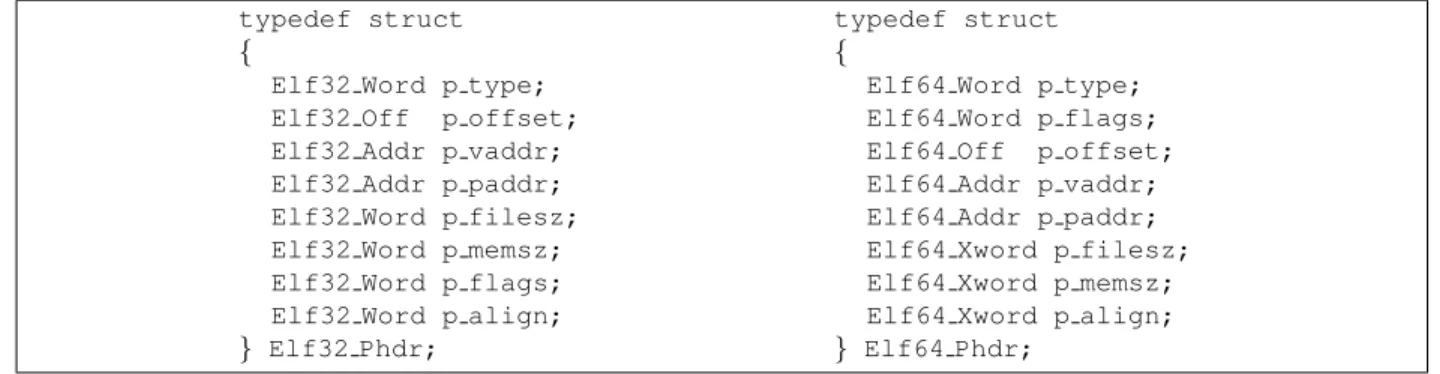
ad-typedef struct typedef struct
{ {
Elf32 Word p type; Elf64 Word p type;
Elf32 Off p offset; Elf64 Word p flags; Elf32 Addr p vaddr; Elf64 Off p offset; Elf32 Addr p paddr; Elf64 Addr p vaddr; Elf32 Word p filesz; Elf64 Addr p paddr; Elf32 Word p memsz; Elf64 Xword p filesz; Elf32 Word p flags; Elf64 Xword p memsz; Elf32 Word p align; Elf64 Xword p align;
} Elf32 Phdr; } Elf64 Phdr;
Figure 1: ELF Program Header C Data Structure
dress space content is replaced by the content of the file containing the program. This does not happen by sim-ply mapping (usingmmap) the content of the file. ELF files are structured and there are normally at least three different kinds of regions in the file:
• Code which is executed; this region is normally not writable;
• Data which is modified; this region is normally not executable;
• Data which is not used at run-time; since not needed it should not be loaded at startup.
Modern operating systems and processors can protect mem-ory regions to allow and disallow reading, writing, and executing separately for each page of memory.1 It is
preferable to mark as many pages as possible not writable since this means that the pages can be shared between processes which use the same application or DSO the page is from. Write protection also helps to detect and prevent unintentional or malignant modifications of data or even code.
For the kernel to find the different regions, or segments in ELF-speak, and their access permissions, the ELF file format defines a table which contains just this informa-tion, among other things. The ELF Program Header ta-ble, as it is called, must be present in every executable and DSO. It is represented by the C typesElf32 Phdr
andElf64 Phdrwhich are defined as can be seen in fig-ure 1.
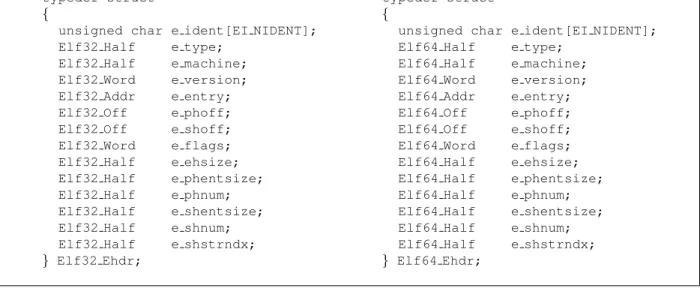
To locate the program header data structure another data structure is needed, the ELF Header. The ELF header is the only data structure which has a fixed place in the file, starting at offset zero. Its C data structure can be seen in figure 2. Thee phofffield specifies where, counting from the beginning of the file, the program header table starts. Thee phnumfield contains the number of entries in the program header table and thee phentsizefield 1A memory page is the smallest entity the memory subsystem of
the OS operates on. The size of a page can vary between different architectures and even within systems using the same architecture.
contains the size of each entry. This last value is useful only as a run-time consistency check for the binary. The different segments are represented by the program header entries with thePT LOADvalue in thep typefield. Thep offsetandp fileszfields specify where in the file the segment starts and how long it is. Thep vaddr
andp memszfields specify where the segment is located in the the process’ virtual address space and how large the memory region is. The value of thep vaddrfield itself is not necessarily required to be the final load address. DSOs can be loaded at arbitrary addresses in the virtual address space. But the relative position of the segments is important. For pre-linked DSOs the actual value of the
p vaddrfield is meaningful: it specifies the address for which the DSO was pre-linked. But even this does not mean the dynamic linker cannot ignore this information if necessary.
The size in the file can be smaller than the address space it takes up in memory. The firstp fileszbytes of the memory region are initialized from the data of the seg-ment in the file, the difference is initialized with zero. This can be used to handle BSS sections2, sections for uninitialized variables which are according to the C stan-dard initialized with zero. Handling uninitialized vari-ables this way has the advantage that the file size can be reduced since no initialization value has to be stored, no data has to be copied from disc to memory, and the mem-ory provided by the OS via themmapinterface is already initialized with zero.
Thep flagsfinally tells the kernel what permissions to use for the memory pages. This field is a bitmap with the bits given in the following table being defined. The flags are directly mapped to the flagsmmapunderstands.
2A BSS section contains only NUL bytes. Therefore they do not
have to be represented in the file on the storage medium. The loader just has to know the size so that it can allocate memory large enough and fill it with NUL
typedef struct typedef struct
{ {
unsigned char e ident[EI NIDENT]; unsigned char e ident[EI NIDENT];
Elf32 Half e type; Elf64 Half e type;
Elf32 Half e machine; Elf64 Half e machine;
Elf32 Word e version; Elf64 Word e version;
Elf32 Addr e entry; Elf64 Addr e entry;
Elf32 Off e phoff; Elf64 Off e phoff;
Elf32 Off e shoff; Elf64 Off e shoff;
Elf32 Word e flags; Elf64 Word e flags;
Elf32 Half e ehsize; Elf64 Half e ehsize;
Elf32 Half e phentsize; Elf64 Half e phentsize;
Elf32 Half e phnum; Elf64 Half e phnum;
Elf32 Half e shentsize; Elf64 Half e shentsize;
Elf32 Half e shnum; Elf64 Half e shnum;
Elf32 Half e shstrndx; Elf64 Half e shstrndx;
} Elf32 Ehdr; } Elf64 Ehdr;
Figure 2: ELF Header C Data Structure
p flags Value mmapflag Description
PF X 1 PROT EXEC Execute Permission
PF W 2 PROT WRITE Write Permission
PF R 4 PROT READ Read Permission
After mapping all thePT LOADsegments using the ap-propriate permissions and the specified address, or after freely allocating an address for dynamic objects which have no fixed load address, the next phase can start. The virtual address space of the dynamically linked executable itself is set up. But the binary is not complete. The kernel has to get the dynamic linker to do the rest and for this the dynamic linker has to be loaded in the same way as the executable itself (i.e., look for the loadable segments in the program header). The difference is that the dy-namic linker itself must be complete and should be freely relocatable.
Which binary implements the dynamic linker is not hard-coded in the kernel. Instead the program header of the application contains an entry with the tag PT INTERP. Thep offset field of this entry contains the offset of a NUL-terminated string which specifies the file name of this file. The only requirement on the named file is that its load address does not conflict with the load address of any possible executable it might be used with. In gen-eral this means that the dynamic linker has no fixed load address and can be loaded anywhere; this is just what dy-namic binaries allow.
Once the dynamic linker has also been mapped into the memory of the to-be-started process we can start the dy-namic linker. Note it is not the entry point of the applica-tion to which control is transfered to. Only the dynamic linker is ready to run. Instead of calling the dynamic linker right away, one more step is performed. The dy-namic linker somehow has to be told where the applica-tion can be found and where control has to be transferred
to once the application is complete. For this a structured way exists. The kernel puts an array of tag-value pairs on the stack of the new process. Thisauxiliary vector con-tains beside the two aforementioned values several more values which allow the dynamic linker to avoid several system calls. Theelf.hheader file defines a number of constants with aAT prefix. These are the tags for the entries in the auxiliary vector.
After setting up the auxiliary vector the kernel is finally ready to transfer control to the dynamic linker in user mode. The entry point is defined ine entryfield of the ELF header of the dynamic linker.
1.5
Startup in the Dynamic Linker
The second phase of the program startup happens in the dynamic linker. Its tasks include:
• Determine and load dependencies;
• Relocate the application and all dependencies;
• Initialize the application and dependencies in the correct order.
In the following we will discuss in more detail only the relocation handling. For the other two points the way for better performance is clear: have fewer dependen-cies. Each participating object is initialized exactly once but some topological sorting has to happen. The identify and load process also scales with the number dependen-cies; in most (all?) implementations this does not scale linearly.
The relocation process is normally3 the most expensive
part of the dynamic linker’s work. It is a process which is asymptotically at leastO(R+nr)whereRis the number of relative relocations,ris the number of named reloca-tions, andnis the number of participating DSOs (plus the main executable). Deficiencies in the ELF hash ta-ble function and various ELF extensions modifying the symbol lookup functionality may well increase the factor toO(R+rnlogs)wheresis the number of symbols. This should make clear that for improved performance it is significant to reduce the number if relocations and sym-bols as much as possible. After explaining the relocation process we will do some estimates for actual numbers.
1.5.1 The Relocation Process
Relocation in this context means adjusting the application and the DSOs, which are loaded as the dependencies, to their own and all other load addresses. There are two kinds of dependencies:
• Dependencies to locations which are known to be in the own object. These are not associated with a specific symbol since the linker knows the relative position of the location in the object.
Note that applications do not have relative reloca-tions since the load address of the code is known at link-time and therefore the static linker is able to perform the relocation.
• Dependencies based on symbols. The reference of the definition is generally, but not necessarily, in a different object than the definition.
The implementation of relative relocations is easy. The linker can compute the offset of the target destination in the object file at link-time. To this value the dynamic linker only has to add the load address of the object and store the result in the place indicated by the relocation. At runtime the dynamic linker has to spend only a very small and constant amount of time which does not increase if more DSOs are used.
The relocation based on a symbol is much more compli-cated. The ELF symbol resolution process was designed very powerful so that it can handle many different prob-lems. All this powerful functionality adds to the com-plexity and run-time costs, though. Readers of the fol-lowing description might question the decisions which led to this process. We cannot argue about this here; read-ers are referred to discussions of ELF. Fact is that symbol relocation is a costly process and the more DSOs partic-ipate or the more symbols are defined in the DSOs, the longer the symbol lookup takes.
3We ignore the pre-linking support here which in many cases can
reduce significantly or even eliminate the relocation costs.
The result of any relocation will be stored somewhere in the object with the reference. Ideally and generally the target location is in the data segment. If code is in-correctly generated by the user, compiler, or linker relo-cations might modify text or read-only segments. The dynamic linker will handle this correctly if the object is marked, as required by the ELF specification, with the
DF TEXTREL set in theDT FLAGSentry of the dynamic section (or the existence of theDT TEXTRELflag in old binaries). But the result is that the modified page can-not be shared with other processes using the same object. The modification process itself is also quite slow since the kernel has to reorganize the memory handling data structures quite a bit.
1.5.2 Symbol Relocations
The dynamic linker has to perform a relocation for all symbols which are used at run-time and which are not known at link-time to be defined in the same object as the reference. Due to the way code is generated on some ar-chitectures it is possible to delay the processing of some relocations until the references in question are actually used. This is on many architectures the case for calls to functions. All other kinds of relocations always have to be processed before the object can be used. We will ignore thelazy relocation processingsince this is just a method to delay the work. It eventually has to be done and so we will include it in our cost analysis. To actu-ally perform all the relocations before using the object is used by setting the environment variableLD BIND NOWto a non-empty value. Lazy relocation can be disabled for an individual object by adding the-z nowoption to the linker command line. The linker will set theDF BIND NOW flag in the DT FLAGS entry of the dynamic section to mark the DSO. This setting cannot be undone without relinking the DSOs or editing the binary, though, so this option should only be used if it is really wanted.
The actual lookup process is repeated from start for each symbol relocation in each loaded object. Note that there can be many references to the same symbol in differ-ent objects. The result of the lookup can be differdiffer-ent for each of the objects so there can be no short cuts ex-cept for caching results for a symbol in each object in case more than one relocation references the same sym-bol. Thelookup scopementioned in the steps below is an ordered list of a subset of the loaded objects which can be different for each object itself. The way the scope is computed is quite complex and not really relevant here so we refer the interested reader to the ELF specification and section 1.5.4. Important is that the length of the scope is normally directly dependent on the number of loaded ob-jects. This is another factor where reducing the number of loaded objects is increasing performance.
There are today two different methods for the lookup pro-cess for a symbol. The traditional ELF method proceeds in the following steps:
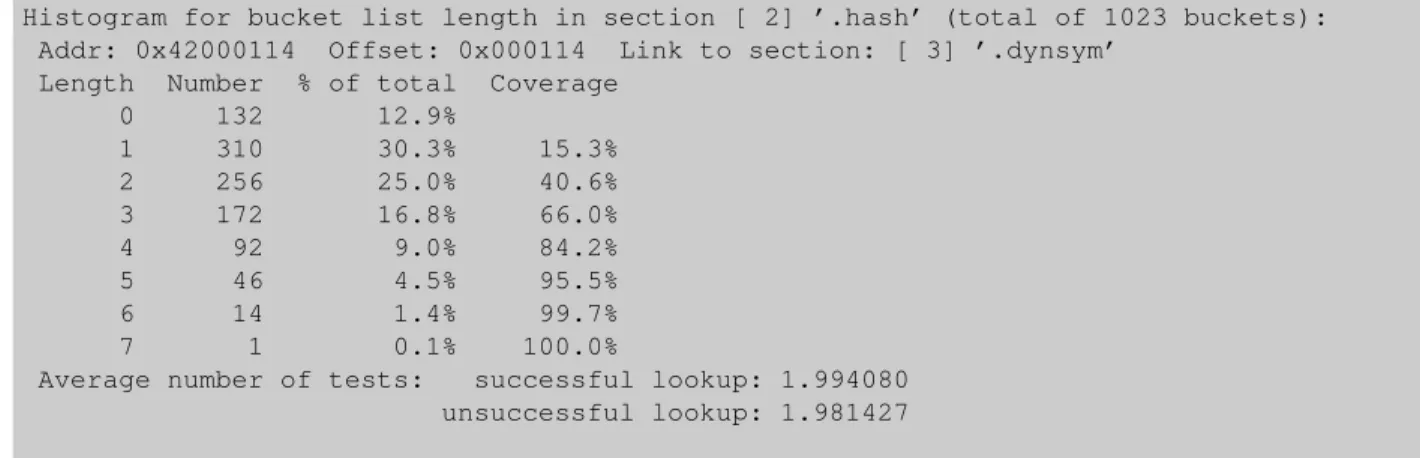
Histogram for bucket list length in section [ 2] ’.hash’ (total of 1023 buckets): Addr: 0x42000114 Offset: 0x000114 Link to section: [ 3] ’.dynsym’
Length Number % of total Coverage
0 132 12.9%
1 310 30.3% 15.3%
2 256 25.0% 40.6%
3 172 16.8% 66.0%
4 92 9.0% 84.2%
5 46 4.5% 95.5%
6 14 1.4% 99.7%
7 1 0.1% 100.0%
Average number of tests: successful lookup: 1.994080 unsuccessful lookup: 1.981427
Figure 3: Example Output foreu-readelf -I libc.so
Histogram for bucket list length in section [ 2] ’.hash’ (total of 191 buckets): Addr: 0x00000114 Offset: 0x000114 Link to section: [ 3] ’.dynsym’
Length Number % of total Coverage
0 103 53.9%
1 71 37.2% 67.0%
2 16 8.4% 97.2%
3 1 0.5% 100.0%
Average number of tests: successful lookup: 1.179245 unsuccessful lookup: 0.554974
Figure 4: Example Output foreu-readelf -I libnss files.so
1. Determine the hash value for the symbol name. 2. In the first/next object in the lookup scope:
2.a Determine the hash bucket for the symbol us-ing the hash value and the hash table size in the object.
2.b Get the name offset of the symbol and using it as the NUL-terminated name.
2.c Compare the symbol name with the reloca-tion name.
2.d If the names match, compare the version names as well. This only has to happen if both, the reference and the definition, are versioned. It requires a string comparison, too. If the ver-sion name matches or no such comparison is performed, we found the definition we are looking for.
2.e If the definition does not match, retry with the next element in the chain for the hash bucket. 2.f If the chain does not contain any further ele-ment there is no definition in the current ob-ject and we proceed with the next obob-ject in the lookup scope.
3. If there is no further object in the lookup scope the lookup failed.
Note that there is no problem if the scope contains more than one definition of the same symbol. The symbol lookup algorithm simply picks up the first definition it finds. Note that a definition in a DSO beingweakhas no effects. Weak definitions only play a role in static linking. Having multiple definitions has some perhaps surprising consequences. Assume DSO ‘A’ defines and references an interface and DSO ‘B’ defines the same interface. If now ‘B’ precedes ‘A’ in the scope, the reference in ‘A’ will be satisfied by the definition in ‘B’. It is said that the definition in ‘B’ interposes the definition in ‘A’. This concept is very powerful since it allows more special-ized implementation of an interface to be used without replacing the general code. One example for this mech-anism is the use of theLD PRELOADfunctionality of the dynamic linker where additional DSOs which were not present at link-time are introduced at run-time. But inter-position can also lead to severe problems in ill-designed code. More in this in section 1.5.4.
Looking at the algorithm it can be seen that the perfor-mance of each lookup depends, among other factors, on the length of the hash chains and the number of objects in the lookup scope. These are the two loops described above. The lengths of the hash chains depend on the number of symbols and the choice of the hash table size. Since the hash function used in the initial step of the algo-rithm must never change these are the only two remaining variables. Many linkers do not put special emphasis on
selecting an appropriate table size. The GNU linker tries to optimize the hash table size for minimal lengths of the chains if it gets passed the-Ooption (note: the linker,not
the compiler, needs to get this option).
A note on the current implementation of the hash table op-timization. The GNU binutils linker has a simple minded heuristic which often favors small table sizes over short chain length. For large projects this might very well in-creasethe startup costs. The overall memory consumption will be sometimes significantly reduced which might com-pensate sooner or later but it is still advised to check the effectiveness of the optimization. A new linker implemen-tation is going to be developed and it contains a better algo-rithm.
To measure the effectiveness of the hashing two numbers are important:
• The average chain length for a successful lookup.
• The average chain length for an unsuccessful lookup. It might be surprising to talk about unsuccessful lookups here but in fact they are the rule. Note that “unsuccess-ful” means only unsuccessful in the current objects. Only for objects which implement almost everything they get looked in for is the successful lookup number more im-portant. In this category there are basically only two ob-jects on a Linux system: the C library and the dynamic linker itself.
Some versions of thereadelfprogram compute the value directly and the output is similar to figures 3 and 4. The data in these examples shows us a number of things. Based on the number of symbols (2027 versus 106) the chosen table size is radically different. For the smaller table the linker can afford to “waste” 53.9% of the hash table en-tries which contain no data. That’s only 412 bytes on a gABI-compliant system. If the same amount of over-head would be allowed for thelibc.sobinary the table would be 4 kilobytes or more larger. That is a big dif-ference. The linker has a fixed cost function integrated which takes the table size into account.
The increased relative table size means we have signifi-cantly shorter hash chains. This is especially true for the average chain length for an unsuccessful lookup. The av-erage for the small table is only 28% of that of the large table.
What these numbers should show is the effect of reduc-ing the number of symbols in the dynamic symbol ta-ble. With significantly fewer symbols the linker has a much better chance to counter the effects of the subopti-mal hashing function.
Another factor in the cost of the lookup algorithm is con-nected with the strings themselves. Simple string com-parison is used on the symbol names which are stored
in a string table associated with the symbol table data structures. Strings are stored in the C-format; they are terminated by a NUL byte and no initial length field is used. This means string comparisons has to proceed until a non-matching character is found or until the end of the string. This approach is susceptible to long strings with common prefixes. Unfortunately this is not uncommon.
namespace some_namespace { class some_longer_class_name {
int member_variable; public:
some_longer_class_name (int p); int the_getter_function (void); };
}
The name mangling scheme used by the GNU C++ com-piler before version 3.0 used a mangling scheme which put the name of a class member first along with a descrip-tion of the parameter list and following it the other parts of the name such as namespaces and nested class names. The result is a name which distinguishable in the begin-ning if the member names are different. For the example above the mangled names for the two members functions look like this figure 5.
In the new mangling scheme used in today’s gcc versions and all other compilers which are compatible with the common C++ ABI the names start with the namespaces and class names and end with the member names. Fig-ure 6 shows the result for the little example. The mangled names for the two member functions differs only after the 43rdcharacter. This is really bad performance-wise if the two symbols should fall into the same hash bucket.4 Ada has similar problems. The standard Ada library for gcc has all symbols prefixed withada, then the pack-age and sub-packpack-age names, followed by function name. Figure 7 shows a short excerpt of the list of symbols from the library. The first 23 character are the same for all the names.
The length of the strings in both mangling schemes is worrisome since each string has to be compared com-pletely when the symbol itself is searched for. The names in the example are not extra ordinarily long either. Look-ing through the standard C++ library one can find many names longer than 120 characters and even this is not the longest. Other system libraries feature names longer than 200 characters and complicated, “well designed” C++ projects with many namespaces, templates, and nested classes can feature names with more than 1,000 charac-4Some people suggested “Why not search from the back?”. Think
about it, these are C strings, not PASCAL strings. We do not know the length and therefore would have to read every single character of the string to determine the length. The result would be worse.
__Q214some_namespace22some_longer_class_namei
the_getter_function__Q214some_namespace22some_longer_class_name
Figure 5: Mangled names using pre-gcc 3 scheme
_ZN14some_namespace22some_longer_class_nameC1Ei
_ZN14some_namespace22some_longer_class_name19the_getter_functionEv
Figure 6: Mangled names using the common C++ ABI scheme
ada__calendar__delays___elabb
ada__calendar__delays__timed_delay_nt ada__calendar__delays__to_duration
Figure 7: Names from the standard Ada library
ters. One plus point for design, but minus 100 points for performance.
With the knowledge of the hashing function and the de-tails of the string lookup let us look at a real-world exam-ple: OpenOffice.org. The package contains 144 separate DSOs. During startup about 20,000 relocations are per-formed. Many of the relocations are performed as the result ofdlopencalls and therefore cannot be optimized away by using prelink [7]. The number of string compar-isons needed during the symbol resolution can be used as a fair value for the startup overhead. We compute an approximation of this value now.
The average chain length for unsuccessful lookup in all DSOs of the OpenOffice.org 1.0 release on IA-32 is 1.1931. This means for each symbol lookup the dynamic linker has to perform on average72×1.1931 = 85.9032string comparisons. For 20,000 symbols the total is 1,718,064 string comparisons. The average length of an exported symbol defined in the DSOs of OpenOffice.org is54.13. Even if we are assuming that only 20% of the string is searched before finding a mismatch (which is an opti-mistic guess since every symbol name is compared com-pletely at least once to match itself) this would mean a to-tal of more then 18.5 million characters have to be loaded from memory and compared. No wonder that the startup is so slow, especially since we ignored other costs. To compute number of lookups the dynamic linker per-forms one can use the help of the dynamic linker. If the environment variableLD DEBUG is set to symbols one only has to count the number of lines which start with
symbol=. It is best to redirect the dynamic linker’s out-put into a file withLD DEBUG OUTPUT. The number of string comparisons can then be estimate by multiplying the count with the average hash chain length. Since the collected output contains the name of the file which is
looked at it would even be possible to get more accurate results by multiplying with the exact hash chain length for the object.
Changing any of the factors ‘number of exported sym-bols’, ‘length of the symbol strings’, ‘number and length of common prefixes’,‘number of DSOs’, and ‘hash table size optimization’ can reduce the costs dramatically. In general the percentage spent on relocations of the time the dynamic linker uses during startup is around 50-70% if the binary is already in the file system cache, and about 20-30% if the file has to be loaded from disk.5 It is
thefore worth spending time on these issues and in the re-mainder of the text we will introduce methods to do just that. So far to remember: pass-O1to the linker to gener-ate the final product.
1.5.3 The GNU-style Hash Table
All the optimizations proposed in the previous section still leave symbol lookup as a significant factor. A lot of data has to be examined and loading all this data in the CPU cache is expensive. As mentioned above, the orig-inal ELF hash table handling has no more flexibility so any solution would have to replace it. This is what the GNU-style hash table handling does. It can peacefully coexist with the old-style hash table handling by having its own dynamic section entry (DT GNU HASH). Updated dynamic linkers will use the new hash table insted of the old, therefore provided completely transparent backward compatibility support. The new hash table implementa-tion, like the old, is self-contained in each executable and DSO so it is no problem to have binaries with the new and some with only the old format in the same process. The main cost for the lookup, especially for certain
ries, is the comparison of the symbol names. If the num-ber of comparisons which actually have to be performed can be reduced we can gain big. A second possible opti-mization is the layout of the data. The old-style hash table with its linked list of symbol table entries is not necessar-ily good to the CPU cache. CPU caches work particularly well when the used memory locations are consecutive. A linked list can jump wildly around and render CPU cache loading and prefetching less effective.
The GNU-style hash tables set out to solve these prob-lem and more. Since compatibility with existing runtime environments could be maintained by providing the old-style hash tables in parallel no restrictions of the changes were needed. The new lookup process is therefore slightly different:
1. Determine the hash value for the symbol name. 2. In the first/next object in the lookup scope:
2.a The hash value is used to determine whether an entry with the given hash value is present at all. This is done with a 2-bit Bloom fil-ter.6. If the filter indicates there is no such
definition the next object in the lookup scope is searched.
2.b Determine the hash bucket for the symbol us-ing the hash value and the hash table size in the object. The value is a symbol index. 2.c Get the entry from the chain array
correspond-ing to the symbol index. Compare the value with the hash value of the symbol we are try-ing to locate. Ignore bit 0.
2.d If the hash value matches, get the name off-set of the symbol and using it as the NUL-terminated name.
2.e Compare the symbol name with the reloca-tion name.
2.f If the names match, compare the version names as well. This only has to happen if both, the reference and the definition, are versioned. It requires a string comparison, too. If the ver-sion name matches or no such comparison is performed, we found the definition we are looking for.
2.g If the definition does not match and the value loaded from the hash bucket does not have bit 0 set, continue with the next entry in the hash bucket array.
2.h If bit 0 is set there are no further entry in the hash chain we proceed with the next object in the lookup scope.
3. If there is no further object in the lookup scope the lookup failed.
6http://en.wikipedia.org/wiki/Bloom filter
This new process seems more complicated. Not only is this not really the case, it is also much faster. The number of times we actually have to compare strings is reduced significantly. The Bloom filter alone usually filters out 80% or more (in many cases 90+%) of all lookups. I.e., even in the case the hash chains are long no work is done since the Bloom filter helps to determine that there will be no match. This is done with one signal memory access. Second, comparing the hash value with that of the symbol table entry prevents yet more string comparisons. Each hash chain can contain entries with different hash value and this simple word comparison can filter out a lot of duplicates. There are rarely two entries with the same hash value in a hash chain which means that an unsuc-cessful string comparison is rare. The probability for this is also increased by using a different hash function than the original ELF specification dictates. The new function is much better in spreading the values out over the value range of 32-bit values.
The hash chain array is organized to have all entries for the same hash bucket follow each other. There is no linked list and therefore the cache utilization is much bet-ter.
Only if the Bloom filter and the hash function test suc-ceed do we access the symbol table itself. All symbol ta-ble entries for a hash chain are consecutive, too, so in case we need to access more than one entry the CPU cache prefetching will help here, too.
One last change over the old format is that the hash ta-ble only contains a few, necessary records for undefined symbol. The majority of undefined symbols do not have to appear in the hash table. This in some cases signif-icantly reduces the possibility of hash collisions and it certainly increases the Bloom filter success rate and re-duces the average hash chain length. The result are sig-nificant speed-ups of 50% or more in code which cannot depend on pre-linking [7] (pre-linking isalwaysfaster). This does not mean, though, that the optimization tech-niques described in the previous section are irrelevant. They still should very much be applied. Using the new hash table implementation just means that not optimizing the exported and referenced symbols will not have a big effect on performance as it used to have.
The new hash table format was introduced in Fedora Core 6. The entire OS, with a few deliberate exceptions, is created without the compatibility hash table by using
--hash-style=gnu. This means the binaries cannot be used on systems without support for the new hash table for-mat in the dynamic linker. Since this is never a goal for any of the OS releases making this decision was a no-brainer. The result is that all binaries are smaller than with the sec-ond set of hash tables and in many cases even smaller than binaries using only the old format.
Going back to the OpenOffice.org example, we can make some estimates about the speedup. If the Bloom filter is able to filter out a low 80% of all lookups and the prob-ability of duplicates hash values is a high 15% we only have to actually compare on average72×0.2×0.15× 1.1931 = 2.58strings. This is an improvement of a fac-tor of 33. Adding to this to improved memory handling and respect for the CPU cache we have even higher gains. In real world examples we can reduce the lookup costs so that programs start up 50% faster or more.
1.5.4 Lookup Scope
The lookup scope has so far been described as an ordered list of most loaded object. While this is correct it has also been intentionally vague. It is now time to explain the lookup scope in more detail.
The lookup scope consists in fact of up to three parts. The main part is the global lookup scope. It initially consists of the executable itself and all its dependencies. The dependencies are added in breadth-first order. That means first the dependencies of the executable are added in the order of theirDT NEEDEDentries in the executable’s dynamic section. Then the dependencies of the first de-pendency are added in the same fashion. DSOs already loaded are skipped; they do not appear more than once on the list. The process continues recursively and it will stop at some point since there are only a limited number of DSOs available. The exact number of DSOs loaded this way can vary widely. Some executables depend on only two DSOs, others on 200.
If an executable has theDF SYMBOLICflag set (see sec-tion 2.2.7) the object with the reference is added in front of the global lookup scope. Note, only the object with the reference itself is added in front, not its dependen-cies. The effects and reasons for this will be explained later.
A more complicated modification of the lookup scope happens when DSOs are loaded dynamic usingdlopen. If a DSO is dynamically loaded it brings in its own set of dependencies which might have to be searched. These objects, starting with the one which was requested in the dlopen call, are appended to the lookup scope if the object with the reference is among those objects which have been loaded bydlopen. That means, those objects are not added to the global lookup scope and they are not searched for normal lookups. This third part of the lookup scope, we will call it local lookup scope, is there-fore dependent on the object which has the reference. The behavior ofdlopencan be changed, though. If the function gets passed theRTLD GLOBALflag, the loaded object and all the dependenciesareadded to the global scope. This is usually a very bad idea. The dynami-cally added objects can be removed and when this hap-pens the lookups of all other objects is influenced. The
entire global lookup scope is searched before the dynam-ically loaded object and its dependencies so that defini-tions would be found first in the global lookup scope ob-ject before definitions in the local lookup scope. If the dynamic linker does the lookup as part of a relocation this additional dependency is usually taken care of auto-matically, but this cannot be arranged if the user looks up symbols in the lookup scope withdlsym.
And usually there is no reason to useRTLD GLOBAL. For reasons explained later it is always highly advised to cre-ate dependencies with all the DSOs necessary to resolve all references.RTLD GLOBALis often used to provide im-plementations which are not available at link time of a DSO. Since this should be avoided the need for this flag should be minimal. Even if the programmer has to jump through some hoops to work around the issues which are solved byRTLD GLOBALit is worth it. The pain of debug-ging and working around problems introduced by adding objects to the global lookup scope is much bigger. The dynamic linker in the GNU C library knows since September 2004 one more extension. This extension helps to deal with situations where multiple definitions of sym-bols with the same name are not compatible and there-fore cannot be interposed and expected to work. This is usally a sign of design failures on the side of the peo-ple who wrote the DSOs with the conflicting definitions and also failure on the side of the application writer who depends on these incompatible DSOs. We assume here that an applicationappis linked with a DSOlibone.so
which defines a symbolduplicateand that it dynami-cally loads a DSOlibdynamic.sowhich depends on another DSO libtwo.sowhich also defines a symbol
duplicate. When the application starts it might have a global scope like this:
app→libone.so→libdl.so→libc.so
If nowlibtwo.sois loaded, the additional local scope could be like this:
libdynamic.so→libtwo.so→libc.so
This local scope is searched after the global scope, pos-sibly with the exception of libdynamic.so which is searched first for lookups in this very same DSO if the
DF DYNAMICflag is used. But what happens if the sym-bolduplicateis required inlibdynamic.so? After all we said so far the result is always: the definition in
libone.sois found sincelibtwo.sois only in the lo-cal scope which is searched after the global scope. If the two definitions are incompatible the program is in trou-ble.
This can be changed with a recent enough GNU C library by ORingRTLD DEEPBINDto the flag word passed as the
second parameter to dlopen. If this happens, the dy-namic linker will search the local scope before the global scope for all objects which have been loaded by the call todlopen. For our example this means the search or-der changes for all lookups in the newly loaded DSOs
libdynamic.soandlibtwo.so, but not forlibc.so
since this DSO has already been loaded. For the two af-fected DSOs a reference toduplicatewill now find the definition inlibtwo.so. In all other DSOs the definition inlibone.sowould be found.
While this might sound like a good solution for handling compatibility problems this feature should only be used if it cannot be avoided. There are several reasons for this:
• The change in the scope affects all symbols and all the DSOs which are loaded. Some symbols might have to be interposed by definitions in the global scope which now will not happen.
• Already loaded DSOs are not affected which could cause unconsistent results depending on whether the DSO is already loaded (it might be dynamically loaded, so there is even a race condition).
• LD PRELOAD is ineffective for lookups in the dy-namically loaded objects since the preloaded ob-jects are part of the global scope, having been added right after the executable. Therefore they are looked at only after the local scope.
• Applications might expect that local definitions are always preferred over other definitions. This (and the previous point) is already partly already a prob-lem with the use ofDF SYMBOLICbut since this flag should not be used either, the arguments are still valid.
• If any of the implicitly loaded DSOs is loaded ex-plicitly afterward, its lookup scope will change.
• Lastly, the flag is not portable.
TheRTLD DEEPBINDflag should really only be used as a last resort. Fixing the application to not depend on the flag’s functionality is the much better solution.
1.5.5 GOT and PLT
The Global Offset Table (GOT) and Procedure Linkage Table (PLT) are the two data structures central to the ELF run-time. We will introduce now the reasons why they are used and what consequences arise from that.
Relocations are created for source constructs like
extern int foo;
extern int bar (int); int call_bar (void) {
return bar (foo); }
The call tobarrequires two relocations: one to load the value offooand another one to find the address ofbar. If the code would be generated knowing the addresses of the variable and the function the assembler instructions would directly load from or jump to the address. For IA-32 the code would look like this:
pushl foo call bar
This would encode the addresses offooandbaras part of the instruction in the text segment. If the address is only known to the dynamic linker the text segment would have to be modified at run-time. According to what we learned above this must be avoided.
Therefore the code generated for DSOs, i.e., when using
-fpicor-fPIC, looks like this:
movl foo@GOT(%ebx), %eax pushl (%eax)
call bar@PLT
The address of the variablefoois now not part of the in-struction. Instead it is loaded from the GOT. The address of the location in the GOT relative to the PIC register value (%ebx) is known at link-time. Therefore the text segment does not have to be changed, only the GOT.7
The situation for the function call is similar. The function
baris not called directly. Instead control is transferred to a stub forbarin the PLT (indicated bybar@PLT). For IA-32 the PLT itself does not have to be modified and can be placed in a read-only segment, each entry is 16 bytes in size. Only the GOT is modified and each entry consists of 4 bytes. The structure of the PLT in an IA-32 DSO looks like this:
.PLT0:pushl 4(%ebx) jmp *8(%ebx) nop; nop
7There is one more advantage of using this scheme. If the
instruc-tion would be modified we would need one relocainstruc-tion per load/store instruction. By storing the address in the GOT only one relocation is needed.
nop; nop
.PLT1:jmp *name1@GOT(%ebx) pushl $offset1 jmp .PLT0@PC
.PLT2:jmp *name2@GOT(%ebx) pushl $offset2 jmp .PLT0@PC
This shows three entries, there are as many as needed, all having the same size. The first entry, labeled with
.PLT0, is special. It is used internally as we will see. All the following entries belong to exactly one function symbol. The first instruction is an indirect jump where the address is taken from a slot in the GOT. Each PLT en-try has one GOT slot. At startup time the dynamic linker fills the GOT slot with the address pointing to the sec-ond instruction of the appropriate PLT entry. I.e., when the PLT entry is used for the first time the jump ends at the followingpushlinstruction. The value pushed on the stack is also specific to the PLT slot and it is the off-set of the relocation entry for the function which should be called. Then control is transferred to the special first PLT entry which pushes some more values on the stack and finally jumps into the dynamic linker. The dynamic linker has do make sure that the third GOT slot (offset 8) contains the address of the entry point in the dynamic linker. Once the dynamic linker has determined the ad-dress of the function it stores the result in the GOT entry which was used in thejmpinstruction at the beginning of the PLT entry before jumping to the found function. This has the effect that all future uses of the PLT entry will not go through the dynamic linker, but will instead directly transfer to the function. The overhead for all but the first call is therefore “only” one indirect jump.
The PLT stub is always used if the function is not guaran-teed to be defined in the object which references it. Please note that a simple definition in the object with the refer-ence is not enough to avoid the PLT entry. Looking at the symbol lookup process it should be clear that the def-inition could be found in another object (interposition) in which case the PLT is needed. We will later explain exactly when and how to avoid PLT entries.
How exactly the GOT and PLT is structured is architecture-specific, specified in the respective psABI. What was said here about IA-32 is in some form applicable to some other architectures but not for all. For instance, while the PLT on IA-32 is read-only it must be writable for other architectures since instead of indirect jumps using GOT values the PLT entries are modified directly. A reader might think that the designers of the IA-32 ABI made a mistake by requiring a indirect, and therefore slower, call instead of a direct call. This is no mistake, though. Hav-ing a writable and executable segment is a huge security problem since attackers can simply write arbitrary code into the PLT and take over the program. We can anyhow summarize the costs of using GOT and PLT like this:
• every use of a global variable which is exported uses a GOT entry and loads the variable values in-directly;
• each function which is called (as opposed to refer-enced as a variable) which is not guaranteed to be defined in the calling object requires a PLT entry. The function call is performed indirectly by trans-ferring control first to the code in the PLT entry which in turn calls the function.
• for some architectures each PLT entry requires at least one GOT entry.
Avoiding a jump through the PLT therefore removes on IA-32 16 bytes of text and 4 bytes of data. Avoiding the GOT when accessing a global variable saves 4 bytes of data and one load instruction (i.e., at least 3 bytes of code and cycles during the execution). In addition each GOT entry has a relocation associated with the costs described above.
1.5.6 Running the Constructors
Once the relocations are performed the DSOs and the ap-plication code can actually be used. But there is one more thing to do: optionally the DSOs and the application must be initialized. The author of the code can define for each object a number of initialization functions which are run before the DSO is used by other code. To perform the ini-tialization the functions can use code from the own object and all the dependencies. To make this work the dynamic linker must make sure the objects are initialized in the correct order, i.e., the dependencies of an object must be initialized before the object.
To guarantee that the dynamic linker has to perform a topological sort in the list of objects. This sorting is no linear process. Like all sorting algorithms the run-time is at least O(nlogn)and since this is actually a topological sort the value is even higher. And what is more: since the order at startup need not be the same as the order at shutdown (when finalizers have to be run) the whole process has to be repeated.
So we have again a cost factor which is directly depend-ing on the number of objects involved. Reducdepend-ing the number helps a bit even though the actual costs are nor-mally much less than that of the relocation process. At this point it is useful to look at the way to correctly write constructors and destructors for DSOs. Some sys-tems had the convention that exported functions named initand finiare automatically picked as constructor and destructor respectively. This convention is still fol-lowed by GNU ld and using functions with these names on a Linux system will indeed cause the functions used in these capacities. But this is totally, 100% wrong!
By using these functions the programmer overwrites what-ever initialization and destruction functionality the sys-tem itself is using. The result is a DSO which is not fully initialized and this sooner or later leads to a catas-trophy. The correct way of adding constructors and de-structors is by marking functions with theconstructor
anddestructorfunction attribute respectively.
void
__attribute ((constructor)) init_function (void)
{ ... } void
__attribute ((destructor)) fini_function (void) {
... }
These functions should not be exported either (see sec-tions 2.2.2 and 2.2.3) but this is just an optimization. With the functions defined like this the runtime will ar-range that they are called at the right time, after perform-ing whatever initialization is necessary before.
1.6
Summary of the Costs of ELF
We have now discussed the startup process and how it is affected by the form of the binaries. We will now summa-rize the various factors so that we later on can determine the benefits of an optimization more easily.
Code Size As everywhere, a reduced size for code with the same semantics often means higher efficiency and performance. Smaller ELF binaries need less memory at run-time.
In general the compiler will always generate the best code possible and we do not cover this further. But it must be known that every DSO includes a certain overhead in data and code. Therefore fewer DSOs means smaller text.
Number of Objects The fact that a smaller number of objects containing the same functionality is bene-ficial has been mentioned in several places:
• Fewer objects are loaded at run-time. This directly translates to fewer system call. In the GNU dynamic linker implementation loading a DSO requires at least 8 system calls, all of them can be potentially quite expensive.
• Related, the application and the dependencies with additional dependencies must record the names of the dependencies. This is not a ter-ribly high cost but certainly can sum up if there are many dozens of dependencies.
• The lookup scope grows. This is one of the dominating factors in cost equation for the re-locations.
• More objects means more symbol tables which in turn normally means more duplication. Un-defined references are not collapsed into one and handling of multiple definitions have to be sorted out by the dynamic linker.
Moreover, symbols are often exported from a DSO to be used in another one. This would not have to happen if the DSOs would be merged.
• The sorting of initializers/finalizers is more complicated.
• In general does the dynamic linker have some overhead for each loaded DSO per process. Every time a new DSO is requested the list of already loaded DSOs must be searched which can be quite time consuming since DSOs can have many aliases.
Number of Symbols The number of exported and unde-fined symbols determines the size of the dynamic symbol table, the hash table, and the average hash table chain length. The normal symbol table is not used at run-time and it is therefore not necessary to strip a binary of it. It has no impact on perfor-mance.
Additionally, fewer exported symbols means fewer chances for conflicts when using pre-linking (not covered further).
Length of Symbol Strings Long symbol lengths cause often unnecessary costs. A successful lookup of a symbol must match the whole string and compar-ing dozens or hundreds of characters takes time. Unsuccessful lookups suffer if common prefixes are long as in the new C++ mangling scheme. In any case do long symbol names cause large string tables which must be present at run-time and thereby is adding costs in load time and in use of address space which is an issue for 32-bit machines.
Number of Relocations Processing relocations constitute the majority of work during start and therefore any reduction is directly noticeable.
Kind of Relocations The kind of relocations which are needed is important, too, since processing a rela-tive relocation is much less expensive than a nor-mal relocation. Also, relocations against text seg-ments must be avoided.
Placement of Code and Data All executable code should be placed in read-only memory and the compiler
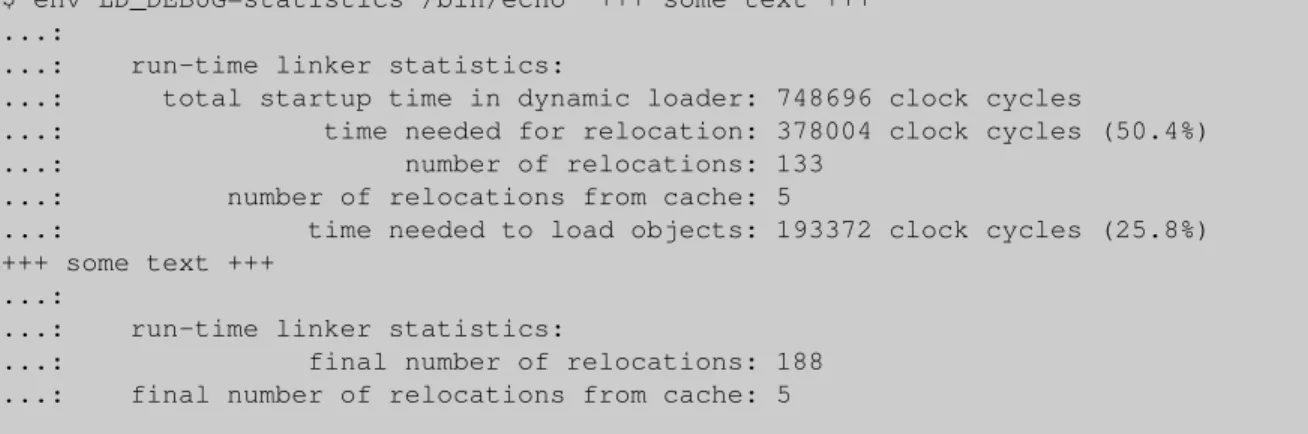
$ env LD_DEBUG=statistics /bin/echo ’+++ some text +++’ ...:
...: run-time linker statistics:
...: total startup time in dynamic loader: 748696 clock cycles
...: time needed for relocation: 378004 clock cycles (50.4%)
...: number of relocations: 133
...: number of relocations from cache: 5
...: time needed to load objects: 193372 clock cycles (25.8%) +++ some text +++
...:
...: run-time linker statistics:
...: final number of relocations: 188 ...: final number of relocations from cache: 5
Figure 8: Gather Startup Statistics
normally makes sure this is done correctly. When creating data objects it is mostly up to the user to make sure it is placed in the correct segment. Ideally data is also read-only but this works only for constants. The second best choice is a zero-initialized variable which does not have to be ini-tialized from file content. The rest has to go into the data segment.
In the following we will not cover the first two points given here. It is up to the developer of the DSO to de-cide about this. There are no small additional changes to make the DSO behave better, these are fundamental de-sign decisions. We have voiced an opinion here, whether it is has any effect remains to be seen.
1.7
Measuring
ld.so
Performance
To perform the optimizations it is useful to quantify the effect of the optimizations. Fortunately it is very easy to do this with glibc’s dynamic linker. Using theLD DEBUG environment variable it can be instructed to dump in-formation related to the startup performance. Figure 8 shows an example invocation, of theecho program in this case.
The output of the dynamic linker is divided in two parts. The part before the program’s output is printed right be-fore the dynamic linker turns over control to the appli-cation after having performed all the work we described in this section. The second part, a summary, is printed after the application terminated (normally). The actual format might vary for different architectures. It includes the timing information only on architectures which pro-vide easy access to a CPU cycle counter register (modern IA-32, IA-64, x86-64, Alpha in the moment). For other architectures these lines are simply missing.
The timing information provides absolute values for the total time spend during startup in the dynamic linker, the time needed to perform relocations, and the time spend
in the kernel to load/map binaries. In this example the relocation processing dominates the startup costs with more than 50%. There is a lot of potential for optimiza-tions here. The unit used to measure the time is CPU cycles. This means that the values cannot even be com-pared across different implementations of the same ar-chitecture. E.g., the measurement for a PentiumRMIII and
a PentiumRM4 machine will be quite different. But the
measurements are perfectly suitable to measure improve-ments on one machine which is what we are interested here.
Since relocations play such a vital part of the startup per-formance some information on the number of relocations is printed. In the example a total of 133 relocations are performed, from the dynamic linker, the C library, and the executable itself. Of these 5 relocations could be served from the relocation cache. This is an optimization imple-mented in the dynamic linker to handle the case of mul-tiple relocations against the same symbol more efficient. After the program itself terminated the same information is printed again. The total number of relocations here is higher since the execution of the application code caused a number, 55 to be exact, of run-time relocations to be performed.
The number of relocations which are processed is stable across successive runs of the program. The time mea-surements not. Even in a single-user mode with no other programs running there would be differences since the cache and main memory has to be accessed. It is there-fore necessary to average the run-time over multiple runs. It is obviously also possible to count the relocations with-out running the program. Runningreadelf -don the binary shows the dynamic section in which theDT RELSZ,
DT RELENT,DT RELCOUNT, andDT PLTRELSZentries are interesting. They allow computing the number of normal and relative relocations as well as the number of PLT en-tries. If one does not want to do this by hand therelinfo
2
Optimizations for DSOs
In this section we describe various optimizations based on C or C++ variables or functions. The choice of vari-able or function, unless explicitly said, is made deliber-ately since many of the implementations apply to the one or the other. But there are some architectures where func-tions are handled like variables. This is mainly the case for embedded RISC architectures like SH-3 and SH-4 which have limitations in the addressing modes they pro-vide which make it impossible to implement the function handling as for other architectures. In most cases it is no problem to apply the optimizations for variables and functions at the same time. This is what in fact should be done all the time to achieve best performance across all architectures.
The most important recommendation is to always use -fpicor-fPICwhen generating code which ends up in DSOs. This applies to data as well as code. Code which is not compiled this way almost certainly will contain text relocations. For these there is no excuse. Text relocations requires extra work to apply in the dynamic linker. And argumentation saying that the code is not shared because no other process uses the DSO is invalid. In this case it is not useful to use a DSO in the first place; the code should just be added to the application code.
Some people try to argue that the use of-fpic/-fPIC on some architectures has too many disadvantages. This is mainly brought forward in argumentations about IA-32. Here the use of%ebx as the PIC register deprives the compiler of one of the precious registers it could use for optimization. But this is really not that much of a problem. First, not having%ebxavailable was never a big penalty. Second, in modern compilers (e.g., gcc after release 3.1) the handling of the PIC register is much more flexible. It is not always necessary to use%ebxwhich can help eliminating unnecessary copy operations. And third, by providing the compiler with more information as explained later in this section a lot of the overhead in PIC can be removed. This all combined will lead to overhead which is in most situations not noticeable.
When gcc is used, the options-fpic/-fPICalso tell the compiler that a number of optimizations which are pos-sible for the executable cannot be performed. This has to do with symbol lookups and cutting it short. Since the compiler can assume the executable to be the first object in the lookup scope it knows that all references of global symbols known to be defined in the executable are re-solved locally. Access to locally defined variable could be done directly, without using indirect access through the GOT. This is not true for DSOs: the DSOs can be later in the lookup scope and earlier objects might be in-terposed. It is therefore mandatory to compile all code which can potentially end up in a DSO with-fpic/-fPIC since otherwise the DSO might not work correctly. There is no compiler option to separate this optimization from
the generation of position-independent code.
Which of the two options,-fpicor-fPIC, have to be used must be decided on a case-by-case basis. For some architectures there is no difference at all and people tend to be careless about the use. For most RISC there is a big difference. As an example, this is the code gcc generates for SPARC to read a global variableglobalwhen using
-fpic:
sethi %hi(_GLOBAL_OFFSET_TABLE_-4),%l7 call .LLGETPC0
add %l7,%lo(_GLOBAL_OFFSET_TABLE_+4),%l7 ld [%l7+global],%g1
ld [%g1],%g1
And this is the code sequence if-fPICis used:
sethi %hi(_GLOBAL_OFFSET_TABLE_-4),%l7 call .LLGETPC0
add %l7,%lo(_GLOBAL_OFFSET_TABLE_+4),%l7 sethi %hi(global),%g1
or %g1,%lo(global),%g1 ld [%l7+%g1],%g1 ld [%g1],%g1
In both cases%l7is loaded with the address of the GOT first. Then the GOT is accessed to get the address of
global. While in the-fpiccase one instruction is suf-ficient, three instructions are needed in the-fPICcase. The-fpicoption tells the compiler that the size of the GOT does not exceed an architecture-specific value (8kB in case of SPARC). If only that many GOT entries can be present the offset from the base of the GOT can be encoded in the instruction itself, i.e., in theld instruc-tion of the first code sequence above. If-fPICis used no such limit exists and so the compiler has to be pes-simistic and generate code which can deal with offsets of any size. The difference in the number of instructions in this example correctly suggests that the-fpicshould be used at all times unless it is absolutely necessary to use
-fPIC. The linker will fail and write out a message when this point is reached and one only has to recompile the code.
When writing assembler code by hand it is easy to miss cases where position independent code sequences must be used. The non-PIC sequences look and actually are simpler and more natural. Therefore it is extremely im-portant to in these case to check whether the DSO is marked to contain text relocations. This is easy enough to do:
If this produces any output text relocations are present and one better starts looking what causes them.
2.1
Data Definitions
Variables can be defined in C and C++ in several different ways. Basically there are three kinds of definitions:
Common Common variables are more widely used FOR-TRAN but they got used in C and C++ as well to work around mistakes of programmers. Since in the early days people used to drop theextern key-word from variable definitions, in the same way it is possible to drop it from function declaration, the compiler often has multiple definitions of the same variable in different files. To help the poor and clueless programmer the C/C++ compiler normally generates common variables for uninitialized defi-nitions such as
int foo;
For common variables there can be more than one definition and they all get unified into one location in the output file. Common variables are always initialized with zero. This means their value does not have to be stored in an ELF file. Instead the file size of a segment is chosen smaller than the memory size as described in 1.4.
Uninitialized If the programmer uses the compiler com-mand line option-fno-commonthe generated code will contain uninitialized variables instead of com-mon variables if a variable definition has no ini-tializer. Alternatively, individual variables can be marked like this:
int foo attribute ((nocommon));
The result at run-time is the same as for common variable, no value is stored in the file. But the rep-resentation in the object file is different and it al-lows the linker to find multiple definitions and flag them as errors. Another difference is that it is pos-sible to define aliases, i.e., alternative names, for uninitialized variables while this is not possible for common variables.
With recent gcc versions there is another method to create uninitialized variables. Variables initialized with zero are stored this way. Earlier gcc versions stored them as initialized variables which took up space in the file. This is a bit cumbersome for vari-ables with structured types. So, sticking with the per-variable attribute is probably the best way.
Initialized The variable is defined and initialized to a programmer-defined value. In C:
int foo = 42;
In this case the initialization value is stored in the file. As described in the previous case
initializa-tions with zero are treated special by some compil-ers.
Normally there is not much the user has to do to create optimal ELF files. The compiler will take care of avoid-ing the initializers. To achieve the best results even with old compilers it is desirable to avoid explicit initializa-tions with zero if possible. This creates normally com-mon variables but if combined with gcc’s-fno-common
flag the same reports about multiple definitions one would get for initialized variables can be seen.
There is one thing the programmer is responsible for. As an example look at the following code:
bool is_empty = true; char s[10];
const char *get_s (void) { return is_empty ? NULL : s; }
The functionget suses the boolean variableis empty
to decide what to do. If the variable has its initial value the variable s is not used. The initialization value of
is emptyis stored in the file since the initialize is non-zero. But the semantics ofis emptyis chosen arbitrar-ily. There is no requirement for that. The code could instead be rewritten as:
bool not_empty = false; char s[10];
const char *get_s (void) { return not_empty ? s : NULL; }
Now the semantics of the control variable is reversed. It is initialized withfalsewhich is guaranteed to have the numeric value zero. The test in the functionget shas to be changed as well but the resulting code is not less or more efficient than the old code.
By simple transformations like that it is often possible to avoid creating initialized variables and instead using common or uninitialized variables. This saves disk space and eventually improves startup times. The transforma-tion is not limited to boolean values. It is sometimes pos-sible to do it for variables which can take on more than two values, especially enumeration values. When defin-ingenums one should always put the value, which is most often used as initializer, first in theenumdefinition. I.e.