TrustSVD: Collaborative Filtering with Both the Explicit and
Implicit Influence of User Trust and of Item Ratings
Guibing Guo, Jie Zhang, Neil Yorke-Smith
∗School of Computer Engineering, Nanyang Technological University, Singapore
∗American University of Beirut, Lebanon; and University of Cambridge, UK
{gguo1,zhangj}@ntu.edu.sg,∗[email protected]
Abstract
Collaborative filtering suffers from the problems of data spar-sity and cold start, which dramatically degrade recommenda-tion performance. To help resolve these issues, we propose TrustSVD, a trust-based matrix factorization technique. By analyzing the social trust data from four real-world data sets, we conclude that not only the explicit but also the implicit influence of both ratings and trust should be taken into con-sideration in a recommendation model. Hence, we build on top of a state-of-the-art recommendation algorithm SVD++ which inherently involves the explicit and implicit influence of rated items, by further incorporating both the explicit and implicit influence of trusted users on the prediction of items for an active user. To our knowledge, the work reported is the first to extend SVD++ with social trust information. Ex-perimental results on the four data sets demonstrate that our approach TrustSVD achieves better accuracy than other ten counterparts, and can better handle the concerned issues.
Introduction
Incorporating trust into recommender systems has demon-strated potential to improve recommendation performance (Yang et al. 2013; Fang, Bao, and Zhang 2014), and to help
mitigate some well-known issues, such asdata sparsityand
cold start (Guo, Zhang, and Thalmann 2012). Such trust-aware approaches are developed based on the phenomenon that friends often influence each other by recommending items. However, even the best performance reported by the latest work (Fang, Bao, and Zhang 2014) can be inferior to that of other state-of-the-art models which are merely based on user-item ratings. For instance, a well-performing trust-based model (Yang et al. 2013) obtains 1.0585 on data set Epinions.com in terms of Root Mean Square Error (RMSE), whereas the performance of a user-item baseline (see Koren
(2008), Sect. 2.1) can achieve 1.0472 in terms of RMSE.1
To investigate this phenomenon, we conduct an empirical trust analysis based on four real-word data sets (FilmTrust, Epinions, Flixster and Ciao) through which two impor-tant observations are concluded. First, trust information is
Copyright c2015, Association for the Advancement of Artificial Intelligence (www.aaai.org). All rights reserved.
1
Smaller RMSE values indicate better predictive accuracy. Result re-ported by the recommendation toolkit MyMediaLite (mymedialite.net/
examples/datasets.html).
also very sparse, yet complementary to rating information. Hence, focusing too much on either one kind of information may achieve only marginal gains in predictive accuracy. Sec-ond, users are strongly correlated with their trust neighbors whereas they have a weakly positive correlation with their
trust-alikeneighbors (e.g., friends). Given that very few trust networks exist, it is better to have a more general trust-based model that can well operate on both trust and trust-alike re-lationships. These observations motivate us to consider both explicit and implicit influence of ratings and of trust in a trust-based model. The influence can be explicit (real values of ratings and trust) or implicit (who rates what (for ratings) and who trusts whom (for trust)). The implicit influence of ratings has been demonstrated useful in providing accurate recommendations (Koren 2008). We will later show that im-plicit trust can also provide added value over exim-plicit trust.
Thus we propose a novel trust-based recommendation
modelTrustSVD. Our approach builds on top of a
state-of-the-art model SVD++ (Koren 2008) where both the explicit and implicit influence of user-item ratings are involved to generate predictions. To the authors’ knowledge, our work is the first to extend SVD++ with social trust information. Specifically, on one hand the implicit influence of trust (who trusts whom) can be naturally added to the SVD++ model by extending the user modeling. On the other hand, the explicit influence of trust (trust values) is used to constrain that user-specific vectors should conform to their social trust relation-ships. This ensures that user-specific vectors can be learned from their trust information even if a few or no ratings are given. In this way, the data sparsity and cold start issues can be better alleviated. Our novel model thus incorporates both explicit and implicit influence of item ratings as well
as user trust. In addition, a weighted-λ-regularization
tech-nique is used to further avoid over-fitting for model learn-ing. Experimental results on the four real-world data sets demonstrate that our approach achieves significantly better accuracy than other trust-based counterparts as well as other ratings-only well-performing models (ten approaches in to-tal), and is more capable of coping with cold start situations.
Related Work
Trust-aware recommender systems have been widely stud-ied, given that social trust provides an alternative view of user preferences other than item ratings (Guo, Zhang, and
Yorke-Smith 2014). Specifically, Ma et al. (2008) propose
a social regularization method (SoRec) by considering the
constraint of social relationships. The idea is to share a com-mon user-feature matrix factorized by ratings and by trust. Ma, King, and Lyu (2009) then propose a social trust
en-semble method (RSTE) to linearly combine a basic matrix
factorization model and a trust-based neighborhood model together. Ma et al. (2011) further propose that the active user’s user-specific vector should be close to the average of her trusted neighbors, and use it as a regularization to form
a new matrix factorization model (SoReg). Jamali and Ester
(2010) build a new model (SocialMF) on top of SoRec by
reformulating the contributions of trusted users to the for-mation of the active user’s user-specific vector rather than to the predictions of items. Yang et al. (2013) propose a hybrid
method (TrustMF) that combines both a truster model and a
trustee model from the perspectives of trusters and trustees, that is, both the users who trust the active user and those who are trusted by the user will influence the user’s ratings on unknown items. Tang et al. (2013) consider both global and local trust as the contextual information in their model, where the global trust is computed by a separate algorithm. Yao et al. (2014) take into consideration both the explicit and implicit interactions among trusters and trustees in a rec-ommendation model. Fang, Bao, and Zhang (2014) stress the importance of multiple aspects of social trust. They de-compose trust into four general factors and then integrate them into a matrix factorization model. All these works have shown that a matrix factorization model regularized by trust outperforms the one without trust. That is, trust is helpful in improving predictive accuracy. However, it is also noted that even the latest work (Fang, Bao, and Zhang 2014) can be inferior to other well-performing ratings-only models. To explain this phenomenon, we next conduct a trust analysis to investigate the value of trust in recommender systems.
Trust Analysis
Four data sets are used in our analysis and also our later experiments: Epinions (trustlet.org/wiki/Epinions datasets),
FilmTrust (www.librec.net/datasets.html), Flixster
(www.cs.sfu.ca/∼sja25/personal/datasets/) and Ciao
(www.public.asu.edu/∼jtang20/datasetcode/truststudy.htm).
All the four data sets contain both item ratings and social relationships specified by active users. The ratings in Epinions and Ciao are integers from 1 to 5, while those in the other data sets are real values, i.e., [0.5, 4.0] for FilmTrust, [0.5, 5.0] for Flixster both with step 0.5. Note that trust is asymmetric in Epinions, FilmTrust and Ciao whereas it is symmetric in Flixster. A subset of the Flixster data set is used in this paper to avoid memory-consuming issues. The data set statistics are illustrated in Table 1. Two important observations are concluded from these data sets.
Observation 1 Trust information is very sparse, yet is com-plementary to rating information.
On one hand, as shown in Table 1, the density of trust is much smaller than that of ratings in Epinions, FilmTrust and Flixster whereas trust is only denser than ratings in Ciao. Both ratings and trust are very sparse across all the data sets.
Table 1: Statistics of the four data sets
Feature Epinions FilmTrust Flixster Ciao
users 40,163 1,508 53,213 7,375
items 139,738 2,071 18,197 99,746
ratings 664,824 35,497 409,803 280,391
density 0.051% 1.14% 0.04% 0.03%
trusters 33,960 609 47,029 6,792
trustees 49,288 732 47,029 7,297
trusts 487,183 1,853 655,054 111,781
density 0.029% 0.42% 0.03% 0.23%
0 0.1 0.2 0.3 0.4 0.5 0.6 0.7 0.8 0.9
0 1-5 6-10 11-20 >20
ratio of users
# ratings per user FilmTrust
Flixster Epinions Ciao Average
(a)
0 0.05 0.1 0.15 0.2 0.25 0.3 0.35 0.4 0.45 0.5
<0 0.0-0.10.1-0.20.3-0.40.4-0.50.5-0.60.6-0.70.7-0.80.8-0.90.9-1.0
Percentage
Correlation Ranges FilmTrust
Flixster Epinions Ciao Average
(b)
Figure 1: (a) The distribution of ratio of users who have is-sued trust statements w.r.t. the number of ratings that they each have given. (b) The correlations between a user’s rat-ings and those of her trusted neighbors in all the data sets. In this regard, a trust-aware recommender system that fo-cuses too much on trust (rather than rating) utility is likely to achieve only marginal gains in recommendation perfor-mance. In fact, the existing trust-based models consider only the explicit influence of ratings. That is, the utility of ratings is not well exploited. In addition, the sparsity of explicit trust also implies the importance of involving implicit trust in col-laborative filtering. On the other hand, trust information is complementary to the rating information. Figure 1a shows that: (1) A portion of users have not rated any items but are
socially connected with other users. (2) For the cold-start
users who have rated few items (less than 5 in our case), trust information can provide a complementary part of source of information with ratio greater than 10% on average. (3) The
warm-startusers who have rated a lot of items (e.g.,>20) are not necessary to specify many other users as trustwor-thy (12% on the average). Although having differing distri-butions across the data sets, trust can be a complementary information source to item ratings for recommendations.
This observation motivates us to consider both the explicit and implicit influence of ratings and trust, making better and more use of ratings and trust to resolve the concerned issues.
Observation 2 A user’s ratings have aweakly positive cor-relationwith the average of her social neighbors under the concept of trust-alike relationships, and astrongly positive correlationunder the concept of trust relationships.
Next, we consider the influence of trust in rating pre-diction, i.e., the influence of trusted neighbors on the
ac-tive user’s rating for a specific item, a.k.a.social influence.
Specifically, we calculate the Pearson correlation coefficient (PCC) between a user’s ratings and the average of her social neighbors. The results are presented in Figure 1b, indicat-ing that: (1) A weakly positive correlation is observed
be-tween a user’s ratings and the average of the social neighbors in FilmTrust (mean 0.183) and Flixster (0.063). The distri-butions of the two data sets are similar. Flixster adopts the symmetric friendship relationships whereas trust is directed. Although FilmTrust adopts the concept of trust (with values from 1 to 10), the publicly available data set contains only binary values (such degrading may cause much noise). We
regard these relationships astrust alike, i.e., the social
re-lationships that are similar with, but weaker (or more noisy) than social trust. (2) Under the concept of trust relationships, on the contrary, a user’s ratings are strongly and positively correlated with the average of trusted neighbors. Specifi-cally, a large portion (17.63% in Epinions, 13.14% in Ciao)
of user correlations are in the range of[0.9,1.0], and (resp.
54.70%, 39.14%) of user correlations are greater than 0.5. The average correlation is 0.446 in Epinions, and 0.322 in
Ciao. Since PCC values are in the range of[−1,1], values
of 0.446 and 0.322 indicate decent correlations. In the so-cial networks with relatively weak trust-alike relationships (e.g., friendship), implicit influence (i.e., binary relation-ships) may be more indicative than explicit (but noisy) val-ues for recommendations. Hence, a trust-based model that ignores the implicit influence of ratings and trust may lead to deteriorated performance if being applied to such cases.
The second observation suggests that incorporating both the explicit and implicit influence of ratings and trust may promote the generality of a trust-based model to both trust and trust-alike social relationships. Our approach presented next is constructed based on these two observations.
TrustSVD: A Trust-based Model
Problem Definition
The recommendation problem in this paper is to predict the rating that a user will give to an unknown item, based on both a user-item rating matrix and a user-user trust matrix.
Suppose that a recommender system includesmusers and
nitems. LetR= [ru,i]m×ndenote the user-item rating
ma-trix, where each entryru,irepresents the rating given by user
uon itemi. For clarity, we preserve symbolsu, vfor users,
andi, j for items. Let Iu denote the set of items rated by
useru. Letpuandqibe ad-dimensional latent feature
vec-tor of useruand itemi, respectively. The essence of matrix
factorization is to find two low-rank matrices: user-feature
matrixP ∈ Rd×mand item-feature matrixQ∈ Rd×nthat
can adequately recover the rating matrixR, i.e.,R≈P>Q,
whereP> is the transpose of matrixP. Hence, the rating
on itemj for userucan be predicted by the inner product
of user-specific vectorpu and item-specific vectorqj, i.e.,
ˆ
ru,j = qj>pu. In this regard, the main task of
recommen-dations is to predict the ratingrˆu,j as close as possible to
the ground truthru,j. Formally, we can learn the user- and
item-feature matrices by minimizing the following loss (ob-jective) function:
Lr= 1 2
X
u
X
j∈Iu
qj>pu−ru,j
2
+λ 2
X
u
kpuk2F+
X
j
kqjk2F
,
wherek · kF denotes the Frobenius norm, andλis a
param-eter to control model complexity and to avoid over-fitting.
On the other hand, suppose that a social network is
rep-resented by a graph G = (V,E), where V includes a set
of m nodes (users) and E represents the directed trust
re-lationships among users. We can use the adjacency matrix
T = [tu,v]m×mto describe the structure of edgesE, where
tu,v indicates the extent to which usersutrustsv. We
de-notepu andwv as the d-dimensional latent feature vector
of trusteruand trusteev, respectively. We limit the trusters
in the trust matrix and the active users in the rating matrix to share the same user-feature space in order to bridge them
together. Hence, we have truster-feature matrixPd×mand
trustee-feature matrixWd×m. By employing the low-rank
matrix approximation, we can recover the trust matrix by
T ≈ P>W. Thus, a trust relationship can be predicted by
the inner product of a truster-specific vector and a
trustee-specific vectortˆu,v=wv>pu. The matricesPandWcan be
learned by minimizing the following loss function:
Lt= 1 2
X
u
X
v∈Tu
w>vpu−tu,v
2
+λ 2
X
u
kpuk2F+
X
v
kwvk2F
,
whereTuis the set of users trusted by useru.
The TrustSVD Model
In line with the two observations of the previous section, our TrustSVD model is built on top of a state-of-the-art model known as SVD++ proposed by Koren (2008). The rationale behind SVD++ is to take into consideration user/item biases and the influence of rated items other than user/item-specific
vectors on rating prediction. Formally, the rating for useru
on itemjis predicted by:
ˆ
ru,j=bu+bj+µ+q>j pu+|Iu|−
1
2 X
i∈Iu
yi,
wherebu,bjrepresent the user and item biases, respectively;
µis the global average rating; andyidenotes the implicit
in-fluence of items rated by useruin the past on the ratings of
unknown items in the future. Thus, useru’s feature vector
can be also represented by the set of items she rated, and
finally modeled as pu+|Iu|−
1
2P
i∈Iuyi
rather than
sim-ply aspu. Koren (2008) has shown that integrating implicit
influence of ratings can well improve predictive accuracy. Previously, we have stressed the importance of trust influ-ence for better recommendations, and its potential to be gen-eralized to trust-alike relationships. Hence, we can enhance the trust-unaware SVD++ model by incorporating trust in-fluence. Specifically, the implicit effect of trusted users on item ratings can be considered in the same manner as rated items, given by:
ˆ
ru,j=bu+bj+µ +qj>pu+|Iu|−
1
2 P
i∈Iu
yi+|Tu|−
1
2 P
v∈Tu
wv
,
wherewv is the user-specific latent feature vector of users
(trustees) trusted by useru, and thusqj>wvcan be explained
by the ratings predicted by the trusted users, i.e., the influ-ence of trustees on the rating prediction. In other words, the
user u’s rating on item j. Similar to ratings, a user’s fea-ture vector can be interpreted by the set of users whom she trusts, i.e.,|Tu|−
1
2P
v∈Tuwv. Therefore, a useruis further
modeled by pu+|Iu|−
1
2P
i∈Iuyi+|Tu|
−1
2 P
v∈Tuwv
in the social rating networks, considering the influence of both rated items and trusted users. The objective function to minimize is then given as follows:
L=12P
u
P
j∈Iu
ˆ
ru,j−ru,j
2
+λ2P
u
b2u+
P
j
b2j
+P
u
kpuk2F+
P
j
kqjk2F+
P
i
kyik2F+
P
v
kwvk2F
.
To reduce the model complexity, we use the same
regular-ization parameterλfor all the variables. Finer control and
tuning can be achieved by assigning separate regularization parameters to different variables, but it may result in great complexity when comparing with different models.
In addition, as explained earlier, we constrain that the user-specific vectors decomposed from the rating matrix and those decomposed from the trust matrix share the same fea-ture space in order to bridge both matrices together. In this way, these two types of information can be exploited in a unified recommendation model. Specifically, we can
regu-larize the user-specific vectorspu by recovering the social
relationships with other users. The new objective function (without the other regularization terms) is given by:
L=1 2
X
u
X
j∈Iu
ˆ
ru,j−ru,j
2
+λt 2
X
u
X
v∈Tu
ˆ
tu,v−tu,v
2 ,
wheretˆu,v =w>vpu is the predicted trust between usersu
andv, andλtcontrols the degree of trust regularization.
Further, as suggested by Yang et al. (2013), a technique
called weighted-λ-regularization can be used to help avoid
over-fitting when learning parameters. In particular, they consider more penalties for the users who rated more items and for the items which received more ratings. However, we argue that such consideration may force the model to be more biased towards popular users and items. Instead, in this paper we adopt a distinct strategy that the popular users and items should be less penalized (due to smaller chance
to be over-fitted), and cold-start users andniche items(those
receiving few ratings) should be more regularized (due to greater chance to be over-fitted). Therefore, the new loss function to minimize is obtained as follows:
L=12P
u
P
j∈Iu
ˆ
ru,j−ru,j
2
+λt 2
P
u
P
v∈Tu
ˆ
tu,v−tu,v
2
+λ2P
u
|Iu|−
1 2b2
u+
λ
2 P
j
|Uj|−
1 2b2
j
+P
u λ
2|Iu| −1
2 +λt 2|Tu|
−1 2)kpuk2
F +λ
2 P
j
|Uj|−
1 2kqjk2
F+
λ
2 P
i
|Ui|−
1 2kyik2
F +λ
2|T +
v |−
1 2kwvk2
F,
(1)
whereUj, Uiare the set of users who rate itemsjandi,
re-spectively; andT+
v is the set of users who trust userv. Since
the active user has rated a number of items and specified other users as trustworthy, the penalization on user-specific
vectorputakes into account both cases.
Model Learning
To obtain a local minimization of the objective function given by Equation 1, we perform the following gradient de-scents onbu, bj, pu, qj, yiandwvfor all the users and items.
∂L
∂bu =
P
j∈Iu
eu,j+λ|Iu|−
1 2bu
∂L
∂bj =
P
u∈Uj
eu,j+λ|Uj|−
1 2bj
∂L
∂pu =
P
j∈Iu
eu,jqj+λt P
v∈Tu
eu,vwv + λ|Iu|−
1
2+λt|Tu|− 1 2)pu
∂L
∂qj =
P
u∈Uj
eu,j
pu+|Iu|−
1
2 P
i∈Iu
yi +|Tu|−
1
2 P
v∈Tu
wv
+λ|Uj|−
1 2qj ∀i∈Iu,∂y∂Li = P
j∈Iu
eu,j|Iu|−
1
2qj+λ|Ui|− 1 2yi ∀v∈Tu,∂w∂Lv=P
j∈Iu
eu,j|Tu|−
1
2qj+λteu,vpu+λ|Tv+|− 1 2wv
(2)
whereeu,j= ˆru,j−ru,jindicates the rating prediction error
for user u on item j, and eu,v = ˆtu,v−tu,v is the trust
prediction error for userutowards userv.
In the cold-start situations where users may have only rated a few items, the decomposition of trust matrix can help to learn more reliable user-specific latent feature vec-tors than ratings-only matrix factorization. In the extreme case where there are no ratings at all for some users, Equa-tion 2 ensures that the user-specific vector can be trained and learned from the trust matrix. In this regard, incorpo-rating trust in a matrix factorization model can alleviate the cold start problem. By considering both explicit and implicit influence of trust rather than either one alone, our model can better utilize trust to further mitigate the concerned issues.
Complexity Analysis
The computational time of learning the TrustSVD model
is mainly taken by evaluating the objective functionLand
its gradients against feature vectors (variables). The time to
compute the objective functionLisO(d|R|+d|T|), where
dis the dimensionality of the feature space, and|R|,|T|
re-fer to the number of observed entries. Due to the sparsity of rating and trust matrices, the values will be much smaller than the matrix cardinality. The computational
complexi-ties for gradients ∂b∂L
u,
∂L
∂bj,
∂L
∂pu,
∂L
∂qj,
∂L
∂yi,
∂L
∂wv in
Equa-tion 2 are O(d|R|), O(d|R|), O(d|R| + d|T|), O(d|R| +
d|T|), O(d|R|k)andO(d|R|p+d|T|p), wherek, pare the average number of ratings and trust statements received by an item and a user, respectively. Hence, the overall
computa-tional complexity in one iteration isO(d|R|c+d|T|c), where
c= max(p, k). Due toc |R|or|T|, the overall computa-tional time is linear with respect to the number of observa-tions in the rating and trust matrices. To sum up, our model has potential to scale up to large-scale data sets.
Experiments and Results
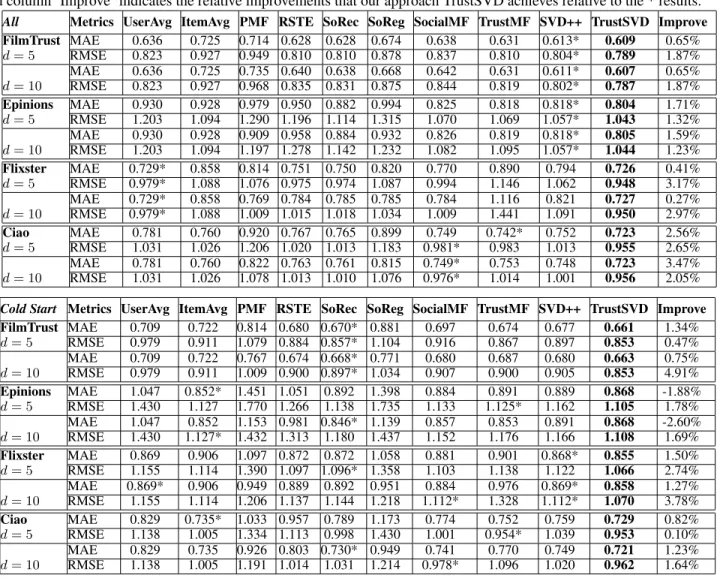
Table 2: Performance comparison in two testing views, where * indicates the best performance among all the other methods, and column ‘Improve’ indicates the relative improvements that our approach TrustSVD achieves relative to the * results.
All Metrics UserAvg ItemAvg PMF RSTE SoRec SoReg SocialMF TrustMF SVD++ TrustSVD Improve FilmTrust MAE 0.636 0.725 0.714 0.628 0.628 0.674 0.638 0.631 0.613* 0.609 0.65%
d= 5 RMSE 0.823 0.927 0.949 0.810 0.810 0.878 0.837 0.810 0.804* 0.789 1.87% MAE 0.636 0.725 0.735 0.640 0.638 0.668 0.642 0.631 0.611* 0.607 0.65%
d= 10 RMSE 0.823 0.927 0.968 0.835 0.831 0.875 0.844 0.819 0.802* 0.787 1.87% Epinions MAE 0.930 0.928 0.979 0.950 0.882 0.994 0.825 0.818 0.818* 0.804 1.71%
d= 5 RMSE 1.203 1.094 1.290 1.196 1.114 1.315 1.070 1.069 1.057* 1.043 1.32% MAE 0.930 0.928 0.909 0.958 0.884 0.932 0.826 0.819 0.818* 0.805 1.59%
d= 10 RMSE 1.203 1.094 1.197 1.278 1.142 1.232 1.082 1.095 1.057* 1.044 1.23% Flixster MAE 0.729* 0.858 0.814 0.751 0.750 0.820 0.770 0.890 0.794 0.726 0.41%
d= 5 RMSE 0.979* 1.088 1.076 0.975 0.974 1.087 0.994 1.146 1.062 0.948 3.17% MAE 0.729* 0.858 0.769 0.784 0.785 0.785 0.784 1.116 0.821 0.727 0.27%
d= 10 RMSE 0.979* 1.088 1.009 1.015 1.018 1.034 1.009 1.441 1.091 0.950 2.97% Ciao MAE 0.781 0.760 0.920 0.767 0.765 0.899 0.749 0.742* 0.752 0.723 2.56%
d= 5 RMSE 1.031 1.026 1.206 1.020 1.013 1.183 0.981* 0.983 1.013 0.955 2.65% MAE 0.781 0.760 0.822 0.763 0.761 0.815 0.749* 0.753 0.748 0.723 3.47%
d= 10 RMSE 1.031 1.026 1.078 1.013 1.010 1.076 0.976* 1.014 1.001 0.956 2.05%
Cold Start Metrics UserAvg ItemAvg PMF RSTE SoRec SoReg SocialMF TrustMF SVD++ TrustSVD Improve
FilmTrust MAE 0.709 0.722 0.814 0.680 0.670* 0.881 0.697 0.674 0.677 0.661 1.34%
d= 5 RMSE 0.979 0.911 1.079 0.884 0.857* 1.104 0.916 0.867 0.897 0.853 0.47% MAE 0.709 0.722 0.767 0.674 0.668* 0.771 0.680 0.687 0.680 0.663 0.75%
d= 10 RMSE 0.979 0.911 1.009 0.900 0.897* 1.034 0.907 0.900 0.905 0.853 4.91% Epinions MAE 1.047 0.852* 1.451 1.051 0.892 1.398 0.884 0.891 0.889 0.868 -1.88%
d= 5 RMSE 1.430 1.127 1.770 1.266 1.138 1.735 1.133 1.125* 1.162 1.105 1.78% MAE 1.047 0.852 1.153 0.981 0.846* 1.139 0.857 0.853 0.891 0.868 -2.60%
d= 10 RMSE 1.430 1.127* 1.432 1.313 1.180 1.437 1.152 1.176 1.166 1.108 1.69% Flixster MAE 0.869 0.906 1.097 0.872 0.872 1.058 0.881 0.901 0.868* 0.855 1.50%
d= 5 RMSE 1.155 1.114 1.390 1.097 1.096* 1.358 1.103 1.138 1.122 1.066 2.74% MAE 0.869* 0.906 0.949 0.889 0.892 0.951 0.884 0.976 0.869* 0.858 1.27%
d= 10 RMSE 1.155 1.114 1.206 1.137 1.144 1.218 1.112* 1.328 1.112* 1.070 3.78% Ciao MAE 0.829 0.735* 1.033 0.957 0.789 1.173 0.774 0.752 0.759 0.729 0.82%
d= 5 RMSE 1.138 1.005 1.334 1.113 0.998 1.430 1.001 0.954* 1.039 0.953 0.10% MAE 0.829 0.735 0.926 0.803 0.730* 0.949 0.741 0.770 0.749 0.721 1.23%
d= 10 RMSE 1.138 1.005 1.191 1.014 1.031 1.214 0.978* 1.096 1.020 0.962 1.64% Cross-validation.We use 5-fold cross-validation for
learn-ing and testlearn-ing. Specifically, we randomly split each data set into five folds and in each iteration four folds are used as the training set and the remaining fold as the test set. Five iter-ations will be conducted to ensure that all folds are tested. The average test performance is given as the final result.
Evaluation Metrics.We adopt two well-known metrics to evaluate predictive accuracy, namely mean absolute error (MAE) and root mean square error (RMSE), defined by:
MAE=
P
u,j|rˆu,j−ru,j|
N ,RMSE=
s P
u,j(ˆru,j−ru,j)2
N
whereN is the number of test ratings. Smaller values of
MAE and RMSE indicate better predictive accuracy.
Testing Views. Two data set views are created for testing.
First, theAll view indicates that all ratings are used as the
test set. Second, theCold Start view means that only the
users who rate less than five items will be involved in the test set. Similar testing views are also defined and used in (Guo, Zhang, and Thalmann 2012; Yang et al. 2013).
Comparison Methods.Three kinds of approaches are
com-pared with our methodTrustSVD2: (1) Baselines:UserAvg
and ItemAvg make predictions by the average of ratings that are given by the active user and received by the target
item, respectively; (2) Trust-based models:SoRec(Ma et al.
2008),RSTE(Ma, King, and Lyu 2009),SoReg(Ma et al.
2011),SocialMF(Jamali and Ester 2010),TrustMF(Yang
et al. 2013) and Fang’s(Fang, Bao, and Zhang 2014); (3)
Ratings-only state-of-the-art models:PMF (Salakhutdinov
and Mnih 2008) andSVD++(Koren 2008).
Parameter Settings.The optimal experimental settings for each method are determined either by our experiments or suggested by previous works. Specifically, the common
set-tings are λ = 0.001, and the number of latent features
d= 5/10, the same as all the previous trust-based models.
The other settings are: (1) RSTE: α = 0.4 for Epinions,
and 1.0 for the others; (2) SoRec:λc= 0.1,1.0,0.001,0.01
corresponding to FilmTrust, Epinions, Flixster and Ciao,
re-spectively; (3) SoReg:β = 1.0for Flixster and 0.1 for the
others; (4) SocialMF, TrustMF:λt = 1; (5) SVD++:λ =
2
0.8 0.85 0.9 0.95 1 1.05 1.1 1.15 1.2 1.25
1-5 6-10 11-20 21-40 41-100
RMSE
Trust Degrees RSTE
SoRec SoReg SocialMF TrustMF TrustSVD
(a) FilmTrust
0.9 0.95 1 1.05 1.1 1.15 1.2 1.25 1.3
1-5 6-10 11-20 21-40 41-100101-500 >500
RMSE
Trust Degrees RSTE
SoRec
SoReg SocialMF
TrustMF TrustSVD
(b) Epinions
0.85 0.9 0.95 1 1.05 1.1 1.15 1.2
1-5 6-10 11-20 21-40 41-100 101-500
RMSE
Trust Degrees RSTE
SoRec SocialMFSoReg TrustSVDTrustMF
(c) Flixster
0.85 0.9 0.95 1 1.05 1.1 1.15
1-5 6-10 11-20 21-40 41-100101-500 >500
RMSE
Trust Degrees RSTE
SoRec
SoReg SocialMF
TrustMF TrustSVD
(d) Ciao
Figure 2: Performance comparison on users with different trust degrees (d= 10) [best viewed in color]
Table 3: Comparing with (Fang, Bao, and Zhang 2014)
Fang’s vs. Epinions Ciao FilmTrust TrustSVD d= 5 d= 10 d= 5 d= 10 d= 5 d= 10 MAE 0.806 0.814 0.737 0.745 0.616 0.625
0.804 0.805 0.723 0.723 0.609 0.607 RMSE 1.047 1.059 0.972 0.985 0.793 0.810 1.043 1.044 0.955 0.956 0.789 0.787
0.1,0.35,0.03,0.1(resp.); (6) TrustSVD:λ= 1.2, λt= 0.9
for FilmTrust, λ = 0.9, λt = 0.5 for Epinions, λ =
0.8, λt= 0.5for Flixster, andλ= 0.5, λt= 1for Ciao.
Comparison with other models.The experimental results are presented in Table 2. For all the comparison
meth-ods in the testing view of All, SVD++ outperforms the
other comparison methods in FilmTrust and Epinions, and UserAvg performs the best in Flixster. This implies that these trust-based approaches cannot always beat other well-performing ratings-only approaches, and even simple base-lines in trust-alike networks (i.e., FilmTrust and Flixster). Only in Ciao, trust-based approach (SocialMF) gives the best performance. On the contrary, our approach TrustSVD is consistently superior to the best approach among the oth-ers across all the data sets. Although the percentage of rela-tive improvements are small, Koren (2010) has pointed out that even small improvements in MAE and RMSE may lead to significant differences of recommendations in practice.
For all the comparison methods in the testing view of
Cold Start, SoRec and SVD++ perform respectively the best in FilmTrust and Flixster (trust-alike), while no single ap-proach works the best in Epinions and Ciao (trust). Gen-erally, our approach performs better than the others both in trust and trust-alike relationships. Although some exceptions are observed in Epinions in terms of MAE, TrustSVD is more powerful in terms of RMSE. Since all the trust-based models aim to optimize the square errors between predic-tions and real values, RMSE is more indicative than MAE, and thus TrustSVD still has best performance overall.
Besides the above-compared approaches, some new trust-based models have been proposed recently. The most rele-vant model is presented in (Fang, Bao, and Zhang 2014);
for clarity, we denote it byFang’s. It is reported to perform
better than other trust-based models and than SVD++ (ex-cept in Ciao). Table 3 shows the comparison between Fang’s and our approach TrustSVD. The results of Fang’s approach are reported in (Fang, Bao, and Zhang 2014), and directly re-used in our paper. Note that we sampled more data for Flixster than Fang’s, and thus their experimental results are not comparable. Table 3 clearly shows that our approach
per-forms better than Fang’s in terms of both MAE and RMSE. One more observation from Tables 2 and 3 is that the
per-formance of TrustSVD when d = 5 is very close to that
whend= 10, indicating the reliability of our approach with
respect to the feature dimensionality. We ascribe this feature to the consideration of both the explicit and implicit influ-ence of ratings and trust in a unified recommendation model. In conclusion, the experimental results indicate that our approach TrustSVD outperforms the other methods in pre-dicting more accurate ratings, and that its performance is reliable with different number of latent features.
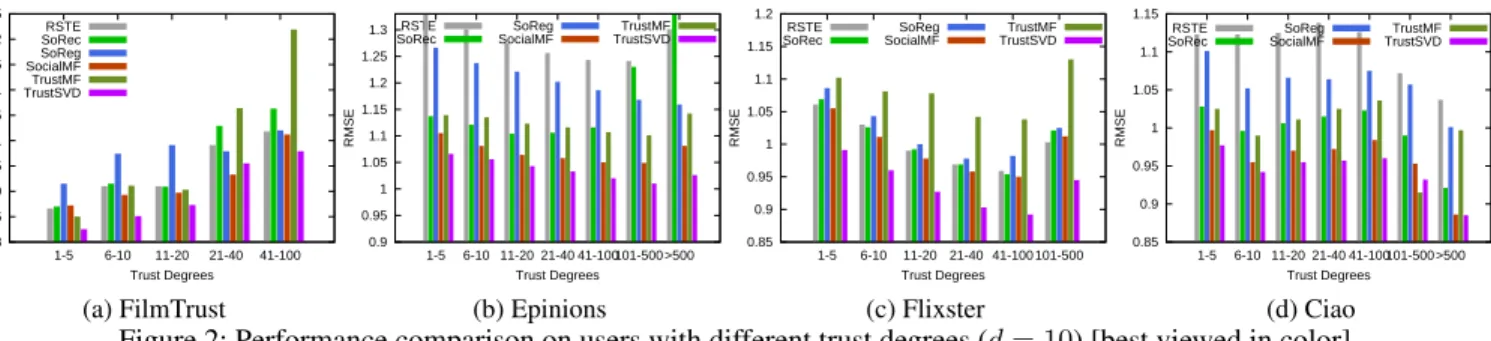
Comparison in trust degrees. Another series of experi-ments are conducted to investigate the performance on users with different trust degrees. The trust degrees refer to the number of trusted neighbors specified by a user. We split the trust degrees into seven categories: 1-5, 6-10, 11-20,
21-40, 41-100, 101-500,>500. The results of trust-based
mod-els are illustrated in Figure 2, where we only present the
performance in RMSE when d = 10due to space
limita-tion; similar trends in other cases. In general, our approach TrustSVD consistently achieves the best performance in the cases of different trust degrees. Paired t-tests (confidence 0.95) shows that such improvements are statistically
signifi-cant (p<10−5) in three data sets but not in FilmTrust (details
are omitted to save space). Two possible explanations can be made: (1) FilmTrust has a smaller data size than the others; (2) due to the noise arising from converting real-valued trust to binary trust, the trust may be less useful in FilmTrust than in the others as indicated in (Fang, Bao, and Zhang 2014).
Conclusion and Future Work
This paper proposed a novel trust-based matrix factoriza-tion model which incorporated both rating and trust infor-mation. Our analysis of trust in four real-world data sets indicated that trust and ratings are complementary to each other, and both pivotal for more accurate recommendations. Our novel approach, TrustSVD, takes into account both the explicit and implicit influence of ratings and trust informa-tion when predicting ratings of unknown items. A
weighted-λ-regularization technique was adapted and used to further
regularize the user- and item-specific latent feature vec-tors. Comprehensive experimental results showed that our approach TrustSVD outperformed both trust- and ratings-based methods in predictive accuracy across different testing views and across users with different trust degrees. For fu-ture work, we intend to further improve the proposed model by considering both the influence of trusters and trustees.
Acknowledgements
Guibing Guo thanks the Institute for Media Innovation for a PhD grant at Nanyang Technological University, Singapore. The work is also partially supported by the MoE AcRF Tier 2 Grant M4020110.020.
References
Fang, H.; Bao, Y.; and Zhang, J. 2014. Leveraging decom-posed trust in probabilistic matrix factorization for effective
recommendation. InProceedings of the 28th AAAI
Confer-ence on Artificial IntelligConfer-ence (AAAI), 30–36.
Guo, G.; Zhang, J.; and Thalmann, D. 2012. A simple but effective method to incorporate trusted neighbors in
recom-mender systems. InProceedings of the 20th International
Conference on User Modeling, Adaptation and Personaliza-tion (UMAP), 114–125.
Guo, G.; Zhang, J.; and Yorke-Smith, N. 2014. Leverag-ing multiviews of trust and similarity to enhance clusterLeverag-ing-
clustering-based recommender systems. Knowledge-Based Systems
(KBS)in press.
Jamali, M., and Ester, M. 2010. A matrix factorization tech-nique with trust propagation for recommendation in social
networks. InProceedings of the 4th ACM Conference on
Recommender Systems (RecSys), 135–142.
Koren, Y. 2008. Factorization meets the neighborhood: a
multifaceted collaborative filtering model. InProceedings of
the 14th ACM SIGKDD International Conference on Knowl-edge Discovery and Data Mining (KDD), 426–434. Koren, Y. 2010. Factor in the neighbors: Scalable and
ac-curate collaborative filtering. ACM Transactions on
Knowl-edge Discovery from Data (TKDD)4(1):1:1–1:24.
Ma, H.; Yang, H.; Lyu, M.; and King, I. 2008. SoRec: social recommendation using probabilistic matrix factorization. In
Proceedings of the 31st International ACM SIGIR Confer-ence on Research and Development in Information Retrieval (SIGIR), 931–940.
Ma, H.; Zhou, D.; Liu, C.; Lyu, M. R.; and King, I. 2011.
Recommender systems with social regularization. In
Pro-ceedings of the 4th ACM International Conference on Web Search and Data Mining (WSDM), 287–296.
Ma, H.; King, I.; and Lyu, M. 2009. Learning to recommend
with social trust ensemble. InProceedings of the 32nd
In-ternational ACM SIGIR Conference on Research and Devel-opment in Information Retrieval (SIGIR), 203–210. Salakhutdinov, R., and Mnih, A. 2008. Probabilistic matrix
factorization. InAdvances in Neural Information Processing
Systems (NIPS), volume 20, 1257–1264.
Tang, J.; Hu, X.; Gao, H.; and Liu, H. 2013. Exploiting local
and global social context for recommendation. In
Proceed-ings of the 23rd International Joint Conference on Artificial Intelligence (IJCAI), 2712–2718.
Yang, B.; Lei, Y.; Liu, D.; and Liu, J. 2013. Social
collab-orative filtering by trust. InProceedings of the 23rd
Inter-national Joint Conference on Artificial Intelligence (IJCAI), 2747–2753.
Yao, W.; He, J.; Huang, G.; and Zhang, Y. 2014. Modeling dual role preferences for trust-aware recommendation. In
Proceedings of the 37th International ACM SIGIR Confer-ence on Research & Development in Information Retrieval (SIGIR), 975–978.