Analysis
James Pustejovsky*
Brandeis UniversityPeter Anick~
Digital Equipment Corporation
Sabine Bergler t
Concordia UniversityIn this paper we outline a research program for computational linguistics, making extensive use of text corpora. We demonstrate how a semantic framework for lexical knowledge can suggest richer relationships among words in text beyond that of simple co-occurrence. The work suggests how linguistic phenomena such as metonymy and polysemy might be exploitable for semantic tagging of lexical items. Unlike with purely statistical collocational analyses, the framework of a semantic theory allows the automatic construction of predictions about deeper semantic relationships among words appearing in collocational systems. We illustrate the approach for the acquisition oflexical information for several classes of nominals, and how such techniques can fine-tune the lexical structures acquired from an initial seeding of a machine-readable dictionary. In addition to conventional lexical semantic relations, we show how information concerning lexical presuppositions and preference relations can also be acquired from corpora, when analyzed with the appropriate semantic tools. Finally, we discuss the potential that corpus studies have for enriching the data set for theoretical linguistic research, as well as helping to confirm or disconfirm linguistic hypotheses.
1. Introduction
The proliferation of on-line textual information poses an interesting challenge to lin- guistic researchers for several reasons. First, it provides the linguist with sentence and word usage information that has been difficult to collect and consequently largely ignored by linguists. Second, it has intensified the search for efficient automated in- dexing and retrieval techniques. FulMext indexing, in which all the content words in a document are used as keywords, is one of the most promising of recent automated approaches, yet its mediocre precision and recall characteristics indicate that there is much room for improvement (Croft 1989). The use of domain knowledge can enhance the effectiveness of a full-text system by providing related terms that can be used to broaden, narrow, or refocus a query at retrieval time (Debili, Fluhr, and Radasua 1988; Anick et al. 1989. Likewise, domain knowledge may be applied at indexing time to do word sense disambiguation (Krovetz and Croft 1989) or content analysis (Jacobs 1991). Unfortunately, for many domains, such knowledge, even in the form of a the- saurus, is either not available or is incomplete with respect to the vocabulary of the texts indexed.
* Computer Science Department, Brandeis University, Waltham MA 02254.
Computational Linguistics Volume 19, Number 2
In this paper we examine how linguistic phenomena such as metonymy and po- lysemy might be exploited for the semantic tagging of lexical items. Unlike purely statistical collocational analyses, employing a semantic theory allows for the auto- matic construction of deeper semantic relationships among words appearing in collo- cational systems. We illustrate the approach for the acquisition of lexical information for several classes of nominals, and h o w such techniques can fine-tune the lexical structures acquired from an initial seeding of a machine-readable dictionary. In addi- tion to conventional lexical semantic relations, we show how information concerning lexical presuppositions and preference relations (Wilks 1978) can also be acquired from corpora, when analyzed with the appropriate semantic tools. Finally, we discuss the potential that corpus studies have for enriching the data set for theoretical linguistic research, as well as helping to confirm or disconfirm linguistic hypotheses.
The aim of our research is to discover what kinds of knowledge can be reliably acquired through the use of these methods, exploiting, as they do, general linguis- tic knowledge rather than domain knowledge. In this respect, our program is simi- lar to Zernik's (1989) work on extracting verb semantics from corpora using lexical categories. Our research, however, differs in two respects: first, we employ a more expressive lexical semantics; second, our focus is on all major categories in the lan- guage, and not just verbs. This is important since for full-text information retrieval, information about nominals is paramount, as most queries tend to be expressed as conjunctions of nouns. From a theoretical perspective, we believe that the contribu- tion of the lexical semantics of nominals to the overall structure of the lexicon has been somewhat neglected, relative to that of verbs. While Zernik (1989) presents ambiguity and metonymy as a potential obstacle to effective corpus analysis, we believe that the existence of motivated metonymic structures actually provides valuable clues for semantic analysis of nouns in a corpus.
We will assume, for this paper, the general framework of a generative lexicon as outlined in Pustejovsky (1991). In particular, we make use of the principles of type coercion and qualia structure. This model of semantic knowledge associated with words is based on a system of generative devices that is able to recursively define new word senses for lexical items in the language. These devices and the associated dictionary make up a
generative lexicon,
where semantic information is distributed throughout the lexicon to all categories. The general framework assumes four basic levels of semantic description: argument structure, qualia structure, lexical inheritance structure, and event structure.Connecting these different levels is a set of generative devices that provide for the compositional interpretation of words in context. The most important of these devices is a semantic transformation called
type coercion--analogous
to coercion in programming languages--which captures the semantic relatedness between syntacti- cally distinct expressions. As an operation on types within a A-calculus, type coercion can be seen as transforming a monomorphic language into one with polymorphic types (cf. Cardelli and Wegner 1985). Argument, event, and qualia types must con- form to the well-formedness conditions defined by the type system defined by the lexical inheritance structure when undergoing operations of semantic composition. ~1 The details of type coercion n e e d n o t concern us here. Briefly, however, w h e n e v e r there exists a grammatical e n v i r o n m e n t w h e r e more than one syntactic type satisfies the semantic type selected b y the g o v e r n i n g element, the g o v e r n i n g e l e m e n t can be analyzed as coercing a range of surface types into a single semantic type. A n example of subject type coercion is a causative verb, semantically selecting an event as subject (as in (i)), b u t syntactically permitting a n o n e v e n t d e n o t i n g N P (as in (ii)):
One component of this approach, the qualia structure, specifies the different as- pects of a word's meaning through the use of subtyping. These include the subtypes CONSTITUTIVE, FORMAL, TELIC, and AGENTIVE. T o illustrate how these are used, the qualia structure for book is given below. 2
• b o o k ( x , y ) . ] GONST = i n f o r m a t i o n ( y l ] FORMAL = physobj(x) [ TELIC = r e a d ( T , w , y ) [ AGENTIVE = w r i t e ( T , z , y ) J
This structured representation allows one to use the same lexical entry in different contexts, where the word refers to different qualia of the noun's denotation. For ex- ample, the sentences in (1)-(3) below refer to different aspects (or qualia) of the general meaning of book. 3
Example 1
This book weighs four ounces.
Example 2
John finished a book.
Example 3
This is an interesting book.
Example 1 makes reference to the formal role, while 3 refers to the constitutive role. Example 2, however, can refer to either the telic or the agentive aspects given above. The utility of such knowledge for information retrieval is readily apparent. This theory claims that noun meanings should make reference to related concepts and the relations into which they enter. The qualia structure, thus, can be viewed as a kind of generic template for structuring this knowledge. Such information about how nouns relate to other lexical items and their concepts might prove to be much more useful in full-text information retrieval than what has come from standard statistical techniques.
To illustrate how such semantic structuring might be useful, consider the general class of artifact nouns. A generative view of the lexicon predicts that by classifying an element into a particular category, we can generate m a n y aspects of its semantic structure, and hence, its syntactic behavior. For example, the representation above for book refers to several word senses, all of which are logically related by the semantic template for an artifactual object. That is, it contains information, it has a material extension, it serves some function, and it is created by some particular act or event.
2 Briefly, the qualia can be defined as follows:
• CONSTITUTIVE: the relation b e t w e e n an object a n d its constituent parts; • FORMAL: that w h i c h distinguishes it within a larger domain;
• TELIC: its p u r p o s e a n d function;
• AGENTIVE: factors involved in its origin or "bringing it about."
In the qualia structures given below, w e a d o p t the convention that [c~, r] d e n o t e s conjunction of formulas w i t h i n the feature structure, while [a; r] will d e n o t e disjunction.
Computational Linguistics Volume 19, Number 2
Such an analysis allows us to minimally structure objects according to these four qualia.
As an example of how objects cluster according to these dimensions, we will briefly consider three object types: (1) containers (of information), e.g.,
book, tape, record;
(2) instruments, e.g.,gun, hammer, paintbrush;
and (3) figure-ground objects, e.g.,door,
room, fireplace.
Because of how their qualia structures differ, these classes appear in vastly different grammatical contexts.As with containers in general, information containers permit metonymic exten- sions between the container and the material contained within it. Collocations such as those in Examples 4 through 7 indicate that this metonymy is grammaticalized through specific and systematic head-PP constructions.
Example 4
read a bookExample 5
read a story in a book
Example 6
read a tapeExample 7
read the information on the tape
Instruments, on the other hand, display classic agent-instrument causative alter- nations, such as those in Examples 8 through 11 (cf. Fillmore 1968; Lakoff 1968, 1970).
Example 8
... smash the vase with the hammer
Example 9
The hammer smashed the vase.
Example 10
... kill him with a gun
Example 11
The gun killed him.
Finally,
figure-ground nominals
(Pustejovsky and Anick 1988) permit perspective shifts such as those in Examples 12 through 15. These are nouns that refer to physical objects as well as the specific enclosure or aperture associated with it.Example 12
John painted the door.
Example 13
Example 14
John is scrubbing the fireplace.
Example 15
The smoke filled the fireplace.
That is,
paint
a n dscrub
are actions on physical objects whilewalk through
andfill
are processes in spaces. These collocational patterns, we argue, are systematicallypredictable from the lexical semantics of the noun, a n d we term such sets of collocated structures
lexical conceptual paradigms (LCPs). 4
To m a k e this point clearer, let us consider a specific example of an LCP from the computer science domain, n a m e l y for the n o u n
tape. Because of the particular
m e t o n y m y observed for a n o u n liketape,
we will classify it as belonging to the con- tainer/containee LCP. This general class is represented as follows, where P and 0 are predicate variables: 5container(x,y)
]
CONST = P(y) FORMAL = Q(x) TELIC = hold(S,x,y)
The LCP is a generic qualia structure that captures not only the semantic relationship between arguments types of a relation, but also, t h r o u g h corpus-tuning, the collocation relations that realize these roles. The telic function of a container, for example, is the relation hold, b u t this underspecifies which spatial prepositions w o u l d adequately satisfy this semantic relation (e.g.
in, on, inside,
etc.).In this view, a n o u n such as
tape w o u l d have the following qualia structure:
tape(x,y)
CONST =
information(y)
FORMAL =
physobj(x),2-dimen(x)
TELIC = contain(S,x,y)AGENTIVE = write(T,z,y)
This states that a tape is an "information container" that is also a two-dimensional physical object, where the information is written onto the object. 6 With such nouns, a
logical metonymy
exists (as the result of type coercion), w h e n the logical a r g u m e n t of a semantic type, which is selected b y a function of some sort, denotes the semantic type itself. Thus, in this example, the type selected for b y a verb such asread refers to
the "information" a r g u m e n t fortape, while a verb such as
carry w o u l d select for the
"physical object" argument. They are, however, logically related, since the n o u n itself denotes a relation.The representation above simply states that a n y semantics for
tape m u s t logically
m a k e reference to the object itself (formal), w h a t it can contain (const), w h a t purpose4 This relates to Mel'~uk's lexical functions a n d the syntactic structures they associate with an element. See Mel'~uk (1988) a n d references therein. Cruse (1986, 1992) a n d N u n b e r g (1978) discuss the foregrounding a n d b a c k g r o u n d i n g of information with respect to similar examples.
5 Within the qualia structure for a term, FORMAL a n d CONST roles typically refer to the object d o m a i n while TELI¢ a n d ACENTIVE refer to events. Hence, the first parameter in the latter two roles refers to an event sort, i.e., a state (s), process (p), or transition (T).
Computational Linguistics Volume 19, Number 2
it serves (telic), and how it arises (agentive). This provides us with a semantic repre- sentation that can capture the multiple perspectives a single lexical item may assume in different contexts. Yet, the qualia for a lexical item such as tape are not isolated values for that one word, but are integrated into a global knowledge base indicating how these senses relate to other lexical items and their senses. This is the contribution of inheritance and the hierarchical structuring of knowledge (cf. Evans and Gazdar 1990; Copestake and Briscoe 1992; Russell et al. 1992). In Pustejovsky (1991) it is sug- gested that there are two types of relational structures for lexical knowledge; a fixed
inheritance similar to that of an i s - a hierarchy (cf. Touretzky 1986); and a dynamic structure that operates generatively from the qualia structure of a lexical item to create a relational structure for ad hoc categories. 7
Reviewing briefly, the basic idea is that semantics allows for the dynamic cre- ation of arbitrary concepts through the application of certain transformations to lexical meanings. Thus for every predicate, Q, we can generate its opposition, =Q. Similarly, these two predicates can be related temporally to generate the transition events defin- ing this opposition. These operations include but may not be limited to: -~, negation; _<, temporal precedence; >, temporal succession; =, temporal equivalence; and act, an operator adding agency to an argument. We will call the concept space generated by these operations the Projective Conclusion Space of a specific quale for a lexical item. To return to the example of tape above, the predicates read and copy are related to the telic value by just such an operation, while predicates such as mount and dismount--i.e, un- mount--are related to the formal role. Following the previous discussion, with mounted
as the predicate Q, successive applications of the negation and temporal precedence operators derives the transition verbs mount and dismount. 8 We return to a discussion of this in Section 3, and to h o w this space relates to statistically significant collocations in text.
It is our view that the approach outlined above for representing lexical knowl- edge can be put to use in the service of information retrieval tasks. In this respect, our proposal can be compared to attempts at object classification in information sci- ence. One approach, known as faceted classification (Vickery 1975) proceeds roughly as follows: collect all terms lying within a field; then group the terms into facets by assigning them to categories. Typical examples of this are state, property, reaction, and
device. However, each subject area is likely to have its own sets of categories, which makes it difficult to re-use a set of facet classifications. 9
Even if the relational information provided by the qualia structure and inheri- tance would improve performance in information retrieval tasks, one problem still remains, namely that it would be very time-consuming to hand-code such structures for all nouns in a domain. Since it is our belief that such representations are generic structures across all domains, it is our long-term goal to develop methods for auto- matically extracting these relations and values from on-line corpora. In the sections that follow, we describe several experiments indicating that the qualia structures do, in fact, correlate with well-behaved collocational patterns, thereby allowing us to perform structure-matching operations over corpora to find these relations.
7 This is similar to thesauruslike structures, within the IR community, cf. for example Sparck Jones (1981). 8 Details of the derivation are as follows. Let Q be mounted, then ~ Q gives ~mounted, and K applied to
these two states gives Q < -~Q, which is lexicalized as dismount. A similar derivation exists for mount.
Cf. Pustejovsky (1991) for details.
2. Seeding Lexical Structures from MRDs
In this section we discuss briefly how a lexical semantic theory can help in extract- ing information from machine-readable dictionaries (MRDs). We describe research on conversion of a machine-tractable dictionary (Wilks et al. 1993) into a usable lexical knowledge base (Boguraev 1991). Although the results here are preliminary, it is im- portant to mention the process of converting an MRD into a lexical knowledge base, so that the process of corpus-tuning is put into the proper perspective. The initial seed- ing of lexical structures is being done independently both from the Oxford Advanced Learners Dictionary (OALD) and from lexical entries in the Longman Dictionary of Contemporary English (Procter, Ilson, and Ayto 1978). These are then automatically adapted to the format of generative lexical structures. It is these lexical structures that are then statistically tuned against the corpus, following the methods outlined in Anick and Pustejovsky (1990) and Pustejovsky (1992).
Previous work by Amsler (1980), Calzolari (1984), Chodorow, Byrd, and Heidorn (1985), Byrd et al. (1987), Markowitz, Ahlswede, and Evens (1986), and Nakamura and Nagao (1988) showed that taxonomic information and certain semantic relations can be extracted from MRDs using fairly simple techniques. Later work by Veronis and Ide (1991), Klavans, Chodorow, and Wacholder (1990), and Wilks et aL (1992) provides us with a number of techniques for transfering information from MRDs to a representation language such as that described in the previous section. Our goal is to automate, to the extent possible, the initial construction of these structures.
Extensive research has been done on the kind of information needed by natural language programs and on the representation of that information (Wang, Vanden- dorpe, and Evens 1985; Ahlswede and Evens 1988). Following Boguraev et al. (1989) and Wilks et al. of 1989), we believe that much of what is needed for NLP lexicons can be found either explicitly or implicitly in a dictionary, and empirical evidence suggests that this information gives rise to a sufficiently rich lexical representation for use in extracting information from texts. Techniques for identifying explicit information in machine-readable dictionaries have been developed by many researchers (Boguraev et al. 1989; Slator 1988; Slator and Wilks 1987; Guthrie et al. 1990) and are well under- stood. Many properties of a word sense or the semantic relationships between word senses are available in MRDs, but this information can only be identified computa- tionally through some analysis of the definition text of an entry (Atkins 1991). Some research has already been done in this area. Alshawi (1987), Boguraev et al. (1989), Vossen, Meijs, and den Broeder (1989), and the work described in Wilks et al. (1992) have made explicit some kinds of implicit information found in MRDs. Here we pro- pose to refine and merge some of the previous techniques to make explicit the implicit information specified by a theory of generative lexicons.
Given what we described above for the lexical structures for nominals, we can identify these semantic relations in the OALD and LDOCE by pattern matching on the parse trees of definitions. To illustrate what specific information can be derived by au- tomatic seeding from machine-readable dictionaries, consider the following examples) ° For example, the LDOCE definition for book is:
"a collection of sheets of paper fastened together as a thing to be read, or to be written in"
Computational Linguistics Volume 19, Number 2
while the OALD provides a somewhat different definition:
"number of sheet of papers, either printed or blank, fastened together in a cover."
Note that both definitions are close to, but not identical to the information structure suggested in the previous section, using a qualia structure for nominals. LDOCE sug- gests
write in rather than write as the value for the telic role, while the OALD suggests
nothing for this role. Furthermore, although the physical contents of a book as "a collection of sheets of paper" is mentioned, nowhere isinformation
made reference to in the definition. When the dictionary fails to provide the value for a semantic role, the information must be either hand-entered or the lexical structure must be tuned against a large corpus, in the hope of extracting such features automatically. We turn to this issue in the next two sections.Although the two dictionaries differ in substantial respects, it is remarkable how systematic the definition structures are for extracting semantic information, if there is a clear idea how this information should be structured. For example, from the following OALD definition for cigarette,
cigarette n roll of shredded tobacco enclosed in thin paper for smok- ing.
the initial lexical structure below is generated.
gls (cigarette, syn( [type (n),
code(C)] ),
qualia ( [formal( [roll] ),
telic ( [smoking] ), const ( [tobacco ,paper] ), agent ( [enclosed] )] ), cospec ( [] ) ) .
Parsing the LDOCE entry for the same noun results in a different lexical structure:
c i g a r e t t e n finely cut shredded tobacco rolled in a narrow tube of thin paper for smoking.
gls (cigarette, syn( [type (n),
code(C),
ldoce id(cigarette 0_1)]), qualia( [formal( [tube] ),
telic( [smoking] ), const ( [tobacco ,paper] ), agent ( [rolled] )] ), cospec ( [] ) ) .
subsequent routines providing for argument binding analyze the relational structure for particular aspects of noun meaning, giving us a lexical structure fairly close to what we need for representation and retrieval purposes, although the result is in no w a y ideal or uniform over all nominal forms. (cf. Cowie, Guthrie, and Pustejovsky [1992] for details of this operation on LDOCE.): 11
cigarette(x)
CONST =
tobacco(y),shredded(y),paper(z)
FOaMAL = roll(x) TELIC = smoke(T,w,x) AGENTIVE =
artifact(x)
In a related set of experiments performed while constructing a large lexical data- base for data extraction purposes, we seeded a lexicon with 6000 verbs from LDOCE. This process and the corpus tuning for both argument typing and subcategorization acquisition are described in Cowie, Guthrie, and Pustejovsky (1992) and Pustejovsky et al. (1992).
In summary, based on a theory of lexical semantics, we have discussed how an MRD can be useful as a corpus for automatically seeding lexical structures. Rather than addressing the specific problems inherent in converting MRDs into useful lexicons, we have emphasized how it provides us, in a sense, with a generic vocabulary from which to begin lexical acquisition over corpora. In the next section, we will address the problem of taking these initial, and often very incomplete lexical structures, and enriching them with information acquired from corpus analysis. As mentioned in the previous section, the power of a generative lexicon is that it takes much of the burden of semantic interpretation off of the verbal system by supplying a much richer semantics for nouns and adjectives. This makes the lexical structures ideal as an initial representation for knowledge acquisition and subsequent information retrieval tasks.
3. Knowledge Acquisition from Corpora
A machine-readable dictionary provides the raw material from which to construct computationally useful representations of the generic vocabulary contained within it. The lexical structures discussed in the previous section are one example of how such information can be exploited. Many sublanguages, however, are poorly represented in on-line dictionaries, if represented at all. Vocabularies geared to specialized domains will be necessary for m a n y applications, such as text categorization and information retrieval. The second area of our research program that we discuss is aimed at devel- oping techniques for building sublanguage lexicons via syntactic and statistical corpus analysis coupled with analytic techniques based on the tenets of generative lexicon theory.
To understand fully the experiments described in the next two sections, we will refer to several semantic notions introduced in previous sections. These include
type
coercion,
where a lexical item requires a specific type specification for its argument, andComputational Linguistics Volume 19, Number 2
the argument is able to change type accordingly--this explains the behavior of logical metonymy and the syntactic variation seen in complements to verbs and nominals; and
cospecification,
a semantic tagging of what collocational patterns the lexical item may enter into.Metonymy, in this view, can be seen as a case of the "licensed violation" of selec- tional restrictions. For example, while the verb
announce
selects for a human subject, sentences likeThe Dow Corporation announced third quarter losses
are not only an accept- able paraphrase of the selectionally correct formMr. Dow Jr. announced third quarter
losses for Dow Corp,
but they are the preferred form in the corpora being examined. This is an example of subjecttype coercion,
where the semantics for Dow Corp as a company must specify that there is a human typically associated with such official pronouncements (see Section 5). 12For one set of experiments, we used a corpus of approximately 3,000 articles writ- ten b y Digital Equipment Corporation's Customer Support Specialists for an on-line computer troubleshooting library. The articles, each one- to two-page long descriptions of a problem and its solution, comprise about I million words. Our analysis proceeds in two phases. In the first phase, we pre-process the corpus to build a database of phrasal relationships. This consists briefly of the following steps:
1. Perform unknown word resolution to the corpus. The corpus is searched for strings that are not members of a 25,000 word generic on-line English lexicon. Morphological analysis is then applied to these unknown strings to identify candidate citation forms and their likely morphological paradigms. Unless morphological evidence indicates otherwise, we enter u n k n o w n words into the lexicon as regular nouns; if there is evidence of some other morphological paradigm, such as verbal or adjectival suffixes, the word is entered into the lexicon accordingly.
2. Corpus tagging. Once the lexicon is updated to include the new single word forms in the domain, the corpus is tagged with part-of-speech indicators. Any words that are ambiguous with respect to category are disambiguated according to a set of several dozen ordered
disambiguation heuristics, which choose a category based on the categories of the words immediately preceding and following the ambiguous term.
3. Partial parsing. The tagged corpus is then segmented into a fiat sequence of phrasal groupings, using closed class words such as prepositions and determiners, as well as certain part-of-speech
transitions, to indicate likely phrase boundaries. No attempt is made to construct a full parse tree or resolve prepositional phrase attachment, conjunction scoping, etc. A concordance is constructed, identifying, for each word appearing in the corpus, the set of sentences, phrases, and phrase locations in which the word appears.
The database of partially parsed sentences provides the raw material for a number of sublanguage analyses. This begins the second phase of analysis:
1.
Noun compound recognition and bracketing.
In technical sublanguages, noun compounds are often employed to expand the working vocabulary without the invention of new word forms. It is therefore useful in applications such as lexicon-assisted full-text information retrieval (Anick 1992) to include such noun compounds as lexical items for bothquerying and thesaurus browsing. We construct bracketed noun compounds from our database of partial parses in a two-step process. The first simply searches the corpus for (recurring) contiguous sequences of nouns. Then, to bracket each compound that includes more than two nouns, we test whether possible subcomponents of the phrase exist on their own (as complete noun compounds) elsewhere in the corpus. Sample bracketed compounds derived from the computer
troubleshooting database include [ [system management] u t i l i t y ] ,
[TK50 [tape drive]], [[database management]
system].
2.
Generation of taxonomic relationships
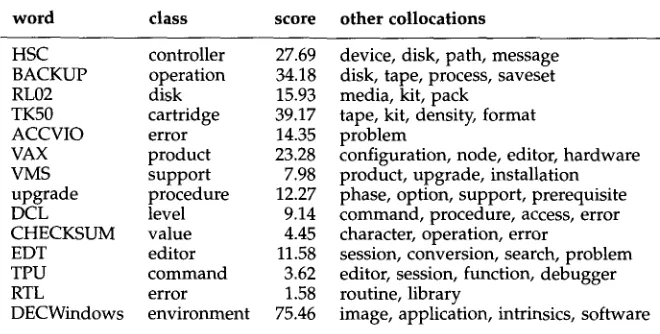
on the basis of collocational information. Technical sublanguages often express subclass relationships in noun compounds of the form <instance-name> <class-name>, as in "Unix operating system" and "C language." Unfortunately, noun compounds are also employed to express numerous other relationships, as in "Unix kernel" and "C debugger." We have found, however, that collocational evidence can be employed to suggest which noun compounds reflect taxonomic relationships, using a strategy similar to that employed by Hindle (1990) for detecting synonyms. Given a term T, we extract from the phrase database those nouns Ni that appear as the head of any phrase in which T is the immediately preceding term. These nouns represent candidate classes of which T may be a member. We then generate the set of verbs that take T as direct object and calculate the mutual information value for each verb/T collocation (cf. Hindle 1990). We do the same for each noun Ni. Under the assumption that instance and class nouns are likely to co-occur with the same verbs, we compute a similarity score between T and each noun Ni, by summing the product of the mutual information values for those verbs occurring with both nouns. (Verbs with negative mutual information values are left out of the calculation.) The noun with the highest similarity score is often the class of which T is an instance, as illustrated by the sample results in Figure 1. For each word displayed in Figure 1, its "class" is the head noun with the highest similarity score. Other head nouns occurring with the word as modifier are listed as well.As with all the automated procedures described here, this algorithm yields useful, but imperfect results. The class chosen for "VMS," for example, is incorrect, and may reflect the fact that in a DEC
troubleshooting database, authors see no need to further specify VMS as "VMS operating system." A more interesting observation is that, among the collocations associated with the terms, there are often several that might qualify as classes of which the term is an instance, e.g.,
DECWindows could also be classified as "software"; TK50 might also qualify as "tape." From a generative lexicon perspective, these
Computational Linguistics Volume 19, Number 2
word class score other collocations
HSC controller 27.69
BACKUP operation 34.18
RL02 disk 15.93
TK50 cartridge 39.17
ACCVIO error 14.35
VAX product 23.28
VMS support 7.98
upgrade procedure 12.27
DCL level 9.14
CHECKSUM value 4.45
EDT editor 11.58
TPU command 3.62
RTL error 1.58
DECWindows environment 75.46
device, disk, path, message disk, tape, process, saveset media, kit, pack
tape, kit, density, format problem
configuration, node, editor, hardware product, upgrade, installation phase, option, support, prerequisite command, procedure, access, error character, operation, error
session, conversion, search, problem editor, session, function, debugger routine, library
image, application, intrinsics, software
Figure 1
Classification of nouns from a computer troubleshooting corpus.
qualia. That is, "cartridge" is further specifying the formal role of tape for TK50. DECWindows is functionally an "environment," its telic role, while "software" characterizes its formal quale.
3. Extraction of i n f o r m a t i o n relating to n o u n ' s qualia. Under certain circumstances, it may be possible to elicit information about a noun's qualia from automated procedures on a corpus. In this line of research, we haved employed the notion of "lexical conceptual paradigm" described above. An LCP relates a set of syntactic behaviors to the lexical semantic structures of the participating lexical items.
For example, the set of expressions involving the w o r d "tape" in the context of its use as a secondary storage device suggests that it fits the
container artifact
schema of the qualia structure, with "information" and "file" as its containees:(a)
read information from tape
(b)write file to tape
(c)
read information on tape
(d)read tape
(e)
write tape
As mentioned in Section 1, containers tend to appear as objects of the prepositions
to, from, in,
andon
as well as in direct object position, in which case they are typically serving metonymically for the containee. Thus, the container LCP relates the set of generalized syntactic patternsV i Nj { t o , f r o i n ~ o n } X k
vi Nj
riNk
to the underlying lexical semantic structure given below.
[image:12.468.78.408.58.225.2] [image:12.468.78.412.60.224.2]verb MI count
unload 5.43 5
position 3.92 5
mount 3.77 29
initialize 3.18 10
dismount 2.88 5
read 1.40 7
load 1.18 4
restore 0.80 3
write -0.24 2
copy -2.55 1
Figure 2
Verbs associated with direct object tape as direct object.
This LCP includes a nominal alternation between the container and containee in the object position of verbs. For tape, this alternation is manifested for verbs that predicate the telic role of data storage but not the formal role of physical object, which refers to the object as a whole regardless of its contents:
T E L I C : data-storage
(a) read (tape/data from tape) (b) write (tape/data on tape) (c) copy (tape/data from tape)
FORMAL= physical object
(a) mount (tape)
(b) dismount (tape)
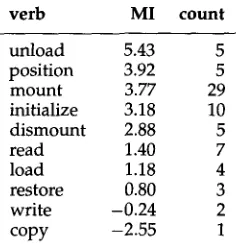
We have explored the use of heuristics to distinguish those predicates that relate to the Telic quale of the noun. Consider the word tape, which occurs as the direct object in 107 sentences in our corpus. It appears with a total of 34 different verbs. By applying the mutual information metric (MI) to the verb-object pairs, we can sort the verbs accordingly, giving us the table of verbs most highly associated with tape, shown in Figure 2. While the mutual information statistic does a good job of identifying verbs that semantically relate to the word tape, it provides no information about how the verbs relate to the noun's qualia structure. That is, verbs such as unload, position, and mount are selecting for the formal quale of
tape, a physical object that can be physically manipulated with respect to a tape drive. Read, write, and copy, on the other hand, relate to the telic role, the function of a tape as a medium for storing information.
Our hypothesis was that the nominal alternation can help to distinguish the two sets of verbs. We reasoned that, if the alternation is based on the container/containee metonymy, then it will be those verbs that apply to the telic role of the direct object that participate in the alternation. We tested this hypothesis as follows.
[image:13.468.163.281.68.190.2]Computational Linguistics Volume 19, Number 2
$1 & 81 NS2 S l - &
Verbs with tape as object
Verbs with a containee of tape as object {restore, create, write, read, copy, replace}
{mount, initialize, unload, position, dismount, load, allocate
}
8182 81 Sl n & - &
Verbs with disk as object
Verbs with a containee of disk as object
{compress, restore, disable, rebuild, modify, recover, search, copy} {mount, initialize, boot, dismount, serve, }
Sl 82 S i n & $1 -- ~2
Verbs with d i r e c t o r y as object
[image:14.468.74.420.61.210.2]Verbs with containee of d i r e c t o r y as object {create, recreate, delete, store, rename, check} {own, miss, search, review}
Figure 3
Intersection and set difference for three container nouns.
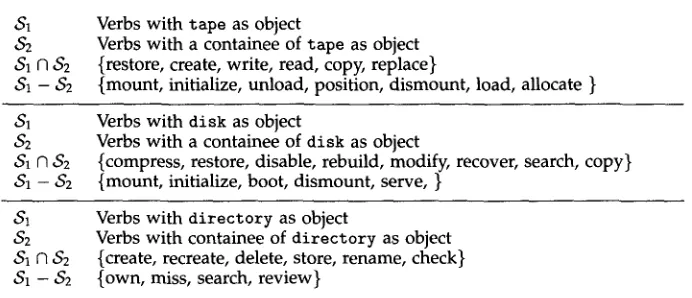
T h e n w e took the set of verbs that h a d one of these containee n o u n s as a direct object a n d c o m p a r e d this set to the set of v e r b s that h a d the container n o u n
tape
as a direct object in the corpus. According to o u r hypothesis, v e r b s a p p l y i n g to the telic role s h o u l d a p p e a r in theintersection of these t w o sets (as a result of the alternation), while those a p p l y i n g to the formal role will a p p e a r in the set difference {verbs w i t h containers as direct o b j e c t } - - { v e r b s w i t h containees as direct object}. The difference o p e r a t i o n s h o u l d serve to r e m o v e a n y v e r b s that co-occur w i t h containee objects. Figure 3 shows the results of intersection a n d set difference for three container n o u n s
tape, disk,
a n ddirectory.
The results indicate that the container LCP is able to differentiate n o u n s w i t h respect to their telic a n d formal qualia, for the n o u n s
tape
a n d
disk
b u t not fordirectory.
The p o o r discrimination in the latter case can be attributed to the fact that a directory is a recursive container. A directory contains files, a n d a directory is itself a file. Therefore, v e r b s that a p p l y to the formal role of directory are likely to a p p l y to the formal role of objects c o n t a i n e d in directories (such as o t h e r directories). This can be seen as a s h o r t c o m i n g of the container LCP for the task at h a n d , b u t m a y be a useful w a y of d i a g n o s i n g w h e n containers contain objects functionally similar to themselves.The result of this c o r p u s acquisition p r o c e d u r e is a kind of minimal faceted analysis for the n o u n
tape,
as illustrated below, s h o w i n g o n l y the qualia that are relevant to the discussion} 3tape(x,y)
1
CONST = information(y);file(y) FORMAL = mount(z,x);dismount(z,x)
TELIC =
read(w,y);write(w,y);copy(w,y);contain(w,y)
What is interesting about the qualia values is how close they are to the concepts in the projective conclusion space of tape, as mentioned in Section 1.
To illustrate this procedure on another semantic category, consider the term mouse in its computer artifact sense. In our corpus, it appears in the object position of the verb use in a "use NP to" construction, as well as the object of the preposition with following a transitive verb and its object:
1. use the mouse to set breakpoints
2. use the mouse anywhere
3. move a w i n d o w with the mouse
4. click on it with the m o u s e . . .
These constructions are symptomatic of its role as an instrument; and the VP complement of to as well as the VP dominating the with-PP identify the telic predicates for the noun. Other verbs, for which mouse appears as a direct object are currently defaulted into the formal role, resulting in an entry for mouse as follows:
mouse(x)
]
CONST =
button(y)
F O R M A L =
physobj(x)
T E L I G =
set(x,breakpoint);move(x,window);click-on(x,z)
The above experiments have met with limited success, enough to warrant continu- ing our application of lexical semantic theory to knowledge acquisition from corpora, but not enough to remove the h u m a n from the loop. As they currently exist, the algorithms described here can be used as tools to help the knowledge engineer ex- tract useful information from on-line textual sources, and in some applications (e.g., a "related terms" thesaurus for full text information retrieval) m a y provide a useful w a y to heuristically organize sublanguage terminology when h u m a n resources are unavailable.
4. Semantic Type Induction from Syntactic Forms
The purpose of the research described in this section is to experiment with the au- tomatic acquisition of semantic tags for words in a sublanguage, tags well beyond that available from the seeding of MRDs. The identification of semantic tags is the result of type coercion on known syntactic forms, to induce a semantic feature, such as [+event] or [+object].
4.1 Coercive Environments in Corpora
Computational Linguistics Volume 19, Number 2
Figure 4
Counts for objects of begin/V.
count verb object
205 begin career
176 begin day
159 begin work
140 begin talk
120 begin campaign
113 begin investigation
106 begin process
92 begin program
85 begin operation
85 begin negotiation
66 begin strike 64 begin production
59 begin meeting
59 begin term
50 begin visit
45 begin test
39 begin construction
31 begin debate
29 begin trial
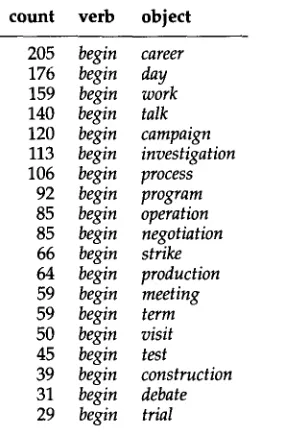
In related work being carried out with Mats Rooth of the University of Stuttgart, we are exploring what the range of coercion types is, and what environments they m a y appear in, as discovered in corpora. Some of our initial data suggest that the hypothesis of deep semantic selection m a y in fact be correct, as well as indicating what the nature of the coercion rules may be. Using techniques described in Church and Hindle (1990), Church and Hanks (1990), and Hindle and Rooth (1991), Figure 4 shows some examples of the most frequent V-O pairs from the AP corpus.
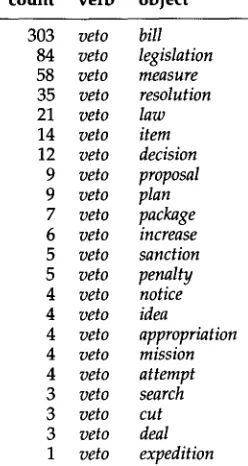
Corpus studies confirm similar results for "weakly intensional contexts" such as the complement of coercive verbs such as veto. These are interesting because regard- less of the noun type appearing as complement, it is embedded within a semantic interpretation of "the proposal to," thereby clothing the complement within an inten- sional context. The examples in Figure 5 with the verb veto indicate two things: first, that such coercions are regular and pervasive in corpora; second, that almost anything can be vetoed, but that the most frequently occurring objects are closest to the type selected by the verb.
What these data show is that the highest count complement types match the type required by the verb; namely, that one vetoes a bill or proposal to do something, not the thing itself. These nouns can therefore be used with some predictive certainty for inducing the semantic type in coercive environments such as "veto the expedition." This work is still preliminary, however, and requires further examination (Pustejovsky and Rooth [unpublished]).
4.2 Induction of Semantic Relations from Syntactic Forms
In this section, we present another experiment indicating the feasibility of inducing semantic tags for lexical items from Corpora. 14 Imagine being able to take the V-O pairs
Figure 5
Counts for objects of veto/V.
count verb object
303 veto bill 84 veto legislation 58 veto measure 35 veto resolution 21 veto law 14 veto item 12 veto decision
9 veto proposal 9 veto plan 7 veto package 6 veto increase 5 veto sanction 5 veto penalty 4 veto notice 4 veto idea 4 veto appropriation 4 veto mission 4 veto attempt 3 veto search 3 veto cut 3 veto deal 1 veto expedition
such as those given in Section 4.1, and then applying semantic tags to the verbs that are appropriate to the role they play for that object (i.e., induction of the qualia roles for that noun). This is similar to the experiment reported on in Section 3. Here we apply a similar technique to a much larger corpus, in order to induce the agentive role for nouns; that is, the semantic predicate associated with bringing about the object.
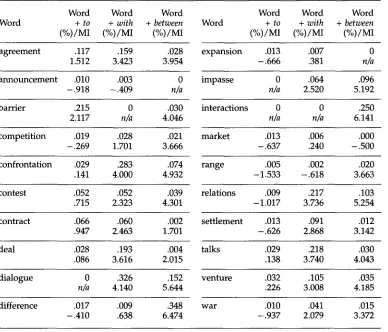
In this example we look at the behavior of noun phrases and the prepositional phrases that follow them. In particular, we look at the co-occurrence of nominals with between, with, and to. Table 1 shows results of the conflating noun plus preposition patterns. The percentage shown indicates the ratio of the particular collocation to the key word. Mutual information (MI) statistics for the two words in collocation are also shown. What these results indicate is that induction of semantic type from conflating syntactic patterns is possible. Based on the semantic types for these prepositions, the syntactic evidence suggests that there is an equivalence class where each preposition makes reference to a symmetric relation between the arguments in the following two patterns:
• Z w i t h y = A R z A x 3 y [ R z ( x , y ) A Rz(y, x)]
• Z b e t w e e n x a n d y =
,XRz3x, y[Rz(x, y)/x Rz(y,
x)]
[image:17.468.162.286.67.300.2]We then take these results and, for those nouns where the association ratios for N with and N between are similar, we pair them with the set of verbs governing these "NP PP" combinations in corpus, effectively partitioning the original V-O set into [+agentive] predicates and [-agentive] predicates.
Computational Linguistics Volume 19, Number 2
Table 1
Mutual information for noun + preposition patterns.
Word Word Word Word Word Word
Word + to + with + between Word + to + with + between
(%)/MI (%)/MI (%)/MI (%)/MI (%)/MI (%)/MI
agreement .117 .159 .028 expansion .013 .007 0
1.512 3.423 3.954 -.666 .381 n/a
announcement .010 .003 0 impasse 0 .064 .096
-.918 -.409 n/a n/a 2.520 5.192
barrier .215 0 .030 interactions 0 0 .250
2.117 n/a 4.046 n/a n/a 6.141
competition .019 .028 .021 market .013 .006 .000
-.269 1.701 3.666 -.637 .240 -.500
confrontation .029 .283 .074 range .005 .002 .020
.141 4.000 4.932 -1.533 -.618 3.663
contest .052 .052 . 0 3 9 relations .009 .217 .103
.715 2.323 4.301 -1.017 3.736 5.254
contract .066 .060 .002 settlement .013 .091 .012
.947 2.463 1.701 -.626 2.868 3.142
deal .028 .193 .004 talks .029 .218 .030
.086 3.616 2.015 .138 3.740 4.043
dialogue 0 .326 .152 venture .032 .105 .035
n/a 4.140 5.644 .226 3.008 4.185
difference .017 .009 .348 war .010 .041 .015
-.410 .638 6.474 -.937 2.079 3.372
W h a t these e x p r e s s i o n s in effect indicate is the r a n g e of s e m a n t i c e n v i r o n m e n t s t h e y will a p p e a r in. T h a t is, in sentences like those in E x a m p l e 16, the force of the relational n o u n s agreement a n d talks is that t h e y are u n s a t u r a t e d for the p r e d i c a t e b r i n g i n g a b o u t this relation. In 17, on the other h a n d , the N P s h e a d e d b y agreement a n d talks are s a t u r a t e d in this respect.
Example 16
a. J o h n m a d e a n a g r e e m e n t w i t h Mary. b. A p p l e o p e n e d talks w i t h IBM.
Example 17
a. This is an a g r e e m e n t b e t w e e n J o h n a n d Mary. b. Those w e r e the first talks b e t w e e n A p p l e a n d IBM.
count verb object
Figure 6
Verb-object pairs with prep = with.
19 form venture 3 announce venture 3 enter venture 2 discuss venture 1 be venture 1 abandon venture 1 begin venture 1 complete venture 1 negotiate venture 1 start venture 1 expect venture
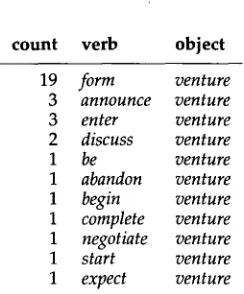
identify the agent of the verb as its argument (cf. Nilsen (1973)). This is confirmed by our data, shown in Figure 6.
Conversely, verbs governing nominals collocating with a between-phrase will not refer to the agentive since the phrase is saturated already. Indeed, the only verb occur- ring in this position with any frequency is the copula be, namely with the following counts: 12 be/V venture/0. Thus, weak semantic types can be induced on the basis of syntactic behavior.
There is a growing literature on corpus-based acquisition and tuning (Smadja 1991a; Zernik and Jacobs 1991; Brent 1991; as well as Grishman and Sterling 1992). We share with these researchers a general dependence on well-behaved collocational patterns and distributional structures. Probably the main distinguishing feature of our approach is its reliance on a fairly well studied semantic framework to aid and guide the semantic induction process itself, whether it involves selectional restrictions or semantic types.
5. Lexical Presuppositions and Preferences
In the previous section we presented algorithms for extracting collocational informa- tion from corpora, in order to supplement and fine-tune the lexical structures seeded by a machine-readable dictionary. In this section we demonstrate that, in addition to conventional lexical semantic relations, it is also possible to acquire information con- cerning lexical presuppositions and preferences from corpora, when analyzed with the appropriate semantic tools. In particular, we will discuss a phenomenon we call discourse polarity, and how corpus-based experiments provide clues toward the repre- sentation of this phenomenon, as well as information on preference relations.
As we have seen, providing a representational system for lexical semantic relations is a nontrivial task. Representing presuppositional information, however, is even more daunting. Nevertheless, there are some systematic semantic generalizations associated with such subtle lexical inferences. To illustrate this, consider the following examples taken from the Wall Street Journal Corpus, involving the verb insist.
Example 18
[image:19.468.167.289.43.190.2]Computational Linguistics Volume 19, Number 2
Example 19
But so far, the majority is insisting that a daily p a p e r in the h o m e is an essential educational resource that Mr. O s h r y m u s t have, like it or not.
Example 20
But Mr. Nishi insists there is a c o m m o n t h e m e to his scattered projects: to i m p r o v e a n d s p r e a d personal computers.
Example 21
"Mister, Djemaa is a crazy place for y o u , " insists the first of m a n y y o u n g men, clutching a visitor's sleeve.
Example 22
But the BNL sources y e s t e r d a y insisted that the h e a d office was a w a r e of only a small p o r t i o n of the credits to Iraq m a d e b y Atlanta.
Example 23
Mr. Smale, w h o ordinarily insists o n a test m a r k e t before a national roll-out, told the t e a m to go a h e a d - - a l t h o u g h he said he was skeptical that Pringle's c o u l d survive, Mr. Tucker says.
Example 24
The Cantonese insist that their fish be "fresh," t h o u g h one whiff of H o n g K o n g h a r b o r a n d the visitor m a y y e a r n for s o m e t h i n g s h i p p e d from distant seas.
Example 25
M o n e y isn't the issue, Mr. Bush insists.
From analyzing these a n d similar data, a p a t t e r n emerges c o n c e r n i n g the use of verbs like insist in discourse; namely, the co-occurrence with discourse m a r k e r s d e n o t i n g negative affect, such as although a n d but, as well as literal negatives, e.g., no a n d not.
This is reminiscent of the b e h a v i o r of negative polarity items such as any more a n d at all.
Such lexical items occur only in the context of negatives within a certain structural configuration. 15 In a similar way, v e r b s such as insist seem to require an o v e r t or implicit n e g a t i o n w i t h i n the i m m e d i a t e discourse context, rather t h a n w i t h i n the clause. For this reason, w e will call such v e r b s discourse polarity items.
For o u r p u r p o s e s , the significance of such data is twofold: first, e x p e r i m e n t s o n c o r p o r a can test a n d confirm linguistic intuitions c o n c e r n i n g a subtle semantic judg- ment; second, if such k n o w l e d g e is in fact so systematic, then it m u s t be at least partially r e p r e s e n t e d in the lexical semantics of the verb.
To test w h e t h e r the intuitions s u p p o r t e d b y the a b o v e data c o u l d be c o n f i r m e d in corpora, Bergler (1991) d e r i v e d the statistical co-occurrence of insist with discourse polarity m a r k e r s in the 7 m i l l i o n - w o r d c o r p u s of Wall Street Journal articles. She d e r i v e d the statistics r e p o r t e d in Figure 7.
Let us assume, on the basis of this p r e l i m i n a r y data 16 p r e s e n t e d in Bergler (1992) that these v e r b s in fact d o b e h a v e as discourse polarity items. The question t h e n
Keywords
insist
insist on
insist & but
insist & negation
Count
586
109
[image:21.468.56.403.60.185.2]insist & subjunctive
Figure
7117
186
159
Comments
occurrences throughout the corpus
these have been cleaned by hand and are actually oc- currences of the idiom insist on rather than accidental co-occurrences.
occurrences of both insist and but in the same sentence
includes not and n't
includes would, could, should, and be
Negative markers with insist in WSJC.
i m m e d i a t e l y arises as to h o w w e r e p r e s e n t this t y p e of k n o w l e d g e . U s i n g the l a n g u a g e of the qualia structure discussed above, w e can m a k e explicit reference to the p o l a r i t y behavior, in the following i n f o r m a l b u t intuitive r e p r e s e n t a t i o n for the v e r b insist. 17
insist(x:ind,y:prop)
]
FORMAL = REPORTING-VERB--LCP
TELIC = say(x,true(y)) & presupposed(~b) & y = ~ b
This e n t r y states that in the REPORTING-VERB sense of the w o r d , insist is a relation b e t w e e n a n i n d i v i d u a l a n d a s t a t e m e n t that is the n e g a t i o n of a p r o p o s i t i o n , ~b, pre- s u p p o s e d in the context of the utterance. As a r g u e d in P u s t e j o v s k y (1991) a n d Miller a n d F e l l b a u m (1991), such s i m p l e o p p o s i t i o n a l predicates f o r m a central p a r t of o u r lexicalization of concepts. Semantically m o t i v a t e d collocations such as these extracted f r o m large c o r p o r a c a n p r o v i d e p r e s u p p o s i t i o n a l i n f o r m a t i o n for w o r d s that w o u l d o t h e r w i s e be m i s s i n g f r o m the lexical s e m a n t i c s of an entry. While full a u t o m a t i c ex- traction of s e m a n t i c collocations is n o t y e t feasible, s o m e recent research in related areas is p r o m i s i n g .
H i n d l e (1990) r e p o r t s interesting results of this k i n d b a s e d on literal collocations, w h e r e he p a r s e s the c o r p u s (Hindle 1983) into p r e d i c a t e - a r g u m e n t structures a n d a p p l i e s a mutual information m e a s u r e (Fano 1961; M a g e r m a n a n d M a r c u s 1990) to w e i g h the association b e t w e e n the p r e d i c a t e a n d each of its a r g u m e n t s . For e x a m p l e , as a list of the m o s t f r e q u e n t objects for the v e r b drink in his corpus, H i n d l e f o u n d beer, tea, Pepsi, a n d champagne. Based on the distributional h y p o t h e s i s that the d e g r e e of s h a r e d contexts is a similarity m e a s u r e for w o r d s , he d e v e l o p s a similarity metric for n o u n s b a s e d on their substitutability in certain v e r b contexts. H i n d l e thus finds sets of s e m a n t i c a l l y similar n o u n s b a s e d on syntactic co-occurrence data. The sets he extracts are p r o m i s i n g ; for e x a m p l e , the ten m o s t similar n o u n s to treaty in his c o r p u s are agreement, plan, constitution, contract, proposal, accord, amendment, rule, law,
a n d legislation.
This w o r k is v e r y close in spirit to o u r o w n investigation here; the e m p h a s i s on syntactic co-occurrence enables H i n d l e to extract his similarity lists automatically; t h e y
Computational Linguistics Volume 19, Number 2
are therefore easy to compile for different corpora, different sublanguages, etc. Here we are attempting to use these techniques together with a model of lexical meaning, to capture deeper lexical semantic collocations; e.g., the generalization that the list of objects occurring for the word
drink
contains only liquids.In the final part of this section, we turn to how the analysis of corpora can provide lexical semantic preferences for verb selection. As discussed above, there is a growing body of research on deriving collocations from corpora (cf. Church and Hanks 1990; Klavans, Chodorow, and Wacholder 1990; Wilks et al. 1993; Smadja 1991a, 1991b; Cal- zolari and Bindi 1990). Here we employ the tools of semantic analysis from Section 1 to examine the behavior of metonymy with reporting verbs. We will show, on the ba- sis of corpus analysis, how verbs display marked differences in the ability to license metonymic operations over their arguments. Such information, we argue, is part of the preference semantics for a sublanguage, as automatically derived from corpus.
Metonymy can be seen as a case of "licensed violation" of selectional restric- tions. For example, while the verb announce selects for a h u m a n subject, sentences like
The Phantasie Corporation announced third quarter losses are not only an acceptable para-
phrase of the selectionally correct formMr. Phantasie Jr. announced third quarter losses
for Phantasie
Corp, but they are the preferred form in theWall Street Journal).
This is an example of subjecttype coercion,
as discussed in Section 1. For example, the qualia structure for a noun such as corporation might be represented as below:corporation(x)
CONST =
group(y),spokesperson(w),executive(z)
FORMAL =organization(x)
TELIC =
execute(z, decisions)
AGENTIVE =
incorporate(y,x)
The metonymic extension in this example is straightforward: a spokesman, executive, or otherwise legitimate representative "speaking for" a company or institution can be metonymically replaced by that company or institution. TM
We find that this type of metonymic extension for the subject is natural and indeed very frequent with
reporting verbs
Bergler (1991), such asannounce, report, release, and
claim, while it is in general not possible with other verbs selecting h u m a n subjects, e.g.,
the verbs of contemplation (such ascontemplate, consider,
andthink).
However, there are subtle differences in the occurrence of such metonymies for the different members of the same semantic verb class that arise from corpus analysis.A reporting verb
is an utterance verb that is used to relate the words of a source. In a careful study of seven reporting verbs on a 250,000-word corpus ofTime
magazine articles from 1963, we found that the preference for different metonymic extensions varies considerably within this field (Bergler 1991). Figure 8 shows the findings for the wordsinsist, deny, admit, claim, announce, said, and
told for two metonymic extensions,
namely where a group stands for an individual (Analysts said... ) and where acompany
or other institution stands for the individual (IBM announced ... ).19The difference in patterns of metonymic behavior is quite striking: semantically similar verbs seem to pattern similarly over all three categories; admit, insist, and deny show a closer resemblance to each other than to any of the others, while
said
and18 Note, h o w e v e r , that t h e m e t o n y m i c e x t e n s i o n is n o t q u i t e as s i m p l e as e x t e n d i n g f r o m a n y employee to the w h o l e c o m p a n y or institution, b u t that a f o r m of legitimation h a s to be involved.) For m o r e detail see Bergler (1992).
admit deny insist
announce claim
said told
person
64% 59% 57%
51% 35%
69%
19% 11% 24%
10% 21%
14% 19% 16%
31% 38%
other
2% 11% 3%
8% 6%
8%
[image:23.468.120.329.56.214.2]16%
Figure 8
Preference for different metonymies in subject position.
- - t person
WSJ 49%
TIME 83%
group
15%
6%
institution other
34% 2%
4% 8%
Figure 9
Preference for metonymies for said in a 160,000-word fragment of the Wall Street Journal
corpus.
told form a category by themselves. There may be a purely semantic explanation w h y
said and told seem not to prefer the metonymic use in subject position; e.g., perhaps these verbs relate more closely to the act of uttering, or perhaps they are too informal, stylistically. Evidence from other corpora, however, suggests that such information is accurately characterized as lexical preference. An initial experiment on a subset of the
Wall Street Journal Corpus, for example, shows that said has a quite different metonymic distribution there, reported in Figure 9.
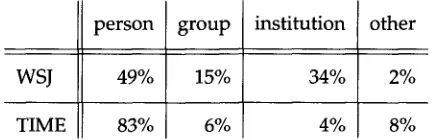
In this corpus we discovered that subject selection for an individual person ap- peared in only 50% of the sentences, while a company/institution appeared in 34% of the cases. This difference could either be attributed to a difference in style between
Time magazine and the Wall Street Journal or perhaps to a difference in general usage between 1963 and 1989. The statistics presented here can of course not determine the reason for the difference, but rather help establish the lexical semantic preferences that exist in a certain corpus and sublanguage.
[image:23.468.118.336.272.342.2]