kmerican
Journal
of Computational Linguir
tics
M i c r o f i c h e 3Jaime
R. Carbonell andLAl'lan M.Collins
Bolt Besanek and Newman I n c .Cambridge, Massachusetts
ABSTRACT
This papar d i s c u ~ s e e human semantic knowledge and proceesing i n terms of the SCHOLAR system. In one major s e c t i o n we d i s c u s s
t h e imprecision, the incompleteness, the open-endedness, and the u n c e r t a i n t y of psopl,eqs knowledge. In t h e o t h e r major s e c t i o n we d i e c u s s strategies people use t o make d i f f e r e n t types of deductive, n e g a t i v e , and functional i n f e r e n c e s , and the way u n c e r t a i n t i e s
combine i n these i n f e r e n c e s .
Irapreeision can occur either i n memory or i n c a m u n i c a t i o n .
SCHOLAR can have precf ae values or fuzzy v a l u e s stored, and its procedures can, t o eome extent, deal w i t h fuzzy questions when
precise valtues
are
stored, and w i t h precise queltions, when fuzzyvalues are stored. Embedding allows i n f o t i o n to be specified i n the data base t o any level of d e t a i l
or
preci s f o n . But SCHOLARo n l y camunicatea the nwst important i n f o t i o n on any topic (as
rneasured by importmce t a g s ) , unless more i n f o t i o n i s requested.
1.t should a l s o be p o s s i b l e by using importance tags to a d j u s t what
+jon SCHOLAR communicates, i n accord with the sophistication and, i n t e r e s t s of the l i s t e n e r .
Inference atrategiee t h a t are appropriate when the complete set of object attributes, or values, i s known (i .em, in a closed
world) do not apply when knowledge is incomplete e , i n an open w r l d )
.
There are a variety of u n c e r t ~ i n i n f e r c n c e s t h a tpeople use to circumvent the hales i n their knowledge, which are being progr e d i n SCHOLAR.
There is a set o f transitive relations
--
superordinate,superpart, s l a r i t y , p r a i m i t y
,
subordinate, and subpart relationsCurrently SCHO o n l y handles superordinate i n f e r e n c e s ( e m g
.
,
the Llanos has a rainy season because it is a savanna) and super- part inferences (e .g,
,
the language in Rio is Portuguese becauseR i o is part of Brazil). ~ e d u c t i v e inferences can be more or l e a s
c e r t a i n (similarity inferences are l i k e s u p t o r d i n a t e inferences. but l e a s c e r t a i n ) and can have restrictions on t h e i r use ( o n l y certain attributes transfer an s u p e r p a r t ) .
~ b knowledge n is incomplete, it is not safe t o assume that something is n o t true just because i t i s not s t o r e d . Thus an in- ference is necessary to decide when to say ' N o w and when to say
'I d o n B t know,@ There is a eamp1Pcated s e t sf strategies in
SCHOLAR to find vatious kinds of contradictions that people case to say *NO,
"
If a c o n t r a d i c t i o n c a n n o t be f o u n d , a n o t h e r nega8ive inference, c a l l e d the Wlack-aF-knawledgea inference, f s tried*When enough is known a b u t an a b j e c h it is possible to c o n c l u d e that someaing is not true ut mat object ow t h e ground8 that if it were true, it m u l d be stared,
another class of w c e r t a i n i n f e r e n c e s depends an i l l - d e f ined
knovledge of functional d a t e n a i n a n t s
,
e .g.,
that climate dependsO R l a t i t u d e and a l t i t u d e . D % f ferent ways t h a t p o p l e use f m c t i o n a l knowledge irnm1ve f m c t i a n a l ealeulatisms ( a . g , , if a place h a s a
p a r t i c u l a r latitude, i t probably has a particular elihate), func-
tional analogies ( e , g , , if a place is like another place in latitude and altitude, it probably has the s m e c h i m t e )
,
and ts answer Why q u e s t i o n s (egg,, a place h g a particular e l f m t e because of itslatitude and altitude),
D i f f e r e n t inf erenees can esIwBine in d i f f e r e n t ways, Somtims one strategy may call another strategy to h i n d an anewer, men
d i f f e r e n t inferences i n d e p e n d e n t l y reach the s m e or d i f f e r m t con-- elusions, a e y coItnbiwe to increase or d s r e a s s certainty, T h e pm-
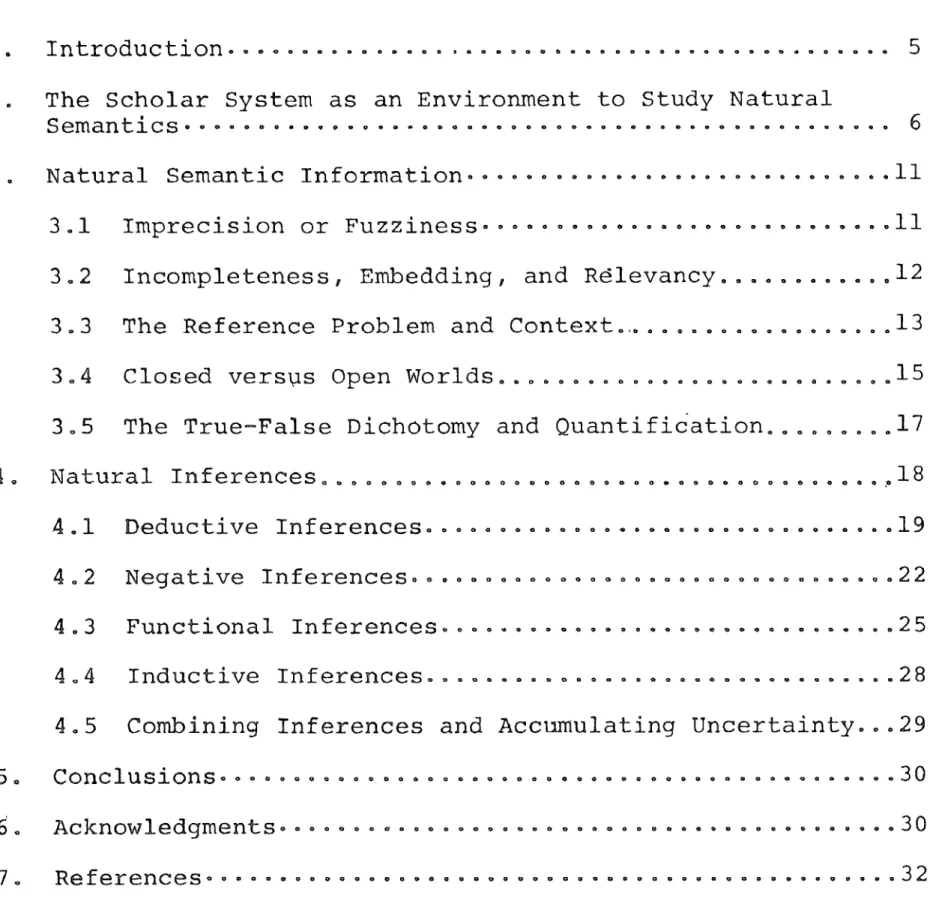
TABLE OF CONTENTS
2 . The S c h o l a r System a s a n E n v i r o n m e n t t o Study Natural
~ ~ m a ~ ~ i ~ ~ . ~ ~ . ~ . ~ 6 . . ~ ~ ~ ~ ~ ~ ~ ~ ~ ~ ~ ~ ~ ~ ~ . ~ ~ ~ ~ ~ ~ ~ ~ ~ . ~ . . ~ . ~ ~ . ~ . ~ ~ ~
3 . 1 Imprecision or F u z z i n e s s . . o a . . . o o O O o a I ) D o O o ~ O o O o O O O o O ~ ~
3.2 Incompleteness, Embedding, and R~levancy... 12
3 - 3 The R e f e r e n c e Problem and Context
...
133,4 Closed versus Open Worlds o O o ~ o ~ o ~ o ~ ~ O ~ D o D e O o 15 o ~ d ~ O O D o
3.5 The True-False ~ichotorny and ~ u a n t i f i c a t i o n
..,...
174 , N a t u r a l I n f e u e n @ e s . , . . o . . . , P 0 D o o m o e O O o 0 O O ~ B O o O O O o o . ~ . o . o . 0 1 8
4 . 1 Deductive ~ ~ f ~ ~ e ~ ~ e ~ . . o O Q . o O . O ~ O o O O ~ ~ O O ~ o O ~ O O O O O O . O o ~ ~ 4 . 2 Negative I n f e r ~ ~ ~ e s . . o . . o . o o O o O o D o o O O o O o O o o O o o a o O ~ o . ~ ~
4 - 4 Inductive I n f e r e n c e s o 0 . 0 . 0 0 D ~ 0 0 0 D o D . 0 . . o ~ a ~ O O O o O O D ~ 0 2 8
% , I n t r o d u c t i o n
In t h i s paper we will discuss how to eepresent and process
i n f o m a t i o i l in a computer in ways t h a t are natural to p e o p l e .
This does n o t mean doing away completely w i t h representations and procedures which computers have traditionally used, but adding
new representations and procedures which they have not used.
People o f t e n store and communicate imprecise, incomplete, and unquantified info t i o n ; they a f t e n assert truth o r falsity
in relative terms; and they seldom seem to use r i g o r o u s l o g i c in
t h e i r i n f e r e n t i a l processes. Because of these c o n d i t i o n s , people s , e e m to have an almost i n f i n i t e i n f o tion processing c a p a c i t y ,
w i t h i n f e r e n c e making and problem s o l v i n g abilities more r e f i n e d
and far more f l e x i b l e than any e x i s t i n g computer program.
Now man we study a e s e h m a n eapabiLities in order to make
our machines show similar perfbnnance? A combination of
approaches is perhaps best. O b s e r v a t i o n of people
'
s behavior, introspection, some experimentation, protocol analysf s, andsynthesis of computer programs can a l l be vhluable t e c h n i l ~ u e s . A 6
recent paper (CalZins, mrnock and P a s s a f i m e ) d i s c u s s e s a tech- nique for combining protocol analysis with program synthesis as
a p p l i e d to t u t o r i a l d i a l o g u e s . The synthesis directs what to
analyze, and the strategies observed in the analysis are evaluated
the SCHOLAR
system
in this
way as avehicle
f o rexperimentation
w i t hnatural
semnties.
Before
we
d i s c u s ssome
of
t h emajor
problems
in natural
semantics, we
w i l l
b r i e f l y describethe
SCHOLAR system,since
iti e
t h ee n v i r o m e n t
f o ro u r
research.
A wordof
c a u t i o nthough:
we
are
o n l y
t r y i n gto
develop
some
i n s i g h t s ,w i t h o u t
attempting
to
be
exhaustive.
More
q u e s t i o n s
w i l . 1be raised
thanqnewers
provided.
There
are
many
observable
t h i n g speople do
t h a t
we
do
n o t
h o w
how tosimulate,
Semantics
.-
1x1
this
s e c t i o n
we
w i l l
d i s c u s s ,very
b r i e f l y ,same
p e r t i n e n t
aspects
o f SCBO amixed-initiative
i n s t r u c t i o n a l
system.
More
d e b i l e d
dilseussions
a r e
pmvidedi n
CarboneIlP 3 p and Wamock14
and C o l l i n s ,
.
Several
databases
c u r r e n t l y
e x i s t :
m eis
&out
t h e geographyof
SouthAmerica,
anoeher
a b o u t t h e ARPA n e t w o r k , and a t h i r dabout
a t e x t - e d i t i n gsystem called
NLS.SCHOLAR s knowledge about any subject matter is
in
the formof
as t a t i c
semantic
network
of
f a c t s , concepts,
and
procedures.
T h i s12
i a
amodified and
extendednemork
ala
Q u i l l i n
and
has a r i c h~ i a l o g u e
w i t h
SCHOLAR take8place
$XI a aeubaetof ~ n g l i s h
t h a tis limited
mainly
by
SCHOLAR%currently
primitive
syntactic
capabi
l i t i e s .
In tutorial
fashion,
t h esystem
uses
its
semantic
n e t w o r k
to
generate
t h ematerial
it presents,
t h e questionsit
asks,
and
the
corrections
it
makes.
At
any
time
SCHOLAR
accepts
questions and
r
ests
f r o m
the
s t u d e n t ,
and
generatesresponses
based
on its
semantic
network, making
c a l c u l a t i o n s
andf nferences
of
d i f f e r e n t
types t h a t i t h a sbeen
progaamedto
handle.The
dialogue
is
unanticipated,
and i s dependenton
t h estudent's
rsspanses,
questions,
and
requests.
Figure 1
presents
asample
protocol
of
an
i n t e r a c t i o n
w i t h SCHOLAR:the
person
typesa f t e r
t h e
a s t e r i s k and
returns c o n t r o l
to the system
w i t h asecond
a s t e r i s k ,
F i g u r e 2
shows
some excerpts
of SCHOLAR'S
semantic
network.
Properties,
none of which
are
obligatory, can
have
asvalues
( s i n g l e
words
u s u a l l y
English
words
d e f i n e delsewhere
in
the
n e t w o r k ) ,
n
ers,
different types
of
l i r t s ,
and
o t h e r p r o p e r t i e s .
Attributes
are usually English words,
but
there
is
a s e tof
special
a t t r i b u t e s
f o ri
r t a n t r e l a t i o n s ,
like
SUPERC( f o r
superconcept
or
superardinate, e.g.,
Lima
is
acity and
a capft a l )
,
SUPERP
(for
superpart,
e.g.,Lima
i a
ap a r t
of
P e r u
and
South
~ m e r i c a ) , SUPERA
( f o r superattribute,
e , g , , f e r t i l erefers
tos o i l
*PROBABLY SPANISH*
"TELL ME SOFIETHING ABOUT PERU* PERU IS A COUNTRY,
IT IS IN WESTERN SOUTH RSCCA w
IT IS ON THE COAST OF THE P A C I F I C ,
THE ITRL IS L a
THE MOUNTAINS ARE W OUS
.
THE REGIONS ARE THE ZON mNGLE, THE ATaC DESERT, AND
THE A N D E S ,
NOW YOU CAN EITHER A N S m R MY QUESTION OR ASK A NEW ONE, *THE A OF ARGENTINA IS PIP(90,000 SQUARE MILES*.
APPROX TELY TRUE, BUT A M O W EXACT VALUE I$ ~ , 2 0 0 , 0 0 0 ,
THE EASTERN BORDERING COUNTRY OF PEhU IS
----
NO.
THE SOUTHERN BORDEMNG COUNTRY OF PERU SfS C H I L E , THE EASTERN BORDERING COUNTRY OF PERU IS BRAZIL,
6 T 1s THE MOST mPOR'PCWT D I F F E CE BE EM PERU AND P
THE P R f Y D I F F E m N C E 4115':
PERU IS IN WESTERN SOUTH RICA.
BUT PAmGWAY IS IN CENTRAL SOUTH RICA,
F i g u r e 11, A Sample Dialogue mtwean S & - I O U R and a S t u d e n t .
PTAL
SUPERC
( r
0 ) CITYPLACE ( X 01
OP (I: 0 ) GOVElRNmNT Z E D / m
(T
4 ) COUNTRY STATEPLES (I 2 ) ($EOR BUEN MONTEVIDEO
l3RAS I L I A GEORGECS(FOW BW(P"rA Q U I T O SAPaTfAGO ASUNCTON U / P A Z WASHINGTON)
FERTILE
CONTRA (I 0) BA SUPERA (I 0) SOfE
P E W
SUPERC (I 0) CO
S U P E X (I 1 B ) LOCATION (I 0)
IN (I 0 )
~ O U T N / M E R I C A (I. O ) STE EN
ON (I 0)
COAST (I 0)
OF (I 0) P A C I F I C
IATITWDE (I 4 )
CE (I 0) -18 0 LONG1 E (1 5)
GE (1 0) - 8 2 -68 ~ R D E R I N G / C O ~ T R I E S (I: 1 )
N O R T ~ ~ (I 1) (SL COLOMBIA ECU EASTERN (I 11 IBWiZfL
SOVTHEASTEHaM (1 1) B O L I V I A
SOUTHERN (1 2 ) CHILE e-nTaE (I 1) E X ~
C I T I E S (1 2 )
PR1PaCI:PAE (I 0) (,$L LIMA ClhEEWO AREQUIPA TRUJILLO C H I C I A Y O CUZCO)
LIMA
SUPEW ( I 0 ) C f W CAPITAL SUPERC (I 1 B) PERU SOUTH/ LOCATION (I 0 )
IN (I 0 ) PERU
and capit.1 to countrian and s t a t e s )
,
CONTRA (for contradihflon, e .gobarren contradicts fertile and democracy c o n t r a d i c t s d i c t a t o r s h i p )
,
8case-structure a t t r i b u t e s l i k e a g e n t and instrument (see Fillmbre )
,
and various o a e r t s ,
The e n t r y f o r l o c a t i o n under P e r u in Figure. 2 i l l u s t r a t e s an
important aspect of SCWOIARBs semantic n e t m 9 k called Under t h e attribute l o c a t i o n there is t h e value S o u t h
plus several s & a t t r i b u t e s ng which is h r d e e f n g countries.
But mder bordering c o u n t r i e s there are s - a t t r i b u t e s like S o r t h e r n
and e a s t e r n , some af w h i c h have several v a l u e s , E&eddfng
describes t h e a b i l i t y $a go dom as deep as n s e e s s a q to describe
a property i n more or less d e t a i l .
In the data base there are a l e 0 tags, s u c h as the ( X 0) a f t e r Pocation and the (1 1) a f t e r b r d e r i n g csmtries, m e a e tags are
e a l l e d or t a g s ( 1 - t a g s ) , and t h e y vary
f r o m 0 to 6 , The lower t h e tag, the mre b p r t a t the piece sf in fa t i o n is, The tags add up a s you ga dam through Pmer e&edded Bevels. One of t h e ways SCHO uses 1 - a g s is to decide w h a t +s r e l e v a n t to say at any g i v e n ti-,
In the rest of this paper, we will d i ~ c u s s how we are u s i n g
SCHOLkR to cope:
wi*
gome of the problems in n a t u r a l s e m a n t i c s . However, Lhero are still many nathral-aewantics problems we have3 ,
In this section we discuss some a s p e c t s of natural semantic
i n f o m a t i o n and its r e l a t i o n to a r t f F i c i a l intelligence.
3 , f
Imprecise language is an essential characteristic of human PO
comnrun&cation. As Lyons says, *Far from b e i n g a defect a s
some philosophers have suggested, referential 'impreciseness'
...
makes language a more efficient means of communication."
T a l k i n gut a tall person or a blue-green object does not require
precise s p e c i f i c a t i o n of h e i g h t or spectral characteristics. The imprecision may occur either in communication or storage. If we
say that a colleague receives a large salary, we
may
or may n o t h o w the f i g u r e .SCHOLAR c u r r e n t l y stores areas and populations in n
form, but it can respond to the fuzzy question "Is Montevideo
large?" w i t h a p e r t i n e n t answer l i k e : 'It is n o t one of the largest cities in South America, but it is the largest c i t y in Uruguay,
"
Here SCWOLaR has found tm s u p e q a r t s , South merieaand Uruguay* and then campred M n t e v i d w to o t h e r c i t i e s in each
w i t h qespect to population.
However, it is mrce co n f o r people to @tore v a l u e s
t h a t are irarprecise or f l f u z z y ' , what 2adeb19 calls 'linguistic'
' r i c h g , etc. It
seems
to us t h a tone
must be a b l e to storee i t h e r precise values
or
f u z z yvalues
interchangeably. (In f a c t , SCHO has fuzzyvalues
aswell
aspreoiae values
a t o t e d , e . g . ,t h a t t h e Brazilian Highlands has a large population.) F u r t h e r -
more,
the
procedures
t h a t a c tupon therre values
must be
f l e x i b l eenough to d e a l
with
e i t h e r .3 2
Imprecise statements $re
of
t e n
motivated by incompletes p e c i f i c a t i o n .
S i n c e a l lspecifications
c a n berefined,
theyare
essentially
incomplete. Westore
whatis
necessary, andif
we
store more,
we o n l y comunieate what is pertinent. SCHOLARdoes this through its I - t a g s . If it
is
asked ' T e l lme
about Perm," it only gims a f e ws a l i e n t
f a c t s .F u r t h e r s p e c i f i c a t i o n
can
be
added byr e f i n i n g e x i s t i n g
values. l o r a x m p l e , i n s t e a d
of 'blue
we can have 'Navybluev,
OB.
'quite
dark
MaPry b l u e " ,tee.Furbher
specification
can
a l s o
be
added by giving plow properties w i t ha t t r i b u t e s
somenhatortkogonal to previous ones. An example of this
is
'tall man'veraua
'tall,h e a v m n
wearing glasses0.
P r o p e r t i e s c a n beSomawhat related to incompleteness and relevancy is the eference
problem
(seeOlsonl')
Referring to acolleague,
we
nay 'define8 him a s t h e father
of
Jack and Jill,or
t h eauthor
oft h a t paper
on
self-referential o t a t m e n t s , or tihe t a l l t h i n f e l l - ufth glasses. We decide onsome
specification de.pending on the:ontext, i n c l u d i n g our assumptions about t h e person
we
are talking to. People usually s p e c i f y o n l y to the degree that is needed.In this sense, every partial specification is a ' d e f i n i t i o n ' .
The problem of context pemades matualb senam8;%es.
D e f i n i t i o n s and s p e c i f i c a t i o n s , anaphoric references, what and
h o w to answer, a l l depend
on
context. Furthe re, there u s u a l l ye o - e x i s t a range of contexts from overall c o n t e x t to s h o r t - t e r n r u n n i n g c o n t e x t s . For example. at a given time, SCHOLAR may
have the contexts South America, Argentina and Buenos A i r e s r each
w i t h some dwamically a d j u s t a b l e
If
fe. What is releva*. at anygiven t h e depends
on
this contextual hierarchy.A s t a r t toward making references specific to t h e listener
is possible in a SCHOLAR-type system by u s i n g I-tags (see Collins,
Warnock, and ~ a s s a f
iumeb)
.
The likelihood t h a t anotherpereon
will k n o w about any concept i e raugkily pmwrtional to t h e
importance of
the
c o n c e p t , a s measured by the 1 - t a g s , withsstfmate .the s o p h i s t i c a t i o n of a permn based
on
the level of tagsof the concepts he m e n t i o n s in h i s conversation. This estimate
then can i n f l u e n c e t h e d e s c r i p t i o n one uses in referring to Some concept. For example, to an unsophisticated listener one might
refer to the " c a p i t a l of Argentina" rather t h a n 'Buenos Aires, a
because t h e I - t a g s f o r the concepts *capitalw and "Argentinaw are lamr than *ose f o r 'Buenos A i r e s F w a s masured from a c o n t e x t such a8 geographyc
In t h e f u g u r e we want to have adjustable c o n t e x t s in S C R O L M ,
eo
mat
it c a n t a l k about ~e ARPA n e t w o r k , say, "from a communi-c a t i o n s p o i n t of viewm to one p e r s o n and *from a progr f n g p o i n t a%
viewm
to another person. What this e n t a i l sis
a temporarya l t e r a t i o n of t h e r e l a t i v e v a l u e s of I-tags t h r o u g h o u t t h e
s a a n t i c n e b o r k , T h w e concepts t h a t are referred to u n d e r $Pae
concept w c o m m i c a t i o n U (such as message c a p a c i t y b i t - r a t e , e e
.
) should be temporarily increased in importance wherever they occurd a b base, f o r the person i n t e r e s t e d in communication. A
c o r r e s p o n d i n g chmge must be made f o r the p e r s o n i n t e r e s t e d in ing OP any a a e r concept
or
s e t of concepts. This k i n d of sensitivity to tihe interests and background of the person, andthe kind of s e n s i t i v i t y (described above) to the s a p h i s t i c a t i o n
3.4
In
some realm o f discourse such as an a i r l i n e resrsmatians17 1 5
.ystam
(Hoods ),
a blocks world (WinogradF,
or alunar
rockscatalogue (Woods, Kaplan, and ~ a s h - ~ e ~ e r l ~ )
,
there is a closed a e t of objects, a t t r i b u t e s , and rmluel~ to deal w i t h . However,.ip most real world domains such as those faced by SIR ( ~ a ~ h a e l " ) ,
2
TLC
(quillian'2)
at SCHOLAR (Carbonell ),
there are open s e t 8 of objects, attributes, and values. It turns o u t t h a t the proceduresand
even the rulae of inferdnce that can be applied are differenti n
closed
and open worlds,The d i s t i n c t i o n between closed and open assts is one of exhaustiveness and not one of s i z e , For ex le,, the set of
s t a t e s (e.g., Iowa)
.
which is a cYbeed s e t for most people, isprobably larger than the set of cattle breeds ( e a g e r Aolatein), nfrich is an o s e t . However, & p a s e t s t m d to be l k r g e r i n %
general than closed s e t s .
The d i s t i n c t i o n
is
important in a variety of ways. For example, if there are no basaleic r o c k s stored 191 a ehasad a t abase, then it makes sense to aay *Nom to the quelrtian %ere any basaltic rocks brought back?* Bag if no oolcanoea are
stared
for the U. S,, it does not f o l l m that the aur
to the question "Are there any mlcandee
in
the U. S . 7 . A moreappropriate answer i s *I dont.t know.' P u t t h e re, it makes
w i a
l e a s t a l m i n m c ~ n c m t R a t f s n ,But
it makes no sense to askwhat is t h e m a l l e a t c i t y in B r a z i l or the l e a a t f
in t h e U. S, It uould be an appmpriate strategy for d e c i d i n g
how many flights f r o m Boston to Chitago are nonstop, to consider each flight and count how m n y make O stops. But it would n o t
be an appropriate strategy to consider each person smred in a
1 h P t e d h t a base (such as h s b v e ) , in orden to answer the
question *How many people
in
the U. S. are over 30 years old?"Within open worlds there are c b s e d s e t s , so t h a t a question l i k e 'How many states are on the Pacific?' makes sense whereae 'How
many cities
are
onthe
P a c i f i c ? " does not. SCAOLAR dais w i t h thie by distinguishing exhaustive s e t s from n~n-exhaustive sets.We
w i l l
d i s c u s s in S e c t i o n 4 how SdlHOmR Begins to deal with open mrld semantics. We essmtial p o i n t here is that the well- defined pmcadums t h a t are appropriate for a closed world s h p l ydo n o t carry
over
toan
open world. U n f o r t u n a t e l y , m a t of hknowledge is open-ended, and
w
people have complex s t r a t e g i e s f o r d e a l i n g with uncertainty and f a c i n g problears such as h o w to applynew
a t t r i b u t e sar
values Lo objects where they haven't appliedin
3 3
me two-valued logic that undatliee t h e propasitional calculus and related approachee to inference c a ~ o t encompass natural ssltwa cs. The tfouble arises because
truth
varies indegree,
in
t h e , in range,in
c e r t a i n t y , and in p o i n t o fview
ofthe observer, when it
is
applied to real-world objects. We will briefly examine someof
the implications of the multivalued n a t u r eor
t g u % P a f o r n a t u r a l smaatica,olVc logic uses quantif i c e t i o n to d i s t i n g u i s h between
t h e universal and the particular, e.g., between "All men are
m r t d W
andamme
men b v e m r t s , "" But *ere is no allowancemde for the degrees of t r u t h as between say "Some nren have wartsR and .Some men have ears,* even though o n l y a f r a c t i o n have warts
and a &t a l l haw ears, P w p l e w i l l i n f e r t h a t Mewbn had ears (given no
info
t i o n to t h e contrary as w i t h Van Gogh),
b u t willnot i n f e r *at Nets&an had warts, The i n f e r e n c e
in
*efomer
case t r e a t s t h e particular l i k e the universal, because almost all men have ears. The m o r e generally t r w a statement
is,
themore c e r t a i n t y people a s s i g n to such an inference. There j u s t are n o t many universal t r u t h s to be found o u t i n the cold, c r u e l world,
and so p a ~ p l e make the Best of it,
Degree of truth mries not o n l y w i t h respect ta fuzzy
respects. The aky i s blue, but not all the t h e . The y e l l o w of a l e m n Pa less variable
an
the yellow sf corn, which sometimes b r d e r s O M w h i t e , IBsaton is c o l d in the w i n t e r , but it i s not m%acold from the p a i n t of view of an Eskimo. Nixan t o l d us t h a t he didn't know a b o u t the cover-up of Watergate, b u t o n e is only
=re
or lees c a t a i n t h a t he didn't know. What these examples aredesigned to show
is
e a t people are u n c e r t a i n about the t r u t h ofany p r o p a i t i o n for a v a r i e t y of reasons. Sometimes people seem to merge a l l the many sources of u n c e r t a i n t y together, but
somethes they can distinguish d i f f e r e n t aspects sf a e i r u n c e r t a i n t y w i t h respect to a s i n g l e proposition.
SCMOLM does not
wow
have m y means f a r representingu n c e r t a i n t y , b u t t h e n a t u r a l w a y to add such info t i a n is i n
tags s t o r e d along w i t h t h e I-tags.
J u s t
ae w i t h I-tagsp U-tagscan
apply at a l l edded levels of a e data b a s e . B e a u s e wehave ~ t a r t e d on p r s g r ng uncertain in'ferences (discussed below),
it has be~orrme desfraB%e ka represent the u n d e r l y i n g uncertainty
in
cIatxa base as well., %n order ta e v a l u t e how c e r t a i n a n yinference m y be,
4 , Natural Pfiferenees
W e c l a s s i f y h u m senoantic i n f e r e n c e s i n t o Pour major t y p e s :
5
and Quillian7 and C o l l i n s , Carbonell, and Warnock We do
not
arguemat
these describe all the inferentialstrategies
that people use, but o n l y some of the major v a r i e t i e s . The d i f f e r e n t strategies describedare being
i m p l m e n t e d as subroutines inSCWO
m i l e
we
think that people have a large eet of such strategies, the n er is probably less than one hundred.Therefore, d e s p i t e the inelegance of such an approach, we do not
regard it as an e n d l e s s t a s k to encompass the bag of i n f e r e n t i a l t r i c k s a person uses,
In Figure 3 we have included excerpts from tape-recorded dialogues between h n tutares and s t u d m t s to i l l u s t r a t e some
of the more complicated strategies p e o p l e use, and t h e ways they
ca&ine togethere We will discuss examples i n d i v i d u a l l y
be low,
4.1 Deductive Inferences
There are several
transitive
relationsthat
people usefrequently to i n f e r that a property of one t h i n g may be a property of the
other.
These include superordinate, superpart, s i m i l a r i t y , proximity, s rdinate, and eubpart r e l a t i o n s .O f the above types SCHO
now
h a n a e s o n l y s u p r a r d i n a t eand superpart infersnces, mich are the mast co n. For example,
There
is
some
j u n g l ein
here( p o i n t s
to Venezuela) butthis breaks
i n t o
asavanna
around the O r i n o c o ,Oh r i g h t , t h a t
is
where they grow t h e coffee up there? I don't t h i n k t h a t thesavanna
is
used f o r growingcoffee. The trouble is the
savanna
h a s a rainy seasonand *u can't count on r a i n in general. But I don't know. T h i s area around Sao Paula
is
caf fee regionr and it is sort of g e t t i n gi n t o
the savanna region there.A r e there any other areas where o i l is found o t h e r than
Venezuela?
N o t p a r t i c u l a r l y . There
is
samea i l
o f f s h o r e there b u t in g e n e r a l o i l comes from Venezuela. Venezuela i e t h eo n l y one t h a t b making any money in o i l .
Is t h e C h a c ~ t h e cattle c a u n t q ?
I
know the c a t t l e c o u n t r y is down there,I
t h i n kit's
mre
sheep c o u n t r y . I t @ , e l i k e w e s t e r n Texas80 i n same sense 1 guess
i t u s
c a t t l e country.&nd t h e
n o ~ t h e r n
p a r toT
Argentina hasa
l a r g esort
of semi-arid p l a i n t h a te x t e n d s
i n t o
Paraguay. And that's a p l a i n s area h a tis r e l a t i v e l y
unpopulated.Because it" p r e t t y drya
f i r s t l o o k under Llanos and failing to find the
info
there, will look under Llanosv S U P E X (for superordinate), which
is savanna, and its SUPEW (far superpart), which is Venezuela
and Colombia. A rainy season i s a property of savannas and so the superordinate i n f e r e n c e
p r o v i e s
the answer. The superpart inference is less general because it i s restricted to certain a t t l t l b u t e s such as climate, language, and topography. One wouldnot want to conclude that the capital of Massachusetts is Washington, D. C., j u s t because Massachusetts is part of the United Shates, Because moat properties of a sdperordinate or
superpart are o n l y generally true, and hot u n i v e r s a l l y true,
e x c e p t i o n s must be stored to preclude an i n c o r r e c t inference (~a~heel'~).
similarity and proximity inferences parallel the eupemrdihate
and superpart inferences, but they carry less c e r t a i n t y . An ex- ample of a person u s i n g a pmximity i n f e r e n c e i s sham in t h e
latter part of the tutor's response
in
EThe tutor f i r s t said t h a t a savanna c o u l d n o t be used f o r growing caf f e e , b u t then he backed o f f this conelusion because of the
proximity of the large Brazilian savanna to the coffee-growing region there. To illustrate a similarity inference: if one
knows a wallaby is like a kangaroo, Only a m a l l e r , then one will
infer that a wallaby probably has a pouch. W e plan to add
will a l s o b e u s e f u l
in
making functioaal analogieswhich
are discussed below. The tecently added map f a c i l i t y (Harnock and~ollins'') which ties together visual and semantic representations,
makes proximity inferences possible, but they are still a way off.
Subordinate and subpart i n f erencee follow a somewhat d i f f e r e n t pattern f r o m the athers discussed. If asked whether South rfca
produces any o i l , a person
will
answer "YesM because Venezuela,which
is
part of South America, produces oil. But one does n o twant
to conclude t h a t South merica is h o t because the mazonjungle is. We haven't warked out the d e t a i l s of the r e s t r i c t i o n s
on these i n f e r e n c e s a s y e t .
There are o t h e r t r a n s i t i v e r e l a t i o n s that are used to mke deductive i n f e r e n c e s but they are not as p r e v a l e n t a s t h e ones o u t l i n e d here,
Negative i n f o r m a t i o n , such as t h e fact that men do not have
wheels, is n o t u s u a l l y stared b u t rather i n f e r r e d . In a closed
world t h i a p r e s e n t s no prablemt it is r e a e o n d l e to assume t h a t
if
something it? n o t stored, then it is n o t true. In f a c t r e a r l y versions of SCHOLAR say * N o w if asked "fso i l
a product of B r a z i l ? "t
itis
n o t
true.
People seem to have complex strategies f o rd e c i d i n g
when
to say @ N o w andwhen
to say@I
don't know. ~4 Wehave recently
been
implementing t h e s ein
SCHOLAR.One k i n d
of
negativeinference
now in
SCHOLARis
asimple
contradiction procedure. It r e l i e s
on
contradictory valuesstored w i t h various concepts: for example, barren c o n t r a d i c t s
fertile, and democracy contradicts dictatorship. Suppose
SCHOLAR i a a s k e d 1 s the Pampas barren?* It would f i n d the s o i l
of the Pampas 1s f e r t i l e , anti since f e r t i l e c o n t r a d i c t s barren, it w u l d say *No. The s o i l of t h e Pampas
is
f e r t i l e . "There
is
an h p o N a n t class of c o n t r a d i c t i o n s t h a t are n o tsubsumed under t h e procedure
ve. For
example, conrtider theq u e s t i o ~ *Is Buenos A i r e s a c i t y in Brazil?. The fact t h a t
Buenos Aires
is
n o t among t h e c i t i e s of B r a z i lis
no reason tosay "Norw because there are eitiea
in
B r a z i l , such as Corwhich are not stored. But there are three f a c t s that ether
make a
contradiction
possible$
(1) Buenos A i r e sis
locatedin
Argentina, (2) c i t i e s only have one l o c a t i o n , and 3 ) Argentina and Brazil are mutually exclusive. We can i l l u s t r a t e tne
necessity
for
conditions ( 2 ) and ( 3 ) : (2) even though Portugueseis the language of Portugal, it is a l s d the language of B r a z i l
e , language can have mbre than one location]; ( 3 ) even though
America and Brazil
are
notmutually
exclusive). Making anincorrect negative
inference aboutcities
w i t hmore
thanone
location (e.g. Kansas C i t y ) or different c i t i e s w i t h the same
name
(Rome,
NewYork,
andRome,
Italy)is
precluded bystoring
bath locations specifically, just
as
with deductive inferences.
The strategy wehave
worked o u t and implemented to find differentcontradictions of t h i s kind
is
f a i r l y complex.Failure to find a c o n t r a d i c t i o n leads
to anather
k i n d of negativei n f e r e n c e
people -use
whichwe c a l l
the lack-of -knowledge5
i n f e r e n c e
( C o l l i n s , Carbonell and Warnock.
Ex
le 2of
F i g u r e 3 shows the tutor using this strategy. The baeiB of t h e
t u b r w s i n f e r e n c e is this: since he knows as muck a b u t o t h e r
Sou*
merican
countries
as he knows about Venezuela, itis
ap l a u s i b l e b u t u n c e r t a i n i n f e r e n c e that. if other countries produced a i l ,
he
would h o w about L t . ( h i s conclusion was at l e a s tsomavhat wrong, because there are
in
fact several other aountries in South A m e ~ i c a that produce o i l . though far those countries oil is not nearly so i m p o r t a n t a% it is f o r Venezuela.)Sach a s t r a t e g y
is
c u r r e n t l y b e i n g implementedin
SCHOin
the following way: If asked a q u e s t i o n l i k e *Is o i l a product of
Uruguay?" where no a i l
is
stored, SCHOLAR can look f o r oil undera i d l a r object8 k e g . , Venezuela
or
B r a z i l ) or objects w i t h theVenezuela (say w i t h an 1 -tag of 3 ) and i f it has enough
t i o n stored a b u t Uruguay (up to
an
I-mg of 8, s a y )to know about oil
if
it were a t a l l important, then it can i n f e r t h a t Uruguay probably has noI
.
The degree of c e r t a i n t yexpressed
in
the answer ~ h o u l d dependon
the difference in I - t a g sen
the depth of what it k n m s ut Uruguay and the l e v e l atwhich o i l
is
stored w i t h s M l a r ob j e c t a . If SCHOLAR can f i n d nosimilar objects
t h a t
have propertyin
question, as with "Is sand a product of Uruguay?" the appropriate answer is somethinglike *I donot know whether sand
is
a product of any country inSouth America." The 'heaakk-of-knowledge inference is based on the assumption t h a t one's knowledge is fairly coneistent for similar
o b j e c t s .
4 . 3 Functional Inferences
F m c tional inferences are ca n
in
t h e dialogues we collected6
(Ccllins, Wainock, and Passafiume ) . Examples 1, 3, and 4 in
Figure 3 i l l u s t r a t e the three different ways m have s e e n people
use functional knowledge: in quasi calculations, in analogies,
Functional knowledge, which includes knowledge about func- t i o n a l determinants and their i n t g r a c t i o n s ,
i e
learned, j u s t asis
f a c t u a l knowledge, and thereforeis
stored in SCHOLAR'S d a t a base under concept8 such as climate or a g r i c u l t u r a l products. We w u P d argue t the representation of f u n c t i o n a l knowledgeshould be in a f o m that different procedures can use. One
problem is to find a why to represent such knowledge in SCHOLAR so t h a t it can be more or less precise, and s t i l l be accessible to d i f f e r e n t s a r s m ~ n e s that. infer anmers to q u e s t i o n s or t h a t describe the functional relation to students.
FmctPanaB c a l c u l a t i o n s can be used Pa both. a p o s i t i v e and negative m y . One simple positive f u n c t i o n now in SCHOLAR
calculates the climate of a place if the information is not
s t w e d , Based ow the major functional dete nawts of climate,
which are l a t i t u d e m d a l t i t u d e , SCMOUR will i n f e r *ether t h e
climate is t r o p i c a l , sub-*apical, temperate, or cold/palar. A
n e g a t i v e use 0% c a l c u l a t i o n based on t h e a g r i c u l t u r a l products
e m ~ t i ~ n
is s h o w inme
first pa9$ of t h e tutoro s aaamr inExample 1. The f u n c t i o n a l determinants of agricultural products
Pwelude the c l $ m a & e , s o i l , and r a i n f a l l , The t u t o r p i e k e d the
l a c k of r a i n as a basis f o r a t e n t a t i v e wNo.w N q a t i v e cabcula-
t i a n s do n o t require a s precise knawledge as positive calculations. They often only require t h a t one or two of the f u n c t i o n a l
Like funcf i o n a l c a l c u l a t i o n e , functional analogies can be
m e i t i v e
or
negative. Example 3 shows the tutor making a positivefunctional analogy, again
with
the agricultural products function. Phere he thought of a region, western Texas, t h a t matched the2haeo En terns of climate a d r a i n f a l l , the functiokaf B e t e m i n -
s n t s of c a t t l e raising, Since he knew that western W x a s was
c a t t l e country he i n f e r r e d t h a t t h e Chaco might be as well. A
negative f nnc t i o n a l analogy might have occurred if the student had a s k e d whether the Chiieo produced rubber. S i n c e the zon jungle and Xndonesfa produce rubber, the tutor could have s a i d
W N ~ W on t h e basis of the m i s m t c h between the Chaea and those
r e g i o n s , w i t h respect to climate and r a i d f a l l .
A positive and n e g a t i v e analogy subroutine has been
implemented in SCHOLAR. It is a f a l l b a c k strategy to be used icf them is not enough i n f o t f s n stared c a l c u l a t e a e
f u n c t i o n a l relationship. For a functional analogy it is only
necessary to know t h e functionally relevant a l t r f i u t e s and Uaeir
relative importance. Then SCHOLAR looks to see if it knows any
similar objects where the property in question is in f a c t stored.
I t tries to find a match or a mismatch by comparing t h e g i o e n object and the similar object w i t h respect to their v a l u e s on
t h e Eunctiollally relevant a t t r i b u t e s . P e o p l e frequently uae
The laet example in Figure 3 sh&s the use o f a f u n c t i o n a l r e l a t i o n to anewer a @Whyw question. T h e population density of
a place depends on an indefinite set o f functional determinants: climate, soil, and rainfall are major o n e s but d i s t a n c e from the
sea, the par'icular c o n t i n e n t , presence o f valuable minerals, all c o n t r i b u t e in different ways. The tutor p i c k e d one determinant
t had a value inapprgpriate f o r a large p o p u l a t i o n density and gave t h a t as a reason. By contrast a geographer c o u l d
probably m i t e a mole treatise on why t h e Chaco has a l o w
pspulation d m s i t y , W h a t we a s p i r e POP SCHOLAR to do 1s w h t the
tumr
d i d p t h a t is, to pick o n e or t w o of thernarmr
d e t e m i n a n t aw i t 2 1 a p p r o p r i a t e v a l u e s and g i v e those as a reason.
Q,4 Xndubtive Inferences
We m e n u o n i n d u c t i v e i n f e r e n c e s here o n l y because t h e y a r e
a
major c l a s s of human i n f e r e n c e . We have n o t y e t t r i e d to progrm *em in I A R since they occur m s t l y i n s t a r i n gr a t h e r than retrieving i n f o m a t i o n , The generalization and d f s - c r i d n a t i o n processes underlyfwg i n d u e t i on have been dasenssed
4.5
The inferential procdaserr described can combine
in
a ~ r i e t yof
ways. For inehance, contradictions can combine w i t h deductiveinferences. SCBOWLR will anmer a question like "Is the A t l a n t i c orange?" w i t h wNo, it
is
blue, because it finds blue f e atorad with the S U P E R . , ocean. A l s o one fanctfanal inference may c a l lanother. If the agricultural products function needs a value for
bhe climate of some region, it could call the climate function to compute it.
A more important way t h a t inferences combine s h o w s up when d i f f e r e n t strategies reach independent canclusiona about the same question. A good example is Example
I.
in F i g u r e 3 . Them anegative functional i n f e r e n c e , w k t h an implicit lack-of-knowledge ihferance,
f i e s t
led to a tentative * N o u m a w e r , but *en aproximity inference produced a p o s s i b l e 'Yeem a n s w e r , and so the tutor backed o f f his earlier ""No." men several i n f e r e n c e s co-ine to yield the s m e conclusion, a e y increase the c e r t a i n t y of
answer, and when they produce oppasite e o n e l u s l o n s , a e y d e r e s s e
the certainty,
There are a n er of sources of m c e r a i n t y in i n f e r e n t i a l
procedures. Uncertainty can derive from the s i z e sf Ule diffemrence between I-tags &n Ule lack-of-knowledge inference, it can derive
d a t e m i n a n t s , andl as m discussed
earlier,
it can derivef m m
Uaedegree of certainty about the info t f o n storad. Theae s o u c e s
of uncertainty may be c i n e d ta produce an o v e r d l uncertainty
9
(see for example tling T h i s overall uncertainty ia important so t h a t long, tenuous chains of reasoning are not pursued to their pointless end, and so t h a t the degree o f u n c e r t a i n t y in the a n s w e r c a n be S a d i c a t e d to the student,
5, Copcluaions
what we have t r i e d Ca show in t h i s paper i s t h e fuzzy, ill- def Fned, mcer-in n a t u r e of much of h n h o w l e d g e and thinking.
We want = H O U R ta be just a a f u z x y - t h i n k i n g a s we are.
6,
This paper was s t a r t e d by Jaim R. Carbonell who died
quddsnly F & a a r y 2, 1973, I have completed it as best I c o u l d following h i s o u t l i n e , I w a n t to thank E l e a n o r H, Wamock wha
helped me w i t h the e d i t i n g and D a n i e l 6 , B o b r a w and M s s Quillian w h o have contributed many ideas to our work. The programing of
v a r i o u s s u b r o u t i n e s described in the paper was done by Nelleke A i e l l o , Jaime G. Carbonell, Susan k. Greesser, Mark L o Miller.
T h i s research was supparted
in
part by the Office o f Naval-search, XmPo t i o n Systsma, uader Contract No, NO00f4-70-C-0264, and a l s o in part by Ule Office sf Naval Research, Permnnel and Training, under Contract No, M00014-7%-C-0228, and by the Air Fame Systams Command, Electronic S y s t m s Division, under
J. D. Becker, "A Model for the Encoding of E x p e r i a t i a l I n f o t i o n , *
in
R. Schank & K. Colby ( B d s . ) ,,
Freeman., S a F r a n c i ~ c oJ. R. Carbonell, * ~ i x e d - I n i a t i a t i w Man-Computer
Instructional Dialogues. * P h . L Thesis, M.I,T,, Dept. of
Electrical Engineering (June 1970).
J. R. C a r b o n e l l . *A. I. in C . A . I . : An Artificial-Intelligence
Approach to Computer-Ass is-d I n s t m c t ion" IEEE T r a n s . on
I V o l , MMS-11, No. 4 (Dece&er 1970).
J, R. Carbonell, *Artificial Intelligence and Large
I n t e r a c t i v e Man-Computer Systems " Proceedings of 1971 IEEE
Systems, M a n , and Cybernetics Conference, Anaheim, C a l i f o r n i a
A, M, Collins, J, R. C a r k n e l l , and E, H. Warnoek, "Semmtic
I n f e r e n t i a l Processing by Computer" in J. Rose (Ed.) Advances
Wrdaw 6 Breach, Mndon ( 1 9 9 4 ) .
A. M. C o l l i n s , E. H, Warnock, and J. J Q Passafiume, "Analysis and S y n t h e s i s of Tutorial Dialoguesn in G. B o w e r (Ed. )
.
-
TheT Q A. M.
Collins and M.
R e
QuiL'lian,
"How toMake
aLanguage
Usera
in
E. Tulvingand
W eDonaldeon
(Eds.
)Academic
Press, New York(1972).
8. C.
Pillmre,
"The Case for Casewin
Bachand
Hams ( ~ d a . ),
M o l t , Mnehart, andWinston, N. Y e (1968).
9. R e Kling, "FUZZY P NER: Computing Inexactness
in
aProcedural
Problem
Salving Language."
U n i w r s i t y ofWisconsin Technical Report NO. 168 (February 1973).
ridge University
Press,
Cambridqe, England (1968).
.LA o D. R e Olson, wLanguage and Thought: Aspects of a Cognitive
Theory of SemanticsY I
Vole
77, No. 4 ( J u l y 1 9 7 0 1 .12. M. R. Q u i l l i a n , 'The Teachable Language Comprehender: A Simulation
Program
and Theory of Languagew CACM,-
Vol.
12,No. 8 (August 1969).
13. B.
Raphael,
*SIR: A Computer Program f o r Semantic InformationRetrievaln in
M. L.Minsky
(Ed. ) SemanticInformation
Proceers-6ng7 M.1.T. Press, Cambridge, Mass. (1968).