Design and Fabrication of Automatic Inter-Row
Weeding Machine
Abhijit S. Aabbad1, Mayur V. Bhadke2, Rahul S. Gite3, Nandkishor T. Bhusare4, Prof. Shreekant P. Pawar5
1, 2, 3, 4, 5
Mechanical Department, Savitribai Phule Pune University
Abstract: Sophisticated machines and modern techniques have to be constantly developed and implemented for new products. At the same time, we should take care that there has been no compromise made with quality and accuracy. Agricultural area has been the area of continuous research, and has made significant improvement in the recent period. Currently, standard cultivation removes weeds from the majority of the bed using sweeps, knives, coulters and blades. Typically a 4-inch wide band is left around the seed line. Weeds in the uncultivated band are typically removed by hand, and the density of weeds that occur there, determines how laborious and costly subsequent hand weeding will be. Automatic weeding machine is a project used to remove unwanted plants/weeds, which grows around the crops. Technology will continue to develop and improve in the coming years. These technologies do not entirely replace the need for hand labor, but they can make subsequent hand weeding operations less costly and more efficient. Our intension is to make a machine which removes these unwanted plants more efficiently and at a considerable less cost. A machine which removes weed from in the line and around the plants. It uses rotary motor operated jaws which indeed removes weed. The design and other technical details are presented in this paper.
Keywords: Automatic, Inter-Row, Weeding machine, Efficient, Less Cost, electronic sensing,
I. INTRODUCTION
In vegetables crop production, weed management is very critical and is considered one of the most important operations. More than 70% of its population is dependent on agriculture for their living, still many of the farmers use conventional methods for farming. Thus there is a need to bring in new modern technologies to make farming easy and time saving. To achieve a high yielding vegetable production, good agricultural practices are required. Weeds are known to be very competitive in obtaining moisture, sunlight and nutrients. This competitive nature will unfortunately affect the crop yield. One of the most important practices is to properly manage weeds. Most crops require that the field be kept weed-free during the first four to six weeks after planting to prevent serious yield losses from early season weed competition. Our intention is to make a machine which removes these unwanted plants more efficiently and at a considerable less cost. We have made a machine which removes weed from in the line and around the plants. It uses rotary motor operated jaws which indeed removes weed. This machine totally works on the electronic sensing parts. Electronic control could provide more precise and reliable response with low maintenance. Mechanical Inter-Row Weeders control weeds within the crop rows.As the machine is moving the weed remover removes the weeds present between the plants. To use this machine in agriculture field the seeds should be sowed at a distance equal to or more than the width of this machine. This machine eliminates the need for many workers and makes the work easier, economical and efficient.
A. Need of Development of System
At present To achieve a high yielding vegetable production, good agricultural practices are required. One of the most important practices is to properly manage weeds. Weeds affect crop yield due to competition to acquire plant nutrients and resources. Weeds have very fast growth rates compared to crops, and if not treated and managed, they may dominate the agro field.
II. LITERATUREREVIEW
The literature review focuses on the literature study done on the review of related journal papers, articles available as open literature. This literature covers the contribution given by different researcher in the field of filling machines and their performances. The papers focused on Inter-Row Weeding machine, Intra-Row Weeding Machine, Automatic machine, Weed Control.
In [1] Sridhar. H .S Studied On “Development Of Single Wheel Multi Use Manually Operated Weed Remover”Decreasing income
that tools such as cutlass and hoes require high drudgery, time consuming and high labour force. As a solution to these problems, mechanical weeder was designed and constructed. The mechanical weeder was made of two implements attachment i.e. the primary cutting edge which is in front to loose soil above and the secondary cutting edge which is behind to do cutting and lifting of weeds. The overall machine field efficiency was 98.67%.
In [2] J. O. Olaoye, And T. A. Adekanye Studied On “Development And Evaluation Of A Rotary Power Weeder”Weed control is
one of the most difficult tasks in agriculture that accounts for a considerable share of the cost involved in agricultural production. The use of mechanical weeder will reduce drudgery and ensure a comfortable posture of the farmer or operator during weeding. This will resultantly increase production. It is against this background that a rotary power weeder was developed. Results of field performance evaluation showed that the field capacity and weeding efficiency of the rotary power weeder were 0.0712 ha/hr and 73%. The cost of operation with this weeder was estimated to be N 2,700.00 / ha as against N 12,000.00 / ha by manual weeding. In [3] D A Mortensen, L Bastiaans & M Sattin Studied On “The Role Of Ecology In The Development Of Weed Management Systems” This paper discusses the extent to which knowledge of weed biology and ecology can contribute to the development of weed management strategies. Eco-physiological research has helped to guide the development of biologically effective herbicide dosage strategies, whereas mechanistic interplant competition modeling coupled with empirical field studies have aided in the identification of weed-suppressive crop phenotypes.In this paper, examples are reviewed where research in ecology and biology has helped to shape the practice of integrated weed management. More importantly, characteristics of such research programs are identified so that future efforts in the discipline will have a context in which the relevance of research questions and approaches can be considered.
In [4] Krishna A. Madalli, Maruti B, Labbi, Mallikarjun J Kanoj, Mahantesh Mirji M. Studied On Mechanical Weeder a weed is essentially any plant which grows where it is unwanted. A weed can be thought of as any plant growing in the wrong place at the wrong time and doing more harm than good. The main objective is the development of a weeding tool, which can be used in different plant spacing systems, various plant intra-row distances and growth stages. The need for non-chemical weed control techniques has steadily increased in the last fifteen years, as a consequence of the environmental pollution originated by the intensive application of pesticides in agriculture. Another reason why non-chemical weeding is in the limelight nowadays is increased interest in the organically produced agricultural products and foodstuffs. To ensure, with high confidence, that the weeding tool will not cause any negative influence on the crop, the area in which the plant is, should be always increased with a so-called “protected” (ring-shape) area around it.
In [5] Wakchaure Prakash, Wakchaure Shamli, Wani Priyanka, Parhad Kalpana, Arote Dnyaneshwar Studied on “Design and Development of Automated Farm Weeding Machine” An engineer is always focused towards challenges of bringing ideas and concepts to life. Therefore, sophisticated machines and modern techniques have to be constantly developed and implemented for new products. Automatic weeding machine is a project used to remove unwanted plants/weeds, which grows around the crops. Technology will continue to develop and improve in the coming years. These technologies do not entirely replace the need for hand labor, but they can make subsequent hand weeding operations less costly and more efficient. So we are going to make a prototype which removes these unwanted plants more efficiently and at a considerable less cost. We have made a machine which removes weed from in the line and around the plants.
In [6]Akhtar Ali Rizvi, Aqib Naque, Amogh V. Tijarem, A. B. Tupkar Studied on “Design, Development and Fabrication of Soil Tiller and Weeder” The soil tiller and weeder is one of the many farm mechanization in promoting soil tiller and weeders especially considering the fact that the majority of farmers are having small land. It reduces human effort. it will have very effective uses on the farm field either for tiling as well as for weeding. Development of high capacity energy efficient versatile machines and combination machinery for increased labor productivity, reduced unit cost of operation, improved timeliness of operation and suitable for custom hiring.
In [8] Olawale John, Olukunlea, Philip Oguntundea Studied on “Design of a Row Crop Weeder” the operation involved in crop production cycle include land clearing land leveling, tillage, and crop establishment, harvesting and post-harvest operations. Crop establishment is necessary to eliminate the effect of weeds, pests and disease infestation and to provide suitable conditions for optimum yield. The machine is simple, cost effective and useful for small to medium scale farm holders. It is also a positive step towards reduction of drudgery involved in row crop weeding. Zero tillage, conventional tillage (with plough and harrow) and other cultural tillage practices that would present crops on the flat are well suited for the adoption of this machine. The cost of the prototype machine was estimated at 500 US Dollars (N 65,000.00). However the cost of the commercial model was estimated at 300 US Dollars (N39, 000.00). The machine is economically viable with fuel consumption limited to 8 liters per day.
In [9] Albert Francis A, Aravindh R, Ajith M, Barath Kumar M studied on "Weed Removing Machine For Agriculture" the effective design of weed removing machine is to minimize the time taken for removing weed present between the growing plants. The vertical adjustment is to increase and decrease the height of the secondary rotating shaft and the rotary blades. It is mainly focused to increase the growth rate of plants. The horizontal distance can be adjusted by increasing the distance between the individual blades of the machine.
III.DESIGNCRITERIAANDWORKING
A. Design Procedure
Design consists of application of scientific principles, technical information and imagination for development of new or improvised machine or mechanism to perform a specific function with maximum economy and efficiency. Hence a careful design approach has to be adopted. The design criteria is conducted for the load of 5kg mass on the experimental basis.
In mechanical design the components are listed down and stored on the basis of their procurement in two categories,
1) Part Design : For designed parts detailed design is done and dimensions there obtained are compared to next dimensions which are already available in market. This simplifies the assembly as well as the post production and maintenance work. The various tolerances on work are specified. In mechanical designed at the first stage selection of appropriate material for the part to be designed for specific application is done. This selection is based on standard catalogues or data books. e.g. PSG Design Data Books, SKF Bearing Catalogue etc
2) Mild Steel : The machine is basically made up of mild steel. Why use mild steel, Mild steel is readily available in market, It is economical to use, It is available in standard sizes, It has good mechanical properties i.e. it is easily machine able. It has moderate factor of safety, because factor of safety results in unnecessary wastage of material and heavy selection. Low factor of safety results in unnecessary risk of failure, It has high tensile strength, Low co-efficient of thermal expansion
3) Motor Selection : We select the motor of the following specifications Single phase AC motor
Power = 1/15hp = 50 watt Speed = 60 rpm
Motor Torque P =
T =
T = 7.96 N-m
Power is transmitted from the motor shaft to the input shaft by means of an v-belt drive, Motor pulley diameter = 20 mm
IP shaft pulley diameter = 60 mm Reduction ratio = 3 IP shaft speed = = 20 rpm Torque at IP rear shaft = 3 x 7.96
Width (w) = 5mm thickness of belt (t) = 5mm
Mass of belt per unit length is given by; density of belt material ( ) = 950 kg/m3
m = 0.0285 kg/m Velocity of V-Belt is given by
V = П
= П
V = 0.078 m/s ---Linear velocity To find out tension in the belt is
P = ( )
50 x 10-3 = ( ) .
F1−F2 = 636.619 N --- (1) Center distance between two pulley of motor and pulley's output (C) = 200mm.
α = sin-1
= sin-1( )
α = 5.7390 (In Degrees)
α = 5.739 x П
α = 0.10c (In Radians)
θ = Angle of lap of belt.
θ = П – 2 α
= П – [2 x 0.10]
θ = 2.94c (In Radians)
θ = 168.54O (In Degrees)
Now,
= e Ɵ
= e
( . . ) ˚
= 7.97
F1 = 7.97 F2 --- (2) Put Eq. (2) in Eq. (1)
F1- F2 = 636.619 7.97 F2 - F2 = 636.619 6.972 F2 = 636.619 F2 = 91.3 N Put in Eq. (3)
F1 = 727.69 N
Centrifugal force in belt is given by, Fc = mV2
= 0.0285 x (0.078)2 Fc = 1.73 N
T =
τact =
7.763 =
d3 = 737.089 d = 9.033mm select d = 20mm.
5) Bearing selection: As shaft diameter is 20mm so we have selection a pedestal bearing having shaft outer diameter = 20mm. Motor power P = HP = 50watt
Speed N = 60rpm. Small pulley diameter. d = 20mm. Big pulley diameter. D = 60mm. Center distance between two pulley's
C = 200mm. Shaft diameter. d = 20mm.
[image:5.612.54.565.334.537.2]6) Frame : The frame is of MS material. The frame of our machine is basically used to support all the components mounted on it. That is motor, transmission components, sensors wheels etc. are mounted on frame. The dimensions of the frame are 900mm X 500mm.
Figure 3.1 Frame Structure of the machine
7) Blade : The blade is made of MS material. With the dimensions of 150mm X 27mm. It is the major part to cut the weed with the sharp edges. It is connected to the motor with the help of pulley assembly and shaft the shaft is connected to the cutting Rotor and the blade is attached to the cutting rotor with the help of nut and bolt of 8mm diameter.
Figure 3.2 Blade of the mechanism
[image:5.612.114.498.603.698.2]8) Weed cutter: The weed cutter is the rotating part of the mechanism which is connected to the shaft which moves with the help of motor. The cutter is made of Mild Steel and has the dimensions of 300mm X 30mm in width and 150mm X 3 mm in height.
Figure 3.3 Weed Cutter of the mechanism
B. Parts to be purchased
[image:6.612.44.567.339.463.2]1) Pedestal Bearings: This type of bearing consists of a cast iron pedestal, gun metal, or brass bush split into two halves called “brasses”, and a cast iron cap and two mild steel bolts. The detailed drawing of a pedestal bearing is shown in image below. The rotation of the bush inside the bearing housing is arrested by a snug at the bottom of the lower brass. The cap is tightened on the pedestal block by means of bolts and nuts. The detailed part drawings of another Plummer block with slightly different dimensions are also shown in image below. The minimum diameter of this bearing is 20mm and we have used the same bearing as the shaft diameter is 20mm. There are two types of pedestal bearing horizontal and vertical bearings.
Figure 3.4 Pedestal bearing
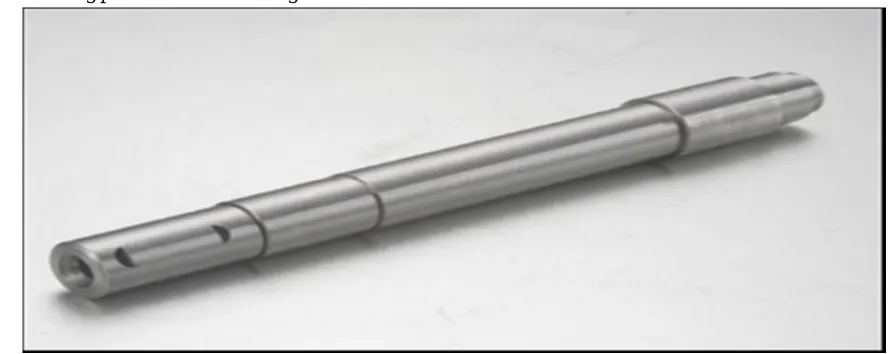
2) Shaft: Shaft is a common and important machine element. It is a rotating member, in general, has a circular cross-section and is used to transmit power. The shaft may be hollow or solid. The shaft is supported on bearings and it rotates a set of gears or pulleys for the purpose of power transmission. It is made of the ferrous, non-ferrous materials and non-metals are used as shaft material depending on the application. The shaft diameter is 20mm. The height of the shaft is 700mm for the Axle wheel and the shaft of the cutting part is of 300mm in height.
[image:6.612.101.545.544.721.2]
3) Washer: A washer is a thin plate (typically disk-shaped) with a hole (typically in the middle) that is normally used to distribute the load of a threaded fastener such as a screw or nut. Other uses are as a spacer, spring (wave washer), wear pad, preload indicating device, locking device, and to reduce vibration rubber washer.
4) Nut and Bolt: As nuts and bolts are not perfectly rigid, but stretch slightly under load, the distribution of stress on the threads is not uniform. In fact, on a theoretically infinitely long bolt, the first thread takes a third of the load, the first three threads take three-quarters of the load, and the first six threads take essentially the whole load.
5) Battery: An electric battery is a device consisting of one or more electrochemical cells that convert stored chemical energy into electrical energy. Each cell contains a positive terminal, or cathode, and a negative terminal, or anode. Electrolytes allow ions to move between the electrodes and terminals, which allows current to flow out of the battery to perform work.
[image:7.612.176.437.263.441.2]6) IR Transmitter And IR Receiver Sensor: The IR transmitting circuit is used in many projects. The IR transmitter sends 40 kHz (frequency can be adjusted) carrier control. IR carriers at around 40 kHz carrier frequencies are widely used in TV remote controlling and ICs for receiving these signals are quite easily available. The transmitted signal reflected by the obstacle and the IR receiver circuit receives the signal and giving control signal to the control unit. The control unit activates the weeding cutter & motor system.
Figure 3.6 IR Sensor
7) Wheels: A wheel is a circular component that is intended to rotate on an axle bearing. The wheel is one of the main components of the wheel and axle which is one of the six simple machines. Wheels, in conjunction with axles, allow heavy objects to be moved easily facilitating movement or transportation while supporting a load, or performing labor in machines
8) Motor: An electric motor is an electrical machine that converts electrical energy into mechanical energy. A motor controllers a device that serves to govern in some predetermined manner the performance. The motor rotates in clockwise as well as in anti-clockwise direction. Motor needs electricity for its functioning.
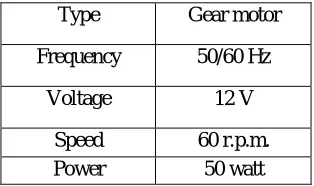
Table No. 3.1. Specification of motor Type Gear motor
Frequency 50/60 Hz
Voltage 12 V
Speed 60 r.p.m. Power 50 watt
C. Working Principles
There are only two major principles on which system generally works:
1) Electronic Sensing for automatic actuation of the machine
[image:7.612.228.385.559.652.2]D. Working of the Model
This project consists of weeder/cutter which is mounted on end side of movable trailer platform on M.S. frame. The two rotary weed cutters are mounted at the bottom side of the rotary disc. When we required operating the weed cutter/remover, we can push the weeder trolley in forward direction. When there is sensing of crop/bushes due to proximity sensor it supply signal to electric motor. Due to this electric motor is on and rotates the weed cutter by using chain drive in circular around the crop/bushes to weed the unwanted crops around the main trees. After one rotation of weeder blade the motor will stop. This weeder is operated by using electric geared motor & proximity sensor with the application of batteries. The weeding trailer either attached to tractor or operated manually for giving forward weeding motion.
Figure 3.7 Set Up of Automatic Inrter-Row Weeding Machine
IV.RESULTSANDDISCUSSION
The main goal of the work proposed is to signify an innovative concept. For this, certain useful data are extracted from our theoretical model, and a calculation on the deviation percentage derived from the standard calculated values is deliberated as follows.
The testing are been conducted in cabbage field for which the following observations are made: Observation made for 5 kg of load on the machine.
Time Required to cut 1 Plant = 30sec No. of plants in 1 Acre of land Approx. = 1500 plants
which gives the resultant time of = 30 x 1500 = 45000 sec therefore time required in hrs =
By conventional method,
Time required to cut the 1 acre of land
No. of labor required for work = 5 labor working hrs/ day = 8 hrs/ day
= 4 x 8 = 32hrs for 5 labors
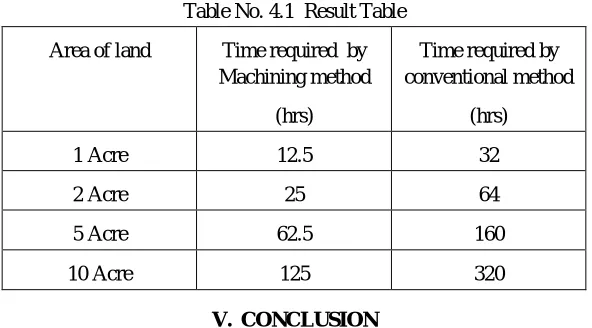
Therefore time required to working for same field is less by Machining method then conventional method.
[image:9.612.159.455.195.359.2]A. Result Table
Table No. 4.1 Result Table
Area of land Time required by Machining method
(hrs)
Time required by conventional method
(hrs)
1 Acre 12.5 32
2 Acre 25 64
5 Acre 62.5 160
10 Acre 125 320
V. CONCLUSION
We had enormous practical experience on fulfillment of the manufacturing schedules of the working project model. We are therefore, happy to state that the in calculation of mechanical aptitude proved to be a very useful purpose. Although the design criterions imposed challenging problems which, however were overcome by us due to availability of good reference books. The selection of choice raw materials helped us in machining of the various components to very close tolerance and thereby minimizing the level of balancing problem. Needless to emphasis here that we had lift no stone unturned in our potential efforts during machining, fabrication and assembly work of the project model to our entire satisfaction to solve the problem in agricultural field for social welfare.
VI.ACKNOWLEDGMENT
We wish to express our gratitude to all those who provided help and cooperation in various ways at the different stages for this research paper. Also, we would like to express our sincere appreciation to principal of Loknete Gopinathji Munde Institute of Engineering Education & Research Dr.K. V. Chandratrae, Head of Mechanical Department Prof. R. R. Chakule.
REFERENCES
[1] Sridhar.H .S, “Development Of Single Wheel Multi Use Manually Operated Weed Remover” International Journal of Modern Engineering Researc (IJMER),
Vol. 3, Issue. 6, Nov - Dec. 2013.
[2] Olaoye, J. O. And T. A. Adekanye, “Development And Evaluation Of A Rotary Power Weeder” International Journal of Agricultural and Biological
Engineering, Vol-3, Issue-3, 18 August 2010
[3] D A Mortensen, L Bastiaans & M Sattin, “The Role Of Ecology In The Development of Weed Management Systems” An Innternational Journal of Weed
Biology, Ecology and Vegetation Management, 05 January 2002.
[4] Krishna A. Madalli, Maruti B, Labbi, Mallikarjun J Kanoj, Mahantesh Mirji M. "Mechanical Weeder" B V Bhoomaraddi College Of Engineering And
Technology, Hubballi, Project Reference No. 39s_Be_1232
[5] Wakchaure Prakash, Wakchaure Shamli, Wani Priyanka, Parhad Kalpana, Arote Dnyaneshwar, “Design and Development of Automated Farm Weeding
Machine” IJARIIE-ISSN(O)-2395-4396, Vol-3 Issue-2 2017
[6] Akhtar Ali Rizvi, Aqib Naque, Amogh v. Tijarem, A. B. Tupkar, “Design & Development and Fabrication of Soil Tiller and Weeder” International Journal of
Innovations in Engineering and Technology (IJIET), Vol. 2 Issue 2 April 2013.
[7] Thorat Deepak Sabaji, P. K. Sahoo, Dipankar D. and Mir Asif Iqueba “Design And Development Of Ridge Profile Power Weeder” Journal of Agricultural
Engineering, Vol. 51 (4), October-December, 2014
[8] Olawale John, Olukunlea, Philip Oguntundea, “Design of a Row Crop Weeder” Prosperity and Poverty in a Globalised World Challenges for Agricultural
Research October 11-13, 2006
A. Books