Shallow Discourse Parsing with Syntactic and (a Few) Semantic Features
Shubham Mukherjee, Abhishek Tiwari, Mohit Gupta and Anil Kumar Singh
Department of Computer Science and Engineering Indian Institute of Technology (BHU), Varanasi, India {shubham.mukherjee.cse11,abhishek.ktiwari.cse11,
mohit.gupta.cse11,aksingh.cse}@iitbhu.ac.in
Abstract
Discourse parsing is a challenging task and is crucial for discourse analysis. In this paper, we focus on labelling argument spans of discourse connectives and sense identification in the CoNLL-2015 shared task setting. We have used syntactic fea-tures and have also tried a few semantic features. We employ a pipeline of classi-fiers, where the best features and parame-ters were selected for each individual clas-sifier, based on experimental evaluation. We could only get results somewhat bet-ter than of the baseline on the overall task, but the results over some of the sub-tasks are encouraging. Our initial efforts at us-ing semantic features do not seem to help.
1 Introduction
Different natural language constructs are depen-dent on each other to form a coherent discourse. Extraction of discourse relations is a challeng-ing task. Interest in discourse parschalleng-ing has in-creased after the release of the Penn Discourse TreeBank (PDTB) (Miltsakaki et al., 2004). Shal-low discourse parsing involves classifying con-nectives, relation classification and labelling ar-gument spans, the last of which is considerably harder.
Previously, an end-to-end model by Lin et al. (2014) was developed which used only syn-tactic features from parse trees and improved the discourse parser performance. In our paper, we have constructed an analogous pipeline of classi-fiers which extracts the shallow discourse informa-tion based on the PDTB based annotainforma-tion scheme. However, since discourse relations directly affect the semantic understanding of the text, the use of semantic features can prove useful if explored. We tried to use a few such features, though without
much success. Implicit relations were handled us-ing a heuristic-based baseline parser.
2 Resources and Corpus
For our purposes, we needed syntactic parse trees for the extraction of syntactic features, for which we used the PDTB corpus. These features were used for training each classifier stage of the pipeline.
The PDTB is the first large-scale corpus includ-ing a million words taken from the Wall Street Journal (Miltsakaki et al., 2004) and is based on the observation that no discourse relations in any language have been identified with more than two arguments. It uses the connective as the predicate, and the two text spans as the predicate’s argument. Specifically, the span syntactically attached to the connective is Arg1 and the second span is Arg2.
The relative position of the Arg1 and Arg2 can appear in any order, at any distance to each other, although the position of Arg2 is fixed once the connective is identified in case of explicit rela-tions. There are distribution statistics from (Milt-sakaki et al., 2004) which will prove beneficial in our algorithm. For example, in explicit relations, Arg1 precedes Arg2 39.51% of times and lies in the same sentence 60.38% of the times. Even when Arg1 precedes Arg2, 79.9% of cases are with adjacent sentences. Also, almost all (96.8%) of the implicit cases are where Arg1 precedes Arg2.
For our experiments, we required syntactic fea-tures derived from parse trees, along with semantic features. Tokenisation was based on the gold stan-dard PTB tree structure. The parsed trees, which were provided by CoNLL-2015 shared task or-ganisers, were created by the Berkeley parser and were provided in thejsonformat.
We did not use any other resources.
3 Related Work
Argument labelling can be done by locating parts within an argument, or by labelling the entire span, the latter being the preferred method. Explicit connective classification is usually done before-hand. (Pitler and Nenkova, 2009) achieved an F-Score of 94.19% which was extended by (Lin et al., 2014) to get an F-score of 95.36%.
Various approaches have been used for argu-ment span labelling. (Ghosh et al., 2014) used a linear tagging approach based on Conditional Random Fields. (Lin et al., 2014), however, used a completely different approach using argument node classification within the syntax tree. Our ap-proach resembles the architecture used by (Lin et al., 2014), with the addition of a few semantic features. Surprisingly, semantic features have not been tried for this task.
A hybrid approach was explored by (Kong et al., 2014) taking advantages of both the linear tag-ging and sub-tree extraction by using a constituent based approach. In contrast, we employ the idea of integrating additional heuristic and semantic fea-tures at different points in the pipeline.
For non-explicit relations, (Lin et al., 2009) have used word-pair features, which was the Cartesian product of all words from Arg1 and Arg2. Simple heuristic-based approaches have also shown reasonably high accuracy (Xue et al., 2015).
4 An Overview of Our Approach
Similar to the Lin et. al. (2014) model, we em-ployed use a pipeline of classifiers, namely Ex-plicit Connective Classifier, Argument Position Classifier, Argument Identifier and Sense Classi-fier. We used a seperate but linked parser for non-explicit cases. Given only the raw text of the sen-tence(s) and their parse trees, we attempt to deter-mine:
1. Whether the sentence(s) have discourse rela-tion present. And if so, the locarela-tion of the connective in case of explicit relations.
2. The Argument span of the two arguments in terms of token numbers.
3. The sense of the discourse relation.
For this purpose, we employed a modular ap-proach, building classifiers for each stage of the
process. Each module effectively performs a clas-sification task.
Each classifier was trained individually with the inclusion of heuristics and a variety of features. Evaluation after each modification enabled selec-tion of better parameters for that particular mod-ule. In particular, the methodology used for con-nective matching and usage of the uncovered sets is explained in sections 5.1 and 8, respectively. We also explored the use of semantic features at each stage.
5 Explicit Connective Classification
Explicit connective classification involves two steps: (a) matching all the occurrences of the con-nective and (b) disambiguating them as discourse vs. non-discourse. We have used the set of 99 con-nective heads from the PDTB Annotation Manual1 (2007) to match the connectives and then classi-fied them based on the features extracted from the connective.
5.1 Connective Matching
The PDTB Annotation Manual gives an exhaus-tive list of 99 connecexhaus-tive heads, based on which we generated rules for extracting occurrences of each of the connectives (such asand,or,thereforeetc.). As a prepossessing step in the training dataset, the entire connective span was first mapped to the con-nective heads using a mapper script for cases like “either... or” and “if... then”, which had to be treated separately by considering the entire seg-ment as a whole. This method ensures that all con-nectives are identified exhaustively and the train-ing process improves.
5.2 Features Used
(Lin et al., 2014) used an extension of the syntac-tic features used by (Pitler and Nenkova, 2009), which resulted in a higher F-score of 95.36%. They were extracted after generating appropriate graphical representation of the parse tree2. We em-ployed the same features, along with a few seman-tic features (see section 7).
1http://www.seas.upenn.edu/˜pdtb/
PDTBAPI/pdtb-annotation-manual.pdf
2Python NLTK library was used for all syntax features in
6 Argument Identification with Additional Heuristics
Argument identification is directly dependent on the relative position of the arguments as shown by (Lin et al., 2014). For Arg1 occurring before Arg2 (the PS class), a baseline parser with the assump-tion of adjacent sentences was used. This is mo-tivated by the fact that 79.9% of cases within the PS class lie in this category. Extension of the same logic was used for non-explicit discourse relations as described in section 8. Where both arguments occur in the same sentence (the SS class) (Lin et al., 2014) used node classification with syntac-tic parse tree. In our system, we used additional heuristics observed from manual observations of incorrect cases.
After applying the implementation, we manu-ally observed each case in the training set where there was a mismatch between the expected and predicted results. Observations showed that the Arg1 node tends to appear towards the root of the sentence encompassing the entire sentence. And the Arg2 node often tends to appear towards the leaf nodes.
Although in some cases the Arg1 node may in-deed be the root of the syntax tree, but those cases were infrequent. Hence, after altering the algo-rithm to specifically avoid any of the above men-tioned scenarios, the results showed marginal but noticeable improvement in both arg1 and arg2 per-formance. F-Score of the Arg1 node detection im-proved by 2.14% and the corresponding score for the Arg2 node improved by 0.1%.
7 Use of Semantic Features
All the related work referred to in this paper only used syntactic features for every classifier. Intu-itively speaking, there seems to be a good case for using semantic features, in addition to syntac-tic features. However, the extraction of semansyntac-tic features from raw text is comparatively hard.
Many semantic features also tend to be incon-sistent or sparse. Features detected in one sentence may be completely absent in a large majority of sentences, leading to ineffective features.
7.1 The Boxer Tool
The C&C tool Boxer (Bos, 2014), developed by Johan Bos, is a toolkit for creating the semantic representation of sentences, developed by Johan Bos. Boxer is capable of extracting features from
the majority of sentences, although it has some limitations. Boxer works by chunking the sen-tence into blocks or ‘boxes’ and then subsequently identifying semantic relations between them. The Boxer tool also marks the tokens of specific se-mantic roles such as agent, patient etc. We only used the features which were more commonly oc-curring. These were: the POS tag of the agent’s token, the theme’s token and the patient’s token. We used the POS tags instead of the tokens them-selves because tags are more general whereas to-kens become too specific (with lower frequencies). Based on results and on more reflection we realize that this choice was not well motivated.
7.2 Application of Features
As mentioned in section 4, we tried the integra-tion of semantic features at each feasible point in the pipeline and tested the results. Since labelling of Arg1 and Arg2 nodes is done through node-wise feature extraction, semantic features, which are extracted from a sentence as a whole, could not be easily integrated. Semantic features were included in two classifier stages: (a) the argument position classifier and (b) the sense classifier. This was the best combination we could get for seman-tic features. However, the integration of these ad-ditional features did not improve the overall per-formance. Instead, there was a 1.1% decrease in the overall parser F1 score. The inability of the semantic features to improve the classifier perfor-mance can be attributed to the fact that the particu-lar features used had high correlation with syntac-tic features.
8 Non-explicit Identification
We have used a simple heuristic-based baseline parser as done by Lin et al. (2014) for implicit con-nectives. The parser is based on the adjacent sen-tence argument assumption mentioned in section 6. This is motivated by the fact that non-explicit relation also have a majority of cases in this cate-gory, akin to the PS case for explicit relations.
Classifier Precision Recall F1 Score Type of Classifier Connective Classifier 91.76% 91.70% 91.73% Maximum-Entropy
Argument Position 98.79% 97.11% 97.94% Maximum-Entropy
Argument Position + Semantic Features 97.61% 93.18% 95.34% Naive-Bayesian Argument Extraction (Arg1 + Arg2) 21.89% 34.47% 26.78% Maximum-Entropy
Sense 29.95% 6.33% 5.95% Maximum-Entropy
[image:4.595.113.485.65.135.2]Sense + Semantic Features 27.81% 5.39% 4.68% Naive-Bayesian
Table 1: Individual Classifier Analysis
Dev Set
Parameter Without Semantic Features With Semantic Features Blind Set Test Set
Arg 1 Arg2 extraction f1 26.78% 26.78% 21.71% 22.52%
Arg 1 Arg2 extraction precision 21.89% 21.89% 18.14% 18.19%
Arg 1 Arg2 extraction recall 34.46% 34.37% 27.05% 29.55%
Arg1 extraction f1 36.25% 36.25% 32.2% 32.7%
Arg1 extraction precision 29.63% 29.63% 26.9% 26.41%
Arg1 extraction recall 46.66% 46.66% 40.12% 42.91%
Arg2 extraction f1 49.82% 49.81% 48.87% 44.68%
Arg2 extraction precision 40.73% 40.73% 40.82% 36.1%
Arg2 extraction recall 64.14% 64.14% 60.88% 58.64%
Explicit connective f1 93.55% 93.55% 89.3% 93.06%
Explicit connective precision 95.41% 95.41% 91.67% 93.93%
Explicit connective recall 91.76% 91.76% 87.05% 92.2%
Sense f1 5.95% 4.68% 6.44% 7.17%
Sense precision 29.95% 27.81% 14.87% 25.67%
Sense recall 6.33% 5.39% 7.16% 8.05%
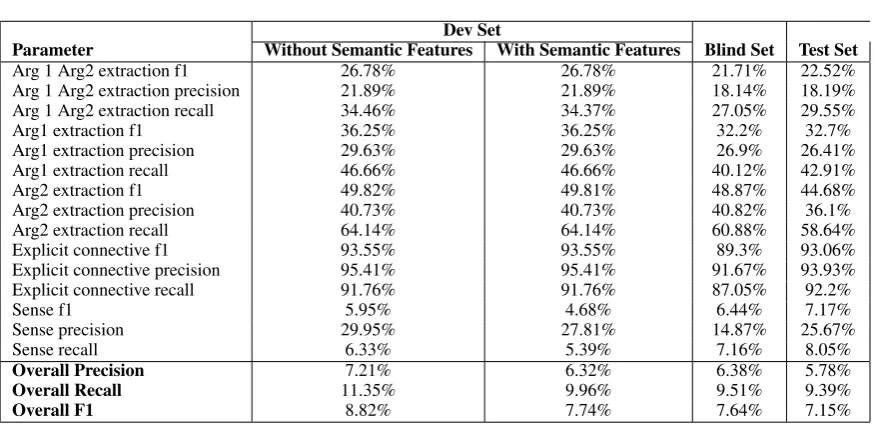
[image:4.595.81.520.161.375.2]Overall Precision 7.21% 6.32% 6.38% 5.78% Overall Recall 11.35% 9.96% 9.51% 9.39% Overall F1 8.82% 7.74% 7.64% 7.15%
Table 2: Overall Parser Performance for Explicit Connectives
sentences among these were then sense classified, along with the PS category explicit sentences.
9 Explicit Sense Classification
Sense classification is the final step in our model. (Lin et al., 2014) reported an F-Score of 86.77% using connective-based features over the PDTB corpus. The integration of semantic features was done as described in section 7. This degraded the F-Score by 1.3%. Thus, the use of (the few) se-mantic features with high correlation to syntactic features decreases the performance.
10 Evaluation
The pipeline architecture which was used had sev-eral classifiers, each of which was evaluated indi-vidually on two kinds of training models: (a) the Naive-Bayesian classifier and (b) the Maximum Entropy classifier. For each of the individual clas-sifiers, training and test sets were divided in a 4:1 ratio with a 5-fold cross-validation.
Table 1 presents the individual classifier results. Each phase was tested on the Naive-Bayesian and the Maximum Entropy classifiers. The better one for each sub-task is displayed. It should be noted
that sense classification was computed only when both Arg1 and Arg2 spans exactly matched. Sense classification with incorrect argument spans would not be a useful statistical measure.
The overall parser performance was also mea-sured when the complete end-to-end pipeline was implemented for sentences, accompanied by their corresponding syntactic parse trees and feature representations. Table 2 presents the overall best performance on the blind set after multiple trials on a sufficiently large subset of the PDTB cor-pus. It further compares performance of the over-all system with semantic features included vis-a-vis without them. The overall parser performance is only somewhat better (nearly double) than those of the baseline, but the sense classification recall, sense precision and Arg1 extraction precision are bringing down the overall F1 score, as the perfor-mance on other sub-tasks is relatively much better. We are investigating the cause for this.
11 Conclusion
[image:4.595.82.518.170.374.2]heuris-tics and a few semantic features obtained from the Boxer tool. The core idea is using syntactic and semantic features for classification and labelling. However, we were not able to get better results with the semantic features that we tried. We plan to explore more sophisticated semantic features. While our overall performance was relatively low, we did get good results for some of the sub-tasks. We will try to include more results in the final ver-sion of the paper.
References
Johan Bos. 2014. Open-domain semantic parsing with boxer. In Proceedings of the 20th Nordic Confer-ence of Computational Linguistics, pages 301–304. Sucheta Ghosh, Richard Johansson, Giuseppe
Ric-cardi, and Sara Tonelli. 2014. Shallow discourse parsing with conditional random fields. In Proceed-ings of the 5th International Joint Conference on Natural Language Processing.
Fang Kong, Hwee Tou Ng, and Guodong Zhou. 2014. A constituent-based approach to argument labeling with joint inference in discourse parsing. In Pro-ceedings of the 2014 Conference on Empirical Meth-ods in Natural Language Processing (EMNLP).
Ziheng Lin, Min-Yen Kan, and Hwee Tou Ng. 2009. Recognizing implicit discourse relations in the penn discourse treebank. InProceedings of the 2009 Con-ference on Empirical Methods in Natural Language Processing.
Ziheng Lin, Hwee Tou Ng, and Min-Yen Kan. 2014. A pdtb-styled end-to-end discourse parser. Natural Language Engineering, Cambridge Univ Press.
Leni Miltsakaki, Rashmi Prasad, Aravind Joshi, and Bonnie Webber. 2004. The penn discourse tree-bank. In Proceedings of the Fourth International Conference on Language Resources and Evaluation.
Emily Pitler and Ani Nenkova. 2009. Using syntax to disambiguate explicit discourse connectives in text.
In Proceedings of the ACL-IJCNLP 2009
Confer-ence Short Papers.
Nianwen Xue, Hwee Tou Ng, Sameer Pradhan, Rashmi Prasad, Christopher Bryant, and Attapol Ruther-ford. 2015. The conll-2015 shared task on shal-low discourse parsing. InProceedings of the Nine-teenth Conference on Computational Natural