Effect of Cu on the Precipitation of Deleterious Phases and the Mechanical
Properties of 27Cr
7Ni Hyper Duplex Stainless Steels
Soon-Hyeok Jeon, Il-Jeong Park, Hye-Jin Kim, Soon-Tae Kim,
Young-Kook Lee and Yong-Soo Park
+Department of Material Science and Engineering, Yonsei University, 134 Shinchon-dong, Seodaemun-gu, Seoul 120-749, Republic of Korea
Cu addition to the base alloy reduces the total amount of deleterious phases such as chromium nitride and sigma and chi phases. In particular, Cu addition to the base alloy results in pronounced suppression of the amount of sigma phase whereas it slightly facilitates the precipitation of chromium nitride and chi phase along the phase boundaries and within ferrite grains. During the initial stage of aging, the preferential precipitation of chromium nitride and chi phase seems to be closely associated with the retardation of the precipitation of the sigma phase. The preferential precipitation of chromium nitride and the chi phase inhibits the nucleation and growth of the sigma phase by depleting the Cr adjacent to the chromium nitride particles and depleting the Mo and W adjacent to the chi phase. Thus, the addition of Cu to the base alloy reduces its embrittlement owing to the delayed precipitation of these deleterious phases. [doi:10.2320/matertrans.M2013471]
(Received December 26, 2013; Accepted March 26, 2014; Published May 2, 2014)
Keywords: copper, duplex stainless steel, sigma phase, chi phase, chromium nitride
1. Introduction
Super duplex stainless steels (SDSSs) are increasingly being used in various applications, including in power plants, desalination facilities, and chemical plants. This is owing to their high resistance to pitting and crevice corrosion, excellent mechanical properties, and relatively low cost, in contrast to other high performance materials such as super austenite stainless steels.13)
However, when used in shell and tube exchangers, SDSSs exhibit corrosion resistance that is insufficient to allow for high temperature operations and a long service life. Hence, hyper duplex stainless steels (HDSSs), which exhibit high resistance to pitting corrosion, combined with improved mechanical properties, have been developed.
When duplex stainless steels (DSSs) are aged at 600 950°C, deleterious phases such as chromium nitride, as well as secondary (i.e., sigma (·) and chi (»)) phases, tend to precipitate in them.49)This precipitation of secondary phases and chromium nitride leads to a significant reduction in the corrosion resistance of the steels as well as a deterioration of their mechanical properties owing to their inherent brittleness and the formation of Cr-, Mo-, and W-depleted regions around the phases.1015)
DSSs contain a significant amount of Cr, Mo, and W which improves corrosion resistance. These alloying ele-ments facilitate precipitation of secondary phases such as the · and » phases. In addition, for DSSs, the tendency to secondary phases precipitation is crucial since the existence of the ferrite (¡) phase will enhance the kinetics for precipitation of secondary phases. The secondary phases preferentially precipitate into the ¡ phase due to the higher Cr and Mo concentration in the ¡ phase.16) A fundamental reason why the secondary phases preferentially grow into the
¡phase is that the¡phase is thermodynamically meta-stable at temperature where the secondary phases precipitate.17,18)In
addition, the diffusion rates of the alloying elements in the¡
phase are 100 times faster than the corresponding values in the austenite (£) phase.19,20)
The effects of various alloying elements on the precip-itation of secondary phases such as·and»phases have been investigated previously. The addition of C and N in ferritic stainless steels (FSSs) retards the formation of the·phase by increasing the incubation period.21)The addition of N reduces
the tendency of · phase formation in the ¡ phase since it results in the removal of Cr from the solution through the formation of chromium nitride.22)Kimet al.23)reported that
the addition of a small amount of Ce (55110 ppm) to HDSSs results in the homogeneous distribution of Ce in the alloy matrix and delays the precipitation of secondary phases by reducing the diffusion rates of Cr, Mo, and W. Parket al.24)
showed that partially substituting W for Mo retarded the formation of the·phase in FSSs. This was due to an increase in the tendency of formation of a » phase with a higher nucleation efficiency and lower growth rate than those of the
· phase. Nana and Cortie25)reported that the addition of Cu in FSSs suppresses the precipitation of the·phase since the excessive Cu is shifted away from the reaction¡/·interface. Smuket al.26) showed that the addition of Cu results in Cu
precipitates in the ¡ phase during slow cooling and retards the precipitation of the · phase; this is due to the fact that the Cu precipitates pin the moving · phase boundaries in DSSs.
However, the effects of Cu addition on the precipitation of chromium nitride and the· and »phases as well as on the mechanical properties of HDSSs have not yet been inves-tigated. In particular, the mechanisms by which the addition of Cu affects the precipitation of chromium nitride and the· and»phases in HDSSs during the initial stage of aging have not been elucidated.
Therefore, in this study, we employed focused ion beam (FIB) milling and transmission electron microscopy (TEM) to study the microstructural changes induced in HDSSs during the initial aging stage by the addition of Cu. The FIB milling technique was used to fabricate the TEM samples, allowing us to prepare samples from specific sites of interest such that
+Corresponding author, E-mail: corrus@yonsei.ac.kr
the precipitation behavior of chromium nitride and · and
» phase could be investigated in depth. This is permitted for greater flexibility in the TEM-based measurements. In addition, to elucidate the effects of Cu addition on the precipitation of chromium nitride and the · and » phases as well as the mechanical properties of HDSSs, X-ray diffraction (XRD) analysis, scanning electron microscope-energy dispersive X-ray spectroscopy (SEM-EDS) analyses, and TEM-EDS, image analysis, tensile tests were also performed.
2. Experimental Procedures
Ingots weighing 50 kg with dimensions 150 by 150 by 300 mm (width by length by height) were manufactured using a high frequency vacuum induction furnace. After these ingots were hot rolled in the range of 1333 to 1523 K, plates of 6 mm thickness were manufactured. The chemical compositions of the alloys are presented in Table 1. The experimental alloys were cut and solution heat-treated for 5 min per 1 mm thickness at 1363 K and then quenched in water. The specimens were then isothermally aged at 1123 K for 10 and 30 min.
To observe the microstructures of the alloys, they were ground to 2000 grit using SiC abrasive papers, polished surface using diamond paste. The sample was ultrasonic cleaned in acetone and distilled water to remove any impurities from the polished surface of the sample. The · and » phases and chromium nitrides were observed using SEM in backscattered electron mode (BSE). In addition, the chemical compositions of the secondary phases and chro-mium nitrides were analyzed by an EDS attached to the SEM. XRD analysis was performed on specimens containing a relatively large fraction of precipitates for the phase identification. FIB milling technique for the preparation of TEM specimens was conducted. The»phase and chromium nitrides were analyzed using a TEM. The line profiles of the Cr, Mo and W in the » phase and chromium nitrides were measured using an EDS attached to the TEM.
Tensile tests were conducted at room temperature to investigate the effects of secondary phases on the ductility of the alloys under constant strain rate of 0.01/s. Tensile specimens were cut parallel to the rolling direction of the sheets 3 mm thick with a gage section 25 mm long and 6.35 mm wide.
3. Results and Discussion
3.1 Microstructures
Figure 1 shows the microstructures of solution-annealed alloy specimens and aged alloy specimens at 1123 K for 10 and 30 min. The solution-annealed alloy specimens had £ phase and ¡ phase without secondary phases. The £ phase can be seen as an isolated phase on the background of the
[image:2.595.102.494.69.262.2]¡ phase, which looks relatively dark (Figs. 1(a) and 1(d)). Meanwhile, after the specimens had being aged at 1123 K for 10 min, it was found that precipitates were formed in the specimens and that these precipitates formed continuous networks along the grain boundaries while also appearing randomly within the grains (Figs. 1(b) and 1(e)). These precipitates were revealed the » and· phases and chemical compositions of these were confirmed by SEM-EDS analy-ses, as shown in Table 2. Only precipitates greater than 1 µm in size were selected in order to minimize the influence of the matrix on the analysis results. A few precipitates of the » phases formed continuously along the phase boundaries between the £ and ¡ phases, and the · phase appeared randomly within the grain of the¡phase, in keeping with the eutectoid reaction. In the case of the specimens that were aged at 1123 K for 30 min (Figs. 1(c) and 1(f )), the total size
Table 1 Chemical compositions of the experimental alloys (mass%).
Alloy C Cr Ni Mo W Si Mn Cu S N Fe
Base 0.020 27.01 7.00 2.52 3.28 0.35 0.88 ® 0.003 0.35 Bal.
1.5Cu 0.017 26.91 6.59 2.50 3.30 0.33 0.94 1.45 0.004 0.38 Bal.
35 μm σ
χ
σ χ
σ χ
σ
χ
35 μm
35 μm 35 μm
Base alloy-10 min. Base alloy-30 min.
1.5Cu alloy-10 min. 1.5Cu alloy-30 min.
(c)
(e) (f)
35 μm 1.5Cu alloy-solution annealed
(b)
35 μm Base alloy-solution annealed
(a)
α γ
α γ
(d)
[image:2.595.304.550.341.386.2]of the secondary (»+·) phases at the grain boundaries as well as that within the ¡ grains increased. Although the secondary (»+·) phases grew further in both the exper-imental alloys, the precipitation rate and type of secondary phases in the case of the base alloy were different from that in the case of the 1.5Cu alloy. In particular, in the case of the base alloy, in numerous instance, the· phase formed within the¡grains and the»phase precipitated continuously along the boundaries between the£and¡phases. However, in the case of the 1.5Cu alloy, the · phases did not grow to a significant degree at the grain boundaries and within the ¡ grains, but, in a number of instances, the»phase grew further along the phase boundaries between £ and ¡ phases and within the¡grains. In a previous study, it was found that the addition of Cu to the HDSSs facilitates the precipitation rate of » phase owing to the increase in the activity of W and retards the precipitation of· phase owing to the decrease in the activity of Mo.27)
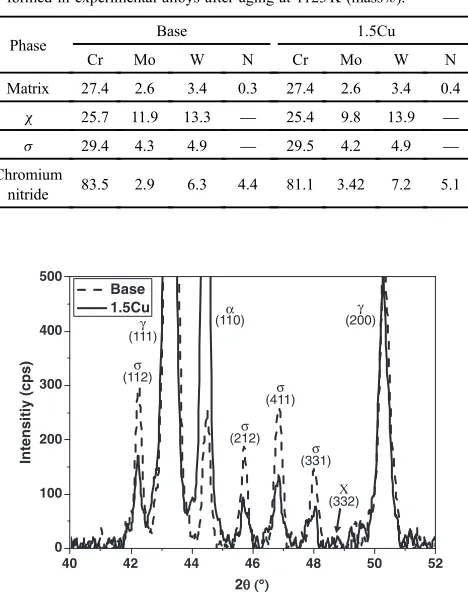
Figure 2 shows the XRD analysis of the alloys aged at 1123 K for 30 min. With increasing aging time, the peak of
¡ phase is led to become lower conspicuously, gradually deriving·phase. After aging at 1123 K for 30 min, the peak of·phase of the base alloy is higher than that of 1.5Cu alloy. On the other hand, the peak of »phase of the base alloy is lower than that of 1.5Cu alloy. Small amounts of · and » phases are not detected by XRD analysis due to overlap between secondary phases with¡phase and, mainly,£phase reflections. Nevertheless, the · phase reflections such as (112), (212), (411) and (331) are led to become higher conspicuously.
Figure 3 shows SEM-BSE images of chromium nitride particles in the alloy specimens aged at 1123 K for 10 and 30 min. In the case of the base alloy, in numerous instances, the · phase formed within the ¡ grains and the » phase precipitated continuously along the boundaries between the£ and¡phases. In addition, a few rounded and acicular nitride particles precipitated continuously along the phase bounda-ries (Figs. 3(a) and 3(b)). The results of the SEM-EDS analyses indicated that these rounded and acicular nitride particles were of chromium nitride; this was owing to the fact their Cr content was much higher than that of the matrix. The chemical composition of the chromium nitride particles as determined by the SEM-EDS analyses is listed in Table 2. The precipitation rate and type of the secondary (»+·) phases and chromium nitride particles in the base alloy, however, were different from those in the case of the 1.5Cu alloy. In the case of the 1.5Cu alloy, the·phase did not grow to a significant degree at the grain boundaries or within the¡ grains; instead, in a number of instance, the » phase and chromium nitride particles precipitated along the boundaries between the£and¡phases and within the¡grains (Figs. 3(c) and 3(d)). It is known that chromium nitride particles nucleate at¡/£phase boundaries and within¡grains as well as at ¡ grain boundaries (¡/¡) in the ¡ phase.2830) Further, the · phase did not form or grow at the phase boundaries where the preferential precipitation of chromium nitride and the»phase occurred. This result confirmed that the preferential precip-itation of chromium nitride and the » phase in the experimental alloys inhibited the nucleation and growth of the·phase. The addition of Cu to the base alloy significantly suppresses the extent of the·phase; this is due to the number of precipitated chromium nitride particles and the»phase. In a previous study, it was found that the addition of Cu to the HDSSs facilitates the precipitation of chromium nitride and stabilizes the alloy at high temperatures owing to the increase in the activity of Cr.31)
Figure 4 shows a TEM bright-field image, SAED pattern, and the result of the line analysis of the»phase in the 1.5Cu alloy specimens aged at 1123 K for 10 min. The results of the TEM analysis demonstrated that the precipitates were » phases in the 1.5Cu alloy specimens aged at 1123 K for 10 min (Fig. 4(a)). Based on the SAED pattern (Fig. 4(b)), the» phase has a body centered cubic (BCC) structure. Mo and W-depleted zones adjacent to the»phase were observed (Fig. 4(c)). The results show that» phases leads to Mo and W-depleted areas at the interfaces between the matrix and the
»phases.
[image:3.595.54.288.87.384.2]Figure 5 shows a TEM bright-field image, Selected Area Electron Diffraction (SAED) pattern, and the result of the line analysis of the chromium nitride in the 1.5Cu alloy specimens aged at 1123 K for 10 min. The results of the TEM analysis demonstrate that the precipitates were chromium nitride particles in the 1.5Cu alloy specimens aged at 1123 K for 10 min (Fig. 5(a)). Based on the SAED pattern (Fig. 5(b)), we realized that the chromium nitride had a hexagonal close packed (HCP) structure. A Cr-depleted zone adjacent to the chromium nitride was observed (Fig. 5(c)). The results indicate that the formation of chromium nitride particles leads to Cr-depleted areas at the interfaces between the matrix and the chromium nitride particles.
Table 2 Chemical compositions of the»and·phase and chromium nitride formed in experimental alloys after aging at 1123 K (mass%).
Phase Base 1.5Cu
Cr Mo W N Cr Mo W N
Matrix 27.4 2.6 3.4 0.3 27.4 2.6 3.4 0.4
» 25.7 11.9 13.3 ® 25.4 9.8 13.9 ®
· 29.4 4.3 4.9 ® 29.5 4.2 4.9 ®
Chromium
nitride 83.5 2.9 6.3 4.4 81.1 3.42 7.2 5.1
γ (200) α
(110) γ
(111)
σ (112)
σ (411)
σ (212)
σ (331)
Χ (332)
40 42 44 46 48 50 52 0
100 200 300 400 500
Intensitiy (cps)
2θ (°) Base
1.5Cu
The preferential precipitation of chromium nitride and the
»phase seems to be closely associated with the retardation of the precipitation of the · phase. As was found during the previous metallographic observations, the preferential pre-cipitation of chromium nitride and the»phase occurred along the phase boundaries and within the ¡ grains. In particular, the » phase develops from the · phase, which acts as a precursor. Thus, the formation of the· phase is significantly
influenced by the chemical compositions of the» phase and chromium nitride. Since the formation of the· phase in the experimental alloys requires high concentrations of Cr, Mo and W, the preferential precipitation of chromium nitride and the » phase in the alloys during the initial stage of aging inhibits the nucleation and growth of the·phase owing to the depletion of the Cr adjacent to the chromium nitride particles as well as the depletion of the Mo and W adjacent to the »
(c)
0 2 4 6 8 10 12 14 16 18 20
Concentration of W (mass %)
Distance, D/nm
W depleted zone
-100 -75 -50 -25 0 25 50 75 100 -100 -75 -50 -25 0 25 50 75 100
0 2 4 6 8 10 12 14 16 18 20
Concentration of Mo (mass %)
Distance, D/nm
Mo depleted zone
100 nm
(a)
(113)
(110)
P113
χ(BCC)
(b)
χ
Fig. 4 TEM analyses of chi phase in the 1.5Cu alloy aged at 1123 K for 10 min: (a) the brightfield images, (b) Selected Area Electron Diffraction (SAED) pattern and (c) the line analysis of Mo and W adjacent to chi phase.
Cr2N
σ
χ
Cr2N
σ
χ
5 μm
5 μm
Cr2N
σ χ
5 μm Cr2N
σ
χ
5 μm
(a)
(b)
(c)
(d)
Base alloy-10 min. Base alloy-30 min.
1.5Cu alloy-10 min. 1.5Cu alloy-30 min.
[image:4.595.111.487.69.349.2] [image:4.595.152.443.409.642.2]phase. In the initial stage of chromium nitride and the»phase formation, the · phase formed is small in size, because the amount of Cr, Mo, and W present for·phase formation are insufficient around the chromium nitride particle, which have a very high Cr content, as well as around the»phase, which has very high W and Mo contents. The addition of Cu to the base alloy significantly suppresses the extent of the·phase, owing to the number of precipitated chromium nitride particles and the » phase. Park et al.24) have reported that the preferential precipitation of the » phase in the FSSs during the initial stage of aging can inhibit the nucleation and growth of the·phase, owing to depletion of the Mo and W adjacent to the»phase.
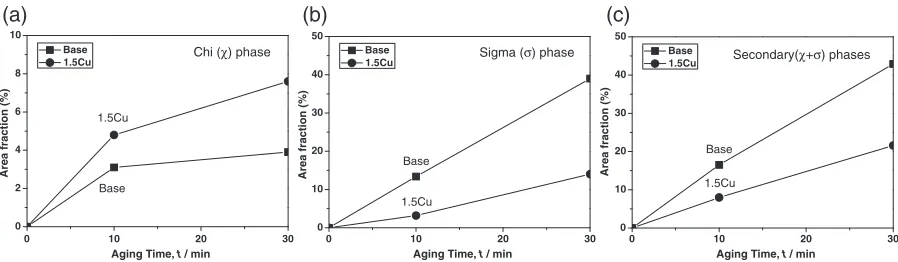
Figure 6 shows the effects of Cu addition and aging at 1123 K on the area fraction of the» phase, the·phase and the total secondary (»+·) phases in the experimental alloys by computer based image analyzing system. Ten randomly dispersed BSE images were used for the quantitative measurement of the phase fraction. In BSE image, the secondary phases embedded in the¡phase had a high Cr, Mo and W content, and produced bright shadeds, such as light grey (·) and white (»), respectively. With an increase in the aging time, the area fraction of the » phase precipitated in the 1.5Cu alloy becomes much higher than that in the base alloy (Fig. 6(a)). However, the area fraction of the · phase precipitated in the base alloy is higher than that in the 1.5Cu alloy (Fig. 6(b)). Figure 6(c) shows that the area fraction of the total secondary phases (»+·) precipitated in the base alloy was much higher than that in the 1.5Cu alloy. In summary, as the aging time is increased, the addition of Cu
to the base alloy reduces the extent of the secondary phases (»+·). In particular, the addition of Cu to the base alloy significantly suppresses the extent of the · phase whereas it slightly increases that of the»phase. This result suggests that adding Cu to the base alloy effectively retards the precipitation of the deleterious phases.
3.2 Effect of Cu addition on mechanical properties
Tensile tests were performed to measure the mechanical properties of the alloy specimens in order to elucidate the effect of Cu addition and the different aging times on the precipitation of deleterious phases and the associated mechanical properties of HDSSs. In previous studies, these tests have shown that the embrittlement caused by the addition of Cu may be due to the precipitation of the·and» phases.32,33)
To investigate the effect of aging on the tensile properties, tensile tests were performed using base and 1.5Cu alloy aged at 1123 K for 10 min at room temperature. The tensile properties data of base and 1.5Cu alloy aged at 1123 K for 30 min could not be determined due to brittle failure in elastic range. The total elongation of base alloy was greatly reduced after aging from 29.2 to 2.5%, and that of Cu alloy was reduced by aging from 27.8 to 10%. It is thought that the embrittlement of the alloys was apparent during plastic deformation owing to the precipitation of secondary phases (»+·) and chromium nitride particles. The decrease in the total elongation of the experimental alloys seemed to depend on the total area fraction of the deleterious phases, as shown in Fig. 7. It is realized that deleterious phases, such as»and
-300 -200 -100 0 100 200 300 10
20 30 40 50 60 70 80 90 100
Concentration of Cr (mass %)
Distance, D/nm Cr depleted
zone Cr depleted zone
P0010
(0001) (0001)
(1120) (1121) (1121)
(0000)
100 nm
(a)
(b)
(c)
Cr2N (HCP)
Cr2N
Fig. 5 TEM analyses of chromium nitride in the 1.5Cu alloy aged at 1123 K for 10 min: (a) the brightfield images, (b) Selected Area Electron Diffraction (SAED) pattern and (c) the line analysis of Cr adjacent to chromium nitride.
0 2 4 6 8 10
Aging Time, t / min
Area fraction (%)
Base 1.5Cu
1.5Cu
Base
Chi (χ) phase
0 10 20 30
(a)
0 10 20 30 40 50
Aging Time, t / min
Area fraction (%)
Base 1.5Cu
1.5Cu Base
Sigma (σ) phase
0 10 20 30
(b)
0 10 20 30
0 10 20 30 40 50
Aging Time, t / min
Area fraction (%)
Base
1.5Cu Secondary(χ+σ) phases (c)
1.5Cu Base
[image:5.595.57.539.71.198.2] [image:5.595.74.523.247.378.2]· phases and chromium nitride particles, were induced to decrease the total elongation of specimens. The deterioration of ductility by the precipitation of deleterious phases was significantly retarded in 1.5Cu alloy compare with that in base alloy owing to the delayed precipitation of these deleterious phases.
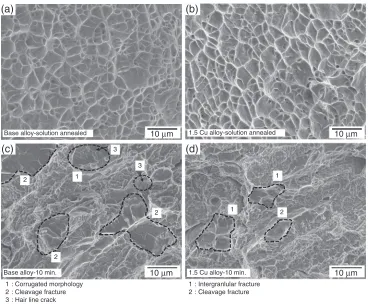
Figure 8 shows the fracture surfaces of the solution-annealed and aged base alloy and 1.5Cu alloy specimens after they had been subjected to tensile tests at room temperature in air. The solution-annealed base and 1.5Cu alloy specimens exhibited fully ductile fracture surfaces with a well-developed dimple structure (Figs. 8(a) and 8(b)). However, the base alloy specimen aged at 1123 K for 10 min showed
somewhat complicated fractured surfaces as shown in Fig. 8(c). The fracture surface showed various brittle fractured modes such as corrugated morphology,34,35)as well
as cleavage fracture36,37) and hair-line cracks.35,37) Chun et al.37) reported that cleavage fracture and hair-line cracks were deteriorated the tensile properties in high Mn austenitic steel. Meanwhile, the fracture surface of the 1.5Cu alloy specimen aged at 1123 K for 10 min showed both ductile and brittle mixed mode (Fig. 8(d)). Although a few cleavage and intergranular fractures38) were observed in the aged 1.5 Cu alloy, the area fraction of the brittle fracture surface was greatly reduced. Therefore, the reason that the decrease in elongation of the base alloy specimen aged at 1123 K for 10 min (Fig. 7) was due to the easy transition of the fracture mode from ductile to brittle. Thus, this is further proof that, when added to the base alloy, Cu retards the decrease in the ductility of the alloy owing to the delayed precipitation of deleterious phases.
4. Conclusions
(1) The addition of Cu to the base alloy reduces the total amount of deleterious phases precipitated in it. In particular, Cu addition to the base alloy results in pronouncedly suppressing the amount of sigma phase whereas it slightly facilitates the precipitation of chromium nitride and» phase along phase boundaries and within¡grains.
(2) Tensile tests were used to evaluate the mechanical properties of the experimental alloys. The results of the test suggested that the embrittlement of the base alloy
0 5 10 15 20 25 30 35
0 200 400 600 800 1000
Engineering Strength,
σ
/ MPa
Engineering Strain, ε / %
Base alloy – S.A. 1.5Cu alloy – S.A.
1.5Cu alloy – 10 min.
Base alloy – 10 min.
Fig. 7 Tensileflow curve of the solution annealed alloys and alloys aged at 1123 K for 10 min.
10 μm
10 μm
10 μm
10 μm
2 1
2
2
3
1 : Corrugated morphology 2 : Cleavage fracture 3 : Hair line crack
2 1
1
1 : Intergranlular fracture 2 : Cleavage fracture Base alloy-solution annealed 1.5 Cu alloy-solution annealed
3
(d) (c)
Base alloy-10 min. 1.5 Cu alloy-10 min.
(a) (b)
[image:6.595.55.284.245.413.2] [image:6.595.115.483.457.762.2]might also be due to the precipitation of deleterious phases such as the·and»phases and chromium nitride particles. The addition of Cu to the base alloy reduces its embrittlement owing to the delayed precipitation of these deleterious phases.
(3) The preferential precipitation of chromium nitride and the » phase along the phase boundaries and within the ¡ grains seems to be closely associated with the retardation of the precipitation of the·phase. Since the formation of the · phase in the experimental alloys required high concentrations of Cr, Mo and W, the preferential precipitation of chromium nitride and the» phase in the alloys in the initial stage of aging inhibited the nucleation and growth of the · phase. This was because of the depletion of the Cr adjacent to the chromium nitride particles and the depletion of the Mo and W adjacent to the» phase.
REFERENCES
1) J. Olson and S. Nordin: Proc. Duplex Stainless Steels Symp., The Hague, (1986) pp. 219225.
2) E. Perteneder, J. Tosch, P. Reiterer and G. Rabensteiner: Proc. Duplex Stainless Steels Symp., The Hague, (1986) pp. 4856.
3) J. O. Nilsson:Mater. Sci. Technol.8(1992) 685700.
4) M. Seo, G. Hultquist, C. Leygraf and N. Sato:Corros. Sci.26(1986) 949960.
5) R. F. Steigerwald:Corrosion33(1977) 338344.
6) H. Kiesheyer and H. Brandis: Z. Metallkd.67(1976) 258263. 7) L. Duprez, B. C. De Cooman and N. Akdut: Steel Res.72(2001) 311
316.
8) S. H. Byun, N. Kang, T. H. Lee, S. K. Ahn, H. Lee, W. S. Chang and K. M. Cho:Met. Mater. Int.18(2012) 201207.
9) C. C. Hsieh and W. Wu:Met. Mater. Int.17(2011) 375381.
10) N. Lopez, M. Cid and M. Puiggali:Corros. Sci.41(1999) 16151631.
11) J. O. Nilsson and A. Wilson:Mater. Sci. Technol.9(1993) 545554.
12) J. O. Nilson, P. Kangas, T. Karlsson and A. Wilson: Metall. Mater. Trans. A31(2000) 3545.
13) B. Deng, Z. Wang, Y. Jiang, T. Sun, J. Xu and J. Li:Corros. Sci.51
(2009) 29692975.
14) J. W. Simmon:Scr. Metall. Mater.32(1995) 265270.
15) Z. Z. Yuan, Q. X. Dai, X. N. Chen and K. M. Chen:Mater. Charact.58
(2007) 8791.
16) A. J. Strutt, G. W. Lorimer, C. V. Roscoe and K. J. Gradwell: Proc. Duplex Stainless Steels’86, (1986) p. 310.
17) A. J. Strutt, G. W. Lorimer, C. V. Roscoe and K. J. Gradwell: Proc. Duplex Stainless Steels’86, (1986) p. 310.
18) C. S. Huang and C. C. Shih:Mater. Sci. Eng. A402(2005) 6675.
19) K. M. Lee, H. S. Cho and D. C. Choi:J. Alloy. Compd.285(1999) 156161.
20) T. H. Chen and J. R. Yang:Mater. Sci. Eng. A311(2001) 2841.
21) A. S. Zubchenko:Mater. Sci. Heat Treat.24(1982) 274276.
22) E. O. Hall and S. H. Algie:Metall. Rev.11(1966) 6188.
23) S. M. Kim, J. S. Kim, K. T. Kim, K. T. Park and C. S. Lee: Met. Mater. Trans. A573(2013) 2736.
24) C. J. Park, M. K. Ahn and H. S. Kwon:Mater. Sci. Eng. A418(2006) 211217.
25) S. Nana and M. B. Cortie:Metall. Mater. Trans. A27(1996) 2436 2444.
26) O. Smuk, P. Nenonen, H. Hänninen and J. Liimatainen:Metall. Mater. Trans. A35(2004) 21032109.
27) S. H. Jeon, S. T. Kim, I. S. Lee, J. S. Kim, K. T. Kim and Y. S. Park:
Corros. Sci.66(2013) 217224.
28) S. D. Brandi and A. J. Ramirez: Proc. Duplex Stainless Steels’97, Conf., KCI, Maastricht, The Netherlands, (1997) pp. 405410. 29) H. Kokawa, E. Tsory and T. H. North:ISIJ Int.35(1995) 12771283.
30) H. L. Cao and S. Hertzman: Proc. Duplex Stainless Steels’91, Conf., Les Editions de Physique, Paris, France, (1991) pp. 363372. 31) S. H. Jeon, S. T. Kim, J. S. Kim, J. S. Kim, K. T. Kim and Y. S. Park:
Mater. Trans.53(2012) 21292134.
32) A. R. Akisanya, U. Obi and N. C. Renton:Mater. Sci. Eng. A535
(2012) 281289.
33) T. Børvik, H. Lange, L. A. Marken, M. Langseth, O. S. Hopperstad, M. Aursand and G. Rørvik:Mater. Sci. Eng. A527(2010) 69456955.
34) M. C. San, B. P. Somerday, X. Tang and G. H. Schiroky: Int. J. Hydrogen Energy33(2008) 889904.
35) I. J. Park, K. H. Jeong, J. G. Jung, C. S. Lee and Y. K. Lee:Int. J. Hydrogen Energy37(2012) 99259932.
36) H. J. Ji, I. J. Park, S. M. Lee and Y. K. Lee:J. Alloy. Compd.598
(2014) 205212.
37) Y. S. Chun, J. S. Kim, K. T. Park, Y. K. Lee and C. S. Lee:Mater. Sci. Eng. A533(2012) 8795.
38) L. W. Tsay, M. Y. Chi, Y. F. Wu, J. K. Wu and D. Y. Lin:Corros. Sci.