Part-of-Speech Induction in Dependency Trees for Statistical Machine
Translation
Akihiro Tamura†,‡, Taro Watanabe†, Eiichiro Sumita†, Hiroya Takamura‡, Manabu Okumura‡
†National Institute of Information and Communications Technology
{akihiro.tamura, taro.watanabe, eiichiro.sumita}@nict.go.jp
†Precision and Intelligence Laboratory, Tokyo Institute of Technology
{takamura, oku}@pi.titech.ac.jp
Abstract
This paper proposes a nonparametric Bayesian method for inducing Part-of-Speech (POS) tags in dependency trees to improve the performance of statistical machine translation (SMT). In particular, we extend the monolingual infinite tree model (Finkel et al., 2007) to a bilin-gual scenario: each hidden state (POS tag) of a source-side dependency tree emits a source word together with its aligned tar-get word, either jointly (joint model), or independently (independent model). Eval-uations of Japanese-to-English translation on the NTCIR-9 data show that our in-duced Japanese POS tags for dependency trees improve the performance of a forest-to-string SMT system. Our independent model gains over 1 point in BLEU by re-solving the sparseness problem introduced in the joint model.
1 Introduction
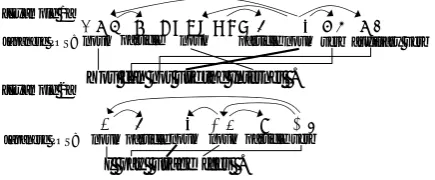
In recent years, syntax-based SMT has made promising progress by employing either depen-dency parsing (Lin, 2004; Ding and Palmer, 2005; Quirk et al., 2005; Shen et al., 2008; Mi and Liu, 2010) or constituency parsing (Huang et al., 2006; Liu et al., 2006; Galley et al., 2006; Mi and Huang, 2008; Zhang et al., 2008; Cohn and Blunsom, 2009; Liu et al., 2009; Mi and Liu, 2010; Zhang et al., 2011) on the source side, the target side, or both. However, dependency parsing, which is a popular choice for Japanese, can incorporate only shallow syntactic information, i.e., POS tags, compared with the richer syntactic phrasal cate-gories in constituency parsing. Moreover, exist-ing POS tagsets might not be optimal for SMT because they are constructed without considering the language in the other side. Consider the ex-amples in Figure 1. The Japanese noun “利用” in
私 が 利用利用 料金利用利用 を 払う
あなた は インターネット が 利用利用利用利用 でき ない
You can not usethe Internet .
I pay usage fees .
noun particle noun particlenoun verb auxiliary verb
[image:1.595.309.527.209.299.2]noun particle noun noun particleverb [Example 1]
[Example 2] Japanese POS:
Japanese POS:
Figure 1: Examples of Existing Japanese POS Tags and Dependency Structures
Example 1 corresponds to the English verb “use”, while that in Example 2 corresponds to the English noun “usage”. Thus, Japanese nouns act like verbs in English in one situation, and nouns in English in another. If we could discriminate POS tags for two cases, we might improve the performance of a Japanese-to-English SMT system.
In the face of the above situations, this pa-per proposes an unsupa-pervised method for inducing POS tags for SMT, and aims to improve the perfor-mance of syntax-based SMT by utilizing the in-duced POS tagset. The proposed method is based on the infinite tree model proposed by Finkel et al. (2007), which is a nonparametric Bayesian method for inducing POS tags from syntactic de-pendency structures. In this model, hidden states represent POS tags, the observations they generate represent the words themselves, and tree structures represent syntactic dependencies between pairs of POS tags.
The proposed method builds on this model by incorporating the aligned words in the other lan-guage into the observations. We investigate two types of models: (i) a joint model and (ii) an in-dependent model. In the joint model, each hid-den state jointly emits both a source word and its aligned target word as an observation. The in-dependent model separately emits words in two languages from hidden states. By inferring POS
tags based on bilingual observations, both mod-els can induce POS tags by incorporating infor-mation from the other language. Consider, for ex-ample, inducing a POS tag for the Japanese word “
利用” in Figure 1. Under a monolingual induction method (e.g., the infinite tree model), the “利用” in Example 1 and 2 would both be assigned the same POS tag since they share the same observa-tion. However, our models would assign separate tags for the two different instances since the “利 用” in Example 1 and Example 2 could be disam-biguated by encoding the target-side information, either “use” or “usage”, in the observations.
Inference is efficiently carried out by beam sam-pling (Gael et al., 2008), which combines slice sampling and dynamic programming. Experi-ments are carried out on the NTCIR-9 Japanese-to-English task using a binarized forest-to-string SMT system with dependency trees as its source side. Our bilingually-induced tagset signifi-cantly outperforms the original tagset and the monolingually-induced tagset. Further, our inde-pendent model achieves a more than 1 point gain in BLEU, which resolves the sparseness problem introduced by the bi-word observations.
2 Related Work
A number of unsupervised methods have been proposed for inducing POS tags. Early methods have the problem that the number of possible POS tags must be provided preliminarily. This limita-tion has been overcome by automatically adjust-ing the number of possible POS tags usadjust-ing non-parametric Bayesian methods (Finkel et al., 2007; Gael et al., 2009; Blunsom and Cohn, 2011; Sirts and Alum¨ae, 2012). Gael et al. (2009) applied infinite HMM (iHMM) (Beal et al., 2001; Teh et al., 2006), a nonparametric version of HMM, to POS induction. Blunsom and Cohn (2011) used a hierarchical Pitman-Yor process prior to the transition and emission distribution for sophisti-cated smoothing. Sirts and Alum¨ae (2012) built a model that combines POS induction and morpho-logical segmentation into a single learning prob-lem. Finkel et al. (2007) proposed the infinite tree model, which represents recursive branching structures over infinite hidden states and induces POS tags from syntactic dependency structures. In the following, we overview the infinite tree model, which is the basis of our proposed model. In par-ticular, we will describe the independent children
H
φ
kπ
π
π
π
kρ
z
1z
2z
3x
1x
2x
3k=1,…,C
H
k k
~
) ,..., ( Dirichlet ~
| φ
ρ ρ ρ
[image:2.595.307.531.63.158.2]π
Figure 2: A Graphical Representation of the Finite Tree Model
model (Finkel et al., 2007), where children are dependent only on their parents, used in our pro-posed model1.
2.1 Finite Tree Model
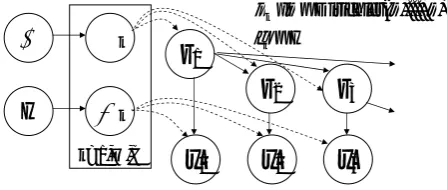
We first review the finite tree model, which can be graphically represented in Figure 2. Let
Tt denote the tree whose root node is t. A
node t has a hidden state zt (the POS tag)
and an observation xt (the word). The prob-ability of a tree Tt, pT(Tt), is recursively
de-fined: pT(Tt) =p(xt|zt) ∏
t′∈c(t)
p(zt′|zt)pT(Tt′),
wherec(t)is the set of the children oft.
Let each hidden state variable have C possible values indexed by k. For each state k, there is a parameterϕkwhich parameterizes the
observa-tion distribuobserva-tion for that state:xt|zt∼F(ϕzt).ϕk is distributed according to a prior distributionH:
ϕk∼H.
Transitions between states are governed by Markov dynamics parameterized by π, where
πij =p(zc(t) =j|zt=i)andπkare the transition
probabilities from the parent’s statek. πk is
dis-tributed according to a Dirichlet distribution with parameter ρ: πk|ρ ∼ Dirichlet(ρ, . . . , ρ). The
hidden state of each childzt′is distributed accord-ing to a multinomial distributionπztspecific to the parent’s statezt:zt′|zt∼Multinomial(πzt).
2.2 Infinite Tree Model
In the infinite tree model, the number of possible hidden states is potentially infinite. The infinite model is formed by extending the finite tree model using a hierarchical Dirichlet process (HDP) (Teh et al., 2006). The reason for using an HDP rather
1Finkel et al. (2007) originally proposed three types of
H
φ
kπ
π
π
π
kα
0z
1z
2z
3x
1x
2x
3∞
γ
β
β
β
β
H k
k ~
) , ( DP ~ , |
) ( GEM ~ |
0 0
φ
β α β α π
γ γ
[image:3.595.77.285.60.183.2]β
Figure 3: A Graphical Representation of the Infi-nite Tree Model
than a simple Dirichlet process (DP)2 (Ferguson, 1973) is that we have to introduce coupling across transitions from different parent’s states. A similar measure was adopted in iHMM (Beal et al., 2001). HDP is a set of DPs coupled through a shared random base measure which is itself drawn from a DP: eachGk ∼ DP(α0, G0)with a shared base
measureG0, and G0 ∼ DP(γ, H) with a global
base measureH. From the viewpoint of the stick-breaking construction3 (Sethuraman, 1994), the
HDP is interpreted as follows: G0=
∞
∑
k′=1 βk′δϕ
k′
and Gk =
∞
∑
k′=1
πkk′δϕk′, where β ∼ GEM(γ),
πk ∼DP(α0,β), andϕk′ ∼H.
We regard eachGk as two coindexed
distribu-tions: πk, a distribution over the transition
prob-abilities from the parent’s statek, andϕk′, an ob-servation distribution for the state k′. Then, the infinite tree model is formally defined as follows:
β|γ ∼GEM(γ), πk|α0,β∼DP(α0,β),
ϕk∼H,
zt′|zt∼Multinomial(πzt),
xt|zt∼F(ϕzt).
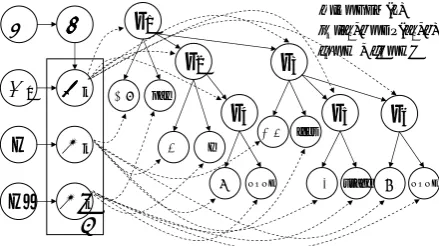
Figure 3 shows the graphical representation of the infinite tree model. The primary difference
be-2
DP is a measure on measures. It has two parameters, a scaling parameterαand a base measureH:DP(α, H).
3
Sethuraman (1994) showed a definition of a measure G∼DP(α0, G0). First, infinite sequences of i.i.d variables (πk′)∞k=1and(ϕk)∞k=1are generated: πk′|α0 ∼Beta(1, α0),
ϕk ∼G0. Then,Gis defined as:πk =π′k
∑k−1
l=1(1−πl′),
G=∑∞k=1πkδϕk. Ifπis defined by this process, then we
writeπ∼GEM(α0).
H φk
π π π πk
α0
∞ γ ββββ
z
1z
2z
3z
4z
5z
6“払う
+pay” “を”
“料金
+fees” “利用
+usage” “私+I” “が”
Figure 4: An Example of the Joint Model
tween Figure 2 and Figure 3 is whether the number of copies of the state is finite or not.
3 Bilingual Infinite Tree Model
We propose a bilingual variant of the infinite tree model, the bilingual infinite tree model, which uti-lizes information from the other language. Specifi-cally, the proposed model introduces bilingual ob-servations by embedding the aligned target words in the source-side dependency trees. This paper proposes two types of models that differ in their processes for generating observations: the joint model and the independent model.
3.1 Joint Model
The joint model is a simple application of the in-finite tree model under a bilingual scenario. The model is formally defined in the same way as in Section 2.2 and is graphically represented simi-larly to Figure 3. The only difference from the infinite tree model is the instances of observations (xt). Observations in the joint model are the
com-bination of source words and their aligned target words4, while observations in the monolingual in-finite tree model represent only source words. For each source word, all the aligned target words are copied and sorted in alphabetical order, and then concatenated into a single observation. Therefore, a single target word may be emitted multiple times if the target word is aligned with multiple source words. Likewise, there may be target words which may not be emitted by our model, if the target words are not aligned.
Figure 4 shows the process of generating Exam-ple 2 in Figure 1 through the joint model, where aligned words are jointly emitted as observations. In Figure 4, the POS tag of “利用” (z5) generates
4When no target words are aligned, we simply add a
[image:3.595.310.525.64.168.2]H φk
π ππ
πk
α0
γ ββββ
z
1z
2z
3z
4z
5H’ φ'k
払う pay
I
私
を 利用 料金
が NONE usage NONE
fees
z
6
∞
' ~ ' , ~
) , ( DP ~ , |
) ( GEM ~ |
0 0
H H
k k
k
φ φ
β α β α π
[image:4.595.73.293.63.186.2]γ γ β
Figure 5: A Graphical Representation of the Inde-pendent Model
the string “利用+usage” as the observation (x5).
Similarly, the POS tag of “利用” in Example 1 would generate the string “利用+use”. Hence, this model can assign different POS tags to the two dif-ferent instances of the word “利用”, based on the different observation distributions in inference.
3.2 Independent Model
The joint model is prone to a data sparseness prob-lem, since each observation is a combination of a source word and its aligned target word. Thus, we propose an independent model, where each hidden state generates a source word and its aligned target word separately. For the aligned target side, we in-troduce an observation variablex′tfor eachztand a parameter ϕ′k for each state k, which parame-terizes a distinct distribution over the observations
x′tfor that state. ϕ′k is distributed according to a prior distribution H′. Specifically, the indepen-dent model is formally defined as follows:
β|γ ∼GEM(γ), πk|α0,β∼DP(α0,β),
ϕk∼H, ϕ′k ∼H′, zt′|zt∼Multinomial(πzt),
xt|zt∼F(ϕzt), x′t|zt∼F′(ϕ′zt).
When multiple target words are aligned to a single source word, each aligned word is generated sepa-rately from observation distribution parameterized byϕ′k.
Figure 5 graphs the process of generating Ex-ample 2 in Figure 1 using the independent model.
x′tandϕ′kare introduced for aligned target words. The state of “利用” (z5) generates the Japanese
word “利用” asx5 and the English word “usage”
asx′5. Due to this factorization, the independent model is less subject to the sparseness problem.
3.3 Introduction of Other Factors
We assumed the surface form of aligned target words as additional observations in previous sec-tions. Here, we introduce additional factors, i.e., the POS of aligned target words, in the observa-tions. Note that POSs of target words are assigned by a POS tagger in the target language and are not inferred in the proposed model.
First, we can simply replace surface forms of target words with their POSs to overcome the sparseness problem. Second, we can incorporate both information from the target language as ob-servations. In the joint model, two pieces of in-formation are concatenated into a single observa-tion. In the independent model, we introduce ob-servation variables (e.g., x′t andx′′t) and parame-ters (e.g.,ϕ′kandϕ′′k) for each information. Specif-ically, x′t and ϕ′k are introduced for the surface form of aligned words, andx′′t andϕ′′kfor the POS of aligned words. Consider, for example, Example 1 in Figure 1. The POS tag of “利用” generates the string “利用+use+verb” as the observation in the joint model, while it generates “利用”, “use”, and “verb” independently in the independent model.
3.4 POS Refinement
We have assumed a completely unsupervised way of inducing POS tags in dependency trees. An-other realistic scenario is to refine the existing POS tags (Finkel et al., 2007; Liang et al., 2007) so that each refined sub-POS tag may reflect the in-formation from the aligned words while preserv-ing the handcrafted distinction from original POS tagset. Major difference is that we introduce sep-arate transition probabilities πsk and observation distributions (ϕsk,ϕ′ks) for each existing POS tags. Then, each nodetis constrained to follow the dis-tributions indicated by the initially assigned POS tagst, and we use the pair (st,zt) as a state
repre-sentation.
3.5 Inference
In inference, we find the state set that maximizes the posterior probability of state transitions given observations (i.e., P(z1:n|x1:n)). However, we
Gibbs sampling, individual hidden state variables are resampled conditioned on all other variables. Unfortunately, its convergence is slow in HMM settings because sequential data is likely to have a strong correlation between hidden states (Gael et al., 2008).
We present an inference procedure based on beam sampling (Gael et al., 2008) for the joint model and the independent model. Beam sam-pling limits the number of possible state transi-tions for each node to a finite number using slice sampling (Neal, 2003), and then efficiently sam-ples whole hidden state transitions using dynamic programming. Beam sampling does not suffer from slow convergence as in Gibbs sampling by sampling the whole state variables at once. In ad-dition, Gael et al. (2008) showed that beam sam-pling is more robust to initialization and hyperpa-rameter choice than Gibbs sampling.
Specifically, we introduce an auxiliary variable
ut for each node in a dependency tree to limit
the number of possible transitions. Our procedure alternates between sampling each of the follow-ing variables: the auxiliary variables u, the state assignments z, the transition probabilitiesπ, the shared DP parametersβ, and the hyperparameters
α0 andγ. We can parallelize procedures in
sam-plinguandzbecause the slice sampling foruand the dynamic programing forzare independent for each sentence. See Gael el al. (2009) for details.
The only difference between inferences in the joint model and the independent model is in com-puting the posterior probability of state transi-tions given observatransi-tions (e.g., p(z1:n|x1:n) and p(z1:n|x1:n, x′1:n)) in sampling z. In the
follow-ing, we describe each sampling stage. See Teh et al., (2006) for details of samplingπ,β,α0andγ.
Samplingu:
Each ut is sampled from the uniform
distribu-tion on [0, πzd(t)zt], where d(t) is the parent of
t: ut ∼ Uniform(0, πzd(t)zt). Note that ut is a positive number, since each transition probability
πzd(t)zt is larger than zero.
Samplingz:
Possible values k of zt are divided into the two
sets using ut: a finite set with πzd(t)k > ut and
an infinite set with πzd(t)k ≤ ut. The beam
sampling considers only the former set. Owing to the truncation of the latter set, we can compute the posterior probability of a state zt given
ob-servations for allt(t = 1, . . . , T) using dynamic programming as follows:
In the joint model,p(zt|xσ(t), uσ(t))∝
p(xt|zt)·
∑
zd(t):πzd(t)zt>ut
p(zd(t)|xσ(d(t)), uσ(d(t))),
and in the independent model,
p(zt|xσ(t), x′σ(t), uσ(t))∝p(xt|zt)·p(x′t|zt)
· ∑
zd(t):πzd(t)zt>ut
p(zd(t)|xσ(d(t)), x′σ(d(t)), uσ(d(t))),
wherexσ(t)(oruσ(t)) denotes the set ofxt(orut)
on the path from the root node to the nodetin a tree.
In our experiments, we assume that F(ϕk)
is Multinomial(ϕk) andH is Dirichlet(ρ, . . . , ρ),
which is the same in Finkel et al. (2007). Un-der this assumption, the posterior probability of an
observation is as follows: p(xt|zt) = ˙ nxtk+ρ
˙
n·k+N ρ ,
where n˙xk is the number of observationsx with
statek, n˙·k is the number of hidden states whose
values arek, andN is the total number of
observa-tionsx. Similarly,p(x′t|zt) = n˙x′tk+ρ ′
˙
n·k+N′ρ′
,where
N′is the total number of observationsx′.
When the posterior probability of a state zt
given observations for all t can be computed, we first sample the state of each leaf node and then perform backtrack sampling for every other
zt where the zt is sampled given the sample for zc(t) as follows: p(zt|zc(t), x1:T, u1:T) ∝ p(zt|xσ(t), uσ(t))∏t′∈c(t)p(zt′|zt, ut′).
Samplingπ:
We introduce a count variable nij ∈ n, which is the number of observations with state j whose parent’s state is i. Then, we sample π using the Dirichlet distri-bution: (πk1, . . . , πkK,∑k∞′=K+1πkk′) ∼ Dirichlet(nk1 + α0β1, . . . , nkK + α0βK, α0∑∞k′=K+1βk′), where K is the number of distinct states inz.
Samplingβ:
We introduce a set of auxiliary variablesm, where
mij ∈ m is the number of elements of πj
corresponding to βi. The conditional
distribu-tion of each variable is p(mij = m|z,β, α0) ∝
S(nij, m)(α0βj)m, where S(n, m) are unsigned
Stirling numbers of the first kind5.
5S(0,0) = S(1,1) = 1, S(n,0) = 0 for n > 0,
S(n, m) = 0form > n, andS(n+ 1, m) = S(n, m−
The parametersβare sampled using the Dirich-let distribution: (β1, . . . , βK,∑∞k′=K+1βk′) ∼ Dirichlet(m·1, . . . , m·K, γ), where m·k = ∑K
k′=1mk′k.
Samplingα0:
α0 is parameterized by a gamma hyperprior
with hyperparameters αa and αb. We introduce
two types of auxiliary variables for each state (k = 1, . . . , K), wk ∈ [0,1] and vk ∈ {0,1}.
The conditional distribution of each wk is p(wk|α0)∝wkα0(1−wk)n·k−1and that of eachvk
isp(vk|α0) ∝(n·k
α0
)vk, wheren·k =∑Kk′=1nk′k.
The conditional distribution of α0 given wk
and vk (k = 1, . . . , K) is p(α0|w,v) ∝
ααa−1+m..−
∑K k=1vk
0 e−α0(αb−
∑K
k=1logwk), where
m··=∑Kk′=1∑Kk′′=1mk′k′′.
Samplingγ:
γ is parameterized by a gamma hyperprior with hyperparameters γa and γb. We introduce an
auxiliary variable η, whose conditional distribu-tion is p(η|γ) ∝ ηγ(1 − η)m··−1. The con-ditional distribution of γ given η is p(γ|η) ∝ γγa−1+Ke−γ(γb−logη).
4 Experiment
We tested our proposed models under the NTCIR-9 Japanese-to-English patent translation task (Goto et al., 2011), consisting of approxi-mately 3.2 million bilingual sentences. Both the development data and the test data consist of 2,000 sentences. We also used the NTCIR-7 develop-ment data consisting of 2,741 sentences for devel-opment testing purposes.
4.1 Experimental Setup
We evaluated our bilingual infinite tree model for POS induction using an in-house developed syntax-based forest-to-string SMT system. In the training process, the following steps are per-formed sequentially: preprocessing, inducing a POS tagset for a source language, training a POS tagger and a dependency parser, and training a forest-to-string MT model.
Step 1. Preprocessing
We used the first 10,000 Japanese-English sen-tence pairs in the NTCIR-9 training data for
in-ducing a POS tagset for Japanese6. The Japanese sentences were segmented using MeCab7, and the English sentences were tokenized and POS tagged using TreeTagger (Schmid, 1994), where 43 and 58 types of POS tags are included in the Japanese sentences and the English sentences, respectively. The Japanese POS tags come from the second-level POS tags in the IPA POS tagset (Asahara and Matsumoto, 2003) and the English POS tags are derived from the Penn Treebank. Note that the Japanese POS tags are used for initialization of hidden states and the English POS tags are used as observations emitted by hidden states.
Word-by-word alignments for the sentence pairs are produced by first running GIZA++ (Och and Ney, 2003) in both directions and then com-bining the alignments using the “grow-diag-final-and” heuristic (Koehn et al., 2003). Note that we ran GIZA++ on all of the NTCIR-9 training data in order to obtain better alignements.
The Japanese sentences are parsed using CaboCha (Kudo and Matsumoto, 2002), which generates dependency structures using a phrasal unit called abunsetsu8, rather than a word unit as
in English or Chinese dependency parsing. Since we focus on the word-level POS induction, each
bunsetsu-based dependency tree is converted into its corresponding word-based dependency tree us-ing the followus-ing heuristic9: first, the last func-tion word inside each bunsetsu is identified as the head word10; then, the remaining words are treated as dependents of the head word in the same
bunsetsu; finally, abunsetsu-based dependency structure is transformed to a word-based depen-dency structure by preserving the head/modifier relationships of the determined head words.
Step 2. POS Induction
A POS tag for each word in the Japanese sentences is inferred by our bilingual infinite tree model,
ei-6
Due to the high computational cost, we did not use all the NTCIR-9 training data. We leave scaling up to a larger dataset for future work.
7http://mecab.googlecode.com/svn/
trunk/mecab/doc/index.html
8
Abunsetsu is the smallest meaningful sequence con-sisting of a content word and accompanying function words (e.g., a noun and a particle).
9
We could use other word-based dependency trees such as trees by the infinite PCFG model (Liang et al., 2007) and syntactic-head or semantic-head dependency trees in Nakazawa and Kurohashi (2012), although it is not our major focus. We leave this for future work.
10If no function words exist in abunsetsu, the last content
ther jointly (Joint) or independently (Ind). We also performed monolingual induction of Finkel et al. (2007) for comparison (M ono). In each model, a sequence of samplingu, z, π, β, α0, andγ is
repeated 10,000 times. In samplingα0 andγ,
hy-perparameters αa, αb, γa, and γb are set to 2, 1,
1, and 1, respectively, which is the same setting in Gael et al. (2008). In samplingz, parametersρ,ρ′,
. . ., are set to 0.01. In the experiments, three types of factors for the aligned English words are com-pared: surface forms (‘s’), POS tags (‘P’), and the combination of both (‘s+P’). Further, two types of inference frameworks are compared: induction
(IN D) andref inement(REF). In both frame-works, each hidden state zt is first initialized to
the POS tags assigned by MeCab (the IPA POS tagset), and then each state is updated through the inference procedure described in Section 3.5. Note that inREF, the sampling distribution over
zt is constrained to include only states that are a
refinement of the initially assigned POS tag.
Step 3. Training a POS Tagger and a Dependency Parser
In this step, we train a Japanese dependency parser from the 10,000 Japanese dependency trees with the induced POS tags which are derived from Step 2. We employed a transition-based dependency parser which can jointly learn POS tagging and dependency parsing (Hatori et al., 2011) under an incremental framework11. Note that the learned parser can identify dependencies between words and attach an induced POS tag for each word.
Step 4. Training a Forest-to-String MT
In this step, we train a forest-to-string MT model based on the learned dependency parser in Step 3. We use an in-house developed hypergraph-based toolkit, cicada, for training and decoding with a tree-to-string model, which has been successfully employed in our previous work for system com-bination (Watanabe and Sumita, 2011) and online learning (Watanabe, 2012). All the Japanese and English sentences in the NTCIR-9 training data are segmented in the same way as in Step 1, and then each Japanese sentence is parsed by the de-pendency parser learned in Step 3, which simul-taneously assigns induced POS tags and word de-pendencies. Finally, a forest-to-string MT model is learned with Zhang et al., (2011), which ex-tracts translation rules by a forest-based variant of
11http://triplet.cc/software/corbit/
IN D REF
BS 27.54
M ono 27.66 26.83
Joint[s] 28.00 28.00 Joint[P] 26.36 26.72
[image:7.595.345.486.60.188.2]Joint[s+P] 27.99 27.82 Ind[s] 28.00 27.93 Ind[P] 28.11 28.63 Ind[s+P] 28.13 28.62
Table 1: Performance on Japanese-to-English Translation Measured by BLEU (%)
the GHKM algorithm (Mi and Huang, 2008) af-ter each parse tree is restructured into a binarized packed forest. Parameters are tuned on the devel-opment data using xBLEU (Rosti et al., 2011) as an objective and L-BFGS (Liu and Nocedal, 1989) as an optimization toolkit, since it is stable and less prone to randomness, unlike MERT (Och, 2003) or PRO (Hopkins and May, 2011). The develop-ment test data is used to set up hyperparameters, i.e., to terminate tuning iterations.
When translating Japanese sentences, a parse tree for each sentence is constructed in the same way as described earlier in this step, and then the parse trees are translated into English sentences using the learned forest-to-string MT model.
4.2 Experimental Results
Table 1 shows the performance for the test data measured by case sensitive BLEU (Papineni et al., 2002). We also present the performance of our baseline forest-to-string MT system (BS) us-ing the original IPA POS tags. In Table 1, num-bers in bold indicate that the systems outperform the baselines, BS andM ono. Under the Moses phrase-based SMT system (Koehn et al., 2007) with the default settings, we achieved a 26.80% BLEU score.
Table 1 shows that the proposed systems outper-form the baselineM ono. The differences between the performance ofInd[s+P] andM onoare statis-tically significant in the bootstrap method (Koehn, 2004), with a 1% significance level both inIN D
andREF. The results indicate that integrating the aligned target-side information in POS induction makes inferred tagsets more suitable for SMT.
Model IN D REF
Joint[s+P] 164 620
[image:8.595.309.524.60.201.2]Ind[s+P] 102 517 IPA POS tags 42
Table 2: The Number of POS Tags
POS induction when jointly encoding bilingual in-formation into observations. Additionally, all the systems using the independent model outperform
BS. The improvements are statistically significant in the bootstrap method (Koehn, 2004), with a 1% significance level. The results show that the pro-posed models can generate more favorable POS tagsets for SMT than an existing POS tagset.
In Table 1,REFs are at least comparable to, or better than,IN Ds except forM ono. This shows thatREFachieves better performance by preserv-ing the clues from the original POS tagset. How-ever, REF may suffer sever overfitting problem forM ono since no bilingual information was in-corporated. Further, when the full-level IPA POS tags12 were used in BS, the system achieved a 27.49% BLEU score, which is worse than the re-sult using the second-level IPA POS tags. This means that manual refinement without bilingual information may also cause an overfitting problem in MT.
5 Discussion
5.1 Comparison to the IPA POS Tagset
Table 2 shows the number of the IPA POS tags used in the experiments and the POS tags induced by the proposed models. This table shows that each induced tagset contains more POS tags than the IPA POS tagset. In the experimental data, some of Japanese verbs correspond to genuine En-glish verbs, some are nominalized, and others cor-respond to English past participle verbs or present participle verbs which modify other words. Re-spective examples are “Iusea card.”, “U singthe index is faster.”, and “I explain using an exam-ple.”, where all the underlined words correspond to the same Japanese word, “用い”, whose IPA POS tag is a verb. Ind[s+P] in REF generated the POS tagset where the three types are assigned to separate POS groups.
The Japanese particle “に” is sometimes at-tached to nouns to give them adverb roles. For
12377 types of full-level IPA POS tags were included in our
experimental data.
Tagging Dependency
IN D REF IN D REF
Original 90.37 93.62
M ono 90.75 88.04 91.77 91.51
Joint[s] 89.08 86.73 91.55 91.14
Joint[P] 80.54 79.98 91.06 91.29
Joint[s+P] 87.56 84.92 91.31 91.10
Ind[s] 87.62 84.33 92.06 92.58
Ind[P] 90.21 88.50 92.85 93.03
Ind[s+P] 89.57 86.12 92.96 92.78
Table 3: Tagging and Dependency Accuracy (%)
example, “相互 (mutual) に” is translated as the adverb “mutually” in English. Other times, it is attached to words to make them the objects of verbs. For example, “彼(he) に 与える
(give)” is translated as “give him”. The POS tags byInd[s+P] inREF discriminated the two types. These examples show that the proposed mod-els can disambiguate POS tags that have different functions in English, whereas the IPA POS tagset treats them jointly. Thus, such discrimination im-proves the performance of a forest-to-string SMT.
5.2 Impact of Tagging and Dependency Accuracy
The performance of our methods depends not only on the quality of the induced tag sets but also on the performance of the dependency parser learned in Step 3 of Section 4.1. We cannot directly eval-uate the tagging accuracy of the parser trained through Step 3 because we do not have any data with induced POS tags other than the 10,000-sentence data gained through Step 2. Thus we split the 10,000 data into the first 9,000 data for train-ing and the remaintrain-ing 1,000 for testtrain-ing, and then a dependency parser was learned in the same way as in Step 3.
Table 3 shows the results. Originalis the per-formance of the parser learned from the training data with the original POS tagset. Note that the de-pendency accuracies are measured on the automat-ically parsed dependency trees, not on the syntac-tically correct gold standard trees. ThusOriginal
achieved the best dependency accuracy.
In Table 3, the performance for our bilingually-induced POSs, Joint and Ind, are lower than
[image:8.595.109.251.61.118.2]in-formation is available to the parser. However, our bilingually-induced POSs, except for Joint[P], with the lower accuracies are more effective for SMT than the monolingually-induced POSs and the original POSs, as indicated in Table 1. The tagging accuracies forJoint[P]both inIN Dand
REF are significantly lower than the others, while the dependency accuracies do not differ signifi-cantly. The lower tagging accuracies may directly reflect the lower translation qualities forJoint[P]
in Table 1.
6 Conclusion
We proposed a novel method for inducing POS tags for SMT. The proposed method is a non-parametric Bayesian method, which infers hidden states (i.e., POS tags) based on observations repre-senting not only source words themselves but also aligned target words. Our experiments showed that a more favorable POS tagset can be induced by integrating aligned information, and further-more, the POS tagset generated by the proposed method is more effective for SMT than an existing POS tagset (the IPA POS tagset).
Even though we employed word alignment from GIZA++ with potential errors, large gains were achieved using our proposed method. We would like to investigate the influence of align-ment errors in the future. In addition, we are plan-ning to prove the effectiveness of our proposed method for language pairs other than Japanese-to-English. We are also planning to introduce our proposed method to other syntax-based SMT, such as a string-to-tree SMT and a tree-to-tree SMT.
Acknowledgments
We thank Isao Goto for helpful discussions and anonymous reviewers for valuable comments. We also thank Jun Hatori for helping us to apply his software, Corbit, to our induced POS tagsets.
References
Masayuki Asahara and Yuji Matsumoto. 2003.
IPADIC User Manual. Technical report, Japan.
Matthew J. Beal, Zoubin Ghahramani, and Carl E. Ras-mussen. 2001. The Infinite Hidden Markov Model. In Advances in Neural Information Processing
Sys-tems, pages 577–584.
Phil Blunsom and Trevor Cohn. 2011. A Hierarchical Pitman-Yor Process HMM for Unsupervised Part of
Speech Induction. In Proceedings of the 49th
An-nual Meeting of the Association for Computational Linguistics, pages 865–874.
Trevor Cohn and Phil Blunsom. 2009. A Bayesian Model of Syntax-Directed Tree to String Grammar Induction. In Proceedings of the 2009 Conference
on Empirical Methods in Natural Language Pro-cessing, pages 352–361.
Yuan Ding and Martha Palmer. 2005. Machine Trans-lation Using Probabilistic Synchronous Dependency Insertion Grammars. In Proceedings of the 43rd
An-nual Meeting of the Association for Computational Linguistics, pages 541–548.
Thomas S. Ferguson. 1973. A Bayesian Analysis of Some Nonparametric Problems. The Annals of
Statistics, 1(2):209–230.
Jenny Rose Finkel, Trond Grenager, and Christo-pher D. Manning. 2007. The Infinite Tree. In
Pro-ceedings of the 45th Annual Meeting of the Associa-tion of ComputaAssocia-tional Linguistics, pages 272–279.
Jurgen Van Gael, Yunus Saatci, Yee Whye Teh, and Zoubin Ghahramani. 2008. Beam Sampling for the Infinite Hidden Markov Model. In Proceedings
of the 25th International Conference on Machine Learning, pages 1088–1095.
Jurgen Van Gael, Andreas Vlachos, and Zoubin Ghahramani. 2009. The infinite HMM for unsuper-vised PoS tagging. In Proceedings of the 2009
Con-ference on Empirical Methods in Natural Language Processing: Volume 2 - Volume 2, pages 678–687.
Michel Galley, Jonathan Graehl, Kevin Knight, Daniel Marcu, Steve DeNeefe, Wei Wang, and Ignacio Thayer. 2006. Scalable Inference and Training of Context-Rich Syntactic Translation Models. In
Proceedings of the 21st International Conference on Computational Linguistics and 44th Annual Meet-ing of the Association for Computational LMeet-inguis- Linguis-tics, pages 961–968.
Isao Goto, Bin Lu, Ka Po Chow, Eiichiro Sumita, and Benjamin K. Tsou. 2011. Overview of the Patent Machine Translation Task at the NTCIR-9 Work-shop. In Proceedings of the 9th NTCIR Workshop, pages 559–578.
Jun Hatori, Takuya Matsuzaki, Yusuke Miyao, and Jun’ichi Tsujii. 2011. Incremental Joint POS Tag-ging and Dependency Parsing in Chinese. In
Pro-ceedings of 5th International Joint Conference on Natural Language Processing, pages 1216–1224.
Mark Hopkins and Jonathan May. 2011. Tuning as Ranking. In Proceedings of the 2011 Conference on
Empirical Methods in Natural Language Process-ing, pages 1352–1362.
Computationally Hard Problemsand Joint Inference in Speech and Language Processing, pages 1–8.
Philipp Koehn, Franz Josef Och, and Daniel Marcu. 2003. Statistical Phrase-Based Translation. In
Pro-ceedings of the 2003 Human Language Technology Conference: North American Chapter of the Associ-ation for ComputAssoci-ational Linguistics, pages 48–54.
Philipp Koehn, Hieu Hoang, Alexandra Birch, Chris Callison-Burch, Marcello Federico, Nicola Bertoldi, Brooke Cowan, Wade Shen, Christine Moran, Richard Zens, Chris Dyer, Ondrej Bojar, Alexan-dra Constrantin, and Evan Herbst. 2007. Moses: Open Source Toolkit for Statistical Machine Trans-lation. In Proceedings of the 45th Annual Meeting of
the Association for Computational Linguistics on In-teractive Poster and Demonstration Sessions, pages
177–180.
Philipp Koehn. 2004. Statistical Significance Tests for Machine Translation Evaluation. In Proceedings of
the 2004 Conference on Empirical Methods in Nat-ural Language Processing, pages 388–395.
Taku Kudo and Yuji Matsumoto. 2002. Japanese De-pendency Analysis using Cascaded Chunking. In
Proceedings of the 6th Conference on Natural Lan-guage Learning, pages 63–69.
Percy Liang, Slav Petrov, Michael I. Jordan, and Dan Klein. 2007. The Infinite PCFG using Hierarchi-cal Dirichlet Processes. In Proceedings of the 2007
Joint Conference on Empirical Methods in Natural Language Processing and Computational Natural Language Learning, pages 688–697.
Dekang Lin. 2004. A Path-based Transfer Model for Machine Translation. In Proceedings of the 20th
In-ternational Conference on Computational Linguis-tics, pages 625–630.
Dong C. Liu and Jorge Nocedal. 1989. On the limited memory BFGS method for large scale optimization.
Mathematical Programming B, 45(3):503–528.
Yang Liu, Qun Liu, and Shouxun Lin. 2006. Tree-to-String Alignment Template for Statistical Machine Translation. In Proceedings of the 21st
Interna-tional Conference on ComputaInterna-tional Linguistics and 44th Annual Meeting of the Association for Compu-tational Linguistics, pages 609–616.
Yang Liu, Yajuan L¨u, and Qun Liu. 2009. Improv-ing Tree-to-Tree Translation with Packed Forests. In Proceedings of the 47th Annual Meeting of the
Association for Computational Linguistics and the 4th International Joint Conference on Natural Lan-guage Processing of the Asian Federation of Natural Language Processing, pages 558–566.
Haitao Mi and Liang Huang. 2008. Forest-based Translation Rule Extraction. In Proceedings of the
2008 Conference on Empirical Methods in Natural Language Processing, pages 206–214.
Haitao Mi and Qun Liu. 2010. Constituency to De-pendency Translation with Forests. In Proceedings
of the 48th Annual Conference of the Association for Computational Linguistics, pages 1433–1442.
Toshiaki Nakazawa and Sadao Kurohashi. 2012. Alignment by Bilingual Generation and Monolin-gual Derivation. In Proceedings of the 24th
Inter-national Conference on Computational Linguistics,
pages 1963–1978.
Radford M. Neal. 2003. Slice Sampling. Annals of
Statistics, 31:705–767.
Franz Josef Och and Hermann Ney. 2003. A System-atic Comparison of Various Statistical Alignment Models. Computational Linguistics, 29:19–51.
Franz Josef Och. 2003. Minimum Error Rate Training in Statistical Machine Translation. In Proceedings
of the 41st Annual Meeting of the Association for Computational Linguistics, pages 160–167.
Kishore Papineni, Salim Roukos, Todd Ward, and Wei-Jing Zhu. 2002. BLEU: a Method for Automatic Evaluation of Machine Translation. In Proceedings
of 40th Annual Meeting of the Association for Com-putational Linguistics, pages 311–318.
Chris Quirk, Arul Menezes, and Colin Cherry. 2005. Dependency Treelet Translation: Syntactically In-formed Phrasal SMT. In Proceedings of the 43rd
Annual Conference of the Association for Computa-tional Linguistics, pages 271–279.
Antti-Veikko Rosti, Bing Zhang, Spyros Matsoukas, and Richard Schwartz. 2011. Expected BLEU Training for Graphs: BBN System Description for WMT11 System Combination Task. In Proceedings
of the Sixth Workshop on Statistical Machine Trans-lation, pages 159–165.
Helmut Schmid. 1994. Probabilistic Part-of-Speech Tagging Using Decision Trees. In Proceedings of
the International Conference on New Methods in Language Processing, pages 44–49.
Jayaram Sethuraman. 1994. A Constructive Definition of Dirichlet Priors. Statistica Sinica, 4(2):639–650.
Libin Shen, Jinxi Xu, and Ralph Weischedel. 2008. A New String-to-Dependency Machine Translation Algorithm with a Target Dependency Language Model. In Proceedings of the 46th Annual
Confer-ence of the Association for Computational Linguis-tics: Human Language Technologies, pages 577–
585.
Kairit Sirts and Tanel Alum¨ae. 2012. A Hierarchi-cal Dirichlet Process Model for Joint Part-of-Speech and Morphology Induction. In Proceedings of the
Yee Whye Teh, Michael I. Jordan, Matthew J. Beal, and David M. Blei. 2006. Hierarchical Dirichlet Processes. Journal of the American Statistical
Asso-ciation, 101(476):1566–1581.
Taro Watanabe and Eiichiro Sumita. 2011. Machine Translation System Combination by Confusion For-est. In Proceedings of the 49th Annual Meeting of
the Association for Computational Linguistics: Hu-man Language Technologies, pages 1249–1257.
Taro Watanabe. 2012. Optimized Online Rank Learn-ing for Machine Translation. In ProceedLearn-ings of the
2012 Conference of the North American Chapter of the Association for Computational Linguistics: Hu-man Language Technologies, pages 253–262.
Min Zhang, Hongfei Jiang, Aiti Aw, Haizhou Li, Chew Lim Tan, and Sheng Li. 2008. A Tree Se-quence Alignment-based Tree-to-Tree Translation Model. In Proceedings of the 46th Annual
Confer-ence of the Association for Computational Linguis-tics: Human Language Technologies, pages 559–
567.
Hao Zhang, Licheng Fang, Peng Xu, and Xiaoyun Wu. 2011. Binarized Forest to String Translation. In