ImpAr: A Deterministic Algorithm for Implicit Semantic Role Labelling
Egoitz Laparra
IXA Group
University of the Basque Country San Sebastian, Spain [email protected]
German Rigau
IXA Group
University of the Basque Country San Sebastian, Spain [email protected]
Abstract
This paper presents a novel deterministic algorithm for implicit Semantic Role La-beling. The system exploits a very sim-ple but relevant discursive property, the ar-gument coherence over different instances of a predicate. The algorithm solves the implicit arguments sequentially, exploit-ing not only explicit but also the implicit arguments previously solved. In addition, we empirically demonstrate that the algo-rithm obtains very competitive and robust performances with respect to supervised approaches that require large amounts of costly training data.
1 Introduction
Traditionally, Semantic Role Labeling (SRL) sys-tems have focused in searching the fillers of those explicit roles appearing within sentence bound-aries (Gildea and Jurafsky, 2000, 2002; Carreras and M`arquez, 2005; Surdeanu et al., 2008; Hajiˇc et al., 2009). These systems limited their search-space to the elements that share a syntactical re-lation with the predicate. However, when the par-ticipants of a predicate are implicit this approach obtains incomplete predicative structures with null arguments. The following example includes the gold-standard annotations for a traditional SRL process:
(1) [arg0 The network] had been expected to have [np losses] [arg1of as much as $20 million] [arg3on base-ball this year]. It isn’t clear how much those [nplosses] may widen because of the short Series.
The previous analysis includes annotations for the nominal predicatelossbased on the NomBank structure (Meyers et al., 2004). In this case the annotator identifies, in the first sentence, the argu-mentsarg0, the entity losing something,arg1, the
thing lost, andarg3, the source of that loss. How-ever, in the second sentence there is another in-stance of the same predicate,loss, but in this case no argument has been associated with it. Tradi-tional SRL systems facing this type of examples are not able to fill the arguments of a predicate because their fillers are not in the same sentence of the predicate. Moreover, these systems also let unfilled arguments occurring in the same sentence, like in the following example:
(2) Quest Medical Inc said it adopted [arg1a sharehold-ers’ rights] [npplan] in which rights to purchase shares of common stock will be distributed as a dividend to shareholders of record as of Oct 23.
For the predicateplanin the previous sentence, a traditional SRL process only returns the filler for the argumentarg1, the theme of the plan.
However, in both examples, a reader could eas-ily infer the missing arguments from the surround-ing context of the predicate, and determine that in (1) both instances of the predicate share the same arguments and in (2) the missing argument corresponds to the subject of the verb that domi-nates the predicate,Quest Medical Inc. Obviously, this additional annotations could contribute posi-tively to its semantic analysis. In fact, Gerber and Chai (2010) pointed out that implicit arguments can increase the coverage of argument structures in NomBank by 71%. However, current automatic systems require large amounts of manually anno-tated training data for each predicate. The effort required for this manual annotation explains the absence of generally applicable tools. This prob-lem has become a main concern for many NLP tasks. This fact explains a new trend to develop accurate unsupervised systems that exploit sim-ple but robust linguistic princisim-ples (Raghunathan et al., 2010).
In this work, we study the coherence of the predicate and argument realization in discourse. In particular, we have followed a similar approach to
the one proposed by Dahl et al. (1987) who filled the arguments of anaphoric mentions of nominal predicates using previous mentions of the same predicate. We present an extension of this idea assuming that in a coherent document the differ-ent ocurrences of a predicate, including both ver-bal and nominal forms, tend to be mentions of the same event, and thus, they share the same argument fillers. Following this approach, we have developed a deterministic algorithm that ob-tains competitive results with respect to supervised methods. That is, our system can be applied to any predicate without training data.
The main contributions of this work are the fol-lowing:
• We empirically prove that there exists a strong discourse relationship between the im-plicit and exim-plicit argument fillers of the same predicates.
• We propose a deterministic approach that
ex-ploits this discoursive property in order to ob-tain the fillers of implicit arguments.
• We adapt to the implicit SRL problem a clas-sic algorithm for pronoun resolution.
• We develop a robust algorithm, ImpAr, that
obtains very competitive results with respect to existing supervised systems. We release an open source prototype implementing this algorithm1.
The paper is structured as follows. Section 2 discusses the related work. Section 3 presents in detail the data used in our experiments. Section 4 describes our algorithm for implicit argument resolution. Section 5 presents some experiments we have carried out to test the algorithm. Section 6 discusses the results obtained. Finally, section 7 offers some concluding remarks and presents some future research lines.
2 Related Work
The first attempt for the automatic annotation of implicit semantic roles was proposed by Palmer et al. (1986). This work applied selectional restric-tions together with coreference chains, in a very specific domain. In a similar approach, Whitte-more et al. (1991) also attempted to solve implicit
1http://adimen.si.ehu.es/web/ImpAr
arguments using some manually described seman-tic constraints for each themaseman-tic role they tried to cover. Another early approach was presented by Tetreault (2002). Studying another specific do-main, they obtained some probabilistic relations between some roles. These early works agree that the problem is, in fact, a special case of anaphora or coreference resolution.
Recently, the task has been taken up again around two different proposals. On the one hand, Ruppenhofer et al. (2010) presented a task in SemEval-2010 that included an implicit argu-ment identification challenge based on FrameNet (Baker et al., 1998). The corpus for this task consisted in some novel chapters. They covered a wide variety of nominal and verbal predicates, each one having only a small number of instances. Only two systems were presented for this sub-task obtaining quite poor results (F1 below 0,02). VENSES++ (Tonelli and Delmonte, 2010) applied a rule based anaphora resolution procedure and se-mantic similarity between candidates and thematic roles using WordNet (Fellbaum, 1998). The sys-tem was tuned in (Tonelli and Delmonte, 2011) improving slightly its performance. SEMAFOR (Chen et al., 2010) is a supervised system that extended an existing semantic role labeler to en-large the search window to other sentences, replac-ing the features defined for regular arguments with two new semantic features. Although this system obtained the best performance in the task, data sparseness strongly affected the results. Besides the two systems presented to the task, some other systems have used the same dataset and evaluation metrics. Ruppenhofer et al. (2011), Laparra and Rigau (2012), Gorinski et al. (2013) and Laparra and Rigau (2013) explore alternative linguistic and semantic strategies. These works obtained signifi-cant gains over previous approaches. Silberer and Frank (2012) adapted an entity-based coreference resolution model to extend automatically the train-ing corpus. Exploittrain-ing this additional data, their system was able to improve previous results. Fol-lowing this approach Moor et al. (2013) present a corpus of predicate-specific annotations for verbs in the FrameNet paradigm that are aligned with PropBank and VerbNet.
regres-sion classifier. Unlike the dataset from SemEval-2010 (Ruppenhofer et al., SemEval-2010), in this work the authors focused on a small set of ten predicates. But for those predicates, they annotated a large amount of instances in the documents from the Wall Street Journal that were already annotated for PropBank (Palmer et al., 2005) and NomBank. This allowed them to avoid the sparseness prob-lems and generalize properly from the training set. The results of this system were far better than those obtained by the systems that faced the SemEval-2010 dataset. This works represent the deepest study so far of the features that charac-terizes the implicit arguments 2. However, many
of the most important features are lexically depen-dent on the predicate and cannot been generalized. Thus, specific annotations are required for each new predicate to be analyzed.
All the works presented in this section agree that implicit arguments must be modeled as a particu-lar case of coreference together with features that include lexical-semantic information, to build se-lectional preferences. Another common point is the fact that these works try to solve each instance of the implicit arguments independently, without taking into account the previous realizations of the same implicit argument in the document. We propose that these realizations, together with the explicit ones, must maintain a certain coherence along the document and, in consequence, the filler of an argument remains the same along the fol-lowing instances of that argument until a stronger evidence indicates a change. We also propose that this feature can be exploited independently from the predicate.
3 Datasets
In our experiments, we have focused on the dataset developed in Gerber and Chai (2010, 2012). This dataset (hereinafter BNB which stands for ”Be-yond NomBank”) extends existing predicate an-notations for NomBank and ProbBank.
BNB presented the first annotation work of im-plicit arguments based on PropBank and Nom-Bank frames. This annotation was an extension of the standard training, development and testing sections of Penn TreeBank that have been typi-cally used for SRL evaluation and were already annotated with PropBank and NomBank predicate
2Gerber and Chai (2012) includes a set of 81 different
fea-tures.
structures. The authors selected a limited set of predicates. These predicates are all nominaliza-tions of other verbal predicates, without sense am-biguity, that appear frequently in the corpus and tend to have implicit arguments associated with their instances. These constraints allowed them to model enough occurrences of each implicit argu-ment in order to cover adequately all the possible cases appearing in a test document. For each miss-ing argument position they went over all the pre-ceding sentences and annotated all mentions of the filler of that argument. In tables 3 and 4 we show the list of predicates and the resulting figures of this annotation.
In this work we also use the corpus provided for the CoNLL-2008 task. These corpora cover the same BNB documents and include annotated predictions for syntactic dependencies and Super-Sense labels as semantic tags. Unlike Gerber and Chai (2010, 2012) we do not use the constituent analysis from the Penn TreeBank.
4 ImpAr algorithm
4.1 Discoursive coherence of predicates Exploring the training dataset of BNB, we ob-served a very strong discourse effect on the im-plicit and exim-plicit argument fillers of the predi-cates. That is, if several instances of the same predicate appear in a well-written discourse, it is very likely that they maintain the same argument fillers. This property holds when joining the dif-ferent parts-of-speech of the predicates (nominal or verbal) and the explicit or implicit realizations of the argument fillers. For instance, we observed that 46% of all implicit arguments share the same filler with the previous instance of the same predi-cate while only 14% of them have a different filler. The remaining 40% of all implicit arguments cor-respond to first occurrences of their predicates. That is, these fillers can not be recovered from pre-vious instances of their predicates.
predicate lossare missing, but they can be easily inferred from the previous instance of the same predicate.
(1) [arg0 The network] had been expected to have [np losses] [arg1of as much as $20 million] [arg3on base-ball this year]. It isn’t clear how much those [nplosses] may widen because of the short Series.
Therefore, we propose to exploit this property in order to capture correctly how the fillers of all predicate arguments evolve through a document.
Our algorithm, ImpAr, processes the docu-ments sentence by sentence, assuming that se-quences of the same predicate (in its nominal or verbal form) share the same argument fillers (ex-plicit or im(ex-plicit)3. Thus, for everycoreargument
argn of a predicate, ImpAr stores its previous
known filler as a defaultvalue. If the arguments of a predicate are explicit, they always replace de-fault fillers previously captured. When there is no antecedent for a particular implicit argumentargn,
the algorithm tries to find in the surrounding con-text which participant is the most likely to be the filler according to some salience factors (see Sec-tion 4.2). For the following instances, without an explicit filler for a particular argument position, the algorithm repeats the same selection process and compares the new implicit candidate with the default one. That is, the default implicit argument of a predicate with no antecedent can change ev-ery time the algorithm finds a filler with a greater salience. A damping factor is applied to reduce the salience of distant predicates.
4.2 Filling arguments without explicit antecedents
Filling the implicit arguments of a predicate has been identified as a particular case of corefer-ence, very close to pronoun resolution (Silberer and Frank, 2012). Consequently, for those implicit arguments that have not explicit antecedents, we propose an adaptation of a classic algorithm for deterministic pronoun resolution. This component of our algorithm follows the RAP approach (Lap-pin and Leass, 1994). When our algorithm needs to fill an implicit predicate argument without an explicit antecedent it considers a set of candidates within a window formed by the sentence of the predicate and the two previous sentences. Then, the algorithm performs the following steps:
3Note that the algorithm could also consider sequences of
closely related predicates.
1. Apply two constraints to the candidate list:
(a) All candidates that are already explicit arguments of the predicate are ruled out.
(b) All candidates commanded by the predicate in the dependency tree are ruled out.
2. Select those candidates that are semantically consistent with the semantic category of the implicit argument. 3. Assign a salience score to each candidate.
4. Sort the candidates by their proximity to the predicate of the implicit argument.
5. Select the candidate with the highest salience value.
As a result, the candidate with the highest salience value is selected as the filler of the im-plicit argument. Thus, this filler with its corre-sponding salience weight will be also considered in subsequent instances of the same predicate.
Now, we explain each step in more detail using example (2). In this example,arg0 is missing for the predicateplan:
(2) Quest Medical Inc said it adopted [arg1a sharehold-ers’ rights] [npplan] in which rights to purchase shares of common stock will be distributed as a dividend to shareholders of record as of Oct 23.
Filtering. In the first step, the algorithm fil-ters out the candidates that are actual explicit argu-ments of the predicate or have a syntactic depen-dency with the predicate, and therefore, they are in the search space of a traditional SRL system.
In our example, the filtering process would re-move[a shareholders’ rights]because it is already the explicit argument arg1, and [in which rights to purchase shares of common stock will be dis-tributed as a dividend to shareholders of record as of Oct 23]because it is syntactically commanded by the predicateplan.
Semantic consistency. To determine the se-mantic coherence between the potential candidates and a predicate argumentargn, we have exploited
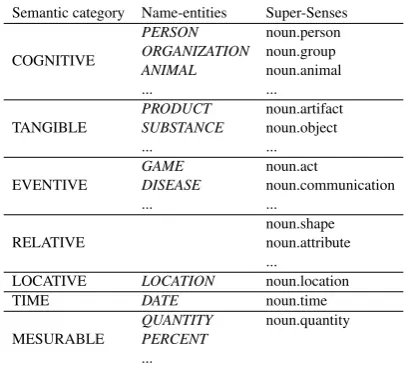
the selectional preferences in the same way as in previous SRL and implicit argument resolution works. First, we have designed a list of very general semantic categories. Second, we have semi-automatically assigned one of them to every predicate argument argn in PropBank and
named-entities and WordNet Super-Senses4. We
have also defined a mapping between the semantic classes provided by the SuperSenseTagger and our seven semantic categories (see Table 1 for more details). Then, we have acquired the most com-mon categories of each predicate argumentargn.
ImpAr algorithm also uses theSuperSenseTagger over the documents to be processed from BNB to check if the candidate belongs to the expected semantic category of the implicit argument to be filled.
Following the example above, [Quest Medi-cal Inc] is tagged as anORGANIZATION by the SuperSenseTagger. Therefore, it belongs to our semantic category COGNITIVE. As the seman-tic category for the implicit argument arg0 for the predicateplanhas been recognized to be also COGNITIVE,[Quest Medical Inc]remains in the list of candidates as a possible filler.
Semantic category Name-entities Super-Senses
COGNITIVE
PERSON noun.person
ORGANIZATION noun.group
ANIMAL noun.animal ... ...
TANGIBLE
PRODUCT noun.artifact
SUBSTANCE noun.object ... ...
EVENTIVE GAMEDISEASE noun.actnoun.communication ... ...
RELATIVE noun.shapenoun.attribute ...
LOCATIVE LOCATION noun.location TIME DATE noun.time
MESURABLE QUANTITYPERCENT noun.quantity
[image:5.595.364.471.70.141.2]...
Table 1: Links between the semantic categories and some name-entities and super-senses.
Salience weighting. In this process, the algo-rithm assigns to each candidate a set of salience factors that scores its prominence. The sentence recency factor prioritizes the candidates that oc-cur close to the same sentence of the predicate. Thesubject,direct object,indirect objectand non-adverbialfactors weight the salience of the candi-date depending on the syntactic role they belong to. Additionally, the head of these syntactic roles are prioritized by the headfactor. We have used the same weights, listed in table 2, proposed by Lappin and Leass (1994).
In the example, candidate[Quest Medical Inc] is in the same sentence as the predicate plan, it 4Lexicographic files according to WordNet terminology.
Factor type weight Sentence recency 100
Subject 80
Direct object 50
Indirect object 40
Head 80
[image:5.595.78.281.338.521.2]Non-adverbial 50
Table 2: Weights assigned to each salience factor.
belongs to a subject, and, indeed, it is the head of that subject. Hence, the salience score for this candidate is: 100 + 80 + 80 = 260.
4.3 Damping the salience of the default candidate
As the algorithm maintains the default candidate until an explicit filler appears, potential errors pro-duced in the automatic selection process explained above can spread to distant implicit instances, spe-cially when the salience score of the default can-didate is high. In order to reduce the impact of these errors we have included a damping factor that is applied sentence by sentence to the salience value of the default candidate. ImpAr applies that damping factor,r, as follows. It assumes that,
in-dependently of the initial salience assigned, 100
points of the salience score came from the sen-tence recencyfactor. Then, the algorithm changes this value multiplying it byr. So, given a salience
scores, the value of the score in a following sen-tence,s0, is:
s0=s−100 + 100·r
Obviously, the value ofrmust be defined
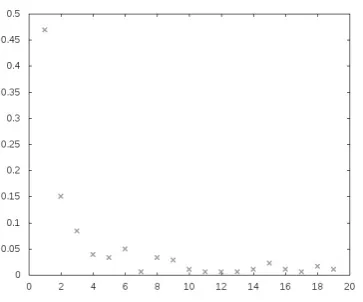
with-out harming excessively those cases where the de-fault candidate has been correctly identified. For this, we studied in the training dataset the cases of implicit arguments filled with the default can-didate. Figure 1 shows that the influence of the default filler is much higher in near sentences that in more distance ones.
Figure 1: Distances between the implicit argument and the default candidate. Theyaxis indicate the percentage of cases
occurring in each sentence distance, expressed inx
r =αd
In this function, dstands for the sentence
dis-tance andrfor the damping factor to apply in that
sentence. In this paper, we have decided to set the value ofαto0.5.
r= 0.5d
This value maintains the influence of the default fillers with high salience in near sentences. But it decreases that influence strongly in the following. In order to illustrate the whole process we will use the previous example. In that case, [Quest Medical Inc]is selected as thearg0 ofplanwith a salience score of 260. Therefore [Quest
Medi-cal Inc]becomes the defaultarg0ofplan. In the following sentence the damping factor is:
0.5 = 0.51
Therefore, its salience score changes to260− 100+100·0.5 = 210. Then, the algorithm changes
the default filler for arg0 only if it finds a candi-date that scores higher in their current context. At two sentence distance, the resulting score for the default filler is260−100 + 100·0.25 = 185. In
this way, at more distance sentences, the influence of the default filler ofarg0 becomes smaller.
5 Evaluation
In order to evaluate the performance of the Im-pAr algorithm, we have followed the evaluation method presented by Gerber and Chai (2010, 2012). For every argument position in the gold-standard the scorer expects a single predicted con-stituent to fill in. In order to evaluate the correct span of a constituent, a prediction is scored using the Dice coefficient:
2|P redicted∩T rue| |P redicted|+|T rue|
The function above relates the set of tokens that form a predicted constituent, P redicted, and the
set of tokens that are part of an annotated con-stituent in the gold-standard, T rue. For each
missing argument, the gold-standard includes the whole coreference chain of the filler. Therefore, the scorer selects from all coreferent mentions the highest Dice value. If the predicted span does not cover the head of the annotated filler, the scorer re-turns zero. Then, P recisionis calculated by the
sum of all prediction scores divided by the number of attempts carried out by the system. Recall is
equal to the sum of the prediction scores divided by the number of actual annotations in the gold-standard. F-measure is calculated as the harmonic mean of recall and precision.
Traditionally, there have been two approaches to develop SRL systems, one based on constituent trees and the other one based on syntactic depen-dencies. Additionally, the evaluation of both types of systems has been performed differently. For constituent based SRL systems the scorers eval-uate the correct span of the filler, while for depen-dency based systems the scorer just check if the systems are able to capture the head token of the filler. As shown above, previous works in implicit argument resolution proposed a metric that in-volves the correct identification of the whole span of the filler. ImpAr algorithm works with syntac-tic dependencies and therefore it only returns the head token of the filler. In order to compare our results with previous works, we had to apply some simple heuristics to guess the correct span of the filler. Obviously, this process inserts some noise in the final evaluation.
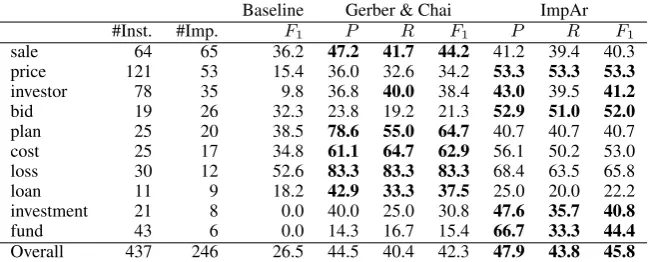
We have performed a first evaluation over the test set used in (Gerber and Chai, 2010). This dataset contains 437 predicate instances but just 246 argument positions are implicitly filled. Table 3 includes the results obtained by ImpAr, the re-sults of the system presented by Gerber and Chai (2010) and the baseline proposed for the task. Best results are marked in bold5. For all predicates,
ImpAr improves over the baseline (19.3 points higher in the overall F1). Our system also out-performs the one presented by Gerber and Chai (2010). Interestingly, both systems present very different performances predicate by predicate. For
5No proper significance test can be carried out without the
Baseline Gerber & Chai ImpAr
#Inst. #Imp. F1 P R F1 P R F1
sale 64 65 36.2 47.2 41.7 44.2 41.2 39.4 40.3
price 121 53 15.4 36.0 32.6 34.2 53.3 53.3 53.3
investor 78 35 9.8 36.8 40.0 38.4 43.0 39.5 41.2
bid 19 26 32.3 23.8 19.2 21.3 52.9 51.0 52.0
plan 25 20 38.5 78.6 55.0 64.7 40.7 40.7 40.7
cost 25 17 34.8 61.1 64.7 62.9 56.1 50.2 53.0
loss 30 12 52.6 83.3 83.3 83.3 68.4 63.5 65.8
loan 11 9 18.2 42.9 33.3 37.5 25.0 20.0 22.2
investment 21 8 0.0 40.0 25.0 30.8 47.6 35.7 40.8
fund 43 6 0.0 14.3 16.7 15.4 66.7 33.3 44.4
Overall 437 246 26.5 44.5 40.4 42.3 47.9 43.8 45.8
Table 3: Evaluation with the test. The results from (Gerber and Chai, 2010) are included. Baseline Gerber & Chai ImpAr
#Inst. #Imp. F1 P R F1 P R F1
sale 184 181 37.3 59.2 44.8 51.0 44.3 43.3 43.8
price 216 138 34.6 56.0 48.7 52.1 55.0 54.5 54.7
investor 160 108 5.1 46.7 39.8 43.0 28.2 27.0 27.6
bid 88 124 23.8 60.0 36.3 45.2 48.4 41.8 45.0
plan 100 77 32.3 59.6 44.1 50.7 47.0 47.0 47.0
cost 101 86 17.8 62.5 50.9 56.1 49.2 43.7 46.2
loss 104 62 54.7 72.5 59.7 65.5 63.0 58.2 60.5
loan 84 82 31.2 67.2 50.0 57.3 56.4 45.6 50.6
investment 102 52 15.5 32.9 34.2 33.6 41.2 30.9 35.4
fund 108 56 15.5 80.0 35.7 49.4 55.6 44.6 49.5
[image:7.595.136.462.70.201.2]Overall 1,247 966 28.9 57.9 44.5 50.3 47.7 43.0 45.3
Table 4: Evaluation with the full dataset. The results from (Gerber and Chai, 2012) are included.
instance, our system obtains much higher results for the predicatesbidandfund, while much lower forloss andloan. In general, ImpAr seems to be more robust since it obtains similar performances for all predicates. In fact, the standard deviation,
σ , ofF1 measure is 10.98 for ImpAr while this value for the (Gerber and Chai, 2010) system is
20.00.
In a more recent work, Gerber and Chai (2012) presented some improvements of their previous results. In this work, they extended the evalua-tion of their model using the whole dataset and not just the testing documents. Applying a cross-validated approach they tried to solve some prob-lems that they found in the previous evaluation, like the small size of the testing set. For this work, they also studied a wider set of features, specially, they experimented with some statistics learnt from parts of GigaWord automatically annotated. Table 4 shows that the improvement over their previous system was remarkable. The system also seems to be more stable across predicates. For compar-ison purposes, we also included the performance of ImpAr applied over the whole dataset.
The results in table 4 show that, although ImpAr still achieves the best results in some cases, this time, it cannot beat the overall results obtained by
the supervised model. In fact, both systems obtain a very similar recall, but the system from (Gerber and Chai, 2012) obtains much higher precision. In both cases, theσ value of F1 is reduced, 8.81 for ImpAr and8.21for (Gerber and Chai, 2012). However, ImpAr obtains very similar performance independently of the testing dataset what proves the robustness of the algorithm. This suggests that our algorithm can obtain strong results also for other corpus and predicates. Instead, the su-pervised approach would need a large amount of manual annotations for every predicate to be pro-cessed.
6 Discussion
6.1 Component Analysis
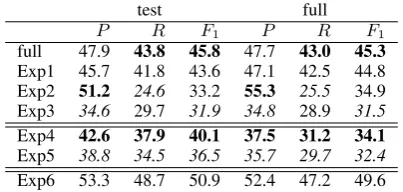
In order to assess the contribution of each sys-tem component, we also tested the performance of ImpAr algorithm when disabling only one of its components. With this evaluations we pretend to sight the particular contribution of each compo-nent. In table 5 we present the results obtained in the following experiments for the two testing sets explained in section 5:
• Exp1: The damping factor is disabled. All
all sentences.
• Exp2: Only explicit fillers are considered as candidates6.
• Exp3: No default fillers are considered as candidates.
As expected, we observe a very similar perfor-mances in both datasets. Additionally, the high-est loss appears when the default fillers are ruled out (Exp3). In particular, it also seems that the explicit information from previous predicates pro-vides the most correct evidence (Exp2). Also note that for Exp2, the system obtains the highest preci-sion. This means that the most accurate cases are obtained by previous explicit antecedents.
test full
P R F1 P R F1
full 47.9 43.8 45.8 47.7 43.0 45.3
Exp1 45.7 41.8 43.6 47.1 42.5 44.8 Exp2 51.2 24.6 33.2 55.3 25.5 34.9 Exp3 34.6 29.7 31.9 34.8 28.9 31.5
Exp4 42.6 37.9 40.1 37.5 31.2 34.1
Exp5 38.8 34.5 36.5 35.7 29.7 32.4
[image:8.595.79.281.300.396.2]Exp6 53.3 48.7 50.9 52.4 47.2 49.6
Table 5: Exp1, Exp2 and Exp3 correspond to ablations of the components. Exp3 and Exp4 are experiments over the cases that are not solved by explicit antecedents. Exp6 evaluates the system capturing just the head tokens of the constituents.
As Exp1 also includes instances with explicit antecedents, and for these cases the damping fac-tor component has no effect, we have designed two additional experiments:
• Exp4: Full system for the cases not solved by explicit antecedents.
• Exp5: As in Exp4 but with the damping
fac-tor disabled.
As expected, now the contribution of the dump-ing factor seems to be more relevant, in particular, for thetestdataset.
6.2 Correct span of the fillers
As explained in Section 5, our algorithm works with syntactic dependencies and its predictions only return the head token of the filler. Obtaining the correct constituents from syntactic dependen-cies is not trivial. In this work we have applied a simple heuristic that returns all the descendant 6That is, implicit arguments without explicit antecedents
are not filled.
tokens of the predicted head token. This naive process inserts some noise to the evaluation of the system. For example, from the following sentence our system gives the following prediction for an implicitarg1of an instance of the predicatesale:
Ports of Call Inc. reached agreements to sell its re-maining seven aircraft [arg1 to buyers] that weren’t disclosed.
But the actual gold-standard annotation is: [arg1buyers that weren’t disclosed]. Although the head of the constituent, buyers, is correctly cap-tured by ImpAr, the final prediction is heavily pe-nalized by the scoring method. Table 5 presents the results of ImpAr when evaluating the head to-kens of the constituents only (Exp6). These results show that the current performance of our system can be easily improved applying a more accurate process for capturing the correct span.
7 Conclusions and Future Work
In this work we have presented a robust determin-istic approach for implicit Semantic Role Label-ing. The method exploits a very simple but rel-evant discoursive coherence property that holds over explicit and implicit arguments of closely re-lated nominal and verbal predicates. This prop-erty states that if several instances of the same predicate appear in a well-written discourse, it is very likely that they maintain the same argument fillers. We have shown the importance of this phe-nomenon for recovering the implicit information about semantic roles. To our knowledge, this is the first empirical study that proves this phenomenon. Based on these observations, we have devel-oped a new deterministic algorithm, ImpAr, that obtains very competitive and robust performances with respect to supervised approaches. That is, it can be applied where there is no available manual annotations to train. The code of this algorithm is publicly available and can be applied to any docu-ment. As input it only needs the document with explicit semantic role labeling and Super-Sense annotations. These annotations can be easily ob-tained from plain text using available tools7, what
makes this algorithm the first effective tool avail-able for implicit SRL.
As it can be easily seen, ImpAr has a large margin for improvement. For instance, providing more accurate spans for the fillers. We also plan 7We recommend mate-tools (Bj¨orkelund et al., 2009) and
to test alternative approaches to solve the argu-ments without explicit antecedents. For instance, our system can also profit from additional annota-tions like coreference, that has proved its utility in previous works. Finally, we also plan to study our approach on different languages and datasets (for instance, the SemEval-2010 dataset).
8 Acknowledgment
We are grateful to the anonymous reviewers for their insightful comments. This work has been partially funded by SKaTer (TIN2012-38584-C06-02), OpeNER SME-DCL-296451) and NewsReader (FP7-ICT-2011-8-316404), as well as the READERS project with the financial support of MINECO, ANR (convention ANR-12-CHRI-0004-03) and EPSRC (EP/K017845/1) in the framework of ERA-NET CHIST-ERA (UE FP7/2007-2013).
References
Baker, C. F., C. J. Fillmore, and J. B. Lowe (1998). The berkeley framenet project. InProceedings of the 36th Annual Meeting of the Association for Computational Linguistics and 17th Inter-national Conference on Computational Linguis-tics, ACL ’98, Montreal, Quebec, Canada, pp. 86–90.
Bj¨orkelund, A., L. Hafdell, and P. Nugues (2009). Multilingual semantic role labeling. In Pro-ceedings of the Thirteenth Conference on Com-putational Natural Language Learning: Shared Task, CoNLL ’09, Boulder, Colorado, USA, pp. 43–48.
Carreras, X. and L. M`arquez (2005). Introduction to the conll-2005 shared task: Semantic role la-beling. In Proceedings of the 9th Conference on Computational Natural Language Learning, CoNLL ’05, Ann Arbor, Michigan, USA, pp. 152–164.
Chen, D., N. Schneider, D. Das, and N. A. Smith (2010). Semafor: Frame argument resolution with log-linear models. In Proceedings of the 5th International Workshop on Semantic Eval-uation, SemEval ’10, Los Angeles, California, USA, pp. 264–267.
Ciaramita, M. and Y. Altun (2006). Broad-coverage sense disambiguation and information extraction with a supersense sequence tagger. In
Proceedings of the 2006 Conference on Empir-ical Methods in Natural Language Processing, EMNLP ’06, Sydney, Australia, pp. 594–602. Dahl, D. A., M. S. Palmer, and R. J. Passonneau
(1987). Nominalizations in pundit. InIn Pro-ceedings of the 25th Annual Meeting of the As-sociation for Computational Linguistics, ACL ’87, Stanford, California, USA, pp. 131–139. Fellbaum, C. (1998).WordNet: an electronic
lexi-cal database. MIT Press.
Gerber, M. and J. Chai (2012, December). Se-mantic role labeling of implicit arguments for nominal predicates. Computational Linguis-tics 38(4), 755–798.
Gerber, M. and J. Y. Chai (2010). Beyond nom-bank: a study of implicit arguments for nomi-nal predicates. InProceedings of the 48th An-nual Meeting of the Association for Computa-tional Linguistics, ACL ’10, Uppsala, Sweden, pp. 1583–1592.
Gildea, D. and D. Jurafsky (2000). Automatic la-beling of semantic roles. InProceedings of the 38th Annual Meeting on Association for Com-putational Linguistics, ACL ’00, Hong Kong, pp. 512–520.
Gildea, D. and D. Jurafsky (2002, September). Automatic labeling of semantic roles. Compu-tational Linguistics 28(3), 245–288.
Gorinski, P., J. Ruppenhofer, and C. Sporleder (2013). Towards weakly supervised resolution of null instantiations. InProceedings of the 10th International Conference on Computational Se-mantics, IWCS ’13, Potsdam, Germany, pp. 119–130.
Hajiˇc, J., M. Ciaramita, R. Johansson, D. Kawa-hara, M. A. Mart´ı, L. M`arquez, A. Meyers, J. Nivre, S. Pad´o, J. ˇStˇep´anek, P. Straˇn´ak, M. Surdeanu, N. Xue, and Y. Zhang (2009). The CoNLL-2009 shared task: Syntactic and semantic dependencies in multiple languages. In Proceedings of the Thirteenth Conference on Computational Natural Language Learning: Shared Task, CoNLL ’09, Boulder, Colorado, USA, pp. 1–18.
Laparra, E. and G. Rigau (2013). Sources of evi-dence for implicit argument resolution. In Pro-ceedings of the 10th International Conference on Computational Semantics, IWCS ’13, Pots-dam, Germany, pp. 155–166.
Lappin, S. and H. J. Leass (1994, December). An algorithm for pronominal anaphora resolution. Computational Linguistics 20(4), 535–561. Meyers, A., R. Reeves, C. Macleod, R. Szekely,
V. Zielinska, B. Young, and R. Grishman (2004). The nombank project: An interim re-port. In In Proceedings of the NAACL/HLT Workshop on Frontiers in Corpus Annota-tion, HLT-NAACL ’04, Boston, Massachusetts, USA, pp. 24–31.
Moor, T., M. Roth, and A. Frank (2013). Predicate-specific annotations for implicit role binding: Corpus annotation, data analysis and evaluation experiments. In Proceedings of the 10th International Conference on Compu-tational Semantics, IWCS ’13, Potsdam, Ger-many, pp. 369–375.
Palmer, M., D. Gildea, and P. Kingsbury (2005, March). The proposition bank: An annotated corpus of semantic roles. Computational Lin-guistics 31(1), 71–106.
Palmer, M. S., D. A. Dahl, R. J. Schiffman, L. Hirschman, M. Linebarger, and J. Dowding (1986). Recovering implicit information. In Proceedings of the 24th annual meeting on As-sociation for Computational Linguistics, ACL ’86, New York, New York, USA, pp. 10–19. Raghunathan, K., H. Lee, S. Rangarajan,
N. Chambers, M. Surdeanu, D. Jurafsky, and C. Manning (2010). A multi-pass sieve for coreference resolution. InProceedings of the 2010 Conference on Empirical Methods in Nat-ural Language Processing, EMNLP ’10, Cam-bridge, Massachusetts, USA, pp. 492–501. Ruppenhofer, J., P. Gorinski, and C. Sporleder
(2011). In search of missing arguments: A lin-guistic approach. InProceedings of the Inter-national Conference Recent Advances in Nat-ural Language Processing 2011, RANLP ’11, Hissar, Bulgaria, pp. 331–338.
Ruppenhofer, J., C. Sporleder, R. Morante, C. Baker, and M. Palmer (2010). Semeval-2010 task 10: Linking events and their participants in discourse. InProceedings of the 5th
Inter-national Workshop on Semantic Evaluation, Se-mEval ’10, Los Angeles, California, USA, pp. 45–50.
Silberer, C. and A. Frank (2012). Casting implicit role linking as an anaphora resolution task. In Proceedings of the First Joint Conference on Lexical and Computational Semantics, *SEM ’12, Montr´eal, Canada, pp. 1–10.
Surdeanu, M., R. Johansson, A. Meyers, L. M`arquez, and J. Nivre (2008). The CoNLL-2008 shared task on joint parsing of syntactic and semantic dependencies. InProceedings of the Twelfth Conference on Natural Language Learning, CoNLL ’08, Manchester, United Kingdom, pp. 159–177.
Tetreault, J. R. (2002). Implicit role reference. InInternational Symposium on Reference Res-olution for Natural Language Processing, Ali-cante, Spain, pp. 109–115.
Tonelli, S. and R. Delmonte (2010). Venses++: Adapting a deep semantic processing system to the identification of null instantiations. In Pro-ceedings of the 5th International Workshop on Semantic Evaluation, SemEval ’10, Los Ange-les, California, USA, pp. 296–299.
Tonelli, S. and R. Delmonte (2011). Desperately seeking implicit arguments in text. In Proceed-ings of the ACL 2011 Workshop on Relational Models of Semantics, RELMS ’11, Portland, Oregon, USA, pp. 54–62.