Contrastive Estimation: Training Log-Linear Models on Unlabeled Data
∗Noah A. Smith and Jason Eisner
Department of Computer Science / Center for Language and Speech Processing Johns Hopkins University, Baltimore, MD 21218 USA
{nasmith,jason}@cs.jhu.edu
Abstract
Conditional random fields (Lafferty et al., 2001) are quite effective at sequence labeling tasks like shal-low parsing (Sha and Pereira, 2003) and named-entity extraction (McCallum and Li, 2003). CRFs are log-linear, allowing the incorporation of arbi-trary features into the model. To train on unlabeled data, we require unsupervised estimation methods for log-linear models; few exist. We describe a novel approach, contrastive estimation. We show that the new technique can be intuitively understood as ex-ploiting implicit negative evidence and is computa-tionally efficient. Applied to a sequence labeling problem—POS tagging given a tagging dictionary and unlabeled text—contrastive estimation outper-forms EM (with the same feature set), is more robust to degradations of the dictionary, and can largely re-cover by modeling additional features.
1 Introduction
Finding linguistic structure in raw text is not easy. The classical forward-backward and inside-outside algorithms try to guide probabilistic models to dis-cover structure in text, but they tend to get stuck in local maxima (Charniak, 1993). Even when they avoid local maxima (e.g., through clever initializa-tion) they typically deviate from human ideas of what the “right” structure is (Merialdo, 1994).
One strategy is to incorporate domain knowledge into the model’s structure. Instead of blind HMMs or PCFGs, one could use models whose features
∗
This work was supported by a Fannie and John Hertz Foundation fellowship to the first author and NSF ITR grant IIS-0313193 to the second author. The views expressed are not nec-essarily endorsed by the sponsors. The authors also thank three anonymous ACL reviewers for helpful comments, colleagues at JHU CLSP (especially David Smith and Roy Tromble) and Miles Osborne for insightful feedback, and Eric Goldlust and Markus Dreyer for Dyna language support.
are crafted to pay attention to a range of domain-specific linguistic cues. Log-linear models can be so crafted and have already achieved excellent perfor-mance when trained on annotated data, where they are known as “maximum entropy” models (Ratna-parkhi et al., 1994; Rosenfeld, 1994).
Our goal is to learn log-linear models from
unannotated data. Since the forward-backward and inside-outside algorithms are instances of Expectation-Maximization (EM) (Dempster et al., 1977), a natural approach is to construct EM algo-rithms that handle log-linear models. Riezler (1999) did so, then resorted to an approximation because the true objective function was hard to normalize.
Stepping back from EM, we may generally en-vision parameter estimation for probabilistic mod-eling as pushing probability mass toward the train-ing examples. We must consider not only where the learner pushes the mass, but also from where the mass is taken. In this paper, we describe an alterna-tive to EM: contrasalterna-tive estimation (CE), which (un-like EM) explicitly states the source of the
probabil-ity mass that is to be given to an example.1
One reason is to make normalization efficient. In-deed, CE generalizes EM and other practical tech-niques used to train log-linear models, including conditional estimation (for the supervised case) and Riezler’s approximation (for the unsupervised case). The other reason to use CE is to improve
accu-racy. CE offers an additional way to inject domain
knowledge into unsupervised learning (Smith and Eisner, 2005). CE hypothesizes that each positive example in training implies a domain-specific set of examples which are (for the most part) degraded
(§2). This class of implicit negative evidence
pro-vides the source of probability mass for the observed example. We discuss the application of CE to log-linear models in§3.
1Not to be confused with contrastive divergence minimiza-tion (Hinton, 2003), a technique for training products of experts.
We are particularly interested in log-linear models over sequences, like the conditional random fields (CRFs) of Lafferty et al. (2001) and weighted CFGs (Miyao and Tsujii, 2002). For a given sequence, im-plicit negative evidence can be represented as a
lat-tice derived by finite-state operations (§4). Effec-tiveness of the approach on POS tagging using
un-labeled data is demonstrated (§5). We discuss future
work (§6) and conclude (§7).
2 Implicit Negative Evidence
Natural language is a delicate thing. For any plausi-ble sentence, there are many slight perturbations of it that will make it implausible. Consider, for ex-ample, the first sentence of this section. Suppose we choose one of its six words at random and re-move it; on this example, odds are two to one that the resulting sentence will be ungrammatical. Or, we could randomly choose two adjacent words and transpose them; none of the results are valid conver-sational English. The learner we describe here takes into account not only the observed positive exam-ple, but also a set of similar but deprecated negative examples.
2.1 Learning setting
Let~x =hx1, x2, ...i, be our observed example
sen-tences, where each xi ∈ X, and letyi∗ ∈ Ybe the
unobserved correct hidden structure for xi (e.g., a
POS sequence). We seek a model, parameterized by
~
θ, such that the (unknown) correct analysisyi∗is the best analysis forxi(under the model). Ifyi∗were
ob-served, a variety of training criteria would be
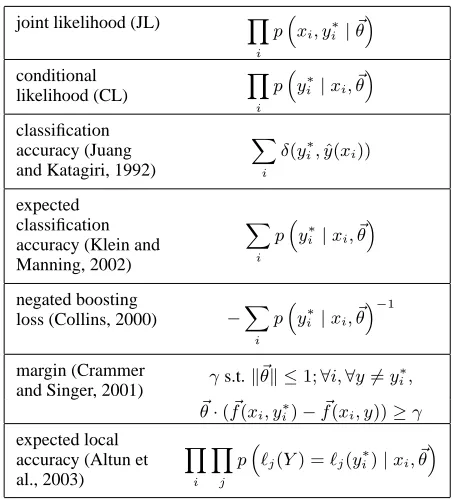
avail-able (see Tab. 1), butyi∗is unknown, so none apply.
Typically one turns to the EM algorithm (Dempster et al., 1977), which locally maximizes
Y
i
pX=xi|~θ
=Y
i
X
y∈Y
pX=xi, Y =y|~θ
(1)
where X is a random variable over sentences and
Y a random variable over analyses (notation is
of-ten abbreviated, eliminating the random variables). An often-used alternative to EM is a class of so-called Viterbi approximations, which iteratively find
the probabilistically-best yˆand then, on each
itera-tion, solve a supervised problem (see Tab. 1).
joint likelihood (JL) Y
i
pxi, y ∗ i |~θ
conditional likelihood (CL)
Y
i
py∗i |xi, ~θ
classification accuracy (Juang and Katagiri, 1992)
X
i
δ(y∗i,y(xˆ i))
expected classification accuracy (Klein and Manning, 2002)
X
i
py∗i |xi, ~θ
negated boosting
loss (Collins, 2000) −X
i
pyi∗|xi, ~θ
−1
margin (Crammer
and Singer, 2001) γs.t.k ~
θk ≤1;∀i,∀y6=yi∗,
~
θ·(f~(xi, yi∗)−f(x~ i, y))≥γ
expected local accuracy (Altun et al., 2003)
Y
i
Y
j
p`j(Y) =`j(y∗i)|xi, ~θ
[image:2.612.313.540.52.302.2]
Table 1: Various supervised training criteria. All functions are written so as to be maximized. None of these criteria are avail-able for unsupervised estimation because they all depend on the correct label,y∗.
2.2 A new approach: contrastive estimation
Our approach instead maximizes
Y
i
pXi=xi|Xi∈N(xi), ~θ
(2)
where the “neighborhood” N(xi) ⊆ X is a set of
implicit negative examples plus the example xi
it-self. As in EM,p(xi | ..., ~θ)is found by
marginal-izing over hidden variables (Eq. 1). Note that the
x0 ∈ N(xi) are not treated as hard negative
exam-ples; we merely seek to move probability mass from
them to the observedx.
The neighborhood ofx,N(x), contains examples
that are perturbations ofx. We refer to the mapping
N:X→ 2X as the neighborhood function, and the
optimization of Eq. 2 as contrastive estimation (CE). CE seeks to move probability mass from the
neighborhood of an observed xi to xi itself. The
learner hypothesizes that good models are those which discriminate an observed example from its neighborhood. Put another way, the learner assumes
not only thatxi is good, but that xi is locally
op-timal in example space (X), and that alternative,
observed sentence is better than its neighbors. Of course, the validity of this hypothesis will depend on the form of the neighborhood function.
Consider, as a concrete example, learning nat-ural language syntax. In Smith and Eisner (2005), we define a sentence’s neighborhood to be a set of slightly-altered sentences that use the same lexemes, as suggested at the start of this section. While their syntax is degraded, the inferred meaning of any of these altered sentences is typically close to the
in-tended meaning, yet the speaker chose x and not
one of the other x0 ∈ N(x). Why? Deletions
are likely to violate subcategorization requirements, and transpositions are likely to violate word order requirements—both of which have something to do
with syntax.xwas the most grammatical option that
conveyed the speaker’s meaning, hence (we hope) roughly the most grammatical option in the
neigh-borhoodN(x), and the syntactic model should make
it so.
3 Log-Linear Models
We have not yet specified the form of our
probabilis-tic model, only that it is parameterized by~θ ∈ Rn.
Log-linear models, which we will show are a natural fit for CE, assign probability to an (example, label) pair(x, y)according to
px, y|~θdef= 1 Z~θ
ux, y|~θ (3)
where the “unnormalized score”u(x, y|~θ)is
ux, y|~θdef= exp~θ·f(x, y)~ (4)
The notation above is defined as follows. f~ : X×
Y → Rn
≥0 is a nonnegative vector feature function,
and~θ ∈ Rn are the corresponding feature weights
(the model’s parameters). Because the features can take any form and need not be orthogonal, log-linear models can capture arbitrary dependencies in the data and cleanly incorporate them into a model.
Z(~θ) (the partition function) is chosen so that
P
(x,y)p(x, y|θ) = 1~ ; i.e.,Z(~θ) =
P
(x,y)u(x, y |
~
θ).uis typically easy to compute for a given(x, y),
butZ may be much harder to compute. All the
ob-jective functions in this paper take the form
Y
i
P
(x,y)∈Aip
x, y|~θ
P
(x,y)∈Bip
x, y|~θ
(5)
likelihood criterion Ai Bi
joint {(xi, y∗i)} X×Y
conditional {(xi, y∗i)} {xi} ×Y
marginal (a l`a EM) {xi} ×Y X×Y
[image:3.612.322.534.45.101.2]contrastive {xi} ×Y N(xi)×Y
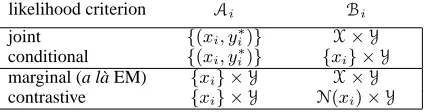
Table 2: Supervised (upper box) and unsupervised (lower box) estimation with log-linear models in terms of Eq. 5.
whereAi ⊂ Bi (for eachi). For log-linear models
this is simply
Y
i
P
(x,y)∈Aiu
x, y|θ~
P
(x,y)∈Biu
x, y|θ~
(6)
So there is no need to computeZ(~θ), but we do need
to compute sums overAandB. Tab. 2 summarizes
some concrete examples; see also§3.1–3.2.
We would prefer to choose an objective function such that these sums are easy. CE focuses on choos-ing appropriate small contrast setsBi, both for
effi-ciency and to guide the learner. The natural choice forAi(which is usually easier to sum over) is the set
of(x, y)that are consistent with what was observed
(partially or completely) about the ith training
ex-ample, i.e., the numerator P
(x,y)∈Aip(x, y |
~ θ) is
designed to findp(observationi|~θ). The idea is to
focus the probability mass withinBi on the subset
Ai where theithe training example is known to be.
It is possible to build log-linear models where
each xi is a sequence.2 In this paper, each model
is a weighted finite-state automaton (WFSA) where states correspond to POS tags. The parameter vector
~
θ ∈ Rn specifies a weight for each of then
transi-tions in the automaton. y is a hidden path through
the automaton (determining a POS sequence), andx
is the string it emits. u(x, y | ~θ) is defined by
ap-plyingexpto the total weight of all transitions iny.
This is an example of Eqs. 4 and 6 wherefj(x, y)is
the number of times the pathy takes thejth
transi-tion.
The partition functionZ(θ)~ of the WFSA is found
by adding up theu-scores of all paths through the
WFSA. For ak-state WFSA, this equates to solving
a linear system ofkequations inkvariables (Tarjan,
1981). But if the WFSA contains cycles this infi-nite sum may diverge. Alternatives to exact
com-2
putation, like random sampling (see, e.g., Abney, 1997), will not help to avoid this difficulty; in addi-tion, convergence rates are in general unknown and bounds difficult to prove. We would prefer to sum
over finitely many paths inBi.
3.1 Parameter estimation (supervised)
For log-linear models, both CL and JL estimation
(Tab. 1) are available. In terms of Eq. 5, both
set Ai = {(xi, yi∗)}. The difference is in B: for
JL, Bi = X×Y, so summing over Bi is
equiva-lent to computing the partition functionZ(~θ).
Be-cause that sum is typically difficult, CL is preferred;
Bi = {xi} ×Y for xi, which is often tractable.
For sequence models like WFSAs it is computed us-ing a dynamic programmus-ing algorithm (the forward algorithm for WFSAs). Klein and Manning (2002) argue for CL on grounds of accuracy, but see also
Johnson (2001). See Tab. 2; other contrast sets Bi
are also possible.
WhenBicontains onlyxi paired with the current
best competitor (yˆ) toy∗i, we have a technique that resembles maximum margin training (Crammer and
Singer, 2001). Note that yˆwill then change across
training iterations, makingBidynamic.
3.2 Parameter estimation (unsupervised)
The difference between supervised and unsuper-vised learning is that in the latter case,Ai is forced
to sum over label sequencesybecause they weren’t
observed. In the unsupervised case, CE maximizes
LN
~ θ
= logY
i
X
y∈Y
uxi, y|~θ
X
(x,y)∈N(xi)×Y
ux, y|~θ (7)
In terms of Eq. 5,A={xi}×YandB=N(xi)×Y.
EM’s objective function (Eq. 1) is a special case
where N(xi) = X, for all i, and the
denomina-tor becomes Z(~θ). An alternative is to restrict the
neighborhood to the set of observed training exam-ples rather than all possible examexam-ples (Riezler, 1999; Johnson et al., 1999; Riezler et al., 2000):
Y
i
" uxi|~θ
,
X
j
uxj|θ~
#
(8)
Viewed as a CE method, this approach (though ef-fective when there are few hypotheses) seems mis-guided; the objective says to move mass to each ex-ample at the expense of all other training exex-amples.
Another variant is conditional EM. Let xi be a
pair (xi,1, xi,2) and define the neighborhood to be
N(xi) = {x¯ = (¯x1, xi,2)}. This approach has
been applied to conditional densities (Jebara and Pentland, 1998) and conditional training of acoustic models with hidden variables (Valtchev et al., 1997). Generally speaking, CE is equivalent to some
kind of EM when N(·) is an equivalence relation
on examples, so that the neighborhoods partitionX.
Then if q is any fixed (untrained) distribution over
neighborhoods, CE equates to running EM on the model defined by
p0x, y|~θdef= q(N(x))·px, y|N(x), ~θ (9)
CE may also be viewed as an importance sam-pling approximation to EM, where the sample space
X is replaced by N(xi). We will demonstrate
ex-perimentally that CE is not just an approximation to EM; it makes sense from a modeling perspective.
In §4, we will describe neighborhoods of
se-quences that can be represented as acyclic lattices built directly from an observed sequence. The sum
overBi is then the totalu-score in our model of all
paths in the neighborhood lattice. To compute this, intersect the WFSA and the lattice, obtaining a new
acyclic WFSA, and sum theu-scores of all its paths (Eisner, 2002) using a simple dynamic programming algorithm akin to the forward algorithm. The sum
overAimay be computed similarly.
CE with lattice neighborhoods is not confined to the WFSAs of this paper; when estimating weighted CFGs, the key algorithm is the inside algorithm for lattice parsing (Smith and Eisner, 2005).
3.3 Numerical optimization
To maximize the neighborhood likelihood (Eq. 7), we apply a standard numerical optimization method (L-BFGS) that iteratively climbs the function using knowledge of its value and gradient (Liu and
No-cedal, 1989). The partial derivative ofLN with
re-spect to thejth feature weightθjis
∂LN ∂θj
=X
i
E~θ[fj|xi]−E~θ[fj|N(xi)] (10)
natural language is a delicate thing
a. DEL1WORD:
natural language is a delicate thing
language is a delicate thing
is a delicate thing ?:ε
? ?
b. TRANS1:
natural language is a delicate thing
delicate is
is
a natural
a
is a delicate thing
language
language delicate thing
:x x2 1 x2
x1: :
x x2 3 x x3: 2
:
x xm m−1 xm−1:xm
? ?
...
(Each bigramxii+1in the sentence has an arc pair(xi:xi+1, xi+1:xi).)
c. DEL1SUBSEQ:
natural language is a delicate thing
language is
is a
a
a delicate thing
?:ε ?:ε
?:ε
?
?
? ?
ε
[image:5.612.85.528.53.307.2]ε
Figure 1: A sentence and three lattices representing some of its neighborhoods. The transducer used to generate each neighborhood lattice (via composition with the sentence, followed by determinization and minimization) is shown to its right.
expectations in Eq. 10 are computed by the forward-backward algorithm generalized to lattices.
We emphasize that the function LN is not
glob-ally concave; our search will lead only to a local
op-timum.3 Therefore, as with all unsupervised
statisti-cal learning, the bias in the initialization of~θwill af-fect the quality of the estimate and the performance of the method. In future we might wish to apply techniques for avoiding local optima, such as deter-ministic annealing (Smith and Eisner, 2004).
4 Lattice Neighborhoods
We next consider some non-classical neighborhood
functions for sequences. When X = Σ+ for some
symbol alphabetΣ, certain kinds of neighborhoods
have natural, compact representations. Given an in-put string x = hx1, x2, ..., xmi, we write xji for
the substringhxi, xi+1, ..., xjiandxm1 for the whole
string. Consider first the neighborhood consisting of all sequences generated by deleting a single symbol
from them-length sequencexm1 :
DEL1WORD(xm1) =
n x`−1 1x
m
`+1|1≤`≤m
o ∪ {xm1 }
This set consists ofm+ 1strings and can be
com-pactly represented as a lattice (see Fig. 1a). Another
3Without any hidden variables,L
Nis globally concave.
neighborhood involves transposing any pair of adja-cent words:
TRANS1(xm1) =
n
x`−1 1x`+1x`xm`+2|1≤` < m
o ∪ {xm1 }
This set can also be compactly represented as a
lat-tice (Fig. 1b). We can combine DEL1WORD and
TRANS1 by taking their union; this gives a larger
neighborhood, DELORTRANS1.4
The DEL1SUBSEQneighborhood allows the
dele-tion of any contiguous subsequence of words that is strictly smaller than the whole sequence. This lattice
is similar to that of DEL1WORD, but adds some arcs
(Fig. 1c); the size of this neighborhood isO(m2).
A final neighborhood we will consider is LENGTH, which consists of Σm. CE with the
LENGTHneighborhood is very similar to EM; it is equivalent to using EM to estimate the parameters
of a model defined by Eq. 9 where q is any fixed
(untrained) distribution over lengths.
When the vocabulary Σis the set of words in a
natural language, it is never fully known;
approx-imations for defining LENGTH = Σm include
us-ing observedΣ from the training set (as we do) or
adding a specialOOVsymbol.
30 40 50 60 70 80 90 100
0.1 1 10
% correct tags
smoothing parameter
0 8
12K 24K 48K 96K
sel. oracle sel. oracle sel. oracle sel. oracle
CRF (supervised) 100.0 99.8 99.8 99.5
HMM (supervised) 99.3 98.5 97.9 97.2
LENGTH 74.9 77.4 78.7 81.5 78.3 81.3 78.9 79.3
DELORTR1 70.8 70.8 78.6 78.6 78.3 79.1 75.2 78.8 TRANS1 72.7 72.7 77.2 77.2 78.1 79.4 74.7 79.0 EM 49.5 52.9 55.5 58.0 59.4 60.9 60.9 62.1 DEL1WORD 55.4 55.6 58.6 60.3 59.9 60.2 59.9 60.4 DEL1SSQ 53.0 53.3 55.0 56.7 55.3 55.4 57.3 58.7
random expected 35.2 35.1 35.1 35.1
[image:6.612.75.540.45.188.2]ambiguous words 6,244 12,923 25,879 51,521
Figure 2: Percent ambiguous words tagged correctly in the 96K dataset, as the smoothing parameter (λin the case of EM,σ2in the CE cases) varies. The model selected from each criterion using unlabeled development data is circled in the plot. Dataset size is varied in the table at right, which shows models selected using unlabeled development data (“sel.”) and using an oracle (“oracle,” the highest point on a curve). Across conditions, some neighborhood roughly splits the difference between supervised models and EM.
5 Experiments
We compare CE (using neighborhoods from §4)
with EM on POS tagging using unlabeled data.
5.1 Comparison with EM
Our experiments are inspired by those in
Merialdo (1994); we train a trigram tagger using only unlabeled data, assuming complete knowledge
of the tagging dictionary.5 In our experiments,
we varied the amount of data available (12K–96K words of WSJ), the heaviness of smoothing, and the estimation criterion. In all cases, training stopped when the relative change in the criterion fell below
10−4between steps (typically≤100 steps). For this
corpus and tag set, on average, a tagger must decide between 2.3 tags for a given token.
The generative model trained by EM was identical to Merialdo’s: a second-order HMM. We smoothed
using a flat Dirichlet prior with single parameter λ
for all distributions (λ-values from 0 to 10 were
tested).6 The model was initialized uniformly.
The log-linear models trained by CE used the same feature set, though the feature weights are no longer log-probabilities and there are no sum-to-one constraints. In addition to an unsmoothed trial, we tried diagonal Gaussian priors (quadratic penalty)
with σ2 ranging from 0.1 to 10. The models were
initialized with allθj = 0.
Unsupervised model selection. For each
(crite-5
Without a tagging dictionary, tag names are interchange-able and cannot be evaluated on gold-standard accuracy. We address the tagging dictionary assumption in§5.2.
6This is equivalent to add-λsmoothing within every M step.
rion, dataset) pair, we selected the smoothing trial that gave the highest estimation criterion score on a 5K-word development set (also unlabeled).
Results. The plot in Fig. 2 shows the Viterbi
ac-curacy of each criterion trained on the 96K-word dataset as smoothing was varied; the table shows, for each (criterion, dataset) pair the performance of
the selectedλorσ2and the one chosen by an oracle.
LENGTH, TRANS1, and DELORTRANS1 are con-sistently the best, far out-stripping EM. These gains dwarf the performance of EM on over 1.1M words (66.6% as reported by Smith and Eisner (2004)), even when the latter uses improved search (70.0%).
DEL1WORDand DEL1SUBSEQ, on the other hand,
are poor, even worse than EM on larger datasets.
An important result is that neighborhoods do not succeed by virtue of approximating log-linear EM; if that were so, we would expect larger
neighbor-hoods (like DEL1SUBSEQ) to out-perform smaller
ones (like TRANS1)—this is not so. DEL1SUBSEQ
and DEL1WORDare poor because they do not give
helpful classes of negative evidence: deleting a word or a short subsequence often does very little dam-age. Put another way, models that do a good job of explaining why no word or subsequence should be deleted do not do so using the familiar POS cate-gories.
The LENGTH neighborhood is as close to
log-linear EM as it is practical to get. The
inconsis-tencies in the LENGTH curve (Fig. 2) are notable
DELORTRANS1 TRANS1 LENGTH EM words in trigram + spellingtrigram trigram + spellingtrigram trigram + spellingtrigram trigram
tagging dict. sel. oracle sel. oracle sel. oracle sel. oracle sel. oracle sel. oracle sel. oracle random expect
ed
ambiguous wor
ds
ave. tags/tok
en
all train & dev. 78.3 90.1 80.9 91.1 90.4 90.4 88.7 90.9 87.8 90.4 87.1 91.9 78.0 84.4 69.5 13,150 2.3 1st500 sents. 72.3 84.8 80.2 90.8 80.8 82.9 88.1 90.1 68.1 78.3 76.9 83.2 77.2 80.5
[image:7.612.77.546.53.131.2]60.5 13,841 3.7 count≥2 69.5 81.3 79.5 90.3 77.0 78.6 78.7 90.1 65.3 75.2 73.3 73.8 70.1 70.9 56.6 14,780 4.4 count≥3 65.0 77.2 78.3 89.8 71.7 73.4 78.4 89.5 62.8 72.3 73.2 73.6 66.5 66.5 51.0 15,996 5.5
Table 3: Percent of all words correctly tagged in the 24K dataset, as the tagging dictionary is diluted. Unsupervised model selection (“sel.”) and oracle model selection (“oracle”) across smoothing parameters are shown. Note that we evaluated on all words (unlike Fig. 3) and used 17 coarse tags, giving higher scores than in Fig. 2.
accuracy of the LENGTH models; the same “dips”
were present. This could indicate that the learner was trapped in a local maximum, suggesting that, since other criteria did not exhibit this behavior, LENGTH might be a bumpier objective surface. It would be interesting to measure the bumpiness (sen-sitivity to initial conditions) of different contrastive objectives.7
5.2 Removing knowledge, adding features
The assumption that the tagging dictionary is com-pletely known is difficult to justify. While a POS lexicon might be available for a new language, cer-tainly it will not give exhaustive information about all word types in a corpus. We experimented with removing knowledge from the tagging dictionary, thereby increasing the difficulty of the task, to see how well various objective functions could recover. One means to recovery is the addition of features to the model—this is easy with log-linear models but not with classical generative models.
We compared the performance of the best
neighborhoods (LENGTH, DELORTRANS1, and
TRANS1) from the first experiment, plus EM,
us-ing three diluted dictionaries and the original one, on the 24K dataset. A diluted dictionary adds (tag, word) entries so that rare words are allowed with
any tag, simulating zero prior knowledge about the
word. “Rare” might be defined in different ways; we used three definitions: words unseen in the first 500 sentences (about half of the 24K training
cor-pus); singletons (words with count≤1); and words
with count≤2. To allow more trials, we projected
the original 45 tags onto a coarser set of 17 (e.g.,
7
A reviewer suggested including a table comparing different criterion values for each learned model (i.e., each neighborhood evaluated on each other neighborhood). This table contained no big surprises; we note only that most models were the best on their own criterion, and among unsupervised models, LENGTH
performed best on the CL criterion.
RB∗ →ADV).
To take better advantage of the power of log-linear models—specifically, their ability to incorpo-rate novel features—we also ran trials augmenting the model with spelling features, allowing exploita-tion of correlaexploita-tions between parts of the word and a possible tag. Our spelling features included all ob-served 1-, 2-, and 3-character suffixes, initial capital-ization, containing a hyphen, and containing a digit.
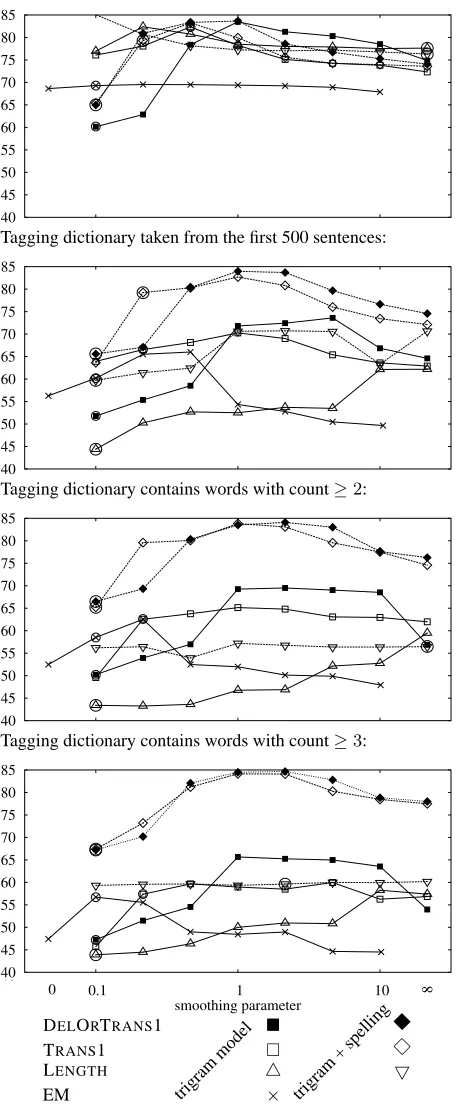
Results. Fig. 3 plots tagging accuracy (on
am-biguous words) for each dictionary on the 24K
dataset. Thex-axis is the smoothing parameter (λ
for EM,σ2for CE). Note that the different plots are
not comparable, because theiry-axes are based on
different sets of ambiguous words.
So that models under different dilution conditions could be compared, we computed accuracy on all words; these are shown in Tab. 3. The reader will notice that there is often a large gap between unsu-pervised and oracle model selection; this draws at-tention to a need for better unsupervised regulariza-tion and model selecregulariza-tion techniques.
Without spelling features, all models perform
worse as knowledge is removed. But LENGTH
suf-fers most substantially, relative to its initial
perfor-mance. Why is this? LENGTH (like EM) requires
the model to explain why a given sentence was seen instead of some other sentence of the same length. One way to make this explanation is to manipulate emission weights (i.e., for (tag, word) features): the learner can construct a good class-based unigram model of the text (where classes are tags). This is
good for the LENGTHobjective, but not for learning
good POS tag sequences.
In contrast, DELORTRANS1 and TRANS1 do not
check this intuition, we built local normalized
mod-els p(word | tag) from the parameters learned by
TRANS1 and LENGTH. For each tag, these were
compared by KL divergence to the empirical lexical distributions (from labeled data). For the ten tags
accounting for 95.6% of the data, LENGTH more
closely matched the empirical lexical distributions. LENGTH is learning a correct distribution, but that distribution is not helpful for the task.
The improvement from adding spelling features
is striking: DELORTRANS1 and TRANS1 recover
nearly completely (modulo the model selection
problem) from the diluted dictionaries. LENGTH
sees far less recovery. Hence even our improved fea-ture sets cannot compensate for the choice of borhood. This highlights our argument that a neigh-borhood is not an approximation to log-linear EM; LENGTH tries very hard to approximate log-linear EM but requires a good dictionary to be on par with the other criteria. Good neighborhoods, rather, per-form well in their own right.
6 Future Work
Foremost for future work is the “minimally super-vised” paradigm in which a small amount of la-beled data is available (see, e.g., Clark et al. (2003)). Unlike well-known “bootstrapping” approaches (Yarowsky, 1995), EM and CE have the possible ad-vantage of maintaining posteriors over hidden labels (or structure) throughout learning; bootstrapping ei-ther chooses, for each example, a single label, or remains completely agnostic. One can envision a
mixed objective function that tries to fit the labeled
examples while discriminating unlabeled examples
from their neighborhoods.8
Regardless of how much (if any) data are labeled, the question of good smoothing techniques requires more attention. Here we used a single zero-mean, constant-variance Gaussian prior for all parameters. Better performance might be achieved by allowing different variances for different feature types. This
8
Zhu and Ghahramani (2002) explored the semi-supervised classification problem for spatially-distributed data, where some data are labeled, using a Boltzmann machine to model the dataset. For them, the Markov random field is over label-ing configurations for all examples, not, as in our case, com-plex structured labels for a particular example. Hence theirB (Eq. 5), though very large, was finite and could be sampled.
All train & development words are in the tagging dictionary:
40 45 50 55 60 65 70 75 80 85
Tagging dictionary taken from the first 500 sentences:
40 45 50 55 60 65 70 75 80 85
Tagging dictionary contains words with count≥2:
40 45 50 55 60 65 70 75 80 85
Tagging dictionary contains words with count≥3:
40 45 50 55 60 65 70 75 80 85
40 45 50 55 60 65 70 75 80 85
0.1 1 10
smoothing parameter
0 8
50
DELORTRANS1
TRANS1
LENGTH 4 5
EM trigram
model
[image:8.612.313.541.78.631.2]× trigram +spelling
leads to a need for more efficient tuning of the prior parameters on development data.
The effectiveness of CE (and different neighbor-hoods) for dependency grammar induction is ex-plored in Smith and Eisner (2005) with considerable success. We introduce there the notion of design-ing neighborhoods to guide learndesign-ing for particular tasks. Instead of guiding an unsupervised learner to match linguists’ annotations, the choice of neighbor-hood might be made to direct the learner toward hid-den structure that is helpful for error-correction tasks like spelling correction and punctuation restoration that may benefit from a grammatical model.
Wang et al. (2002) discuss the latent maximum entropy principle. They advocate running EM many times and selecting the local maximum that maxi-mizes entropy. One might do the same for the local maxima of any CE objective, though theoretical and experimental support for this idea remain for future work.
7 Conclusion
We have presented contrastive estimation, a new probabilistic estimation criterion that forces a model to explain why the given training data were better than bad data implied by the positive examples. We have shown that for unsupervised sequence model-ing, this technique is efficient and drastically out-performs EM; for POS tagging, the gain in accu-racy over EM is twice what we would get from ten times as much data and improved search, sticking with EM’s criterion (Smith and Eisner, 2004). On this task, with certain neighborhoods, contrastive estimation suffers less than EM does from dimin-ished prior knowledge and is able to exploit new features—that EM can’t—to largely recover from the loss of knowledge.
References
S. P. Abney. 1997. Stochastic attribute-value grammars.
Com-putational Linguistics, 23(4):597–617.
Y. Altun, M. Johnson, and T. Hofmann. 2003. Investigating loss functions and optimization methods for discriminative learning of label sequences. In Proc. of EMNLP.
E. Charniak. 1993. Statistical Language Learning. MIT Press. S. Clark, J. R. Curran, and M. Osborne. 2003. Bootstrapping
POS taggers using unlabelled data. In Proc. of CoNLL. M. Collins. 2000. Discriminative reranking for natural
lan-guage parsing. In Proc. of ICML.
K. Crammer and Y. Singer. 2001. On the algorithmic imple-mentation of multiclass kernel-based vector machines.
Jour-nal of Machine Learning Research, 2(5):265–92.
A. Dempster, N. Laird, and D. Rubin. 1977. Maximum likeli-hood estimation from incomplete data via the EM algorithm.
Journal of the Royal Statistical Society B, 39:1–38.
J. Eisner. 2002. Parameter estimation for probabilistic finite-state transducers. In Proc. of ACL.
G. E. Hinton. 2003. Training products of experts by mini-mizing contrastive divergence. Technical Report GCNU TR 2000-004, University College London.
T. Jebara and A. Pentland. 1998. Maximum conditional like-lihood via bound maximization and the CEM algorithm. In
Proc. of NIPS.
M. Johnson, S. Geman, S. Canon, Z. Chi, and S. Riezler. 1999. Estimators for stochastic “unification-based” grammars. In
Proc. of ACL.
M. Johnson. 2001. Joint and conditional estimation of tagging and parsing models. In Proc. of ACL.
B.-H. Juang and S. Katagiri. 1992. Discriminative learning for minimum error classification. IEEE Trans. Signal
Process-ing, 40:3043–54.
D. Klein and C. D. Manning. 2002. Conditional structure vs. conditional estimation in NLP models. In Proc. of EMNLP. J. Lafferty, A. McCallum, and F. Pereira. 2001. Conditional
random fields: Probabilistic models for segmenting and la-beling sequence data. In Proc. of ICML.
D. C. Liu and J. Nocedal. 1989. On the limited memory method for large scale optimization. Mathematical Programming B, 45(3):503–28.
A. McCallum and W. Li. 2003. Early results for named-entity extraction with conditional random fields. In Proc.
of CoNLL.
B. Merialdo. 1994. Tagging English text with a probabilistic model. Computational Linguistics, 20(2):155–72.
Y. Miyao and J. Tsujii. 2002. Maximum entropy estimation for feature forests. In Proc. of HLT.
A. Ratnaparkhi, S. Roukos, and R. T. Ward. 1994. A maximum entropy model for parsing. In Proc. of ICSLP.
S. Riezler, D. Prescher, J. Kuhn, and M. Johnson. 2000. Lex-icalized stochastic modeling of constraint-based grammars using log-linear measures and EM training. In Proc. of ACL. S. Riezler. 1999. Probabilistic Constraint Logic Programming.
Ph.D. thesis, Universit¨at T¨ubingen.
R. Rosenfeld. 1994. Adaptive Statistical Language Modeling:
A Maximum Entropy Approach. Ph.D. thesis, CMU.
F. Sha and F. Pereira. 2003. Shallow parsing with conditional random fields. In Proc. of HLT-NAACL.
N. A. Smith and J. Eisner. 2004. Annealing techniques for unsupervised statistical language learning. In Proc. of ACL. N. A. Smith and J. Eisner. 2005. Guiding unsupervised
gram-mar induction using contrastive estimation. In Proc. of
IJ-CAI Workshop on Grammatical Inference Applications.
R. E. Tarjan. 1981. A unified approach to path problems.
Jour-nal of the ACM, 28(3):577–93.
V. Valtchev, J. J. Odell, P. C. Woodland, and S. J. Young. 1997. MMIE training of large vocabulary speech recognition sys-tems. Speech Communication, 22(4):303–14.
S. Wang, R. Rosenfeld, Y. Zhao, and D. Schuurmans. 2002. The latent maximum entropy principle. In Proc. of ISIT. D. Yarowsky. 1995. Unsupervised word sense disambiguation
rivaling supervised methods. In Proc. of ACL.