audiences’ perception of characters that speak in different
varieties of English, Spanish and Catalan
DARDER, Laia <http://orcid.org/0000-0002-3296-2349>
Available from Sheffield Hallam University Research Archive (SHURA) at:
http://shura.shu.ac.uk/15046/
This document is the author deposited version. You are advised to consult the
publisher's version if you wish to cite from it.
Published version
DARDER, Laia (2014). Exploring the translation of animated films : quantifying
audiences’ perception of characters that speak in different varieties of English,
Spanish and Catalan. Journal of Research Design and Statistics in Linguistics and
Communication Science, 1 (2), 147-168.
Copyright and re-use policy
See
http://shura.shu.ac.uk/information.html
Sheffield Hallam University Research Archive
jrds (print) issn 2052-417x jrds (online) issn 2052-4188
jrds vol 1.2 2014 147–168
©2015, equinox publishing doi : 10.1558/jrds/25251
Article
Exploring the translation of animated films:
quantifying audiences’ perception of characters
that speak in different varieties of English,
Spanish and Catalan
Laia Darder
Abstract
The visibility of language variation in films has become a challenge to translation for dubbing, and the need arises to understand how the process of translating variation can influence the product in significant ways. By carrying out a quantitative study, we answered questions such as whether the practice is acceptable amongst audiences, or whether some language choices alter the perception of certain characters. We mea-sured the perception of ten opposed personality traits amongst native audiences in English, Spanish and Catalan using a Semantic Differential Scale, and assessed the global impression of characters that had been translated with and without the use of varieties. The results show that characters overall are perceived the same way across languages regardless of whether they use varieties in or outside the mainstream, and conclude that this tool can be used to quantify and compare the same characters across languages.
Keywords: audiences; audiovisual translation; questionnaire design; reception
Affiliation
1. Introduction
The visibility of language variation in original animated films in English has become a new challenge for distributors and translators alike when dubbing into a ‘standard’1 variety no longer suffices in an increasingly diverse world that
is also reflected in film. Translations of films that include a range of characters that speak in different varieties have started to appear in Catalan and Spanish, where products are distributed following a dubbing process that substitutes the voices in the original versions for voices in the target language. In the case of
Shark Tale (2004), Madagascar (2005) and Cars (2005), language variation is present for some characters which have subsequently been dubbed into variet-ies (or near-varietvariet-ies) in the target texts. In this article we propose a method to measure personality traits of characters as a way to explore quantitatively the reception of these films amongst English, Catalan and Spanish native speakers. This way, we can access the global perception of characters and see whether the use of varieties in the original and the translated versions has an impact that results in different characteristics being attributed to the same characters. Mea-suring the impact of an original filmic text on English-speaking audiences and the subsequent translations on the target audiences increases the knowledge of the potential acceptability of these dubbed products, and of the new techniques implemented when approaching translation, especially the translation of varia-tion. The right analysis could reveal whether the decisions taken in translating a corpus of films affect the product when it is presented in different versions, and whether it is accepted by audiences across languages in similar ways. The implications of translating varieties from one language to another are significant, in terms of potential changes in language use and perception, but also commercialization, ethics and even political impact. This is particularly true if the text at stake is a film that may be seen by millions. Despite this, studies into the reception of translated audiovisual products are scarce, as ‘[a]lthough many theories and studies talk about the reader as the key factor, very few focus on reception, and there are hardly any empirical studies on the reception of translated texts’ (Fuentes Luque 2003: 294), an opinion shared by Denton (2007: 27). Furthermore, Gambier asserts that ‘[v]ery few studies have dealt with the issue of reception in [audiovisual translation], and even fewer have looked at it empirically, even though we continually make reference to readers, viewers, consumers, users, etc.’ (Gambier 2009: 52). In response to Gambier’s views, this study seeks to add to the empirical evidence into the reception of audiovisual translation (AVT) through analysing the perception of individual characters in three languages by native audiences.
Laia Darder 149
aims and the subject profile, along with an outline of the process of reception. The results are presented in the relevant figures, where results for individ-ual adjectives will be introduced. Finally, the data collected are used to draw conclusions about the acceptability of this form of stylistic translation as per-ceived by the target audience.
2. Methodology
The methodology used for the present study describes the design of the Seman-tic Differential Scale (SDS), including the selection of appropriate adjectives. In the next section we outline the subjects’ profile, followed by their demo-graphics and the description of the process that was performed. A subsequent section is dedicated to further explaining the selection of clips for the study, and background information on the way audiovisual messages are decoded. The final section comprises the statistical analyses applied to the results. This study was performed with ethical clearance from the University of Sheffield according to relevant guidelines.
2.1. Experimentation
The purpose of this study is to gather information on the reception of dubbed products amongst native audiences by examining the perception of characters in films with language variation. This involves using the SDS to elicit responses from native speakers of English, Catalan and Spanish who viewed film clips featuring characters who used variation in their native language.
For this work the following questions are addressed:
• What is the perception of each selected character in each language?
• To what extent does the translation of variation affect the perception of characters?
Answering these questions will provide an important insight to determine whether the acceptability of stylistic renditions of original material exists amongst Spanish and Catalan audiences in relation to the impact of the origi-nal material on native English speakers.
2.2. Semantic Differential Scale
In Palencia’s work, data collection is performed using Osgood’s Differential Scale and, in doing so, builds upon other studies that utilize the same method for related topics within audiovisual media. The original scale was designed by Osgood et al. (1957), and subsequently has become widely known as the Semantic Differential, or Semantic Differential Scale. The SDS is used here, as in the referenced works, to measure the meaning of items, in this case the affective meaning of the selected characters as perceived by audiences. By requiring subjects to define their perceptions of different aspects of a char-acter, a subjective response can be quantified and analysed using statistical methods. Generally, a Likert scale is used, which allows respondents to grade their perception between two opposing adjectives (Likert 1932), hence getting a more sensitive distinction than a simple positive or negative response. The SDS was chosen not only with reference to Palencia’s experience, but also for its reliability in eliciting viewers’ responses, and for its widespread applicability across disciplines. Also, ‘[t]he SDS has been used extensively in language attitude studies as a means of measuring subjects’ attitudes towards various languages, dialects, accents, as well as the speakers of different vari-eties’ (Al-Hindawe 1996: 1). Whilst other techniques to measure audiences’ affective responses exist (Gunter 2000), the SDS has also previously been val-idated in areas such as the audiovisual media and variational research. In combination with its previous use by Palencia (2002) in the specific area of dubbing, a valid precedent therefore exists for its use in this setting. In all, the SDS allows for a relatively robust approach to data collection and quantita-tive analysis. Additionally, ‘[o]ne advantage of this technique is that it forces subjects to focus on the expected dimensions since the categories are already provided’ (Agheyisi and Fishman 1970: 148), which was considered an obvi-ous advantage.
The SDS has also been used to elicit speakers’ attitudes towards dialects. In previous variational studies utterances may have been heard in isolation. In this case, due to the aim of the study and the nature of the original and trans-lated texts, as well as the technical constraints (background music and sound effects), the voices are not dissociated from their context. Although it would be possible to dissociate the visual text from the soundtrack, this was not con-sidered relevant to this study given that the primary aim is to provide an over-view of the global perception of individual characters to compare the outcome of the translation process with the original.
2.3. Construction of the differential: Selection of adjectives
Laia Darder 151
Balanced Unbalanced
Humble Arrogant
Calm Nervous
Confident Insecure
Intelligent Stupid
Extravert Introvert
Strong Weak
Sincere Hypocrite
Close Distant
[image:6.442.76.371.64.212.2]Credible Non-credible
Figure 1: Questionnaire in English
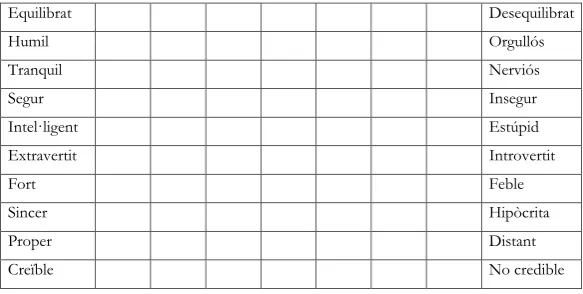
Equilibrat Desequilibrat
Humil Orgullós
Tranquil Nerviós
Segur Insegur
Intel·ligent Estúpid
Extravertit Introvertit
Fort Feble
Sincer Hipòcrita
Proper Distant
[image:6.442.78.370.246.393.2]Creïble No credible
Figure 2: Questionnaire in Catalan
Equilibrado Desequilibrado
Humilde Orgulloso
Tranquilo Nervioso
Seguro Inseguro
Inteligente Estúpido
Extrovertido Introvertido
Fuerte Débil
Sincero Hipócrita
Cercano Distante
Creíble No credible
[image:6.442.78.373.427.572.2]Palencia (2002) performed a pilot study prior to the design of her definitive tool for data collection from which she short-listed eight adjectives. The pur-pose of that survey is to determine which pairs of adjectives appear most useful to a group of subjects, from a longer list of seemingly redundant or unnecessary adjectives. In the final selection, Palencia includes the semantic duality of ‘credi-ble’, which has also been incorporated here. The importance of this adjective will be highlighted at a later stage in this article, as it offers direct access to the view-ers’ opinions on the character as a whole. For the present study it was consid-ered that Palencia’s work would be an ideal starting point, given the similar aims of both studies in determining the reception of dubbed films on given audiences by focusing on the perception of individual characters. In the final version of the SDS, ten pairs of opposing adjectives are chosen, with the addition of ‘close-distant’. This is used to account for the level of familiarity with the utterances. Al-Hyndawe (1996) raises awareness about the implications of using pairs of adjectives that may not be complementary antonyms or that may lead to ambiguity. Given that this study would involve three linguistic groups, pre-cision of language was a priority in translating adjectives from the original Spanish, as used by Palencia, into English and Catalan.
2.4. Construction of the differential: Layout design
The main objective in designing the layout was to obtain a grid that was neat and easy to understand. For the SDS, a seven-point scale was used to deter-mine the grade within a pair of opposed adjectives. Although the scale is often annotated with numbers 1–7, written between two adjectives, in this case the resulting layout was busy; it was therefore decided to simplify the scale by using seven clear boxes. If a mark was placed in the middle of the grid (fourth box), it meant that the subject did not feel strongly on that category, whereas a mark positioned towards one or other adjective indicated a preference whose magnitude increased with proximity to the end of the scale. All subjects were asked to complete all categories for all characters.
2.5. Subject profile
As per the languages of the original and translated versions of the films, Eng-lish, Catalan and Spanish, three groups of adult native speaker subjects were devised. For the present study, a minimum of 20 subjects per language was considered adequate. All subjects were approached via email and invited to take part in this anonymized study. They were informed that the only infor-mation collected would be age, gender and their questionnaire responses according to the language they were recruited for.
Laia Darder 153
This meant that they were familiar with the Spanish dubbing style of the films we presented to them. Dubbing in Spain differs from that of other Spanish-speaking countries where the concept of vernacular and mainstream variety is different. This way, the subjects’ diegetic experience would be complete and effortless. Also, it was intended in the recruitment process that all subjects forming the Spanish group were not bilingual in any other languages of Spain, so they would be accustomed to watching films dubbed only into Spanish. However, this was not possible for the Catalan speakers, as all Catalan speak-ers are bilingual and accustomed to watching productions in Spanish. The selection of participants was performed regardless of whether the sub-jects had previously seen the films. Given the worldwide popularity of all three films, limiting the study to subjects that had not seen any in the corpus would have seriously compromised the chances of finding sufficient participants. Although it was not possible to control for this aspect in the study, an attempt to limit its impact was made in the way the clips were presented. Clips were treated as a text that has a beginning and an end in the form of a scene, and no other information was given on the film. Subjects were therefore encour-aged to base their views on the selected scenes, and not to consciously recol-lect their memories of the film. We recognize that this is a limitation of this form of audience perception research.
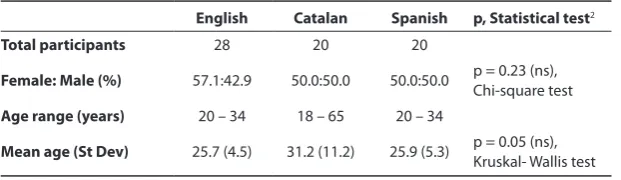
The composition and demographics of the three groups are shown in Table 1, along with the results of statistical tests for between-group differences. The groups did not differ in their age or gender demographics although there was a trend for Catalan participants to be older, which did not reach statistical significance.
[image:8.442.62.373.498.588.2]Additionally, we intended to include speakers of different varieties within their languages, so as to represent as wide an audience as possible. Although this aspect is not analysed in detail within this study, this could be taken into account for future research. Another feature that was not part of the study criteria but that was noted is that all participants were either graduates or in higher education, due to the nature of the recruitment process.
Table 1: Demographics of participants.
English Catalan Spanish p, Statistical test2
Total participants 28 20 20
Female: Male (%) 57.1:42.9 50.0:50.0 50.0:50.0 p = 0.23 (ns),Chi-square test
Age range (years) 20 – 34 18 – 65 20 – 34
2.6. Description of process
The process started by inviting native speakers of the relevant languages to participate in this study. For logistical reasons, the viewings were divided into several groups. The groups contained unequal numbers of participants, given the varied availability of the subjects. All viewers were requested to follow exactly the same process: viewing all clips in the same order, supervised by the same researcher. Although it was not possible to standardize the equipment or viewing room for all groups, it was ensured that the sound was optimal for all subjects, and that the screen orientation was satisfactory. All films were shown from four original DVDs of the Spanish edition of each film, which contained all three language versions.
At the start of the viewing session participants were given precise instruc-tions about the correct process for answering the questionnaires, as follows. Upon arriving at the session, subjects were requested to take a seat and exam-ine the questionnaires. These were a collection of stapled pages with two grids per page. At the top of each grid there was the name of a character and a brief description to aid their recognition. This limited description was as neutral as possible, so as not to influence the viewers. The subjects were then invited to ask questions about any adjectives that were unclear. Emphasis was placed on ensuring that the quality of ‘credible’ was understood, i.e. whether they thought the character was well constructed and that it fitted in the scene. There were a total of sixteen grids, one for each character to be assessed. To allow a full discussion of the methodology, the focus of this article is on a subset of four characters.
After clarification of the adjectives, the participants were requested to follow instructions to answer the questionnaires appropriately. They were shown each clip twice. During the first viewing they were asked to listen and look at the screen, to try to form their opinions of each character. They were required not to take any notes at this stage to aid a global perception of the characters in the text. They were requested to complete the questionnaires during the second viewing of the clips. It was reiterated that all categories should be filled in, and that if they did not feel strongly about a particu-lar adjective pair, they had the chance to select the middle column, which served as the neutral perception. It was not possible to separate subjects phys-ically such that they could not see other participants’ answers, but sincerity was encouraged, and they were informed that there were no right or wrong answers.
Laia Darder 155
research was revealed at this stage, once subjects could not be influenced by the purpose of the study on stylistic features. The information exchanged at this stage was sometimes very valuable, but it was not analysed for this study; this could be considered for future research as a source of qualitative perceptions.
2.7. Characteristics of clips
A prerequisite for each clip was a sequence where the four main characters intervened in a conversation within the selected films, in a segment lasting around five minutes. These scenes are considered to constitute macro-signs that can be evaluated in their own right. In each original film at least two characters used vernaculars, some of which had been carried to the dubbed versions. Four characters were selected from each film, which in its entirety consisted of Madagascar, Shark Tale, Cars and Shrek 2, the latter not having been included in this article.
Only four characters have been chosen for this article from the 16 that the participants assessed. The selection criteria for these characters depended on their variety in the original and the subsequent versions, as they present a unique combination. The selected characters were Lightning McQueen from
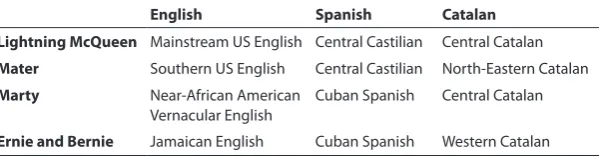
[image:10.442.64.364.416.494.2]Cars, who speaks in a mainstream variety in all three versions of the films; Mater, also from Cars, who uses a vernacular in English and Catalan, but not in Spanish; Marty from Madagascar, who uses a vernacular in English and Spanish, but not in Catalan; Ernie and Bernie, who use a vernacular in all three versions.
Table 2: Summary of varieties used by each character.
English Spanish Catalan
Lightning McQueen Mainstream US English Central Castilian Central Catalan
Mater Southern US English Central Castilian North-Eastern Catalan
Marty Near-African American
Vernacular English
Cuban Spanish Central Catalan
Ernie and Bernie Jamaican English Cuban Spanish Western Catalan
2.8. Combined cues in audiovisual texts
these voices through their previous knowledge of the language in which these are expressed’ (Palencia 2002: 89, my translation). This process explains how listeners can also learn arbitrary languages that aid the diegetic experience when viewing dubbed films. And, most importantly, they attribute meanings locally depending on their previous experience and the current context, as noted by Coupland (2007: 45).
Laia Darder 157
Palencia’s previous research allows the assumption that body language does not interfere with the process of decoding speech. In this case, we could assume that any differences that arise can be attributable to dialogue. For each language version, images act as an invariable text, together with sound effects and music. This could lead us to consider that the distinctive features, if they appear, will derive almost exclusively from the translation or dubbing deci-sions, be it what is said or how it is said.
2.9. Statistical analysis
The answers for each questionnaire were converted to a numerical scale, with each adjective for each character assigned a value from 1 to 7. As will be seen in the figures, for each character and language analysed, the values were sum-marized by calculating the mean and standard deviation. Additionally, the mean and standard deviation were calculated for all selected characters com-bined, shown in the first column for each adjective. The overall effect of both language and characters were examined using two-way ANOVA, while dif-ferences between languages for each character were tested using one-way ANOVA, and post-hoc Tukey-Scheffe correction for multiple comparisons. Statistical significance was accepted at p < 0.05.
Statistical analysis and data representation were performed using Microsoft Excel 2007 and SPSS 20.0.
3. Results
The following section is introduced by a summary table and thereafter ten fig-ures that emerged from analysing the ten opposed adjectives presented in the grid, accompanied by a brief explanation. The section that follows (3.2) will seek to account for the differences that emerge from looking at ethically sen-sitive attributes, namely intelligence, confidence and credibility, and discuss general findings.
3.1. Audience perception of character traits across different languages
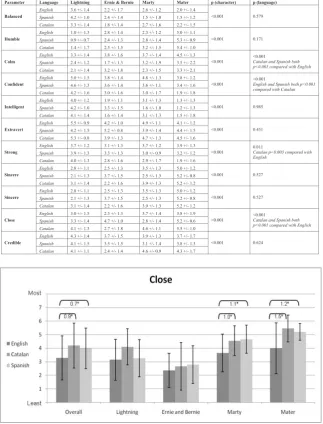
Table 3: Summary statistics for all characters and languages. Values expressed as mean +/- standard deviation. Statistical testing: 2 way ANOVA using Character and Language as dependent variables. For each parameter, there is a highly significant effect of character indicating that audiences distinguish between personality traits, but in general the effect of language is non-significant. Several exceptions are noticed, where characteristics are perceived differently across languages; these are discussed further in the text.
Parameter Language Lightning Ernie & Bernie Marty Mater p (character) p (language)
Balanced English Spanish 3.6 +/- 1.4 4.2 +/- 1.0 2.2 +/- 1.7 2.4 +/- 1.4 2.6 +/- 1.2 1.5 +/- 1.0 2.0 +/- 1.4 1.5 +/- 1.2 <0.001 0.579
Catalan 3.3 +/- 1.4 1.8 +/- 1.4 2.7 +/- 1.6 2.2 +/- 1.5
Humble English Spanish 1.0 +/- 1.3 0.9 +/- 0.7 2.8 +/- 1.4 2.4 +/- 1.3 2.3 +/- 1.2 2.8 +/- 1.4 5.0 +/- 1.1 5.3 +/- 0.9 <0.001 0.171
Catalan 1.4 +/- 1.7 2.5 +/- 1.5 3.2 +/- 1.5 5.4 +/- 1.0
Calm English 3.3 +/- 1.4 3.8 +/- 1.6 3.7 +/- 1.4 4.5 +/- 1.3 <0.001 <0.001 Catalan and Spanish both p<0.001 compared with English Spanish 2.4 +/- 1.2 1.7 +/- 1.3 3.2 +/- 1.9 3.5 +/- 2.2
Catalan 2.1 +/- 1.4 3.2 +/- 1.8 2.3 +/- 1.5 3.3 +/- 2.1
Confident English 5.0 +/- 1.5 3.8 +/- 1.4 4.8 +/- 1.3 3.8 +/- 1.2 <0.001 <0.001 English and Spanish both p<0.001 compared with Catalan Spanish 4.6 +/- 1.3 3.6 +/- 1.4 3.6 +/- 1.1 3.4 +/- 1.6
Catalan 4.2 +/- 1.6 3.0 +/- 1.6 3.0 +/- 1.7 1.9 +/- 1.8
Intelligent English Spanish 4.0 +/- 1.2 4.2 +/- 1.0 1.9 +/- 1.1 3.3 +/- 1.5 3.1 +/- 1.3 1.6 +/- 1.0 1.3 +/- 1.3 1.2 +/- 1.3 <0.001 0.985
Catalan 4.1 +/- 1.4 1.6 +/- 1.4 3.1 +/- 1.3 1.5 +/- 1.8
Extravert
English 5.5 +/- 0.9 4.2 +/- 1.0 4.9 +/- 1.1 4.1 +/- 1.2
<0.001 0.451
Spanish 4.2 +/- 1.5 5.2 +/- 0.8 3.9 +/- 1.4 4.4 +/- 1.5
Catalan 5.3 +/- 0.8 3.9 +/- 1.3 4.7 +/- 1.3 4.5 +/- 1.6
Strong
English 3.7 +/- 1.2 3.1 +/- 1.3 3.7 +/- 1.2 3.9 +/- 1.3
<0.001 0.011 Catalan p=0.003 compared with English
Spanish 3.9 +/- 1.3 3.3 +/- 1.3 3.0 +/- 0.9 3.2 +/- 1.2
Catalan 4.0 +/- 1.3 2.8 +/- 1.6 2.9 +/- 1.7 1.9 +/- 1.6
Sincere
English 2.8 +/- 1.1 2.5 +/- 1.3 3.5 +/- 1.3 5.0 +/- 1.2
<0.001 0.527
Spanish 2.1 +/- 1.3 3.7 +/- 1.5 2.5 +/- 1.3 5.2 +/- 0.8
Catalan 3.1 +/- 1.4 2.2 +/- 1.6 3.9 +/- 1.3 5.2 +/- 1.2
Sincere
English 2.8 +/- 1.1 2.5 +/- 1.3 3.5 +/- 1.3 5.0 +/- 1.2
<0.001 0.527
Spanish 2.1 +/- 1.3 3.7 +/- 1.5 2.5 +/- 1.3 5.2 +/- 0.8
Catalan 3.1 +/- 1.4 2.2 +/- 1.6 3.9 +/- 1.3 5.2 +/- 1.2
Close
English 3.0 +/- 1.5 2.3 +/- 1.3 3.7 +/- 1.4 3.8 +/- 1.9
<0.001 <0.001 Catalan and Spanish both p<0.001 compared with English Spanish 3.3 +/- 1.4 4.7 +/- 1.0 2.8 +/- 1.4 5.2 +/- 0.6
Catalan 4.1 +/- 1.3 2.7 +/- 1.8 4.6 +/- 1.1 5.5 +/- 1.0
Credible
English 4.3 +/- 1.4 3.7 +/- 1.5 3.9 +/- 1.3 3.7 +/- 1.7
<0.001 0.624
Spanish 4.1 +/- 1.5 3.5 +/- 1.5 3.1 +/- 1.4 3.8 +/- 1.3
Catalan 4.1 +/- 1.1 2.4 +/- 1.4 4.6 +/- 0.9 4.3 +/- 1.7
Figure 4: Audience perception of closeness. Where marked with an asterisk (*),
between-group difference is significant (p < 0.05) and the associated value is the difference
Laia Darder 159
[image:14.442.63.385.140.296.2]There are no significant differences on the perception of sincerity across languages, as seen in Figure 5. Regarding the strength of the characters, the only statistically significant difference in Figure 6 characters can be seen between English and Catalan in the case of Mater, with a difference of 1.6 points, which in turn affects the overall result.
Figure 5: Audience perception for sincerity.
Figure 6: Audience perception for strength.
[image:14.442.63.385.330.487.2]Figure 7: Audience perception for extraversion.
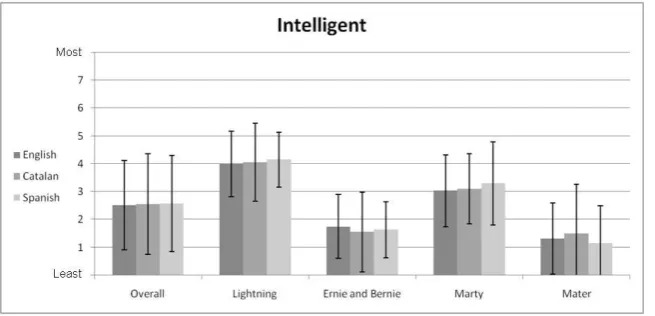
Figure 8: Audience perception for intelligence.
[image:15.442.57.385.262.420.2]Laia Darder 161
Figure 9: Audience perception for confidence.
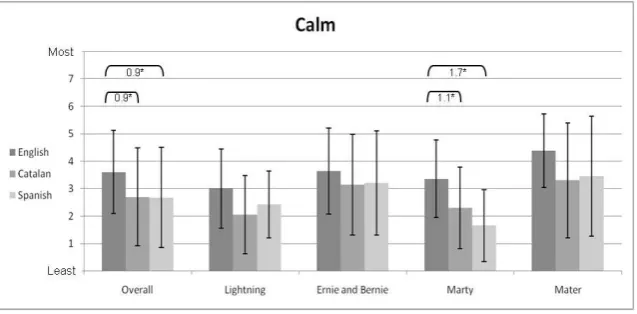
Overall, as demonstrated by Figure 10, characters are perceived as less calm in Spanish and Catalan compared to English, although for individual char-acters a statistically significant difference was only observed for Marty. It is noteworthy that Palencia (2002: 330) also identified higher perceptions of nervousness in the dubbed version into Spanish in comparison with the orig-inal in English; there may therefore be a systematic bias in the perception of calmness in these languages.
Figure 10: Audience perception for calmness.
[image:16.442.66.385.359.516.2]Figure 11: Audience perception for balance.
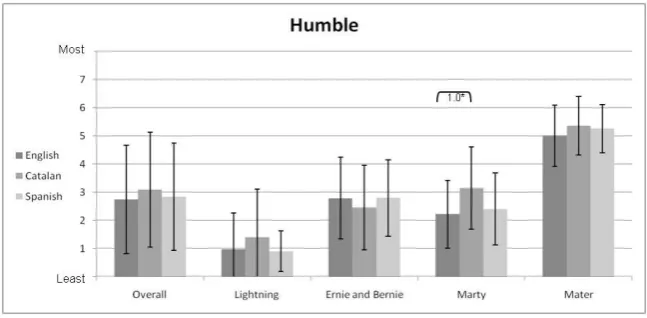
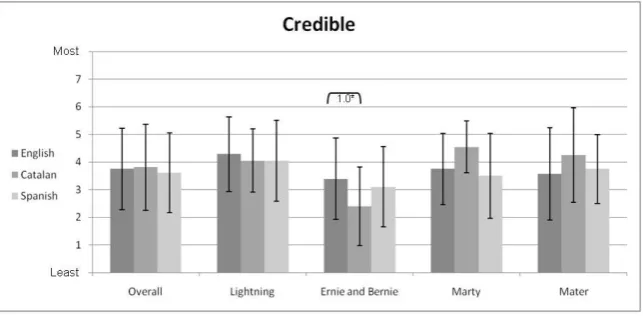
In Figure 12 we can see that the Catalan Marty, the only Marty who does not use a vernacular, is perceived as marginally more humble; the rest do not show any significant differences. Finally, credibility (Figure 13) does not show any general difference across languages, although Ernie and Bernie are mar-ginally less credible in Catalan than in English. The findings of Prado et al
(1997: 2–3) concluded that formal texts are perceived as more credible than informal texts, which may account for the relatively low marks for credibility in a text where formality is not sought.
[image:17.442.56.380.375.534.2]Laia Darder 163
Figure 13: Audience perception for credibility.
3.2. Discussion of the results
In general, there is evidence of statistically significant differences in several measurements and characters. However, it may be that discrepancies in one or two character traits have limited impact on the overall perception of char-acters when other features are maintained. When differences do occur, they happen both for characters who use mainstream and vernacular varieties, be it in a case like Lightning, who uses a mainstream variety throughout, or char-acters such as Marty and Mater who use a vernacular in two out of the three versions. It therefore appears that the choice of a mainstream or vernacular language does not have a general effect on the translation of characters within these scenes, but this requires validation in a larger selection of characters. There are, however, some discrepancies that might be attributed to other fac-tors, which range from voice frequency to hesitation, or decoding of other aspects of the whole audiovisual text, which would warrant further investi-gation. This would be the case of Mater’s low levels of strength or Lightning’s perceived lower extraversion.
the English and Catalan versions requires further examination. Finally, credi-bility can be shown to be useful to access the global perception of a character: if credibility is impaired, it might be considered that the translation as a whole suffers.
In this study, no significant impact of the translation process on perceived intelligence was demonstrated. However, it is striking that all characters were rated mostly below 4, indicating that they were not perceived as par-ticularly intelligent. This could be a reflection of the animation genre, where this trait may not be prominent or sought; further research would be nec-essary to determine a cause conclusively. Nevertheless, considering the spe-cific cases of Mater and Marty, it is notable that perceived intelligence is not affected even when they speak in vernacular. These characters use a vernacu-lar variety only in two of the three versions so, to answer Baker’s question, the use of vernacular in these translations for dubbing does not affect the percep-tion of intelligence based on these data. In this aspect, other features might be more important to the global perception, such as imagery, gesticulation and soundtrack.
With regards to the perceived confidence, the values are significantly lower for the translated versions, especially in the case of Mater.3 These differences
Laia Darder 165
also reflects the lesser availability of films shown in Catalan in cinemas (in 2010 only three,1% of films offered in cinemas, were in Catalan),4 and a sense
of normality in viewing US films dubbed into Spanish due to the overwhelm-ingly larger presence of such versions.
Finally, as with Palencia’s analysis (2002), credibility is an important fea-ture in assessing the global perception of the character, and hence it is inter-esting to analyse this in depth. Figure 13 reveals that credibility is similarly perceived across languages for these characters, with the only significant dif-ference being the case of Ernie and Bernie. This is of particular interest when considering characters which are portrayed with different prejudice or stereo-types in the original and translated versions. For example, given that Mater is based on a specific demographic of Southern USA, his portrayal in Catalan has less visible prejudice than in English, but this did not affect the credibility score. However, Ernie and Bernie were described as demonstrating negative prejudices in English (Darder 2012), given that they are unscrupulous assas-sins, and in the dubbed versions they use a contrived use of variation; this appears to be accompanied by low levels of credibility in all three languages. Hence, low levels of credibility could be due to the portrayal of the charac-ters: in the informal discussions held after the questionnaires, many viewers thought these characters were not very likeable, considering them to be poorly developed, which affected their credibility.
4. Conclusion
This empirical research into character perception has demonstrated that over-all audience perception of characters does not show a generalized pattern of differences across languages, even when variation is a factor. The SDS has proven to be a useful method for collecting data to determine character per-ception, most applicable in determining the reception of the text at a global scale, which includes the complete soundtrack and visual cues that are unde-niably transferring additional information. Although there are some isolated cases where differences might be attributed to vernacular use, the general trend is for the characters to show similar attributes.
As per the effects of style and its translation, there are no indications that variation affects the perception of characters in general. The study has revealed its usefulness in gathering information on how originals and translations are regarded in general terms, highlighting relevant trends and differences. At this stage, there is no clear evidence that preserving vernaculars in the translated product has a globally detrimental effect. Varieties are shown to be just one part of the message when there are multiple codes such as body language and personality, values, soundtrack, and even the colours used on the scene or voice frequency. Therefore, a larger study involving more characters would give more information about the way this new product is perceived amongst audiences, and the acceptability that variation has in an increasingly accepting diverse world.
From the test results, it can be inferred that in the cases where a character has been translated using varieties, it has a comparable match in most of the traits. The exception to this is the confidence perceived by the Catalan audi-ence. Due to the lack of previous studies, it is not possible to determine a defi-nite cause for this general reduction. There is a clear need for further research into this aspect, which would gain particular relevance if it could be compared to the translations in other minoritized languages.
Notes
1. Throughout this article we will refer to ‘standard’ or mainstream variety as the one that has been promoted in the media and perhaps institutionally, and at least until recently was per-ceived to be more prestigious. This refers to Southern English (UK) or North-American general English (USA), Castillian Spanish in Spain and Central Catalan. We refer to varieties outside the mainstream as vernaculars, and we use the term ‘varieties’ or ‘language variation’ to depict the broad range of diversity within a language. The concept of vernacular and mainstream varieties work in opposition: mainstream variety refers to the variety that is favoured amongst prestigious or privileged backgrounds, such as Central Spanish in Spain’s media.
2. Unless otherwise stated, statistical significance is accepted where p < 0.05.
3. In the results presented by Palencia (2002: 330), where only the original and Spanish versions were assessed, confidence was not affected, although the genre of the film for Palencia’s corpus, Peter’s Friends (1992) was very different.
4. Information released by the Generalitat de Catalunya, http://tinyurl.com/pmm2meb [Last accessed October 2014]
About the author
Laia Darder 167
of Sheffield and the University of Leeds as part of the MA in Screen Translation. She is currently a research fellow at the GRALing (Research Group in Linguistic Analysis) at the Universitat de les Illes Balears. She also works as a translator and interpreter and has extensive experience in multimedia translation for arts festi-vals. Her thesis explores the Spanish and Catalan translations of four animated films and assesses the implications of translation choices on the audience using statistical analysis of collected data, together with a qualitative stylistic analysis. Dr Laia Darder’s research takes into account the sociolinguistic and cultural issues connected to the translation of language varieties and their use in audiovisual media. She has presented her research at several international conferences.
References
Agheyisi, R. and Fishman, J. A. (1970) Language attitude studies: A brief survey of method-ological approaches. Anthropological Linguistics,12(5): 137–157.
Al-Hindawe, J. (1996) Considerations when constructing a Semantic Differential Scale. La Trobe working papers in Linguistics, 9. Retrieved on 8 October 2014 from http://arrow. latrobe.edu.au:8080/vital/access/manager/Repository/latrobe:33069
Baker, M. (2011) In Other Words. A Coursebook on Translation [2nd edition]. London and New York: Routledge.
Baròmetre de la comunicació i la cultura (2011) La dieta cultural dels catalans 2010. Barce-lona: Fundació Audiències de la Comunicació i la Cultura. Retrieved on 8 October 2014 from http://www.fundacc.org/docroot/fundacc/pdf/la_dieta_cultural_dels_catalans10.pdf Bartrina, F. and Espasa, E. (2005) Audiovisual translation. In M. Tennent (ed.) Training for
the New Millenium: Pedagogies for Translation and Interpreting. Amsterdam and Phila-delphia, PA: John Benjamins Publishing. http://dx.doi.org/10.1075/btl.60.10bar Coupland, N. (2007) Style. Language Variation and Identity. Cambridge: Cambridge
Uni-versity Press. http://dx.doi.org/10.1017/CBO9780511755064
Darder, L. (2012) Style as a translatable dimension of language.Doctoral thesis. Sheffield: University of Sheffield.
Delabastita, D. (1989) Translation and mass communication: Film and TV. Translation as evidence of cultural dynamics. Babel 35(4): 193–218. http://dx.doi.org/10.1075/babel.35. 4.02del
Denton, J. (2007) Audience reception of translated audiovisual texts and the problem of visual and verbal shared/unshared knowledge.In G. Massara (ed.) La lingua invisibile. Aspetti teorici e tecnici del doppiaggio in Italia. Roma: Nuova Editrice Universitaria. Disney Pixar (2006) Cars [DVD] Madrid: Disney Pixar.
Dreamworks Animation (2004) El Espantatiburones [DVD] Glendale: Dreamworks LLC. Dreamworks Animation (2005) Madagascar [DVD] Glendale: Dreamworks LLC.
A case study of the Marx Brothers’ Duck Soup. The Translator, 9(2). Special Issue: Screen Translation, pp. 293–306.
Gambier, Y. (2009) Perception and reception of audiovisual translation: Implications and challenges. In H. C. Omar, H. Haroon and A. A. Ghani (eds) The Sustainability of the Translation Field. Kuala Lumpur: Malaysian Translators Association.
Gunter, B. (2000) Media Research Methods. Measuring Audiences, Reactions and Impact. London, Thousand Oaks, New Dehli: SAGE Publications.
Likert, R. (1932) A technique for the measurement of attitudes. Archives of Psychology 140: 1–55.
Osgood, C. E., Suci, G. J. and Tannenbaum, P. H. (1957) The Measurement of Meaning.
Urbana, IL: University of Illinois Press.
Palencia Villa, R. M. (1998) Factores de eficacia del doblaje en el cine narrativo. Un estudio desde la recepción. Research dissertation. Departament de Comunicació Audiovisual i Publicitat. Barcelona: Universitat Autònoma de Barcelona.
Palencia Villa, R. M. (2002) La influencia del doblaje audiovisual en la percepción de los per-sonajes. Doctoral Thesis. Barcelona: Universitat Autònoma de Barcelona.
Prado Pico, E. et al. (1997) El Modelo Acústico de Credibilidad (MAC) de la voz en el marco de la gramática de la expresión fonoestética. Research Dissertation. Departament de Comunicació Audiovisual i Publicitat. Barcelona: Universitat Autònoma de Barcelona. Rodríguez Bravo, A. (1998) La dimensión sonora del lenguaje audiovisual. Barcelona: