snowboard wrist protectors
ADAMS, CarolineAvailable from Sheffield Hallam University Research Archive (SHURA) at: http://shura.shu.ac.uk/24463/
This document is the author deposited version. You are advised to consult the publisher's version if you wish to cite from it.
Published version
ADAMS, Caroline (2018). Development of methods to evaluate the performance of snowboard wrist protectors. Doctoral, Sheffield Hallam University.
Copyright and re-use policy
See http://shura.shu.ac.uk/information.html
Sheffield Hallam University Research Archive
Development of methods to evaluate the performance of snowboard wrist
protectors
Caroline Adams
A thesis submitted in partial fulfilment of the requirements of Sheffield Hallam University for the degree of Doctor of Philosophy
i
Abstract
In snowboarding, the wrist is the most common injury site, as snowboarders often put their arms out to cushion a fall. This can result in a compressive load through the carpals coupled with wrist hyperextension, leading to ligament sprains or carpal and forearm bone fractures. Wrist protectors are worn by snowboarders in an effort to reduce injury risk, by decreasing peak impact forces and limiting wrist extension to prevent hyperextension during falls. There is no international standard or universally accepted performance specification that snowboarding wrist protectors should conform to, resulting in an inability to judge which designs offer the best protection. The aim of this project was to develop mechanical test methods to evaluate the protective characteristics of snowboarding wrist protectors.
ii
Acknowledgements
No man is an island. This project would not have been possible without the support of numerous people who have travelled with me on this PhD journey.
Firstly, I would like to acknowledge the support of my supervisors: Nick Hamilton, Tom Allen and David James, you inspired me to persevere. Your patience, knowledge, enthusiasm and soldering assistance has been unwavering throughout the project. I would like to extend this thanks to all the members of the Centre for Sports Engineering Research, for your advice and willingness to be measured. Without the support and guidance of Terry Senior, the rigs would have never been developed.
To my fellow PhD students in Chestnut Court, it has been a privilege to share a portacabin with you all. Thanks for your friendship, engagement in scientific and not so scientific discussion and feedback. It has helped me grow as a researcher and kept me sane. Where else could I climb around a table, talk volleyball tactics and discuss regression analysis while eating obscene amounts of cake?!
iii
Contents
Abstract ... i
Acknowledgements ... ii
1 Introduction ... 1
1.1 Motivation for Research ... 1
1.2 Aim and Objectives ... 3
1.3 Thesis Structure ... 3
2 Literature Review ... 5
2.1 Introduction ... 5
2.2 Wrist Injuries ... 5
2.2.1 Wrist anatomy ... 5
2.2.2 Injury Causality ... 6
2.2.3 Wrist Fractures ... 7
2.2.4 Wrist Injuries in Snowboarding ... 8
2.2.5 Summary ... 9
2.3 Mechanism of injury ... 9
2.3.1 Injury Threshold ... 10
2.3.2 Summary ... 13
2.4 Wrist protectors ... 14
2.4.1 Protective Mechanisms ... 15
2.4.2 Design of wrist protection ... 15
2.4.3 The effectiveness of wrist protectors ... 17
2.4.4 Summary ... 19
2.5 Injury Mechanics ... 20
2.5.1 Experimental laboratory-based fall studies ... 20
2.5.2 Extrinsic factors ... 23
2.5.3 Summary ... 25
iv
2.6.1 Test Setups ... 26
2.6.2 Surrogate Designs ... 30
2.6.3 Summary ... 36
2.7 Chapter Summary ... 36
3 Requirement specification for mechanical test methods ... 38
3.1 Test development approach ... 38
3.2 Boundary parameters ... 39
3.2.1 Boundary parameters for quasi-static test ... 39
3.2.2 Boundary parameters for impact test ... 40
3.3 Product Design Specification ... 51
3.4 Chapter summary ... 53
4 Development of Quasi-Static Test ... 54
4.1 Introduction ... 54
4.2 Critique of EN 14120 stiffness test ... 54
4.2.1 Test Setup & protocol ... 54
4.2.2 Surrogate Design ... 56
4.3 Development of test method to quasi-statically measure wrist protector stiffness ... 60
4.3.1 Concept Design ... 60
4.3.2 Concept Selection... 61
4.3.3 Detail Design ... 62
4.4 Experimental validation of new test method ... 64
4.4.1 Test Protocol ... 64
4.4.2 Data Analysis ... 67
4.4.3 Results ... 69
4.4.4 Discussion ... 72
4.5 Chapter Summary ... 74
v
5.1 Introduction ... 76
5.2 Surrogate development ... 76
5.2.1 Geometric surrogate ... 76
5.2.2 Scanned surrogate ... 80
5.3 Investigation of the effect of surrogate design on the measured rotational stiffness of snowboarding wrist protectors ... 85
5.3.1 Method ... 86
5.3.2 Results ... 89
5.3.3 Discussion ... 93
5.4 Chapter Summary ... 96
6 Characterising wrist protector stiffness using a quasi-static test ... 97
6.1 Introduction ... 97
6.2 Method ... 97
6.2.1 Protectors ... 97
6.3 Results ... 101
6.3.1 Protector comparison ... 101
6.4 Case Studies ... 102
6.5 Discussion ... 105
6.6 Chapter Summary ... 106
7 Development of Impact Test ... 107
7.1 Introduction ... 107
7.2 Development of impact test ... 107
7.2.1 Concept Design ... 107
7.2.2 Concept Selection... 108
7.2.3 Detail Design ... 110
7.2.4 Overview of Impact test setup... 122
7.3 Experimental validation of impact test ... 123
vi
7.3.2 Pilot testing: protected condition ... 125
7.3.3 Modifications to the test setup ... 126
7.3.4 Overview of impact ... 128
7.4 Chapter Summary ... 129
8 Characterising wrist protectors using an impact test... 131
8.1 Introduction ... 131
8.2 Method ... 131
8.2.1 Data analysis ... 132
8.3 Overview of impact ... 134
8.4 Results ... 138
8.4.1 Protector comparison ... 138
8.5 Case studies ... 141
8.6 Discussion ... 146
8.7 Chapter Summary ... 149
9 Discussion and Future work ... 150
9.1 Comparison in measured performance between quasi-static test and impact test 150 9.2 Limitations of Developed Tests ... 153
9.3 Future work ... 154
9.3.1 Surrogate Design ... 154
9.3.2 Test Setup ... 155
9.3.3 Injury monitoring and promotion of injury prevention strategies ... 156
9.3.4 Test Parameters ... 156
9.3.5 Product Design ... 156
9.4 Chapter Summary ... 157
10 Conclusion ... 158 10.1 Introduction ... Error! Bookmark not defined.
vii
10.2.1 To investigate current practices in protective equipment testing and determine performance criteria to evaluate snowboarding wrist protectors .... Error! Bookmark not defined.
10.2.2 To identify boundary conditions, the mechanical test should replicate to characterise snowboarding wrist protectors ... Error! Bookmark not defined.
10.2.3 To develop and validate mechanical tests to characterise snowboarding wrist protectors ... Error! Bookmark not defined.
10.2.4 To compare the protective characteristics of a range of wrist protectors using the developed methods ... Error! Bookmark not defined.
10.3 Contributions to knowledge ... Error! Bookmark not defined.
1.Introduction
1
10
Introduction
This thesis documents the development of new methods to evaluate the protective characteristics of snowboarding wrist protectors. This first chapter explains the motivation for the research and outlines the aim this body of work set out to achieve.
10.1 Motivation for Research
Snowboarding is a popular sport, enjoyed by an estimated 10-15 million people worldwide (Michel et al. 2013). Resorts, artificial and indoor slopes are spread across six of the seven continents. It has been an Olympic sport since 1998 (Russel, Hagel and Goulet, 2010), half-pipe, giant parallel slalom, parallel slalom, slopestyle and snowboard cross are all currently Olympic snowboard disciplines for men and women. The risk of sustaining an injury while snowboarding is higher than alpine skiing (Hagel, 2005) and injury rates are among the highest of all sports in the 9 to 19-year- old age group (Michaud, Renaud and Narring, 2001).
In snowboarding, the wrist is the most frequently injured region (K. Sasaki et al. 1999; Ekeland, Rødven and Heir, 2017; Costa-Scorse et al., 2017), with wrist fractures a common occurrence (Russell, Hagel and Francescutti, 2007). Snowboarders often attempt to cushion a fall with outstretched hands. In this scenario, impact loads can be transmitted along the upper extremity as an axial compression force and extension torque resulting in wrist hyperextension, which can lead to ligament sprains or carpal and forearm bone fractures (Whiting and Zernicke, 2008; Bartlett and Bussey, 2013).
2
assess PPE typically use surrogates as an artificial representation of humans, to enable products to be tested under injurious conditions.
Wrist protectors have been adopted amongst a limited number of snowboarders as a preventative measure to i) limit peak impact forces, ii) absorb or shunt the impact energy, and iii) prevent hyperextension (Hwang and Kim, 2004; Michel et al., 2013). At present, a range of different designs are commercially available, but unlike other PPE, no standard exists stipulating protective performance parameters snowboarding wrist protectors should meet (Michel et al., 2013). Unlike a wrist brace worn post-injury, wrist protectors (synonymous to wrist guards) aim to prevent wrist injuries. Whilst some studies have shown them to be an effective device in reducing the risk of injury (Machold, Kwasny and Eisenhardt, 2005; Russell, Hagel and Francescutti, 2007) others claim they have little effect or just transfer the load elsewhere (Chow, Corbett and Farstad, 1996; Hagel, 2005). There is little consensus as to which particular design features offer the most effective form of protection (Kim and Lee, 2011).
Previous research has sought to document the prevalence of injuries; facilitate a greater understanding of falls from a biomechanics perspective; validate the value of wrist protectors in the prevention of snowboarding upper extremity injuries. Following a call in 2013 (Michel et al., 2013), the ISO/CD 20320 was set up to develop a standard for these products (International Organization for Standardization, 2016a). This PhD project is concerned with establishing mechanical tests and surrogates, to evaluate the protective performance of wrist protectors in scenarios representative of snowboarding falls.
1.Introduction
3
As a member of the British Standards Institute (Bsi), this body of work will support the International Organization for Standardization in the implementation of ISO/CD 20320 'Protective clothing for use in Snowboarding -- Wrist Protectors -- Requirements and test methods'. This, in turn, will influence the design of next-generation wrist protectors, providing consumers with more transparency and ultimately decreasing the number of wrist injuries in the popular sport of snowboarding.
10.2 Aim and Objectives
The aim of this thesis is to develop test methods to evaluate the protective
characteristics of snowboarding wrist protectors. This will be achieved through the following objectives:
1. To investigate current practices in protective equipment testing and determine performance criteria to evaluate snowboarding wrist protectors
2. To identify boundary conditions, the mechanical test should replicate to characterise snowboarding wrist protectors
3. To develop and validate mechanical tests to characterise snowboarding wrist protectors
4. To compare the protective characteristics of a range of wrist protectors using the developed methods
10.3 Thesis Structure
4
2. Literature Review
5
11
Literature Review
11.1 Introduction
This chapter reviews the relevant literature in five sections. Section 2.2 outlines the research problem and need for prevention through examining wrist injury rates and patterns in snowboarding. Fracture mechanisms are reviewed in section 2.3, to aid in the prevention of wrist injuries, through an understanding of injury causation. Section 2.4 concerns the design of commercially available wrist protectors, to understand the current mechanisms used to prevent injury and identify protective performance criteria that tests should measure. Section 2.5 reviews the experimental recreation of falls to inform the selection of input parameters and boundary conditions the developed test should include. Section 2.6 reviews and evaluates test setups, including existing safety standards and mechanical surrogates, to help inform the development of new mechanical tests.
11.2 Wrist Injuries
The wrist is one of the most common fracture sites in the human body (Schuit et al. 2004). Wrist injuries place a significant burden on health services, in the United States Englander et al. (1996) predict that medical costs associated with fall injuries will reach $85.4 billion dollars by 2020. Sports injuries are some of the most common injuries in western societies, and their treatment can be difficult, expensive and time-consuming. The development of preventative strategies, such as the design of wrist protection through a new test method, are justified on medical as well as economic grounds (Parkkari et al. 2001).
11.2.1 Wrist anatomy
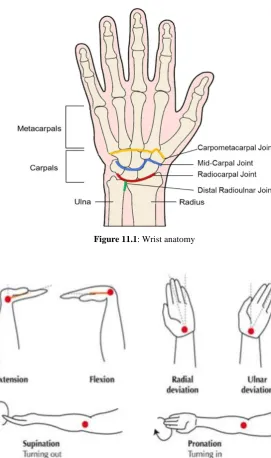
6
[image:15.595.181.453.181.640.2]the bones to slide against each other without causing damage. Relative to the forearm the hand is capable of 3 degrees of freedom (Figure 11.2). A biofidelic surrogate is recommended to evaluate the protective capacity of wrist protectors. Given the complexity of the joint with 3 degrees of freedom achieved through different rate-dependent materials, pragmatically a number of simplifications will be necessary when developing a surrogate.
Figure 11.1: Wrist anatomy
Figure 11.2: Wrist Motion (adapted from Medlej, 2014)
11.2.2 Injury Causality
2. Literature Review
7
for persons over 65 years is reported to be 7–10 per 1000 person-years (Kim and Ashton-Miller, 2003). Fall-related wrist injuries account for 37% of all inline skating injuries (Schieber et al., 1996) and 69-93% of snowboarding injuries (Hagel, 2005). Individuals use their upper extremities to help manage a fall event, instinctively throwing their arms out to protect the head or torso. This action is associated with the potential risk for a wrist injury, a risk-benefit ratio that seems reasonable given the potential severity of head or hip injury in the absence of such a strategy (DeGoede, Ashton-Miller and Schultz, 2003). Directly falling onto a straight arm has been shown to increase the risk of injury (DeGoede, Ashton-Miller and Schultz, 2003) and is often considered to be the worst case. To protect the head and torso from hitting the ground, there needs to be a level of elbow and shoulder extension.
11.2.3 Wrist Fractures
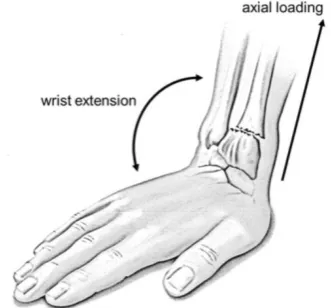
[image:16.595.237.403.569.723.2]Wrist injuries vary in severity and are generally classified as a sprain, contusion or fracture. Sprains can heal in a few weeks, whereas repairing a displaced fracture requires surgery and permanent inserts. In some instances, the pain never subsides, and there is a permanent loss of movement. A fracture occurs when the bone cannot support an applied force and fails. In the case of a fall onto an outstretched arm, a load is transmitted along the upper extremity as an axial compression force and torque (Figure 11.3). This may result in wrist hyperextension, wrist sprains or fractures (Whiting & Zernicke 2008; Bartlett & Bussey 2013). Hyperextension is defined as the extension of the wrist beyond its normal healthy range. Distal radius fractures are the most common forearm fracture and account for approximately 16% of all skeletal fractures (Porrino, 2015).
8
11.2.4 Wrist Injuries in Snowboarding
Upper-extremity injuries represent 35% to 45% of all snowboarding injuries (Russell, Hagel and Francescutti, 2007). A number of epidemiological studies present upper extremity injury rates rather than the anatomical location, so it is not always possible to obtain accurate wrist specific injury rates. Nevertheless, numerous studies have reported the wrist as the most affected site in snowboarding (Chow, Corbett and Farstad, 1996; K. Sasaki et al., 1999; Kim and Lee, 2011). Distal radius fractures are the most common fracture in snowboarding (K Sasaki et al., 1999; O’Neill, D, 2003; Wadsworth, Binet and Rowlands, 2012), with an injury rate of 0.28-0.31 per 1000 snowboarder daily visits (Matsumoto et al. 2004; Sasaki et al. 1999).
It is difficult to determine an absolute number of distal radius fractures per year amongst snowboarders, due to different reporting mechanisms used by different resorts and a limited number of publications. Assuming the injury rate per 1000 snowboarder days of 0.28-0.31 is relevant for the USA in 2016, it is possible to determine the approximate the number of distal radius injuries based on published statistics. Given that there were 54.7 million skier/boarder days during the 2016/2017 season in the USA (Statistica, 2018a) and snowboarders are reported to account for 35% of the snow sports population (Statistica, 2018b), the number of distal radius injuries that year was approximately 5000.
Snowboarding injuries tend to be caused by impacts resulting from falls, collisions or lift related incidences. When snowboarders experience a loss of balance, they are limited in regaining their stability as both feet are attached to the board through a non-release binding system. If incapable of stopping the fall, snowboarders often reach out with their arms in an effort to cushion the fall which can result in injury (Figure 11.4).
2. Literature Review
9 11.2.4.1 Risk Groups
The incidence and pattern of injury have been identified to differ between snowboarders by varying ability (Bladin et al. 2004; Yamauchi et al. 2010). Beginners with less than 5 days snowboarding experience are more prone to injury, due to the numerous falls involved in learning this new skill (Rønning et al., 2001; Langran and Selvaraj, 2004). Wrist injury rates are highest in beginner snowboarders (Hagel, 2005), whilst intermediate, advanced and elite snowboarders are more susceptible to injuries affecting other regions (Ogawa et al. 2010; Idzikowski et al. 2000;Flørenes et al. 2012; Torjussen & Bahr 2006). This is likely due to the difference in speed and nature of manoeuvres being executed by snowboarders of different skill levels.
Adolescents have also been identified as a high-risk group susceptible to wrist injuries (Hagel, 2005; Dickson and Terwiel, 2011; Kim et al., 2012) as growth plates, the area of cartilage at the end of children's bones are the last portion to harden, are particularly vulnerable to fracture. Concerns have been raised over the lasting impact of paediatric wrist injuries which can result in arrested bone growth and deformity (Brown and Deluca, 1992).
11.2.5 Summary
This section has put snowboarding wrist injuries in context, highlighting that fall-related wrist injuries are the most common injury in snowboarding. Wrist injuries have been seen to affect various demographics, beginners and adolescents have been identified as high-risk groups. Given the frequency of injuries coupled with the financial implications of healthcare, there is a need for prevention based on an understanding of injury mechanisms and causation. Therefore, the developed test method should facilitate the replication of a range of different fall scenarios and body masses.
11.3 Mechanism of injury
10
11.3.1 Injury Threshold
To effectively mitigate the risk of injuries it is important to understand the human body’s response to specific events including causal injury mechanisms and thresholds (Merkle 2013). Various studies on loading and functional range of movement (ROM) provide insight into the threshold values above which a fracture is likely to occur.
Reproducing falls to trigger fractures in participants would be unethical, hence studies using cadaveric forearms have attempted to determine the force required to fracture an adult radius. Different test setups including drop rigs and universal testing machines have been used to initiate fractures in cadavers. Despite cadaver testing being conducted under controlled laboratory conditions, there is considerable variation in fracture loads both between and within studies. Forces in the range of 1580-3600 N are needed to fracture a female adult radius and 2370-3773 N for males (Table 11.1). A preventative approach should aim to limit impact loads to 3340N (mean fracture force + standard deviation (SD), 2618 + 822N, Table 11.1), to reduce the incidence of snowboarding related wrist injuries.
A limitation of cadaver testing is the limited sample size and physical variation between samples. There are particular difficulties with obtaining cadaver specimens due to both ethical and social acceptance issues (Payne, Mitchell and Bibb, 2013). Available specimens tend to be biased towards the elderly population and no studies to date report the fracture loads of child or adolescent forearms. Mechanical properties differ between age groups as cortical bone strength has been shown to decrease with age (Helelä, 1969). As a large portion of the snowboarding demographic is made up of adolescents, this gap in fracture threshold data presents difficulties when trying to develop representative test setups. It is also apparent that a relationship between gender and injury response exists, with lower fracture loads reported for females. As almost 40% of snowboarders are female (SIA, 2011), preventative measures should be designed to meet the lower thresholds, to maximise the protective effect on the whole population.
2. Literature Review
11
12
Table 11.1: Fracture Loads of Adult Cadaver Forearm
Gender Sample Size Mean Sample age
(yr) Experimental Setup Fracture Site
Mean fracture load (N)
± SD (if recorded) Reference
Female
18 74 Dynamic Radius 1580 ± 600 (Myers et al. 1993)
1 - Dynamic Radius 1863 (Frykman 1967)
11 76 Dynamic Radius 3180 ± 1000 (Myers et al. 1991)
13 63 Quasi-static compression Radius 1917 ± 640 (Frykman 1967)
17 70 Quasi-static compression Radius 3600 ±1160 (Horsman et al. 1983)
12 85 Quasi-static Radius 2008 ± 913 (Augat et al. 1996)
10 84 Dynamic Radius 1956 ±467 (Zapata et al. 2017)
Group mean ± SD 2300 ± 766
Male
7 74 Dynamic Radius 2370 ± 420 (Myers et al. 1993)
7 76 Dynamic Radius 3740 ± 532 (Myers et al. 1991)
2 - Dynamic Radius 3874 ± 624 (Frykman 1967)
9 59 Quasi-static compression Radius 2769 ± 1266 (Frykman 1967)
7 77 Quasi-static Radius 3773 ± 1573 (Augat et al. 1996)
4 74 Dynamic Radius 3148 ± 452 (Zapata et al. 2017)
Group mean± SD 3279 ± 619
Unknown
12 76 Quasi-static Radius 1640 ± 980 (Spadaro et al. 1994)
5 76 Quasi-static Scaphoid 2410 ± 913 (Spadaro et al. 1994)
5 47 Dynamic Forearm 2821 ± 763 (Greenwald et al. 1998)
20 - Dynamic compression Radius 2245 (Giacobetti et al. 1997)
17 67 Dynamic Radius 2648 ± 1489 (Augat et al. 1998)
9 76 Dynamic - Incline Radius with ulnar 2920 ± 1197 (Lubahn et al. 2005)
11 76 Dynamic - vertical Radius with ulnar 3896 ± 1991 (Lubahn et al. 2005)
5 - Dynamic - Incline
Radius
1104 ± 119 (McGrady et al.2001) Radius with ulnar
scaphoid
8 61 Dynamic Radius 2141 ± 1229 (Burkhart et al. 2012)
Group mean± SD 2425 ± 798
Overall mean ±
2. Literature Review
13
Unlike fracture force thresholds, specific values for injurious wrist extension angles have not been documented in the literature. Studies have focused on defining the functional range of movement and the necessary physiological range required to perform activities of daily living (Boone and Azen, 1979; Palmer et al., 1985; Ryu et al., 1991) rather than identifying the maximum possible angle that can safely be achieved under load. The range of wrist motion is reported to be 60-75° of extension to 60-82° of flexion for healthy adults.
During an on-slope study using an instrumented glove, Greenwald et al. (2013) observed wrist extension angles of 80.2 ± 15.8° (mean ± SD) at low loads as a result of a fall, without obtaining a fracture. Similarly, Schmitt et al. (2012) reported wrist extension values nearing hyperextension in a laboratory-based fall arrest study. The relationship between impact load, the angle of wrist extension and fracture is not well established in literature. Fractures may result from a combination of both the load and extension above certain thresholds. Frykman (1967) observed laboratory induced distal radius fractures in cadavers at extension angles as low as 40° when coupled with high loads (1917-2769 N), yet Greenwald et al. (2013) reported no fractures at angles above 80° with low loads (266 ± 232 N).
Peak impact force has been reported to contribute to fractures (Hwang et al., 2006), but the contribution of other aspects such as strain rate or impact energy to injury incidence is poorly understood (DeGoede, Ashton-Miller and Schultz, 2003). Studies using cadavers provide insight into peak fracture load. As such, fracture load is most commonly reported in relation to injurious scenarios in literature. To mitigate injury risk wrist protectors must lower the impact force below the reported fracture force.
11.3.2 Summary
14
related wrist injuries. The lack of adolescent-specific fracture thresholds has been identified as a limitation. Whilst this section has provided insight about the maximum injury thresholds, an understanding of kinematics and biomechanical loading surrounding fall scenarios is necessary for the development of a new test method.
11.4 Wrist protectors
Cadaver studies provide insight into the peak force wrist protectors should limit to prevent injury. This section will discuss the efficacy, protective mechanisms and design features employed in wrist protectors to reduce wrist injury
PPE has become an increasingly common method of injury prevention in a range of sporting contexts. In numerous cases, PPE is a requirement of governing bodies to ensure participant safety and prevent avoidable injuries including shin pads in association football, hockey and cricket (Marshall et al., 2002). Generally, the design of PPE is regulated by a standards institution such as the International Organization for Standardization (ISO) to ensure that products on the market are safe and of sufficient quality. Such standards prescribe testing protocols and minimum performance requirements products should met. There is a range of snowboarding wrist protectors on the market (Figure 11.5): protectors of varying length; gloves/mittens with integrated protection; stand-alone protectors, yet no international standard or design regulations exist that these specific products should meet (Michel et al., 2013).
2. Literature Review
15
11.4.1 Protective Mechanisms
A range of approaches have been discussed in the literature as to how wrist protectors should function and protect the user from injury. Michel et al. (2013) argue that preventing wrist hyperextension and damping impact forces are the two fundamental functions of a wrist protector. This is in line with the requirements specified by the EN 14120 standard for roller sport wrist protectors (European Committee for Standardization, 2003b). Hwang et al., 2006 suggest that impact force reduction is achieved through absorbing or shunting the impact energy to facilitate a time delay and thus level out the impulse curve. This is similar to the principles used in car design, where crumple zones are designed to reduce the initial force of the crash and redistribute it to keep the occupants safe. Staebler et al. (1999) identified that at sub failure loads wrist protectors have a load sharing function, transferring the applied load away from the palm directly to the mid-forearm, bypassing the carpus and distal radius.
In contrast to Michel et al. (2013), Maurel et al. (2013) argue that there is no basis in literature for the prevention of hyperextension reducing the risk of fracture. Chen et al. (2014) observed that the contact area between the scaphoid and distal radius is maximised when the wrist is fully extended and hypothesise that the risk of fracture is reduced when the wrist is fully extended, as the radiocarpal joint is more stable in this orientation. To date, there is no evidence to show that limiting hyperextension has negative consequences. A range of different approaches have been proposed to protect the wrist from injury, yet to date, no study has measured all these performance parameters for a range of commercial products.
11.4.2 Design of wrist protection
16
extension whilst still allowing full range of motion for the fingers and thumb (Cheng et al., 1995).
Rigid splint elements on the palmar and dorsal side of the hand combined with palmar damping elements are the most commonly employed mechanisms in commercial products (Figure 11.6). The splints physically limit hyperextension as well as storing the kinetic energy, then release it over an extended period. The damping elements dissipate kinetic energy through deformation acting as a crumple zone, further reducing the transmitted force. Machold et al. (2005) suggest the following design criteria for optimised wrist protectors: the position of palmar padding; shape; length; stiffness; and fixation to the arm. To date, no study has evaluated the influence of these parameters on protective performance.
Figure 11.6: a) Dorsal splint b) Palmar damping element (adapted from Burton 2015; Decathlon 2015)
2. Literature Review
17
who wore protectors compared to those who didn't, which they suggest is due to the design of dorsal splints.
11.4.3 The effectiveness of wrist protectors
An effective wrist protector would prevent the user from wrist injuries; however, mixed results have been found in the literature concerning the protective capabilities of wrist protectors. Epidemiological and clinical studies have been conducted to compare injury rates in snowboarders wearing wrist protection against those who do not. Tests involving cadavers, mechanical surrogates and human volunteers have attempted to quantify the protective effect of wrist protectors.
11.4.3.1 Experimental studies
To date, no two studies have used the same wrist protectors or setup. Different products of different sizes, shape and materials have been tested in different ways. The results of experimental studies using cadavers, mechanical surrogates and participants will be reviewed in turn. A disagreement in the effectiveness of wrist protectors has been found by researchers using cadavers to determine protective capabilities of wrist protectors. Both Moore et al. (1997) and Lewis et al. (1997) observed differences in fracture severity between protected and unprotected groups, implying the protective benefits of wrist protectors. Conversely, when using comparable input parameters, three other studies using cadavers did not report a difference in injury severity when wrist protectors were used (Greenwald et al. 1998; McGrady, Hoepfner et al. 2001; Giacobetti et al. 1997). Variations exist in the cadaver samples with different ages and section methods being used. No cadaver studies testing commercially available wrist protection in the past fourteen years were found in the literature search, meaning the suitability and functionality of newer generation designs has gone virtually untested.
18
when subjected to a 3 Nm torque. The majority of products (67%) failed to attenuate the impact force to within the specified boundaries, whilst 56% of products failed to comply with the wrist extension angle requirement. The results from Schmitt et al. (2012) suggest that: the test standard is not necessarily applicable to snowboard specific equipment; snowboard wrist protectors are not fit for purpose or a combination of both. The results also imply that products are designed with greater consideration towards reducing hyperextension rather than the reduction of peak force. Both Kim et al. (2006) and Maurel et al. (2013) confirmed that wrist protectors protect the point of impact at the carpals through a reduction in peak force, although only Maurel et al.(2013) found this to be true at representative fracture loads.
At sub fracture loads, studies have been conducted using live participants to explore the effectiveness of snowboarding wrist protectors. Hwang & Kim (2004) found that palmar pads improved energy absorption by more than 38% compared with the bare hand but had no effect on the peak impact force. In a later study, utilising a different mass-spring-damper model, they reported that wrist protectors had no significant effect in terms of force transmission or energy storage and absorption (Hwang et al., 2006). Whilst, Burkhart & Andrews (2010) found that wrist protectors demonstrate a protective effect in terms of reducing off-axis wrist accelerations and elbow accelerations in 2 axes. Experimental tests using cadavers, mechanical surrogates and participants have shown that in some cases commercially available wrist protectors exhibit protective capabilities.
11.4.3.2 Epidemiological studies
2. Literature Review
19
majority of clinical studies, it appears that wrist protectors do play a role in reducing fall-related snowboarding wrist injuries.
Despite the effectiveness of wrist protectors reported in a number of experimental and epidemiological studies and the commercial availability of these products, the rate of wrist injuries has remained relatively constant. Michel et al. (2013) speculate that this could be due to the low usage of wrist protectors, with a reported usage rate between 1 and 18% for snowboarders who have sustained a wrist injury. Low levels of comfort; a belief that wrist protectors can trigger certain injuries; and general apathy towards the need for protection have been cited as the three main barriers to use (Bianchi et al., 2012). A study by the Swiss Council for Accident Prevention observed that even though protector usage in Switzerland increased from 37% to 42% from 2003 to 2007, the proportion of wrist injuries remained unchanged (Swiss Council for Accident Prevention (bfu), 2012; Michel et al., 2013). Despite the fact that wrist protectors have been shown to provide a protective effect, in some instances even when used, snowboarders have sustained wrist injuries (Cheng et al., 1995; Idzikowski, Janes and Abbott, 2000). This raises questions about the design and protective capabilities of wrist protectors.
At present no study has systematically analysed a range of different protectors using a repeatable and comparable test approach, meaning current understanding about the effect of different wrist protector design elements is limited. These disparities between current approaches, further emphasise the need for a repeatable and representative test method. The use of a mechanical surrogate can be justified as it enables a consistent, repeatable method, which can characterise a range of products under the same parameters representative of injurious fall scenarios.
11.4.4 Summary
Studies have shown that wrist protectors are an effective method in reducing wrist injuries, yet injuries still occur. From a review of protective mechanisms, it can be concluded that to be an effective preventative measure; wrist protectors should meet the following performance criteria:
20
Store, absorb and transfer impact energy safely away from the wrist joint without putting other regions at risk
Stabilise the wrist and limit hyperextension
Comfortable to wear to encourage higher usage rates
The development of a representative test and surrogate would enable the influence of design parameters on the protector’s efficacy to be evaluated. Given the weaknesses associated with cadaveric studies and the ethical implications of participant-based studies a mechanical approach is necessary. The following section will provide insight into current approaches, to inform the design of the physical setup.
11.5 Injury Mechanics
The previous sections have identified the forces associated with wrist fractures and the way in which wrist protectors attempt to mitigate injury. To develop a test that represents injurious fall scenarios an understanding of the mechanics surrounding injury is necessary. Obtaining biomechanical information regarding injury scenarios is important (Bahr, R. & Krosshaug, 2005) yet ethically difficult due to its injurious nature (Krosshaug et al., 2005). The biomechanics of sports injury scenarios have informed the development of a variety of mechanical test devices (Grund, Senner and Grube, 2007; Laing and Robinovitch, 2008; Ura and Carré, 2016).
This section will review the experimental recreation of falls to inform the selection of input parameters and boundary conditions for a representative test. To determine the kinetic and kinematic parameters associated with a snowboarding fall-induced wrist injury, ideally, an in-situ slope study involving snowboarders of various body sizes, replicating injurious falls instrumented with force and angle sensors, combined with motion capture would be required. Since this is neither ethical, repeatable or practical an alternative solution is needed. From existing literature boundary parameters can be selected from either cadaver studies resulting in fracture or from biomechanical data collected during low-level non-injurious falls in a laboratory.
11.5.1 Experimental laboratory-based fall studies
2. Literature Review
21
(Figure 11.7a) or by applying a load to the outstretched forearm using a dynamic pendulum (Figure 11.7b) (Chiu & Robinovitch 1998; Hsiao & Robinovitch 1998; Robinovitch & Chiu 1998; DeGoede & Ashton-Miller 2002; Kim & Ashton-Miller 2003; Lo et al. 2003; Schmitt et al. 2012; Choi & Robinovitch 2011; Tan et al. 2006; Hwang et al. 2006; DeGoede et al. 2002; Burkhart & Andrews 2010). Combinations of experimental and mathematical models have been used to study fall scenarios and to characterise the impact response of the body (Figure 11.7c).
Figure 11.7: Experimental fall arrest setups a)Tethered cable (DeGoede and Ashton-Miller, 2002) b) Seated pendulum fall (Burkhart and Andrews, 2010) c) Experimental and mathematical model (Chiu and Robinovitch, 1998)
22
Table 11.2:Biomechanical factors in falling (DeGoede, Ashton-Miller and Schultz, 2003)
Extrinsic Factors Intrinsic Factors
Unmodifiable factors Modifiable factors
Cause of fall Bone properties Configuration of head, torso and extremities during descent
Fall direction Soft-tissue properties Selected momentum arrest/ energy dissipation strategy before and during impact Fall height Maximum muscular rate
of strength development
Body segment orientation and limb configurations at impact Initial speed at the
loss of balance
Reaction time Velocity of body segment and its contact point with the ground at impact
Surface conditions (stiffness, coefficient of friction)
Movement time Location of impact point relative to the whole-body centre of mass
Values of pre-set muscular stiffness and damping about involved joints
11.5.1.1 Altering fall kinematics
2. Literature Review
23
Langran & Selvaraj (2002) observed that first day snowboarders who had taken professional instruction were three times more likely to be injured than those who had not. The authors hypothesise that this may be because snowboarders gain a false sense of skill once a small amount of experience has been gained, leading to an increase in risk-taking behaviour. Alternatively, this finding could be a reflection on the characteristics of those who opt to teach themselves rather than seeking instruction. Whilst in a laboratory context learning how to fall can reduce peak forces additional methods of intervention are necessary on the slopes. On the slopes falls are unexpected, and beginners are focused on learning the sport rather than arresting their falls. These findings highlight that additional preventative interventions in the form of PPE are necessary.
11.5.2 Extrinsic factors
11.5.2.1 Fall direction
Backward falls have been found to result in more wrist fractures (Davidson and Laliotis, 1996; Idzikowski, Janes and Abbott, 2000; Deady and Salonen, 2010; Yamauchi et al., 2010), whilst Yamauchi et al., (2010) found that forward falls were more likely to result in shoulder dislocations and upper arm fractures. Tan et al., (2016) found that backward falls resulted in larger impact velocities of the distal radius during simulated falling compared to forward falls. However, Schmitt et al. (2012) conducted a study using a similar setup and noted no significant difference in impact velocity between forward and backward falls. Elbow flexion may be a contributing factor to the difference in fall direction injury pattern; limited elbow flexion treats the arm as a single segment known as ‘stiff-arming’. DeGoede and Ashton-Miller, (2002) observed forward stiff-arm falls resulted in higher peak forces than when the elbow was flexed, an effect that is likely to be observed in backward falls. Backward falls are the worst-case scenario that protective equipment should attempt to mitigate; therefore the developed impact test will attempt to mimic backward falls with a stiff-arm posture.
11.5.2.2 Mass of body acting on the wrist joint
24
equivalent to some proportion of the body's mass stopping abruptly at the point of impact (Lieberman et al., 2010) and the term 'effective mass' is used to describe this proportion of body segment mass that contributes to an impact (Chi & Schmitt 2005; Lenetsky et al., 2015; Rousseau & Hoshizaki 2015). Simplifying the whole body into a rigid block of mass misrepresents the physical system, as body segments such as joints and muscles flex and deform on impact (Gruber et al., 1998) reducing impact forces. Flexing the elbow when landing has been shown to reduce the effective mass and thus impact force (DeGoede and Ashton-Miller, 2002). In the case of falling onto an outstretched arm, Schmitt et al. (2012) define the effective mass as the mass that affects the wrist at the time of impact, comprised of the forearm, upper arm, and parts of the shoulder. A diverse range of values have been presented in the literature to describe the effective mass acting on the wrist during falls (Table 11.3).
Table 11.3: Overview of effective mass used in different studies Experimental setup Effective Mass (kg) References
Mean Range
Mechanical using cadavers 23 7.9-45.5 (Frykman, 1967; Lewis et al., 1997; Moore et al., 1997; Greenwald et al., 1998; Lubahn et al., 2005; Burkhart, Dunning and Andrews, 2012; Zapata et al., 2017)
Biomechanics using
participants
3 1.7-5.5 (Chiu and Robinovitch, 1998; DeGoede et al., 2002; Schmitt et al., 2012)
Mechanical using surrogates 3 2.5-3.5 (Maurel et al., 2013; Thoraval et al., 2013)
2. Literature Review
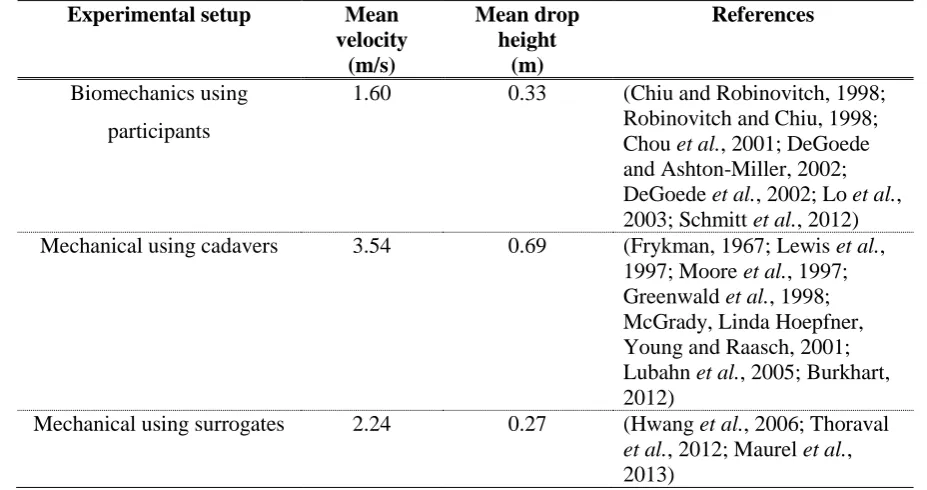
25 11.5.2.3 Inbound velocity and fall height
A range of impact velocities have been used in previous studies to replicate fall scenarios. No impact velocity data exists for backward falls from standing as biomechanics studies have been limited to low level falls to ensure participant safety. The inbound velocities used in a number of the cadaver studies was determined by increasing the drop height until a fracture was observed (Frykman, 1967; Lewis et al., 1997; McGrady, Linda Hoepfner, Young and Raasch, 2001; Burkhart, Andrews and Dunning, 2012). No justification is provided for the drop heights used in the mechanical studies.
Table 11.4: Overview of inbound velocity and drop height used in different studies Experimental setup Mean
velocity (m/s) Mean drop height (m) References Biomechanics using participants
1.60 0.33 (Chiu and Robinovitch, 1998; Robinovitch and Chiu, 1998; Chou et al., 2001; DeGoede and Ashton-Miller, 2002; DeGoede et al., 2002; Lo et al., 2003; Schmitt et al., 2012) Mechanical using cadavers 3.54 0.69 (Frykman, 1967; Lewis et al.,
1997; Moore et al., 1997; Greenwald et al., 1998; McGrady, Linda Hoepfner, Young and Raasch, 2001; Lubahn et al., 2005; Burkhart, 2012)
Mechanical using surrogates 2.24 0.27 (Hwang et al., 2006; Thoraval et al., 2012; Maurel et al., 2013)
11.5.3 Summary
Biomechanics studies have emphasised that while bone strength establishes the ultimate threshold for fracture, a range of biomechanical factors alter the demand on bone. Altering fall kinematics and modifying the impact contact through protective equipment can aid in lowering the peak force.
[image:34.595.93.557.278.523.2]26
their behaviour and force outcome. A weakness of cadaver tests to date is that they only utilised the forearm and did not consider this in relation to other limbs or the full body. Biomechanics investigations have considered the full body albeit at lower loads. Given that protective equipment should reduce the risk of injury rather than merely transferring it, a test method that considers more than just the wrist is preferable.
Despite these limitations, the knowledge of injury parameters developed in this section will inform the development of a mechanical test to facilitate the replication of fall scenarios at injurious load conditions. Backward falls have been found to result in more wrist fractures then forward with a high degree of variation existing between studies. Therefore, ranges of variable parameters have been identified for three boundary parameters:
Effective mass (1.7-45.5kg) Inbound velocity (1.6-3.5 m/s) Fall height (0.3-0.7m)
Future chapters will justify the selection and magnitude of these parameters in more detail. There is a need to understand the application of these parameters in current tests of protective equipment.
11.6 Current test setups
The previous sections have identified the need for a mechanical test and surrogate to evaluate the protective characteristics of snowboarding wrist protectors repeatably. This section will review existing test setups, safety standards and surrogate design.
11.6.1 Test Setups
2. Literature Review
27
there is presently no international standard governing the design of snowboarding wrist protectors; there is little motivation for manufacturers to invest in product testing.
Two approaches are typically used to impact test protective equipment. Moving a surrogate onto a rigid surface or moving a mass onto a surrogate fixed to a rigid surface. These test setups use a range of different orientations: vertically using a linear drop tower, horizontally by driving the surrogate into a plate, or angularly using a pendulum (Figure 11.8). A horizontal setup requires some form of external force input e.g. pneumatics, unlike the drop test and pendulum which can be driven by gravity, making them preferential.
Figure 11.8: Sample of different impact test setups a) Cadaver dropped onto rigid surface (Lubahn et al., 2005) b) load dropped onto rigidly mounted cadaver (Moore et al., 1997) c) Hip surrogate mounted to pendulum impactor (Laing et al., 2011) d) horizontal impact with pneumatic ram driving surrogate foot into impact surface (Van Tuyl,
Burkhart and Quenneville, 2016)
28
The European Standard EN 14120 stipulates performance requirements that roller sport wrist protectors must meet in terms of damping behaviour and stiffness (tests 1 and 2 in Table 11.5, European Committee for Standardization, 2003). The standard stipulates that a protector designed for users >50kg should limit the peak force to 3 kN when subjected to a 5 J linear impact (Figure 11.9b). The standard also demands that products should limit wrist extension angles between 35-55° when subjected to a 3Nm torque (Figure 11.10c). Schmitt et al. (2012) used both the damping and stiffness tests from EN 14120 to evaluate the performance of snowboarding wrist protectors. The work of Schmitt et al. (2012) is the only study in the literature that has sought to characterise wrist protector stiffness.
Table 11.5: Mechanical test setups to measure wrist protector performance
Test Surrogate Instrumentation Reference Associated
figure
1. Simplified wooden arm Force sensor, digital
protractor
European Committee
for Standardization,
2003; K.-U. Schmitt,
Michel and Staudigl,
2012
11.11c
11-9e
2. Spherical metal anvil Force plate European Committee
for Standardization,
2003; K.-U. Schmitt,
Michel and Staudigl,
2012
11.12b
3. Rigid hand model
made from body filler
coupled with rubber to
simulate soft tissue
Load cell, surrogate
mounted
accelerometer
Maurel et al., 2013 11.13a 11-9c
4. 5th % le Hybrid III
dummy instrumented arm Force plate, surrogate mounted load cell, potentiometer
Kim et al., 2006 11-9a
5. Cast polyurethane
wrist model
Force plate, Flexible
bend sensors, Force
sensing resistors
Greenwald et al. (2013) 11-9d
2. Literature Review
29
based on wrist scans 11-9b
Figure 11.14: Mechanical test setups to measure wrist protector performance a) Maurel et al., 2013 b & c) K.-U. Schmitt, Michel and Staudigl, 2012
The international standards for protective equipment, 13:340, are used to test PPE for various limbs across a wide range of applications (International Organization for Standardization, 2018). For the majority of standards, a rigid surrogate was used to represent the human body and subjected to a metal anvil at a specified input energy. Products were deemed acceptable if the mean transmitted force was below a set threshold in each case. While this enables a systematic way to characterise and compare protectors, it is disconnected from the context of their use. In reality, protectors are worn by humans with their complex geometries and non-rigid soft tissue structures.
Peak force is the measurement criteria specified in most standards however criteria such as deformation rate and load transfer could give richer information about the equipment's protective capability. Although the reviewed standards aim to protect limbs and joints, most test setups only measure impact attenuation from point impacts at specific locations. The stabilising of joints or reduction of certain movements which could aid in injury prevention are not considered.
30
derived. Ankrah & Mills (2003) argue that the football shin guard standard has been designed to protect the rig, rather than match the impact intensities encountered in the sport. Walker et al. (2010) state that the British Standard for cricket PPE is disconnected from the reality of gameplay, arguing that more representative test setups are necessary to provide a realistic indicator of the protection levels provided by PPE.
11.6.2 Surrogate Designs
Payne et al. (2015a) argue that human surrogates are critical in the development and testing of sports PPE due to the ethical restrictions of testing participants at injurious levels and the limitations of cadaveric tests. The following section provides an overview of surrogates currently used in product testing. Merkle et al. (2013) state that surrogates must closely represent anatomical structures, be composed of biomechanically representative simulant materials, and operate as a durable, repeatable test device capable of measuring tissue-level responses. To investigate injury mechanisms, support surgical repair and study grip strength, various attempts have been made to model the wrist joint both computationally and physically (Gíslason, Stansfield and Nash, 2010). Modelling the wrist has been achieved with varying degrees of anatomical and biomechanical accuracy. Physical and computation models will be discussed below. 11.6.2.1 Physical Models
Mechanical surrogates provide a physical interface for protective equipment to execute performance evaluations. Surrogates vary in levels of complexity but when instrumented are capable of providing a wealth of feedback through devices such as pressure films; load cells; accelerometers; and strain gauges (T Payne et al., 2015b). Physical biofidelic human surrogates are necessary to test the effectiveness of real products rather than simply relying on what was intended or predicted by a computational model (T Payne et al., 2015a). At present this field is limited, with largely simplified and non-anatomical models being presented in the literature.
2. Literature Review
31
Biofidelic exterior human geometries, to ensure that PPE is attached and aligned correctly before impact
Biofidelic inertial properties, ensuring that the surrogate recoils accurately on impact
Tissue structure biofidelity, i.e. the surrogate needs to represent the key human structural elements so that specific injury outcomes can be explored
Tissue impact response biofidelity, i.e. the structures should have comparable strength and stiffness properties to approximate human behaviour on impact Instrumentation capabilities, to provide accurate feedback mechanisms to
correlate the impact parameters to specific injury outcomes
Durable, i.e. capable of providing consistent results from repeated impacts
32
Figure 11.15: Mechanical surrogates used to test wrist protectors a) Kim et al., 2006 b)Thoraval et al., 2013 c) Maurel et al., 2013 d)Greenwald, Simpson and Michel, 2013 e)Schmitt, Michel and Staudigl, 2012
The models used by Maurel et al. (2013), Thoraval et al. (2013) and Greenwald et al. (2013) are biofidelic in terms of hand geometry as they are based on casts or 3D scans of a human hand but do not consider muscle or soft tissue. The models used by Maurel et al. (2013) and Thoraval et al. (2013) are rigid and set at different wrist extensions angles to facilitate repeatable impacts onto the palm, limiting their use to evaluating palmar padding. The surrogates by Greenwald et al. (2013) and Schmitt, Michel and Staudigl, (2012) incorporate two solid sections connected with a single joint providing 1 degree of freedom replicating flexion-extension limiting biofidelity. To facilitate the testing of protective gloves Schmitt et al. (2012) modified the EN 14120 surrogate design to incorporate fingers (Figure 11.15e). The impact test specified in the EN 14120 (not pictured) uses a hemispherical anvil and a rectangular striker to measure damping behaviour. These geometric simplifications raise concerns about the fit of products during testing (Payne et al. 2013). The use of stiff steel anvils produces impact phenomena unrepresentative of the more viscoelastic human tissue response (Payne et al. 2015).
2. Literature Review
33
Surrogates used in other injury prevention scenarios do exist. An instrumented surrogate knee known as the "Kandy" (Figure 11.16a), is a cast of a male's knee and contains three measurement points below the kneecap and along the tibial tuberosity to test knee pads. The protective knee pad is fixed to the surrogate knee and subjected to a load for a specified length of time while the force at each of the transducers is recorded (European Committee for Standardization, 2010). A similar approach using an instrumented surrogate could be developed to measure the force transfer along the forearm in the proposed impact test setup that will be developed as part of objective 3.
[image:42.595.192.474.471.694.2]To test protective gloves designed for use in cold temperatures, the EN 511:2006 specifies a test to measure convective cold (European Committee for Standardization, 2006). Gloves are fitted to a thermal hand mannequin positioned in an environmental chamber. The thermal insulation of the glove is determined through the amount of power required to maintain a constant temperature between the surface of the hand and the surrounding chamber. Thermetrics produce thermal hand systems based on 75th percentile male hand dimensions that can be used to certify products to EN 511 (Figure 11.16b). The model includes an articulated thumb to reduce the hassle of mounting gloves to the surrogate. The techniques used by these two surrogates could assist in the development of a surrogate to test snowboarding wrist protectors.
Figure 11.16: Instrumented surrogates a) BGIA “Kandy” test knee with transducers shown in red (European Committee for Standardization, 2010; Institut fuer Arbeitsschutz der Deutschen, 2015) b) Thermal hand system
34
11.6.2.2 Computational Models
Thoraval et al. (2013) proposed a new method to test protector performance based on the EN 14120 standard. Their approach utilised both computational and physical modelling (Figure 11.17). The solid resin forearm presented in Figure 11.17 was set at an angle of 55° in accordance with EN 14120. A complementary numerical model was developed by scanning the physical setup, applying material properties and fitting the wrist protector using spring elements in Pam-Crash software. The loads transmitted to the hand and forearm correlated well between the computational model and the physical rig.
Figure 11.17: Physical and numerical model to evaluate protector performance (Thoraval et al., 2013)
Validated computational models can be an effective tool for exploring joint kinematics, joint contact pressures and forces, soft tissue tensions and range of motion (Majors and Wayne, 2011). Computational wrist models fall under two main categories: finite element analysis (FEA) and rigid body modelling (RBM). Through advances in both knowledge and technology, computational models of the musculoskeletal system have gone through numerous iterations over the past 25 years (Gislason and Nash, 2012). Historically early models simplified the wrist joint to a 2-dimensional representation, by restricting the wrist position or fusing the bones together. Whilst such models were suited to specific applications and studies, their usefulness is limited to a particular case, as they cannot be used across a range of applications.
2. Literature Review
35
enables wrist protector models to be applied to the forearm, albeit directly to the bone and comparisons of stress contours across the structure to be obtained (Figure 11.18). As no paediatric data from cadaver tests are available, the authors adopted a scaling approach using values from adults to determine the relevant material properties. Validation of the model was not possible due to limited paediatric data which is contrary to Choppin and Allen, (2012) who state that user interactions and fully representative models need to be present for predictive models to provide realistic results.
Figure 11.18: Wrist protector applied to the FEA model and stress contour comparison with and without protector (Mao, Cai and Yang, 2014)
Lehner et al. (2014) also used a combination of computer-aided engineering (CAE) tools to simulate falling scenarios and study the functional design of wrist protectors. The wrist joint and wrist protector designs were modelled in Computer-aided design software (CAD) and tested using FEA. The falls and loading situations were then simulated using a bespoke multibody system (MBS) to compare the performance of different protector designs (Senner, 2015). Through a series of laboratory studies, in which participants wearing a harness fell onto a crash mat, it was possible to obtain parameters such as impact force and wrist angle on impact enabling the validation of the MBS model (Schmitt et al. 2012).
36
computational models are valuable; physical models are also needed to facilitate the performance testing of impact protection and support the validation of computational models. Payne et al. (2015a) argue that relying on computational analysis alone is unethical as it is necessary to test the physical product rather than relying on what was intended or predicted.
A major limitation of both computer and physical models is that their accuracy is largely dependent on the information that can be obtained from living and cadaver studies (Tsui, 2010). To date, numerous biomedical parameters related to simulating the wrist are ill-defined such as the fracture loads of adolescents; the relationship between peak load and hyperextension in a fracture; and the effective mass related to falling. As such, the developed test will be a pragmatic compromise between a true mechanical test and complete biofidelity.
11.6.3 Summary
The techniques presented provide a starting point for the characterisation of wrist protectors. Given the complexity of the wrist joint surrogates in literature lack biofidelity and fail to conform to the surrogate design principles outlined by Payne et al., (2013). To date, only Schmitt et al., (2012), based on EN 14120 standard, have tested a range of commercially available products. However, both the physical setup and test parameters used by Schmitt et al., (2012) lack a theoretical basis and consider only a single case rather than a range of parameters. This section has highlighted a gap in current research which limits the understanding of wrist protector efficacy and the effect of design elements.
11.7 Chapter Summary
From a review of the literature, the need for a representative test method and surrogate to evaluate the performance of a range of different snowboarding wrist protectors has been established.
2. Literature Review
37
beginners and adolescents, there is a need for prevention based on an understanding of injury mechanisms and causation. Peak fracture force thresholds have been identified based on cadaveric studies. Whilst the samples used in these studies are not a true representation of the snowboarding population they serve as a useful starting point. Through a review of PPE design mechanisms, a set of protective performance criteria has been established. The field of fall biomechanics can also aid in the development of a test method, through the identification of the necessary parameters the test should consider in addition to peak force. Finally, by examining the current best practices in the field of mechanical testing and surrogate design, the limitations of current approaches have been identified and the need for a new method further emphasised.
Despite the existence of snowboard specific wrist protectors, fall-induced wrist injuries are still prevalent. Whilst some studies have demonstrated the protective capabilities of wrist protection at fracture load, no single test setup has evaluated the performance of a range of different products in a representative way. As such, there is a need for the development of a test method and surrogate to evaluate these products in an ethical, repeatable way.
38
12
Requirement specification for mechanical test methods
Previous research has identified that wrist protectors should: i) attenuate peak impact force; ii) absorb and transfer impact energy safely away from the wrist joint; iii) Stabilise the wrist and limit hyperextension. At present, there is no test set-up that can repeatedly assess wrist protectors based on these requirements. The limitations of existing approaches have been presented, highlighting the need for a new test method and surrogate. This chapter aims to identify the design requirements for new mechanical test methods. This aim will be achieved through the following objectives;
To select appropriate boundary conditions related to injurious snowboarding falls
To identify the design criteria for test setups
12.1 Test development approach
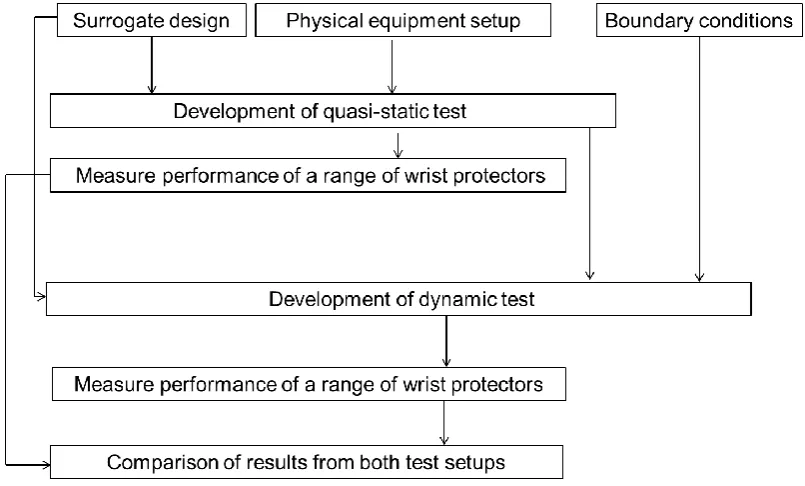
Most wrist protectors incorporate palmar pads for force attenuation and splints to reduce hyperextension. Testing to evaluate the protective pads in isolation and determine force attenuation is well established. However, no published approach has been established to quantify the rotational stiffness of wrist protectors, despite many products incorporating splints to reduce hyperextension. This project will take an incremental approach to developing new mechanical test setups. Firstly, a quasi-static test measuring the ability of wrist protectors to reduce hyper-extension will be developed as a preliminary tool to characterise products. As a quasi-static test cannot assess force attenuation properties of the palmar pad or rate effects of splints, a complementary approach employing an impact test will also be developed. Early identification of issues concerning the interaction of the wrist guard and surrogate during a quasi-static test will inform the development of an impact test.
3. Requirement Specification for mechanical test methods
[image:48.595.123.526.60.303.2]39
Figure 12.1: Test development approach
12.2 Boundary parameters
It is necessary to identify the requirements the system should adhere to in a product design specification (PDS), to facilitate the development of a test setup. Numerous factors should be considered when developing mechanical tests: boundary conditions (replicating injurious scenarios), physical test setup and physical constraints of university resources. Adopting a biomechanical approach with an understanding of injury mechanisms and human tolerance to load is important when designing injury prevention equipment (Odenwald, 2006; McIntosh, 2012). These parameters should be translated into input parameters and reproduced mechanically to test wrist protectors. Before a list of requirements can be established, it is necessary to identify the boundary parameters the test should replicate. The boundary parameters for the quasi-static test will be explored first, then the parameters specific to an impact test will be discussed.
12.2.1 Boundary parameters for quasi-static test