A Rich Feature Vector for Protein-Protein Interaction Extraction from
Multiple Corpora
Makoto Miwa1 Rune Sætre1 Yusuke Miyao1 Jun’ichi Tsujii1,2,3
1Department of Computer Science, the University of Tokyo, Japan Hongo 7-3-1, Bunkyo-ku, Tokyo, Japan.
2School of Computer Science, University of Manchester, UK 3National Center for Text Mining, UK
{mmiwa,rune.saetre,yusuke,tsujii}@is.s.u-tokyo.ac.jp
Abstract
Because of the importance of protein-protein interaction (PPI) extraction from text, many corpora have been proposed with slightly differing definitions of pro-teins and PPI. Since no single corpus is large enough to saturate a machine learn-ing system, it is necessary to learn from multiple different corpora. In this paper, we propose a solution to this challenge. We designed a rich feature vector, and we applied a support vector machine modi-fied for corpus weighting (SVM-CW) to complete the task of multiple corpora PPI extraction. The rich feature vector, made from multiple useful kernels, is used to express the important information for PPI extraction, and the system with our fea-ture vector was shown to be both faster and more accurate than the original kernel-based system, even when using just a sin-gle corpus. SVM-CW learns from one cor-pus, while using other corpora for support. SVM-CW is simple, but it is more effec-tive than other methods that have been suc-cessfully applied to other NLP tasks ear-lier. With the feature vector and SVM-CW, our system achieved the best perfor-mance among all state-of-the-art PPI ex-traction systems reported so far.
1 Introduction
The performance of an information extraction pro-gram is highly dependent on various factors, in-cluding text types (abstracts, complete articles, re-ports, etc.), exact definitions of the information to be extracted, shared sub-topics of the text collec-tions from which information is to be extracted.
Even if two corpora are annotated in terms of the same type of information by two groups, the per-formance of a program trained by one corpus is unlikely to be reproduced in the other corpus. On the other hand, from a practical point of view, it is worth while to effectively use multiple existing an-notated corpora together, because it is very costly to make new annotations.
One problem with several different corpora is protein-protein interaction (PPI) extraction from text. While PPIs play a critical role in un-derstanding the working of cells in diverse bio-logical contexts, the manual construction of PPI databases such as BIND, DIP, HPRD, IntAct, and MINT (Mathivanan et al., 2006) is known to be very time-consuming and labor-intensive. The au-tomatic extraction of PPI from published papers has therefore been a major research topic in Natu-ral Language Processing for Biology (BioNLP).
Among several PPI extraction task settings, the most common is sentence-based, pair-wise PPI ex-traction. At least four annotated corpora have been provided for this setting: AIMed (Bunescu et al., 2005), HPRD50 (Fundel et al., 2006), IEPA (Ding et al., 2002), and LLL (N´edellec, 2005). Each of these corpora have been used as the standard cor-pus for training and testing PPI programs. More-over, several corpora are annotated for more types of events than just for PPI. Such examples include BioInfer (Pyysalo et al., 2007), and GENIA (Kim et al., 2008a), and they can be reorganized into PPI corpora. Even though all of these corpora were made for PPI extraction, they were constructed based on different definitions of proteins and PPI, which reflect different biological research inter-ests (Pyysalo et al., 2008).
Research on PPI extraction so far has revealed that the performance on each of the corpora could
benefit from additional examples (Airola et al., 2008). Learning from multiple annotated cor-pora could lead to better PPI extraction perfor-mance. Various research paradigms such as induc-tive transfer learning (ITL) and domain adaptation (DA) have mainly focused on how to effectively use corpora annotated by other groups, by reduc-ing the incompatibilities (Pan and Yang, 2008).
In this paper, we propose the extraction of PPIs from multiple different corpora. We design a rich feature vector, and as an ITL method, we ap-ply a support vector machine (SVM) modified for corpus weighting (SVM-CW) (Schweikert et al., 2008), in order to evaluate the use of multiple cor-pora for the PPI extraction task. Our rich feature vector is made from multiple useful kernels, each of which is based on multiple parser inputs, pro-posed by Miwa et al. (2008). The system with our feature vector was better than or at least compa-rable to the state-of-the-art PPI extraction systems on every corpus. The system is a good starting point to use the multiple corpora. Using one of the corpora as the target corpus, SVM-CW weights the remaining corpora (we call them the source corpora) with “goodness” for training on the tar-get corpus. While SVM-CW is simple, we show that SVM-CW can improve the performance of the system more effectively and more efficiently than other methods proven to be successful in other NLP tasks earlier. As a result, SVM-CW with our feature vector is comprised of a PPI system with five different models, of which each model is su-perior to the best model in the original PPI extrac-tion task, which used only the single corpus.
2 Related Works
While sentence-based, pair-wise PPI extraction was initially tackled by using simple methods based on co-occurrences, lately, more sophisti-cated machine learning systems augmented by NLP techniques have been applied (Bunescu et al., 2005). The task has been tackled as a classifica-tion problem. To pull out useful informaclassifica-tion from NLP tools including taggers and parsers, several kernels have been applied to calculate the similar-ity between PPI pairs. Miwa et al. (2008) recently proposed the use of multiple kernels using multi-ple parsers. This outperformed other systems on the AIMed, which is the most frequently used cor-pus for the PPI extraction task, by a wide margin.
To improve the performance using external
Classification Result Training
Data
Feature vector Raw Texts
Parsers Classifier
Test Data
Raw Texts
Model Pair Information
Pair Information
Label
Figure 1: Overview of our PPI extraction system
training data, many ITL and DA methods have been proposed. Most of ITL methods assume that the feature space is same, and that the labels may be different in only some examples, while most of DA methods assume that the labels are the same, and that the feature space is different. Among the methods, we use adaptive SVM (aSVM) (Yang et al., 2007), singular value decomposition (SVD) based alternating structure optimization (SVD-ASO) (Ando et al., 2005), and transfer AdaBoost (TrAdaBoost) (Dai et al., 2007) to compare with SVM-CW. We do not use semi-supervised learn-ing (SSL) methods, because it would be consid-erably costly to generate enough clean unlabeled data needed for SSL (Erkan et al., 2007). aSVM is seen as a promising DA method among sev-eral modifications of SVM including SVM-CW. aSVM tries to find a model that is close to the one made from other classification problems. SVD-ASO is one of the most successful SSL, DA, or multi-task learning methods in NLP. The method tries to find an additional useful feature space by solving auxiliary problems that are close to the tar-get problem. With well-designed auxiliary prob-lems, the method has been applied to text clas-sification, text chunking, and word sense disam-biguation (Ando, 2006). The method was reported to perform better than or comparable to the best state-of-the-art systems in all of these tasks. TrAd-aBoost was proposed as an ITL method. In train-ing, the method reduces the effect of incompatible examples by decreasing their weights, and thereby tries to use useful examples from source corpora. The method has been applied to text classifica-tion, and the reported performance was better than SVM and transductive SVM (Dai et al., 2007).
3 PPI Extraction System
XPGp1 protein interacts with multiple subunits of TFIIHprot and with CSBp2 protein.
Figure 2: A sentence including an interacting pro-tein pair (p1, p2). (AIMed PMID 8652557, 9th sentence, 3rd pair)
BOW v-walkse-walks Graph BOW v-walkse-walks Graph Normalization
Parsers KSDEP Enju
a sentence including a pair feature vector
BOW v-walkse-walks Graph BOW v-walkse-walks Graph
Figure 3: Extraction of a feature vector from the target sentence
of proteins in a sentence is interacting or not. Fig-ure 2 shows an example of a sentence in which the given pair (p1 and p2) actually interacts.
Figure 1 shows the overview of the proposed PPI extraction system. As a classifier using a sin-gle corpus, we use the 2-norm soft-margin lin-ear SVM (L2-SVM) classifier, with the dual co-ordinate decent (DCD) method, by Hsieh et al. (2008). In this section, we explain the two main features: the feature vector, and the corpus weight-ing method for multiple corpora.
3.1 Feature Vector
We propose a feature vector with three types of features, corresponding to the three different ker-nels, which were each combined with the two parsers: the Enju 2.3.0, and KSDEP beta 1 (Miyao et al., 2008); this feature vector is used because the kernels with these parsers were shown to be effec-tive for PPI extraction by Miwa et al. (2008), and because it is important to start from a good per-formance single corpus system. Both parsers were retrained using the GENIA Treebank corpus pro-vided by Kim et al. (2003). By using our linear feature vector, we can perform calculations faster by using fast linear classifiers like L2-SVM, and we also obtain a more accurate extraction, than by using the original kernel method.
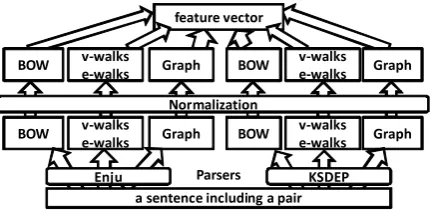
Figure 3 summarizes the way in which the fea-ture vector is constructed. The system extracts Bag-of-Words (BOW), shortest path (SP), and graph features from the output of two parsers. The
PROT M:1, and M:1, interact M:1, multiple M:1, of M:1, protein M:1, subunit M:1, with M:2, pro-tein A:1
Figure 4: Bag-of-Words features of the pair in Fig-ure 2 with their positions (B:Before, M:in the Mid-dle of, A:After) and frequencies.
NMOD SBJ rNMOD ENTITY1 protein protein interact protein ENTITY2 ENTITY1 protein interacts with multiple and with ENTITY2 protein .
NMOD SBJ
COOD COORD
NMOD PMOD
NMOD SBJ rNMOD
protein interact protein SBJ rCOOD rPMOD V-walks
E-walks
・・・ ・・・ ・・・
Figure 5: Vertex walks, edge walks in the upper shortest path between the proteins in the parse tree by KSDEP. The walks and their subsets are used as the shortest path features of the pair in Figure 2.
output is grouped according to the feature-type and parser, and each group of features is separately normalized by the L2-norm1. Finally, all values are put into a single feature vector, and the whole feature vector is then also normalized by the L2-norm. The features are constructed by using pred-icate argument structures (PAS) from Enju, and by using the dependency trees from KSDEP.
3.1.1 Bag-of-Words (BOW) Features
The BOW feature includes the lemma form of a word, its relative position to the target pair of pro-teins (Before, Middle, After), and its frequency in the target sentence. BOW features form the BOW kernel in the original kernel method. BOW fea-tures for the pair in Figure 2 are shown in Figure 4.
3.1.2 Shortest Path (SP) Features
SP features include vertex walks (v-walks), edge walks (e-walks), and their subsets (Kim et al., 2008b) on the target pair in a parse structure, and represent the connection between the pair. The features are the subsets of the tree kernels on the shortest path (Sætre et al., 2007). Figure 5 illus-trates the shortest path between the pair in Fig-ure 2, and its v-walks and e-walks extracted from the shortest path in the parse tree by KSDEP. A v-walk includes two lemmas and their link, while
1
[image:3.595.308.522.163.266.2]an e-walk includes a lemma and its two links. The links indicates the predicate argument relations for PAS, and the dependencies for dependency trees.
3.1.3 Graph Features
Graph features are made from the all-paths graph kernel proposed by Airola et al. (2008). The ker-nel represents the target pair using graph matrices based on two subgraphs, and the graph features are all the non-zero elements in the graph matrices.
The two subgraphs are a parse structure sub-graph (PSS) and a linear order subsub-graph (LOS). Figure 6 describes the subgraphs of the sentence parsed by KSDEP in Figure 2. PSS represents the parse structure of a sentence. PSS has word ver-tices or link verver-tices. A word vertex contains its lemma and its part-of-speech (POS), while a link vertex contains its link. Additionally, both types of vertices contain their positions relative to the shortest path. The “IP”s in the vertices on the shortest path represent the positions, and the ver-tices are differentiated from the other verver-tices like “P”, “CC”, and “and:CC” in Figure 6. LOS repre-sents the word sequence in the sentence. LOS has word vertices, each of which contains its lemma, its relative position to the target pair, and its POS.
Each subgraph is represented by a graph matrix Gas follows:
G=LT X∞ n=1
AnL, (1)
where L is aN×Llabel matrix, Ais an N×N edge matrix,N represents the number of vertices, and L represents the number of labels. The la-bel of a vertex includes all information described above (e.g. “ENTITY1:NN:IP” in Figure 6). If two vertices have exactly same information, the labels will be same. G can be calculated effi-ciently by using the Neumann Series (Airola et al., 2008). The label matrix represents the correspon-dence between labels and vertices. Lij is 1 if the
i-th vertex corresponds to thej-th label, and 0 oth-erwise. The edge matrix represents the connection between the pairs of vertices. Aij is a weightwij (0.9 or 0.3 in Figure 6 (Airola et al., 2008)) if the
i-th vertex is connected to thej-th vertex, and 0 otherwise. By this calculation, Gij represent the sum of the weights of all paths between the i-th label and thej-th label.
A B H I L
[image:4.595.312.523.62.104.2]positive 1,000 2,534 163 335 164 all 5,834 9,653 433 817 330
Table 1: The sizes of used PPI corpora. A:AIMed, B:BioInfer, H:HPRD50, I:IEPA, and L:LLL.
50 60 70 80 90 100
0 20 40 60 80 100 % examples
[image:4.595.312.526.158.256.2]AImed (F) BioInfer (F) AImed (AUC) BioInfer (AUC)
Figure 7: Learning curves on two large corpora. The x-axis is related to the percentage of the ex-amples in a corpus. The curves are obtained by a 10-fold CV with a random split.
3.2 Corpus Weighting for Mixing Corpora
Table 1 shows the sizes of the PPI corpora that we used. Their widely-ranged differences including the sizes were manually analyzed by Pyysalo et al. (2008). While AIMed, HPRD50, IEPA, and LLL were all annotated as PPI corpora, BioInfer in its original form contains much more fine-grained information than does just the PPI. BioInfer was transformed into a PPI corpus by a program, so making it the largest of the five. Among them, AIMed alone was created by annotating whole ab-stracts, while the other corpora were made by an-notating single sentences selected from abstracts.
Figure 7 shows the learning curves on two large corpora: AIMed and BioInfer. The curves are obtained by performing a 10-fold cross valida-tion (CV) on each corpus, with random splits, us-ing our system. The curves show that the perfor-mances can benefit from the additional examples. To get a better PPI extraction system for a chosen target, we need to draw useful shared information from external source corpora. We refer to exam-ples in the source corpora as “source examexam-ples”, and examples in a target corpus as “target exam-ples”. Among the corpora, we assume that the la-bels in some examples are incompatible, and that their distributions are also different, but that the feature space is shared.
ENTITY1 NN
IP
protein NN
IP
interact VBZ
IP
with IN IP
multiple
JJ subunitNNS INof PROTNN andCC withIN IP
ENTITY2 NN
IP
protein NN
IP . . NMOD
IP
SBJ IP
COOD
IP PMOD
NMOD NMOD PMOD
CC COORD
IP
NMOD IP
PMOD IP
P
ENTITY1
NN proteinNN M
interact VBZ
M
with IN M
multiple JJ M
subunit NNS
M of IN M
PROT NN
M and
CC M
with IN M
ENTITY2
NN proteinNN A
. .
0.9, 0.3
IP: In shortest Path, B:Before, M:in the Middle of, A:After
Figure 6: Parse structure subgraph and linear order subgraph to extract graph features of the pair in Figure 2. The parse structure subgraph is from the parse tree by KSDEP.
corpus, we use SVM-CW, which has been used as a DA method. Given a set of instance-label pairs (xi, yi), i = 1, . . ., ls+ lt, xi∈Rn, and
yi∈{−1,+1}, we solve the following problem:
minw 1
2wTw+Cs ls X
i=1
`i+Ct lsX+lt
i=ls+1
`i, (2)
where w is a weight vector, `is a loss function, andlsandltare the numbers of source and target examples respectively. Cs ≥ 0 and Ct ≥ 0 are penalty parameters. We use a squared hinge loss
`i =max(0,1−yiwTxi)2. Here, the source
cor-pora are treated as one corpus. The problem, ex-cluding the second term, is equal to L2-SVM. The problem can be solved using the DCD method.
As an ITL method, SVM-CW weights each cor-pus, and tries to benefit from the source corpora, by adjusting the effect of their compatibility and incompatibility. For the adjustment, these penalty parameters should be set properly. Since we are unaware of the widely ranged differences among the corpora, we empirically estimated them by performing 10-fold CV on the training data.
4 Evaluation
4.1 Evaluation Settings
We used five corpora for evaluation: AIMed, BioInfer, HPRD50, IEPA, and LLL. For the com-parison with other methods, we report the F-score (%), and the area under the receiver op-erating characteristic (ROC) curve (AUC) (%)
using (abstract-wise) a 10-fold CV and a one-answer-per-occurrence criterion. These measures are commonly used for the PPI extraction tasks. The F-score is a harmonic mean of Precision and Recall. The ROC curve is a plot of a true posi-tive rate (TPR) vs a false posiposi-tive rate (FPR) for different thresholds. We tuned the regularization parameters of all classifiers by performing a 10-fold CV on the training data using a random split. The other parameters were fixed, and we report the highest of the macro-averaged F-scores as our fi-nal F-score. For 10-fold CV, we split the corpora as recommended by Airola et al. (2008).
4.2 PPI Extraction on a Single Corpus
In this section, we evaluate our system on a single corpus, in order to evaluate our feature vector and to justify the use of the following modules: nor-malization methods and classification methods.
L2 L1 LR AP CW F 64.2 64.0 64.2 62.7 63.0 AUC 89.1 88.8 89.0 88.5 87.8
Table 2: Classification performance on AIMed us-ing five different linear classifiers. The F-score (F) and Area Under the ROC curve (AUC) are shown. L2 is L2-SVM, L1 is L1-SVM, LR is logistic re-gression, AP is averaged perceptron, and CW is confidence weighted linear classification.
group with different values can produce better re-sults, as will be explored in our future work.
Next, using our feature vector, we applied five different linear classifiers to extract PPI from AIMed: L2-SVM, 1-norm soft-margin SVM (L1-SVM), logistic regression (LR) (Fan et al., 2008), averaged perceptron (AP) (Collins, 2002), and confidence weighted linear classifica-tion (CW) (Dredze et al., 2008). Table 2 indicates the performance of these classifiers on AIMed. We employed better settings for the task than did the original methods for AP and CW. We used a Widrow-Hoff learning rule (Bishop, 1995) for AP, and we performed one iteration for CW. L2-SVM is as good as, if not better, than other classifiers (F-score and AUC). In the least, L2-SVM is as fast as these classifiers. AP and CW are worse than the other three methods, because they require a large number of examples, and are un-suitable for the current task. This result indicates that all linear classifiers, with the exception of AP and CW, per-form almost equally, when using our feature vec-tor.
Finally, we implemented the kernel method by Miwa et al. (2008). For a 10-fold CV on AIMed, the running time was 9,507 seconds, and the per-formance was 61.5% F-score and 87.1% AUC. Our system used 4,702 seconds, and the perfor-mance was 64.2% F-score and 89.1% AUC. This result displayed that our system, with L2-SVM, and our new feature vector, is better, and faster, than the kernel-based system.
4.3 Evaluation of Corpus Weighting
In this section, we first apply each model from a source corpus to a target corpus, to show how dif-ferent the corpora are. We then evaluate SVM-CW by comparing it with three other methods (see Sec-tion 2) with limited features, and apply it to every corpus.
0 10 20 30 40 50 60 70 80 90
AIMed BioInfer HPRD50 IEPA LLL F
Target corpus
AIMed BioInfer HPRD50 IEPA LLL co-occ
Model
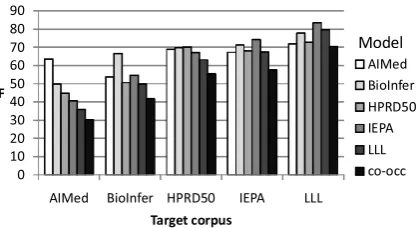
Figure 8: F-score on a target corpus using a model on a source corpus. For the comparison, we show the 10-fold CV result on each target corpus and co-occurrences. The regularization parameter was fixed to 1.
First, we apply the model from a source corpus to a target corpus. Figure 8 shows how the model from a source corpus performs on the target cor-pus. Interestingly, the model from IEPA performs better on LLL than the model from LLL itself. All the results showed that using different corpora (ex-cept IEPA) is worse than just using the same cor-pora. However, the cross-corpora scores are still better than the co-occurrences base-line, which in-dicates that the corpora share some information, even though they are not fully compatible.
[image:6.595.313.523.64.178.2]aSVM SVD-ASO TrAdaBoost SVM-CW L2-SVM
F AUC F AUC F AUC F AUC F AUC
[image:7.595.109.493.63.159.2]AIMed 63.6 88.4 62.9 88.3 63.4 88.4 64.0 88.6 63.2 88.4 BioInfer 66.5 85.2 65.7 85.1 66.1 85.2 66.7 85.4 66.2 85.1 HPRD50 71.2 84.3 68.7 80.8 72.6 85.3 72.7 86.4 67.2 80.7 IEPA 73.8 85.4 72.3 83.8 74.3 86.3 75.2 85.9 73.0 84.7 LLL 85.9 89.2 79.3 85.5 86.5 88.8 86.9 90.3 80.3 86.3
Table 3: Comparison of methods on multiple corpora. Our feature vector without graph features is used. The source corpora with the best F-scores are reported for aSVM, TrAdaBoost, and SVM-CW.
F-score AUC
A B H I L all A B H I L all
A (64.2) 64.0 64.7 65.2 63.7 64.2 (89.1) 89.5 89.2 89.3 89.0 89.4 B 67.9 (67.6) 67.9 67.9 67.7 68.3 86.2 (86.1) 86.2 86.3 86.2 86.4 H 71.3 71.2 (69.7) 74.1 70.8 74.9 84.7 85.0 (82.8) 85.0 83.4 87.9 I 74.4 75.6 73.7 (74.4) 74.4 76.6 86.7 87.1 85.4 (85.6) 86.9 87.8 L 83.2 85.9 82.0 86.7 (80.5) 84.1 86.3 87.1 87.4 90.8 (86.0) 86.2
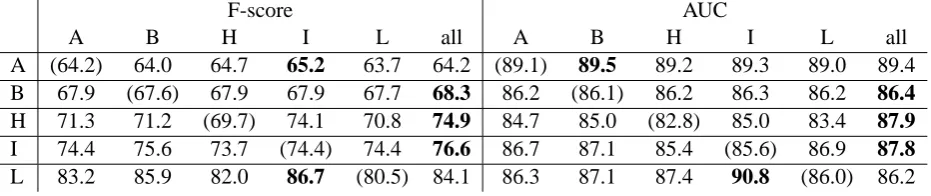
Table 4: F-score and AUC by SVM-CW. Rows correspond to a target corpus, and columns a source corpus. A:AIMed, B:BioInfer, H:HPRD50, I:IEPA, and L:LLL corpora. “all” signifies that all source corpora are used as one source corpus, ignoring the differences among the corpora. For the comparison, we show the 10-fold CV result on each target corpus.
In Table 3, we demonstrate the results of the comparison. SVM-CW improved the classifica-tion performance at least as much as all the other methods. The improvement is mainly attributed to the aggressive use of source examples while learn-ing the model. Some source examples can be used as training data, as indicated in Figure 8. SVM-CW does not set the restriction between Cs and
Ct in Equation (2), so it can use source exam-ples aggressively while learning the model. Since aSVM transfers a model, and SVD-ASO transfers an additional feature space, aSVM and SVD-ASO do not use the source examples while learning the model. In addition to the difference in the data us-age, the settings of aSVM and SVD-ASO do not match the current task. As for aSVM, the DA as-sumption (that the labels are the same) does not match the task. In SVD-ASO, the numbers of both source examples and auxiliary problems are much smaller than those reported by Ando et al. (2005). TrAdaBoost uses the source examples while learn-ing the model, but never increases the weight of the examples, and it attempts to reduce their ef-fects.
Finally, we apply SVM-CW to all corpora using all features. Table 4 summarizes the F-score and AUC by SVM-CW with all features. SVM-CW
[image:7.595.73.539.213.311.2]SVM-CW L2-SVM Airola et al.
F AUC F AUC F AUC
[image:8.595.74.291.63.157.2]A 65.2 89.3 64.2 89.1 56.4 84.8 B 68.3 86.4 67.6 86.1 61.3 81.9 H 74.9 87.9 69.7 82.8 63.4 79.7 I 76.6 87.8 74.4 85.6 75.1 85.1 L 86.7 90.8 80.5 86.0 76.8 83.4
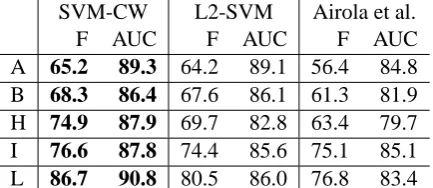
Table 6: Comparison with the results by Airola et al. (2008). A:AIMed, B:BioInfer, H:HPRD50, I:IEPA, and L:LLL corpora. The results with the highest F-score from Table 4 are reported as the results for SVM-CW.
newly found pairs. This analysis is evidence that IEPA contains instances to help find such inter-actions, and that SVM-CW helps to collect gold pairs that lack enough supporting instances in a single corpus, by adding instances from other cor-pora. SVM-CW missed coreferential relations that were also missed by L2-SVM. This can be at-tributed to the fact that the coreferential informa-tion is not stored in our current feature vector; so we need an even more expressive feature space. This is left as future work.
SVM-CW is effective on most corpus combi-nations, and all the models from single corpora can be improved by adding other source corpora. This result is impressive, because the baselines by L2-SVM on just single corpora are already better than or at least comparable to other state-of-the-art PPI extraction systems, and also because the vari-ety of the differences among different corpora is quite wide depending on various factors including annotation policies of the corpora (Pyysalo et al., 2008). The results suggest that SVM-CW is useful as an ITL method.
4.4 Comparison with Other PPI Systems
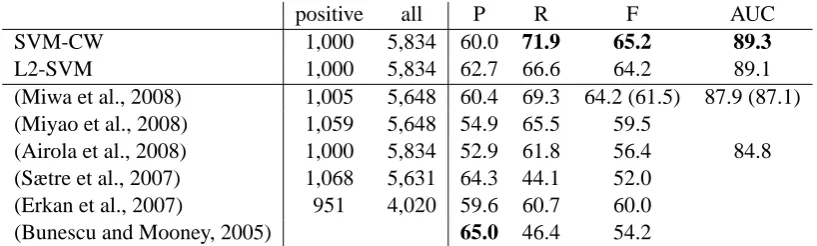
We compare our system with other previously published PPI extraction systems. Tables 5 and 6 summarize the comparison. Table 5 summa-rizes the comparison of several PPI extraction sys-tems evaluated on the AIMed corpus. As indi-cated, the performance of the heavy kernel method is lower than our fast rich feature-vector method. Our system is, to the extent of our knowledge, the best performing PPI extraction system evaluated on the AIMed corpus, both in terms of AUC and F-scores. Airola et al. (2008) first reported results using all five corpora. We cannot directly
com-pare our result with the F-score results, because they tuned the threshold, but our system still out-performs the system by Airola et al. (2008) on ev-ery corpus in AUC values. The results also indi-cate that our system outperforms other systems on all PPI corpora, and that both the rich feature vec-tor and the corpus weighting are effective for the PPI extraction task.
5 Conclusion
In this paper, we proposed a PPI extraction system with a rich feature vector, using a corpus weight-ing method (SVM-CW) for combinweight-ing the mul-tiple PPI corpora. The feature vector extracts as much information as possible from the main train-ing corpus, and SVM-CW incorporate other exter-nal source corpora in order to improve the perfor-mance of the classifier on the main target corpus. To the extent of our knowledge, this is the first ap-plication of ITL and DA methods to PPI extrac-tion. As a result, the system, with SVM-CW and the feature vector, outperformed all other PPI ex-traction systems on all of the corpora. The PPI corpora share some information, and it is shown to be effective to add other source corpora when working with a specific target corpus.
The main contributions of this paper are: 1) conducting experiments in extracting PPI using multiple corpora, 2) suggesting a rich feature vector using several previously proposed features and normalization methods, 3) the combination of SVM with corpus weighting and the new feature vector improved results on this task compared with prior work.
There are many differences among the corpora that we used, and some of the differences are still unresolved. For further improvement, it would be necessary to investigate what is shared and what is different among the corpora. The SVM-CW method, and the PPI extraction system, can be ap-plied generally to other classification tasks, and to other binary relation extraction tasks, without the need for modification. There are several other tasks in which many different corpora, which at first glance seem compatible, exist. By apply-ing SVM-CW to such corpora, we will analyze which differences can be resolved by SVM-CW, and what differences require a manual resolution.
positive all P R F AUC
SVM-CW 1,000 5,834 60.0 71.9 65.2 89.3
L2-SVM 1,000 5,834 62.7 66.6 64.2 89.1
(Miwa et al., 2008) 1,005 5,648 60.4 69.3 64.2 (61.5) 87.9 (87.1) (Miyao et al., 2008) 1,059 5,648 54.9 65.5 59.5
(Airola et al., 2008) 1,000 5,834 52.9 61.8 56.4 84.8 (Sætre et al., 2007) 1,068 5,631 64.3 44.1 52.0
[image:9.595.95.504.62.185.2](Erkan et al., 2007) 951 4,020 59.6 60.7 60.0 (Bunescu and Mooney, 2005) 65.0 46.4 54.2
Table 5: Comparison with previous PPI extraction results on the AIMed corpus. The numbers of positive and all examples, precision (P), recall (R), F-score (F), and AUC are shown. The result with the highest F-score from Table 4 is reported as the result for SVM-CW. The scores in the parentheses of Miwa et al. (2008) indicate the result using the same 10-fold splits as our result, as indicated in Section 4.2.
of these false negatives more deeply, and design a more discriminative feature space. This is left as a future direction of our work.
Acknowledgments
This work was partially supported by Grant-in-Aid for Specially Promoted Research (MEXT, Japan), Genome Network Project (MEXT, Japan), and Scientific Research (C) (General) (MEXT, Japan).
References
Antti Airola, Sampo Pyysalo, Jari Bj¨orne, Tapio Pahikkala, Filip Ginter, and Tapio Salakoski. 2008. All-paths graph kernel for protein-protein interac-tion extracinterac-tion with evaluainterac-tion of cross corpus learn-ing. BMC Bioinformatics.
Rie Kubota Ando, Tong Zhang, and Peter Bartlett. 2005. A framework for learning predictive struc-tures from multiple tasks and unlabeled data. Jour-nal of Machine Learning Research, 6:1817–1853.
Rie Kubota Ando. 2006. Applying alternating struc-ture optimization to word sense disambiguation. In Proceedings of the Tenth Conference on Compu-tational Natural Language Learning (CoNLL-X), pages 77–84, June.
C. M. Bishop. 1995. Neural Networks for Pattern Recognition. Oxford University Press.
Razvan C. Bunescu and Raymond J. Mooney. 2005. Subsequence kernels for relation extraction. In NIPS 2005.
Razvan C. Bunescu, Ruifang Ge, Rohit J. Kate, Ed-ward M. Marcotte, Raymond J. Mooney, Arun K. Ramani, and Yuk Wah Wong. 2005. Comparative experiments on learning information extractors for proteins and their interactions. Artificial Intelligence in Medicine, 33(2):139–155.
Michael Collins. 2002. Discriminative training meth-ods for hidden markov models: theory and experi-ments with perceptron algorithms. In EMNLP 2002, pages 1–8.
Wenyuan Dai, Qiang Yang, Gui-Rong Xue, and Yong Yu. 2007. Boosting for transfer learning. In ICML 2007, pages 193–200.
J. Ding, D. Berleant, D. Nettleton, and E. Wurtele. 2002. Mining medline: abstracts, sentences, or phrases? Pacific Symposium on Biocomputing, pages 326–337.
Mark Dredze, Koby Crammer, and Fernando Pereira. 2008. Confidence-weighted linear classification. In ICML 2008, pages 264–271.
Gunes Erkan, Arzucan Ozgur, and Dragomir R. Radev. 2007. Semi-supervised classification for extract-ing protein interaction sentences usextract-ing dependency parsing. In EMNLP 2007.
Rong-En Fan, Kai-Wei Chang, Cho-Jui Hsieh, Xiang-Rui Wang, and Chih-Jen Lin. 2008. LIBLINEAR: A library for large linear classification. Journal of Machine Learning Research, 9:1871–1874.
Katrin Fundel, Robert K¨uffner, and Ralf Zimmer. 2006. Relex—relation extraction using dependency parse trees. Bioinformatics, 23(3):365–371.
Cho-Jui Hsieh, Kai-Wei Chang, Chih-Jen Lin, S. Sathiya Keerthi, and S. Sundararajan. 2008. A dual coordinate descent method for large-scale lin-ear SVM. In ICML 2008, pages 408–415.
Jin-Dong Kim, Tomoko Ohta, Yuka Tateisi, and Jun’ichi Tsujii. 2003. GENIA corpus — a semanti-cally annotated corpus for bio-textmining. Bioinfor-matics, 19:i180–i182.
Seonho Kim, Juntae Yoon, and Jihoon Yang. 2008b. Kernel approaches for genic interaction extraction. Bioinformatics, 24(1):118–126.
Suresh Mathivanan, Balamurugan Periaswamy, TKB Gandhi, Kumaran Kandasamy, Shubha Suresh, Riaz Mohmood, YL Ramachandra, and Akhilesh Pandey. 2006. An evaluation of human protein-protein inter-action data in the public domain. BMC Bioinformat-ics, 7 Suppl 5:S19.
Quinn McNemar. 1947. Note on the sampling error of the difference between correlated proportions or percentages. Psychometrika, 12(2):153–157, June.
Makoto Miwa, Rune Sætre, Yusuke Miyao, Tomoko Ohta, and Jun’ichi Tsujii. 2008. Combining mul-tiple layers of syntactic information for protein-protein interaction extraction. In Proceedings of the Third International Symposium on Semantic Mining in Biomedicine (SMBM 2008), pages 101–108.
Yusuke Miyao, Rune Sætre, Kenji Sagae, Takuya Matsuzaki, and Jun’ichi Tsujii. 2008. Task-oriented evaluation of syntactic parsers and their representations. In Proceedings of the 45th Meet-ing of the Association for Computational LMeet-inguistics (ACL’08:HLT).
Claire N´edellec. 2005. Learning language in logic -genic interaction extraction challenge. In Proceed-ings of the LLL’05 Workshop.
Sinno Jialin Pan and Qiang Yang. 2008. A survey on transfer learning. Technical Report HKUST-CS08-08, Department of Computer Science and Engineer-ing, Hong Kong University of Science and Technol-ogy, Hong Kong, China, November.
Sampo Pyysalo, Filip Ginter, Juho Heimonen, Jari Bj¨orne, Jorma Boberg, Jouni J¨arvinen, and Tapio Salakoski. 2007. BioInfer: A corpus for infor-mation extraction in the biomedical domain. BMC Bioinformatics, 8:50.
Sampo Pyysalo, Antti Airola, Juho Heimonen, Jari Bj¨orne, Filip Ginter, and Tapio Salakoski. 2008. Comparative analysis of five protein-protein inter-action corpora. In BMC Bioinformatics, volume 9(Suppl 3), page S6.
Gunnar Ratsch, Takashi Onoda, and Klaus-Robert Muller. 2001. Soft margins for adaboost. Machine Learning, 42(3):287–320.
Rune Sætre, Kenji Sagae, and Jun’ichi Tsujii. 2007. Syntactic features for protein-protein interaction ex-traction. In LBM 2007 short papers.
Gabriele Schweikert, Christian Widmer, Bernhard Sch¨olkopf, and Gunnar R¨atsch. 2008. An empir-ical analysis of domain adaptation algorithms for genomic sequence analysis. In NIPS, pages 1433– 1440.