Mining Name Translations from Entity Graph Mapping
∗Gae-won You† Seung-won Hwang† Young-In Song‡ Long Jiang‡ Zaiqing Nie‡
†Pohang University of Science and Technology, Pohang, Republic of Korea
{gwyou,swhwang}@postech.ac.kr
‡Microsoft Research Asia, Beijing, China
{yosong,longj,znie}@microsoft.com
Abstract
This paper studies the problem of mining en-tity translation, specifically, mining English
and Chinese name pairs. Existing efforts
can be categorized into (a) a transliteration-based approach leveraging phonetic similar-ity and (b) a corpus-based approach exploiting bilingual co-occurrences, each of which suf-fers from inaccuracy and scarcity respectively. In clear contrast, we use unleveraged re-sources of monolingual entity co-occurrences, crawled from entity search engines, repre-sented as two entity-relationship graphs ex-tracted from two language corpora respec-tively. Our problem is then abstracted as find-ing correct mappfind-ings across two graphs. To achieve this goal, we propose a holistic ap-proach, of exploiting both transliteration sim-ilarity and monolingual co-occurrences. This approach, building upon monolingual corpora, complements existing corpus-based work, re-quiring scarce resources of parallel or compa-rable corpus, while significantly boosting the
accuracy of transliteration-based work. We
validate our proposed system using real-life datasets.
1 Introduction
Entity translation aims at mapping the entity names (e.g., people, locations, and organizations) in source language into their corresponding names in target language. While high quality entity translation is es-sential in cross-lingual information access and
trans-∗This work was done when the first two authors visited
Mi-crosoft Research Asia.
lation, it is non-trivial to achieve, due to the chal-lenge that entity translation, though typically bear-ing pronunciation similarity, can also be arbitrary,
e.g., Jackie Chan and dd (pronounced Cheng Long). Existing efforts to address these challenges can be categorized into transliteration- and corpus-based approaches. Transliteration-corpus-based approaches (Wan and Verspoor, 1998; Knight and Graehl, 1998) identify translations based on pronunciation similar-ity, while corpus-based approaches mine bilingual co-occurrences of translation pairs obtained from parallel (Kupiec, 1993; Feng et al., 2004) or compa-rable (Fung and Yee, 1998) corpora, or alternatively mined from bilingual sentences (Lin et al., 2008; Jiang et al., 2009). These two approaches have com-plementary strength– transliteration-based similar-ity can be computed for any name pair but cannot mine translations of little (or none) phonetic simi-larity. Corpus-based similarity can support arbitrary translations, but require highly scarce resources of bilingual co-occurrences, obtained from parallel or comparable bilingual corpora.
In this paper, we propose a holistic approach, leveraging both transliteration- and corpus-based similarity. Our key contribution is to replace the use of scarce resources of bilingual co-occurrences with the use of untapped and significantly larger resources of monolingual co-occurrences for trans-lation. In particular, we extract monolingual co-occurrences of entities from English and Chinese Web corpora, which are readily available from en-tity search engines such as PeopleEnen-tityCube1, de-ployed by Microsoft Research Asia. Such engine
1
http://people.entitycube.com
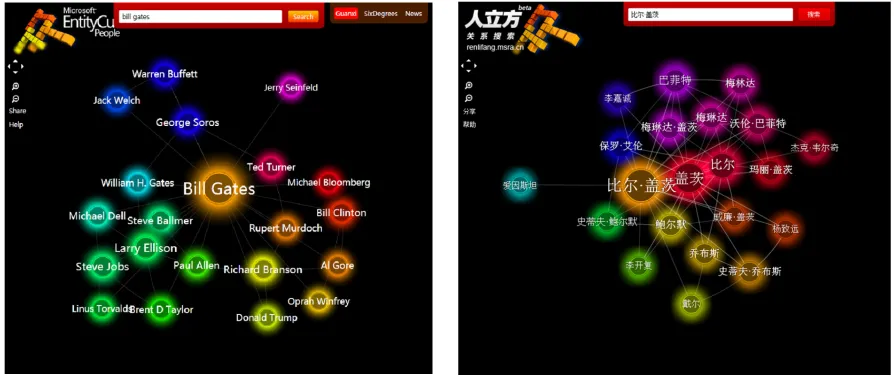
automatically extracts people names from text and their co-occurrences to retrieve related entities based on co-occurrences. To illustrate, Figure 1(a) demon-strates the query result for “Bill Gates,” retrieving and visualizing the “entity-relationship graph” of re-lated people names that frequently co-occur with Bill in English corpus. Similarly, entity-relationship graphs can be built over other language corpora, as Figure 1(b) demonstrates the corresponding results for the same query, from Renlifang2on Chinese Web corpus. From this point on, for the sake of simplic-ity, we refer to English and Chinese graphs, simply asGeandGcrespectively. Though we illustrate with
English-Chinese pairs in the paper, our method can be easily adapted to other language pairs.
In particular, we propose a novel approach of ab-stracting entity translation as a graph matching prob-lem of two graphsGeandGcin Figures 1(a) and (b).
Specifically, the similarity between two nodes ve
andvcinGeandGc is initialized as their
transliter-ation similarity, which is iteratively refined based on relational similarity obtained from monolingual co-occurrences. To illustrate this, an English news ar-ticle mentioning “Bill Gates” and “Melinda Gates” evidences a relationship between the two entities, which can be quantified from their co-occurrences in the entire English Web corpus. Similarly, we can mine Chinese news articles to obtain the re-lationships between “dd·dd” and “ddd·d d”. Once these two bilingual graphs of people and their relationships are harvested, entity translation can leverage these parallel relationships to further evidence the mapping between translation pairs, as Figure 1(c) illustrates.
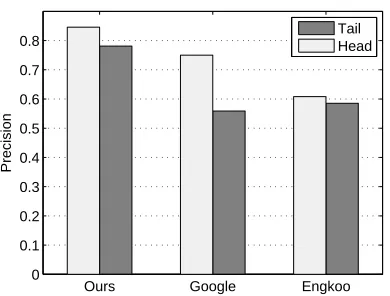
To highlight the advantage of our proposed ap-proach, we compare our results with commercial machine translators (1) Engkoo3 developed in Mi-crosoft Research Asia and (2) Google Translator4. In particular, Figure 2 reports the precision for two groups– “heads” that belong to top-100 popular peo-ple (determined by the number of hits), among ran-domly sampled 304 people names5 from six graph pairs of size 1,000 each, and the remaining “tails”. Commercial translators such as Google, leveraging
2
http://renlifang.msra.cn 3
http://www.engkoo.com 4http://translate.google.com 5
See Section 4 for the sampling process.
Ours Google Engkoo 0
0.1 0.2 0.3 0.4 0.5 0.6 0.7 0.8
Precision
[image:2.612.320.515.62.210.2]Tail Head
Figure 2: Comparison for Head and Tail datasets
bilingual co-occurrences that are scarce for tails, show significantly lower precision for tails. Mean-while, our work, depending solely on monolin-gual co-occurrences, shows high precision, for both heads and tails.
Our focus is to boost translation accuracy for long tails with non-trivial Web occurrences in each monolingual corpus, but not with much bilingual co-occurrences,e.g., researchers publishing actively in two languages but not famous enough to be featured in multi-lingual Wikipedia entries or news articles. As existing translators are already highly accurate for popular heads, this focus well addresses the re-maining challenges for entity translation.
To summarize, we believe that this paper has the following contributions:
• We abstract entity translation problem as a graph mapping between entity-relationship graphs in two languages.
• We develop an effective matching algo-rithm leveraging both pronunciation and co-occurrence similarity. This holistic approach complements existing approaches and en-hances the translation coverage and accuracy.
• We validate the effectiveness of our approach using various real-life datasets.
(a) English PeopleEntityCubeGe (b) Chinese RenlifangGc
[image:3.612.82.529.55.245.2](c) Abstracting translation as graph mapping
Figure 1: Illustration of entity-relationship graphs
2 Related Work
In this section, we first survey related efforts, cate-gorized into transliteration-based and corpus-based approaches. Our approach leveraging both is com-plementary to these efforts.
2.1 Transliteration-based Approaches
Many name translations are loosely based on phonetic similarity, which naturally inspires transliteration-based translation of finding the translation with the closest pronunciation similarity, using either rule-based (Wan and Verspoor, 1998) or statistical (Knight and Graehl, 1998; Li et al., 2004)
approaches. However, people are free to designate arbitrary bilingual names of little (or none) pho-netic similarity, for which the transliteration-based approach is not effective.
2.2 Corpus-based Approaches
Corpus-based approach can mine arbitrary transla-tion pairs, by mining bilingual co-occurrences from parallel and comparable bilingual corpora. Using parallel corpora (Kupiec, 1993; Feng et al., 2004),
1998; Shao and Ng, 2004) explore a more vast re-source of comparable corpora, which share no par-allel document- or sentence-alignments as in paral-lel corpora but describe similar contents in two lan-guages, e.g., news articles on the same event. Al-ternatively, (Lin et al., 2008) extracts bilingual co-occurrences from bilingual sentences, such as an-notating terms with their corresponding translations in English inside parentheses. Similarly, (Jiang et al., 2009) identifies potential translation pairs from bilingual sentences using lexical pattern analysis.
2.3 Holistic Approaches
The complementary strength of the above two ap-proaches naturally calls for a holistic approach, such as recent work combining transliteration-and corpus-based similarity mining bilingual co-occurrences using general search engines. Specifi-cally, (Al-Onaizan and Knight, 2002) uses translit-eration to generate candidates and then web corpora to identify translations. Later, (Jiang et al., 2007) enhances to use transliteration to guide web mining. Our work is also a holistic approach, but leverag-ing significantly larger corpora, specifically by ex-ploiting monolingual co-occurrences. Such expan-sion enables to translate “long-tail” people entities with non-trivial Web occurrences in each monolin-gual corpus, but not much bilinmonolin-gual co-occurrences. Specifically, we initialize name pair similarity using transliteration-based approach, and iteratively rein-forces base similarity using relational similarity.
3 Our Framework
Given two graphsGe= (Ve, Ee)andGc = (Vc, Ec)
harvested from English and Chinese corpora respec-tively, our goal is to find translation pairs, or a setS
of matching node pairs such thatS ⊆Ve×Vc. Let
R be a|Ve|-by-|Vc|matrix where eachRij denotes
the similarity between two nodesi∈Veandj ∈Vc.
Overall, with the matrixR, our approach consists of the following three steps, as we will discuss in the following three sections respectively:
1. Initialization:computing base translation sim-ilarities Rij between two entity nodes using
transliteration similarity
2. Reinforcement model: reinforcing the
trans-lation similaritiesRij by exploiting the
mono-lingual co-occurrences
3. Matching extraction:extracting the matching pairs from the final translation similaritiesRij
3.1 Initialization with Transliteration
We initialize the translation similarity Rij as the
transliteration similarity. This section explains how to get the transliteration similarity between English and Chinese names using an unsupervised approach.
Formally, let an English name Ne =
(e1, e2,· · ·, en) and a Chinese name Nc = (c1, c2,· · ·, cm) be given, where ei is an English
word and Ne is a sequence of the words, and ci
is a Chinese character and Nc is a sequence of
the characters. Our goal is to compute a score indicating the similarity between the pronunciations of the two names.
We first convertNc into its Pinyin representation
P Yc = (s1, s2,· · ·, sm), wheresi is the Pinyin
rep-resentation of ci. Pinyin is the romanization
rep-resentation of pronunciation of Chinese character. For example, the Pinyin representation of Ne =
(“Barack”, “Obama”) is P Yc =(“ba”, “la”, “ke”,
“ao”, “ba”, “ma”). The Pinyin representations of Chinese characters can be easily obtained from Chi-nese character pronunciation dictionary. In our ex-periments, we use an in-house dictionary, which contains pronunciations of20,774Chinese charac-ters. For the Chinese characters having multiple pro-nunciations, we only use the most popular one.
Calculation of transliteration similarity between
NeandNcis now transformed to calculation of
pro-nunciation similarity betweenNeandP Yc. Because
letters in Chinese Pinyins and English strings are pronounced similarly, we can further approximate pronunciation similarity between Ne and P Yc
us-ing their spellus-ing similarity. In this paper, we use Edit Distance (ED) to measure the spelling similar-ity. Moreover, since words inNe are transliterated
into characters inP Yc independently, it is more
ac-curate to compute the ED betweenNeandP Yc,i.e.,
EDname(Ne, P Yc), as the sum of the EDs of all
component transliteration pairs,i.e., everyei inNe
and its corresponding transliteration(si)inP Yc. In
other words, we need to first align all sj’s inP Yc
are translations of each other. Then based on the alignment, we can calculateEDname(Ne, P Yc)
us-ing the followus-ing formula.
EDname(Ne, P Yc) = ∑
i
ED(ei, esi) (1)
whereesiis a string generated by concatenating all
si’s that are aligned to ei and ED(ei, esi) is the
Edit Distance between ei and esi, i.e., the
mini-mum number of edit operations (including inser-tion, deletion and substitution) needed to transform
ei into esi. Because an English word usually
con-sists of multiple syllables but every Chinese charac-ter consists of only one syllable, when aligningei’s
with sj’s, we add the constraint that each ei is
al-lowed to be aligned with 0 to 4si’s but eachsi can
only be aligned with 0 to 1 ei. To get the
align-ment betweenP Yc and Ne which has the minimal
EDname(Ne, P Yc), we use a Dynamic
Program-ming based algorithm as defined in the following formula:
EDname(Ne1,i, P Yc1,j) = min(
EDname(Ne1,i−1, P Yc1,j) +Len(ei),
EDname(Ne1,i, P Y
1,j−1
c ) +Len(sj),
EDname(Ne1,i−1, P Y
1,j−1
c ) +ED(ei, sj),
EDname(Ne1,i−1, P Y
1,j−2
c ) +ED(ei, P Ycj−1,j),
EDname(Ne1,i−1, P Y
1,j−3
c ) +ED(ei, P Ycj−2,j),
EDname(Ne1,i−1, P Y
1,j−4
c ) +ED(ei, P Ycj−3,j))
where, given a sequence X = (x1, x2,· · ·) such that xi is a word, Xi,j is the subsequence (xi, xi+1,· · ·, xj)ofX andLen(X)is the number
of letters except spaces in the sequenceX. For in-stance, the minimal Edit Distance between the En-glish name “Barack Obama” and the Chinese Pinyin representation “ba la ke ao ba ma” is 4, as the best alignment is: “Barack”↔ “ba la ke” (ED: 3), “Obama”↔“ao ba ma” (ED: 1). Finally the translit-eration similarity between Nc andNe is calculated
using the following formula.
Simtl(Nc, Ne) = 1−
EDname(Ne, P Yc)
Len(P Yc) +Len(Ne)
(2)
For example, Simtl(“Barack Obama”, “dd
d·ddd”) is1− 11+124 = 0.826.
3.2 Reinforcement Model
From the initial similarity, we model our problem as an iterative approach that iteratively reinforces the similarityRijof the nodesiandjfrom the matching
similarities of their neighbor nodesuandv.
The basic intuition is built on exploiting the sim-ilarity between monolingual co-occurrences of two different languages. In particular, we assume two entities with strong relationship co-occur frequently in both corpora. In order to express this intuition, we formally define an iterative reinforcement model as follows. LetRtij denote the similarity of nodesiand
jatt-th iteration:
Rtij+1 =λ ∑
(u,v)k∈Bt(i,j,θ)
Rtuv
2k + (1−λ)R 0
ij (3)
The model is expressed as a linear combination of (a) the relational similarity ∑Rtuv/2k and (b) transliteration similarity R0ij. (λ is the coefficient for interpolating two similarities.)
In the relational similarity, Bt(i, j, θ) is an or-dered set of the best matching pairs between neigh-bor nodes of iand ones of j such that ∀(u, v)k ∈
Bt(i, j, θ), Rtuv ≥ θ, where (u, v)k is the
match-ing pair withk-th highest similarity score. We con-sider(u, v) with similarity over some threshold θ, orRtuv ≥ θ, as a matching pair. In this neighbor matching process, if many-to-many matches exist, we select only one with the greatest matching score. Figure 3 describes such matching process more for-mally.N(i)andN(j)are the sets of neighbor nodes ofi andj, respectively, andH is a priority queue sorting pairs in the decreasing order of similarity scores.
Meanwhile, note that, in order to express that the confidence for matching(i, j)progressively con-verges as the number of matched neighbors in-creases, we empirically use decaying coefficient
1/2kforRuvt , because∑∞k=11/2k= 1.
3.3 Matching Extraction
After the convergence of the above model, we get the |Ve|-by-|Vc| similarity matrix R∞. From this
matrix, we extract one-to-one matches maximizing the overall similarity.
1.
2.
3.
4.
5.
6.
7.
8.
9.
10.
11.
12.
Bt(i, j, θ)← {}
∀u∈N(i),∀v∈N(j) :H.push(u, v;Rt uv) whileHis not emptydo
(u, v;s)←H.pop() ifs < θthen
break end if
ifneitherunorvare matched yetthen
Bt(i, j, θ)←Bt(i, j, θ)∪ {(u, v)} end if
[image:6.612.84.291.65.214.2]end while returnBt(i, j, θ)
Figure 3: How to get the ordered setBt(i, j, θ)
2000)– Given two groups of entitiesVeandVcfrom
the two graphsGeandGc, we can build aweighted
bipartite graphisG= (V, E), whereV =Ve∪Vc
andE is a set of edges(u, v)with weightR∞uv. To filter out null alignment, we construct only the edges with weight R∞uv ≥ δ. From this bipartite graph, the maximum weighted bipartite matching problem finds a set of pairwise non-adjacent edgesS ⊆ E
such that ∑(u,v)∈SRuv∞ is the maximum. Well-known algorithms include Hungarian algorithm with time complexity ofO(|V|2log|V|+|V||E|)(West, 2000).
In this paper, to speed up processing, we consider a greedy alternative with the following steps– (1) choose the pair with the highest similarity score, (2) remove the corresponding row and column from the matrix, and (3) repeat (1) and (2) until their match-ing scores are over a specific thresholdδ.
4 Experiments
This section reports our experimental results to eval-uate our proposed approach. First, we report our ex-perimental setting in Section 4.1. Second, we vali-date the effectiveness and the scalability of our ap-proach over a real-life dataset in Section 4.2.
4.1 Experimental Settings
This section describes (1) how we collect the En-glish and Chinese EntityCube datasets, (2) how to build ground-truth test datasets for evaluating our framework, and (3) how to set up three parameters
λ,θ, andδ.
First, we crawled Ge = (Ve, Ee) and Gc = (Vc, Ec) from English and Chinese EntityCubes.
Specifically, we built a graph pairs(Ge, Gc)
expand-ing from a “seed pair” of nodesse∈Veandsc ∈Vc
until the number of nodes for each graph becomes 1,0006. More specifically, when we build a graph
Ge by expanding from se, we use a queue Q. We
first initialize Q by pushing the seed node se. We
then iteratively pop a nodeve fromQ, saveveinto
Ve, and push its neighbor nodes in decreasing order
of co-occurrence scores withve. Similarly, we can
getGc from a counterpart seed nodevc. By using
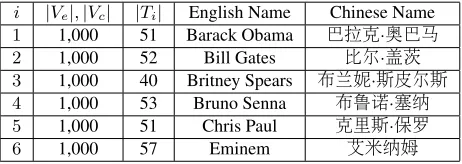
this procedure, we built six graph pairs from six dif-ferent seed pairs. In particular, the six seed nodes are English names and its corresponding Chinese names representing a wide range of occupation do-mains (e.g., ‘Barack Obama,’ ‘Bill Gates,’ ‘Britney Spears,’ ‘Bruno Senna,’ ‘Chris Paul,’ and ‘Eminem’) as Table 1 depicts. Meanwhile, though we demon-strate the effectiveness of the proposed method for mining name translations in Chinese and English languages, the method can be easily adapted to other language pairs.
Table 1: Summary for graphs and test datasets obtained from each seed pair
i |Ve|,|Vc| |Ti| English Name Chinese Name
1 1,000 51 Barack Obama ddd·ddd
2 1,000 52 Bill Gates dd·dd
3 1,000 40 Britney Spears ddd·dddd 4 1,000 53 Bruno Senna ddd·dd
5 1,000 51 Chris Paul ddd·dd
6 1,000 57 Eminem dddd
Second, we manually searched for about 50 “ground-truth” matched translations for each graph pair to build test datasetsTi, by randomly selecting
nodes within two hops7from the seed pair(se, sc),
since nodes outside two hops may include nodes whose neighbors are not fully crawled. More specif-ically, due to our crawling process expanding to add neighbors from the seed, the nodes close to the seed have all the neighbors they would have in the full graph, while those far from the node may not. In or-der to pick the nodes that well represent the actual
6
Note, this is just a default setting, which we later increase for scalability evaluation in Figure 6.
7
[image:6.612.313.544.414.496.2]neighbors, we built test datasets among those within two hops. However, this crawling is used for the evaluation sake only, and thus does not suggest the bias in our proposed framework. Table 1 describes the size of such test dataset for each graph pair.
Lastly, we set up the three parametersλ, θ, and
δ using 6-fold cross validation with 6 test datasets
Ti’s of the graphs. More specifically, for each
dataset Ti, we decide λi and θi such that average
MRR for the other 5 test datasets is maximized. (About MRR, see more details of Equation (4) in Section 4.2.) We then decide δi such that average
F1-score is maximized. Figure 4 shows the average MRR for λi and θi with default values θ = 0.66
andλ= 0.2. Based on these results, we setλi with
values{0.2,0.15,0.2,0.15,0.2,0.15}that optimize MRR in datasets T1, . . . T6, and similarly θi with
{0.67,0.65,0.67,0.67,0.65,0.67}. We also set δi
with values{0.63,0.63,0.61,0.61,0.61,0.61} opti-mizing F1-score with the same default values λ = 0.2 and θ = 0.66. We can observe the variances of optimal parameter setting values are low, which suggests the robustness of our framework.
4.2 Experimental Results
This section reports our experimental results using the evaluation datasets explained in previous sec-tion. For each graph pair, we evaluated the ef-fectiveness of (1) reinforcement model using MRR measure in Section 4.2.1 and (2) overall framework using precision, recall, and F1 measures in Sec-tion 4.2.2. We also validated (3) scalability of our framework over larger scale of graphs (with up to five thousand nodes) in Section 4.2.3. (In all experi-mental results,Bold numbersindicate the best per-formance for each metric.)
4.2.1 Effectiveness of reinforcement model
We evaluated the reinforcement model over MRR (Voorhees, 2001), the average of the recipro-cal ranks of the query results as the following for-mula:
MRR= 1
|Q|
∑
q∈Q 1
rankq
(4)
Each q is a ground-truth matched pair (u, v) such thatu∈Veandv∈Vc, andrankqis the rank of the
similarity score of Ruv among all Ruk’s such that
k ∈ Vc. Q is a set of such queries. By comparing
MRRs for two matricesR0andR∞, we can validate the effectiveness of the reinforcement model.
• Baseline matrix (R0): using only the translit-eration similarity score,i.e., without reinforce-ment
[image:7.612.325.524.210.343.2]• Reinforced matrix (R∞): using the reinforced similarity score obtained from Equation (3)
Table 2: MRR of baseline and reinforced matrices
Set MRR
BaselineR0 ReinforcedR∞
T1 0.6964 0.8377
T2 0.6213 0.7581
T3 0.7095 0.7989
T4 0.8159 0.8378
T5 0.6984 0.8158
T6 0.5982 0.8011
Average 0.6900 0.8082
We empirically observed that the iterative model converges within 5 iterations. In all experiments, we used 5 iterations for the reinforcement.
Table 2 summarizes our experimental results. As these figures show, MRR scores significantly in-crease after applying our reinforcement model ex-cept for the setT4 (on average from 69% to 81%), which indirectly shows the effectiveness of our rein-forcement model.
4.2.2 Effectiveness of overall framework
Based on the reinforced matrix, we evaluated the effectiveness of our overall matching framework using the following three measures–(1) precision: how accurately the method returns matching pairs, (2) recall: how many the method returns correct matching pairs, and (3) F1-score: the harmonic mean of precision and recall. We compared our ap-proach with a baseline, mapping two graphs with only transliteration similarity.
• Baseline: in matching extraction, using R0 as the similarity matrix by bypassing the rein-forcement step
0.1 0.15 0.2 0.25 0.3 0.77
0.78 0.79 0.8 0.81 0.82 0.83 0.84 0.85
λ(θ=0.66)
AVG(MRR)
λ1 λ2 λ3 λ4 λ5 λ6
0.61 0.63 0.65 0.67 0.69 0.74
0.76 0.78 0.8 0.82 0.84
θ (λ=0.2)
AVG(MRR)
θ1 θ2 θ3 θ4 θ5 θ6
0.57 0.59 0.61 0.63 0.65 0.68
0.69 0.7 0.71 0.72 0.73 0.74
δ(λ=0.2, θ=0.66)
AVG(F1−score)
[image:8.612.74.535.57.168.2]δ1 δ2 δ3 δ4 δ5 δ6
Figure 4: Parameter setup forλ,θ, andδ
In addition, we compared ours with the machine translators of Engkoo and Google. Table 3 summa-rizes our experimental results.
As this table shows, our approach results in the highest precision (about 80% on average) without compromising the best recall of Google, i.e., 61% of Google vs. 63% of ours. Overall, our approach outperforms others in all three measures.
[image:8.612.329.521.384.526.2]Meanwhile, in order to validate the translation ac-curacy over popular head and long-tail, as discussed in Section 1, we separated the test data into two groups and analyzed the effectiveness separately. Figure 5 plots the number of hits returned for the names from Google search engine. According to the distribution, we separate the test data into top-100 popular people with the highest hits and the remain-ing, denotedheadandtail, respectively.
0 50 100 150 200 250 300 350
104 105 106 107 108
Number of names
[image:8.612.80.282.476.597.2]Number of hits in Google
Figure 5: Distribution over number of hits
Table 4 shows the effectiveness with both datasets, respectively. As difference of the effective-ness between tail and head (denoteddiff) with re-spect to three measures shows, our approach shows stably high precision, for both heads and tails.
4.2.3 Scalability
To validate the scalability of our approach, we evaluated the effectiveness of our approach over the number of nodes in two graphs. We built larger six graph pairs (Ge, Gc) by expanding them from the
seed pairs further until the number of nodes reaches 5,000. Figure 6 shows the number of matched trans-lations according to such increase. Overall, the ber of matched pairs linearly increases as the num-ber of nodes increases, which suggests scalability. The ratio of node overlap in two graphs is about be-tween 7% and 9% of total node size.
1000 2000 3000 4000 5000 50
100 150 200 250 300 350
|Ve| and |Vc|
# matched translations
Figure 6: Matched translations over|Ve|and|Vc|
5 Conclusion
de-Table 3: Precision, Recall, and F1-score of Baseline, Engkoo, Google, and Ours over test setsTi
Set Precision Recall F1-score
Engkoo Google Baseline Ours Engkoo Google Baseline Ours Engkoo Google Baseline Ours T1 0.5263 0.4510 0.5263 0.8974 0.3922 0.4510 0.1961 0.6863 0.4494 0.4510 0.2857 0.7778
T2 0.7551 0.75 0.7143 0.8056 0.7115 0.75 0.2885 0.5577 0.7327 0.75 0.4110 0.6591
T3 0.5833 0.7925 0.5556 0.7949 0.5283 0.7925 0.1887 0.5849 0.5545 0.7925 0.2817 0.6739 T4 0.5 0.45 0.7368 0.7353 0.425 0.45 0.35 0.625 0.4595 0.45 0.4746 0.6757
T5 0.6111 0.3137 0.5 0.7234 0.4314 0.3137 0.1765 0.6667 0.5057 0.3137 0.2609 0.6939
T6 0.5636 0.8947 0.6 0.8605 0.5438 0.8947 0.1053 0.6491 0.5536 0.8947 0.1791 0.74
[image:9.612.73.538.79.175.2]AVG 0.5899 0.6086 0.6055 0.8028 0.5054 0.6086 0.2175 0.6283 0.5426 0.6086 0.3155 0.7034
Table 4: Precision, Recall, and F1-score of Engkoo, Google, and Ours with head and tail datasets
Method Precision Recall F1-score
head tail diff head tail diff head tail diff
Engkoo 0.6082 0.5854 0.0229 0.59 0.4706 0.1194 0.5990 0.5217 0.0772
Google 0.75 0.5588 0.1912 0.75 0.5588 0.1912 0.75 0.5588 0.1912
Ours 0.8462 0.7812 0.0649 0.66 0.6127 0.0473 0.7416 0.6868 0.0548
veloped a graph alignment algorithm that iteratively reinforces the matching similarity exploiting rela-tional similarity and then extracts correct matches. Our evaluation results empirically validated the ac-curacy of our algorithm over real-life datasets, and showed the effectiveness on our proposed perspec-tive.
Acknowledgments
This work was supported by Microsoft Research Asia NLP theme funding and MKE (Ministry of Knowledge Economy), Korea, under the ITRC (In-formation Technology Research Center) support program supervised by the IITA (Institute for In-formation Technology Advancement) (IITA-2009-C1090-0902-0045).
References
Yaser Al-Onaizan and Kevin Knight. 2002.
Trans-lating Named Entities Using Monolingual and
Bilin-gual Resources. In Proceedings of the 40th Annual
Meeting on Association for Computational Linguistics (ACL’02), pages 400–408. Association for Computa-tional Linguistics.
Donghui Feng, Yajuan L¨u, and Ming Zhou. 2004.
A New Approach for English-Chinese Named
En-tity Alignment. InProceedings of the Conference on
Empirical Methods in Natural Language Processing (EMNLP’04), pages 372–379. Association for Com-putational Linguistics.
Pascale Fung and Lo Yuen Yee. 1998. An IR
Ap-proach for Translating New Words from
Nonparal-lel,Comparable Texts. InProceedings of the 17th
In-ternational Conference on Computational Linguistics (COLING’98), pages 414–420. Association for Com-putational Linguistics.
Long Jiang, Ming Zhou, Lee feng Chien, and Cheng Niu. 2007. Named Entity Translation with Web Mining and
Transliteration. InProceedings of the 20th
Interna-tional Joint Conference on Artificial Intelligence (IJ-CAI’07), pages 1629–1634. Morgan Kaufmann Pub-lishers Inc.
Long Jiang, Shiquan Yang, Ming Zhou, Xiaohua Liu, and Qingsheng Zhu. 2009. Mining Bilingual Data from
the Web with Adaptively Learnt Patterns. In
Proceed-ings of the 47th Annual Meeting of the Association for Computational Linguistics (ACL’09), pages 870–878. Association for Computational Linguistics.
Kevin Knight and Jonathan Graehl. 1998.
Ma-chine Transliteration. Computational Linguistics,
24(4):599–612.
Julian Kupiec. 1993. An Algorithm for finding Noun
Phrase Correspondences in Bilingual Corpora. In
Pro-ceedings of the 31th Annual Meeting of the Association for Computational Linguistics (ACL’93), pages 17–22. Association for Computational Linguistics.
Haizhou Li, Zhang Min, and Su Jian. 2004. A Joint Source-Channel Model for Machine Transliteration. InProceedings of the 42nd Annual Meeting on Associ-ation for ComputAssoci-ational Linguistics (ACL’04), pages 159–166. Association for Computational Linguistics. Dekang Lin, Shaojun Zhao, Benjamin Van Durme, and
[image:9.612.92.512.210.285.2]Transla-tions from the Web by Word Alignment. In Proceed-ings of the 46th Annual Meeting of the Association for Computational Linguistics (ACL’08), pages 994– 1002. Association for Computational Linguistics. Li Shao and Hwee Tou Ng. 2004. Mining New Word
Translations from Comparable Corpora. In
Proceed-ings of the 20th International Conference on Computa-tional Linguistics (COLING’04), pages 618–624. As-sociation for Computational Linguistics.
Ellen M. Voorhees. 2001. The trec question answering
track.Natural Language Engineering, 7(4):361–378.
Stephen Wan and Cornelia Maria Verspoor. 1998. Auto-matic English-Chinese Name Transliteration for
De-velopment of Multilingual Resources. In
Proceed-ings of the 17th International Conference on Compu-tational Linguistics (COLING’98), pages 1352–1356. Association for Computational Linguistics.
Douglas Brent West. 2000. Introduction to Graph