Proceedings of the 2019 Conference on Empirical Methods in Natural Language Processing and the 9th International Joint Conference on Natural Language Processing, pages 3830–3840,
3830
Leverage Lexical Knowledge for Chinese Named Entity Recognition via
Collaborative Graph Network
Dianbo Sui1,2, Yubo Chen1, Kang Liu1,2, Jun Zhao1,2, Shengping Liu3
1 National Laboratory of Pattern Recognition, Institute of Automation,
Chinese Academy of Sciences, Beijing, 100190, China
2 University of Chinese Academy of Sciences, Beijing, 100049, China 3Beijing Unisound Information Technology Co., Ltd, Beijing, 100028, China
{dianbo.sui, yubo.chen, kliu, jzhao}@nlpr.ia.ac.cn [email protected]
Abstract
The lack of word boundaries information has been seen as one of the main obstacles to develop a high performance Chinese named entity recognition (NER) system. Fortunate-ly, the automatically constructed lexicon con-tains rich word boundaries information and word semantic information. However, inte-grating lexical knowledge in Chinese NER tasks still faces challenges when it comes to self-matched lexical words as well as the near-est contextual lexical words. We present a Col-laborative Graph Network to solve these chal-lenges. Experiments on various datasets show that our model not only outperforms the state-of-the-art (SOTA) results, but also achieves a speed that is six to fifteen times faster than that of the SOTA model.1
1 Introduction
Named entity recognition (NER) aims to locate and classify certain occurrences of words or ex-pressions in unstructured text into predefined se-mantic categories such as the person names,
lo-cations, organizations, etc. NER is an
essen-tial pre-processing step for many natural language processing (NLP) applications, such as relation
extraction (Bunescu and Mooney, 2005),
even-t exeven-traceven-tion (Chen et al., 2015), question
answer-ing (Moll´a et al., 2006) etc. In English NER,
LSTM-CRF models (Lample et al.,2016;Ma and
Hovy, 2016;Chiu and Nichols, 2016; Liu et al.,
2018) leveraging word-level representations and
character-level representations achieve the state-of-the-art results.
In this paper, we focus on Chinese NER. Com-pared with English, Chinese has no obvious word boundaries. Since without word boundaries infor-mation, it is intuitive to use character information
1The code is available at https://github.com/
DianboWork/Graph4CNER
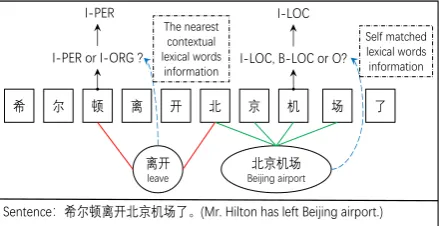
希 尔 顿 离 开 北 京 机 场
离开 leave
北京机场 Beijing airport I-PER or I-ORG ?
I-LOC The nearest
contextual lexical words information
Self matched lexical words information I-PER
I-LOC, B-LOC or O?
了
Sentence:希尔顿离开北京机场了。(Mr. Hilton has left Beijing airport.) Matched Lexical Words: 希尔(Hill), 希尔顿(Hilton), 离开(leave), 北京(Beijing),
[image:1.595.309.529.223.336.2]北京机场(Beijing Airport)
Figure 1: An example sentence integrating the near-est contextual lexical words (red line) and self-matched lexical words (green line)
only for Chinese NER (He and Wang, 2008;Liu
et al.,2010;Li et al.,2014), although such meth-ods could result in the disregard of word informa-tion. However, word information is very useful in Chinese NER, because word boundaries are usu-ally the same as named entity boundaries. For
ex-ample, as shown in Figure1, the boundaries of the
word “ ¬::” (Beijing airport) are the same as
the boundaries of the named entity “ ¬::”
(Beijing airport). Therefore, making full use of word information would help to improve the Chi-nese NER performance.
There are three main ways to incorporate word information in NER. The first one is the pipeline method. The way of pipeline method is to apply Chinese Word Segmentation (CWS) first, and then to use a word-based NER model. However, the pipeline method suffers from error propagation, s-ince the error of CWS may affect the performance of NER. The second one is to learn CWS and NER
tasks jointly (Xu et al., 2013; Peng and Dredze,
2016;Cao et al., 2018; Wu et al., 2019). How-ever, the joint models must rely on CWS annota-tion datasets, which are costly and are annotated
et al.,2017). The third one is to leverage an auto-matically constructed lexicon, which is pre-trained on large automatically segmented texts. Lexical knowledge includes boundaries and semantic in-formation. Boundaries information is provided by the lexicon word itself, and semantic information
is provided by pre-trained word embeddings (
Ben-gio et al.,2003;Mikolov et al.,2013). Compared with joint methods, a lexicon is easy to obtain and additional annotation CWS datasets are not
re-quired. Recently,Zhang and Yang(2018) propose
a lattice LSTM to integrate lexical knowledge in NER. However, integrating lexical knowledge in-to sentences still faces two challenges.
The first challenge is to integrate self-matched
lexical words. A self-matched lexical word of
a character is the lexical word that contains this
character. For instance, “ ¬::::” (Beijing
Air-port) and “::::” (Airport) are the self-matched
words of the character “:::” (airplane). “» ”
(leave) is not the self-matched word of the
char-acter “:” (airplane), since “:” (airplane) is not
contained in the word “» ” (leave). The lexical
knowledge of self-matched word is useful in
Chi-nese NER. For example, as shown in Figure1, the
boundaries and semantic knowledge of the
self-matched word “ ¬::” (Beijing Airport) can
help the character “:”(airplane) to predict an
“I-LOC” tag, instead of “O” or “B-“I-LOC” tags. How-ever, due to the limits of the word-character lattice,
the lattice LSTM (Zhang and Yang,2018) fails to
integrate the self-matched word “ ¬::”
(Bei-jing Airport) into the character “:” (airplane).
The second challenge is to integrate the nearest contextual lexical words directly. The nearest con-textual lexical word of a character is the word that matches the nearest past or future subsequence in the given sentence of this character. For instance,
the lexical word “» ” (leave) is the nearest
con-textual word of the character “•” (-ton), since
the word matches the nearest future subsequence
“» ” of the character, while “ ¬” (Beijing)
is not the nearest contextual lexical word of this character. The nearest contextual lexical words are beneficial for Chinese NER. For example, as
shown in Figure1, by directly using the semantic
knowledge of the nearest contextual words “» ”
(leave), an “I-PER” tag can be predicted instead
of an “I-ORG” tag, since “ •” (Hilton
Hotel-s) cannot be taken as the subject of the verb “»
” (leave). However, a lattice model (Zhang and
Yang, 2018) only implicitly integrate the
knowl-edge of the nearest contextual lexical words via the previous hidden state. The information of the nearest contextual lexical word may be disturbed by other information.
To solve the above challenges, we propose a character-based Collaborative Graph Network, in-cluding an encoding layer, a graph layer, a
fu-sion layer and a decoding layer. Specifically,
there are three word-character interactive graphs in the graph layer. The first one is the Contain-ing graph (C-graph), which is designed for inte-grating self-matched lexical words. It models the connection between characters and self-matched lexical words. The second one is the Transition graph (T-graph), which builds the direct connec-tion between characters and the nearest contextual matched words. It helps to handle the challenge of integrating the nearest contextual words direct-ly. The third one is the Lattice graph (L-graph),
which is inspired by the lattice LSTM (Zhang and
Yang,2018). L-graph captures partial information
of self-matched lexical words and the nearest con-textual lexical words implicitly by multiple hops. These graphs are built without external NLP tools, which can avoid error propagation problem. Be-sides, these graphs complement each other nicely and a fusion layer is designed for collaboration be-tween these graphs.
We test our model with various Chinese NER datasets. our model not only significantly outper-forms the existing state-of-the-art (SOTA) model but also is six to fifteen times faster than the speed of the SOTA model.
In summary, our main contributions are as fol-lows:
• We propose a Collaborative Graph Network
to integrate lexical knowledge directly and efficiently for Chinese NER.
• To solve the challenges of integrating
self-matched lexical words and the nearest con-textual lexical words, we propose three
word-character interactive graphs. These
inter-active graphs can capture different lexical knowledge and are built without external NLP tools.
• We achieve the state-of-the-art results in
2 Related Work
NER. There is rich literature on NER. This
in-cludes statistic methods, such as SVM (Isozaki
and Kazawa, 2002), HMMs (Bikel et al., 1997)
and CRF (Lafferty et al., 2001), suffering from
feature engineering. There are also a number of recent neural network approaches applied to NER,
such as (Collobert et al.,2011;Huang et al.,2015;
Lample et al., 2016; Ma and Hovy, 2016; Chiu and Nichols,2016;Liu et al., 2018;Akbik et al.,
2018;Jie et al.,2019;Akbik et al.,2019). Com-pared with English, Chinese is not featured with obvious word boundaries, but it is important to leverage word boundaries and semantic informa-tion in Chinese NER. Many works use word seg-mentation information as extra features for
Chi-nese NER, such as (Peng and Dredze, 2015;He
and Sun,2017a;Zhu and Wang,2019). Peng and Dredze (2016), Cao et al. (2018) and Wu et al.
(2019) propose joint models to train NER together
with CWS. Our work is inspired by lattice LST-M (Zhang and Yang, 2018), which can integrate lexicon in NER.
Graph convolutional networks. There are a number of recent graph convolutional network
(GCN) architectures (Kipf and Welling, 2017;
Hamilton et al.,2017;Veliˇckovi´c et al.,2018;Qu et al., 2019) for learning over graphs. Our work is closely related to the graph attention
network-s (GAT), introduced by Veliˇckovi´c et al. (2018),
leveraging masked self-attention layers to assign different importance to neighbouring nodes. In re-cent years, there is more and more literature about
the application of GCN in NLP (Bastings et al.,
2017;Marcheggiani and Titov,2017;Zhang et al.,
2018;Yao et al.,2019;Wang et al.,2018;Mishra et al.,2019;Cao et al.,2019;Zhang et al.,2019).
Cetoli et al.(2017) use GCN to investigate the role of the dependency tree in English named entity
recognition. However, most of the works (
Bast-ings et al., 2017; Marcheggiani and Titov, 2017;
Cetoli et al.,2017;Zhang et al.,2018) heavily re-ly on the dependency tree to construct a single graph, which suffer from error propagation. To capture different semantic and boundaries infor-mation, we propose a Collaborative Graph Net-work consisting of three automatically constructed graphs, which can avoid error propagation
prob-lem naturally. To our best knowledge, we are
the first to introduce GAT and automatically con-structed semantic graphs to Chinese NER tasks.
3 Approach
In this section, we first introduce the construction of graphs to integrate self-matched lexical words and the nearest contextual lexical words into sen-tences. We then introduce the architecture of Col-laborative Graph Network as a core for solving Chinese NER tasks.
3.1 The Construction of Graphs
To integrate self-matched lexical words and the n-earest contextual lexical words, we propose three
word-character interactive graphs. The first is
the word-character Containing graph (C-graph), which is to assist the character to capture the boundaries and semantic information of self-matched lexical words. The second is the word-character Transition graph (T-graph). The func-tion of T-graph is to assist the character to capture the semantic information of the nearest contextu-al lexiccontextu-al words. The third is the Lattice graph
(L-graph). Zhang and Yang(2018) propose a
lat-tice structure, nested in the LSTM (Hochreiter and
Schmidhuber, 1997), to integrate lexical knowl-edge. We free the lattice structure from the LSTM and adopt it as the third graph.
These three graphs share the same vertex set, but the edge sets of the three graphs are completely different. The vertex set is made up of the charac-ters in the sentence and the matched lexical words,
for example, as shown in Figure1, the vertex set is
V={ , ,..., †, , •, ..., ¬::}.
To represent the edge set, adjacency matrix needs to be introduced. The elements of the adjacency matrix indicate whether pairs of vertices are adja-cent or not in the graph. Since the edge sets of the three graphs are totally different, the adjacen-cy matrices of these three graphs are introduced below:
希 尔 顿 离 开 休 斯 顿 机 场
休斯顿机场
Houston airport
休斯顿
Houston
机场
Airport
希尔顿
Hilton
了
离开
leave
希尔
[image:3.595.308.527.614.721.2]Hill
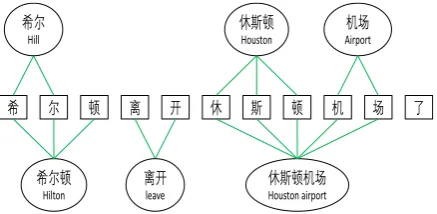
Word-Character Containing graph
With the C-graph, the characters in the sentence can capture the boundaries and semantic informa-tion of self-matched lexical words. As shown in
Figure2, if a lexical wordicontains a characterj,
the (i, j)-entry of the C-graph corresponding
ad-jacency matrixAC will be assigned a value of 1.
希 尔 顿 离 开 休 斯 顿 机 场
休斯顿机场 Houston airport 休斯顿
Houston
机场 Airport
希尔顿 Hilton
了
离开 leave 希尔
[image:4.595.73.290.183.296.2]Hill
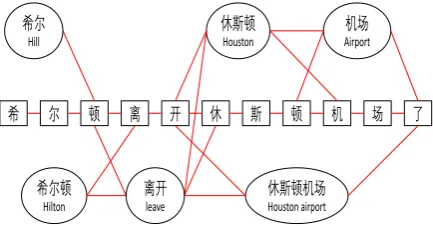
Figure 3: Word-Character Transition graph
Word-Character Transition graph
The T-graph is to assist the character to capture the semantic information of the nearest contextual
lexical words. As shown in Figure 3, if a
lexi-cal word ior a character m matches the nearest
preceding or following subsequence of a character
j, the(i, j) or(m, j)-entry of the T-graph
corre-sponding adjacency matrixAT will be assigned a
value of 1. Moreover, for capturing the contex-t relacontex-tion becontex-tween lexical words, if a lexical word
iis the preceding or following context of another
lexical word k, we will assign“ATik = 1”. Note
that the T-graph is the same with the word cutting graph which is used in Chinese Word Segmenta-tion.
希 尔 顿 离 开 休 斯 顿 机 场
休斯顿机场
Houston airport
休斯顿
Houston
机场
Airport
希尔顿
Hilton
了
离开
leave
希尔
[image:4.595.73.296.563.662.2]Hill
Figure 4: Word-Character Lattice graph
Word-Character Lattice graph
Zhang and Yang(2018) propose a lattice structure LSTM to exploit lexical knowledge for Chinese N-ER. A lattice structure can capture the information
of the nearest contextual lexical words implicitly and capture some information of self-matched
lex-ical words. As shown in Figure4, if a characterm
is the nearest preceding or following character of
a characterj, the(m, j)-entry of the L-graph
cor-responding adjacency matrixALwill be assigned
a value of 1. Moreover, if a character j matches
the lexical wordifirst character or end character,
we will assign“ALij = 1”.
3.2 Model
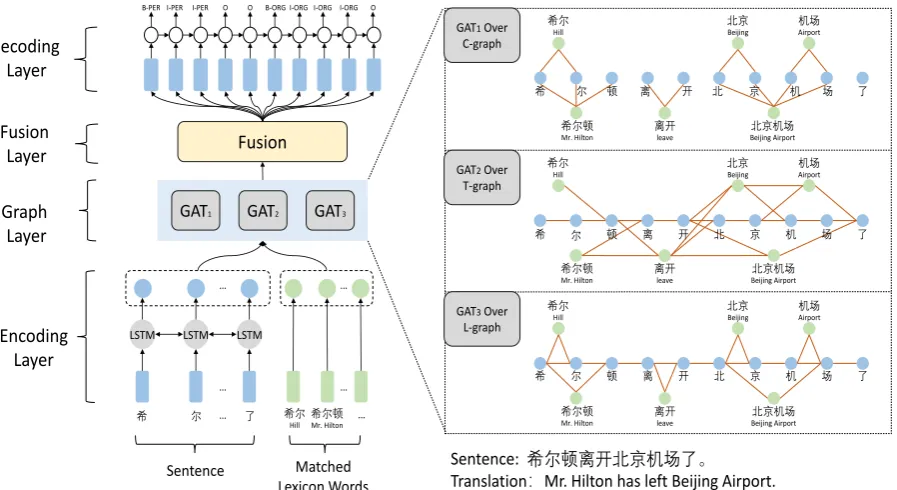
A character-based Collaborative Graph Network includes an encoding layer, a graph layer, a fu-sion layer, and a decoding layer. The encoding layer is to capture contextual information of the sentence and to represent the semantic information of lexical words. The graph layer is based on GAT (Veliˇckovi´c et al., 2018) for modeling over three word-character interactive graphs. A fusion lay-er is used for fusing difflay-erent lexical knowledge captured by these three graphs. Finally, a standard
CRF (Lafferty et al.,2001) model is used for
de-coding labels.
Encoding
The input of the model is a sentence and all lex-ical words that match consecutive subsequences
of the sentence. We denote the sentence as
s = {c1, c2, ..., cn}, where ci is the i-th
char-acter, and denote the matched lexical words as
l={l1, l2, ..., lm}. By looking up the embedding
vector from a pre-train character embedding
ma-trix, each character ci is represented as a vector,
which denotes asxi.
xi =ec(ci) (1)
ecis a character embedding lookup table.
To capture contextual information, A
bidirec-tional LSTM (Hochreiter and Schmidhuber,1997)
is applied to {x1, x2, ..., xn}. By
concatenat-ing the left-to-right and right-to-left LSTM hid-den states, we obtain the contextual representation
H={h1,h2, ...,hn}.
~hi =−−−−→LST M(xi, ~hi−1) (2)
~
hi =
←−−−−
LST M(xi, ~hi+1) (3)
hi=~hi⊕hi~ (4)
GAT1 GAT2 GAT3 Fusion
希 开 北 京 机 场
希尔 Hill
希尔顿 Mr. Hilton
离开 leave
北京机场 Beijing Airport
机场 Airport
尔 顿 离 了
北京 Beijing
希尔顿 Mr. Hilton
希 开 北 京 机 场
希尔 Hill
希尔顿 Mr. Hilton
离开 leave
北京机场 Beijing Airport
机场 Airport
尔 顿 离 了
北京 Beijing
GAT2Over T-graph
GAT3Over L-graph GAT1Over
C-graph
希 开 北 京 机 场
希尔 Hill
希尔顿 Mr. Hilton
离开 leave
北京机场 Beijing Airport
机场 Airport
尔 顿 离 了
北京 Beijing
LSTM LSTM LSTM Fusion
Layer
Sentence
Graph Layer Decoding
Layer
希 … 了 希尔
Hill … Encoding
Layer
Matched Lexicon Words 尔
B-PER I-PER I-PER O O B-ORGI-ORGI-ORG I-ORG O
Sentence: 希尔顿离开北京机场了。
Translation:Mr. Hilton has left Beijing Airport.
… …
[image:5.595.78.527.61.306.2]… …
Figure 5: Main architecture of a Collaborative Graph Network for integrating lexical knowledge in Chinese NER. The left side shows the overall architecture, including an encoding layer, a graph layer, a fusion layer, and a decoding layer. On the right side, we show the details of graph attention networks over three word-character interactive graphs. We use blue to denote the characters in the sentence and use green to denote the matched lexicon words.
pre-train word embedding matrix, and each
lexi-cal words li is represented as a semantic vector,
which denotes aswvi.
wvi =ew(li) (5)
ewis a word embedding lookup table. We
concate-nate the contextual representation and the word embeddings as the output of this layer, denoting
it asNodef.
Nodef = [h1,h2, ...,hn,wv1,wv2, ...,wvm] (6)
Graph Attention Networks over Word-Character Interactive Graphs
We use Graph Attention Networks (GAT) to mod-el over three interactive graphs. In an M-layer
GAT, the input of j-th layer is a set of node
fea-tures,NFj ={f1,f2, ...,fN}, together with an
ad-jacency matrixA, fi ∈ RF, A ∈ RN×N, where
N denotes the number of the nodes and F is the
the dimension of features atj-th layer. The
out-put of j-th layer is a new set of node features,
NF(j+1)={f01,f02, ...,f0N}. A GAT operation with
K independent attention head can be written as :
f0i=
K
k
k=1
σ( Σ
j∈Ni
αkijWkfj) (7)
αkij = exp(LeakyReLU(a
T[Wkf
ikWKfj]))
Σk∈Niexp(LeakyReLU(aT[W
kf
ikWKfk]))
(8)
where k denotes concatenation operation, σ is a
nonlinear activation function,Niis the
neighbor-hood of nodeiin the graph, αkij are the attention
coefficients, Wk ∈ RF0×F
, and a ∈ R2F0
is a single-layer feed-forward neural network. Note
that, the dimension of the output f0i is KF0. At
the last layer, averaging will be adopted, and the
dimension of final output features isF0.
ff inali =σ(1
K
K
Σ
k=1j∈ΣNi
αkijWkfj) (9)
To model three totally different word-character interactive graphs, We build three independen-t graph aindependen-tindependen-tenindependen-tion neindependen-tworks, which are denoindependen-ted as
GAT1, GAT2, and GAT3. Since three
word-character interactive graphs share the same vertex set, the input node features of all GAT are matrix
Nodef, which is shown in Equation6. The output
node features are denoted asG1,G2andG3,
G1 =GAT1(Nodef, AC) (10)
G2 =GAT2(Nodef, AT) (11)
Extra Resource Models Named Entity Named Mention Overall P(%) R(%) F1(%) P(%) R(%) F1(%) F1(%) Automatic word seg Peng and Dredze(2015) 74.78 39.81 51.96 71.92 53.03 61.05 56.05 Word Seg Data Peng and Dredze(2016) 66.67 47.22 55.28 74.48 54.55 62.97 58.99 Automatic word seg He and Sun(2017a) 66.93 40.67 50.60 66.46 53.57 59.32 54.82 Other data He and Sun(2017b) 61.68 48.82 54.50 74.13 53.54 62.17 58.32 Word Seg Data Cao et al.(2018) 59.51 50.00 54.43 71.43 47.90 57.53 58.70 Automatic word seg Zhu and Wang(2019) - - 55.38 - - 62.98 59.31 Lexicon Zhang and Yang(2018) - - 53.04 - - 62.25 58.79 Lexicon Ours 67.31 48.61 56.45 75.15 62.63 68.32 63.09
Table 1: Main results on Weibo NER
whereGk ∈ RF
0×(n+m)
,k ∈ {1,2,3}. We keep
the firstncolumns of these matrices and discard
the lastmcolumns, because only character
repre-sentations are used to decode labels.
Qk =Gk[ :,0 :n], k∈ {1,2,3} (13)
Fusion Layer
A fusion layer is used to fuse different lexical knowledge captured by word-character interactive graphs. The input of the fusion layer is the
contex-tual representation Hand the output of the graph
layerQi,i∈ {1,2,3}. The equation of the fusion
layer is introduced below:
R=W1H+W2Q1+W3Q2+W4Q3 (14)
whereW1, W2, W3 andW4 are trainable
matri-ces. Via a fusion layer, we obtain a matrix R,
R ∈ RF 0×n
, which is a new sentence representa-tion integrating the contextual informarepresenta-tion as well as the lexical knowledge of self-matched lexical words and the nearest contextual lexical words.
Decoding and Training
We use a standard CRF (Lafferty et al.,2001)
lay-er to capture the dependencies between successive
labels. Given a sentences = {c1, c2, ..., cn}, the
input of the CRF layer isR={r1,r2, ...,rn}, and
the probability of the ground-truth tag sequence
y={y1, y2, ..., yn}is
p(y|s) = exp(
P
i(Wyiri+T(yi−1,yi)))
P y0exp(
P i(Wy
0
iri+T
(y0i−1,yi0)))
(15)
Herey0is an arbitrary label sequence,Wyi is used
for modeling emission potential for thei-th
char-acter in the sentence, andT is the transition
ma-trix storing the score of transferring from one tag
to another. Viterbi algorithm (Viterbi, 1967) is
used to get the label sequence with the highest s-core. Given a manually annotated training data
Resource Models P(%) R(%) F1(%)
Che et al.(2013) 77.71 72.51 75.02
Wang et al.(2013) 76.43 72.32 74.32 Gold Seg Yang et al.(2016) 65.59 71.84 68.57
Yang et al.(2016) 72.98 80.15 76.40
Zhu and Wang(2019) 75.05 72.29 73.64
Lexicon Zhang and Yang(2018) 76.35 71.56 73.88 Ours 75.06 74.52 74.79
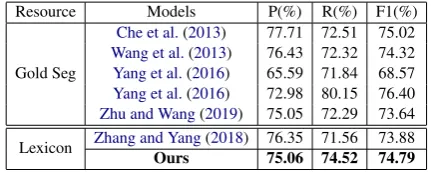
Table 2: Main results on OntoNotes. Gold seg means gold-standard segmentation, which is not available in the real world.
{(si, yi)}|Ni=1, we optimize the model by
minimiz-ing the negative log-likelihood loss withL2
regu-larization. The loss function is defined as:
L=−
N X
i=1
log(P(yi|si)) +
λ
2kΘk
2 (16)
whereλ denotes theL2 regularization parameter
andΘis the all trainable parameters set
4 Experiments
In this section, we carry out extensive experiments to investigate the effectiveness of the Collabora-tive Graph Network.
4.1 Datasets
We evaluate our model on Weibo NER (Peng and
Dredze, 2015; He and Sun, 2017a), OntoNotes 4 (Weischedel et al.,2011), and MSRA (Levow,
2006), where Weibo NER is in social domain,
OntoNotes and MSRA are in the news domain. On Weibo NER, we use the same training,
devel-opment and test split asPeng and Dredze (2015).
On OntoNotes, we use the same data split asChe
[image:6.595.309.525.215.302.2]Models P(%) R(%) F1(%)
Chen et al.(2006) 91.22 81.71 86.20
Zhang et al.(2006) 92.20 90.18 91.18
Zhou et al.(2013) 91.86 88.75 90.28
Lu et al.(2016) - - 87.94
Dong et al.(2016) 91.28 90.62 90.95
Cao et al.(2018) 91.73 89.58 90.64
Zhu and Wang(2019) 93.53 92.42 92.97
[image:7.595.96.269.60.167.2]Zhang and Yang(2018) 93.57 92.79 93.18 Ours 94.01 92.93 93.47
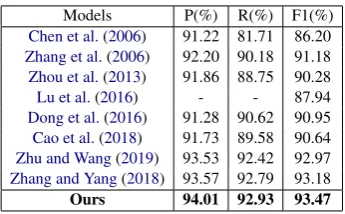
Table 3: Main results on MSRA
4.2 Experimental Settings
In our experiments, We use the same character
em-beddings asZhang and Yang(2018), which is
pre-trained on Chinese Giga-Word. We use the
lex-icon provided by Li et al. (2018), including 1.3
million Chinese words. We set the dimensionali-ty of LSTM hidden states to 300 and set the ini-tial learning rate to 0.001. Since the scale of each dataset varies, we set different training batch size for different datasets. Specifically, we set batch sizes of MSRA, OntoNotes and Weibo NER as 64, 20 and 10. We use stochastic gradient De-scent (SGD) algorithm to optimize parameters in
OntoNotes and WeiboNER, and use Adam (
King-ma and Ba,2014) algorithm to optimize parame-ters in MSRA. We stop the training when we find the best result in the development set.
4.3 Overall Performance
Weibo NER. Table 1 shows the results on
Wei-bo NER. Zhu and Wang (2019) propose a
Con-volutional Attention Network using segmentation information, which is the existing state-of-the-art
(SOTA) model. Our model outperforms SOTA
model by 3.78%, 1.07% and 5.34% in F1 score on Overall, Named Entity, and Nominal Mention.
Zhang and Yang (2018) propose a lattice LSTM to integrate lexical knowledge. Our model out-performs the lattice LSTM by 4.3%, 3.41% and 6.07% in F1 score on Overall, Named Entity, and Nominal Mention.
OntoNotes. Table 2 shows the results on
OntoNotes. Compared with lattice LSTM (Zhang
and Yang, 2018), Our model gains a 0.91% im-provement in F1 score. Compared with the best
re-sult (Yang et al.,2016), our model doesn’t rely on
gold-standard segmentation, which is not available in the real world. Note that our model even
outper-forms the model proposed by (Wang et al.,2013;
Yang et al.,2016;Zhu and Wang,2019), which us-es the information of gold-standard segmentation.
Dataset Ours(s) Lattice(s) Speedup MSRA 344 13723 ×15 Training OntoNotes 188 2561 ×13 Weibo NER 64 458 ×7
MSRA 52 344 ×6
[image:7.595.310.524.62.139.2]Testing OntoNotes 27.1 386 ×14 Weibo NER 2.2 23 ×10
Table 4: The performance of models in training and testing time. Time is measured in seconds. Lattice means the lattice LSTM (Zhang and Yang,2018).
MSRA. Results on the MSRA dataset are
shown in Table 3. By leveraging hand crafted
features (Chen et al., 2006; Zhang et al., 2006;
Zhou et al.,2013) and character embeddings (Lu et al., 2016), statistical models achieve good
re-sults on MSRA dataset. Dong et al.(2016)
inte-grate LSTM-CRF with radical features andZhang
and Yang(2018) propose a lattice LSTM to inte-grate lexical knowledge. Our model outperforms the lattice LSTM by 0.29% in F1 score on MSRA datasets.
Speed. As an essential preprocessing NLP tool, NER tasks require high speeds of both training and testing. Since aligning word-character lattice structure for batch training is usually non-trivial,
the lattice LSTM (Zhang and Yang,2018) suffers
from slow speeds in training and testing. Howev-er, both LSTM and GAT in our model can compute efficiently by batch training.
For fair comparison, both the lattice LSTM and
our model are implemented under PyTorch2. By
using a single NVIDIA GeForce GTX 1080 Ti G-PU, We randomly select 10 training and testing e-poch as samples. The average time of training and
testing is shown in Table4. Our model can achieve
a 6-15x speedup over the lattice LSTM.
4.4 Effectiveness of Three Word-Character Interactive Graphs
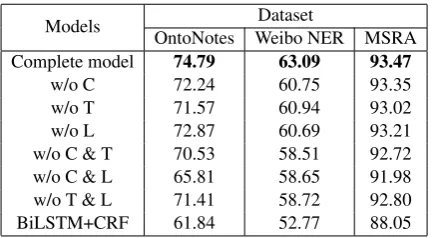
We conduct ablation experiments to demonstrate the effectiveness of these three word-character in-teractive graphs.
Comparison Setting. We design ablation stud-ies as follow: 1) w/o C: without word-character
Containing graph(C-graph). 2) w/o T: without
word-character Transition graph (T-graph). 3)
w/o L: without word-character Lattice graph (L-graph). 4)w/o C & T: without C-graph and T-graph, only keep L-graph. 5)w/o C & L : without C-graph and L-graph, only keep T-graph. 6) w/o
Case1
Sentence &&//@•‰5PÑ€'f:#é‰& //@Xidian University:#good morning&
Case2
Sentence ~¯TóTTencent and Lenovo jointly launched a computer cleaning day&Ñw5 å&
Matched lexical word
&•‰5PÑ€'f(XidianUniversity) •‰(Xi an)
5PÑ€'f(UESTC) ‰5(An Dian) 5PÑ€(Electronics Technology),
é‰(Good Morning)&
Matched lexical word
~¯(Tencent),Tó(Lenovo),T (Joint),
Ñw(Launch),5 (Computer), (Clean)& Sentence with
gold label
&// (O)@(O)•(B-ORG)‰(I-ORG)5(I-ORG)P(I-ORG)
Ñ(I-ORG)€(I-ORG)'(I-ORG)f(I-ORG):(O)#(O)é(O)‰(O)&
Sentence with gold label
~(B-ORG)¯(I-ORG)T(B-ORG)ó(I-ORG)T(O) (O)
Ñ(O)w(O)5(O) (O) (O) (O)å(O)& w/o C-graph
predicted label
&// (O)@(O)•(B-LOC)‰(I-LOC)5(B-ORG)P(I-ORG)
Ñ(I-ORG)€(I-ORG)'(I-ORG)f(I-ORG):(O)#(O)é(O)‰(O)&
w/o T-graph predicted label
~(B-ORG)¯(I-ORG)T(O)ó(O)T(O) (O)
Ñ(O)w(O)5(O) (O) (O) (O)å(O)& with C-graph
predicted label
&// (O)@(O)•(B-ORG)‰(I-ORG)5(I-ORG)P(I-ORG)
Ñ(I-ORG)€(I-ORG)'(I-ORG)f(I-ORG):(O)#(O)é(O)‰(O)&
with T-graph predicted label
~(B-ORG)¯(I-ORG)T(B-ORG)ó(I-ORG)T(O) (O)
[image:8.595.71.537.62.148.2]Ñ(O)w(O)5(O) (O) (O) (O)å(O)&
Table 6: Case study. w/o C-graph predicted label means without C-graph predicted label, and w/o T-graph predict-ed label means without T-graph prpredict-edictpredict-ed label. We use green to denote the correct labels and use rpredict-ed to denote the wrong labels.
Models Dataset
OntoNotes Weibo NER MSRA Complete model 74.79 63.09 93.47
w/o C 72.24 60.75 93.35 w/o T 71.57 60.94 93.02 w/o L 72.87 60.69 93.21 w/o C & T 70.53 58.51 92.72 w/o C & L 65.81 58.65 91.98 w/o T & L 71.41 58.72 92.80 BiLSTM+CRF 61.84 52.77 88.05
Table 5: Ablation study on reducing word-character in-teractive graphs, For example, ”w/o C” means remov-ing word-character containremov-ing graph from the complete model.
T & L : without T-graph and L-graph, only keep L-graph. 7) BiLSTM+CRF: baseline model.
Comparison Results. Table 5 shows the re-sults of ablation experiments. We can clearly see that removing any graph causes obvious perfor-mance degradation, but the importance of different graphs varies from dataset to dataset. Specifically, on OntoNotes and MSRA, ’w/o T-graph’ obtains worse performance than others, showing that T-graph is important. However, T-T-graph performs poorly without cooperating with other graphs. We guess that “T-graph” graph can only capture the information of the nearest contextual lexical word-s, and it is not enough to rely solely on T-graph. On Weibo NER, these graphs show equal impor-tance. Since dialects slangs and irregular phrases are very common in social domain, we must rely on C-graph, T-graph, and L-graph jointly to handle the informal and complex contexts. In conclusion, from ablation experiments, we can find that each graph can be implemented independent of the oth-er, but together they can achieve the best result, showing that all these three graphs are essential to our model.
5 Case Study
To show visually that our model can solve the challenges when integrating self-matched lexical words and the nearest contextual lexical words, a case study comparing without C-graph, without T-graph and the complete model is shown in Table
6. In the first case, there is an entity “•‰5PÑ
€'f”(Xidian University) with nested “•‰”
(Xi’an) and “ 5PÑ€'f” (UESTC). These
common entities are all in the lexicon. Without C-graph, the model can’t integrate the information of
the self-matched lexical word ‘•‰5PÑ€'
f” (Xidian University) into the characters “ 5”
and “‰”. Influenced by another lexical word “5
PÑ€'f” (UESTC), the predicted label of the
character “ 5” is “B-ORG”, and the label of the
character “‰” is predicted to be “I-ORG”, affect
by the lexical word “•‰” (Xi’an). In the second
case, there is an entity “Tó” (Lenovo), which
can also be a common verb (“Associate”) in Chi-nese. Without T-graph, the model can’t integrate the information of the nearest contextual lexical
words “ ~¯” (Tencent) and “T ” (Joint) into
the characters “ T” and “ ó”, so the predicted
labels of the characters “T” and “ó” are ”O”s.
However, with the help of T-graph, the model can use the information of the nearest contextual
lexi-cal words “~¯” (Tencent) and “T ” (Joint) to
predict the correct labels.
6 Conclusion
[image:8.595.75.292.212.331.2]Acknowledgments
This work is supported by the National Natu-ral Science Foundation of China (No.61533018), the Natural Key R&D Program of China (No.2017YFB1002101), the National Natural Sci-ence Foundation of China (No.61806201) and the independent research project of National Labo-ratory of Pattern Recognition. This work is al-so supported by the CCF-Tencent Open Research Fund. We thank the anonymous reviewers for their insightful comments. We also thank Xiangrong Zeng, Pengfei Cao and Yushan Xie for helpful comments and suggestions.
References
Alan Akbik, Tanja Bergmann, and Roland Vollgraf. 2019. Pooled contextualized embeddings for named entity recognition. InProceedings of the 2019 Con-ference of the North American Chapter of the Asso-ciation for Computational Linguistics: Human Lan-guage Technologies, Volume 1 (Long and Short Pa-pers), pages 724–728.
Alan Akbik, Duncan Blythe, and Roland Vollgraf. 2018. Contextual string embeddings for sequence labeling. In COLING 2018: The 27th Internation-al Conference on ComputationInternation-al Linguistics, pages 1638–1649.
Joost Bastings, Ivan Titov, Wilker Aziz, Diego Marcheggiani, and Khalil Simaan. 2017. Graph convolutional encoders for syntax-aware neural ma-chine translation. InProceedings of the 2017 Con-ference on Empirical Methods in Natural Language Processing, pages 1957–1967.
Yoshua Bengio, R´ejean Ducharme, Pascal Vincent, and Christian Jauvin. 2003. A neural probabilistic lan-guage model. Journal of machine learning research, 3(Feb):1137–1155.
Daniel M. Bikel, Scott Miller, Richard Schwartz, and Ralph Weischedel. 1997. Nymble: a high-performance learning name-finder. InFifth Confer-ence on Applied Natural Language Processing.
Razvan C Bunescu and Raymond J Mooney. 2005. A shortest path dependency kernel for relation extrac-tion. In Proceedings of the conference on human language technology and empirical methods in nat-ural language processing, pages 724–731.
Pengfei Cao, Yubo Chen, Kang Liu, Jun Zhao, and Shengping Liu. 2018. Adversarial transfer learn-ing for Chinese named entity recognition with self-attention mechanism. In Proceedings of the 2018 Conference on Empirical Methods in Natural Lan-guage Processing, pages 182–192.
Yu Cao, Meng Fang, and Dacheng Tao. 2019. BAG: Bi-directional attention entity graph convolutional network for multi-hop reasoning question answer-ing. In Proceedings of the 2019 Conference of the North American Chapter of the Association for Computational Linguistics: Human Language Tech-nologies, Volume 1 (Long and Short Papers), pages 357–362.
Alberto Cetoli, Stefano Bragaglia, Andrew O’Harney, and Marc Sloan. 2017. Graph convolutional net-works for named entity recognition. InProceedings of the 16th International Workshop on Treebanks and Linguistic Theories, pages 37–45.
Wanxiang Che, Mengqiu Wang, Christopher D. Man-ning, and Ting Liu. 2013. Named entity recogni-tion with bilingual constraints. InProceedings of the 2013 Conference of the North American Chapter of the Association for Computational Linguistics: Hu-man Language Technologies, pages 52–62.
Aitao Chen, Fuchun Peng, Roy Shan, and Gordon Sun. 2006. Chinese named entity recognition with con-ditional probabilistic models. InProceedings of the Fifth SIGHAN Workshop on Chinese Language Pro-cessing, pages 173–176.
Xinchi Chen, Zhan Shi, Xipeng Qiu, and Xuanjing Huang. 2017. Adversarial multi-criteria learning for Chinese word segmentation. InProceedings of the 55th Annual Meeting of the Association for Compu-tational Linguistics (Volume 1: Long Papers), pages 1193–1203.
Yubo Chen, Liheng Xu, Kang Liu, Daojian Zeng, and Jun Zhao. 2015. Event extraction via dy-namic multi-pooling convolutional neural network-s. InProceedings of the 53rd Annual Meeting of the Association for Computational Linguistics and the 7th International Joint Conference on Natural Lan-guage Processing (Volume 1: Long Papers), pages 167–176.
Jason PC Chiu and Eric Nichols. 2016. Named entity recognition with bidirectional lstm-cnns. Transac-tions of the Association for Computational Linguis-tics, 4:357–370.
Ronan Collobert, Jason Weston, L´eon Bottou, Michael Karlen, Koray Kavukcuoglu, and Pavel Kuksa. 2011. Natural language processing (almost) from scratch. Journal of machine learning research, 12(Aug):2493–2537.
Chuanhai Dong, Jiajun Zhang, Chengqing Zong, Masanori Hattori, and Hui Di. 2016. Character-based lstm-crf with radical-level features for chi-nese named entity recognition. InNatural Language Understanding and Intelligent Applications, pages 239–250.
Hangfeng He and Xu Sun. 2017a. F-score driven max margin neural network for named entity recognition in Chinese social media. InProceedings of the 15th Conference of the European Chapter of the Associa-tion for ComputaAssocia-tional Linguistics: Volume 2, Short Papers, pages 713–718.
Hangfeng He and Xu Sun. 2017b. A unified model for cross-domain and semi-supervised named entity recognition in chinese social media. InThirty-First AAAI Conference on Artificial Intelligence.
Jingzhou He and Houfeng Wang. 2008. Chinese named entity recognition and word segmentation based on character. In Proceedings of the Sixth SIGHAN Workshop on Chinese Language Process-ing.
Sepp Hochreiter and J¨urgen Schmidhuber. 1997. Long short-term memory. Neural computation, 9(8):1735–1780.
Zhiheng Huang, Wei Xu, and Kai Yu. 2015. Bidirec-tional lstm-crf models for sequence tagging. arXiv preprint arXiv:1508.01991.
Hideki Isozaki and Hideto Kazawa. 2002. Efficien-t supporEfficien-t vecEfficien-tor classifiers for named enEfficien-tiEfficien-ty recog-nition. In COLING 2002: The 19th International Conference on Computational Linguistics.
Zhanming Jie, Pengjun Xie, Wei Lu, Ruixue Ding, and Linlin Li. 2019. Better modeling of incomplete an-notations for named entity recognition. In Proceed-ings of the 2019 Conference of the North American Chapter of the Association for Computational Lin-guistics: Human Language Technologies, Volume 1 (Long and Short Papers), pages 729–734.
Diederik P Kingma and Jimmy Ba. 2014. Adam: A method for stochastic optimization. arXiv preprint arXiv:1412.6980.
Thomas N. Kipf and Max Welling. 2017. Semi-supervised classification with graph convolutional networks. InInternational Conference on Learning Representations (ICLR).
John D. Lafferty, Andrew McCallum, and Fernando C. N. Pereira. 2001. Conditional random fields: Probabilistic models for segmenting and labeling se-quence data. InProceedings of the Eighteenth In-ternational Conference on Machine Learning, pages 282–289.
Guillaume Lample, Miguel Ballesteros, Sandeep Sub-ramanian, Kazuya Kawakami, and Chris Dyer. 2016. Neural architectures for named entity recognition. InProceedings of the 2016 Conference of the North American Chapter of the Association for Computa-tional Linguistics: Human Language Technologies, pages 260–270.
Gina-Anne Levow. 2006. The third international chi-nese language processing bakeoff: Word segmen-tation and named entity recognition. In Proceed-ings of the Fifth SIGHAN Workshop on Chinese Lan-guage Processing, pages 108–117.
Haibo Li, Masato Hagiwara, Qi Li, and Heng Ji. Ji. 2014. Comparison of the impact of word segmenta-tion on name tagging for chinese and japanese. In LREC, page 2532¨C2536.
Shen Li, Zhe Zhao, Renfen Hu, Wensi Li, Tao Liu, and Xiaoyong Du. 2018. Analogical reasoning on chi-nese morphological and semantic relations. In Pro-ceedings of the 56th Annual Meeting of the Associa-tion for ComputaAssocia-tional Linguistics (Volume 2: Short Papers), pages 138–143.
Liyuan Liu, Jingbo Shang, Frank Xu, Xiang Ren, Jian Gui, Huan Peng, and Jiawei. Han. 2018. Empower sequence labeling with task-aware neural language model. InThirty-Second AAAI Conference on Arti-ficial Intelligence.
Zhangxun Liu, Conghui Zhu, and Tieju Zhao. 2010. Chinese named entity recognition with a sequence labeling approach: based on characters, or based on words? InAdvanced intelligent computing theories and applications. With aspects of artificial intelli-gence, page 634¨C640.
Yanan Lu, Yue Zhang, and Donghong Ji. 2016. Multi-prototype Chinese character embedding. In Pro-ceedings of the Tenth International Conference on Language Resources and Evaluation (LREC 2016), pages 855–859.
Xuezhe Ma and Eduard Hovy. 2016. End-to-end se-quence labeling via bi-directional lstm-cnns-crf. In Proceedings of the 54th Annual Meeting of the As-sociation for Computational Linguistics (Volume 1: Long Papers), pages 1064–1074.
Diego Marcheggiani and Ivan Titov. 2017. Encoding sentences with graph convolutional networks for se-mantic role labeling. In Proceedings of the 2017 Conference on Empirical Methods in Natural Lan-guage Processing, pages 1506–1515.
Tomas Mikolov, Ilya Sutskever, Kai Chen, Greg S Cor-rado, and Jeff Dean. 2013. Distributed representa-tions of words and phrases and their compositional-ity. InAdvances in neural information processing systems, pages 3111–3119.
Diego Moll´a, Menno van Zaanen, and Daniel Smith. 2006. Named entity recognition for question an-swering. In Proceedings of the Australasian Lan-guage Technology Workshop 2006, pages 51–58, Sydney, Australia.
Nanyun Peng and Mark Dredze. 2015. Named enti-ty recognition for Chinese social media with joint-ly trained embeddings. InProceedings of the 2015 Conference on Empirical Methods in Natural Lan-guage Processing, pages 548–554.
Nanyun Peng and Mark Dredze. 2016. Improving named entity recognition for Chinese social media with word segmentation representation learning. In Proceedings of the 54th Annual Meeting of the As-sociation for Computational Linguistics (Volume 2: Short Papers), pages 149–155.
Meng Qu, Yoshua Bengio, and Jian Tang. 2019. Gmn-n: Graph markov neural networks. In Internation-al Conference on Machine Learning, pages 5241– 5250.
Petar Veliˇckovi´c, Guillem Cucurull, Arantxa Casano-va, Adriana Romero, Pietro Li`o, and Yoshua Ben-gio. 2018. Graph Attention Networks. International Conference on Learning Representations.
Andrew Viterbi. 1967. Error bounds for convolutional codes and an asymptotically optimum decoding al-gorithm. IEEE transactions on Information Theory, 13(2):260–269.
Mengqiu Wang, Wanxiang Che, and Christopher D Manning. 2013. Effective bilingual constraints for semi-supervised learning of named entity recogniz-ers. In Twenty-Seventh AAAI Conference on Artifi-cial Intelligence.
Zhichun Wang, Qingsong Lv, Xiaohan Lan, and Yu Zhang. 2018. Cross-lingual knowledge graph alignment via graph convolutional networks. In Pro-ceedings of the 2018 Conference on Empirical Meth-ods in Natural Language Processing, pages 349– 357.
Ralph Weischedel, Sameer Pradhan, Lance Ramshaw, Martha Palmer, Nianwen Xue, Mitchell Marcus, An-n Taylor, Craig GreeAn-nberg, Eduard Hovy, Robert Belvin, et al. 2011. Ontonotes release 4.0. LD-C2011T03, Philadelphia, Penn.: Linguistic Data Consortium.
Fangzhao Wu, Junxin Liu, Chuhan Wu, Yongfeng Huang, and Xing Xie. 2019. Neural chinese named entity recognition via cnn-lstm-crf and joint training with word segmentation. In The World Wide Web Conference, WWW ’19, pages 3342–3348.
Yan Xu, Yining Wang, Tianren Liu, Jiahua Liu, Yubo Fan, Yi Qian, Junichi Tsujii, and Eric I Chang. 2013. Joint segmentation and named entity recognition us-ing dual decomposition in chinese discharge sum-maries. Journal of the American Medical Informat-ics Association, 21(e1):e84–e92.
Jie Yang, Zhiyang Teng, Meishan Zhang, and Yue Zhang. 2016. Combining discrete and neural fea-tures for sequence labeling. InInternational Con-ference on Intelligent Text Processing and Compu-tational Linguistics, pages 140–154.
Liang Yao, Chengsheng Mao, and Yuan Luo. 2019. Graph convolutional networks for text classification. InThirty-Third AAAI Conference on Artificial Intel-ligence.
Ningyu Zhang, Shumin Deng, Zhanlin Sun, Guany-ing Wang, Xi Chen, Wei Zhang, and Huajun Chen. 2019. Long-tail relation extraction via knowledge graph embeddings and graph convolution networks. InProceedings of the 2019 Conference of the North American Chapter of the Association for Computa-tional Linguistics: Human Language Technologies, Volume 1 (Long and Short Papers), pages 3016– 3025.
Suxiang Zhang, Ying Qin, Juan Wen, and Xiaojie Wang. 2006. Word segmentation and named entity recognition for sighan bakeoff3. InProceedings of the Fifth SIGHAN Workshop on Chinese Language Processing, pages 158–161.
Yue Zhang and Jie Yang. 2018. Chinese NER us-ing lattice LSTM. InProceedings of the 56th An-nual Meeting of the Association for Computational Linguistics (Volume 1: Long Papers), pages 1554– 1564.
Yuhao Zhang, Peng Qi, and Christopher D. Manning. 2018. Graph convolution over pruned dependency trees improves relation extraction. InProceedings of the 2018 Conference on Empirical Methods in Nat-ural Language Processing, pages 2205–2215.
Junsheng Zhou, Weiguang Qu, and Fen Zhang. 2013. Chinese named entity recognition via joint identifi-cation and categorization. Chinese journal of elec-tronics, 22(2):225–230.
Yuying Zhu and Guoxin Wang. 2019.