2000 Acta Structilia Vol 7 No 1
K Kusel
1, D Conradie
2 &D Holm
3The development of Web-enabled Knowledge
based {WBK) systems for the South African
conslrucfionindusby
Abstract
It is increasingly obvious that a significant proportion of international Architectural Engineering and Construction (AEC) industries are adopting Web-enabled Knowledge-based (WKB) Product Life Cycle Development (LCD) approaches to meet the needs of the global information economy. The WKB approach is fast becoming the new paradigm for designing client-orientated product development systems. This article examines the status quo of the Life Cycle Development (LCD) process in the construction industry, as well as new approaches, showing its principles, goals and benefits. It also introduces ORBIT, a WKB system, which provides a platform for the implementation of the new approaches and concludes with a presentation of a conceptual model of the system. Keywords: Web-enabled Knowledge-based Approach, Life Cycle Development (LCD) process, knowledge delivery, knowledge manipulation.
DIE ONTWIKKELING VAN WEB-TOEGANKLIKE KENNIS-GEBASEERDE SISTEME (WBK) VIR DIE SUID-AFRIKAANSE KONSTRUKSIE-BEDRYF Dit word toenemend duidelik dot 'n aansienlike gedeelte van die internasionale argiteks-, ingenieurs- en konstruksie-bedrywe (AEK), 'n Web ondersteunde Kennis-gebaseerde (WKG) stelselbenadering tot die Lewenssiklusontwikkeling (LSO) van produkte aanneem, ten einde die behoeftes van die wereld-informasie-era aan te spreek. 'n WGB benadering is vinnig besig om die nuwe paradigma te word vir die ontwerp van klient-georienteerde produkontwikkelingstelsels. Hierdie artikel ondersoek die huidige toestand van die lewenssiklus ontwikkelingsproses (LSO) in die bou- en konstruksie-bedrywe, asook die mikpunte en voordele wat die nuwe benaderings mag inhou. Die ORBIT stelsel word bekend gestel, wat 'n platform kan bied vir die implementering van die nuwe WKB-benadering. 'n Aanbieding van 'n konseptuele model van die ORBIT-sisteem word verder ook in oenskou geneem.
Sleutelwoorde: Webondersteunde kennis-gebaseerde stelselbenadering, lewenssiklusontwikkeling, ORBITstelsel.
Kirstin Kusel, B Arch (UP), Arch SA, Architect and Building Research Consultant: Division of Building and Construction Technology, Council for Scientific and Industrial Research, Pretoria. Web address: <[email protected]>
2 Dirk Conradie, M Arch (UP), Arch SA, Managing Director: Polygon Software Development CC, Pretoria. Web address: <[email protected]>
1. Introduction
The emergent global information economy and the customer's need for life cycle quality is increasing the complexity in the LCD process. Hence, two issues are important: Firstly, the ability to deliver relevant life cycle project information and knowledge to distributed planners, designers, builders and managers and secondly, the ability to retrieve, view, evaluate and adapt life cycle project design fragments on the desktop with a chosen application, regardless of time and location.
Several initiatives are under way in international AEC industries to generate guidance in process improvements and stimulate real cost improvements towards global competitiveness. Initiatives are usually a partnership between academic institutions and industrial sponsors. Developments in ISO standards on product development processes, suggest movements towards a generic global business process standard, based on system engineering principles, for life cycle product development in 2001 (Stephens, 1999: 354). New developments in Web technology are fast providing the new operational platform for such a standard and will enable integration and implementation of a global AEC industry.
2000 Acta Structilia Vol 7 No 1
the South African context. Such processes and systems should focus on empowering the various functional disciplines in a project with the ability to evaluate and address life cycle issues at an early stage in the project life cycle, regardless of time and location. This article examines the imperative within the context of a Web-enabled Knowledge-based (WKB) approach. Discussion will include the principles inherent in such an approach and a conceptual model of an implementation platform.
2.
Status quo on Life Cycle Development processes2.1 The development process in reality
The products of the construction industry (buildings, roads, bridges) are designed and custom-built to unique specifications and usually immovable. The facilities Life Cycle Development (LCD) process, also called the 'procurement process', was defined by the International Council for Building Research Studies and Documentation, Working Group, C1BW92 as: the "framework within which construction is brought about, acquired or obtained" or as the "acquisition of project resources for the realisation of a constructed facility" (Rawlinson, 1999: 34).
Construction projects involve several disciplines collaborating for relatively short periods of time in the various phases of the LCD process. Traditionally, facilities were developed using a sequential approach, where process steps are conceived as separate units with definite inputs and outputs, the process is compartmentalised and characterised by sub-optimal communication between team members. However, in reality, this approach fails when faced with the complexity of dispersed project teams, changing client expectations, e-commerce and emerging Information Technologies (IT), especially Web technologies. IT now facilitates concurrent development of facilities by a multi-disciplinary virtual team at a continuous 24 hour pace. As a result, many facilities development projects have for the past few years followed a Concurrent Engineering (CE) or fast-track process, where the design and construction phases are undert.aken simultaneously and briefing and design are considered a constituent part of the delivery process, although often not paid for.
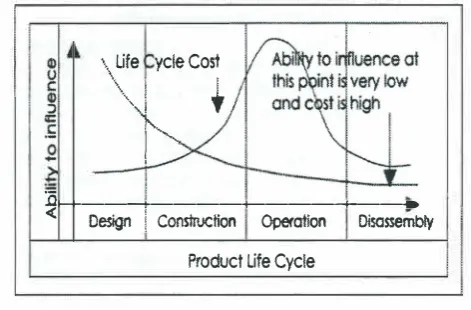
to CE are "simultaneous engineering", life cycle engineering, parallel engineering or the "multi-disciplinary team approach". CE aims to achieve more informed decisions upstream in the life cycle development process where costs are low and the ability to influence decisions is high (Sparrius, 1998) (Figure l ).
The CE process is further driven by the strategy of construction professionals to build long-term relationships with clients, which in turn leads to the integration of design, construction and facilities management activities into a seamless process.
\ Life ycle Cost
\·,,
II
I
'
l'"
:.Of--+----+,---+---+---•
<
Design I Construction Operation Disassembly
Product Life Cycle
Figure l : The ability to influence system characteristics (Sparrius 1998)
2.2 A lack of realistic process guidelines
[image:4.394.87.323.211.366.2]2000 Acta Structilia Vol 7 No l
3. A need for the introduction of new approaches
A recent study identified three key requirements for an
integrated and concurrent project environment in the South
African construction industry (Kusel, 2000). The requirements are
based on new LCD process approaches in international AEC
industries. These requirements may serve as a guideline to a
review of existing process guidelines.
3.1 Requirement 1: A collaboration strategy
The end-product in the construction industry is the result of
contributions by a range of specialised organisations, which
convene as a temporary multi-organisation to complete the
project. Construction professionals are now facing various
organisational procedures and processes on one project,
ambiguous objectives and constantly changing requirements.
Rawlinson and Mcdermott (1999: 36) describe two key problems:
Firstly, it makes the traditional "control and command paradigm
of project management" inefficient, causing methodologies
such as value management, which is concerned with "resolving
ambiguity by constructing a shared consensus of the project
objectives", to be introduced into construction projects in an
increasing degree. Secondly, it makes implementation of the
traditional fragmented procurement process very difficult,
resulting in methodologies such as CE and Systems Engineering
(SE) that allow simultaneous design, continuous inputs by the
various project members and integration between enterprise
objectives, project management and SE processes.
Team collaboration between project members should be
promoted in order to ensure qualitative processing of client
requirements, communication and co-operation between all
stakeholders involved with the LCD process. The practice of
partnering could facilitate this principle, which enables strategic
relationships and knowledge supply chains beyond a project-to
project basis, towards a more long-term arrangement. Allen
(1999) describes partnering as "a management approach (
EPSRC
IMI
practice
partnering
guidelines
http://
www.constructit.salford.ac.uk) to construction that places the
emphasis upon continuity and the development of long-term
non-adversarial relationships between all project members".
c«pabllily Dovelopmonl Proce:u
Allocoad 1'qoirtmen!J & c.,-., proposed agreement _wma ____________ _
Supplier
9)'1tom O.V.lopmonl Protest
Component OIYtlopmant Process
Upper-level customer processes
�ropOled d'lar•ctarl1tie, & 19reemu11
Lower-level supplier processes
Opetallonal SIIPl'Ofl S)'lloma
corasyswn
Components supplied
ln11t9rated 1ub-1ystem
"1he generic proc.,.. storis with o request �om a customer and responds by generating on ab,1raci solution (,ystem requremenls). ond an archilec!Ulal design. This enables the developer io negotiate with suppllen to determine lhe pradcoily ol the proposed design. With lhis informolion. the developer can negotlale lhe 09"'emenl with lhe customer and ,tort lo ;enerote the ag,eed system. The views the world from the per,pectlve of each separote development; It Is a system, engineering ,,;ew of the cvstomer-suppier relationship.
[image:6.395.67.352.87.417.2]The generic process if 'contexl-independenr and apples at the overall sy,tem level and al oU lower ktvel sub-tys:tem development levels. In each context. ii hos o!'le c1..1stomer and mony supplier levels. The customer process trigger1 the p,ocess into exidenc:e; the supplier fnterfoceJ ore developed as wori:. procl!eds. The proceu can be oppl!ed repeated;.,, to define the overall development process'' [Stephens et al. t 999:206).
2000 Acta Structilia Vol 7 No l
procedures and processes through resource exchange and an adherence to agreed strategy" and describes strategic partnering as the "key to innovation". He summarises six benefits:
• Improved contractual situation
• Improved communication and information flow • Increased understanding
• Improved efficiency of resources • Improved financial situation
• Improved quality.
3.2 Requirement 2: Integrated process management
Systems engineering refers to creating effective solutions to problems and managing the technical complexity of the resultant developments. At the outset it is a creative activity, defining the requirements and the product to be built (Stephens, 1999: 5)
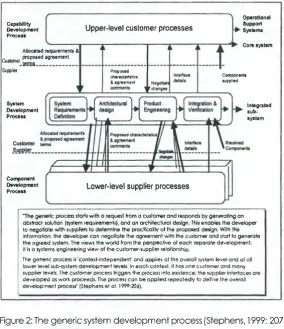
Pressure is exerted on companies to compete globally and they are driven by an increasing need for the ability to handle complexity. SE (http://www.incose.org) is a key technology for managing this complexity. The SE process (Figure 2) aims to achieve 'time to market with the right product', where right means what users really want, affordable and produced ahead of competitors.
project manager, whose task it is to ensure that everything is done, but not necessarily to do it.
The systems engineer must understand technical issues, translates them into user needs and negotiate with the project manager regarding the schedule and cost impacts. Stephens (1999: 7) mention that project management without system engineering is meaningless: "Successful management requires trade-offs between variables such as cost, schedule, quality and performance. These tasks cannot be meaningful without the information produced by systems engineering. Because time and resources are easy to measure, management sometimes attempt to control projects without the key element of requirements. What use is meeting cost and budget targets without producing a useful product?"
Stephens ( 1999) proposes a multi-level approach to ensure consistency of requirements, design, costs, schedule and risks. He describes a generic system development process (Figure 2), which, when applied recursively and concurrently, describes the entire development. He also describes the results of this realistic system development approach as:
• Feedback from design before commitment to requirements
• Concurrent exploration of design options at many levels
• A multi-level recursive structuring of the system into separate developments
• Additional engineering processes to cope with the inevitable changes at all times.
2000 Acta Structilia Vol 7 No 1
3.3 Requirement 3: Concurrent modelling and simulation When we mean to build,
we first survey the plot, then draw the model, and when we see the figure of the house, then must we rote the cost of erection;
Which if we do find outweighs ability What do we then but draw anew a model In fewer office, or at least desist to build at all?
(Bardolph Shakespeare, Henry IV, Part II, Act I)
A recent study of the requirements of a dispersed multidisciplinary project team within a Rl billion South African project indicated the primary need in the South African construction industry for a capability in what-if scenario modelling and simulation across the LCD process (Kusel, 2000). Due to increasing building costs, distributed project teams and the difficulty in grasping the holistic picture, it is becoming increasingly important for construction professionals to study and evaluate the effectiveness and emergent life cycle behavior of a facility, before actually constructing it and during the construction process if changes occur. This ability is specifically important for emerging economies with limited resources.
Modelling can be described as a representation of the behaviour of a system ( Roodt, 2000: 1). Axelrod (1997) describes simulation as the act of driving a model of a system with suitable inputs and observes the corresponding outputs. Concurrent Modelling and Simulation (CMS) can be described as the principle of multiple parties working simultaneously on projects through a standardised and structured LCD process allowing open information exchange, modelling and simulation of design solutions and prototypes. Modelling and Simulation (M&S) add value by improving the final operational capability through primarily changing the design information and clarifying the risk.
during a concurrent LCD process. Such an environment is described as a modularised project model, which is defined by Bjoerk ( 1999) as "a software representation of construction data, which supports the project throughout its life cycle".
The modularised model is capable of serving existing and future construction applications. In the modularised model design review and control are supported by full electronic traceability. Structured and hierarchical design information are linked to a relational database, where all actions, changes and decisions are stored for rapid retrieval in multi-media reports. The benefits of such an approach are that it ensures electronic traceability and integrity of all customer requirements and technical solutions throughout the facilities LCD process. It also facilitates the creation of an information model of the project, which supports successful decision-making.
2000 Acta Structilia Vol 7 No l
3.4 Extensible Markup Language (XML)
XML is a new Web language for describing information. An aecXML Working Group met in Dallas, Texas in September 1999 and five sub-committees were formed to lay the foundation for XML implementation in the construction industry. The group also works in tandem with the integration efforts of the International Standards Organization for the Exchange of Product Model Data (STEP) and the Alliance for Interoperability (IAI). The STEP aims to create an international standard for computer-based description and exchange of the physical and functional characteristics of products throughout their life cycle and the IAI aims to develop a mechanism for sharing information during design and construction throughout the life cycle of buildings. Extensible means authors can add their own self-defining tags to Web documents that identify information semantically and thus go beyond the relative primitive formatting, linking and display options offered by HTML.
Where HTML describes how data should be presented, XML describes the data itself. For example <INSULVAL> might tell the browser that the next section of bracketed text describes the insulating properties of a material (Cohen, 2000: 256). XML is seen as a key technology enabling open information exchange between systems that use different forms of data representation - a problem to date. A number of industries, for example the medical and newspaper publishing industries are using the technology to exchange information across platforms and applications (Cohen, 2000: 256). However, as Cohen (2000: 256) mentions, the key to successful application of XML in the AEC industry is to find a standardised AEC terminology. If XML is widely adopted, it will enable data sharing and e-commerce in the building and construction industry on a new scale. Internet delivered product data will be classified and delivered with life cycle performance data.
4. Knowledge-based d evelopment approaches
fragments on their desktops, using a chosen application, regardless
of time and location. WKB is important to the South African
construction industry as a tool to achieve global competitiveness,
customer satisfaction and life cycle quality in product development.
It can play a significant role in improving information delivery,
decision-making and knowledge management within a distributed
project environment.
4.2 ORBIT - A design knowledge delivery system
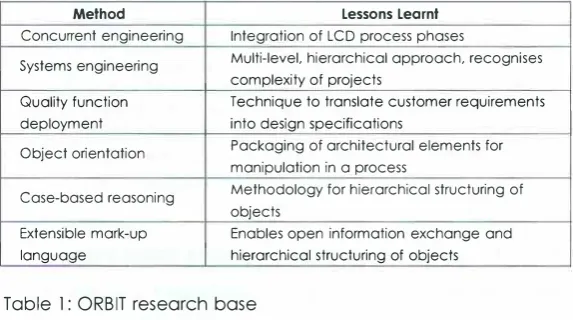
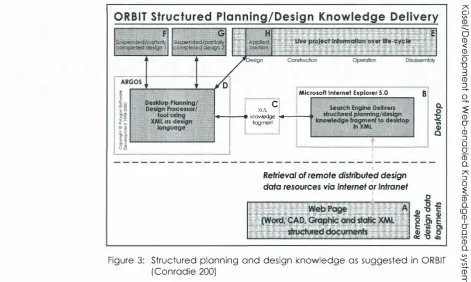
The ORBIT system (Figure 3) is a prototype WKB system. Analogous
to the way books are delivered to potential users from
Amazon.com. The system aims to deliver relevant design
knowledge to project team members and to facilitate the
secondary manipulation of relevant parts of the knowledge on
the desktop. The research that led to the systems' evolution
involved an extensive review of design philosophies, models,
methods and systems in both the architectural and
manufacturing field (Table l). It also involved the development
of a prototype system called AEDES (Architectural Evaluation
and Design System) (Conradie 2000) and innovative work on the
design of Web-enabled intelligent components for briefing and
design (Conradie, 2000).
Method Lessons Learnt
Concurrent engineering Integration of LCD process phases
Systems engineering Multi-level. hierarchical approach. recognises complexity of projects
Quality function Technique to translate customer requirements deployment into design specifications
Object orientation Packaging of architectural elements for
manipulation in a process
Case-based reasoning Methodology for hierarchical structuring of objects
Extensible mark-up Enables open information exchange and
[image:12.395.61.348.359.519.2]language hierarchical structuring of objects
Table l: ORBIT research base
2000 Acta Structilia Vol 7 No 1
carrier such as the Internet. Such knowledge standard has been identified in the World Wide Web consortium XML referred to previously. It must be stressed that although the conceptual model in Figure 3 is an oversimplified purist example, the following important principles are used:
• The designer remains in full control of the ultimate solution at all times
• Design experience is stored in a structured format
• Most information required in the planning and design environments are basically hierarchical and occur at various levels of specificity
• XML supports the inclusion of non-XML data and can act as
an integrator of diverse data sources
• XML supports distribution of data and hyper linking • XML supports multi-media data sources
• The system attempts to support design as a pragmatic and cognitive activity
• The solution assumes that planning and design require a continuum of design methods that use model-based, rule based and case-based reasoning. It is ultimately up to the designer to decide what method he prefers
• Current relational databases such as Oracle support the
generation of XML data from a relational query.
i C
Microsoft Internet Explorer 5.0
j X/v\L
--- knov,tadge
--+-
fragrrentRetrieval of remote distributed design data resources via Internet or Intranet
B
.::::::: 0 (D < (D
0
u
3
(D
�
S,
�
(D 0-1 (D :::J 0 0-CD Q.7" :::J 0
[image:14.676.138.610.60.342.2]2000 Acta Structilia Vol 7 No 1
6.
Conclusion
The status quo of facilities LCD processes in an information age context has been shown. The requirements of an integrated and concurrent project environment were discussed and new approaches to the LCD process introduced. The key principles and benefits of a WKB approach and a prototype WKB system, called ORBIT, were also discussed.
Key benefits to South African construction professionals include:
• An improved ability to evaluate and adapt LCD information throughout the LCD process, regardless of time and location
• An improved ability to provide customer value, by empowering professionals to model emerging life cycle behaviour before actual construction.
Potential barriers/disadvantages include:
• Any innovation meets with resistance, even if it is only the inertia of set procedures
• The change entails a considerable investment in training cost, which the industry may be hesitant to invest in a scenario of stop-go demand and the impact of AIDS
• Government departments in the building sector seem to have priorities other than efficiency and international competitiveness
• Commercial developers even work in the speculative market with tenuous linkages to end-users. In this case the 'voice of the customer' is very faint.
The South African construction industry, which includes all stakeholders at all levels, is afforded the opportunity to become
part of the global e-commerce AEC Industries. Although some
Bibliography
For further reading on 'competitiveness' visit the following Websites:
http://www.bath.ac.uk/departments/management/research/agile/ overview.htm
http://www.construct-it.salford.ac.uk http:/ /pp2.dct .salfod .ac.uk/overview.htm http://www.abdeakin.edu.au/agile/aghome.htm http://www.scpm.salford.ac.uk/cibw-65/SPICEproject.htm ALLEN, S.
1999. Partnering: A guideline for managing complex projects. Pretoria: Council for Scientific and Industrial Research.
ALLEN, S. & KOSEL, K.
1999. Effective delivery of construction projects: integrating supply chains for delivery of customer benefit and value for money. Proposal prepared for DACST Innovation Fund, Council for Scientific and Indus trial Research. Boutek. November.
AXELROD, R.
1997. Advancing the Art of Simulation in the Social Sciences: Obtaining, analysing and sharing results of computer models. Complexity, 3(2), pp. 16-22.
BJOERK, B.C.
1999. A Modularised Integrated Computer Environment for the Construction Industry. SPACE. Internet: http://itcon.org/l 999/3 l
COHEN, L.
1995. Quality function deployment: how to make QFD work for you. Reading, MA: Addison-Wesley.
COHEN, J.
2000. Communication and Design with the Internet: A Guide for Architects, Planners and Building Professionals. New York: WW Norton.
CONRADIE, D.C.U.
2000. The Use of Software Systems to Implement Case-Based
Reasoning Enabled Intelligent Components for Architectural Briefing
and Design. Dissertation presented for the Degree of Ph D (Applied Science) (Unpublished). University of Pretoria.
CONRADIE, D.C.U. & KOSEL, K.
2000 Acta Structilia Vol 7 No 1
2000. Development of ORBIT: a new generation building industry
Website. Proposal prepared for BOUTEK. Council for Scientific and
Industrial Research, Pretoria. EVBUOMWAN, N.F.O. & ANUMBA, C.J.
1996. Towards a Concurrent Engineering Model for Design-and-Build projects. The Structural Engineer, 74(5), pp. 73-78.
KOSEL, K.
2000. The Requirements of an integrated project environment in the South African construction industry. Dissertation presented for the
degree of MSc (Unpublished). University of Pretoria.
ROWLINSON, S. & McDERMOTI, P.
1999. Procurement systems: a guide to best practice in construction. London: E & F N Spon.
ROODT, J. & BASSON, M.
Modelling and simulation with specific reference to hardware-in-the loop testing. Version I: Internet: http://www.aoc.org.za
SPARRJUS, A.
1998. Specification practices. Course documentation. Ad Sparrius Systems Engineering and Management (Pty) Ltd, South Africa. June. STEPHENS, R. ET AL.