Unsupervised Information Extraction Approach Using Graph Mutual
Reinforcement
Hany Hassan Ahmed Hassan Ossama Emam
IBM Cairo Technology Development Center Giza, Egypt
P.O. Box 166 Al-Ahram
[email protected] [email protected] [email protected]
Abstract
Information Extraction (IE) is the task of extracting knowledge from unstructured text. We present a novel unsupervised approach for information extraction based on graph mutual reinforcement. The proposed approach does not require any seed patterns or examples. Instead, it depends on redundancy in large data sets and graph based mutual reinforcement to induce generalized “extraction patterns”. The proposed approach has been used to acquire extraction patterns for the ACE (Automatic Content Extraction) Relation Detection and Characterization (RDC) task. ACE RDC is considered a hard task in information extraction due to the ab-sence of large amounts of training data and inconsistencies in the available data. The proposed approach achieves superior performance which could be compared to supervised techniques with reasonable training data.
1 Introduction
In this paper we propose a novel, and completely unsupervised approach for information extrac-tion. We present a general technique; however we focus on relation extraction as an important task of Information Extraction. The approach depends on constructing generalized extraction patterns, which could match many instances, and deploys graph based mutual reinforcement to weight the importance of these patterns. The mu-tual reinforcement is used to automatically
iden-tify the most informative patterns, where patterns that match many instances tend to be correct. Similarly, instances matched by many patterns tend to be correct. The intuition is that large un-supervised data is redundant, i.e. different in-stances of information could be found many times in different contexts and by different repre-sentation. The problem can therefore be seen as hubs (instances) and authorities (patterns) prob-lem which can be solved using the Hypertext Induced Topic Selection (HITS) algorithm (Kleinberg, 1998).
HITS is an algorithmic formulation of the no-tion of authority in web pages link analysis, based on a relationship between a set of relevant “authoritative pages” and a set of “hub pages”. The HITS algorithm benefits from the following observation: when a page (hub) links to another page (authority), the former confers authority over the latter.
By analogy to the authoritative web pages problem, we could represent the patterns as au-thorities and instances as hubs, and use mutual reinforcement between patterns and instances to weight the most authoritative patterns. Highly weighted patterns are then used in extracting in-formation.
The proposed approach does not need any seeds or examples. Human involvement is only needed in determining the entities of interest; the entities among which we are seeking relations.
The paper proceeds as follows: in Section 2 we discuss previous work followed by a brief definition of our general notation in Section 3. A detailed description of the proposed approach then follows in Section 4. Section 5 discusses the application of the proposed approach to the
lem of detecting semantic relations from text. Section 6 discusses experimental results while the conclusion is presented in Section 7.
2 Previous Work
Most of the previous work on Information Ex-traction (IE) focused on supervised learning. Re-lation Detection and Characterization (RDC) was introduced in the Automatic Content Extraction Program (ACE) (ACE, 2004). The approaches proposed to the ACE RDC task such as kernel methods (Zelenko et al., 2002) and Maximum Entropy methods (Kambhatla, 2004) required the availability of large set of human annotated cor-pora which are tagged with relation instances. However human annotated instances are limited, expensive, and time consuming to obtain, due to the lack of experienced human annotators and the low inter-annotator agreements.
Some previous work adopted weakly super-vised or unsupersuper-vised learning approaches. These approaches have the advantage of not needing large tagged corpora but need seed ex-amples or seed extraction patterns. The major drawback of these approaches is their depend-ency on seed examples or seed patterns which may lead to limited generalization due to de-pendency on handcrafted examples. Some of these approaches are briefed here:
(Brin,98) presented an approach for extracting the authorship information as found in books de-scription on the World Wide Web. This tech-nique is based on dual iterative pattern relation extraction wherein a relation and pattern set is iteratively constructed. This approach has two major drawbacks: the use of handcrafted seed examples to extract more examples similar to these handcrafted seed examples and the use of a lexicon as the main source for extracting infor-mation.
(Blum and Mitchell, 1998) proposed an ap-proach based on co-training that uses unlabeled data in a particular setting. They exploit the fact that, for some problems, each example can be described by multiple representations.
(Riloff & Jones, 1999) presented the Meta-Bootstrapping algorithm that uses an un-annotated training data set and a set of seeds to learn a dictionary of extraction patterns and a domain specific semantic lexicon. Other works tried to exploit the duality of patterns and their extractions for the purpose of inferring the se-mantic class of words like (Thelen & Riloff, 2002) and (Lin et al, 2003).
(Muslea et al., 1999) introduced an inductive algorithm to generate extraction rules based on user labeled training examples. This approach suffers from the labeled data bottleneck.
(Agichtein et. al, 2000) presented an approach using seed examples to generate initial patterns and to iteratively obtain further patterns. Then ad-hoc measures were deployed to estimate the relevancy of the patterns that have been newly obtained. The major drawbacks of this approach are: its dependency on seed examples leads to limited capability of generalization, and the esti-mation of patterns relevancy requires the de-ployment of ad-hoc measures.
(Hasegawa et. al. 2004) introduced unsuper-vised approach for relation extraction depending on clustering context words between named enti-ties; this approach depends on ad-hoc context similarity between phrases in the context and focused on certain types of relations.
(Etzioni et al, 2005) proposed a system for building lists of named entities found on the web. Their system uses a set of eight domain-independent extraction patterns to generate can-didate facts.
All approaches, proposed so far, suffer from either requiring large amount of labeled data or the dependency on seed patterns (or examples) that result in limited generalization.
3 General Notation
In graph theory, a graph is a set of objects called vertices joined by links called edges. A bipartite graph, also called a bigraph, is a special graph where the set of vertices can be divided into two disjoint sets with no two vertices of the same set sharing an edge.
The Hypertext Induced Topic Selection (HITS) algorithm is an algorithm for rating, and therefore ranking, web pages. The HITS algo-rithm makes use of the following observation: when a page (hub) links to another page (author-ity), the former confers authority over the latter. HITS uses two values for each page, the "author-ity value" and the "hub value". "Author"author-ity value" and "hub value" are defined in terms of one an-other in a mutual recursion. An authority value is computed as the sum of the scaled hub values that point to that authority. A hub value is the sum of the scaled authority values of the authori-ties it points to.
over the given instances. An example template is:
GPE POS (PERSON)+
GPE: Geographical Political En-tity
POS: possessive ending PERSON: PERSON Entity
This template could match the sentence: “France’s President Jacque Chirac...”. This tem-plate is derived from the representation of the Named Entity tags, Part-of-Speech (POS) tags and semantic tags. The choice of the template representation here is for illustration purpose only; any combination of tags, representations and tagging styles might be used.
A pattern is more specific than a template. A pattern specifies the role played by the tags (first entity, second entity, or relation). An example of a pattern is:
GPE(E2) POS (PERSON)+(E1)
This pattern indicates that the word(s) with the tag GPE in the sentence represents the second en-tity (Entity 2) in the relation, while the word(s) tagged PERSON represents the first en-tity (Enen-tity 1) in this relation, the “+” symbol means that the (PERSON) entity is repetitive (i.e. may consist of several tokens).
A tuple, in our notation during this paper, is the result of the application of a pattern to un-structured text. In the above example, one result of applying the pattern to some raw text is the following tuple:
Entity 1: Jacque Chirac
Entity 2: France
Relation: EMP-Executive
4 The Approach
The unsupervised graph-based mutual rein-forcement approach, we propose, depends on the construction of generalized “extraction patterns” that could match many instances. The patterns are then weighted according to their importance by deploying graph based mutual reinforcement techniques. This duality in patterns and extracted information (tuples) could be stated that patterns could match different tuples, and tuples in turn could be matched by different patterns. The pro-posed approach is compro-posed of two main steps namely, initial patterns construction and pattern
weighting or induction. Both steps are detailed in the next sub-sections.
4.1 Initial Patterns Construction
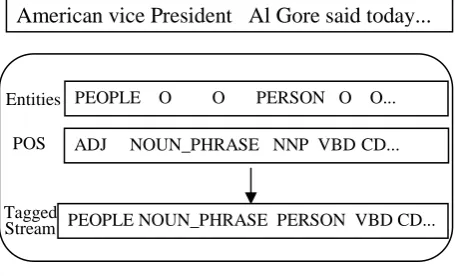
As shown in Figure 1, several syntactic, lexical, and semantic analyzers could be applied to the unstructured text. The resulting analyses could be employed in the construction of extraction pat-terns. It is worth mentioning that the proposed approach is general enough to accommodate any pattern design; the introduced pattern design is for illustration purposes only.
Initially, we need to start with some templates and patterns to proceed with the induction proc-ess. Relatively large amount of text data is tagged with different taggers to produce the pre-viously mentioned patterns styles. An n-gram language model is built on this data and used to construct weighted finite state machines.
Paths with low cost (high language model probabilities) are chosen to construct the initial set of templates; the intuition is that paths with low cost (high probability) are frequent and could represent potential candidate patterns.
The resulting initial set of templates is applied to a very large text data to produce all possible patterns. The number of candidate initial patterns could be reduced significantly by specifying the candidate types of entities; for example we might specify that the first entity could be PEROSN or PEOPLE while the second entity could be OR-GANIZATION, LOCATION, COUNTRY and etc...
The candidate patterns are then applied to the tagged stream and the unstructured text to collect a set of patterns and matched tuples pairs.
The following procedure briefs the Initial Pat-tern Construction Step:
• Select a random set of text data.
American vice President Al Gore said today...
PEOPLE O O PERSON O O...
ADJ NOUN_PHRASE NNP VBDCD...
PEOPLE NOUN_PHRASE PERSON VBD CD... Entities
POS
[image:3.595.307.535.237.375.2]Tagged Stream
• Apply various taggers on text data and con-struct templates style.
• Build n-gram language model on template style data.
• Construct weighted finite state machines from the n-gram language model.
• Choose n-best paths in the finite state ma-chines.
• Use best paths as initial templates. • Apply initial templates on large text data. • Construct initial patterns and associated
tu-ples sets.
4.2 Pattern Induction
The inherent duality in the patterns and tuples relation suggests that the problem could be inter-preted as a hub authority problem. This problem could be solved by applying the HITS algorithm to iteratively assign authority and hub scores to patterns and tuples respectively.
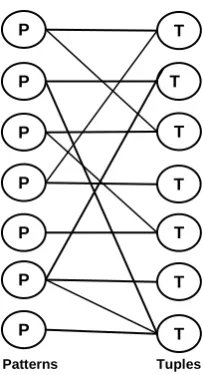
Patterns and tuples are represented by a bipar-tite graph as illustrated in figure 2. Each pattern or tuple is represented by a node in the graph. Edges represent matching between patterns and tuples. The pattern induction problem can be formulated as follows: Given a very large set of data D containing a large set of patterns P which match a large set of tuples T, the problem is to
identify P~, the set of patterns that match the set
of the most correct tuples T~. The intuition is
that the tuples matched by many different pat-terns tend to be correct and the patpat-terns matching many different tuples tend to be good patterns. In other words; we want to choose, among the large space of patterns in the data, the most informa-tive, highest confidence patterns that could iden-tify correct tuples; i.e. choosing the most “thoritative” patterns in analogy with the hub
au-thority problem. However, bothP~and T~are un-known. The induction process proceeds as fol-lows: each pattern p in P is associated with a numerical authority weight av which expresses
how many tuples match that pattern. Similarly, each tuple t in T has a numerical hub weight ht
which expresses how many patterns were matched by this tuple. The weights are calculated iteratively as follows:
( )
( )( )
=
+ = T p
u i
i i
H u h p
a
1 ()
) ( )
1 (
(1)
( )
( )( )
=
+ = P t
u i
i i
A u a t
h 1 ( )
) ( )
1 (
(2)
where T(p) is the set of tuples matched by p, P(t) is the set of patterns matching t, a(i+1)
( )
p is the authoritative weight of pattern p at iteration) 1
(i+ , and h(i+1)
( )
t is the hub weight of tuple t at iteration (i+1) . H(i) and A(i) are normaliza-tion factors defined as:( )
( )= =
= | |
1 1
) ( )
( P
p p T u
i i
u h
H (3)
( )
( )= =
=
| |1 1
) ( )
( T
v
t P
u i i
u
a
A
(4)Highly weighted patterns are identified and used for extracting relations.
4.3 Tuple Clustering
The tuple space should be reduced to allow more matching between pattern-tuple pairs. This space reduction could be accomplished by seeking a tuple similarity measure, and constructing a weighted undirected graph of tuples. Two tuples are linked with an edge if their similarity meas-ure exceeds a certain threshold. Graph clustering algorithms could be deployed to partition the graph into a set of homogeneous communities or clusters. To reduce the space of tuples, we seek a matching criterion that group similar tuples to-gether. Using WordNet, we can measure the se-mantic similarity or relatedness between a pair of concepts (or word senses), and by extension, be-tween a pair of sentences. We use the similarity P
P
P P
P
T
T
T T
T P
P
T
T
[image:4.595.126.228.374.562.2]Patterns Tuples
measure described in (Wu and Palmer, 1994) which finds the path length to the root node from the least common subsumer (LCS) of the two word senses which is the most specific word sense they share as an ancestor. The similarity score of two tuples, ST, is calculated as follows:
2 2 2
1 E
E
T S S
S = + (5)
where SE1, and SE2 are the similarity scores of the
first entities in the two tuples, and their second entitles respectively.
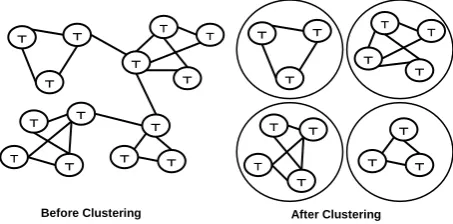
[image:5.595.71.298.485.597.2]The tuple matching procedure assigns a simi-larity measure to each pair of tuples in the data-set. Using this measure we can construct an undi-rected graph G. The vertices of G are the tuples. Two vertices are connected with an edge if the similarity measure between their underlying tu-ples exceeds a certain threshold. It was noticed that the constructed graph consists of a set of semi isolated groups as shown in figure 3. Those groups have a very large number of inter-group edges and meanwhile a rather small number of intra-group edges. This implies that using a graph clustering algorithm would eliminate those weak intra-group edges and produce separate groups or clusters representing similar tuples. We used Markov Cluster Algorithm (MCL) for graph clustering (Dongen, 2000). MCL is a fast and scalable unsupervised clustering algorithm for graphs based on simulation of stochastic flow.
Figure 3: Applying Clustering Algorithms to Tu-ple graph
An example of a couple of tuples that could be matched by this technique is:
United Stated(E2) presi-dent(E1)
US(E2) leader(E1)
A bipartite graph of patterns and tuple clusters is constructed. Weights are assigned to patterns and tuple clusters by iteratively applying the
HITS algorithm and the highly ranked patterns are then used for relation extraction.
5 Experimental Setup
5.1 ACE Relation Detection and Charac-terization
In this section, we describe Automatic Content Extraction (ACE). ACE is an evaluation con-ducted by NIST to measure Entity Detection and Tracking (EDT) and Relation Detection and Characterization (RDC). The EDT task is con-cerned with the detection of mentions of entities, and grouping them together by identifying their coreference. The RDC task detects relations be-tween entities identified by the EDT task. We choose the RDC task to show the performance of the graph based unsupervised approach we pro-pose. To this end we need to introduce the notion of mentions and entities. Mentions are any in-stances of textual references to objects like peo-ple, organizations, geopolitical entities (countries, cities …etc), locations, or facilities. On the other hand, entities are objects containing all mentions to the same object. Here, we present some exam-ples of ACE entities and relations:
Spain’s Interior Minister announced this evening the arrest of separatist organi-zation Eta’s presumed leader Ignacio Garcia Arregui. Ar-regui, who is considered to be the Eta organization’s top man, was arrested at 17h45 Greenwich. The Spanish judiciary suspects Arregui of ordering a failed attack on King Juan Carlos in 1995.
In this fragment, all the underlined phrases are mentions to “Eta” organization, or to “Garcia Arregui”. There is a management relation be-tween “leader” which references to “Gar-cia Arregui” and “Eta”.
5.2 Patterns Construction and Induction
We used the LDC English Gigaword Corpus, AFE source from January to August 1996 as a source for unstructured text. This provides a total of 99475 documents containing 36 M words. In the performed experiments, we focus on two types of relations EMP-ORG relations and GPE-AFF relations which represent almost 50% of all relations in RDC – ACE task.
T
T T
T T
T
T T
T T
T T
T T
T
T T
T T
T
T T
T T
T T
T T
POS (part of speech) tagger and mention tagger were applied to the data, the used pattern design consists of a mix between the part of speech (POS) tags and the mention tags for the words in the unsupervised data. We use the mention tag, if it exists; otherwise we use the part of speech tag. An example of the analyzed text and the pre-sumed associated pattern is shown:
Text: Eta’s presumed leader Arregui …
Pos: NNP POS JJ NN NNP Mention: ORG 0 0 0 PERSON Pattern: ORG(E2) POS JJ NN(R) PERSON(E1)
An n-gram language model, 5-gram model and back off to lower order n-grams, was built on the data tagged with the described patterns’ style. Weighted finite states machines were constructed with the language model probabilities. The n-best paths, 20 k paths, were identified and deployed as the initial template set. Sequences that do not contain the entities of interest, and hence cannot represent relations, were automatically filtered out. This resulted in an initial templates set of around 3000 element. This initial templates set was applied on the text data to establish initial patterns and tuples pairs. Graph based mutual reinforcement technique was deployed with 10 iterations on the patterns and tuples pairs to weight the patterns.
We conducted two groups of experiments, the first with simple syntactic tuple matching, and the second with semantic tuple clustering as de-scribed in section 4.3
6 Results and Discussion
We compare our results to a state-of-the-art su-pervised system similar to the system described in (Kambhatla, 2004). Although it is unfair to make a comparison between a supervised system and a completely unsupervised system, we chose to make this comparison to test the performance of the proposed unsupervised approach on a real task with defined test set and state-of-the-art per-formance. The supervised system was trained on 145 K words which contain 2368 instances of the two relation types we are considering.
The system performance is measured using precision, recall and F-Measure with various amounts of induced patterns. Table 1 presents the precision, recall and F-measure for the two rela-tions using the presented approach with the
utili-zation of different amount of highly weighted patterns. Table 2 presents the same results using semantic tuple matching and clustering, as de-scribed in section 4.3.
No. of
Patterns Precision Recall F-Measure
1500 35.9 66.3 46.58 1000 41.2 59.7 48.75 700 43.1 58.1 49.49
500 46 56.5 50.71
400 46.9 52.9 49.72 200 50.1 44.9 47.36
Table 1: The effect of varying the number of induced patterns on the system performance (syntactic tuple matching)
No. of
Patterns Precision Recall F-Measure
1500 36.1 67.2 46.97 1000 43.7 59.6 50.43 700 44.1 59.3 50.58 500 46.3 57.2 51.18
400 47.3 57.6 51.94
200 48.1 45.9 46.97
Table 2: The effect of varying the number of induced patterns on the system performance (se-mantic tuple matching)
0 10 20 30 40 50 60 70 80
Sup 67.1 54.2 59.96
Unsup-Syn 46 56.5 50.71
Unsup-Sem 47.3 57.6 51.94
[image:6.595.306.527.134.245.2]Precision Recall F Measure
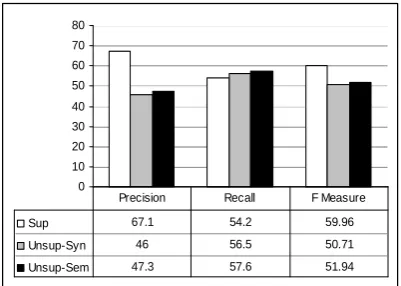
Figure 4: A comparison between the supervised system (Sup), the unsupervised system with syn-tactic tuple matching (Unsup-Syn), and with se-mantic tuple matching (Unsup-Sem)
Best F-Measure is achieved using relatively small number of induced patterns (400 and 500 patterns) while using more patterns increases the recall but degrades the precision.
[image:6.595.319.520.468.611.2]improve-ment; although better performance was achieved with less number of patterns (400 patterns). We think that the deployed similarity measure and it needs further investigation to figure out the rea-son for that.
Figure 4 presents the comparison between the proposed unsupervised systems and the reference supervised system. The unsupervised systems achieves good results even in comparison to a state-of-the-art supervised system.
Sample patterns and corresponding matching text are introduced in Table 3 and Table 4. Table 3 shows some highly ranked patterns while Table 4 shows examples of low ranked patterns.
Pattern Matches
GPE (PERSON)+ Peruvian President Alberto Fu-jimori
GPE (PERSON)+ Zimbabwean President Robert Mugabe
GPE (PERSON)+ PLO leader Yasser Arafat GPE POS (PERSON)+ Zimbabwe 's President Robert
Mugabe
GPE JJ PERSON American clinical neuropsy-chologist
GPE JJ PERSON American diplomatic personnel PERSON IN JJ GPE candidates for local government ORGANIZATION
PER-SON Airways spokesman
ORGANIZATION
PER-SON Ajax players
PERSON IN DT (OR-GANIZATION)+
chairman of the opposition par-ties
(ORGANIZATION)+
PERSON opposition parties chairmans
Table3: Examples of patterns with high weights
Pattern Matches GPE CC (PERSON)+ Barcelona and Johan
Cruyff
GPE , CC PERSON Paris , but Riccardi GPE VBZ VBN PERSON Pyongyang has accepted
Gallucci
GPE VBZ VBN PERSON Russia has abandoned us GPE VBZ VBN P
PER-SON
Rwanda 's defeated Hutu
GPE VBZ VBN PERSON state has pressed Arafat GPE VBZ VBN TO VB
PERSON
Taiwan has tried to keep Lee
(PERSON)+ VBD GPE ORGANIZATION
Alfred Streim told Ger-man radio
(PERSON)+ VBD GPE ORGANIZATION
Dennis Ross met Syrian army
(PERSON)+ VBD GPE ORGANIZATION
Van Miert told EU indus-try
Table4: Examples of patterns with low weights
7 Conclusion and Future Work
In this work, a general framework for unsuper-vised information extraction based on mutual reinforcement in graphs has been introduced. We construct generalized extraction patterns and de-ploy graph based mutual reinforcement to auto-matically identify the most informative patterns. We provide motivation for our approach from a graph theory and graph link analysis perspective. Experimental results have been presented sup-porting the applicability of the proposed ap-proach to ACE Relation Detection and Charac-terization (RDC) task, demonstrating its applica-bility to hard information extraction problems. The proposed approach achieves remarkable re-sults comparable to a state-of-the-art supervised system, achieving 51.94 F-measure compared to 59.96 F-measure of the state-of-the-art super-vised system which requires huge amount of hu-man annotated data. The proposed approach represents a powerful unsupervised technique for information extraction in general and particularly for relations extraction that requires no seed pat-terns or examples and achieves significant per-formance.
In our future work, we plan to focus on general-izing the approach for targeting more NLP prob-lems.
8 Acknowledgements
We would like to thank Salim Roukos for his invaluable suggestions and support. We would also like to thank Hala Mostafa for helping with the early investigation of this work. Finally we would like to thank the anonymous reviewers for their constructive criticism and helpful com-ments.
References
ACE. 2004. The NIST ACE evaluation website. http://www.nist.gov/speech/tests/ace/
Eugene Agichtein and Luis Gravano. 2000.
Snow-ball: Extracting Relations from Large Plain-Text Collections. Proceedings of the 5th ACM
Confer-ence on Digital Libraries (DL 2000).
Sergy Brin. 1998. Extracting Patterns and Relations
from the World Wide Web. Proceedings of the 1998
International Workshop on the Web and Data-bases”
Stijn van Dongen. 2000. A Cluster Algorithm for
Graphs. Technical Report INS-R0010, National
Stijn van Dongen. 2000. Graph Clustering by Flow
Simulation. PhD thesis, University of Utrecht
Oren Etzioni, Michael Cafarella, Doug Downey, Ana-Maria Popescu, Tal Shaked, Stephen Soderland, Daniel S. Weld, and Alexander Yates. 2004.
Web-scale information extraction in KnowItAll (prelimi-nary results). In Proceedings of the 13th World
Wide Web Conference, pages 100-109.
Oren Etzioni, Michael Cafarella, Doug Downey, Ana-Maria Popescu, Tal Shaked, Stephen Soderland, Daniel S. Weld, and Alexander Yates. 2005.
Unsu-pervised Named-Entity Extraction from the Web: An Experimental Study. Artificial Intelligence,
2005.
Radu Florian, Hany Hassan, Hongyan Jing, Nanda Kambhatla, Xiaqiang Luo, Nicolas Nicolov, and Salim Roukos. 2004. A Statistical Model for
multi-lingual entity detection and tracking. Proceedings
of the Human Language Technologies Conference (HLT-NAACL 2004).
Dayne Freitag, and Nicholas Kushmerick. 2000.
Boosted wrapper induction. The 14th European
Conference on Artificial Intelligence Workshop on Machine Learning for Information Extraction
Rayid Ghani and Rosie Jones. 2002. A Comparison of
Efficacy and Assumptions of Bootstrapping Algo-rithms for Training Information Extraction Sys-tems. Workshop on Linguistic Knowledge
Acquisi-tion and RepresentaAcquisi-tion: Bootstrapping Annotated Data at the Linguistic Resources and Evaluation Conference (LREC 2002).
Takaaki Hasegawa, Satoshi Sekine, Ralph Grishman. 2004. Discovering Relations among Named
Enti-ties from Large Corpora. Proceedings of The 42nd
Annual Meeting of the Association for Computa-tional Linguistics (ACL 2004).
Taher Haveliwala. 2002. Topic-sensitive PageRank. Proceedings of the 11th International World Wide Web Conference
Thorsten Joachims. 2003. Transductive Learning via
Spectral Graph Partitioning. Proceedings of the
In-ternational Conference on Machine Learning (ICML 2003).
Nanda Kambhatla. 2004. Combining Lexical,
Syntac-tic, and Semantic Features with Maximum Entropy Models for Information Extraction. Proceedings of
The 42nd Annual Meeting of the Association for Computational Linguistics (ACL 2004).
John Kleinberg. 1998. Authoritative Sources in a
Hy-perlinked Environment. Proceedings of the 9th
ACM-SIAM Symposium on Discrete Algorithms.
N. Kushmerick, D.S. Weld, R.B. Doorenbos. 1997.
Wrapper Induction for Information Extraction.
Proceedings of the International Joint Conference on Artificial Intelligence.
Winston Lin, Roman Yangarber, Ralph Grishman.
2003. Bootstrapped Learning of Semantic Classes from Positive and Negative Examples. Proceedings
of the 20th International Conference on Machine Learning (ICML 2003) Workshop on The Contin-uum from Labeled to Unlabeled Data in Machine Learning and Data Mining.
Ion Muslea, Steven Minton, and Craig
Knoblock.1999. A hierarchical approach to
wrap-per induction. Proceedings of the Third
Interna-tional Conference on Autonomous Agents.
Ted Pedersen, Siddharth Patwardhan, and Jason Michelizzi. 2004, WordNet::Similarity - Measuring
the Relatedness of Concepts. Proceedings of Fifth
Annual Meeting of the North American Chapter of the Association for Computational Linguistics (NAACL 2004)
Ellen Riloff and Rosie Jones. 2003. Learning
diction-aries for information extraction by multilevel boot-strapping. Proceedings of the Sixteenth national
Conference on Artificial Intelligence (AAAI 1999).
Michael Thelen and Ellen Riloff. 2002. A
Bootstrap-ping Method for Learning Semantic Lexicons using Extraction Pattern Contexts. Proceedings of the
2002 Conference on Empirical Methods in Natural Language Processing (EMNLP 2002).
Scott White, and Padhraic Smyth. 2003. Algorithms
for Discoveing Relative Importance in Graphs.
Proceedings of Ninth ACM SIGKDD International Conference on Knowledge Discovery and Data Mining.
Zhibiao Wu, and Martha Palmer. 1994. Verb
seman-tics and lexical selection. Proceedings of the 32nd
Annual Meeting of the Association for Computa-tional Linguistics (ACL 1994).
Xiaojin Zhu, Zoubin Ghahramani, and John Lafferty. 2003. Semi-supervised Learning using Gaussian
Fields and Harmonic Functions. Proceedings of