Enhanced Answer Type Inference from Questions using Sequential Models
Vijay Krishnan and Sujatha Das and Soumen Chakrabarti∗ Computer Science and Engineering Department, IIT Bombay, India
Abstract
Question classification is an important step in factual question answering (QA) and other dialog systems. Several at-tempts have been made to apply statistical machine learning approaches, including Support Vector Machines (SVMs) with sophisticated features and kernels. Curi-ously, the payoff beyond a simple bag-of-words representation has been small. We show that most questions reveal their class through a short contiguous token subse-quence, which we call its informer span. Perfect knowledge of informer spans can enhance accuracy from 79.4% to 88% using linear SVMs on standard bench-marks. In contrast, standard heuristics based on shallow pattern-matching give only a 3% improvement, showing that the notion of an informer is non-trivial. Us-ing a novel multi-resolution encodUs-ing of the question’s parse tree, we induce a Con-ditional Random Field (CRF) to identify informer spans with about 85% accuracy. Then we build a meta-classifier using a linear SVM on the CRF output, enhancing accuracy to 86.2%, which is better than all published numbers.
1 Introduction
An important step in factual question answering (QA) and other dialog systems is to classify the question (e.g., Who painted Olympia?) to the antic-ipated type of the answer (e.g., person). This step is called “question classification” or “answer type identification”.
The answer type is picked from a hand-built tax-onomy having dozens to hundreds of answer types (Harabagiu et al., 2000; Hovy et al., 2001; Kwok et al., 2001; Zheng, 2002; Dumais et al., 2002). QA
∗
systems can use the answer type to short-list answer tokens from passages retrieved by an information re-trieval (IR) subsystem, or use the type together with other question words to inject IR queries.
Early successful QA systems used manually-constructed sets of rules to map a question to a type, exploiting clues such as the wh-word (who, where, when, how many) and the head of noun phrases associated with the main verb (what is the tallest mountain in. . .).
With the increasing popularity of statistical NLP, Li and Roth (2002), Hacioglu and Ward (2003) and Zhang and Lee (2003) used supervised learning for question classification on a data set from UIUC that is now standard1. It has 6 coarse and 50 fine answer types in a two-level taxonomy, together with 5500 training and 500 test questions. Webclopedia (Hovy et al., 2001) has also published its taxonomy with over 140 types.
The promise of a machine learning approach is that the QA system builder can now focus on de-signing features and providing labeled data, rather than coding and maintaining complex heuristic rule-bases. The data sets and learning systems quoted above have made question classification a well-defined and non-trivial subtask of QA for which al-gorithms can be evaluated precisely, isolating more complex factors at work in a complete QA system.
Prior work: Compared to human performance, the accuracy of question classifiers is not high. In all studies, surprisingly slim gains have resulted from sophisticated design of features and kernels.
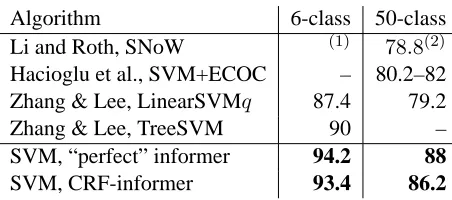
Li and Roth (2002) used a Sparse Network of Winnows (SNoW) (Khardon et al., 1999). Their fea-tures included tokens, parts of speech (POS), chunks (non-overlapping phrases) and named entity (NE) tags. They achieved 78.8% accuracy for 50 classes, which improved to 84.2% on using an (unpublished, to our knowledge) hand-built dictionary of “seman-tically related words”.
1http://l2r.cs.uiuc.edu/˜cogcomp/Data/
Hacioglu and Ward (2003) used linear support vector machines (SVMs) with question word 2-grams and error-correcting output codes (ECOC)— but no NE tagger or related word dictionary—to get 80.2–82% accuracy.
Zhang and Lee (2003) used linear SVMs with all possible question word q-grams, and obtained 79.2% accuracy. They went on to design an inge-nious kernel on question parse trees, which yielded visible gains for the 6 coarse labels, but only “slight” gains for the 50 fine classes, because “the syntactic tree does not normally contain the information re-quired to distinguish between the various fine cate-gories within a coarse category”.
Algorithm 6-class 50-class Li and Roth, SNoW (1) 78.8(2)
Hacioglu et al., SVM+ECOC – 80.2–82 Zhang & Lee, LinearSVMq 87.4 79.2 Zhang & Lee, TreeSVM 90 – SVM, “perfect” informer 94.2 88
[image:2.612.73.299.254.354.2]SVM, CRF-informer 93.4 86.2
Table 1: Summary of % accuracy for UIUC data.
(1)SNoW accuracy without the related word
dictio-nary was not reported. With the related-word dic-tionary, it achieved 91%. (2) SNoW with a related-word dictionary achieved 84.2% but the other algo-rithms did not use it. Our results are summarized in the last two rows, see text for details.
Our contributions: We introduce the notion of the answer type informer span of the question (in §2): a short (typically 1–3 word) subsequence of question tokens that are adequate clues for question classification; e.g.: How much does an adult ele-phant weigh?
We show (in§3.2) that a simple linear SVM us-ing features derived from human-annotated informer spans beats all known learning approaches. This confirms our suspicion that the earlier approaches suffered from a feature localization problem.
Of course, informers are useful only if we can find ways to automatically identify informer spans. Sur-prisingly, syntactic pattern-matching and heuristics widely used in QA systems are not very good at cap-turing informer spans (§3.3). Therefore, the notion of an informer is non-trivial.
Using a parse of the question sentence, we derive a novel set of multi-resolution features suitable for training a conditional random field (CRF) (Lafferty et al., 2001; Sha and Pereira, 2003). Our feature de-sign paradigm may be of independent interest (§4). Our informer tagger is about 85–87% accurate.
We use a meta-learning framework (Chan and Stolfo, 1993) in which a linear SVM predicts the an-swer type based on features derived from the origi-nal question as well as the output of the CRF. This meta-classifier beats all published numbers on stan-dard question classification benchmarks (§4.4). Ta-ble 1 (last two rows) summarizes our main results.
2 Informer overview
Our key insight is that a human can classify a ques-tion based on very few tokens gleaned from skeletal syntactic information. This is certainly true of the most trivial classes (Who wrote Hamlet? or How many dogs pull a sled at Iditarod?) but is also true of more subtle clues (How much does a rhino weigh?). In fact, informal experiments revealed the surpris-ing property that only one contiguous span of tokens is adequate for a human to classify a question. E.g., in the above question, a human does not even need the how much clue once the word weigh is avail-able. In fact, “How much does a rhino cost?” has an identical syntax but a completely different answer type, not revealed by how much alone. The only exceptions to the single-span hypothesis are multi-function questions like “What is the name and age of. . .”, which should be assigned to multiple answer types. In this paper we consider questions where one type suffices.
Consider another question with multiple clues: Who is the CEO of IBM? In isolation, the clue who merely tells us that the answer might be a person or country or organization, while CEO is perfectly pre-cise, rendering who unnecessary. All of the above applies a forteriori to what and which clues, which are essentially uninformative on their own, as in “What is the distance between Pisa and Rome?”
span of question token/s, defined as the informer
span of the question, is adequate for question
clas-sification.
The informer span is very sensitive to the struc-ture of clauses, phrases and possessives in the ques-tion, as is clear from these examples (informers ital-icized): “What is Bill Clinton’s wife’s profession”, and “What country’s president was shot at Ford’s Theater”. The choice of informer spans also de-pends on the target classification system. Initially we wished to handle definition questions separately, and marked no informer tokens in “What is digi-talis”. However, what is is an excellent informer for the UIUC class DESC:def (description, defi-nition).
3 The meta-learning approach
We propose a meta-learning approach (§3.1) in which the SVM can use features from the original question as well as its informer span. We show (§3.2) that human-annotated informer spans lead to large improvements in accuracy. However, we show (§3.3) that simple heuristic extraction rules com-monly used in QA systems (e.g. head of noun phrase following wh-word) cannot provide informers that are nearly as useful. This naturally leads us to de-signing an informer tagger in§4.
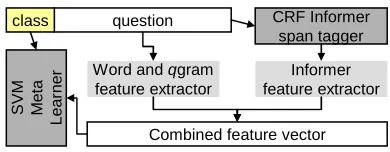
Figure 1 shows our meta-learning (Chan and Stolfo, 1993) framework. The combiner is a linear multi-class one-vs-one SVM2, as in the Zhang and Lee (2003) baseline. We did not use ECOC (Ha-cioglu and Ward, 2003) because the reported gain is less than 1%.
The word feature extractor selects unigrams and q-grams from the question. In our experience,q = 1 or q = 2 were best; if unspecified, all possible qgrams were used. Through tuning, we also found that the SVM “C” parameter (used to trade between training data fit and model complexity) must be set to 300 to achieve their published baseline numbers.
3.1 Adding informer features
We propose two very simple ways to derive features from informers for use with SVMs. Initially, assume that perfect informers are known for all questions;
2http://www.csie.ntu.edu.tw/˜cjlin/
libsvm/
question CRF Informer
span tagger
Word and qgram feature extractor
Informer feature extractor
Combined feature vector class
S
V
M
M
e
ta
L
e
a
rn
e
[image:3.612.328.523.53.129.2]r
Figure 1: The meta-learning approach.
later (§4) we study how to predict informers.
Informerq-grams: This comprises of all wordq -grams within the informer span, for all possibleq. E.g., such features enable effective exploitation of informers like length or height to classify to the NUMBER:distanceclass in the UIUC data.
Informerq-gram hypernyms: For each word or compound within the informer span that is a Word-Net noun, we add all hypernyms of all senses. The intuition is that the informer (e.g. author, crick-eter, CEO) is often narrower than a broad ques-tion class (HUMAN:individual). Following hy-pernym links up to person via WordNet produces a more reliably correlated feature.
Given informers, other question words might seem useless to the classifier. However, retaining regular features from other question words is an ex-cellent idea for the following reasons.
First, we kept word sense disambiguation (WSD) outside the scope of this work because WSD en-tails computation costs, and is unlikely to be reliable on short single-sentence questions. Questions like How long . . . or Which bank . . . can thus become ambiguous and corrupt the informer hypernym fea-tures. Additional question words can often help nail the correct class despite the feature corruption.
Second, while our CRF-based approach to in-former span tagging is better than obvious alterna-tives, it still has a 15% error rate. For the questions where the CRF prediction is wrong, features from non-informer words give the SVM an opportunity to still pick the correct question class.
features (marked “Question bigrams + hypernyms” in Table 2).
3.2 Benefits from “perfect” informers
We first wished to test the hypothesis that identi-fying informer spans to an SVM learner can im-prove classification accuracy. Over and above the class labels, we had two volunteers tag the 6000 UIUC questions with informer spans (which we call “perfect”—agreement was near-perfect).
Features Coarse Fine
Question trigrams 91.2 77.6 All questionqgrams 87.2 71.8 All question unigrams 88.4 78.2
Question bigrams 91.6 79.4 +informer q-grams 94.0 82.4 +informer hypernyms 94.2 88.0
Question unigrams + all informer 93.4 88.0
Only informer 92.2 85.0
Question bigrams + hypernyms 91.6 79.4
Table 2: Percent accuracy with linear SVMs, “per-fect” informer spans, and various feature encodings.
Observe in Table 2 that the unigram baseline is already quite competitive with the best prior num-bers, and exploiting perfect informer spans beats all known numbers. It is clear that both informer q-grams and informer hypernyms are very valuable features for question classification. The fact that no improvement was obtained with over Question bi-grams using Question hypernyms highlights the im-portance of choosing a few relevant tokens as in-formers and designing suitable features on them.
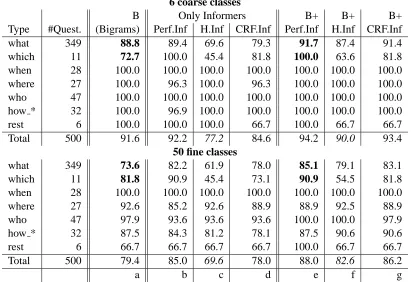
Table 3 (columns b and e) shows the benefits from perfect informers broken down into broad question types. Questions with what as the trigger are the biggest beneficiaries, and they also form by far the most frequent category.
The remaining question, one that we address in the rest of the paper, is whether we can effectively and accurately automate the process of providing in-former spans to the question classifier.
3.3 Informers provided by heuristics
In §4 we will propose a non-trivial solution to the informer-tagging problem. Before that, we must
jus-tify that such machinery is indeed required.
Some leading QA systems extract words very similar in function to informers from the parse tree of the question. Some (Singhal et al., 2000) pick the head of the first noun phrase detected by a shal-low parser, while others use the head of the noun phrase adjoining the main verb (Ramakrishnan et al., 2004). Yet others (Harabagiu et al., 2000; Hovy et al., 2001) use hundreds of (unpublished to our knowledge) hand-built pattern-matching rules on the output of a full-scale parser.
A natural baseline is to use these extracted words, which we call “heuristic informers”, with an SVM just like we used “perfect” informers. All that re-mains is to make the heuristics precise.
How: For questions starting with how, we use the
bigram starting with how unless the next word is a verb.
Wh: If the wh-word is not how, what or which, use
the wh-word in the question as a separate fea-ture.
WhNP: For questions having what and which, use
the WHNP if it encloses a noun. WHNP is the Noun Phrase corresponding to the Wh-word, given by a sentence parser (see§4.2).
NP1: Otherwise, for what and which questions, the
first (leftmost) noun phrase is added to yet an-other feature subspace.
Table 3 (columns c and f) shows that these already-messy heuristic informers do not capture the same signal quality as “perfect” informers. Our find-ings corroborate Li and Roth (2002), who report lit-tle benefit from adding head chunk features for the fine classification task.
Moreover, observe that using heuristic informer features without any word features leads to rather poor performance (column c), unlike using perfect informers (column b) or even CRF-predicted in-former (column d, see§4). These clearly establish that the notion of an informer is nontrivial.
4 Using CRFs to label informers
6 coarse classes
B Only Informers B+ B+ B+
Type #Quest. (Bigrams) Perf.Inf H.Inf CRF.Inf Perf.Inf H.Inf CRF.Inf
what 349 88.8 89.4 69.6 79.3 91.7 87.4 91.4
which 11 72.7 100.0 45.4 81.8 100.0 63.6 81.8
when 28 100.0 100.0 100.0 100.0 100.0 100.0 100.0 where 27 100.0 96.3 100.0 96.3 100.0 100.0 100.0 who 47 100.0 100.0 100.0 100.0 100.0 100.0 100.0 how * 32 100.0 96.9 100.0 100.0 100.0 100.0 100.0
rest 6 100.0 100.0 100.0 66.7 100.0 66.7 66.7
Total 500 91.6 92.2 77.2 84.6 94.2 90.0 93.4
50 fine classes
what 349 73.6 82.2 61.9 78.0 85.1 79.1 83.1
which 11 81.8 90.9 45.4 73.1 90.9 54.5 81.8
when 28 100.0 100.0 100.0 100.0 100.0 100.0 100.0
where 27 92.6 85.2 92.6 88.9 88.9 92.5 88.9
who 47 97.9 93.6 93.6 93.6 100.0 100.0 97.9
how * 32 87.5 84.3 81.2 78.1 87.5 90.6 90.6
rest 6 66.7 66.7 66.7 66.7 100.0 66.7 66.7
Total 500 79.4 85.0 69.6 78.0 88.0 82.6 86.2
[image:5.612.101.512.59.341.2]a b c d e f g
Table 3: Summary of % accuracy broken down by question type (referred from §3.2, §3.3 and§4.4). a: question bigrams, b: perfect informers only, c: heuristic informers only, d: CRF informers only, e–g: bigrams plus perfect, heuristic and CRF informers.
important.
We will model informer span identification as a sequence tagging problem. An automaton makes probabilistic transitions between hidden states y, one of which is an “informer generating state”, and emits tokensx. We observe the tokens and have to guess which were produced from the “informer gen-erating state”.
Hidden Markov models are extremely popular for such applications, but recent work has shown that conditional random fields (CRFs) (Lafferty et al., 2001; Sha and Pereira, 2003) have a consistent ad-vantage over traditional HMMs in the face of many redundant features. We refer the reader to the above references for a detailed treatment of CRFs. Here we will regard a CRF as largely a black box3.
To train a CRF, we need a set of state nodes, a transition graph on these nodes, and tokenized text where each token is assigned a state. Once the CRF is trained, it can be applied to a token sequence,
pro-3We usedhttp://crf.sourceforge.net/
ducing a predicted state sequence.
4.1 State transition models
We started with the common 2-state “in/out” model used in information extraction, shown in the left half of Figure 2. State “1” is the informer-generating state. Either state can be initial and final (double circle) states.
0 1 0 1 2
What kind of an animal is Winnie the Pooh
What, kind, of, an, is, Winnie, the, Pooh
animal
What, kind, of, an
is, Winnie, the, Pooh
animal
start start
Figure 2: 2- and 3-state transition models.
[image:5.612.323.530.548.639.2]A: What country is the largest producer of wheat? B: Name the largest producer of wheat
Thei±1context of producer is identical in A and B. In B, for want of a better informer, we would want producer to be flagged as the informer, although it might refer to a country, person, animal, company, etc. But in A, country is far more precise.
Any 2-state model that depends on positionsi±1
to define features will fail to distinguish between A and B, and might select both country and producer in A. As we have seen with heuristic informers, pol-luting the informer pool can significantly hurt SVM accuracy.
Therefore we also use the 3-state “begin/in/out” (BIO) model. The initial state cannot be “2” in the 3-state model; all states can be final. The 3-state model allows at most one informer span. Once the 3-state model chooses country as the informer, it is unlikely to stretch state 1 up to producer.
There is no natural significance to using four or more states. Besides, longer range syntax dependen-cies are already largely captured by the parser.
What is the capital city of Japan
WP VBZ DT NN NN IN NNP
NP NP
PP
NP VP
SQ
SBARQ WHNP
0
1
2
3
4
5
6
L
e
v
e
l
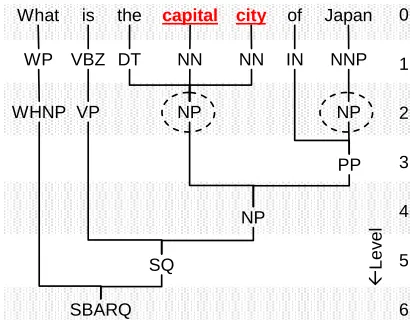
Figure 3: Stanford Parser output example.
4.2 Features from a parse of the question
Sentences with similar parse trees are likely to have the informer in similar positions. This was the in-tuition behind Zhang et al.’s tree kernel, and is also our starting point. We used the Stanford Lexicalized Parser (Klein and Manning, 2003) to parse the ques-tion. (We assume familiarity with parse tree notation for lack of space.) Figure 3 shows a sample parse tree organized in levels. Our first step was to
trans-i 1 2 3 4 5 6 7
yi 0 0 0 1 1 2 2
xi What is the capital city of Japan
`↓ Features forxis
1 WP,1 VBZ,1 DT,1 NN,1 NN,1 IN,1 NNP,1 2 WHNP,1 VP,1 NP,1 NP,1 NP,1 Null,1 NP,2
[image:6.612.82.287.370.530.2]3 Null,1 Null,1 Null,1 Null,1 Null,1 PP,1 PP,1 4 Null,1 Null,1 NP,1 NP,1 NP,1 NP,1 NP,1 5 Null,1 SQ,1 SQ,1 SQ,1 SQ,1 SQ,1 SQ,1 6 SBARQ SBARQ SBARQ SBARQ SBARQ SBARQ SBARQ
Table 4: A multi-resolution tabular view of the ques-tion parse showingtagandnumattributes. capital city is the informer span withy= 1.
late the parse tree into an equivalent multi-resolution tabular format shown in Table 4.
Cells and attributes: A labeled question com-prises the token sequencexi;i= 1, . . .and the label
sequence yi, i = 1, . . . Eachxi leads to a column
vector of observations. Therefore we use matrix no-tation to write downx: A table cell is addressed as x[i, `]whereiis the token position (column index) and`is the level or row index, 1–6 in this example. (Although the parse tree can be arbitrarily deep, we found that using features from up to level`= 2was adequate.)
Intuitively, much of the information required for spotting an informer can be obtained from the part of speech of the tokens and phrase/clause attachment information. Conversely, specific word information is generally sparse and misleading; the same word may or may not be an informer depending on its po-sition. E.g., “What birds eat snakes?” and “What snakes eat birds?” have the same words but different informers. Accordingly, we observe two properties at each cell:
tag: The syntactic class assigned to the cell by the parser, e.g. x[4,2].tag=NP. It is well-known that POS and chunk information are major clues to informer-tagging, specifically, informers are often nouns or noun phrases.
num: Many heuristics exploit the fact that the first NP is known to have a higher chance of containing informers than subsequent NPs. To capture this po-sitional information, we definenumof a cell at[i, `]
forms the first NP, while Japan forms the second NP. Thereforex[7,2].num= 2.
In conditional models, it is notationally conve-nient to express features as functions on(xi, yi). To
one unfamiliar with CRFs, it may seem strange that yi is passed as an argument to features. At training
time, yi is indeed known, and at testing time, the
CRF algorithm efficiently finds the most probable sequence ofyis using a Viterbi search. True labels
are not revealed to the CRF at testing time.
Cell features IsTag and IsNum: E.g., the ob-servation “y4 = 1andx[4,2].tag = NP” is
cap-tured by the statement that “position 4 fires the fea-ture IsTag1,NP,2” (which has a boolean value). There is an IsTagy,t,` feature for each (y, t, `)
triplet. Similarly, for every possible state y, ev-ery possible num value n (up to some maximum horizon), and every level`, we define boolean fea-turesIsNumy,n,`. E.g., position 7 fires the feature
IsNum2,2,2in the 3-state model, capturing the state-ment “x[7,2].num= 2andy7 = 2”.
Adjacent cell features IsPrevTag and
IsNextTag: Context can be exploited by a
CRF by coupling the state at position i with observations at positions adjacent to position i (extending to larger windows did not help). To capture this, we use more boolean features: posi-tion 4 fires the featureIsPrevTag1,DT,1 because x[3,1].tag=DTandy4 = 1. Position 4 also fires
IsPrevTag1,NP,2 becausex[3,2].tag=NPand y4 = 1. Similarly we define a IsNextTagy,t,`
feature for each possible(y, t, `)triple.
State transition features IsEdge: Position i fires feature IsEdgeu,v if yi−1 = u andyi = v.
There is one such feature for each state-pair(u, v)
allowed by the transition graph. In addition we have sentinel featuresIsBeginu andIsEndu marking the beginning and end of the token sequence.
4.3 Informer-tagging accuracy
We study the accuracy of our CRF-based informer tagger wrt human informer annotations. In the next section we will see the effect of CRF tagging on question classification.
There are at least two useful measures of informer-tagging accuracy. Each question has a
known set Ik of informer tokens, and gets a set
of tokens Ic flagged as informers by the CRF. For
each question, we can grant ourself a reward of 1 if Ic = Ik, and 0 otherwise. In §3.1, informers were
regarded as a separate (high-value) bag of words. Therefore, overlap between Ic and Ik would be a
reasonable predictor of question classification accu-racy. We use the Jaccard similarity|Ik∩Ic|/|Ik∪Ic|.
Table 5 shows the effect of using diverse feature sets.
Fraction Jaccard Features used Ic=Ik overlap
IsTag 0.368 0.396
+IsNum 0.474 0.542
[image:7.612.319.532.188.270.2]+IsPrevTag+IsNextTag 0.692 0.751 +IsEdge+IsBegin+IsEnd 0.848 0.867
Table 5: Effect of feature choices.
• IsTagfeatures are not adequate.
• IsNumfeatures improve accuracy 10–20%. • IsPrevTag and IsNextTag (“+Prev
+Next”) add over 20% of accuracy.
• IsEdge transition features help exploit Markovian dependencies and adds another 10–15% accuracy, showing that sequential models are indeed required.
Type #Quest. Heuristic 2-state 3-state Informers CRF CRF
what 349 57.3 68.2 83.4
which 11 77.3 83.3 77.2
when 28 75.0 98.8 100.0
where 27 84.3 100.0 96.3
who 47 55.0 47.2 96.8
how * 32 90.6 88.5 93.8
rest 6 66.7 66.7 77.8
[image:7.612.315.535.428.566.2]Total 500 62.4 71.2 86.7
Table 6: Effect of number of CRF states, and com-parison with the heuristic baseline (Jaccard accuracy expressed as %).
approach.
Unlike the heuristic approach, the CRF approach is relatively robust to the parser emitting a somewhat incorrect parse tree, which is not uncommon. The heuristic approach picks the “easy” informer, who, over the better one, CEO, in “Who is the CEO of IBM”. Its bias toward the NP-head can also be a problem, as in “What country’s president. . .”.
4.4 Question classification accuracy
We have already seen in§3.2 that perfect knowledge of informers can be a big help. Because the CRF can make mistakes, the margin may decrease. In this section we study this issue.
We used questions with human-tagged informers (§3.2) to train a CRF. The CRF was applied back on the training questions to get informer predictions, which were used to train the 1-vs-1 SVM meta-learner (§3). Using CRF-tagged and not human-tagged informers may seem odd, but this lets the SVM learn and work around systematic errors in CRF outputs.
Results are shown in columns d and g of Table 3. Despite the CRF tagger having about 15% error, we obtained 86.2% SVM accuracy which is rather close to the the SVM accuracy of 88% with perfect in-formers.
The CRF-generated tags, being on the training data, might be more accurate that would be for un-seen test cases, potentially misleading the SVM. This turns out not to be a problem: clearly we are very close to the upper bound of 88%. In fact, anec-dotal evidence suggests that using CRF-assigned tags actually helped the SVM.
5 Conclusion
We presented a new approach to inferring the type of the answer sought by a well-formed natural lan-guage question. We introduced the notion of a span of informer tokens and extract it using a sequential graphical model with a novel feature representation derived from the parse tree of the question. Our ap-proach beats the accuracy of recent algorithms, even ones that used max-margin methods with sophisti-cated kernels defined on parse trees.
An intriguing feature of our approach is that when an informer (actor) is narrower than the
ques-tion class (person), we can exploit direct hyper-nymy connections like actor to Tom Hanks, if avail-able. Existing knowledge bases like WordNet and Wikipedia, combined with intense recent work (Et-zioni et al., 2004) on bootstrapping is-a hierarchies, can thus lead to potentially large benefits.
Acknowledgments: Thanks to Sunita Sarawagi for help with CRFs, and the reviewers for improv-ing the presentation.
References
P. K Chan and S. J Stolfo. 1993. Experiments in mul-tistrategy learning by meta-learning. In CIKM, pages 314–323, Washington, DC.
S Dumais, M Banko, E Brill, J Lin, and A Ng. 2002. Web question answering: Is more always better? In SIGIR, pages 291–298.
O Etzioni, M Cafarella, et al. 2004. Web-scale informa-tion extracinforma-tion in KnowItAll. In WWW Conference, New York. ACM.
K Hacioglu and W Ward. 2003. Question classifica-tion with support vector machines and error correcting codes. In HLT, pages 28–30.
S Harabagiu, D Moldovan, M Pasca, R Mihalcea, M Sur-deanu, R Bunescu, R Girju, V Rus, and P Morarescu. 2000. FALCON: Boosting knowledge for answer en-gines. In TREC 9, pages 479–488. NIST.
E Hovy, L Gerber, U Hermjakob, M Junk, and C.-Y Lin. 2001. Question answering in Webclopedia. In TREC 9. NIST.
R Khardon, D Roth, and L. G Valiant. 1999. Relational learning for NLP using linear threshold elements. In IJCAI.
D Klein and C. D Manning. 2003. Accurate unlexical-ized parsing. In ACL, volume 41, pages 423–430. C Kwok, O Etzioni, and D. S Weld. 2001. Scaling
ques-tion answering to the Web. In WWW Conference, vol-ume 10, pages 150–161, Hong Kong.
J Lafferty, A McCallum, and F Pereira. 2001. Con-ditional random fields: Probabilistic models for seg-menting and labeling sequence data. In ICML. X Li and D Roth. 2002. Learning question classifiers. In
COLING, pages 556–562.
G Ramakrishnan, S Chakrabarti, D. A Paranjpe, and P Bhattacharyya. 2004. Is question answering an ac-quired skill? In WWW Conference, pages 111–120, New York.
F Sha and F Pereira. 2003. Shallow parsing with condi-tional random fields. In HLT-NAACL, pages 134–141. A Singhal, S Abney, M Bacchiani, M Collins, D Hindle, and F Pereira. 2000. AT&T at TREC-8. In TREC 8, pages 317–330. NIST.
D Zhang and W Lee. 2003. Question classification using support vector machines. In SIGIR, pages 26–32. Z Zheng. 2002. AnswerBus question answering system.