A discourse-driven content model for summarising scientific articles
evaluated in a complex question answering task
Maria Liakata
University of Warwick/ EMBL-EBI, UK
Simon Dobnik
University of Gothenburg, Sweden
Shyamasree Saha
EMBL-EBI, UK
Colin Batchelor
Royal Society of Chemistry, UK
Dietrich Rebholz-Schuhmann
University of Zurich, Switzerland/ EMBL-EBI, UK
Abstract
We present a method which exploits auto-matically generated scientific discourse an-notations to create a content model for the summarisation of scientific articles. Full pa-pers are first automatically annotated using the CoreSC scheme, which captures 11 content-based concepts such as Hypothesis, Result, Conclusion etc at the sentence level. A content model which follows the sequence of CoreSC categories observed in abstracts is used to pro-vide the skeleton of the summary, making a distinction between dependent and indepen-dent categories. Summary creation is also guided by the distribution of CoreSC cate-gories found in the full articles, in order to adequately represent the article content. Fi-nally, we demonstrate the usefulness of the summaries by evaluating them in a complex question answering task. Results are very en-couraging as summaries of papers from auto-matically obtained CoreSCs enable experts to answer 66% of complex content-related ques-tions designed on the basis of paper abstracts. The questions were answered with a precision of 75%, where the upper bound for human summaries (abstracts) was 95%.
1 Introduction
The publication boom of the last few years, espe-cially in the life sciences, has highlighted the need to facilitate automatic access to the information con-tent of articles. Researchers, curators, reviewers all need to process a continuously expanding flow of articles whether the purpose is to follow the state of the art, curate large knowledge bases or have a good
working knowledge of their own and related disci-plines to assess progress in research. While a lot of effort has concentrated on information extraction of particular types of entities and relations from the scientific literature (Cohen and Hersh, 2005; Kim et al., 2009; Ananiadou et al., 2010; Kim et al., 2011), with a view to support scientists in obtain-ing relevant information from scientific articles and abstracts, less work has focussed on automatically combining such information in the form of a co-hesive summary which preserves the context. Re-searchers rely to a great extent on author-written ab-stracts, but the latter suffer from a number of prob-lems; they are less structured, vary significantly in terms of length, are often not self-contained and have been written independently of the main doc-ument (Teufel, 2010, p.83).
Teufel (2001; 2010), (Teufel and Moens, 2002) identify argumentative zones within scientific arti-cles and use them to create use-targeted extractive summaries. Argumentative zones are annotations which designate the type of knowledge claim and rhetorical status for a sentence and how these relate to the communicative function of the entire paper. A selection of various combinations of argumenta-tive zones are chosen for the use-targeted extracargumenta-tive summaries (rhetorical extracts), each of which ful-fills a different role. For instance, purpose-oriented extracts less than 10 sentences long are generated containing a predetermined number of AIM, SOLU-TION and BACKGROUND zones. As the emphasis of this approach was the identification of the argu-mentative zones, less attention was given to the sen-tence selection criteria for the extractive summaries.
The sentences chosen for the rhetorical extracts were either all sentences of a particular category (in the case of rare categories) (Teufel and Moens, 2002), selected according to a classifier trained on a rele-vance gold standard (Teufel and Moens, 2002), man-ually or randomly selected (Teufel, 2010, p.60).
More recently Contractor et al. (2012) have used automatically annotated argumentative zones (Guo et al., 2011) to guide the creation of extractive sum-maries of scientific articles. Here argumentative zones are used as features for the summariser, along with verbs, tf-idf values and sentence location. They use a standard approach to summarisation, with a bi-nary classification recognising candidate sentences which are then fed into a clustering mechanism. Ex-tracts can be created to summarise the entire paper or focus on specific user-specified aspects. The num-ber of sentences to include in the summary is pre-specified (either directly or using a compression ra-tio).
Our approach also makes use of the scientific dis-course for summarisation purposes. We use the sci-entific discourse to create a content model for ex-tractive summarisation, with a focus on represent-ing the content of the full paper, while keeprepresent-ing the cohesion of the narrative. We first automatically annotate the articles with a scheme which captures fine-grained aspects of the content and conceptual structure of the papers, namely the Core Scientific Concepts (CoreSC) scheme (Liakata et al., 2010; Li-akata et al., 2012). The CoreSC scheme is “uniquely suited to recovering common types of scientific ar-guments about hypotheses, explanations, and evi-dence” (White et al., 2011), which are not read-ily identifiable by other annotation schemes. Also, when compared to argumentative zoning and more specifically its extension for chemistry papers, AZ-II (Teufel et al., 2009), it was shown to provide a greater level of detail in terms of categories denot-ing objectives, methods and outcomes whereas AZ-II focusses on the attribution of knowledge claims and the relation with previous work (Liakata et al., 2010).
We then use the distribution of CoreSC categories observed in abstracts to create a content model which provides a skeleton for extractive summaries. The reasoning behind this is to try to preserve co-hesion within the summaries and we hypothesise
that the sequence of CoreSC categories is a good proxy for cohesion (see section 3.1). In creating the summary, instantiating the content model, we identify independent categories and dependent cate-gories, and we argue that in order to preserve the co-hesion of the text the independent categories should be determined first (see section 3.2). We also pre-serve in the summary the distribution of CoreSC cat-egories found in the corresponding full paper.
Finally, we evaluate the extractive summaries in a complex real world question-answering task, in which we assess the usefulness of the summaries as well as to what extent the generated CoreSC sum-maries represent the content of the original arti-cle. Experts are presented with different types of summaries and are asked to answer article-specific questions on the basis of the summaries (see sec-tion 4.1). Our results show that automatically gen-erated CoreSC summaries can answer 66% of com-plex questions with 75% precision, outperforming a baseline of microsoft autosummarise summaries (See section 4.2).
We have also peformed an intrinsic evaluation of the summaries using ROUGE and automatic mea-sures for summary informativeness, such as the Jensen-Shannon divergence, yielding positive re-sults (See section 4.2). However, as such measures have not yet reached maturity and are harder to in-terpret, we consider the user-based evaluation to be a more reliable measure of summary quality.
Code for generating the summaries can be ob-tained by contacting the first author and/or visiting http://www.sapientaproject.com/software.
2 Related work
The Core Scientific Concepts (CoreSC) Scheme:
with this scheme and trained classifiers using SVMs and CRFs in (Liakata et al., 2012), with an accu-racy of >51% across the 11 concepts. Their data and CoreSC classification system are available on-line and can provide a good benchmark for com-parison. Louis & Nenkova (2012) have successfully used the CoreSC corpus for evaluating syntax-based coherence models, which indicates the strong con-nection between coherence and discourse structure.
Summarisation for scientific articles: A lot of the work on summarising scientific articles has fo-cussed on citation-based summaries. Qazvinian & Radev (2008) use sentences from papers citing the article to be summarised. Sentences are clustered to-gether creating a topic, with the combination of clus-ters forming a citation summary network. Qazvinian & Radev (2010), (Qazvinian et al., 2010) also make use of citation sentences in other scientific papers to summarize the contributions of a paper. The draw-back of citation summaries is that a paper must be already cited, so this type of summary will not be useful to a paper reviewer. Also, citations of articles will have been influenced by other citations rather than the paper itself.
Document models for summarisation: Our con-tent model has some similarities with concon-tent mod-elling using global sentence ordering (Barzilay and Lee, 2004; Chen et al., 2009). In (Barzilay and Lee, 2004) unsupervised methods are used to cre-ate HMM topic sequence models for newswire text articles. Topics are assigned to texts according to the content model and extracts of fixed length are created by selecting the topics most likely to occur in summaries. While we use supervised methods to annotate papers with a fixed set of topics (CoreSCs) in scientific papers, our summary content model for extracts shares similar principles such as global or-dering of sentences and non-recurrence. However, their evaluation involved newspaper articles and ex-tracts which are a lot shorter (15 and 6 sentences, respectively).
It is not clear whether unsupervised topic mod-elling such as (Chen et al., 2009) can be applied to scientific articles (over 100 sentences long), which by nature include repetition of topics. It would be interesting to make comparisons with summaries us-ing content models learnt from our data automati-cally, following a similar approach to (Sauper et al.,
2010) which learns a content model jointly with a particular supervised task in web-based documents.
3 Extractive Summarisation using CoreSCs
In this section we describe how we use CoreSC dis-course categories annotated at the sentence level to create extractive summaries of full papers, which we subsequently evaluate in a question answering task in section 4.
To generate summaries we follow classic text ex-traction techniques while making use of a document content model based on CoreSCs. Our aim is for the content model to reflect both the distribution of CoreSCs in the paper as well as the discourse model of human summaries, as the latter is indicated by the generic ordering of CoreSC categories in abstracts encountered in a corpus of 265 annotated full pa-pers (Liakata and Soldatova, 2009; Liakata et al., 2012). While we do not consider abstracts to be ade-quate summaries, we at least consider them to be co-herent summaries, which is why the content model reflects the distribution of CoreSCs in the abstracts.
To create our summaries, we employed automat-ically generated CoreSC annotations, which are the output of the classifiers described in (Liakata et al., 2012). These classifiers assign CoreSC categories to sentences on the basis of features local to a sen-tence, such as significant n-grams, verbs and word triples, as well as global features such as the posi-tion of the sentence within the document and within a paragraph and section headers. The following sub-sections give details about the creation of extractive summaries from CoreSC categories.
3.1 A content model for CoreSC extractive summaries
Our document content model is primarily based on the global discourse of the article as provided by the type and number of CoreSC categories. How-ever, unlike (Teufel and Moens, 2002), who take a fixed number of AZ categories of specific type to create rhetorical extracts, the number of categories used from each CoreSC category depends on their distribution in the original article. Any and all types of CoreSC category could potentially appear in a summary, as our summaries are meant to be repre-sentative of the entire content of the paper. Also, the ordering of the categories in the summary is learnt to reflect the ordering of categories observed in ab-stracts of papers from the same domain.
Our model also caters for local discourse depen-dencies. For example, the selection of a particu-lar ‘Method’ sentence for inclusion in the summary should influence the choice of ‘Experiment’ sen-tences, which refers to particular experimental pro-cedures performed. This is not an issue of concern to (Teufel and Moens, 2002), but relates to the no-tion of NUCLEUS and SATELLITE clauses, which form the foundation of Rhetorical Structure The-ory (Mann and Thompson, 1998), and guides the summarisation paradigm of (Marcu, 1998a; Marcu, 1998b). However, the difference here is that we define a-priori certain categories to be independent (have the property of playing the role of nucleus in the discourse) and specify their relation with partic-ular types of dependent categories. Thus, nuclearity becomes a property of the CoreSC category, which is indirectly inherited by the sentence.
Therefore, when creating the CoreSC content model for summaries we addressed the following is-sues: (i) summary length; (ii) number of sentences from each CoreSC, (iii) the ordering in which sen-tences from each CoreSC category should appear and (iv) the extraction of sentences according to in-dependent and in-dependent categories.
• Summary length: While the literature (Teufel, 2010, p.45) suggests that 20–30% of the original document is required for an adequately informa-tive summary, (Teufel, 2010, p.55) assumes this is too long for scientific papers. For this reason and to allow better comparison between papers of varying lengths, we fixed our summary length to 20 sentences. This is reasonable considering
we have 11 CoreSCs, any and all of which can appear in both abstracts and full papers.
• Number of sentences from each category: To reflect the content of the paper, the distribution of the CoreSC categories in the extract follows the distribution of CoreSCs in the full paper.
For each CoreSC we determine the number of sentences to be selected (n(selected(C))) by multiplying the ratio of that category in the paper by 20. A difficulty arises if the ratio of a partic-ular concept in the paper is very low (≤ 0.05) in which case we prefer to include one sentence. If a particular concept is not at all present in the paper, the number of selected sentences for that category will be0.
• Ordering of CoreSC categories in the sum-mary: According to a study of empirical sum-maries (Liddy, 1991), sentences of a particular textual type appear in a particular order. Since paper abstracts were the closest approximation of human summaries available to us, CoreSC category transitions found in abstracts have been adopted in our content model for extracts. The transitions were derived semi-empirically. First, we extracted initial, medium and final bi-grams of categories from paper abstracts together with transition probabilities.
3.2 Sentence extraction based on independent and dependent categories
Sentence extraction involves selecting the most rel-evant sentences to include in a summary. Typically, this entails ranking the sentences according to some measure of salience and selecting the top n-best sentences. For example, a sentence will be repre-sented by a number of features associated with it, such as whether it contains certain high frequency words or cue phrases, its location in the document, location in a paragraph (Brandow et al., 1995; Ku-piec et al., 1995). Other methods include clustering based on sentence similarity and choosing the cen-troids (Erkan and Radev, 2004) or choosing the best connected sentences (Mihalcea and Tarau, 2004).
When sentences are classified according to CoreSC categories features such as the ones de-scribed above for text extraction are taken into account. Liakata et al. (2012) report that the most salient features for classifying CoreSC cat-egories are overall n-grams, verbs and direct ob-jects whereas other features such as the location of the sentence, the neighbouring section headings and whether a sentence contains citations play an impor-tant role for some of the categories. Thus, classi-fication into CoreSC categories already provides a selection bias for sentence extraction.
As explained in section 3.1, the number of CoreSC categories in the summaries is determined according to their distribution in the paper and the order of the categories is specified in the content model. Salience for sentence extraction in this case is determined by the need to select the most repre-sentative sentences for a category. There isn’t much point, for example, in identifying that we need to in-clude a Method sentence (MET) and that this should be followed by an Experiment sentence (EXP), if we are not sure that those are indeed the categories of the sentences we are about to select.
We therefore rank sentences according to the clas-sifier confidence score (probability) with which they were assigned a CoreSC category in (Liakata et al., 2012). The intuition behind this is that sentences with high classifier confidence will be less noisy, high precision cases and more representative of a particular category. Indeed, (Liakata et al., 2012) report statistical significance for the correlation
tween high classifier confidence and agreement be-tween manual and automatic classification
However, as mentioned in section 3.1, there is inter-dependence between sentences in the text, which is in turn inherited by the categories assigned to them. For example, the highest ranking MET sentence will be related to an Experiment (EXP) or Background (BAC) sentence, which may not be the ones with the highest confidence score in their cate-gory.
In order to preserve discourse cohesion it is im-portant to select related sentences from different categories. We resolve this by distinguising the CoreSCs into independent categories, which by def-inition are expected to show nucleus behaviour, and dependent categories. We also specify the rela-tion between independent and dependent categories. The independent categories include the categories with the lowest percentage of sentences in scien-tific articles as reported in (Liakata et al., 2012), namely: Motivation (MOT) (1%), Goal (GOA)(1%), Hypothesis (HYP)(2%), Object (OBJ)(3%), Model (MOD)(9%), Conclusion (CON)(9%) and Method (MET)(11%). Categories whose sentence selec-tion semantically depends on the former are Exper-iment (EXP)(10%), Background (BAC)(19%), Re-sult (RES)(21%) and Observation (OBS)(14%). The independent categories also have higher precision than recall, in contrast to the dependent categories. While MET and EXP are almost equally represented in the CoreSC corpus, EXP by definition provides the detailed steps of an experimental method and thus it is semantically dependent on some MET cat-egory. More specifically, the dependencies are con-sidered to be as follows: EXP, BAC depend on MET, RES depends on CON and OBS depends on RES (OBS is double-dependent).
Sentence extraction is driven by first identifying the independent categories based on classifier con-fidence scores and then choosing the corresponding dependent categories on the basis of both related-ness to the independent categories and classifier con-fidence. We use sentence proximity (defined below) as a measure for relatedness and combine it with classifier confidence during sentence extraction.
• For an independent category CatI, order sentences by decreasing order of confidence score. The confidence score is the average confidence score of the SVM and CRF classifiers reported in (Liakata et al., 2012) for a sentence.
• For a dependent category Cat, for which we needn
sentences, given the selected sentencesm from the corresponding independent category CatI we do the following:
• Ifm= 0, then treat Cat as independent category for this case.
• Otherwise, for each selected sentenceti in CatI, calculate its proximity score to every sentencecj of the dependent category Cat.P roximityis de-fined as1−DistancewhereDistanceis an ab-solute difference in sentence ids betweencj and
tinormalised by the maximum absolute distance found between allcjandtipairs.
• The classifier prediction score for eachcjis mul-tiplied by the P roximity(cj, ti) score and the sentences are re-ranked according to the new scores, where only thenhighest rankingcjs are kept. The last two steps result in anm×nmatrix.
• Ifm= 1, then the choice for thensentences for Cat is straightforward.
• Otherwise, we pick the n highest ranking cjs, proceeding row-wise. Thus, the highest ranking
cjs for the highest ranking independent sentences
tiare given priority and anycjis chosen at most once.
Once the sentence ids are selected for each inde-pendent and each deinde-pendent category we plug them into the content model. Sentence order is preserved within each CoreSC category. For example, if two Result sentences are selected, the order in which they appear in the paper will be preserved in the summary.
4 Summary evaluation via question answering
4.1 Task Description and experimental setup
We evaluate the extractive CoreSC summaries in terms of how well they enable 12 chemistry ex-perts/evaluators (with at least a Masters degree in chemistry) to answer complex questions about the papers. Our test corpus consists of 28 papers held out from the ART/CoreSC corpus, roughly 1/9, which were annotated automatically with the SVM
and CRF classifiers described in (Liakata et al., 2012) trained on the remaining 8/9 of the corpus. For each of the 28 papers in the test corpus, we gen-erated CoreSC summaries automatically using the method described in section 3. We compare the performance of the experts on a question answer-ing (Q-A) task when given the CoreSC summaries and two other types of summary, amounting to a total of three experimental conditions (A,B,C). The other two types of summary are the original paper abstracts (summaries A), in the absence of human summaries, and summaries generated by Microsoft Office Word 2007 AutoSummarize (summaries B).
Microsoft Office Word 2007 AutoSummarize (MA) is a widely available commercial system with reportedly good results (Garcia-Hernandez et al., 2009) and performance equivalent to TextRank (Mi-halcea and Tarau, 2004). MA works by assigning a score to each word in a sentence depending on its frequency in the document and sentences are ranked and extracted according to the combination of scores of the words they contain. MA therefore follows classic lexicalised text extraction techniques, is do-main independent and is completely agnostic of the discourse. For the latter reason, we considered MA to be a suitable baseline the comparison with which would illustrate the effect of using CoreSC cate-gories on the summary and the merits of having a discourse based model for summarisation.
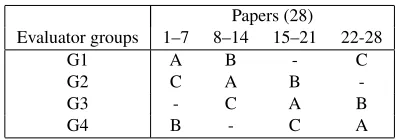
Neither the paper title nor section headings were available to any of the summarising systems as our extractive system does not make direct use of them and we were not sure how they would influence MA. To ensure that each evaluator considered only one type of summary per paper, so as to avoid bias from previous stimuli, and to make sure all experts were exposed to all papers and all types of summary, the 12 experts were assigned to four groups (G1-G4) and were allocated 28 summaries each according to the Latin Square design in Table 1.1.
The experimental setup follows the paradigm of (Teufel, 2001). However, while (Teufel, 2001) de-veloped a Q-A task to evaluate summaries showing the contribution of a scientific article in relation to previous work, the purpose of the Q-A task at hand
1
is to show the usefulness of the extracted summaries in answering questions on the paper, and how they compare to a discourse-agnostic baseline. In the case of (Teufel, 2001) the task consists of a fixed set of five questions, the same for all articles tuned par-ticularly to the relation of current and previous work. By contrast, the current Q-A task aims to show how well the summaries represent the content of the en-tire paper, which means that questions are individ-ual to each paper and required domain knowledge to create.
Each of the 12 experts answered three content-based questions per summary, where the questions were individual to each paper. An example of the questions and the corresponding answers for a given paper can be found below.
Example 4.1.1
• Q:What do DNJ imino sugars inhibit the action of? A: They inhibit glycosidases and ceramide glucosyl-transferases.
• Q:What methods do the authors use to study the confor-mation of N-benzyl-DNJ?
A: They use resonant two-photon ionization (R2PI), ultraviolet–ultraviolet (UV–UV) hole burning, and in-frared (IR) ion-dip spectroscopies in conjunction with electronic structure theory calculations.
• Q:What is the conformation of the exocyclic hydrox-ymethyl group?
A:The exocyclic hydroxymethyl group is axial to the piperidine ring (gauche- to the ring nitrogen).
As one can see, the questions are complex wh-questions and correspond to answers with multiple components. Questions were complex, to minimise the likelihood of correct random answers. They were designed by a senior chemistry expert with knowledge of linguistics, so that they could be an-swered based on the abstracts (A). For this purpose, the senior expert chose abstracts that were at least three sentences long. Ideally, the questions and an-swers should have been set on the basis of the en-tire paper, but this was not possible given our time-frame for the experiment.The underlying assump-tion is that a good summary should cover most of the main points of the paper. One of the merits of set-ting the questions on the basis of the abstracts was that the answers to be identified were deemed suf-ficiently important to be expressed in the humanly created abstract. However, automatic summaries created in the way proposed here could potentially
answer questions beyond the scope of the abstract and in cases of very short abstracts be much more informative.
Experts were told that summaries were automati-cally generated with no details about different types of summary; it is assumed that none of them is com-pletely familiar with the work mentioned in the 28 papers.
On average, it took experts less than 10 minutes to read a summary and answer the three content-based questions.
Papers (28)
Evaluator groups 1–7 8–14 15–21 22-28
G1 A B - C
G2 C A B
-G3 - C A B
[image:7.612.326.525.218.288.2]G4 B - C A
Table 1: Distribution of summaries to evaluators
4.2 Results and Discussion
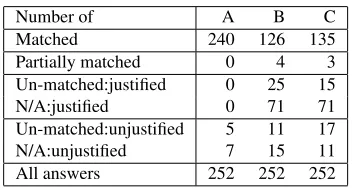
We compared each evaluator’s answers obtained af-ter reading a summary against the model answers set by the senior expert, the author of the questions, based on the abstract (A) of the corresponding pa-per. If an evaluator’s answer is identical to a model answer, then this counts as “matched”.
For instance in example 4.1.1 above, “axial to the piperidine ring”, “gauche- to the ring nitrogen” and “The OH6 group is axial (Gauche) to the ring nitrogen” were all considered correct, fully matched answers to the question “What is the conformation of the exocyclic hydroxymethyl group?”. In the case of the second question in the same example all of the following were considered correct and fully matched: “Resonant two-photon ionization (R2PI), UV/UV hole-burn, and IR ion-dip spectroscopies in conjunction with electronic structure theory calcula-tions”, “R2PI UV/UV hole-burn IR ion-dip e- struc-ture theory calculations” and “a combination of res-onant two-photon ionization (R2PI), UV/UV hole-burn, and IR ion-dip spectroscopies in conjunction with electronic structure theory calculations”.
types. If an un-matched answer coincided with the answer the senior expert would have given after reading that particular summary, then it was marked as “un-matched:justified”: Such answers were cor-rect given the particular summary, but are not nec-essarily correct with respect to the paper and do not count as alternative answers. If the answer was un-matched and also unjustified given the con-tent of the summary, then it was marked as “un-matched:unjustified” . These are cases of evalua-tor error. Similarly, cases where the evaluaevalua-tor gave “N/A” as an answer were marked as “justified” or “unjustified” according to whether the senior expert could find the answer in the summary or not. The results from marking answers are shown in Table 2.
Number of A B C
Matched 240 126 135
Partially matched 0 4 3
Un-matched:justified 0 25 15
N/A:justified 0 71 71
Un-matched:unjustified 5 11 17
N/A:unjustified 7 15 11
[image:8.612.98.274.271.366.2]All answers 252 252 252
Table 2: Matches between summary-based answers and model answers
Micro-AVG Macro-AVG
S. types R P F R P F
A 1 0.95 0.98 1 0.95 0.97
[image:8.612.81.291.411.468.2]B 0.64 0.70 0.67 0.64 0.64 0.60 C 0.66 0.75 0.70 0.64 0.70 0.65
Table 3: Precision, Recall and F-score for answering questions using the four types of summary. A: abstracts, B: autosummarize, C:automatic CoreSC summaries.
We report Precision, Recall and F-score (P-R-F) for answering questions given each type of sum-mary (Table 3). To calculate these we define TP as matched answers, FN as N/A:justified and FP every-thing else (partially matched + un-matched:justified + un-matched:unjustified + N/A:unjustified). Here, the standard definition of recall (TP/(TP+FN)) demonstrates how many questions can be answered using the summary (summary coverage) and Preci-sion (TP/(TP+FP)) how well the questions are an-swered (summary clarity).
We consider the F-measure to be an overall indi-cator of the summary usefulness. Micro-averaging is obtained by adding all answers from all papers to
calculate TP, FN and FP whereas macro-averaging calculates P-R-F first per paper and then averages over all papers.
The rankings remain consistent regardless of the averaging method. Condition A (abstracts) shows perfect Recall (the evaluators are able to answer all the questions) whereas Precision is affected by un-justified failed matches (Table 2). The perfect recall is hardly surprising as the questions are designed on the basis of the abstract but provides a sanity check for the experiment. The precision sets an up-per bound for precision with automatic summaries. Summaries of condition C provide answers to more questions (Recall) and with greater accuracy (Pre-cision) than summaries B. When macro-averaging, the Recall score of summaries C is tied with that for summaries B but Precision is 6% higher.
To verify the statistical significance for the dif-ference in precision and recall for summaries B and C respectively, we performed Monte Carlo sampling 10000 times, for the populations of answers for sum-maries B and C. During each iteration of sampling, precision and recall were calculated, creating popu-lations of 10000 recalls and 10000 precisions propa-gated to be representative of the original population of answers. A t-test performed on the population of precision and the population of recalls showed statistical significance at 95% in both cases, with summaries C having a precision of 5% higher and a recall of 1.4-1.6% higher than summaries B (see Table 4). Therefore, we can say that CoreSC sum-maries C are overall better for answering questions than summaries B.
Comparison between B and C (B-C)
precision recall
t = -105.90 t = -32.52 df = 19959.79 df = 19994.40 p-value<2.2e-16 p-value<2.2e-16 alternative hypothesis: true difference in means6=0 95% confidence interval: 95% confidence interval:
-0.051 -0.049 -0.016 -0.014 sample estimates: sample estimates: mean of x mean of y mean of x mean of y
0.696 0.746 0.639 0.655
Table 4: Test for statistical significance betwen sum-maries B (microsoft) and C (CoreSC)
[image:8.612.322.528.512.637.2]con-tent model: summaries C are significantly clearer. We had also expected CoreSC summaries to have a much higher coverage than summaries B, and there-fore significantly higher recall. However, this dif-ference was less pronounced perhaps because au-tosummarize favours shorter sentences, which are more likely to be found in the abstracts. We expect that a refinement in the sentence selection criterion, which would also take sentence length into account, will help to showcase further the benefits of using a CoreSC-based content model.
Analysis using ROUGE showed that while sum-maries C had a slightly higher ROUGE-1 measure than summaries B (0.75 vs 0.73), with respect to ab-stracts, ROUGE-L was the same for the two (0.70).
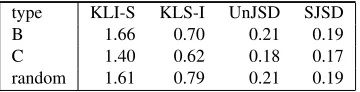
In table 5 we also report measurements on sum-mary informativeness based on divergence (Kull-back Leibler (KL) divergence and Jensen Shannon (JS) divergence), as in (Louis and Nenkova, 2013). KL divergence is asymmetric and reflects the aver-age number of bits wasted by coding samples of a distribution P using another distribution Q. JS diver-gence is an information-theoretic measure, reflect-ing the average distance of the KL divergence be-tween summary and input (the full paper in our case) from the mean vocabulary distributions. Compared to other measures, JS divergence has been found to produce the best predictions of summary qual-ity (Louis and Nenkova, 2013). In practice, what JS divergence tells us is how ‘different’/divergent the summary is from the original paper. Low divergence scores are indicative of greater overlap between the summaries and the original paper and are considered positive in terms of the summary information con-tent.
type KLI-S KLS-I UnJSD SJSD
B 1.66 0.70 0.21 0.19
C 1.40 0.62 0.18 0.17
[image:9.612.97.277.548.594.2]random 1.61 0.79 0.21 0.19
Table 5: Macro-averaged divergence scores for the 28 test summaries. B: Autosummarize, C: CoreSC, random: random summaries each 20 sentences long for each paper. KLI-S: Average Kullback Leibler divergence between in-put and summary. KLS-I: Kullback Leibler divergence between summary and input, since KL divergence is not symmetric. UnJSD: Jensen Shannon divergence between input and summary. No smoothing. SJSD:A version with smoothing.
One can see the that CoreSC summaries have con-sistently lower divergence (both KL and JS) than mi-crosoft autosummarise summaries and random sum-maries of the same length. This is a positive out-come but since such automatic measures of sum-mary quality have not yet reached maturity and are harder to interpret, we consider the manual evalua-tion a more reliable indicator of summary informa-tiveness and usefulness. Note that it is not appropri-ate to use divergence to assess the abstracts as this measure is influenced by the length of a text, which varies dramatically in the case of abstracts.
5 Conclusions and future work
We have shown how a content model based on the scientific discourse as annotated by the CoreSC scheme can be used to produce extractive sum-maries. These summaries can be generated as al-ternatives to abstracts. Since they preserve the dis-tribution of CoreSCs in the paper and are not pro-duced independently of it, as is the case with many abstracts, they are potentially more representative of abstracts than the full article. We have tested the use-fulness CoreSC based summaries in answering com-plex questions relating to the content of scientific papers. Extracts from automated CoreSCs are infor-mative, outperform microsoft autosummarise sum-maries, in both intrinsic and extrinsic evaluation, and enable experts to answer 66% of complex questions with a precision of 75%.
Acknowledgements
This work has been funded by an Early Career Leverhulme Trust Fellowship to Dr Liakata and by EMBL-EBI, UK. The authors would like to thank Annie Louis, Yufan Guo, Simone Teufel, Stephen Clark and the anonymous reviewers for their valu-able comments. We would also like to thank Mo Abrahams for the python version of the summarisa-tion code and the cafe summary toolkit.
References
S. Ananiadou, Pyysalo S., and J. Tsujii. 2010. Event extraction for systems biology by text mining the liter-ature. Trends in Biotechnology, 28(7):381–390. Regina Barzilay and Lillian Lee. 2004. Catching the
drift: Probabilistic content models, with applications to generation and summarization. In HLT-NAACL 2004: Proceedings of the Main Conference, pages 113–120. Best paper award.
R. Brandow, K. Mitze, and L. Rau. 1995. Automatic condensation of electronic publications by sentence selection. Information Processing and Management, 31:675–685.
Harr Chen, S. R. K. Branavan, Regina Barzilay, and David R. Karger. 2009. Content modeling using latent permutations. J. Artif. Int. Res., 36:129–163, Septem-ber.
A. M. Cohen and W. R. Hersh. 2005. A survey of current work in biomedical text a survey of current work in biomedical text mining. Briefings in Bioinformatics, 6:57–71.
Danish Contractor, Yufan Guo, and Anna Korhonen. 2012. Using argumentative zones for extractive sum-marization of scientific articles. In COLING, pages 663–678.
G¨unes¸ Erkan and Dragomir R. Radev. 2004. Lexrank: Graph-based lexical centrality as salience in text sum-marization. Journal of Artificial Intelligence Re-search, 22:2004.
R.A. Garcia-Hernandez, Y. Ledeneva, G.M. Mendoza, A.H. Dominguez, J. Chavez, A. Gelbukh, and J.L.T. Fabela. 2009. Comparing commercial tools and state-of-the-art methods for generating text summaries. In Artificial Intelligence, 2009. MICAI 2009. Eighth Mexican International Conference on, pages 92–96, November.
Yufan Guo, Anna Korhonen, and Thierry Poibeau. 2011. A weakly-supervised approach to argumentative zon-ing of scientific documents. In Proceedings of the Conference on Empirical Methods in Natural Lan-guage Processing, pages 273–283. Association for Computational Linguistics.
T. Kim, J.and Ohta, S. Pyysalo, Y. Kano, and J. Tsujii. 2009. Overview of bionlp’09 shared task on event ex-traction. InProceedings of the Workshop on BioNLP: Shared Task, pages 1–9, Boulder, Colorado.
Julian Kupiec, Jan Pedersen, and Francine Chen. 1995. A trainable document summarizer. InProceedings of the 18th annual international ACM SIGIR conference on Research and development in information retrieval, SIGIR ’95, pages 68–73, New York, NY, USA. ACM. M. Liakata and L.N. Soldatova. 2009. The ART Corpus.
Technical report, Aberystwyth University.
M. Liakata, S. Teufel, A. Siddharthan, and C. Batchelor. 2010. Corpora for the conceptualisation and zoning of scientific papers. In Proceedings of the 7th Interna-tional Conference on Language Resources and Evalu-ation, Valetta,Malta.
M. Liakata, S. Saha, S. Dobnik, C. Batchelor, and Rebholz-Schuhmann D. 2012. Automatic recognition of conceptualisation zones in scientific articles and two life science applications.Bioinformatics, 28:991– 1000.
Elizabeth DuRoss Liddy. 1991. The discourse-level structure of empirical abstracts: an exploratory study. Inf. Process. Manage., 27:55–81, February.
Annie Louis and Ani Nenkova. 2012. A coherence model based on syntactic patterns. In Proceedings of the 2012 Joint Conference on Empirical Methods in Natural Language Processing and Computational Natural Language Learning, pages 1157–1168. Asso-ciation for Computational Linguistics.
Annie Louis and Ani Nenkova. 2013. Automatically as-sessing machine summary content without a gold stan-dard.Computational Linguistics, 39(2):267–300. W. C. Mann and S. A. Thompson. 1998. Rhetorical
structure theory: Toward a functional theory of text organization.Text, 8(3):243–281.
Daniel Marcu. 1998a. Improving summarization through rhetorical parsing tuning. InProceedings of The Sixth Workshop on Very Large Corpora, pages 206–215, Montreal,Canada.
Daniel C. Marcu. 1998b. The rhetorical parsing, summarization, and generation of natural language texts. Ph.D. thesis, Toronto, Ont., Canada, Canada. AAINQ35238.
Kathleen R. McKeown. 1985. Text generation: using discourse strategies and focus constraints to generate natural language text. Cambridge University Press, New York, NY, USA.
Rada Mihalcea and Paul Tarau. 2004. TextRank: Bring-ing Order into Texts. In Conference on Empirical Methods in Natural Language Processing, Barcelona, Spain.
Vahed Qazvinian and Dragomir R. Radev. 2008. Sci-entific paper summarization using citation summary networks. In Proceedings of the 22nd International Conference on Computational Linguistics - Volume 1, COLING ’08, pages 689–696, Morristown, NJ, USA. Association for Computational Linguistics.
Vahed Qazvinian and Dragomir R Radev. 2010. Identi-fying non-explicit citing sentences for citation-based summarization. In Proceedings of the 48th annual meeting of the association for computational linguis-tics, pages 555–564. Association for Computational Linguistics.
Vahed Qazvinian, Dragomir R Radev, and Arzucan ¨
Ozg¨ur. 2010. Citation summarization through keyphrase extraction. InProceedings of the 23rd In-ternational Conference on Computational Linguistics, pages 895–903. Association for Computational Lin-guistics.
Christina Sauper, Aria Haghighi, and Regina Barzilay. 2010. Incorporating content structure into text anal-ysis applications. InEMNLP’10, pages 377–387. Simone Teufel and Marc Moens. 2002.
Summariz-ing scientific articles: experiments with relevance and rhetorical status. Comput. Linguist., 28:409–445, De-cember.
Simone Teufel, Advaith Siddharthan, and Colin Batche-lor. 2009. Towards discipline-independent argumen-tative zoning: Evidence from chemistry and computa-tional linguistics. InProceedings of EMNLP-09, Sin-gapore.
Simone Teufel. 2001. Task-based evaluation of sum-mary quality: Describing relationships between sci-entific papersworkshop “automatic summarization”, naacl-2001. InNAACL-01 Workshop ”Automatic Text Summarisation”, Pittsburgh, PA.
Simone Teufel. 2010. The Structure of Scientific Arti-cles: Applications to Citation Indexing and Summa-rization. CSLI Studies in Computational Linguistics. Center for the Study of Language and Information, Stanford, California.