2005
Subword-Level Language Identification for Intra-Word Code-Switching
Manuel Mager1, ¨Ozlem C¸ etino˘glu1 and Katharina Kann2
1Institute for Natural Language Processing,
University of Stuttgart, Germany
2Center for Data Science, New York University, USA
{manuel.mager, ozlem}@ims.uni-stuttgart.de, [email protected]
Abstract
Language identification for code-switching (CS), the phenomenon of alternating between two or more languages in conversations, has traditionally been approached under the as-sumption of a single language per token. How-ever, if at least one language is morpholog-ically rich, a large number of words can be composed ofmorphemesfrom more than one language (intra-word CS). In this paper, we extend the language identification task to the subword level, such that it includes splitting mixed words while tagging each part with a language ID. We further propose a model for this task, which is based on a segmental recur-rent neural network. In experiments on a new Spanish–Wixarika dataset and on an adapted German–Turkish dataset, our proposed model performs slightly better than or roughly on par with our best baseline, respectively. Consid-ering only mixed words, however, it strongly outperforms all baselines.
1 Introduction
In settings where multilingual speakers share more than one language, mixing two or more languages within a single piece of text, for example a tweet, is getting increasingly common (Grosjean,2010). This constitutes a challenge for natural language processing (NLP) systems, since they are com-monly designed to handle one language at a time.
Code-switching (CS) can be found in multiple non-exclusive variants. For instance, sentences in different languages can be mixed within one text, or words from different languages can be combined into sentences. CS can also occur on the subword level, when speakers combine mor-phemes from different languages (intra-word CS). This last phenomenon can mostly be found if at least one of the languages is morphologically rich. An example for intra-word CS between the
Ro-(a) ne’iwa pecansadox i¯
WIX MIXED
my.brother you-are.tired.PPFV
(b) ne’iwa pe cansado x i¯
WIX WIX ES WIX
my.brother you-are tired PPFV
‘My brother, you are tired.’
Figure 1: Intra-word CS between Spanish and Wixarika,(a)standard LID for CS,(b)our task. PPFV stands for past perfective.
mance language Spanish and the Yuto-Aztecan language Wixarika1is shown in Figure1.
CS language identification (LID) , i.e., predict-ing the language of each token in a text, has at-tracted a lot of attention in recent years (cf.Solorio et al. (2014); Molina et al. (2016)). However, intra-word mixing is mostly not handled explic-itly: words with morphemes from more than one language are simply tagged with amixedlabel.
While this works reasonably well for previously studied language pairs, overlooking intra-word CS leads to a major loss of information for highly pol-synthetic languages. A mixed word is unknown for NLP systems, yet a single word contains much more information, cf. Figure1 (b). Furthermore, we find intra-word CS to be much more frequent for Spanish–Wixarika than for previously studied language pairs, such that it is crucial to handle it.
Motivated by these considerations, we extend the LID task to the subword level (from (a) to (b) in Figure 1). We introduce a new CS dataset for Spanish–Wixarika (ES–WIX) and modify an existing German–Turkish (DE–TR) CS corpus (C¸ etino˘glu,2016) for our purposes. We then
intro-1Wixarika, also known as Huichol, is a polysynthetic
duce a segmental recurrent neural network (Seg-RNN) model for the task, which we compare against several strong baselines. Our experiments show clear advantages of SegRNNs over all base-lines for intra-word CS.
2 Related Work
The task of LID for CS has been frequently stud-ied in the last years (Al-Badrashiny and Diab,
2016;Rijhwani et al., 2017; Zhang et al., 2018), including two shared tasks on the topic (Solorio et al., 2014;Molina et al., 2016). The best sys-tems (Samih et al., 2016; Shirvani et al., 2016) achieved over90%accuracy for all language pairs. However, intra-word CS was not handled explic-itly, and often systems even failed to correctly as-sign themixed label. For Nepali–English, Bar-man et al.(2014) correctly identified some of the mixed words with a combination of linear kernel support vector machines and a k-nearest neigh-bour approach. The most similar work to ours is Nguyen and Cornips (2016), which focused on detecting intra-word CS for Dutch–Limburgish (Nguyen et al., 2015). The authors utilized Mor-fessor (Creutz and Lagus, 2002) to segment all words into morphemes and Wikipedia to assign LID probabilities to each morpheme. However, their task definition and evaluation are on the word level. Furthermore, as this method relies on large monolingual resources, it is not applicable to low-resource languages like Wixarika, which does not even have its own Wikipedia edition.
Subword-level LID consists of both segmenta-tion and tagging of words. An earlier approach to handle a similar scenario was the connection-ist temporal classification (CTC) model devel-oped by Graves et al. (2006). The disadvantage of this model was the lack of prediction of the segmentation boundaries that are necessary for our task. Kong et al. (2016) later proposed the SegRNN model that segments and labels jointly, with successful applications on automatic glossing of polysynthetic languages (Micher,2017,2018). Segmentation of words into morphemes alone has a long history in NLP (Harris, 1951), including semi- or unsupervised methods (Goldsmith,2001;
Creutz and Lagus,2002;Hammarstr¨om and Borin,
2011;Gr¨onroos et al.,2014), as well as supervised ones (Zhang and Clark,2008;Ruokolainen et al.,
2013;Cotterell et al.,2015;Kann et al.,2018).
3 Task and Data Description
3.1 Task Description
Formally, the task of subword-level LID consists of producing two sequences, given an input se-quence of tokens X = hx1, . . . , xi, . . . , x|X|i. The first sequence contains all words and splits Xs=hxs1, . . . , xis, . . . , xs|X|i, where eachxsi is an m-tuple of variable length0 < m ≤ |xi|, where
|xi|is the number of characters inxi. The second sequence is such thatTs =hts1, . . . , tsi, . . . , ts|X|i, where|Ts|=|Xs|=|X|and eachtsi ∈ Tsis an n-tuple of tags from a given set of LID tags. An input–output example for a DE–TR mixed phrase is shown in Figure2.
Input h‘Yerim’, ‘seni’, ‘,’, ‘danke’, ‘Schatzym’i Outputh(Yerim), (seni), (,), (danke), (Schatzy, m)i
h(TR), (TR), (OTHER), (DE), (DE, TR)i
Figure 2: Subword-level LID in German–Turkish.
3.2 Datasets
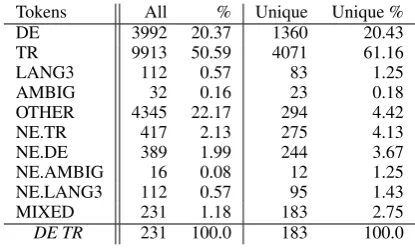
German–Turkish The German–Turkish Twitter Corpus (C¸ etino˘glu and C¸ ¨oltekin, 2016) consists of 1029 tweets with 17K tokens. They are man-ually normalized, tokenized, and annotated with language IDs. The language ID tag set consists ofTR(Turkish),DE(German),LANG3(other lan-guage),MIXED(intra-word CS),AMBIG (ambigu-ous language ID in context), andOTHER (punctu-ation, numbers, emoticns, symbols, etc.). Named entities are tagged with a combination ofNEand their language ID:NE.TR, NE.DE, NE.LANG3. In the original corpus, some Turkish and mixed words undergo a morphosyntactic split,2 with splitting points not usually corresponding to lan-guage boundaries. For the purpose of subword-level LID, these morphosyntactic splits are merged back into single words. We then manually seg-mentMIXED words at language boundaries, and replace their labels with more fine-grained lan-guage ID tags. The total percentage of mixed words is2.75%. However, the percentage of sen-tences with mixed words is 15.66%. The complete dataset statistics can be found in Table1.
Spanish–Wixarika Our second dataset consists of 985 sentences and 8K tokens in Spanish and Wixarika. Wixarika is spoken by approximately
2E.g., separating copular suffixes from roots they are
Tokens All % Unique Unique %
DE 3992 20.37 1360 20.43
TR 9913 50.59 4071 61.16
LANG3 112 0.57 83 1.25
AMBIG 32 0.16 23 0.18
OTHER 4345 22.17 294 4.42
NE.TR 417 2.13 275 4.13
NE.DE 389 1.99 244 3.67
NE.AMBIG 16 0.08 12 1.25
NE.LANG3 112 0.57 95 1.43
MIXED 231 1.18 183 2.75
[image:3.595.76.284.61.187.2]DE TR 231 100.0 183 100.0
Table 1: The frequency breakdown of tokens by lan-guage IDs in the German-Turkish dataset.All: the total number of tokens per tag,%: the percentage of them with respect to the total number of tokens;Unique: the number of unique word types, andUnique %: the per-centage of them with respect the total number of unique word types.
50,000people in the Mexican states of Durango, Jalisco, Nayarit and Zacatecas (Leza and L´opez,
2006) and is polysynthetic, with most morphemes ocurring in verbs. The data is collected from public postings and comments from Facebook ac-counts. To ensure the public characteristic of these posts, we manually collect data that is accessible publicly without being logged in to Facebook, to comply with the terms of use and privacy of the users. These posts and comments are taken from 34 users: 14 women, 10 men, and the rest does not publically reveal their gender. None of them have publically mentioned their age. To get a dataset that focuses on the LID task, we only consider threads where the CS phenomenon appears. We replace usernames with@username in order to preserve privacy. Afterwards, we tokenize the text, segment mixed words, and add language IDs to words and segments.
The tag set is parallel to that of German– Turkish: ES(Spanish), WIX(Wixarika), EN (En-glish),AMBIG(ambiguous)OTHER(punctuation, numbers, emoticons, etc), NE.ES, NE.WIX and NE.EN (named entities). Mixed words are seg-mented and each segment is labeled with its corre-sponding language (ES,WIX,EN). Table2shows a detailed description of the dataset. The percent-age of mixed words is higher than in the DE–TR dataset: 3.13% of the tokens and 4.26% of the types. The most common combination is Spanish roots with Wixarika affixes. Furthermore, 16.55% of the sentences contain mixed words.
We split the DE–TR corpus and the ES–WIX corpus into training and test sets of sizes 800:229
Tokens All % Unique Unique %
ES 4218 50.73 1527 45.76
WIX 2019 24.28 1191 35.69
EN 24 0.29 21 0.63
AMBIG 28 0.34 25 0.75
OTHER 1664 20.01 288 8.63
NE.ES 96 1.15 85 2.55
NE.WIX 77 0.93 49 1.47
NE.EN 11 0.13 9 0.27
MIXED 177 2.13 142 4.26
ES WIX 35 19.77 31 21.83
WIX ES 122 68.93 93 65.49
WIX ES WIX 17 9.60 31 10.56
WIX EN 1 0.07 1 0.07
EN ES 1 0.07 1 0.07
Table 2: Number of tokens classified by language tags seen in the Spanish-Wixarika dataset. We show the to-tal number ofTokensper tag, their proportion (%) with the total tokens, theUniqueword types, and the pro-portion (Unique %) of them with the total number of unique word types.
and 770:216, respectively. Error analysis and hyperparameter tuning are done on the training set via 5-fold cross-validation. We present results on the test sets. Both datasets are available at
https://www.ims.uni-stuttgart. de/institut/mitarbeiter/ozlem/ NAACL2019.html
4 Experiments
Our main system is a neural architecture that jointly solves the segmentation and language iden-tification tasks. We compare it to multiple pipeline systems and another joint system.
4.1 SegRNN
We suggest a SegRNN (Kong et al.,2016) would be the best fit for our task because it models a joint probability distribution over possible segmenta-tions of the input and labels for each segment.
The model is trained to optimize the follow-ing objective, which corresponds to the joint log-likelihood of the segment lengths e and the lan-guage tagst:
L(θ) = X
(x,t,e)∈D
−logp(t, e|x) (1)
Ddenotes the training data, θis the set of model parameters,x the input,tthe tag sequence and e the sequence of segment lengths.
Our inputs are single words.3 As
hyperparame-3We also experimented with entire phrases as inputs, and
[image:3.595.310.525.62.211.2]DE–TR ES–WIX
Segmentation Tagging Char Segmentation Tagging Char
P R F1 P R F1 Acc. P R F1 P R F1 Acc.
SegRNN 60.4 46.8 53.0 78.8 60.2 74.0 72.9 75.6 62.7 68.5 85.3 70.5 77.2 84.6
[image:4.595.78.524.62.154.2]BiLSTM+Seq2Seq 46.1 33.4 38.7 84.3 66.8 74.5 67.7 66.6 52.2 58.5 82.4 66.2 73.4 78.4 BiLSTM+CRF 49.4 34.5 40.6 84.3 66.8 74.5 68.0 61.1 48.4 54.0 82.4 66.3 73.4 76.7 CRFTag+Seq2Seq 12.7 6.8 8.9 27.8 15.2 19.7 37.2 47.2 31.9 38.1 63.5 43.0 51.3 69.6 CRFTag+CRF 11.0 5.9 7.7 27.8 15.2 19.7 36.8 47.6 32.4 38.6 63.5 43.0 51.3 69.4 CharBiLSTM 19.1 26.6 22.2 32.9 45.7 38.2 61.1 49.7 52.2 50.8 63.1 68.1 66.5 75.7
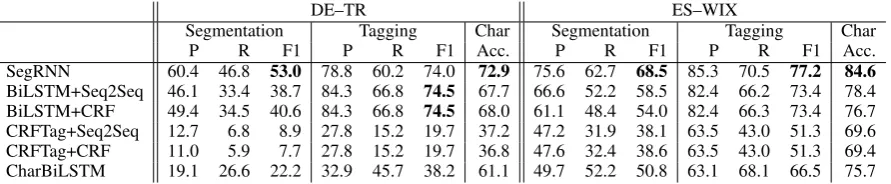
Table 3: Segmentation and LID test results for mixed words only.
ters we use: 1 RNN layer, a 64-dimensional input layer, 32 dimensions for tags, 16 for segments, and 4 for lengths. For training, we use Adam (Kingma and Ba,2014).
4.2 Baselines
BiLSTM+Seq2Seq/BiLSTM+CRF Our first baselines are pipelines. First, the input text is tagged with language IDs. Language IDs of a mixed word are directly predicted as a combination of all language ID tags of the word (i.e., WIX ES). Second, a subword-level model segments words with composed language ID tags. For word-level tagging, we use a hierarchical bidirectional LSTM (BiLSTM) that incorporates both token- and character-level information (Plank et al.,2016), similar to the winning system (Samih et al.,2016) of the Second Code-Switching Shared Task (Molina et al., 2016). 4 For the subword level, we use two supervised segmentation meth-ods: aCRFsegmenter proposed byRuokolainen et al. (2013), that models segmentation as a labeling problem and a sequence-to-sequence (Seq2Seq) model trained with an auxiliary task as proposed byKann et al.(2018).
CRFTag+Seq2Seq/CRFTag+CRF Since our datasets might be small for training neural net-works, we substitute the BiLSTM with a CRF tagger (M¨uller et al., 2013, CRFTag) in the first step. For segmentation, we use the same two approaches as for the previous baselines.
CharBiLSTM We further employ a BiLSTM to tag each character with a language ID. For train-ing, each character inherits the language ID of the word or segment it belongs to. At prediction time, if the characters of a word have different language IDs, the word is split.
4For all BiLSTM models input dimension is 100 with a
hidden layer size of 100. For training we use a stochastic gradient descent (Bottou,2010), 30 epochs, with a learning rate of 0.1. A 0.25 dropout factor is applied.
4.3 Metrics
We use two metrics for evaluation. First, we fol-lowKong et al.(2016) and calculate precision (P), recall (R), and F1, using segments as units (an un-segmented word corresponds to one segment). We also report a tagging accuracy (Char Acc.) by as-signing a language ID to each character and cal-culating the ratio of correct language tags over all characters.
DE–TR ES–WIX
Seg. Tag. Char Seg. Tag. Char
F1 F1 Acc. F1 F1 Acc.
SegRNN 98.7 94.0 93.6 97.8 92.5 92.4
[image:4.595.312.521.331.425.2]BiLSTM+Seq2Seq 98.6 95.1 94.3 98.1 90.9 90.7 BiLSTM+CRF 98.7 94.9 94.4 97.9 87.8 90.6 CRFTag+Seq2Seq 98.4 93.7 93.1 97.7 90.4 90.1 CRFTag+CRF 98.4 93.7 93.1 97.6 90.3 90.1 CharBiLSTM 87.7 88.0 92.5 89.7 87.9 91.3
Table 4: Test set results for entire datasets.
4.4 Results and Discussion
Table4shows all test results for the entire datasets. We find the following: (i) For ES–WIX, SegRNN performs slightly better for tagging than the best baseline, both in terms of F1 and character accu-racy. For DE–TR, SegRNN and BiLSTM+CRF are the best segmentation models, but the BiL-STM models slightly outperform SegRNN for tag-ging. (ii) The CRF pipelines perform slightly worse than the best word-level BiLSTM models for both datasets and all evaluations.
Table 3 shows the results of tagging and segmentation only for the mixed words in our datasets. Here, we can see that: (i) Our SegRNN model achieves the best performance for segmen-tation. Differences to the other approaches are
TR DE DE TR
NE.LANG3
NE.DE NE.TR LANG3 AMBIG OTHER
TR DE DE TR NE.LANG3 NE.DE NE.TR LANG3 AMBIG OTHER
1.0 0.0 0.1 0.1 0.0 0.2 0.3 0.5 0.0 0.0 1.0 0.2 0.4 0.5 0.1 0.3 0.3 0.0 0.0 0.0 0.6 0.1 0.0 0.0 0.0 0.0 0.0 0.0 0.0 0.0 0.1 0.1 0.0 0.0 0.0 0.0 0.0 0.0 0.0 0.3 0.2 0.0 0.0 0.0 0.0 0.0 0.0 0.1 0.0 0.1 0.6 0.0 0.1 0.0 0.0 0.0 0.0 0.0 0.0 0.0 0.1 0.0 0.0 0.0 0.0 0.0 0.0 0.0 0.0 0.0 0.1 0.0 0.0 0.0 0.0 0.0 0.1 0.0 0.2 0.0 1.0
DE-TR BiLSTM
TR DE DE TR
NE.LANG3
NE.DE NE.TR LANG3 AMBIG OTHER
TR DE DE TR NE.LANG3 NE.DE NE.TR LANG3 AMBIG OTHER
1.0 0.0 0.2 0.1 0.2 0.4 0.3 0.5 0.0 0.0 0.9 0.2 0.4 0.4 0.0 0.4 0.1 0.0 0.0 0.0 0.5 0.0 0.0 0.0 0.0 0.0 0.0 0.0 0.0 0.0 0.1 0.1 0.0 0.0 0.0 0.0 0.0 0.0 0.0 0.2 0.2 0.0 0.0 0.1 0.0 0.0 0.0 0.1 0.1 0.0 0.5 0.0 0.1 0.0 0.0 0.0 0.0 0.0 0.0 0.0 0.2 0.0 0.0 0.0 0.0 0.0 0.0 0.0 0.0 0.0 0.2 0.0 0.0 0.0 0.0 0.0 0.0 0.0 0.1 0.0 1.0
DE-TR SegRNN
ES WIX EN ES WIXWIX ES
WIX ES WIX
NE.ESNE.WIX NE.ENOTHER ES WIX EN ES WIX WIX ES WIX ES WIX NE.ES NE.WIX NE.EN OTHER
1.00.10.60.1 0.2 0.00.60.00.70.0 0.00.90.3 0.3 0.1 0.4 0.10.60.2 0.0 0.0 0.0 0.1 0.0 0.0 0.0 0.0 0.0 0.0 0.0 0.0 0.0 0.0 0.4 0.0 0.1 0.0 0.0 0.0 0.0 0.0 0.0 0.0 0.00.70.0 0.0 0.0 0.0 0.0 0.0 0.0 0.0 0.0 0.0 0.5 0.0 0.0 0.0 0.0 0.0 0.0 0.0 0.0 0.0 0.0 0.2 0.0 0.1 0.0 0.0 0.0 0.0 0.1 0.0 0.0 0.0 0.4 0.0 0.0 0.0 0.0 0.0 0.0 0.0 0.0 0.0 0.0 0.0 0.0 0.0 0.0 0.0 0.0 0.0 0.0 0.1 0.0 0.01.0
ES-WIX BiLSTM
ES WIX EN ES WIXWIX ES
WIX ES WIX
NE.ESNE.WIX NE.ENOTHER ES WIX EN ES WIX WIX ES WIX ES WIX NE.ES NE.WIX NE.EN OTHER
1.00.10.70.2 0.2 0.10.60.01.00.0 0.00.90.1 0.4 0.1 0.0 0.1 0.5 0.0 0.0 0.0 0.0 0.0 0.0 0.0 0.0 0.0 0.0 0.0 0.0 0.0 0.0 0.0 0.4 0.0 0.1 0.0 0.0 0.0 0.0 0.0 0.0 0.0 0.00.70.0 0.0 0.0 0.0 0.0 0.0 0.0 0.0 0.0 0.00.80.0 0.0 0.0 0.0 0.0 0.0 0.1 0.0 0.0 0.0 0.3 0.0 0.0 0.0 0.0 0.0 0.0 0.0 0.0 0.0 0.0 0.5 0.0 0.0 0.0 0.0 0.0 0.0 0.0 0.0 0.0 0.0 0.0 0.0 0.0 0.0 0.0 0.0 0.0 0.0 0.1 0.0 0.01.0
[image:5.595.83.519.61.175.2]ES-WIX SegRNN
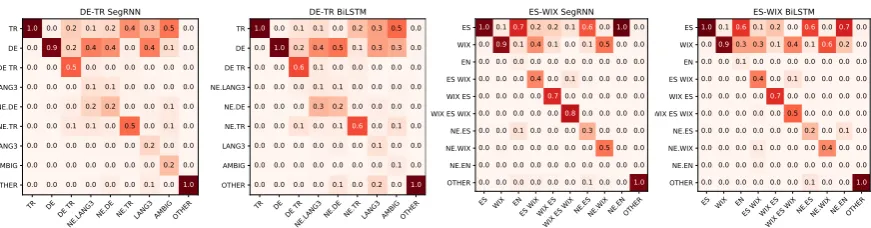
Figure 3: Confusion matrices of the two best models on both datasets. Thexaxis represents tags seen in the gold standard, and theyaxis shows the corresponding predicted tags. Values are rounded up, therefore not all columns add up to 1.
on the ES–WIX dataset as compared to the Seg-RNN models. (iii) Both CRFTag models achieve very low results for both segmentation and tag-ging. (iv) CharBiLSTM performs better than the CRFTag models on both tasks, but is worse than all other approaches in our experiments.
More generally, we further observe that recall on mixed words for the DE–TR pair is low for all systems, as compared to ES–WIX. This effect is especially strong for the CRFTag and CharBiL-STM models, which seem to be unable to cor-rectly identify mixed words. While this tendency can also be seen for the ES–WIX pair, it is less extreme. We suggest that the better segmentation and tagging of mixed words for ES–WIX might mostly be due to the higher percentage of avail-able examples of mixed words in the training set for ES–WIX.
Overall, we conclude that SegRNN models seem to work better on language pairs that have more intra-word CS, while pipeline approaches might be as good for language pairs where the number of mixed words is lower.
Error analysis. Figure 3 shows confusion ma-trices for SegRNN and BiLSTM+Seg2Seg. Both models achieve good results assigning monolin-gual tags (ES, WIX, DE, TR) and punctuation symbols (OTHERS). The hardest labels to clas-sify are named entities (NE, NE.TR, NE.TR, NE.WIX,NE.ES), as well as third language and ambiguous tags (LANG3, EN, AMBIG). Perfor-mance on multilingual tags (DE TR,WIX ES,ES WIX,WIX ES WIX) is mixed. ForDE TR, BiL-STM+Seq2Seq gets slightly better classifications, but for the ES–WIX tags SegRNN achieves better results.
Regarding oversegmentation problems, BiL-STM+Seq2Seq (0.8% for DE–TR and 2.0%
for ES–WIX) slightly underperforms SegRNN (0.7% for DE–TR and 1.13% for ES–WIX). The BiLSTM+Seq2Seq (2.4%) makes fewer under-segmentation errors for DE–TR than SegRNN (2.7%). However, for ES–WIX, SegRNN per-forms better with 3.81% undersegmentation errors compared to 4.2% of BiLSTM+Seq2Seq.
5 Conclusion
In this paper, we extended the LID task to the subword level, which is particularly important for code-switched text in morphologically rich lan-guages. We further proposed a SegRNN model for the task and compared it to several strong base-lines. Investigating the behaviour of all systems, we found that pipelines including a BiLSTM tag-ger work well for tagging DE–TR, where the num-ber of mixed tokens is not that high, but that our proposed SegRNN approach performs better than all other systems for ES–WIX. Also, SegRNNs have clear advantages over all baselines if we con-sider mixed words only. Our subword-level LID datasets for ES–WIX and DE–TR are publicly available.
Acknowledgments
We would like to thank Mohamed Balabel, Sam Bowman, Agnieszka Falenska, Ilya Kulikov and Phu Mon Htut for their valuable feedback. We also want to thank Jeffrey Micher for his help with the setup of the SegRNN code. This project has bene-fited from financial support to Manuel Mager and
¨
References
Mohamed Al-Badrashiny and Mona Diab. 2016. Lili: A simple language independent approach for lan-guage identification. InCOLING.
Utsab Barman, Amitava Das, Joachim Wagner, and Jennifer Foster. 2014. Code mixing: A challenge for language identification in the language of social media. EMNLP.
L´eon Bottou. 2010. Large-scale machine learning with stochastic gradient descent. In COMPSTAT. Springer.
¨
Ozlem C¸ etino˘glu. 2016. A Turkish-German code-switching corpus. InLREC.
¨
Ozlem C¸ etino˘glu and C¸ a˘grı C¸ ¨oltekin. 2016. Part of speech annotation of a Turkish-German code-switching corpus. InLAW-X, Berlin, Germany.
Ryan Cotterell, Thomas M¨uller, Alexander Fraser, and Hinrich Sch¨utze. 2015. Labeled morphological seg-mentation with semi-markov models. InCoNLL.
Mathias Creutz and Krista Lagus. 2002. Unsupervised discovery of morphemes. InSIGMORPHON.
John Goldsmith. 2001. Unsupervised learning of the morphology of a natural language. Computational Linguistics, 27(2):153–198.
Alex Graves, Santiago Fern´andez, Faustino Gomez, and J¨urgen Schmidhuber. 2006. Connectionist temporal classification: labelling unsegmented se-quence data with recurrent neural networks. In
ICML. ACM.
Stig-Arne Gr¨onroos, Sami Virpioja, Peter Smit, and Mikko Kurimo. 2014. Morfessor flatcat: An HMM-based method for unsupervised and semi-supervised learning of morphology. InCOLING.
F. Grosjean. 2010. Bilingual: Life and Reality. Har-vard University Press.
Harald Hammarstr¨om and Lars Borin. 2011. Unsuper-vised learning of morphology. Computational Lin-guistics, 37(2).
Zellig S Harris. 1951. Methods in structural linguistics.
Katharina Kann, Manuel Mager, Ivan Meza, and Hin-rich Sch¨utze. 2018. Fortification of neural mor-phological segmentation models for polysynthetic minimal-resource languages. InNAACL-HLT.
Diederik P Kingma and Jimmy Ba. 2014. Adam: A method for stochastic optimization.ICLR.
Lingpeng Kong, Chris Dyer, and Noah A Smith. 2016. Segmental recurrent neural networks.Interspeech.
Jos´e Luis Iturrioz Leza and Paula G´omez L´opez. 2006.
Gram´atica wixarika, volume 1. Lincom Europa.
Jeffrey Micher. 2017. Improving coverage of an inukti-tut morphological analyzer using a segmental recur-rent neural network. InComputEL.
Jeffrey Micher. 2018. Using the Nunavut Hansard data for experiments in morphological analysis and ma-chine translation. InPYLO.
Giovanni Molina, Fahad AlGhamdi, Mahmoud Ghoneim, Abdelati Hawwari, Nicolas Rey-Villamizar, Mona Diab, and Thamar Solorio. 2016. Overview for the second shared task on language identification in code-switched data. In
CS Workshop.
Thomas M¨uller, Helmut Schmid, and Hinrich Sch¨utze. 2013. Efficient higher-order CRFs for morphologi-cal tagging. InEMNLP.
Dong Nguyen and Leonie Cornips. 2016. Automatic detection of intra-word code-switching. In SIG-MORPHON.
Dong Nguyen, Dolf Trieschnigg, and Leonie Cornips. 2015. Audience and the use of minority languages on twitter. InICWSM.
Barbara Plank, Anders Søgaard, and Yoav Goldberg. 2016. Multilingual part-of-speech tagging with bidirectional long short-term memory models and auxiliary loss. InACL.
Shruti Rijhwani, Royal Sequiera, Monojit Choud-hury, Kalika Bali, and Chandra Shekhar Maddila. 2017. Estimating code-switching on twitter with a novel generalized word-level language detection technique. InACL.
Teemu Ruokolainen, Oskar Kohonen, Sami Virpioja, and Mikko Kurimo. 2013. Supervised morphologi-cal segmentation in a low-resource learning setting using conditional random fields. InCoNLL.
Younes Samih, Suraj Maharjan, Mohammed Attia, Laura Kallmeyer, and Thamar Solorio. 2016. Mul-tilingual code-switching identification via LSTM re-current neural networks. InCS Workshop.
Rouzbeh Shirvani, Mario Piergallini, Gauri Shankar Gautam, and Mohamed Chouikha. 2016. The howard university system submission for the shared task in language identification in Spanish-English codeswitching. InCS Workshop.
Thamar Solorio, Elizabeth Blair, Suraj Mahar-jan, Steven Bethard, Mona Diab, Mahmoud Gohneim, Abdelati Hawwari, Fahad AlGhamdi, Ju-lia Hirschberg, Alison Chang, et al. 2014. Overview for the first shared task on language identification in code-switched data.CS Workshop.